A Daily History of Holes, Dots, Lines, Science, History, Math, Physics, Art, the Unintentional Absurd, Architecture, Maps, Data Visualization, Blank and Missing Things, and so on. |1.6 million words, 7500 images, 4.9 million hits| Press & appearances in The Times, Le Figaro, Mensa, The Economist, The Guardian, Discovery News, Slate, Le Monde, Sci American Blogs, Le Pont, and many othr places… 5000+ total posts since 2008.

Category: Fantastic Titles

  • Terrific Titles: Gentle Explosives and Flagpole Painting

    JF Ptak Science Books LLC Post 206
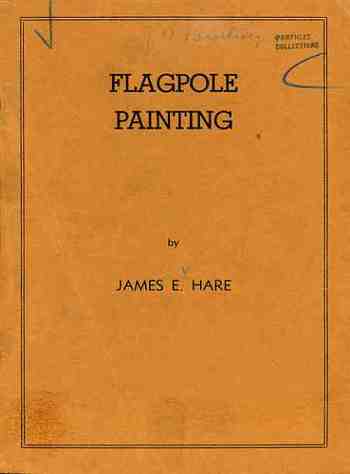
    Blogaugust_18flagpole408 Here are two fantastic (and also completely unrelated!) pamphlets from my Naïve Surreal collection, which have also positively, absolutely never been seen on TV. (As a matter of fact, neither are found in the massive OCLC WorldCat, which librarians use as a cataloging tool and I use as a relative-scarcity engine; and what this means is that neither pamphlet is located in any library collection worldwide.  A bookseller once semi-complained to me that pamphlets such as these which have not been catalogued could very well be in a box in a basement somewhere.  Hm.  That may be true, but what does it matter?  Like  Frenhofer the unfinisher in Balzac’s Unfinished Masterpiece, if it is hidden and unaccountable, it might as well not exist.) 
    Blogaugust_18flagpole_pict410
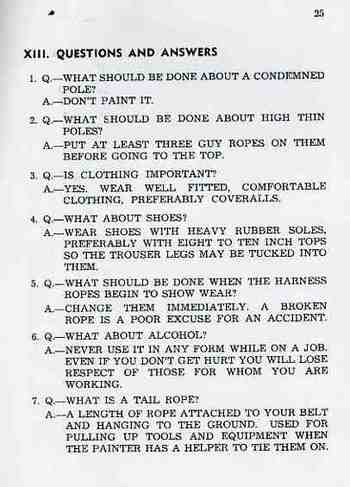
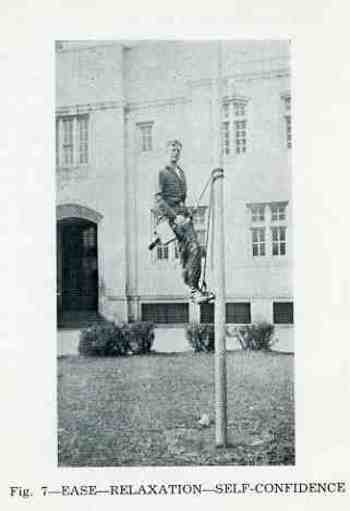
    The first pamphlet, Flagpole Painting, by James E. Hare, is perhaps the Ulysses of works on flagpole painting—according to the OCLC, it may also be the only work ever devoted to the subject.  And it is wonderful!  It is studious and determined, and takes it subject seriously, describing all of the nicks and tucks necessary to do a thorough, correct and injury-free job painting a pole.  The title does produce a chuckle, being so unexpected and seemingly mundane, but it *is* a great work on the subject. 

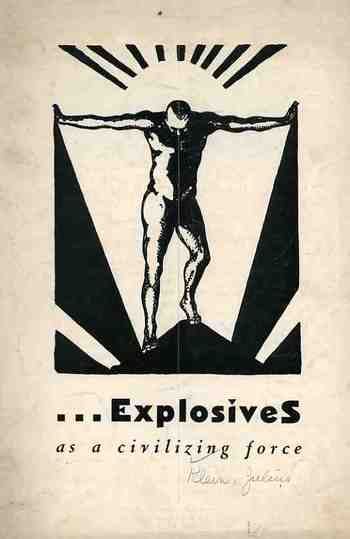
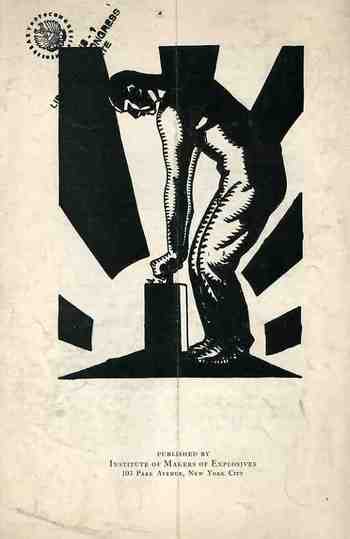
    Even more unexpected is the title of the second pamphlet, Explosives as a Civilizing Force, by the U.S. Assistant Secretary of Commerce, Dr. Julius Klein—a government-endorsed homage to blowing stuff up, published by the Institute of Makers of Explosives (103 Park Ave, NYC).  This is certainly a title you don’t see every day.
    Blogaugust_18explosives411
    Dr. Klein starts off by disabusing the reader of the “bad press” of explosives:  “a good many of us, I imagine, labor under a misapprehension about the explosives industry…we conceive of explosives as an instrumentality of havoc.  But that conception is utterly wrong.”  Utterly?  The man does have a point of course,  which he explains in subject headings like “Dynamite the Liberator”, “Many Unusual Uses”and “Explosives Release Raw Materials”  But “utterly”?  Its a real piece of heavily worked propaganda that makes the case for the economics goodnesses and misunderstood destructive values of TNT. 
    Blogaugust_18explosives_back412

    Blogaugust_18flagpole_text409

    ·Posted by :

    ·in:


  • Fantastic Titles: “Mud, Its Romantic Story”, 1935

    JF Ptak Science Books LLC   Post 149

    Blogmud236I have a collection of some fantastically-titled pamphlets and books.  After considering their reaching, speculative, bizarre and surreal titles, they fall into a number of sub-categories, including:
    –titles with question marks “?” (like the two wonderful pamphlets simply entitled “What ?” and of course the two that have no titles but question marks);
    –title with exclamation points “!” (these two marks actually don’t occur very often at all in titles, especially when the title itself already has a built in question/exclamation mark);
    –titles that include the phrase “the history of…” or “the story of….” so long as that history/story is (very) unusual;
    –titles that demand something or other of  “America”  (i.e., “Will America be Invaded?” or “America, Mussolini or Moscow” or “Sandbags, Worms and America”);
    –title pages with American flags.

    This excludes a lot of the general naïve-surreal and historical pamphlet collection, but these, I think, would make a great exhibition of book of books, simply because so many of them have an unquestionable “what in the _” reaction capacity to them.

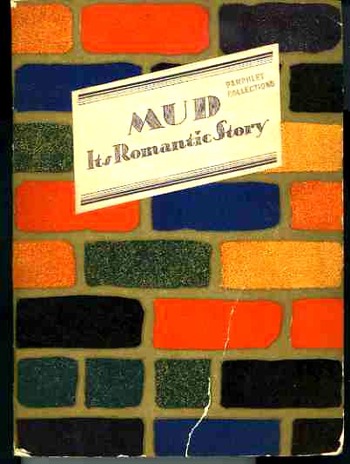
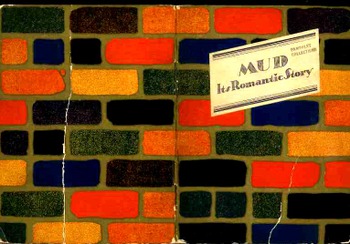
    This pamphlet, Mud, its Romantic Story, (by Richard G. Collier, for the Common Brick Manufacturer Association of America, Cleveland, Ohio)  is a prime example:  a terrific title and a beautiful design.  Point of fact though is that it is a lively little history of brick making in America.  The good content almost takes away from the fantastic title, but so it goes.

    Blogmud2237

    So from time to time I’ll post these titles here even though they really don’t have much to do with the supposed mission of this blog—I’m sure that they’ll be entertaining. 

    ·Posted by :

    ·in:


  • Bizarre Thinking and a Towering Classic of Lost Logic: the Japanese War Lords and Kaiser Wilhelm, the “True Kidnappers” of the Lindbergh Baby and the Beginning of World War Two

    JF Ptak Science Books LLC Post #122
    Lindberh_japanese168

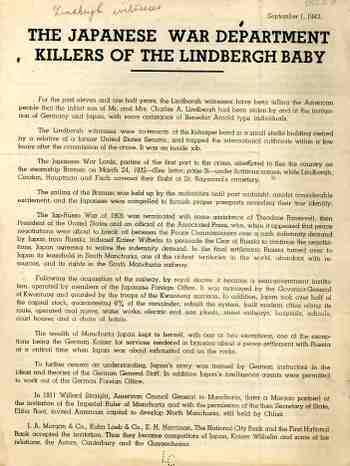
    This four page pamphlet, received by the Library of Congress (and probably nobody else) on 1 October 1943, divines the origins of World War Two and the kidnapping of the Charles Lindbergh baby to a complex and impossible cabal of Japanese “War Lords”, Kaiser Wilhelm of Germany, the assassination of Leon Trotsky, the League of Nations, Elihu Root,  “3 cent gallon kerosene”, the South Manchurian Railway, and some sort of “historical documents of posterity countersigned by Tokyo and Berlin” in the possession of Mrs. Renee Valentine (“Secretary”) of Staten Island, New York. 

    The entire affair began with “co-tenants of the kidnappers band in small studio building owned by a relative of a former U.S. Senator” under the instigation of “Germany, Japan and certain Arnold Benedicts types” brought about by the end of the “Jap-Russo” War of 1905.

    We are told it was an “inside job”.

    Somehow Teddy Roosevelt gets involved with Kaiser Wilhelm in arranging for the Russians to pay indemnity to the Japanese in terms of a land agreement of Southern Manchuria, opening the way to exploitation of China by the Japanese.  Something else happens, the South Manchuria Railroad gets thrown in as well as four competing U.S. banks and Elihu Root and a failed League of Nations agreement which upsets a balance of power and brings “the Astors, Canterbury and the Guggenheims” into competition with the Japanese and Kaiser Wilhelm, doing something to the Treaty of Washington.

    After this incredible and unconnected and partially non-existent series of events is both untangled and entangled before our eyes, the writer reaches the lonely and very solitary conclusion that “the necessary documents to prove these charges (??) could be secured through the kidnapping of the Lindbergh baby”.  I was waiting for the  author to make a case for Lindbergh’s real-life (and long held) Nazi sympathies, but that just didn’t happen. 

    I really have no idea of what the writer is talking about, but the failure of making any connection whatsoever with any of the “facts and circumstances” is magnificently appalling, and has moved itself from the realm of being so bad that it isn’t even “bad” anymore.  It is that singular sort of “badness” that makes the printed words seep into the paper and disappear before your very eyes, and the only thing that you can say is “wow”. 

    ·Posted by :

    ·in:

    — —

  • Not the War of the Worlds II—Ripping Off H.G. Wells

    JF Ptak Science Books  LLC   Post #109
    Blogwelllsgoble

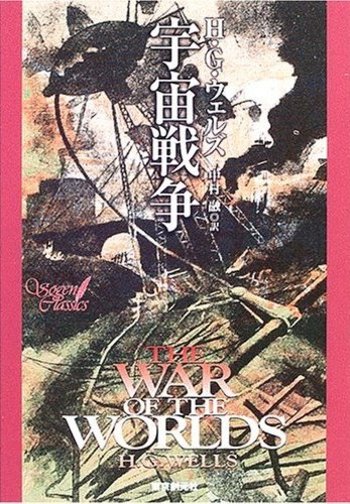
    Herbert George Wells’ War of the Worlds was one of the very first efforts in modern history to reverse the outward-bound human trend of reaching out—he introduced aliens and the big idea of aliens (other than god or gods) coming to earth and doing us harm.  He wrote WOTW in the third year of a very rollicking decade-long intellectual purge that would change the face of science fiction writing in Western lit, changing the idea of fantasy science, replacing burnt brain stems with powerful, well-written ideas.  (In the period 1895-1905 Wells wrote The Time Machine (1895), Island of Dr. Moreau (1896), The Invisible Man (1897), WOTW (1898), The First Men in the Moon (1901), When the Sleeper Awakes (1899), Anticipations (1901), the Discovery of the Future (1902) , A Modern Utopia (1905), among others*.)

    Wells (born a year after the American Civil War ended and died a years after WWII ended) was a huge thinker and a gifted craftsman, with big ideas that he was able to put into simple, well constructed forms that were enormously popular.  (Orwell remarked that Wells was the most read person in English in the 1900-1920 period.)

    The prescient, observant futurist, Wells sought to also protect his own future in regards to his work, particularly with the WOTW—he secured all serial and reprint rights to the work in the United States, where it was being published in installments simultaneously by two different magazines.  But rights be damned, as the magazine editors changed the story to suit their regional needs, painting the work in putrid reds and mauves to such a degree that the enraged Wells—who could do nothing about any of the changes–paid it a salty goodbye in the U.S.

    But I think the major intellectual theft occurred in the weeks following the finale of the installments.  An American popular science writer, Garret P. Serviss, was contracted by the Hearst Newspaper group to pick up the WOTW story where Wells had ended it.  It would be continued—rather the story was stolen so that it could be twisted into another form—as a short novelette, problematic because of its interesting reach, but a problem nonetheless.  Serviss was a popular but modestly gifted writer, both rising and falling to the occasion in the wake of Wells.  His work, Edison’s Conquest of Mars, an intrepid journey in another man’s shoes, featured Thomas Edison raising an army in space ships, hell bent on getting to Mars to extract revenge for a dismembered, fractured earth, rendered nearly impotent by Wells’ Martians attacks.

    Edison et alia make it, and all sorts of first-time stuff happens—the first “phaser” weapons are introduced, mid-space attack and counter-attack, asteroid mining, and lots of other things of concern in the originality of science fiction ideas.  Unfortunately it was all borne on the back of a stolen series of ideas and story, and those happened to belong to Wells.

    Here’s something worth noting, though—Serviss’ work may be one of the only instances of employing Wilhelm Roentgen, (the discoverer of the X-Ray (in 1895) and recipient of the first Nobel Prize in physics) and Lord Kelvin (perhaps the most eminent of English physicists of the late 19th century) as heroic members of a Martian attack force.  Throw in the magnificent but moral incompetent Thomas Edison, and you have a unique real-life triumvirate employed in the telling of a stolen fantasy who, fortunately or not, come up with some really good, and early, ideas.

    *The full 1895-1905 list from the HG Wells Society is very impressive, as is the whole of his output:
    1895
    Select Conversations With an Uncle
    The Time Machine
    The Wonderful Visit
    The Stolen Bacillus, and Other Incidents
    1896
    The Red Room
    Island of Dr. Moreau
    The Wheels of Chance
    1897
    The Plattner Story, and Others
    The Invisible Man
    Certain Personal Matters
    1898
    War of the Worlds
    1899
    When the Sleeper Wakes
    Tales of Space and Time
    1900
    Love and Mr. Lewisham
    1901
    The First Men in the Moon
    Anticipations
    1902
    The Discovery of the Future
    The Sea Lady
    1903
    Mankind in the Making
    Twelve Stories and a Dream
    1904
    The Food of the Gods
    1905
    A Modern Utopia
    Kipps: The Story of a Simple Soul


  • Dr. Seuss and the 236 Words that Changed Reading Forever

    JF Ptak Science Books

    I think that it is difficult to overstate the importance and long-term significance of Dr. Seuss‘ (Theodor Seuss Geisel, 1904-1991, son and grandson of brewmasters) contribution to childhood.  I think that it is impossible to calculate the overall impact of his bringing young people to the joy of reading, and to the familiarization  with the bare mechanics of how to read.  Of course he told a great story, but his books were literally page-tuners—they were simply written with words useful to children, with few words per page, thereby allowing the child to see the pictures, read all of the words, and turn the page, giving them a sense of accomplishment along with enjoying  a fine story.   Perhaps it is the getting-the-kids-used –to-reading that was his most fantastic accomplishment—and something that few others have achieved, measuring by just pure numbers. 

    Blogcathatbook

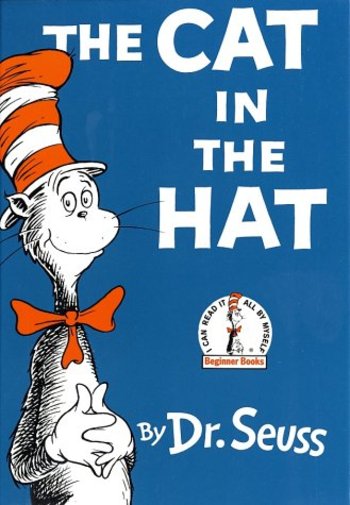
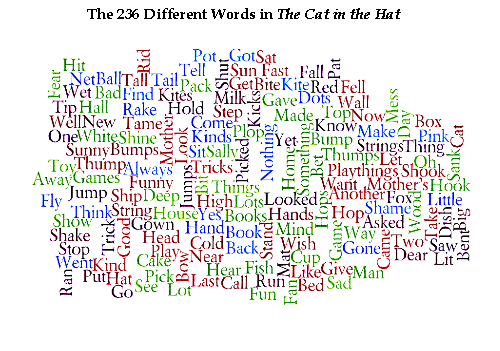
    And the way in which he did this was to artistically use an extremely limited budget of words—Dr. Seuss used precisely 236 different words to write The Cat in the Hat.

    It is certainly true that there have been many sparse, relatively wispy papers in the history of science form which enormous change has sprung..   Pound-for-pound though The Cat in the Hat holds its own. 

    I’ll give the entire list of words below—just have a peek, and try to imagine writing something interesting with just this palette. 

    Wordle--cat in the hat

    It isn’t fair at all to compare this masterpiece with others in different genres, but just to give you an idea of its relative simplicity I’ll quote some numbers taken from an incredible study conducted by Zachary Booth Simpson (“Vocabulary Analysis of Project Gutenberg”).  Simpson’s interpretation is more complex than the story I’ll tell here, but basically he looks at the numbers of words in a piece of literature (for example) and then convenes the number of different words, deducing the actual and then relative density of word usage, which is pretty interesting (and verifies that pit-of-the-stomach feeling about which authors use more words in smaller space). 

    Gibbon’s Decline and Fall seems to lead the way in the absolute number of different words used (43,113!!, which is astonishing), in the 1.5 million word text, while old Uncle Bill uses 4,842 words in the 32,000-word Hamlet—meaning that Measure for Measure (sorry) Mr. Gibbon out-Bills Bill, which I thought was very hard to do.  Other interesting bits are Hugh Lofting’s Doctor Doolittle, who tells the story with 2759 words; Moby Dick, told with a spectrum of 17,227 words; and Les Miserables is painted with 23,334 different words.  The only work that comes close to Seuss in Mr. Simpson’s very considerable list is the New McGuffey Reader, which is really, actually, a tough go, and uses 630 words.

    Unfortunately I do not know about the Dick and Jane readers But they’re no match whatsoever for the Good Doctor.

    So my hat is off and off and off to Theodor Geisel, aka Dr.Seuss—on the anniversary of his anniversary in Seussland, where it is Seussqunetennial every day.