A Daily History of Holes, Dots, Lines, Science, History, Math, Physics, Art, the Unintentional Absurd, Architecture, Maps, Data Visualization, Blank and Missing Things, and so on. |1.6 million words, 7500 images, 4.9 million hits| Press & appearances in The Times, Le Figaro, Mensa, The Economist, The Guardian, Discovery News, Slate, Le Monde, Sci American Blogs, Le Pont, and many othr places… 5000+ total posts since 2008.

Category: Fantastic Titles

  • Women Meat Pioneers, 1943

    JF Ptak Science Books LLC  Post 570

    (Science Book Blog)

    4-1 prop meat
    This simply irresistible, charmingly uncomfortable, and semi-surreal title is an excellent example of what I’ve come to know (and forget) in my  career of doing whatever it is I’m doing.  Generally though the thousand or so titles in my Naive Surreal collection belong to pamphlets and the occasional book, but the occasional advertisement makes its way into the fray.  (None really come quite close to the work of the immortal Otto Fleiss, who produced America’s greatest work on making art with fat,  White Art in the Meat Food Business.  A Practical Handbook for
    Butcher, Pork Stores, Restaurants, Hotels and Delicatessens on How to
    Make Lasting and Transferable White Art Decorations out of Bacon Fat
    Back for Window Displays, Ornaments on Meat Food Cold Buffets and for
    Exhibits and Advertising Purposes.  Enrich yourself with Personal
    Knowledge.
    It is a toweringly fantabulous work, and is one of this blog’s most-viewed posts.)

    This ad is innocent enough:  appearing in the 1 November 1943 issue of LIFE magazine, it was simply encouraging the modern housewife to go adventuring into cuts of meat that had been deemed unacceptable before rationing and the war, which brought about a meat drought.  (The Brits had a far worse time–this issue of LIFE also contained a photo of a leggy London showgirl posing with a “real lemon” which was being raffled off to raise hundreds of pounds for the general welfare.) 
    4-1 renaissance pandora
    I’m sorry to say that this image reminded me of an older, finer, more whimsical but far more damning and stern woodcut.  The two aren’t terribly-well related, I know, but as I shocked myself in being able to locate it I’m bound to use it now before it slips back into my misty print purgatory. 

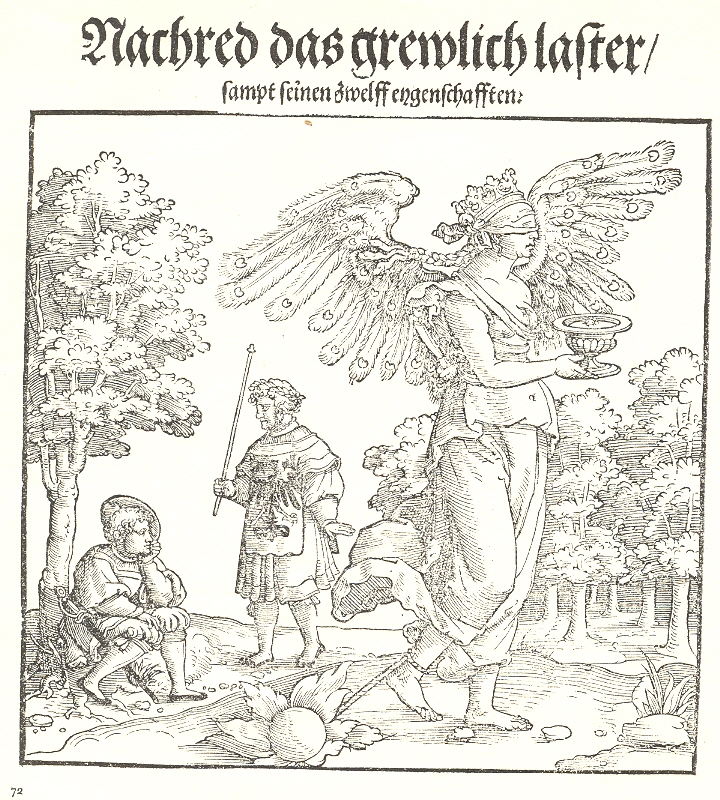
    This image is probably the work of Georg Pencz and appeared in Hans Sachs’ Nachred das grewlihc laster...published in Nuremberg in 1535 The booklet was a work directed against the evils of libel and lying and spreading rumor.  Pencz’ woodcut personified all of this wrapped up in the form of a vice-charmed woman.

    The libel-charged rumor-mongre woman (watched from under a tree by a poet who is protected from her by a fellow with an imperial seal and stanchion) is outfitted with very feathery wings and a crowned seat on a collection of snakes.  She carries a lidded pot, an offering of some sort, while she hides a knife behind her back with her other hand.  She advances with a breast barred and another breast vut and bleeding, while she tugs along in her wake a ball and chain, which sets her traveled path on fire.  All-in-all, Pencz paints a dismal picture of womanhood. 

    As I said, it has little to do with the original image of a Pioneer Meat Woman, but they sort of looked similar in my memory. 


  • Sublime Mundane: a History of High School Lunches and the Commercialization of Children’s Needs

    JF Ptak Science Books  LLC  Post 561

     blog 23 mar lunch724

    This is another in a series of posts on the Sublime Mundane–books and pamphlets whose titles are nothing if not introductions to spectacular nothingness.  Sometimes these publications are indeed about disappearing wisps of lost lint, and sometimes not; sometimes the mundane and seemingly stupifyingly “normality” of their subject matter leads to something of deep depth.  Today’s pamphlet, left, fits the second category. 
    Part of the interest in this work–outside of its momentarily arresting title that has a potential for being a cascade of boredom– is that it so quickly rights itself into an important topic.  That’s not to say that it isn’t a boring topic, as my quick and semi-feeble research reveals.  It does get interesting though when you consider that it took so long for the recognition that, since all of these children in school have been brought together, that there wasn’t some sort of federally organized effort to make sure that the weakest members of this group had at least one decent meal a day.  That said, the earliest program were for students who could afford to pay for their lunches.  Perhaps it was assumed that, around the turn of the century, there were no lunch rooms per se and that children would eat wherever they could find the space, that many children were also going home for lunch, and that they were all being fed.  (I do remember that some classmates of mine in P.S. 29 would go home for lunch, and I remember wondering exactly what that was all about.  I can recall taking my brother for special every-so-often-Friday treats at Joe & Pat’s Pizzeria for three slices and two cokes for a dollar back there in 1968.  But I digress.)  It actually took a little time before children’s lunches at school were made to be free to those who needed it. 

    Which brings us to Marion Nestle’s Food Politics (Berkeley, University
    of California Press, 2002), who discusses the early commodification of children’s food: “School meal programs
    began during the Great Depression of the 1930’s. From
    the outset, they had two purposes: to help dispose of
    surplus agricultural commodities owned by the government
    as a result of price-support agreement with farmers ,
    and to help prevent nutritional deficiencies among low-income
    schoolchildren. Because chronic disease risk factors were
    not an issue at that time, the rules specified meals that
    used surplus commodities and were higher in fat, saturated
    fat, sugar, and salt—and lower in fiber—than recommended
    in later years.”  All of which is detestable and unwholesome and immediately transparent.

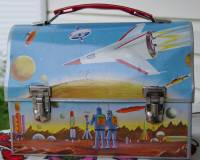
    Perhaps the really interesting stuff on feeding children at school starts here, in the 1930’s, and that with the commercialization of children’s biological needs, breaking the back of an agricultural finance Vintage-space-lunch-boxproblem in the school lunch rooms.  The lunch as commodity expands from massive leftover projects into something a little more insidious in the television age, when children not only get to dress their foods in the sorts of containers that they wanted (lunch boxes), but also were being deluged with displays of foods that they could select for themselves via television.  This commercialization process gets ramped up decade by decade, until in the 1990’s and 2000’s the lunchroom has in some cases become an extension of the t.v. commercial, and that local and state governments are counting the value of sugary waters, salt, and catchup packets while plying the rest of the arrested nutritional package with prepackaged conglomerate goodness.

    And such is the value of the sublime mundane, at least for me–these items are filled with possibilities invisible to their titles. 

    Even after all of this, I must confess that I would dearly like to have a Fireball XL5 lunch box to take with me into eternity.  All systems go!

    Some interesting links with more than you need to know about school lunch history:

    The Food Museum Online Exhibit:  School Lunch History
    School Lunch Programs in the USA (according to city)
    School Lunch Programs in Europe

    ·Posted by :

    ·in:

    — —

  • The “Huh?” Department: Pig Graphs, Pig Checkers and Other Small Confusions. Naive Surreal Advertising Art

    JF Ptak Science Books   Post 485


    “Always remember, a cat looks down on man, a dog looks up to man, but a pig will look man right in the eye and see his equal.”–W.S. Churchill

    0 blog jan 24purina425

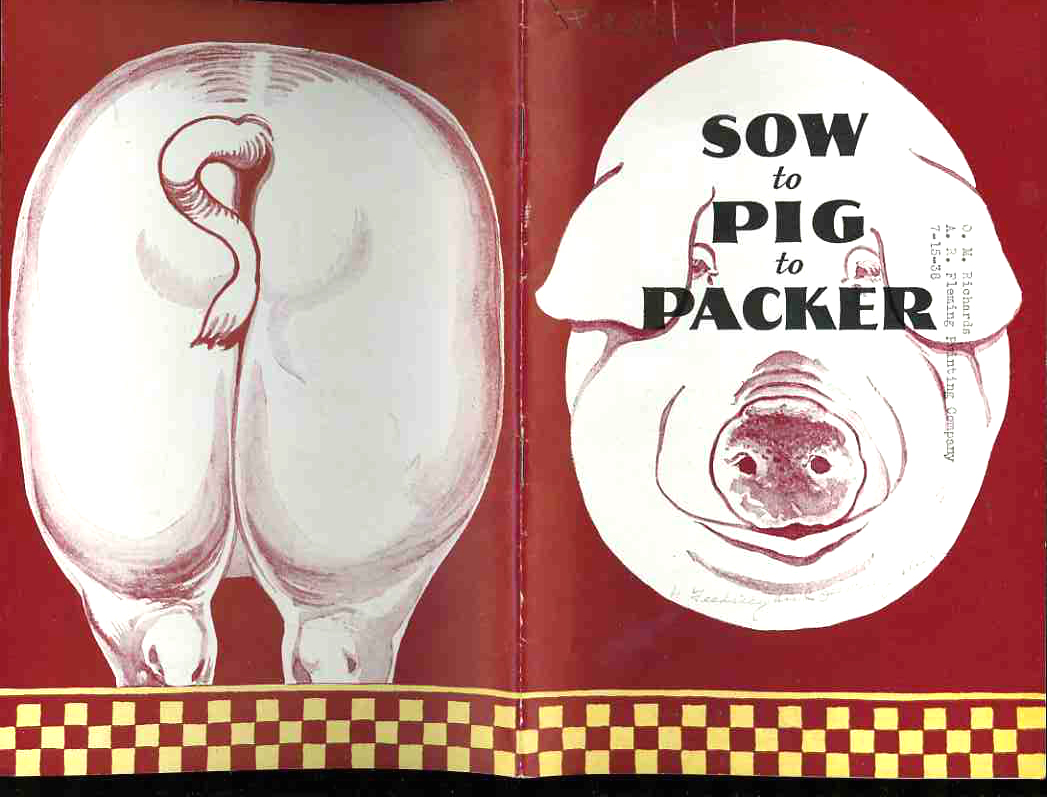
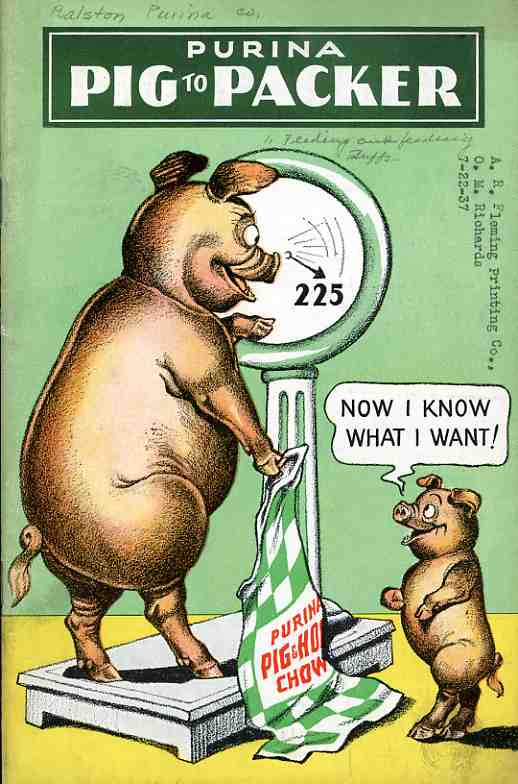
    Well.  Some things can just speak for themselves, as in the case(s) of these curious images brought to you by the graphic design folks working to push feed for Purina Company.  There were still tens of millions of farmers in the U.S. when this pamphlet was printed in 1935, and most of these farms were quite small, and so the Purina Company was reaching out with a broad stroke, right down to the neighborhood guy with 6 pigs on a half acre.  Of course what makes these images so appealing now is that they seem other-worldly, from a time that we have very little connection to even though it existed in the lifetimes of my parents.  The images are discordant, off-centre, not-quite-right–which places them perfectly into my Naive Surreal category.  The images are in their own accidental way quite surreal in that they look to be intentionally bizarre, when the opposite is true.
    0 blog jan 24purina graph426


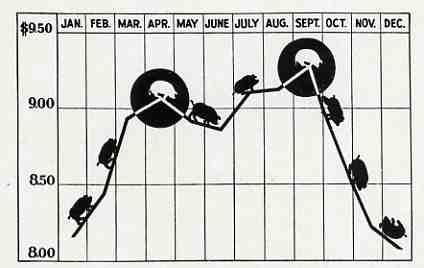
    Nestled snuggly away though is this remarkable graph of pig value versus time–its interest has nothing to do with the data which I suspect was accurate and universally known to be so (at the time), but for the PIG MARKERS at the X/Y interface.  That is something I’m sure I’ve never seen before, and I pay very close attention to the history of the display of quantitative data.  It is a small jewel.  a pearl among, well you know.


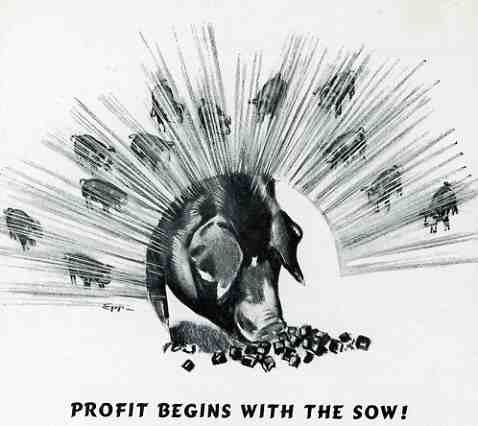
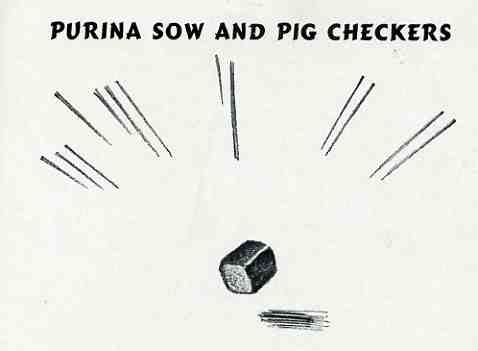
    As for some of the other images and their pig-centeredness, I can only speculate.  “Profit begins with the sow” is a solar porcine sunrise with little pig radiances.  “Purina Sow and Pig Checkers” I thought at first and continue to wrongly think that the cube in the middle was a loaf of bread (complete with shadow!), beautifully confounding the image-heading dichotomy; but it isn’t.  It is still a small magnificance of confusion, thank goodness.

    0 blog jan 24purina profits 428 0 blog jan 24purina graph427

    0 blog jan 24purina profits 429

    ·Posted by :

    ·in:

    — —

  • America’s Greatest Social Export: “We Shall Overcome” and the Importance of Guy Carawan

    JF Ptak Science Books LLC Post 474

    We shall
    Thinking about (really) high explosives for yesterday’s post led me to the American export of arms.  This in  turn led me to
    consider the non-lethal aspects of American exports–specifically, great,
    large-scale  American contributions to
    global society, and about what our greatest non-technical export might be.  (So far as the tech side goes, the most
    important of our exports over the last hundred years or so I would be, I guess,
    the computer—it is basically an American innovation, Charles Babbage and Konrad
    Zuse and a few others notwithstanding. I can’t imagine anything more superior;
    on the other hand, something like “fast food” might be considered, though it is
    ultimately an horrendous blight more than anything else, worldwide phenomenon
    and moneymaker or not.) 

    My candidate for
    this honor of Great American Export is a song:  “We Shall Overcome”. It is  a meme, really, understandable by anyone, anywhere; it meaning universally understood, and it power for gathering people together to fight for the  common good  is  powerful and undeniable.  It  is  a remarkable song, standing for the hope and dreams and  accomplishments of the Civil Rights movement and the vision of Martin Luther King.

    The other candidates that come to
    mind don’t come close to the power, crushing visibility and instantly-attaining
    recognition of WSO.  Free enterprise has
    been mentioned by lots of folks for this honor, but I honestly don’t see how it
    is an American invention—the Brits and Austrians were all over the concept in
    the mid 19th century, so I’m not so sure it can apply.  Perhaps these folks are talking about “virulent
    capitalism”
    , which may be American, and which may again rank quite high on this
    list, but not necessarily so proudly. 
    American Constitutionalism is another idea, as is the concept of image
    and (Martin Amis’) the cool.  Equally significant
    is debt accumulation, which is as interesting as a rash, and the insidious
    post-9/11 Fear, where all of our dreams’ life spans are color coded in segments
    away from oblivion.   Happier and more filling ideas are feminism
    and women’s rights (American only in the last 5- or 75 years or so), which leads to the general appearance of Civil Rights, which gets us right back to where we started, with WSO. In doing a quick mental accounting, WSO trumps all-comers. 

    Guy and candie
    The song’s creation is credited to
    the preacher and songwriter Charles Tindley (1851-1933), the son of a slave, who
    wrote I Shall Over-Come in 1901. The song came to greater life in 1945 as a
    result of a strike against the American Tobacco Company by the Tobacco Workers
    Union. Lucille Simmons, who was a striker, began singing the song at the end of
    the day’s striking activities—it came to the attention of the union’s
    organizer, Zilphia Horton, who was also at the time the musical director (and
    co-founder, with her husband Frank Horton) of the Highlander Folk School (of
    Monteagle, Tennessee. Highlander was started
    in the 1930’s as a place to instruct people how to organize and strike, and evolved
    over time into an extraordinary place of learning (and which was also “stolen”
    and seized by the U.S. 
    government in 1960, but that’s another story). 
    In the hands of Ms. Horton (who tragically died in 1956 at the age of
    46) the song was introduced to Pete Seeger, who published it in
     Bulletin No. 3 (Sept., 1948), #8, in
    1948 in People’s Songs. (Photo at above/right is of Guy Carawan and Cnadie Carawan.)

    Guy-carawan-mlk--1962
    It would take another four years before the song made its first recorded
    appearance. “We Shall Overcome” (changing the “will” to “shall” as in the
    Seeger version) by Laura Duncan and the Jewish Youth Singers (Hootenany
    records).  In 1953 the song was critically
    introduced to Frank Hamilton from Zilphia Horton, and from there to Hamilton’s friend and
    south-swing travelling companion Guy Carawan. (Carawan is seen at left with MLK in 1962.)

    It is in Carawan’s hands that the song , I think, received its most
    important treatment.  Carawan became the
    music director at Highlander in 1959 and re-introduced the song there, the school
    now being principally concerned with civil rights and student activism.  What makes Carawan so supremely important is
    that he traveled with the song and taught it to many groups of the important Student
    Noviolent Coordinating Committee (SNCC); the members of these groups in turn
    taught it to other groups, and so on and so on. 
    Carawan in fact taught the song at the initial meeting of SNCC in Raleigh in 1960, and has
    been credited with his importance by Julian Bond, Pete Seeger and many
    others.  The song is now perhaps the most recognized modern creation in existence, and may very well hold more significance than any other song in recent memory.  It is an anthem of belief, and of hope, and stands for what can be accomplished; it also stands for all of those who have given so much for their beliefs and for the betterment of society–a holy inspiration.
    (Thanks to Jeff Donlan for pointing me to the Mahalia clip on Youtube.)

    [My wife, Patti Digh, and I traveled to interview Guy and Candie
    Carawan a few days ago to talk to them about their lives in social
    awareness and about the song “We Shall Overcome”. To read her article on this experience, visit her blog at 37days.com.]


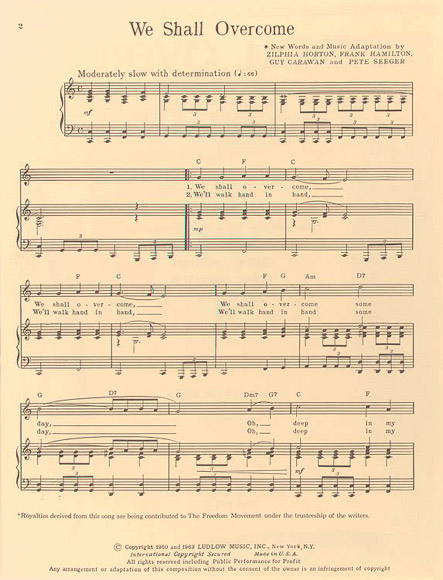
    Note on the WSO sheet music:  the fine print reads as follows:  (copyrighted) by “Horton,
    Silphia; Frank Hamilton; Guy Carawan; and Pete Seeger.. “We Shall
    Overcome.” Ludlow Music, Inc., 1963. Music Division, Library of Congress, Courtesy of
    Ludlow Music, Inc.

    ·Posted by :

    ·in:


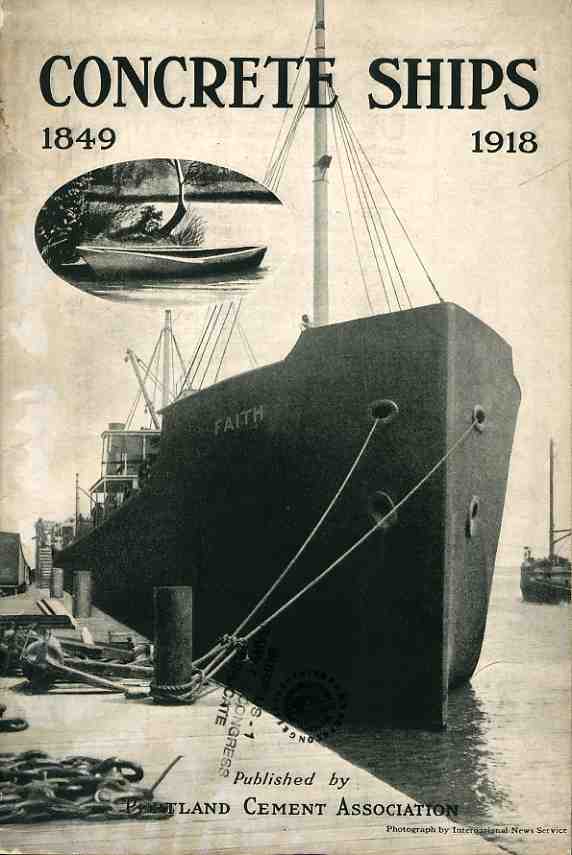
  • Celebrating a Good Idea that Sounds Silly: Concrete Ships

    0 blog jan 06 concrete ship361
    JF Ptak Science Books LLC  Post 459

    0 blog jan 06 concrete ship362

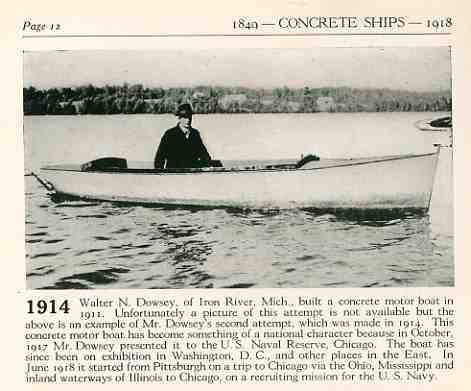
    This 1919 pamphlet’s title certainly sound more odd than the concept it describes:  concrete boats have been around for a long time, (160 years at least), and they make a lot more sense than a quick-think would give them (lumbering, unstoppable, heavy prep trucks come to mind).  For boats over 25 feet long, it is probably the easiest and cheapest material to employ, and it doesn’t need weatherproofing.  And, as an interesting website dedicated to concrete boats (ferro-boats) observes, a 30-foot 8-ton displacement ship made of either wood or concrete will weigh the same, which means that the very first image that comes into our heads when you say “concrete ship” is just wrong. 

    It looks like the French were the first to come up with the idea in about 1848, patenting the most winning methods of construction in 1855.  Since then there have been 12,000 or so of these 25-ft+ ships built, including a 130′ yacht and a 120′ British sub.  This method of construction certainly saw its time, especially during wartime, when steel production was in high demand.

    Please note:  posts over the next seven days or so will be somewhat truncated; I’m moving my store so time is a little scarce. Thanks for bearing with me.


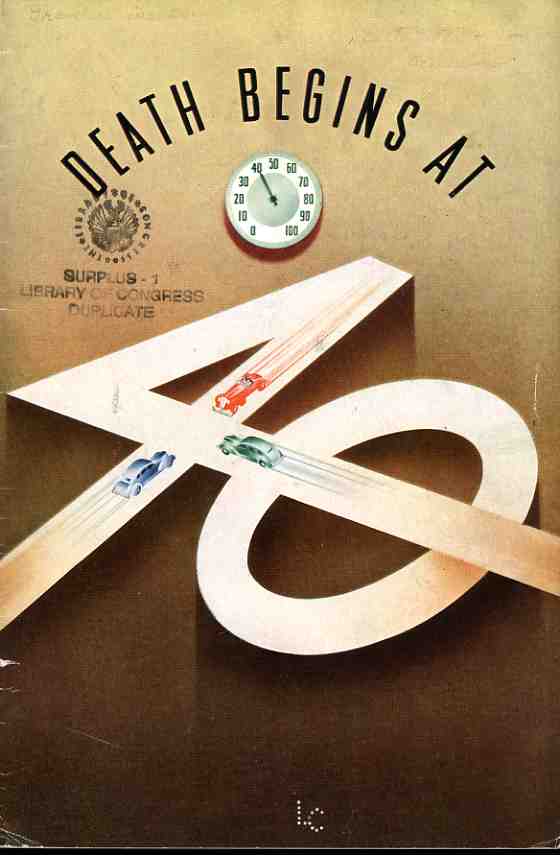
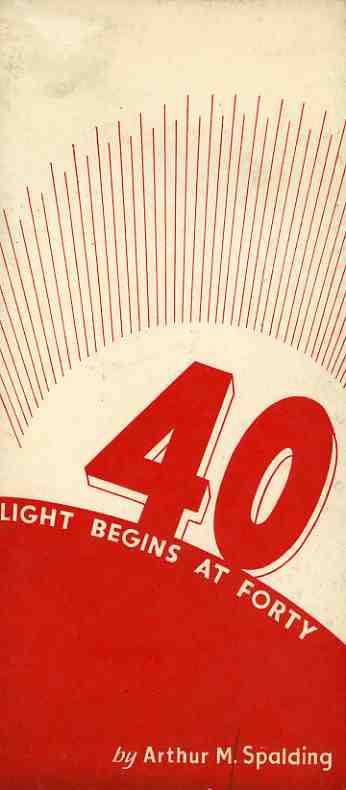
  • The Alpha and Omega of “40”

    JF Ptak Science Books LLC  Post 453

    0 blog jan 02 40342
    Perhaps this is more the Alpher and Omeger of the concept of 40, but, then, one never knows about these things, even when they’re pronounced in the manner of  Mr. Eugene Krabs (a  Spongebob reference; Mr. Krabs tends to put “er” at the end of words ending in “a”, like “spatuler”).  

    0 blog jan 02 40343
    Ah, well. 

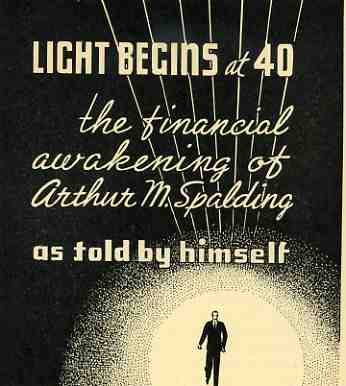
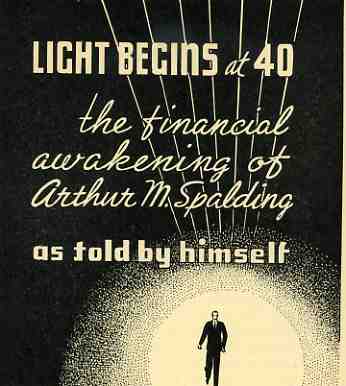
    The warnings of death AND light beginning at 40 seems to be a little contradictory, a little bit of singularity happening at a place  that I left behind 12 years ago. But all these beautifully designed pamphlets are yelling about is traffic speed and life insurance:  traffic deaths start piling up at 40 m.p.h. and men (not women) should start buying life insurance then because their big earnings years “come to light”.

    These pamphlets are both part of my Naive Surreal Collection–works that seem commonplace and standard when they were published but whose context is decidedly antiquarian and semi-existent in 2009.  Often the best part of these pamphlets are their covers, though they can all be mined for the forgotten social ephemera that lurks just beneath their surface.  But in these cases it is really just the incredibly arcane messages in the artwork that I find most interesting. 

    0 blog jan 02 40344

    ·Posted by :

    ·in:

    —

  • Private Smoe, Latrine Orderly, and a Sub-History of the Word “Latrine” in the Titles of Books in English

    JF Ptak Science Books LLC   Post 452

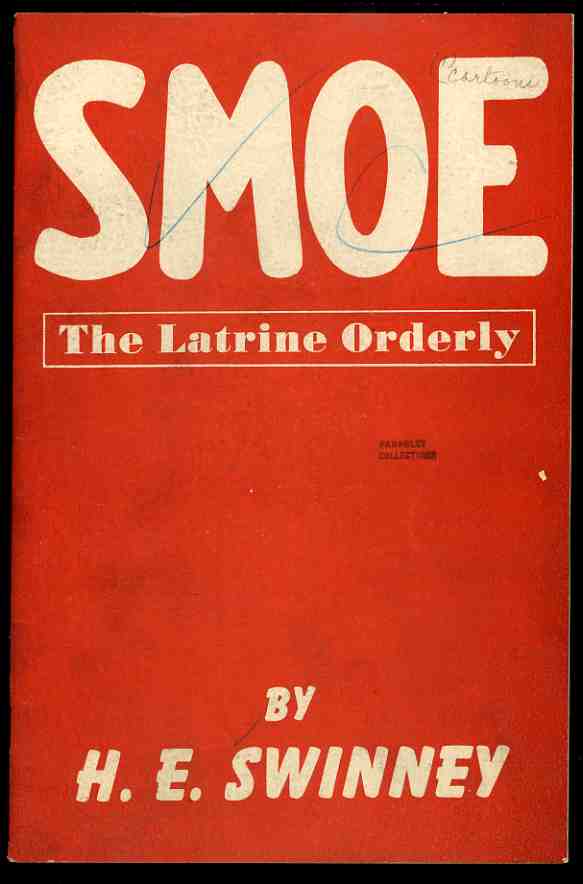
    0 blog dec 31 smoe334 Is it possible that James Steveson’s Paddington : report on the necessity of latrine accommodation for women in the Metropolis, published in 1879, is the first book published in English to use the word “latrine” in the title?! Well, in a lightly interesting and perhaps stupefying way, the answer is “yes”.  And this just to get to this very obscure graphic.cartoon book, Smoe, the Latrine Orderly, by H.E. Swinney, published by the Ledger Company in Fort Worth, Texas.  According to WorldCat/OCLC, the massive cataloging tool used by librarians everywhere, there aren’t any copies of this book in any library anywhere in the world.  I’m both surprised and underwhelmed.  The cartoons all appeared in the Fort Worth Army Air Field’s newspaper “Lone Star Scanner”, which is also a publication that doesn’t seem to have survived anywhere.  H.E. Swinney may be Sergeant H.E. Swinney, who was present at Pearl Harbor on 7 December and who fought his way through WWII, though I’m not sure.

    The pamphlet’s  jokes and cartoons I can appreciate as having been funny once upon a time, making people laugh as they snapped their newspapers over their eggs at the PX.  Maybe they made people laugh for a few years, but probably not much more.  It makes me think for just a little about the average age for how long jokes are “funny”.  I’d say that the Smoe funny lasted about 2 years 5 months and 5 days.  More or less.

    The word “latrine” is from the French and from the Latin before that, and appears fairly early in English (1642 according to my 1933 OED), but for whatever reason, it just doesn’t find its way into the title of any English books for more than two hundred years.

    The reason I’m spending any time at all on this little pamphlet is because its title is so entirely unexpected.  And that, as the man said, is all I have to say about that. 


  • Elves, Fairies, Wanton Spirits, Genius, Spectres and Ghosts: Tremendous Titles in the History of Witchcraft.

    JF Ptak Science Books LLC  Post 447

    Scot
    Below are 31 titles relating to witches and witchcraft, printed in the 16th through 18th century–they all share some absolutely fabulous title constructions, elements and phrases. For example, the great work by Reginald Scot (listed first, below) contains the following phrasing IN ITS TITLE:

    “lewde dealing of witches and witchmongers 

    knaverie of conjurors
    impietie of inchanters
    follie of soothsaiers
    impudent falsehood of cousenors
    infidelitie of atheiststs
    pestilent practises of Pythonists
    curiositie of figurecasters
    vanitie of dreamers
    beggerlie art of Alcumystrie
    abomination of idolatrie, the
    horrible art of poisoning
    vertue and power of naturall magicke,
    conveiances of legierdemaine and juggling are deciphered…”

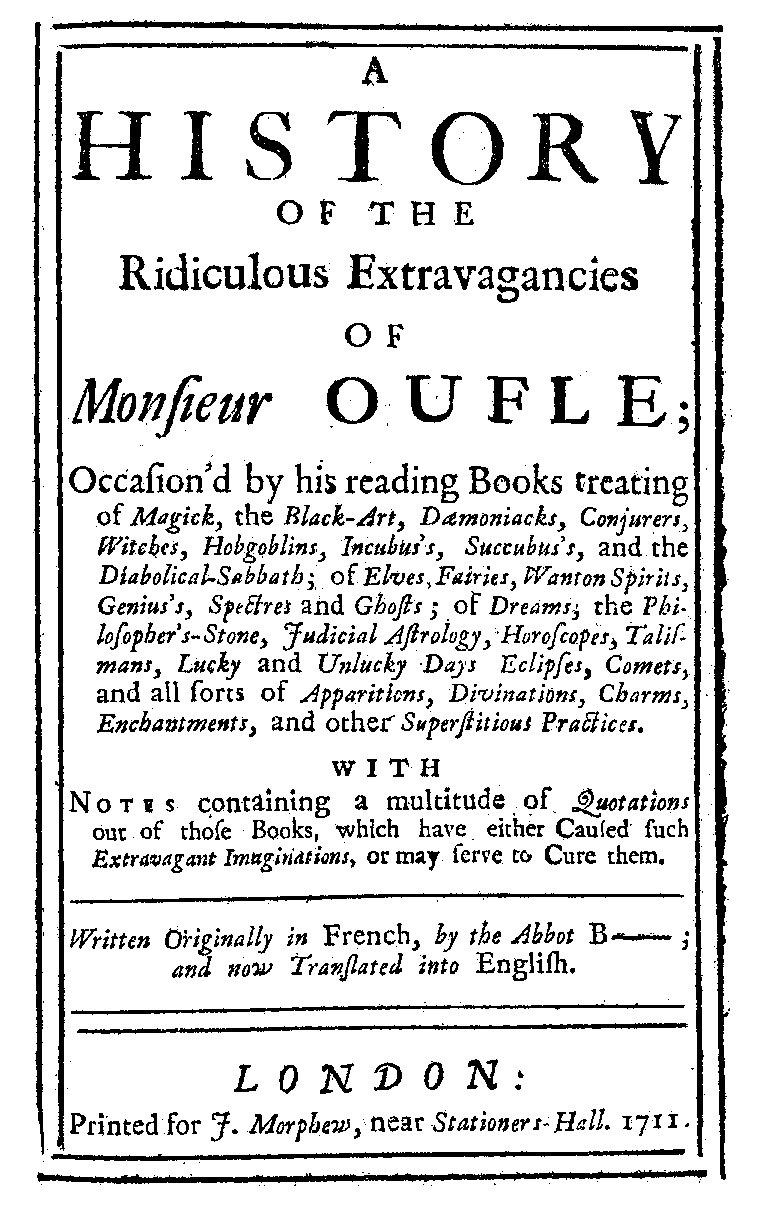
    Laurent.Bordelon’s title includes the following spectacular efforts:  “Ridiculous Extravagancies of…Magick, the Black-Art, Daemoniacks, Conjurers, Witches, Hobgoblins, Incubus’s, Succubus’s and the Diabolical-Sabbath,Elves, Fairies, Wanton Spirits, Genius’s, Spectres and Ghosts, Dreams, the Philosopher’s-Stone, Judicial Astrology, Horoscopes,Talismans, Lucky and Unlucky Days, Eclipses, Comets, and all sorts of Apparitions, Divinations, Charms, Enchantments…”

    Bordelon

    And on and on.  In my experience the titles of books on witchcraft and demonology are among the most creative and imaginatively flouncy.
    Enjoy.

    Scot, Reginald. The Discoverie of Witchcraft, Wherein the lewd dealing of witches and witchmongers is notablie detected, the knaverie of conjurors, the impietie of inchanters, the follie of soothsaiers, the impudent falsehood of cousenors, the infidelity of atheists, the pestilent practises of Pythonists, the curiositie of figurecasters, the vanitie of dreamers, the beggerlie art of Alcumystrie, The abomination of idolatrie, the horrible art of poisoning, the vertue and power of naturall magicke, and all the conveiances of legierdemaine and juggling
     are deciphered: and many other things opened, which have long been hidden, howbeit verie necessarie to be known
    , 1584. Imprinted at London, by William Brome.

    Bordelon, L. A History of the Ridiculous Extravagancies of Monsieur Oufle; Occasion’d by his reading Books treating of Magick, the Black-Art, Daemoniacks, Conjurers, Witches,  Hobgoblins, Incubus’s, Succubus’s and the Diabolical-Sabbath; of Elves, Fairies, Wanton Spirits, Genius’s, Spectres and Ghosts; of  Dreams, the Philosopher’s-Stone, Judicial Astrology, Horoscopes,
      Talismans, Lucky and Unlucky Days, Eclipses, Comets,sorts of Apparitions, Divinations, Charms, Enchantments and otherGlanvil2sm

           Superstitious Practices. With Notes containing a multitude of
           Quotations out of those Books, which have either Caused such
           Extravagant Imaginations, or may serve to Cure them. Written
           originally in French, by the Abbot B–; and now translated into
           English.
    London, Printed for J. Morphew near Stationer’s Hill,
           1711.

    ·Posted by :

    ·in:

    —

  • One of the Worst Santa Claus Titles, Ever: St. Nick & Eraserhead.

    JF Ptak Science Books   Post 411

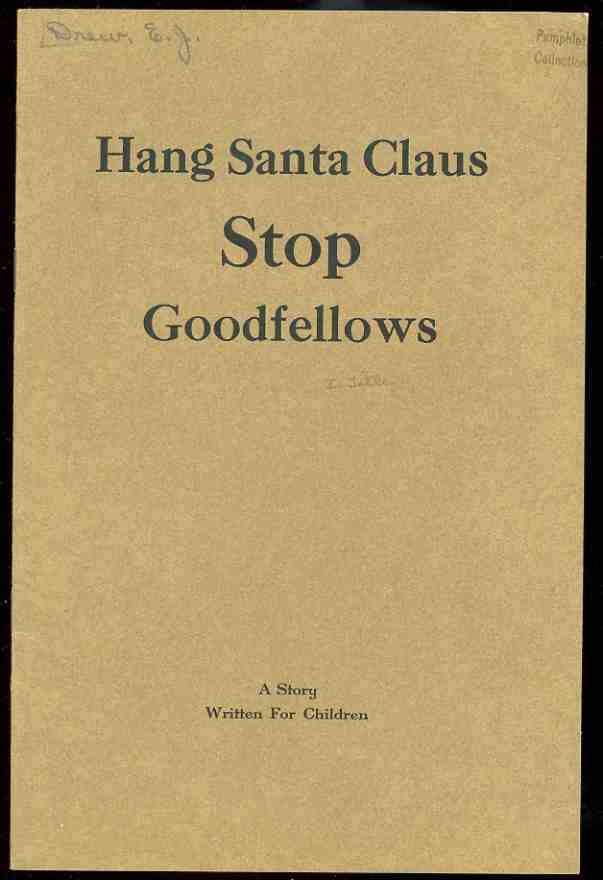
    0--ebay---dec 5 santa183 In the world of bizarrely entitled written works, this extreme effort, written by E.J. Drew (in 1937)   is a prime, glowing, poster-boarded champion.  When you throw Mr. Claus into the mix of bizarre, naive surreal and badly-titled Things Which Have Been Written by Humans, greatness is achieved.  Great badness–even after reading this, um, this written thing (and I’m not sure what category this might occupy but I am sure that whatever it was intended to be written as was written with words, and that’s about it, a Word Written Book, so to speak) I am not sure what it is about. 

    It was a “story written for children”, and such an un-tender Santa-related bad-inducement should certainly never find its way into any hands measuring less than four inches wide; or for that matter, more than four inches wide.

    But getting back to the “about” part–I really can’t tell.  Suffice to say that it involves some bad stories about being in the Dust Bowl, and about children so poor that they were FORGOTTEN by Santa. Then somehow Santa is beaten to a pulp by bad boys, rescued by newspaper boys (the “Goodfellows”), some other stuff, and then everyone winds up being judged by St. Peter as to where they would spend eternity. Santa replaces St. Pete, and then sends people like John Dillinger to the Bad Place. 

    David lynch
    Well.  If there is a moral in here I cannot find it; I can’t figure out the title, either.  The Goodfellows were good and weren’t “Goodfellas”, and the hanging and stopping I just don’t know.  The whole thing is a little disturbing, sort of like the feeling you get when you get your *first* disturbing feelings seeing David Lynch’s twisted/broken Eraserhead.  Pound-for-pound, Drew’s sweaty and nightmarish thing is as unpretty as Lynch’s third-worst. 

    As if one copy wasn’t enough. you can “get additional copies” of this work if you go back in time seven decades years and order them from E.J. Drew, 4034 West Warren Avenue, Detroit, Michigan. No price was listed.

    ·Posted by :

    ·in:

    —

  • Growing a Junk Yard: Salvaging Fat, Bikes and Stockings for Guns and Tanks, 1943

    JF Ptak Science Books LLC Post 379

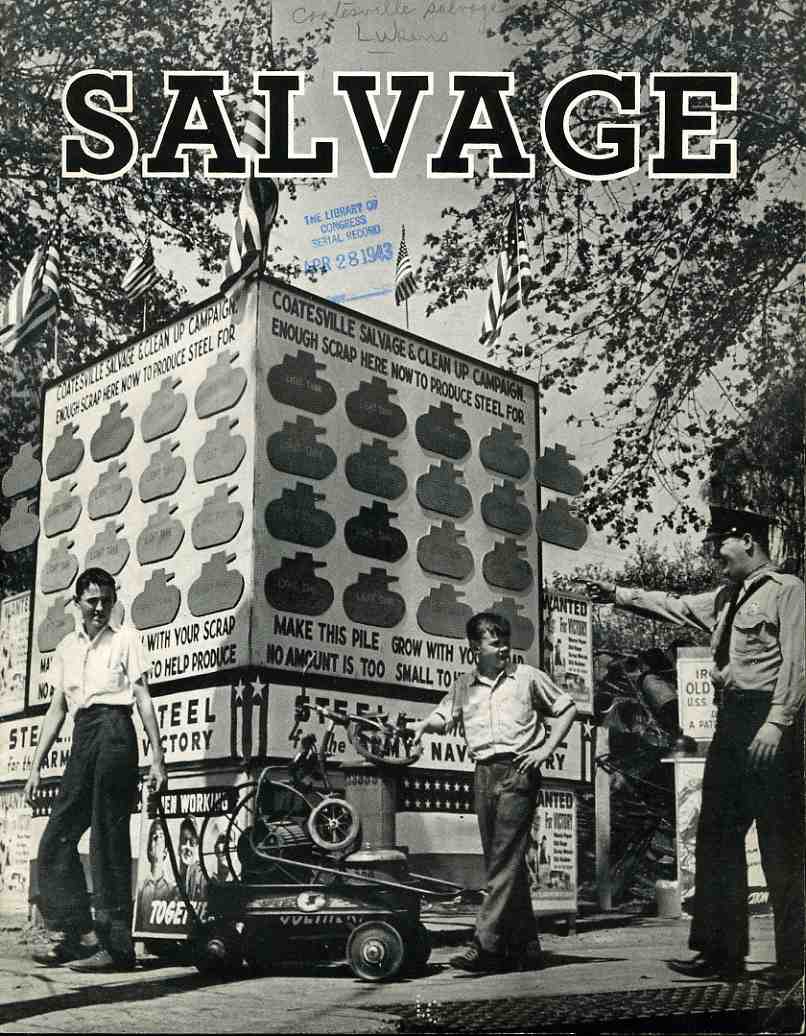
    00-blog-Oct 25 salvage922 Salvage (1943) is just simply brilliant!  It is a superb design, getting its inelegant point elegantly across to the reader, making the collecting of junk  a bona fide war effort, triumphant, superior; it delivers the message gorgeously.  Who wouldn’t want to rush out and look for some metal scrap and bits and grow a neighborhood junk yard so that the community could build a tank?  Certainly these two boys–under the watchful guidance of a smiling cop in a black tie–couldn’t resist, and from the looks of the progress billboard behind them, nor could anybody else in the neighborhood, as the community collected enough metal junk for 14 tanks.  (Or at least pieces and chunks for fourteen tanks.)

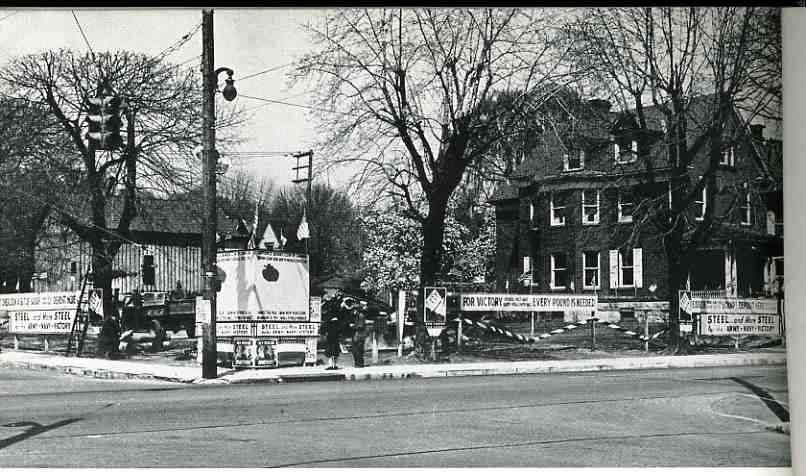
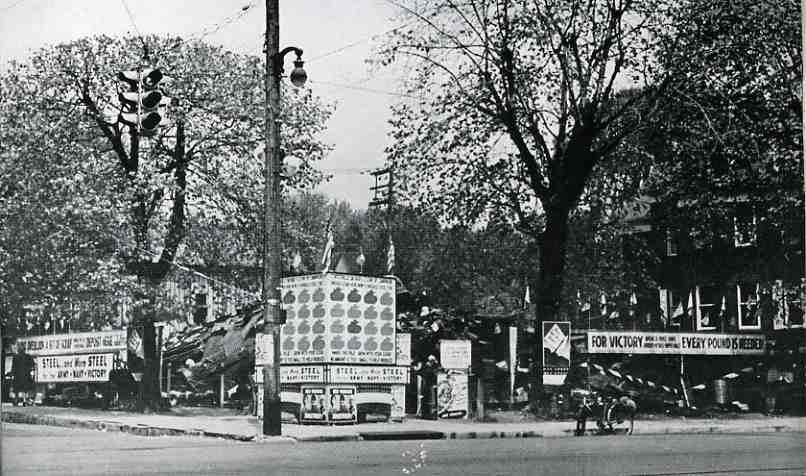
    The community was Coatesville, Pennsylvania, and they certainly did their collecting-best.  The two photos below show (top) the scrap yard after two days of collecting, and (bottom) the end of the campaign two months latter.

    “One pound of fat contained enough glycerin to make a pound of black powder, enough for six 75-mm shells. Twenty three hundred old nylon stockings contained enough nylon to make one parachute.
    Thirty thousand razor blades contained enough steel to make fifty 30-caliber machine guns.”   (Lingeman, Richard R. Don t You Know There Is a War On? The American Home Front, 1941-1945. New York: G.P. Putnam’s Sons 1970, 254-55).  When you have an entire town doing this, you can build tanks; when you have millions of people throwing together to collect this “junk”, then you get part of a war effort.  It is also part of a giant propaganda hearts/minds machine, especially for the U.S., which was (and I use this word with some hesitation) cushioned from the effects of the war by two oceans–it reminded people who hadn’t contributed a life to the war that there was actually something tangible going on, and that they could do something to help.  It kept peoples’ minds in the game.  Rubber was another big concern, as was silk (the controlling exporter of both coming largely from overseas, and in the case of silk, the exporter was Japan.)  Of course there was the introduction of synthetics for both silk and rubber, but the point in fact was that there was indeed a shortage, and the donated and salvaged stuff was necessary. 

    Here’s a beginning picture for the burgeoning community scrapyard:                                                                                                                                              00-blog-Oct 25 salvage before923

    Some interesting works relating to salvage drives:

    Barringer, Edwin C. The Story of Scrap. Washington D.C:Institute of Scrap Iron & Steel Inc., revised edition, 1954.

    Cohen, Stan. V for Victory: America’s Home Front During World War II. Missoula Montana: Pictorial Histories Publishing Co., Inc., 1991.

    And afterwards:

    00-blog-Oct 25 salvage after924

    Hoopes, Roy. Americans Remember the Home Front: An Oral Narrative. New York: Hawthorn Books, 1977.

    Lingeman, Richard R. Don t You Know There Is a War On? The American Home Front, 1941-1945. New York: G.P. Putnam’s Sons, 1970.

    O’Neill, William L. A Democracy at War: America’s Fight at Home and Abroad in World War II. New York: The Free Press, 1993.

    And here’s one I’d like to see (the cover of):

    Wolf, Howard. The Story of Scrap Rubber. Akron, Ohio: A.
    Schulman, Inc., 1943.

    ·Posted by :

    ·in:

    —