A Daily History of Holes, Dots, Lines, Science, History, Math, Physics, Art, the Unintentional Absurd, Architecture, Maps, Data Visualization, Blank and Missing Things, and so on. |1.6 million words, 7500 images, 4.9 million hits| Press & appearances in The Times, Le Figaro, Mensa, The Economist, The Guardian, Discovery News, Slate, Le Monde, Sci American Blogs, Le Pont, and many other places… 5000+ total posts since 2008.

Category: Books: Great & Lost in the Dust

  • Found Poetry in the Universal Knowledge of Huygen’s Great “Cosmotheoros”, 1698

    JF Ptak Science Books   Post 2291

    It seems to me that as a representative of extraterrestrial imagination not being illustrated its hard to beat the case of the beautiful and polymathic Christiaan Huygens.  Huygens (1629-1695) worked across many fields, including astronomy, biology, math and physics, and was extraordinarily productive, making numerous contributions in the physical and theoretical areas, as well as being a prolific author and correspondent. 

    Towards the end of his relatively short life (he died at age 66, completing work enough for a number of very gifted and exacting people) Huygens embarked down the science fiction road in pre-science fiction days, writing wonderful and provocative outre ideas within what was his general/.universal statement of knowledge of all things , a wonderful book entitled Cosmotheoros, The Celestial World Discover’d: or, Conjectures Concerning the Inhabitants, Plants and Productions of the Worlds in the Planets. (The book had a difficult coming-into-being, Huygens completing it at the end of his life, though he would see only one page of printed before he died on 1695, outliving his elderly father by a bit, an accomplished diplomat who died at age 91 in 1687. His request/bequest to his older brother Constantijn—named for his father—was for him to see the book through to publication. Unfortunately, the diarist/painter/gossip brother lived only two more years, and at his death the book was still not printed. The job finally fell to the direction of Burchard de Volder (1643-1709), a Leiden prof of math and physic who established the physics lab there and who was also the teacher of the “father of physiology”, Herman Boerhaaver (a man of considerable taste, seeing his beautiful and tidy manor house at Oegstgeest, nearby Leiden). Happily de Volder saw the book into publication in 1698 (and survived it by 11 years). The book appeared in Latin and was in the same year (anonymously!) translated into English, followed by a Dutch translation in 1699, French in 1702, German in 1703, and Russian in 1717—in other words, a well-received an popular work.

    See the introduction to the work and the digital version here at the University of Utrecht: http://www.staff.science.uu.nl/~gent0113/huygens/huygens_ct_en.htm

    Huygens looked at everything in his world in this book, and many things outside of it: here he establishes the possibilities of life being lived on worlds other than that of Earth. He develops a detailed fabric for these new heavens, so much so that he can also establish samenesses for the ETs and humans, stating here his belief in the eternal/cosmological abilities of mathematics and music:

    “It’s the same with Musick as with Geometry, it’s every where immutably the same, and always will be so. For all Harmony consists in Concord, and Concord is all the World over fixt according to the same invariable measure and proportion. So that in all Nations the difference and distance of Notes is the same, whether they be in a continued gradual progression, or the voice makes skips over one to the next. Nay very credible Authors report, that there’s a sort of Bird in America, that can plainly sing in order six musical Notes: whence it follows that the Laws of Musick are unchangeably fix’d by Nature, and therefore the same Reason holds valid for their Musick, as we even now proposed for their Geometry”–page 86

    Huygens holds close to the immutable nature and close association of music and mathematics,m which would be the same here and everywhere (everywhere else, the ET communities, being referred to here as “other Nations”). 

    “For why, supposing other Nations and Creatures, endued with Reason and Sense as well as we, should not they reap the Pleasures arising from these Senses as well as we too? I don’t know what effect this Argument, from the immutable nature of these   Arts, may have upon the Minds of others; I think it no inconsiderable or contemptible one, but of as great Strength as that which I made use of above to prove that the Planetarians had the sense of Seeing.” page 86/7

    Huygens is so sure of this that he is willing to take a bet with long odds that not only do ETs enjoy the possibilities of music but that they have also created instruments:

    “But if they take delight in Harmony, ’tis twenty to one but that they have invented musical Instruments. For, if nothing else, they could scarce help lighting upon some or other by chance; the sound of a tight String, the noise of the Winds, or the whistling of Reeds, might have given them the hint. From these small beginnings they perhaps, as well as we, have advanced by degrees to the use of the Lute, Harp, Flute, and many string’d Instruments. But altho the Tones are certain and determinate, yet we find among different Nations a quite different manner and rule for Singing; as formerly among the Dorians, Phrygians, and Lydians, and in our time among the French, Italians, and Persians” page 87

    Huygens then continues to make a beautiful distinction between the musics of Earthling and ETs, in that it may not sound anything like any music we have on Earth, but–since the laws that govern math and music are the same, everywhere–it still might be “very good”.  And not only that, the alien music might be better than our’s:

    “In like manner it may so happen, that the Musick of the Inhabitants of the Planets may widely differ  from all these, and yet be very good. But why we should look upon their Musick to be worse than ours, there’s no reason can be given; neither can we well presume that they want the use of half-notes and quarter-notes, seeing the invention of half-notes is so obvious, and the use of ’em so agreeable to nature. Nay, to go a step farther, what if they should excel us in the Theory and practick part of Musick, and outdo us in Consorts of vocal and instrumental Musick, so artificially compos’d, that they shew their Skill by the mixtures of Discords and Concords?”–page 88 

    And so on.  But why I wonder with all of the great images painted for us in his text is there no venturing into a visual artform?  There’s enough information in the Huygens work to allow for a map, but then there are none, not even something along the images of de Bergerac, who was perhaps among the greatest visionary of techno-anthropormorphic human flight.  Before he was the object of Edmund Rostand’s 1897 play, de Bergerac was a massively creative author, producing, among other things, the book Histoire des Etats et Empires de la Lune (History of the States and Empires of the Moon, published posthumously in 1657), followed by Histoire des Etats et Empires du Soleil (History of the States and Empires of the Sun, again, published further and deeper into his life’s surrender, 1662), both eventually collected as L’Autre Monde (Other Worlds).  Bergerac introduces us, the humble reader, to one of the most important concepts in the history of literature–namely that we humans were not only not alone in the universe, but that we were not even the dominant culture, and indeed we were actually hated by some of the other more advanced species.

    The foundations for structuring a visual habitat for the ideas of Huygens are abundant, as you can see easily in the table of contents (which is like an annotated table of contents for a modern book)–the signs for a road map are there, mostly–there’s just no road, but there are plenty of suggestions for one.

    In general though the chapter titles are fantastic, and invite themselves to their own found-poetry—by simply listing and centering them, a person with a good sense for pause and continuity could read these out loud and make them sound like a considered piece of poetry.


    The Chapter heads, in order (!):

    Some have already talk’d of the Inhabitants of the Planets, but went no fartherThe Objections of ignorant Cavillers prevented
    This Enquiry not overcurious
    Conjectures not useless, because not certain
    These Studies useful to Religion
    Copernicus’s System explain’d
    Arguments for the truth of it
    The Proportion of the Magnitude of the Planets, in respect of one another, and the Sun
    The Lamell more convenient than Micrometers
    The Earth justly liken’d to the Planets, and the Planets to it
    Arguments from their Similitude of no small weight
    The Planets are solid, and not without Gravity
    Have Animals and Plants
    Not to be imagin’d too unlike ours
    Planets have Water
    But not just like ours
    Plants grow and are nourish’d there as they are here
    The same true of their Animals
    Great variety of Animals in this Earth
    And no less in the Planets
    The same in Plants
    Vices of Men no hindrance to their being the Glory of the Planet they inhabit
    Reason not different from what ’tis here
    They have Senses
    Sight
    Hearing
    A Medium to convey Sound to the Ear
    Touch
    Smell and Tast
    Their Senses not very different from ours
    They have Pleasure arising from the Senses
    All the Planets have Fire
    The bigness of their Creatures not rightly guest at by the bigness of the Planets
    In the Planets are many sorts of rational Creatures as well as here
    Men chiefly differ from Beasts in the study of Nature
    They have Astronomy
    And all its subservient Arts
    Geometry and Arithmetick
    And Writing
    And Opticks
    These Sciences not contrary to Nature
    They have Hands
    And Feet
    That they are upright
    It follows not therefore that they have the same shape with us
    A rational Soul may inhabit another Shape than ours
    The Planetarians not less than we
    They live in Society
    They enjoy the pleasures of Society
       They have Houses to secure ’em from Weather
    They have Navigation, and all Arts subservient
    As Geometry
    They have Musick
    The Advantages we reap from Herbs and Animals
    And from Metals
    From the discoveries of our Age
    The Planets have, tho not these same, yet as useful Inventions 
    Book 2
    Kircher’s Journey in Ecstacy examin’d
    The System of the Planets in Mercury
    In VenusIn Mars
     Jupiter and Saturn the most eminent of the Planets both for bigness and attendants
    The proportion of the Diameter of Jupiter, and of the Orbs of his Satellites, to the Orbit of the Moon round the Earth
    The periods of Jupiter’s Moons
    And Saturn’s
    This proportion true according to all modern Observations
    The apparent magnitude of the Sun in Jupiter, and a way of finding what light they there enjoy
    And in Saturn
    Always the same length
    They see the fixt Stars just as we do
    The appearances of the Ring in Saturn
    Very little to be said of the Moon
    The Guards of Jupiter and Saturn are of the same nature with our Moon
    The Moon hath Mountains
    But no Sea, nor Rivers, nor Clouds, nor Air and Water
    The Astronomy of the Inhabitants of the Moon
    This may be applied to the Moons about Jupiter and Saturn
    The immense distance between the Sun and Planets illustrated
    No ground for Conjecture in the Sun
    The Faculty in the Sun not easily seen
    By reason of its Heat no Inhabitants like ours can live in the Sun
    The fix’d Stars so many Suns
    They are not all in the same Sphere
    The Stars have Planets about them like our Sun
    A way of making a probable guess at the distance of the Stars
    Every Sun has a vortex round it, very different from those of Cartes 


  • Towering Minor Masterpieces

    JF Ptak Science Books   Post 2271

    Years ago I purchased a very large collection of pamphlets from the Library of Congress, something like 2000 crumbling blue document boxes on two long ranges of metal shelving.  It was creatively called (and stamped) “Pamphlet Collection” and rounded up to about 90,000 items, all of which needed to be hand stamped “Library of Congress Surplus Duplicate”.  Now the great majority of these were things like updates to the Cleveland plumbing code of 1922, but there were still many thousands of interesting items, and even after all of this time I really haven’t dealt with all of it.

    (The remarkable thing is that on the next range over was housed a very large collection of a (or the) Ray Eames archive.  There were models, boxes labeled  “1939 World’s Fair”, “IBM”, so on–and his phone.  I walked the range of this collection but didn’t touch or open anything, which was remarkably tempting.  It was all very dusty–years of dust.)

    The arrangement of storage of the pamphlets was also very precise and thorough and also almost entirely useless. Even though if you squinted everything could be in its proper box, the sorting was very democratic, with things arranged by title and subject and author and period, all within one single category, making the notes on the side of the box just hopeful expressions of what might be inside.   It made for an interesting hunt. 

    One of my favorite categories of pamphlets from this collection were the mimeographed or early-photo-mechanical reproduction productions, things that were home/office produced, and usually for a very restricted audience.  These people meant business.  For example:

    The Struggle for Life in Los Angeles County, published by Edward Reimer (825 West 8th St), Los Angeles; presumably Reimer printed the document, as well, it just has that homemade feel to it, and it seems to be an early mimeographic reproduction production, and, probably, of very  limited distribution.  It was printed on 11×8.5″ sheets in purple ink, 107pp, running about 60,000 words, and is also the Copyright Deposit copy (serial A 208715, July 6, 1936). This seems to be the only available copy of any interesting report on the conditions and remedies of social and economic conditions in Los Angeles in the mid-1930’s, and I think in the right hands could be brought back to life again as a semi-lost social document.  

    [All of the following are available for purchase via the blog bookstore/social history section.]

    LA Struggle176


    LA Struggle178

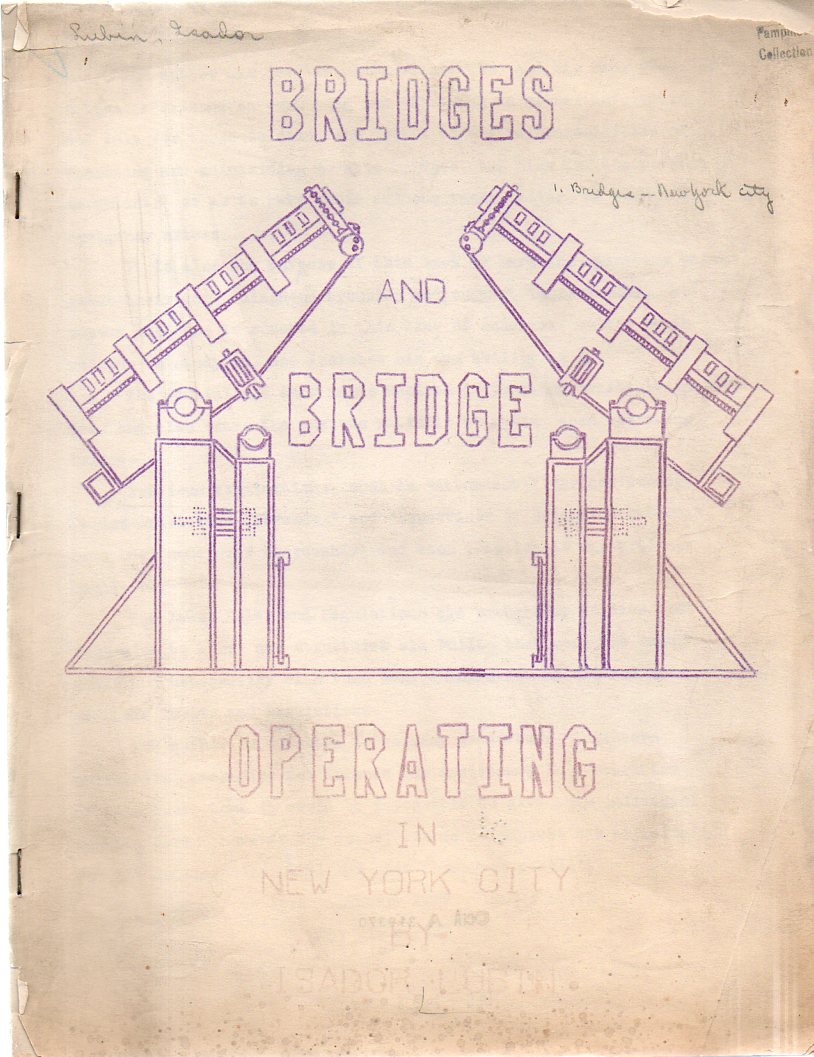
     And another, being everything you wanted to know and then more so on operating movable bridges in New York City, Isidor Lubin’s Bridges and Bridge Operating in New York City, printed in 1939. It is 11×8″, a 114pp, single-spaced typed and mimeographed document of about 70,000 words.  This also seems to be a copyright deposit copy, with no copy turning up in the massive WorldCat catalog, and seemingly no copy available in libraries worldwide. In exhaustive detail Lubin discusses the operations and maintenance of movable bridges–and I mean all manner of things, from oiling to fuse boxes and lighting scenarios of control boxes and communicating with landside control; uniforms, courtesies, questions given in promotion examination to bridge operators (with answers), duties of bridge operators and tenders in operating drawbridges, distress signals and on and on.  

    New York movable bridges180


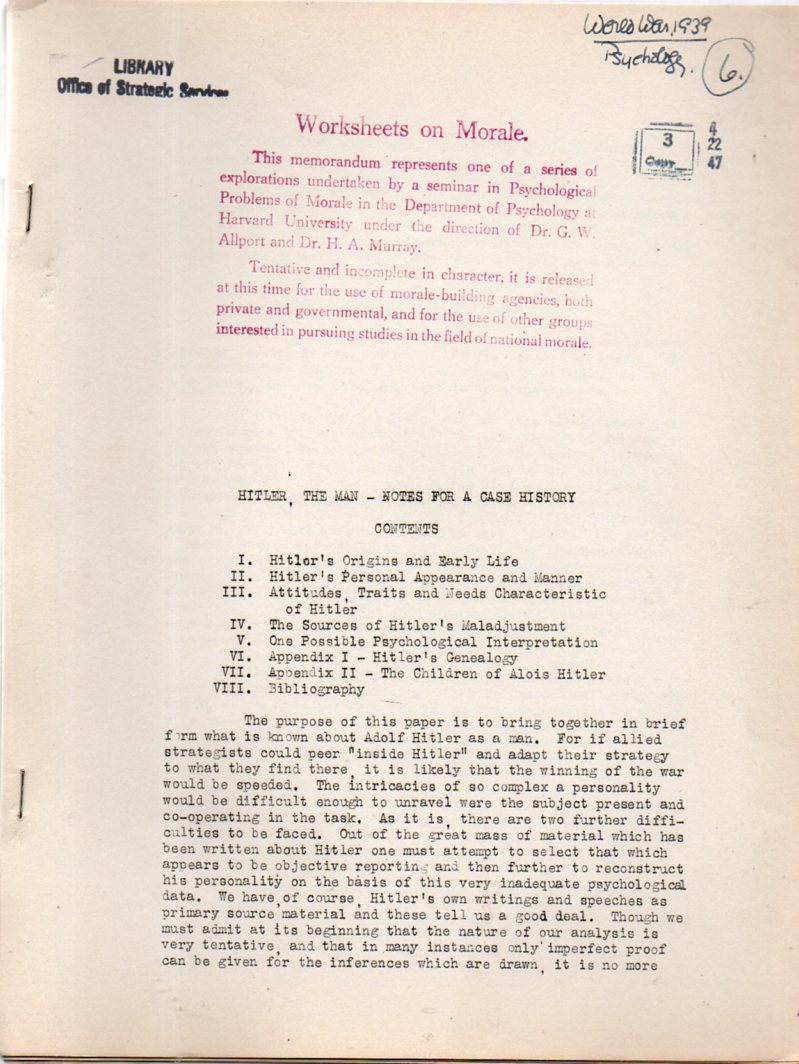
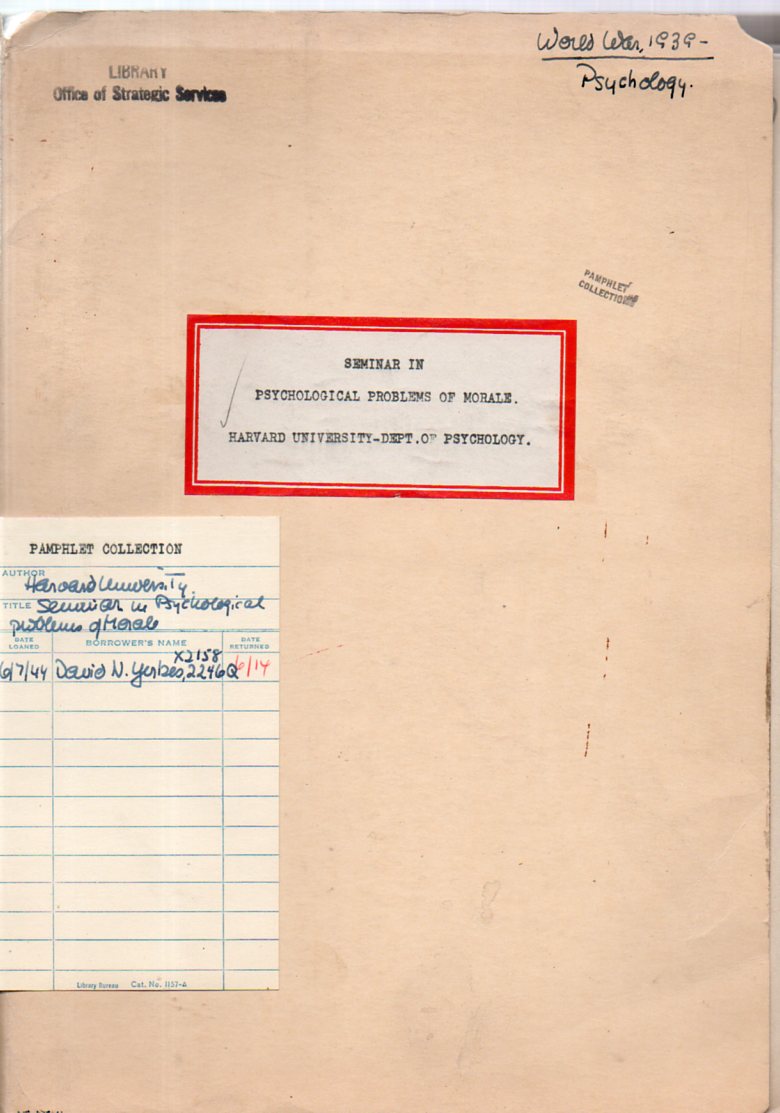
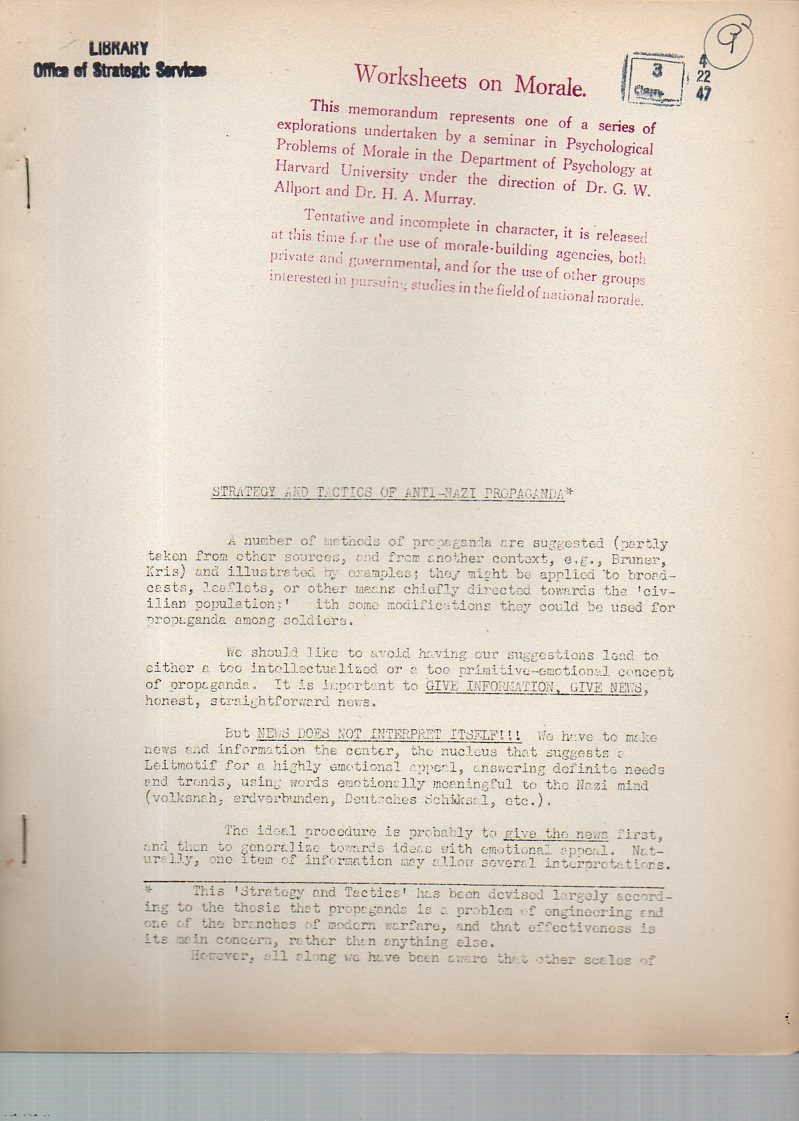
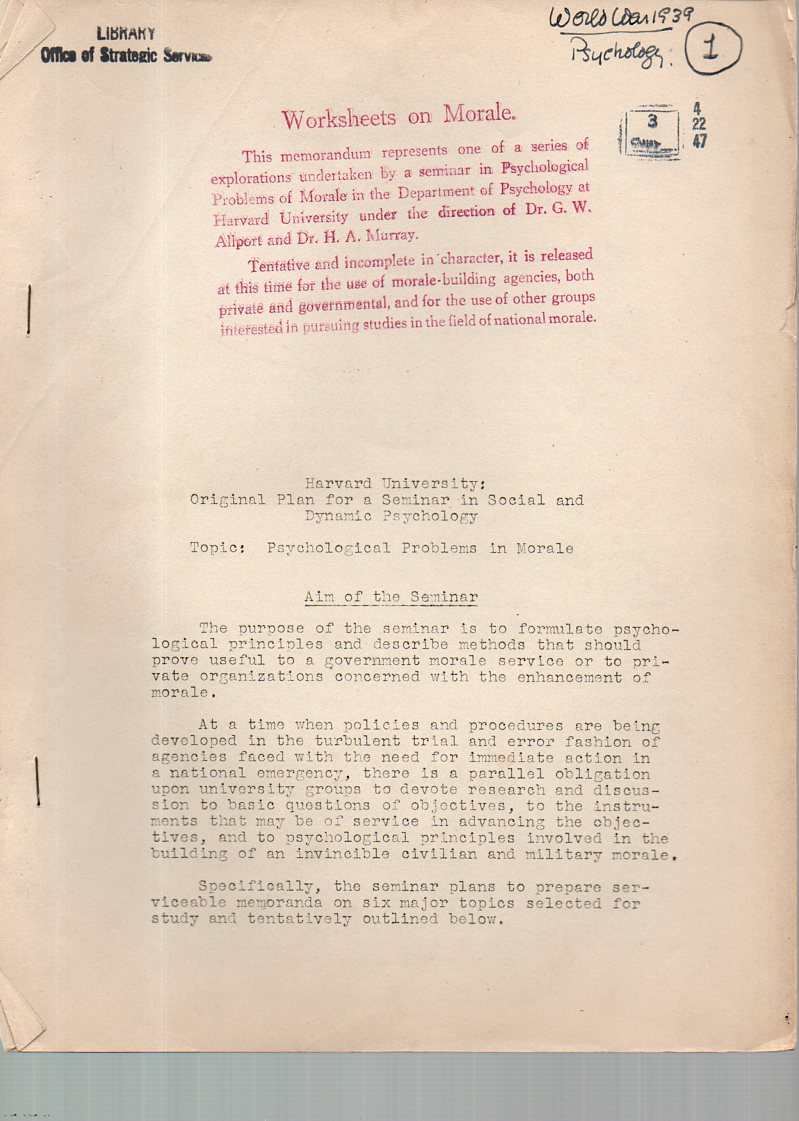
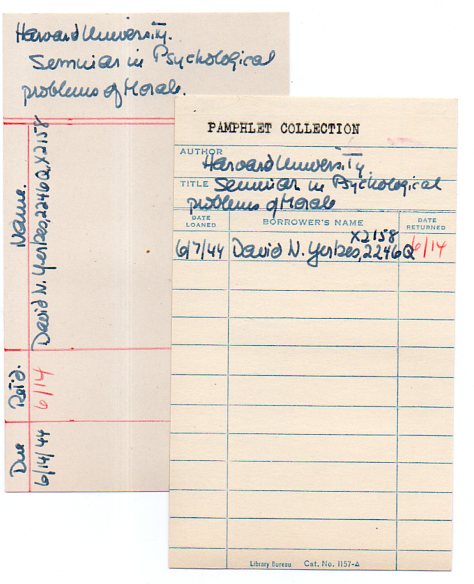
    Then there’s this–a profesisonal production but still of very limited distribution, at least in this format,  a work produced at the Harvard University Department of Psychology by Henry A. Murray (1893-1988). The Worksheets on Morale. Seminar in Psychological Problems of Morale  was published in 1942 and contains a section that turns out to be the first psychological profile of Adolf Hitler–this copy was formerly in the library of the Office of Strategic Services, the precursor and incubator of the CIA.

    Allport696

    Allport697


    The sections include: (1) Aim of Seminar, 2 lvs; (2) Selected Bibliography, 1941, 3 lvs; (3) Notes on the Definition of Morale, 3+3lvs; (4) Determinants of Good and Bad Morale, 18 lvs; (5) Historical Trends of National Socialist Ideology, 14 lvs; (6) Hitler the Man, Notes for a Case Study, 22 lvs; (7) Education in Nazi Germany, 8 lvs; (9) Strategy and Tactics for anti-Nazi propaganda, 10 lvs; (10) Democratic vs. Totalitarian Morale in Groups, 5 lvs; (11) Standards of Democratic Morale-Building in the U.S., 6 lvs; (12) Civilian Morale Building Techniques, 7pp; (13) Psychology of Influence (Education Persuasion) Applied to Morale Building in America, 16 lvs; (14) Long-term Aspects of Democratic Morale-Building, 7 lvs; (15) Analysis and Execution of Propaganda Campaigns, 18 lvs.

    The portions of this publication concerning the psychological profile of Hitler seem to pre-date the very recent re-publication of Murray’s very obscure 1943 work again published for the OSS on the psychological composition of Hitler. The date of publication of these sheets is somewhat uncertain, although there are no references dated after 1941. 

    These sheets were obviously not intended for a wide distribution. It is interesting to note the circulation card in the pocket at the rear of this work as it bears the signature of David N. Yerkes. I spoke with Mr. Yerkes about 15 years ago (he was a neighbor in Georgetown as it turns out, living about six blocks north of the store) and inquired after his interest in this work (taken out on 7 June 1944 and returned 14 June 1944). He told the story that Henry Murray was a pupil of his father’s, who was Robert Yerkes, former president of the American Psychological Association, Professor of Psychology at Harvard and innovator in the use of psychological testing and training of American servicemen during WWI.  He didn’t remember requesting or reading this report, though–after 55 years there’s probably not a lot that most people remember about what they were reading, and when, six decades earlier.

    Hitler six085

    Hitler three082

    Hitler sevewn086


    These are just a few examples of these towering minor classics that I find fantastic and fascinating.  


  • The Task Book, 1819

    JF Ptak Science Books      Quick Post

    TASk book detail

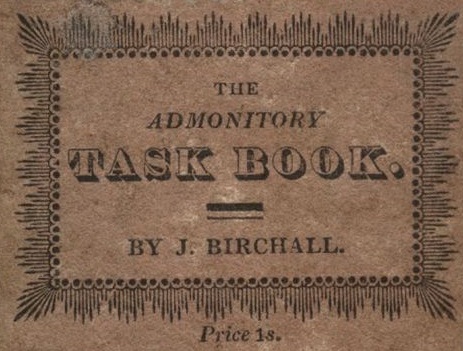
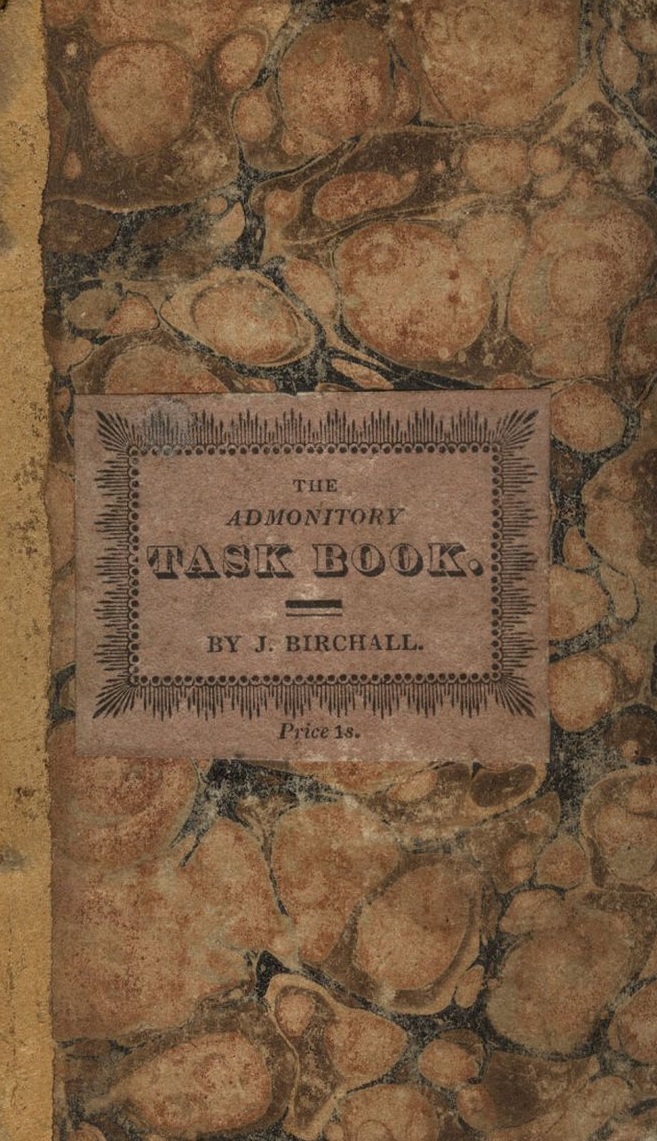
    I would love to write a book like this.  The full title of the work by J. Birchall, The Admonitory Task Book;: Consisting of Prose and Poetry, Original and Selected: Interspersed With Striking Aphorisms, Useful Maxims, and Moral Precepts. Designed for the Use of Schools (1819).  I want very badly to open this book.  Unfortunately, it isn’t anywhere to open–it seems not to be located in WorldCat/OCLC.  

    The source for this lovely title is Holletts Rare Books from the U.K. –its beautiful.  

    TASk book


  • The Society for the Friendless, 1921

    JF Ptak Science Books

     The Charities Bureau of Kansas City published this handbook in 1921 for the annual fund raising season: The Hand Book for the Campaign
    is a concise account of the principal helping-hand organizations, many
    of which have (from our seat here in the future) quite extraordinary
    names.  

    0-blog---Nov 21 social agencies090

    We find “The Rest Cottage” (“maintained as a refuge and
    rehabilitation sot for homeless and unfortunate women and girls and
    their destitute children”), the “Receiving Home for Children”, “The
    Home for Infants”, “The Orphan Home for Girls”, “The Child Welfare
    Club”, “The Children’s Hotel”, “The Whatsoever Circle”, “The Home for
    Aged Women and the Destitute”, “The Presbyterian Home and School for Crippled Children”, “The Helping Hand Association for the Blind”, “The Girls Hotel”, “the Childrens Bureau”, “The Finding Society”, “The Home for Aged Women of the Mexican Christian Institute”, “The Hopkins receiving Home”  and of course “The Society for the Friendless” (providing aid to the “man who comes from prison”, from Lansing, Leavenworth and St. Joesph.  Actually the members of this society would receive the newly released convict as well as visit them in prison; the society reached over 13,000 men (and “girls in Industrial Schools”) between 1919 and 1921. 

    Riis4

    There were dozens of these agencies that were providing help and relief to the needy in the Kansas City area in the pre-Federal-help days.  It is very interesting to see these charities divided along lines of need, rather than have them gathered together under a giant umbrella like, oh, the Department of Health and Human Services or some such agency.  Or just the Department of “Human Service”(?) on the state level of many states.  It seems more appropriate to actually specify the nature of relief rather than hide it away under a giant Orwellian blanketing cover of general services–it would be okay to be reminded that there are needs for abandoned children and destitute girls.  Perhaps it would make us all a little more aware of who needs what in this rich and capable society. It just seems to me that codifying the extreme of social need into more amorphous units like we have done in the last 50 years or so smooths the edges that people like Thomas Nast and Jacob Riis* and Charles Dickens and Virginia Woodhull and Dorothea Lange and Dorthy Day** managed to sharpen.  Sharp edges are good.
    Dorothy day

    * Jacob Riis was perhaps the first documentary photographer of the American “underclass”, putting an indisputable photographic face on the living and working conditions of the laboring poor.  A photograph of these conditions was irreproachable–it was something you could absolutely trust, mree so than an “artist’s representation”; like seeing a photograph from the surface of the Moon.
    ** Dorothy Day, (above), perhaps the least-known of these names, was a tremendous figure in the civil and workers rights movement and the founder of the Catholic Worker. 


  • Enormous Title of Visionary Work Utterly Defeats Library Cataloguer

    JF Ptak Science Books  Post 2076   Outsider Logic  Daily Dose from Dr. Odd


    Follow Me on Pinterest

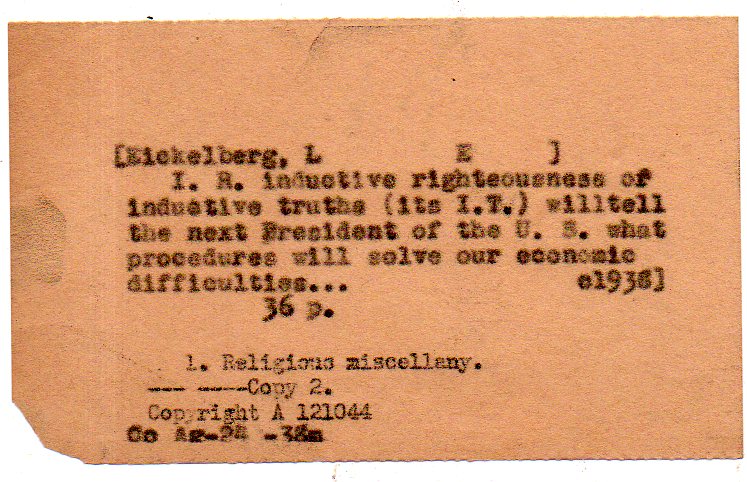
     There appeared on this blog last week a post regarding a library cataloguer who was not threatened or defeated by a work with an enormous and meandering title. The good librarian got right to it, recorded the deed, and moved on. Today’s installment of card catalog magic presents a Library of Congress librarian who decided that enough-was-enough, and that there was simply too-much-title to record, and so simply left the rest of it to dots and to the imagination.

    Title--gigantic424
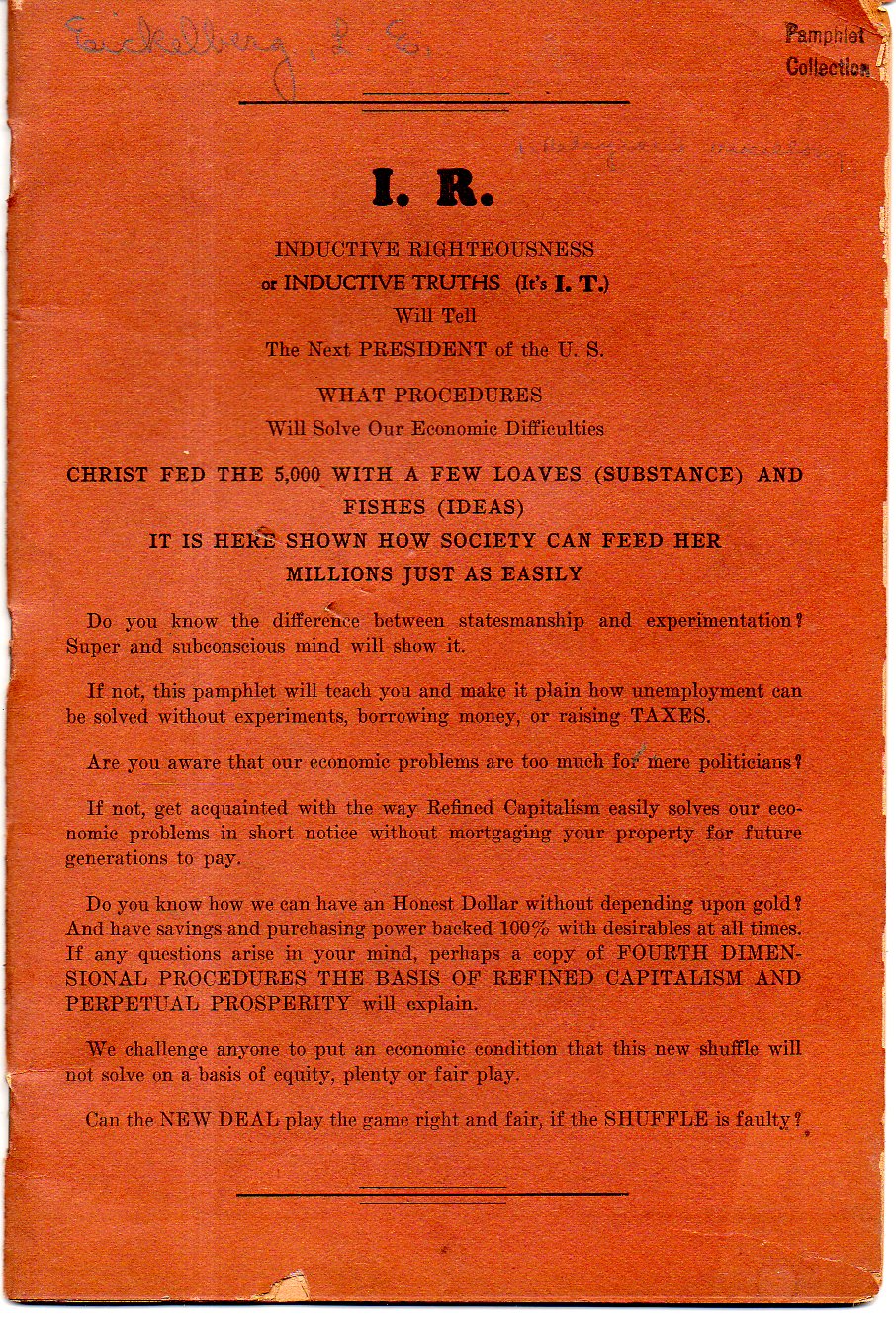
    Now for the pamphlet itself and the rest of the title:

    Title--gigantic423
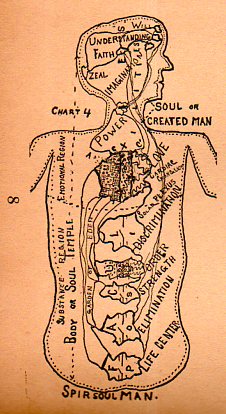
    The author of this 1938 pamphlet simply started to write on the cover and continued through the rest of the work, and ended on the back cover.  There was no title page, no chapter headings, just a collection of ideas with lots of lists and seemingly nowhere to go.  For a short work (36 pages) the author could’ve dedicated another quire to some blank space, which really doesn’t exist in the pamphlet but which is surprisingly helpful even if the message you are trying to deliver is somewhat, well, outre.  There is a lot of very compressed talk about multi-dimensional spirit and conscience and bank deposits and replacing the dollar and tax collection with “circulation of values”, and so on, deep into itself and a closed system of interpretation of the existence of the universe, harmony of spirit, and economic interpretations of “radio bulbs” and the (often misspelled) fourtth [sic] dimension.  The writing is exhausting and enumerated, and even though by its colossal subject matter and the complex brevity it should be a reliably porous document, it is fairly rigid and brittle. It is a visionary work that somehow worked its way into print, and I’m happy for that, and even it is impossible to keep up with its runaway logic it is still a good ride.

    The author’s representation of a semi-vitruvian spiritual anatomy of humans, called Spirisoulman:

    Title--gigantic426
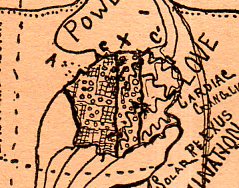
    A detail of the fabulously-decorated heart region:

    Title--gigantic427
    And of course part of the plan for universal economics which somehow wraps up the theory of in I.R., or the Inductive Rightousness of Inductive Truths:

    Title--gigantic428
    Early on in the history of printed books there was a practice of extended title pages, where there would be the title, and then “support literature” further explaining the title to sometimes some great detail, occasionally winging its way into a title 200 words long.  But that was pretty much before the 18th century and mostly before the 17th and mostly a not-common practice.  The gigantic title in the 20th century seems to be mostly relegated to the less-traveled-road variety of public thinking.

    And the card catalog for the undefeated librarian mentioned above:


    Card catalog409 


  • Buying a Stocked Country Store, 1836

    JF Ptak Science Books   Post 2067

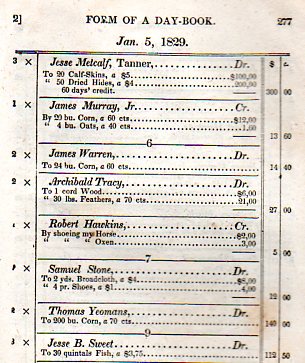
    MATH day bk407There are times when a reader can get a little piece of social history in an unexpected place.  For example, in the math text book that was just addressed on this blog1, there is a short anterior section called  “A Practical System of Book-Keeping for Farmers and Mechanics”.  It is here where the reader is introduced to the keeping of a Day Book (which is different from a  ledger and a cashbook) where the merchant would keep a record of what was sold to whom and for how much. To that end the author includes three pages of a sample Day Book, which displays a host of information for the modern reader about what could be expected to be found in the generic cash-and-carry trade in the U.S. in 1836.  Most of the goods sold would have been purchased to make something else–there were not many items that would be considered to be a product for end use. So someone might not buy a carriage though they would buy the stuff that would go into making a carriage, or the ingredients for making beer rather than the beer itself, and so on.

    And so, some of the entries from this practice Day Book: 

    6 yards of calico ($2.65), 2 yards of  broadcloth ($3.25), 217 pounds of iron @ 8cents/pound= $17.36, 37 pounds of cheese ($3.70), 41 pounds of feathers ($28.70), 32 gallons of molasses, 300 pounds of pork (at 7 cents/pound), 30 bushels of corn ($13.50),1 cask of nails (225 pounds for $18), 32 gallons of molasses ($8), 30 pounds of harness leather ($16), 17 brooms ($2.08), 7 pounds of butter ($1.40), 7 tons of hay ($70), 50 dried hides ($200), 4 bushels of oats ($1.50),  1 cord of wood ($5),  28 pounds of lard ($4), 3 bushels of salt ($1.98), 75 yards of brown sheeting ($10.50), 500 pairs of men’s shoes ($475), 120 pounds of blistered steel ($3.88), 100 pounds of Russia iron ($5), 300 pounds of bacon ($40), 3 pounds of coffee (48 cents), and 6 pounds of raisins ($1.99). 

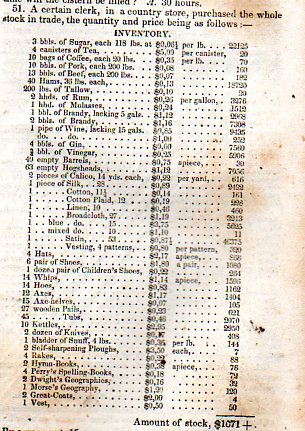
    Fascinating–but even more so from a bit found earlier in the book–an interesting and longish example for practical mathematics, a very detailed question for addition. The presentation is a nearly full-page list of the contents of a country store, the inventory of which was being purchased by “a certain clerk” thus giving issue to the addition problem as well as a hint to what was found in a general store in 1836. 

    MATH406
    In this addition problem (which is somewhat problematic in that in the overall price column there is no differentiation between dollars and cents, so “4” means $4.00 anfd “50” can mean $50 or 50 cents) there are 46 entries, almost all of which are standard necessaries, with a few luxury items tossed in for  the benefit of those who would have the occasional disposable income for such a thing.  Overall the list is dominated by basics: sugar (354 pounds worth), tea, coffee, pork, beef, ham, rum, brandy, wine, vinegar, (40) empty barrels, (63) empty hogsheads, vinegar, axes, whips, wooden pails, kettles, tubs, ploughs, and rakes, and more (as we can see below).  Less common was the book stock:  2 Hymn Books, 4 Perry’s Spelling books, 2 Dwight’s Geographies, and one copy of the iconic Morse’s GeographyAnd it looks as though the buyer purchased everything for about $1071.00—which was a considerable sum. The average farm laborer was paid about $10/week, plus room and board in 1840; a carpenter might make $1-1.50 per say, while laborers in manufacturing (glass, iron, wool, cotton) all made about 80 cents-1.00 per day2.  That means it would take the average man four years to save  $1000, and probably more. In order to start this business to make money, you certainly needed to have some money to get started in making it.  In the meantime, this is an interesting peep into what people bought in country stores in 1836. 

    Notes:

    1. Rosell C. Smith, Practical and Mental Arithmetic, on a New Plan, in which Mental Arithmetic is Combined with the Use of the Slate… which was printed in Hartford beginning in 1829 (my copy being printed in 1836).

    2.  See here for a decent look at what wages were like over decades in the 19th century. 


  • Some Interesting Links for Antiquarian Slang Dictionaries and the Like

    JF Ptak Science Books  Quick Post

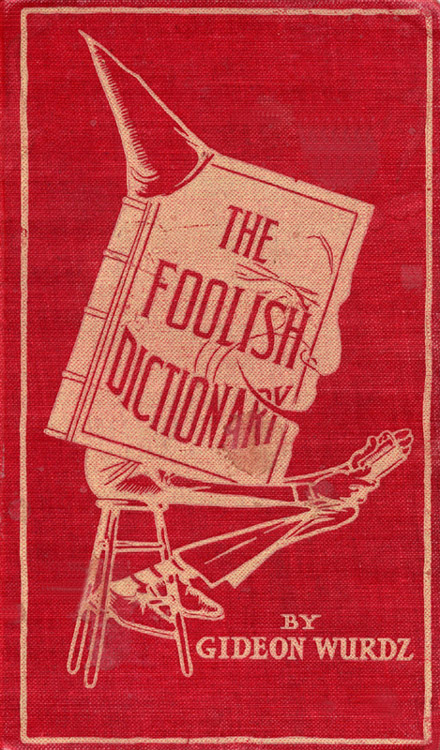
    Dictionary foolish

     DICTIONARY OF THE VULGAR TONGUE. A
    DICTIONARY
    OF
    BUCKISH SLANG, UNIVERSITY WIT,
    AND
    PICKPOCKET ELOQUENCE.

    [Here]  UNABRIDGED FROM THE ORIGINAL 1811 EDITION WITH A FOREWORD BY
    ROBERT CROMIE COMPILED ORIGINALLY BY CAPTAIN GROSE. AND NOW CONSIDERABLY ALTERED AND ENLARGED, WITH THE MODERN
    CHANGES AND IMPROVEMENTS, BY A MEMBER OF THE WHIP CLUB. ASSISTED BY HELL-FIRE DICK, AND JAMES GORDON,
    ESQRS. OF CAMBRIDGE; AND WILLIAM SOAMES, ESQ. OF
    THE HON. SOCIETY OF NEWMAN’S HOTEL.

    “The merit of Captain Grose’s Dictionary of the Vulgar Tongue has
    been long and universally acknowledged. But its circulation was
    confined almost exclusively to the lower orders of society: he
    was not aware, at the time of its compilation, that our young men
    of fashion would at no very distant period be as distinguished
    for the vulgarity of their jargon as the inhabitants of Newgate;
    and he therefore conceived it superfluous to incorporate with his
    work the few examples of fashionable slang that might occur to
    his observation….”–from the preface.


  • Nonsense and the Fourth Dimension, 1899

    JF Ptak Science Books   Post 2059 
     
    Follow Me on Pinterest

    Burgess, gelett
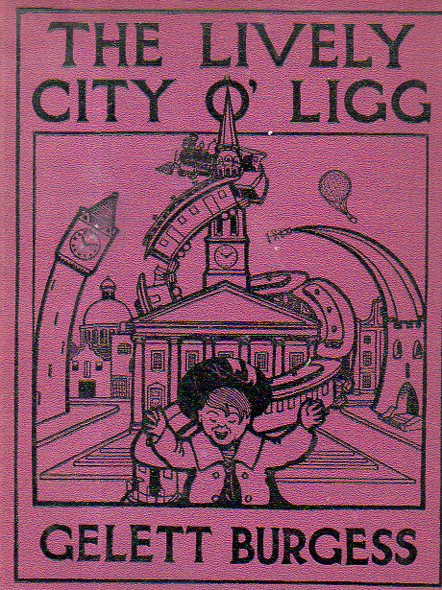
    Gelett Burgess (1866-1951, a Boston high-ground MIT grad poet/critic/all-around lit figure who wrote a lot and created an important Little Magazine called The Lark) continued his work in humor and nonsense and future-vision with his The Lively City O’Ligg, a Cycle of Modern Fairy Tales for City Children,  in 1899.  There’s a lot in this squarish book to suggest itself as a sort of farcical-absurdist tomorrow’s retro-vision fiction–its only his second book, and not the work he is most famous for, and it was written for the amusement of kids, but really for kids of all ages, and very funny. (Full text here via Internet Archive and prettier edition here via Hathi Trust.)

    Burgess387
    And it has great illustrations. For example, the front cover artwork (for the edition here) suggests a dimension of space/landscape and how it changes as a moving body viewing that scene approaches the speed of light–this is Burgess’ art, and it is amazingly prescient of the modern art that was fast approaching in the next decade or so, only Burgess’ name isn’t very commonly associated with the precursors of displaying the fourth dimension in art. [He is there, though with early associations with Stieglitz at 291 and Max Weber.  When I think of these early names it is generally of the more-obscure but very early W. Stringham in his “Regular Figures in n-Dimensional Space”, published in 1880, followed by the great Jouffret in his geometries of four-space (published in the 1900-1905 or so), and then of course Charles Howard Hinton and the hyperspace philosophy of Claude Bragdon, followed by H.P. Manning’s Geometry of Four Dimensions in 1914.  But in between Jouffret and Manning there is also the artwork of Picasso and Braque and Metzinger Gleizes and Le Fauccionier and Gris and Kupka and Duchamp, all of whom addressed this issue of space and time and the fourth dimensions in their work, seminal pieces all and created between 1909-1912.  Burgess himself came to the attention of the Stieglitz group by 1910 or so and was given an exhibition of his watercolors at 291 in 1911.)

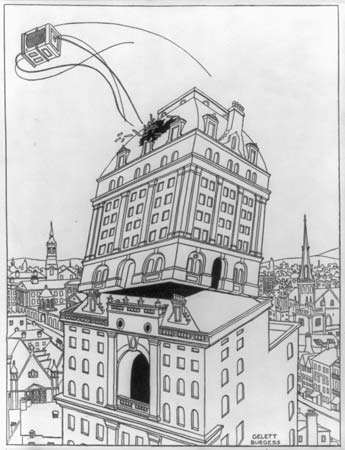
    The image illustrating the chapter three, “The Three Elevators” (above), just shows one of them bursting through the roof of an “immense building in the City of o’Ligg” “Twenty-seven stories high (!)”. (At the time the world’s tallest building wasn’t in O’Ligg but in NYC: in 1890, it was the New York World Building, New York City (309 feet, from 16 to 26 stories, but that is another story; closer to the time of the Burgess book it was the
    Manhattan Life Insurance Building, again in New York City which was 18 stories and 348 feet high. So the Burgess building was a big one by world standards in 1899–and of course there would be no tall structures like this without steel framing, or elevators, or for that matter fool-proof elevator emergency brakes. In any event the elevator spikes through the roof of the o’Ligg building, looking for all the world like one of the aliens from Wells’ War of the Worlds, which was published a year earlier than this book, in 1898. (I should say the appearance was suggested by the first edition of Wells’ 1898 book, as it was not illustrated.)

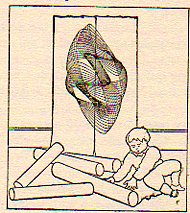
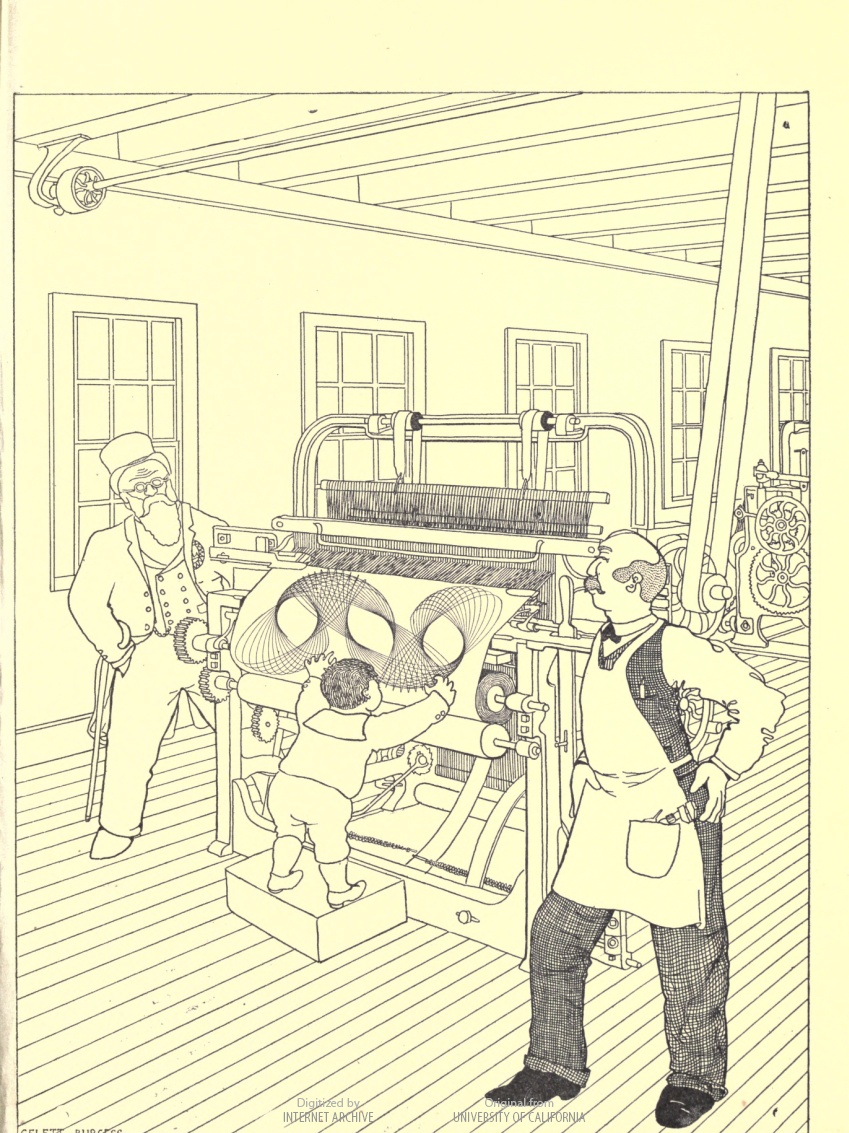
    Another surprising example of found-modern art occurs in the final chapter, “The Eccentric Loom”, when loom No. 7–like the other machines and implements in these stories–has a mind of its own and produces “something queer”, a “crazy design” producing an “insane tapestry”.  The loom is “either crazy”, or “it is a mighty clever machine; altogether too clever for me”.  But the design as an intentional piece of art for 1899 is pretty extraordinary–and the underlying premise, that the machine might be producing the art on its own, is exceptional and early.                           

    Burgess loom388

    To put the artwork in a more machine-creative-context, here’s teh Burgess image that starts off the “Insane Loom” chapter:

    BURGESS LOOM B

    There’s much more in the Burgess book to discuss, particularly in the anthropomorphization of objects, as in the chapters dealing with a sleepwalking house, the boldness of a balloon, the laziness of o’Ligg lampposts, a flying stable, runaway chairs, and the like1. It is very enjoyable to watch Burgess breathe life into these objects, and give them personalities and lives.  But it is a true joy to see him present some of the objects as the “artist” and not just the tool, as we see here in the opening paragraph of the chapter “The Blind Camera”:

    "THERE were many Cameras living in the Ligg Photo- 
    graphic Parlours, artists who looked down with scorn upon 
    all other machines, not only upon the manufacturing 
    or working members of the community, but upon such 
    aristocrats as the Bicycles and Balloons as well. The 
    musical instruments they recognized as artists, it is true, 
    but it was the Cameras' opinion that most musical instru- 
    ments were a bit mad. Even the Very Grand Pianos 
    often got out of tune ; and, besides, they were all totally 
    blind, from the Penny Whistles to the Church Organs. 
    The Cameras themselves were deaf and dumb, but they 
    never thought of that, as they had the best eyes of all 
    the objects in the City o' Ligg, except the Telescopes, 
    and the Telescopes didn't count ; they were not artists- 
    they were merely elaborate tools."


    Perhaps our future Robot Overlords (a phrase taken from Mr. Eugene Krabs in
    Spongebob
    Squarepants) will one day in the future look backwards and find
    the beginning recognitions of the creative souls of machines in the work of
    Mr. Burgess.


  • Everything in the World, in 19 Chapters (1495)

    JF Ptak Science Books    Post 2057  
     
    Follow Me on Pinterest 

    The beautifully-named book by Bartholomaeus Anglicus, All the Properytees of Thyings, which was published in Westminster in 1495 (and also known as De proprietatibus rerum, also translated as On the nature of things, or On the properties of things),  was originally written around 1225.  The book was a
    bestiary, a marvelous encyclopedia, a collection of all things as known
    in the 13th century–it would be interesting to represent all that is
    know today and compact it into a workable, logical, usable (printed !)
    book of a thousand pages.  The question of organization of knowledge
    would be the key, of course, and how to make one flow to another
    complimentarily as practicable…it would be an interesting project (for
    someone else) to try and arrange the basis of human knowledge in a
    finite space like that.

    The titles of the sections of Anglicus’ work consist of the following, lovely, topics:

    1. De deo (On God)

    2. De angelis (On angels)


  • On Learned Ignorance

    JF Ptak Science Books   Post 2015Follow Me on Pinterest

    Nicholas CusaIn keeping with a post earlier today on a Medieval jewel of scholarship (Sacrobosco’s Sphaera) is this short note on Nicolas of Cusa’s beautifully-named de docta ignorantia, or On Learned Ignorance. Nicolaus (1401-1464, Nicholas Cusanus/Kues) was a philosopher, mathematician, theologian, astronomer, cardinal, and mystic, a product of the University of Padua (1423) and then the University of Cologne, and “arguably the most important German thinker of fifteenth century” (Stanford Encyclopedia of Philosophy, here). He was deeply intuitive, a visionary, and in his Learned Ignorance he presented a way of the human mind to release itself to learn the mind of god (among many other things). [Image: detail in Meister des Marienlebens, located in the hospital at Kues (Germany), showing Nicolas of Cusa.]

    In this work is something really amazing–here’s this wide thinker at the end of the Medieval period, writing on advanced theological issues, finding time to stop and smell the astronomical/cosmological roses long enough to think about the unending nature of the universe, about infinity, about the stars being suns for other planets, about the Earth spinning on an axis and circling the Sun. And all of this done without observations, and without calculation, and without a theory–its just a bunch of the big thoughts of modernity found in a small tract about knowing the Creator. Very curious.

    The astronomical views of the cardinal are scattered through his philosophical treatises. They evince complete independence of traditional doctrines, though they are based on symbolism of numbers, on combinations of letters, and on abstract speculations rather than observation. The earth is a star like other stars, is not the centre of the universe, is not at rest, nor are its poles fixed. The celestial bodies are not strictly spherical, nor are their orbits circular. The difference between theory and appearance is explained by relative motion. Had Copernicus been aware of these assertions he would probably have been encouraged by them to publish his own monumental work.–Catholic Encyclopedia, 1913

    Indeed! But I doubt that last sentence–Nicolas’ work was entirely theoretical, and Copernicus was very heavy and deeply laden with data. Even though Nicolas was never considered a heretic–though it must have been a close call here and there–an earlier confrontation by Copernicus with his De Revolutionibus on anything but his death bed would probably have been received with a closed fist.