A Daily History of Holes, Dots, Lines, Science, History, Math, Physics, Art, the Unintentional Absurd, Architecture, Maps, Data Visualization, Blank and Missing Things, and so on. |1.6 million words, 7500 images, 4.9 million hits| Press & appearances in The Times, Le Figaro, Mensa, The Economist, The Guardian, Discovery News, Slate, Le Monde, Sci American Blogs, Le Pont, and many other places… 5000+ total posts since 2008.

Author: JF Ptak

  • Department of “What is It?” #4 (1887)

    JF Ptak Science Books  

    Here’s another in this developing and fun series in the What-is-It? category. At first it reminded me of Renaissance woodcuts of various stages of creation anointed by a coy hand of the creator. This one though is late 19th century and has a definite highly au courant “Oriental” theme which so far as I can tell has nothing to do with the telling of the story of this object.  It looks a little like a multi-horned phonograph (already in existence by about a decade at this point), and it also looks a little like a Chinese earthquake detector. It is surprising for what it actually represents, and it is a lot larger than you’d think, with the figure in the background definitely not to scale. Plus, it comes into the world a few years earlier than its gigantically famous counterpart, as though it had gone back in time…

    What is it?

    Time travel Gaspard detail


    ·Posted by :

    ·in:


  • On How Fast Things Were and Weren’t, including a Faster-than-Light Velocity (1885)

    JF Ptak Science Books  Post 2681

    Superman was (is?) as fast as .00005% of the speed of light, or thereabouts, if you gave him the benefit of the speeding bullet being a 50-cal round muzzle velocity. On the one hand, it is fast; on the other, well, not so. 
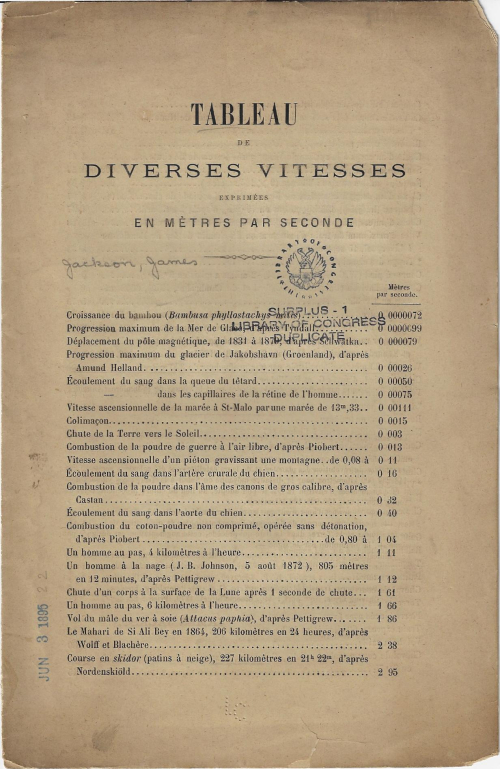
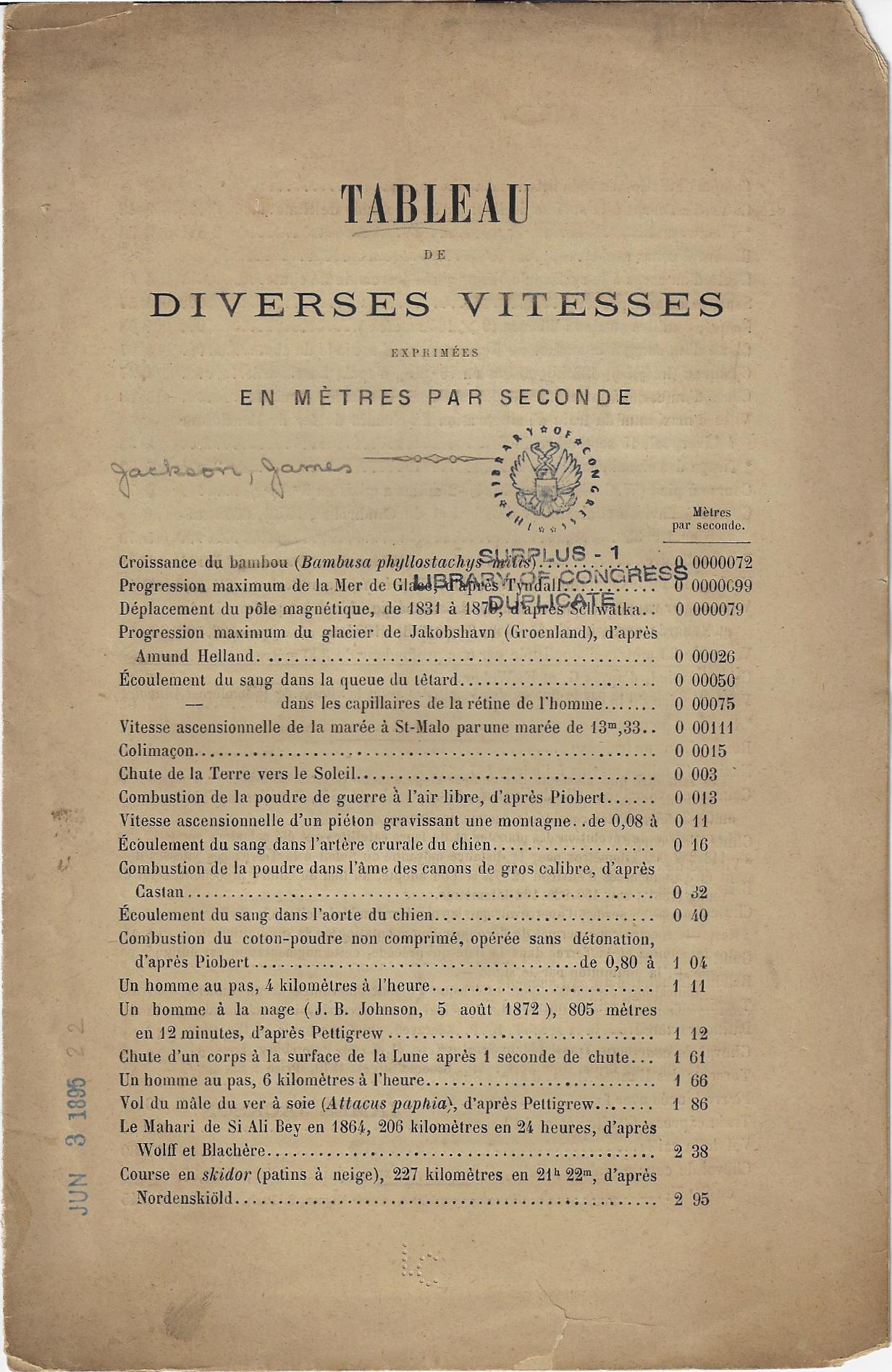
    Speed _1_That is what sort-of attracted me to this present pamphlet. I determined to simply scan the thing (James Jackson, Tableau de Diverses Vitesses exprimes en metres par seconde1, published in Paris in 1885)  for a quick blog post “On How Fast Stuff Is and Isn’t”. The slowest on the list was the “Corissance du bambou”/the growth of bamboo, which is actually a quickly-growing thing but not so when in comparison to how many meters it grows per second.  And that’s what this is, a little 8-page pamphlet listing about 350 things and how fast they are, all calculated in meters/second. The selections are actually pretty interesting in and of themselves.  So first to last, where I find several different calculations for the speed of light…and then something else, faster than the speed of light.  

    The last entry was this: “courant electrique provenant de la decharge d’une bouteille de Leyde dans un fil de cuivre de 0m,0017 de diametre” (“electric current from the discharge of a Leyden bottle into a copper wire of 1/16th of an inch”), with a velocity of 463,000,000 metres/second. No doubt Jackson is just talking about electron flow, which is about 1% of the velocity of the speed of light c along a wire or so (and far less along the wires in your kitchen appliances) while the flow of electromagnetic energy in a vacuum is exactly c–and what he is writing about here is warp 1.2 or a 50% increase in the velocity of electricity over light, when electricity and light are basically the same thing. I just don’t know what he is talking about.

    The Scientific American Supplement posts a notice of this bit, quoting the American Machinist in its review of Jackson’s work, and which also takes care to mention the faster-than-light speed as “the greatest rapidity so far measured”:

    “The American Machinist extracts from a contemporary a gamut of speeds per second beginning with that of the snail oil is half an inch and ending with the following Electric current on telegraph wires 7,000 miles induction current 11,040 miles electric current in copper wire armatures 21,000 miles light 180,000 miles discharge of a Leyden bottle through copper wire 1 16 inch in diameter 277,100 miles This last is the greatest rapidity so far measured. These figures might have more weight and more interest if the methods of calculating them or the authorities had also been given.”  Scientific American: Supplement, Volumes 43-44, July 31, 1897 p 17997. 

    Remember that we’re dealing with c twenty years before Einstein’s seminal year, when the fastest speed obtainable by anything was that of  light and which was considered to be infinite since in space there would be nothing to get in its way, at least according to Johannes Kepler (1571-1630), who imagined that no matter where the originating point of the light source was it would be seen instantaneously from any other point, no matter the location so long as there were no obstacles.  Estimates of light’s finite speed were proposed by scientists who were born at about the time that Kepler died by Ole Roemer and the everything-man, Christiaan Huygens (who estimated the speed of light at very near the present determination, which was 220k km/s. None of these names appears on Jackson’s list, though more recent additions like (Marie Alfred) Cornu (1878 using the not-named-here Fizeau instrument), (A.A.) Michelson (1879), Young, and Forbes (as in James Young and George Forbes in 1882) do. 

    Anyway the faster-than-light speed Jackson was referring to was for electricity, and no doubt came from the experiments in 1834 by Charles Wheatstone (thanks for the push, Dave Wenner!)

    I should make a note within this note of the work of Camille Flammarion (1842-1925), a very provocative and imaginative writer, who produced a small novel called Lumen (1887) in which the main character/souls move through the universe at what must be speeds way beyond the speed of light. His work in general looks like a collection of sci-religio-fiction, with creative writing on time travel (or observation, or viewer, I’m not sure), teeming extra-terrestrial life, transmigration of souls, and so on, filling and flying through the vastness of time and space, and I think collapsing the idea of time itself.  (“Lumen” is a recently-dead ET soul that dialogues with Questor, and they wind up moving through the universe at warp speed.)  So, there’s that.

    Anyway this sort of post calls for a lot more reading, which I’m sorry to say I haven’t done–I just don’t know yet how fast the fastest things were believed to be through the history of science. At least this post gets the ball rolling, if only for me.  

    Notes:

    1.  I found seven copies of this 1885 printing in WorldCat/OCLC, the holdings a stellar pedigree (LC, NYPL, Yale, Harvard, U Wisconsin/Madison, Oxford).

     

    ·Posted by :

    ·in:


  • The Department of “What is It?” (#3)

    JF Ptak Science Books  

    [I apologize for the fuzziness at the top of the image here but I couldn’t get the volume of Nature flat enough on the scanner to avoid the degradation.]

    What is it thermometer

    In the wonderland world of early applications of electricity to anything comes this marvelous image of an electrical thermometer from Nature for March 17, 1881.The original image is only about 3″ tall, and I could not resist reproducing it in what is almost a 3:1 ratio. As pretty as it was/is, the implementation was a bit of a picture of a soggy sandwich.

    Evidently the platinum screws running up the side of the thermometer (at every 3 degrees, though it could be refined to <1-degree increments), were connected to an alerting operator like a bell or some such thing.  That way, if something was being heated to a certain temperature and the temp changed, an alarm would sound, and the whole process could be viewed remotely.  Why this would be necessary I am not so sure–even the author admitted that the whole thing would be very cumbersome with the large number of insulated wires being tracked into the observing station.  In any event, the image is striking, if not the idea.  

    ·Posted by :

    ·in:


  • The Department of “What is It?” (#2)

    JF Ptak Science Books  Quick Post

    Our “What is It?” image for today is the following:


      What is it aurora

    Hints:

    (1) this could be microscopic, but it isn’t; as a matter of fact, this is enormous;

    (2) this is a side view,

    (3) from space,

    (4) and was drawn in 1891.

    (5) That rounded bit on the bottom is the Earth.

    Answer: 

    ·Posted by :

    ·in:


  • Anti-Irish Propaganda–the “Irish Frankenstein”, 1882

    JF Ptak Science Books   Quick Post

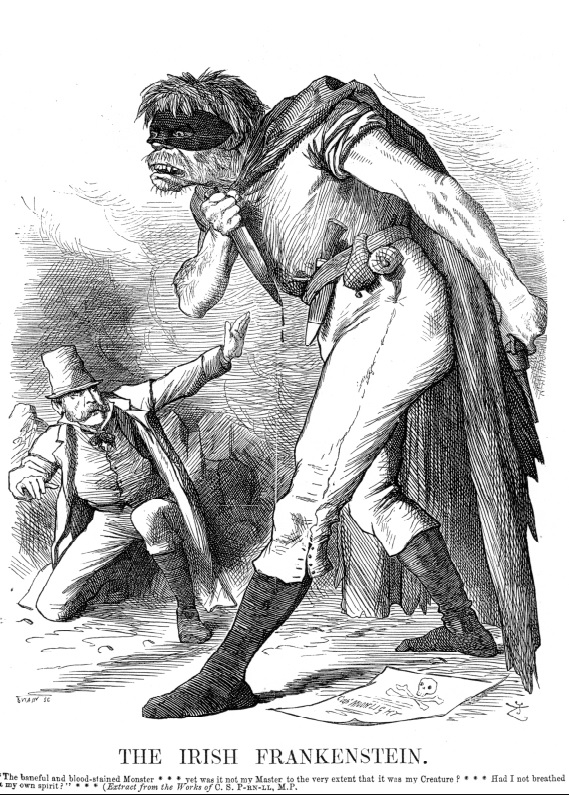
    Is is easy to say that the editors here made a mistake labeling a monster “Frankenstein” as the Mary Shelley creation was only called by its creator’s name by popular usage–but no matter, the message to the readers of Punch magazine where this full-page political cartoon appeared in May 1882 was very clear, and as damaging as it could be short of baby-eating. I think though that the title was referring to the cowering figure in the background, who is supposed to be Charles Stuart Parnell, as “Frankenstein”, and the “monster” was a radical aspect of the Irish Nationalist movement. The image was made in response to the Phoenix Park assassinations which occurred just weeks earlier, and Punch no doubt wanted to send a hard message to its readers.  In any event, I usually come back to the defense of the original “monster”, who was thoughtful, well-read, and philosophical, and not much like how he would be later portrayed. 

    Punch Irish frankenstein


    ·Posted by :

    ·in:


  • Facts and Requirements of Recruitment in the U.S. Army, 1935

    JF Ptak Science Books    Quick Post

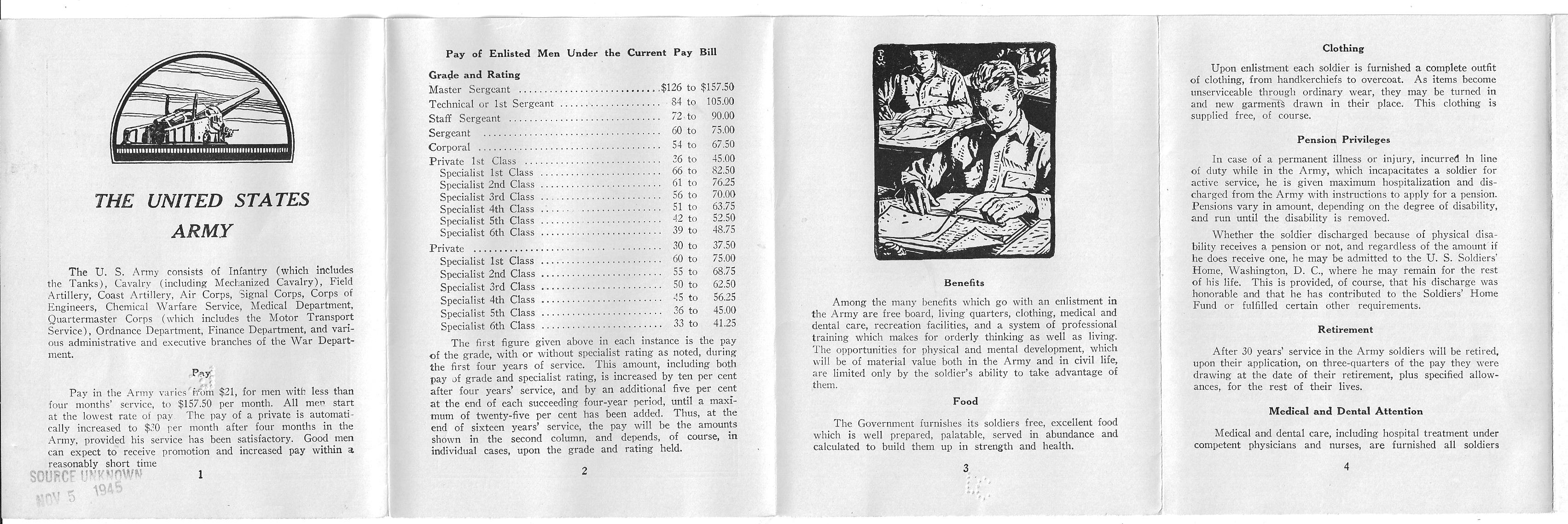
    This bit popped up this afternoon in a browse through some military material: Facts Regarding Enlistment in the United States Army seems to have been printed in the mid-1930’s, the illustrations have a sort of WPA feel to them, or at least they do not have a standard green sensibility. In any event. I’ve reproduced the pamphlet here, with all of its interesting facts and factoids, not the lest of which are the pay grades for non-com and enlisted men.  One thing that stopped me was the dental requirement–the army needed recruits to have at least 12 teeth, which doesn’t really sound like very many. (I think I remember–perhaps in Donald L. Miller’s history of WWII?–that in the bad part of the war the Marine Corps, in 19043/4, lowered that 12-tooth requirement to 8. It was a very tough time for the Corps.) By the way the whole document is printed on one piece of paper, 5″x18″, printed in both sides.

    Army recruit cover 

    Click on each for a clear much expanded view of the pages:

    Army recruit _1_

    ·Posted by :

    ·in:


  • The Department of “What is It?” (#1)

    JF Ptak Science Books   Quick Fanciful Post 

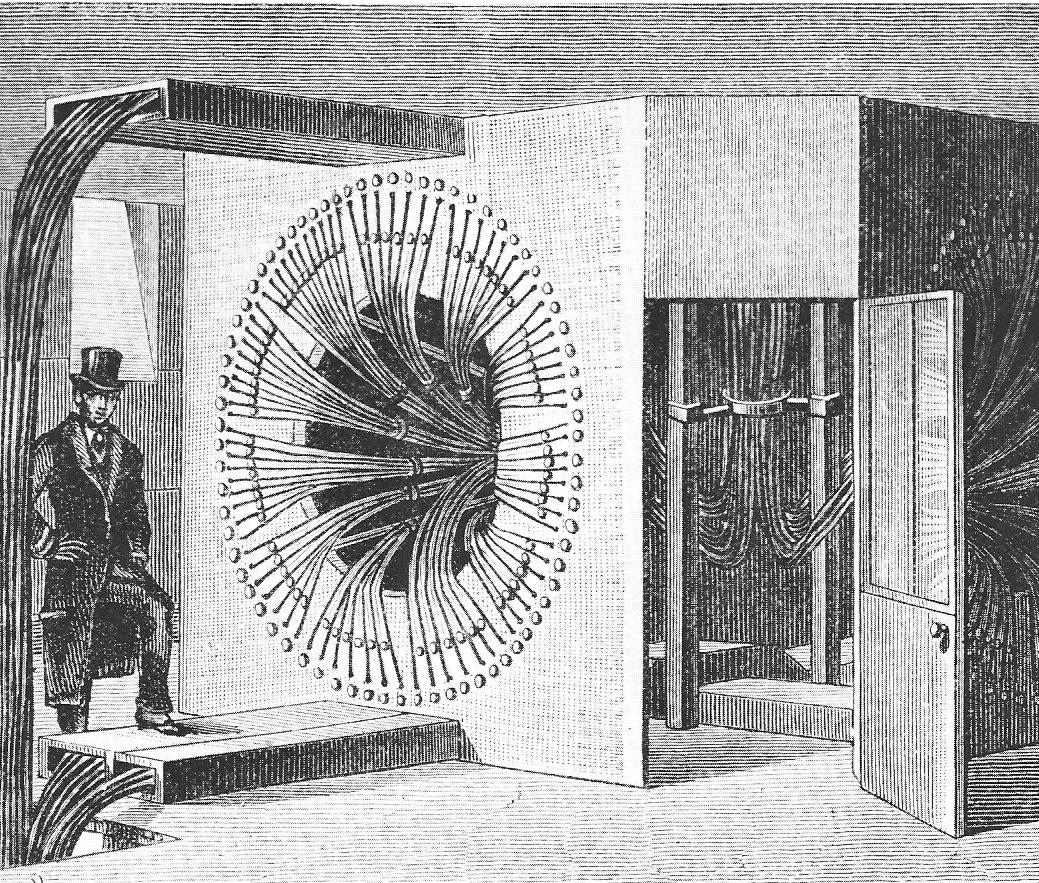
    On a recent reading graze I found this most interesting image and thought that it could be a number of things besides the thing that it really was:

    What is it Paris telegraph nodes

    So, what is it?

    A) An attempt at a Time Machine.  (Stephen Hawking said  “[i]t seems there is a chronology protection agency, which prevents the appearance of closed timelike curves and so makes the universe safe for historians”.  Feh for our story line and image! We’ll let this stand and say that this would be a Wellsian vs. Thornian time machine.)

    B)  A Victorian listening device for extreme and well-to-do introverts that allows for the home dweller to stay inside and listen to everything that is going on in the immediate vicinity of their house.  The remarkable bit here is that it was discussed that a retired physician, Manbot Fettle Dolp had one of these devices installed at his house in Kensington and actually recorded some 100 Edison cylinders worth of found sounds, an acoustical portrait of high Victorian London that without his effort would have been completely lost.

    C) A tailoring device that would automatically record all physical attributes of a customer when they passed through the thing–it turns out that physical anthropologists used the device first to record all body aspect of criminals for a database of “what criminality looks like”, but the results and tests were abandoned after it was determined that the author of the study, Rev. Fitzwilliam Fitz William, was the perfect average of the criminals he measured. Rev. Fitz William said the results were obviously “deeply and irretrievably wrong”, though he did have some thoughts on the redemption of the project when writing from his prison cell twenty years later in Reading Goal. 

    D)  The terminal of a central telegraphic station. (“The requirements of telegraphic communication on a large scale created widespread telegraphic networks. The “nodes” of a network, shown here, involved a respectably large number of circuits.”)

    Answer below the “Note”:

    Note:


  • Found Poetry on Buried Bees (1865)

    JF Ptak Science Books   Quick Post

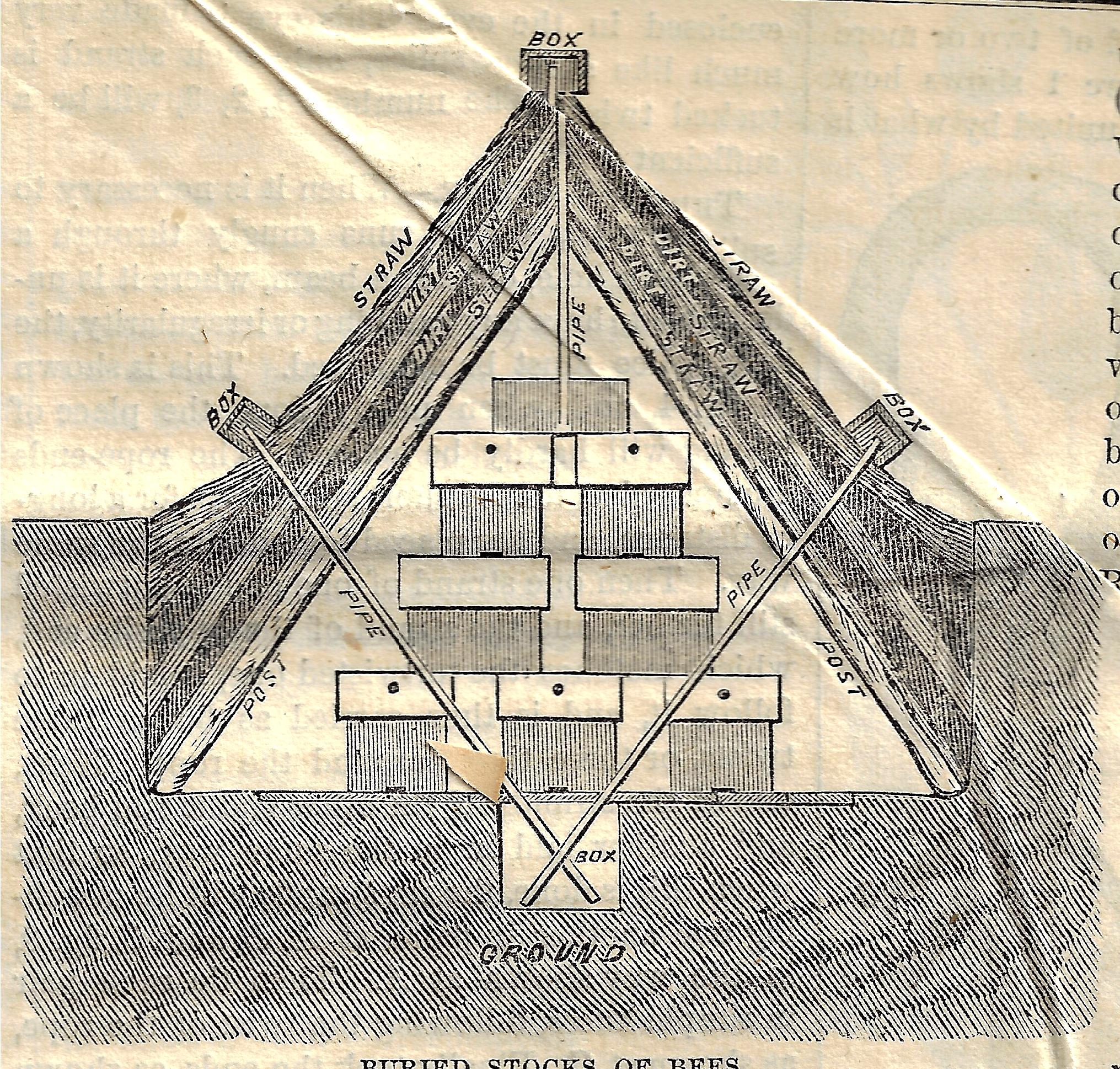
    I found this report in an issue of the American Agriculturalist (1865), waiting quietly to be arranged and re-arrange, but hopefully not mis-arranged.  In any event, the title was quite outre (“Burying Bees”) and so was the caption of the article’s illustration (“Buried Stock of Bees”) which stopped me for various out-of-context reasons, all before I found the dry-but-lyrical descriptive text.  So I lifted a bit of that directly, and poemized it in placement only. The result:

    Bee underground

    Bees may be buried when flowers are gone,

    and left until they come again.

    Weak stocks may be wintered,

    but they are usually more trouble than they are worth,

    because they are annoyed and kept weak,

    if not robbed by the stronger stocks,

    and because they consume proportionally more honey to keep them warm.

    While in the ground each bee eats its own allowance.

    They are not annoyed by the mice,

    nor disturbed by the changes of the weather

    but really are at rest; nor is the expense much compared with preparing

    and placing bees in a  room, or cellar, or watching out of doors,

    following which we buried our stocks last winter.

    ·Posted by :

    ·in:


  • Another Antiquarian Man Ray Rayograph (1872)

    JF Ptak Science Books   Quick Post

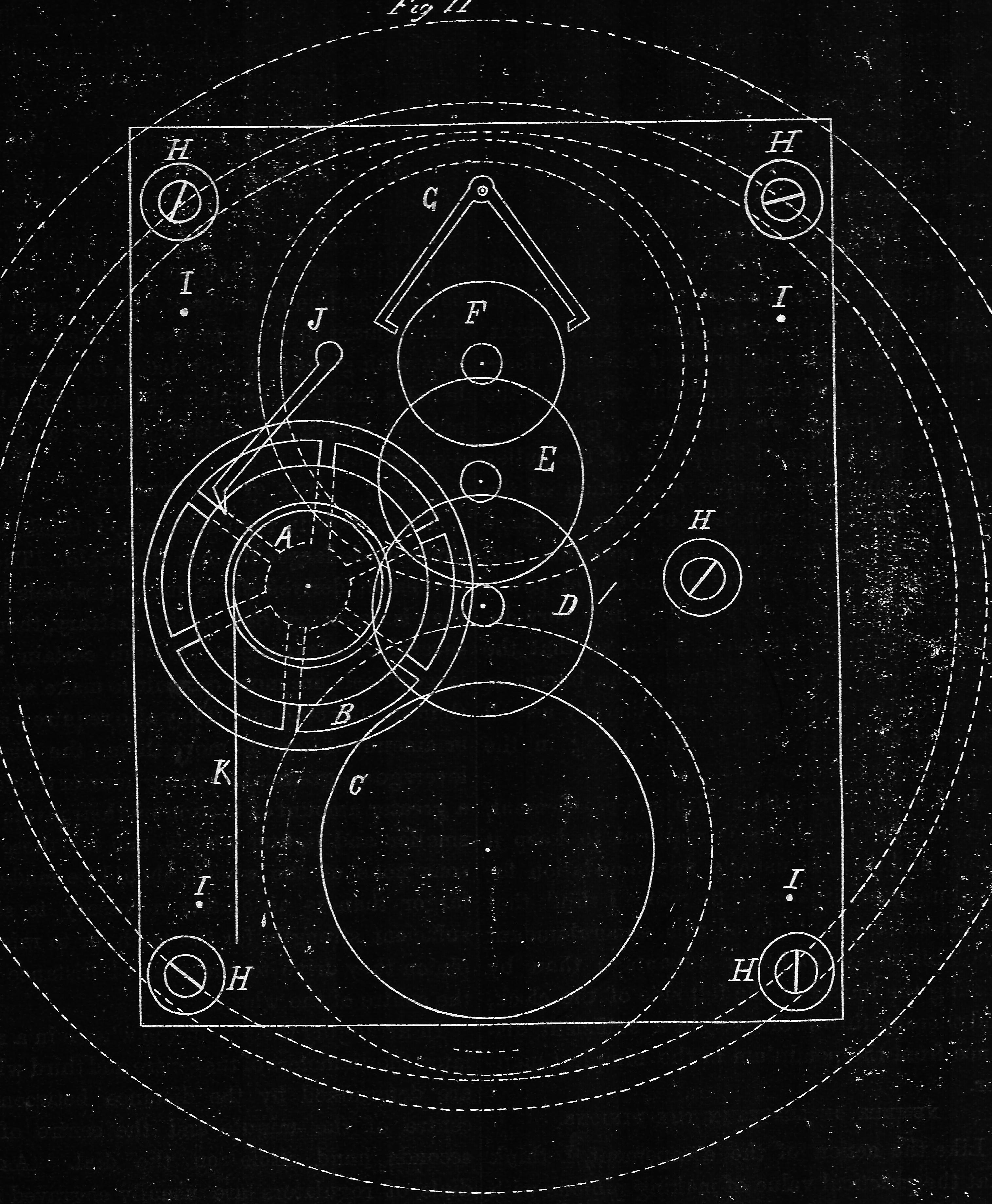
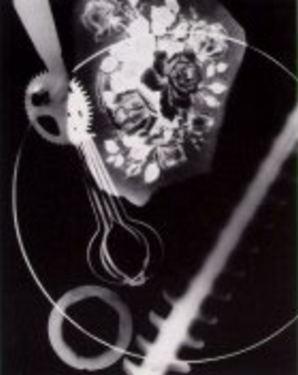
    Earlier on this blog I posted about a prehistoric (man)rayograph, using a negative of an engraving from 1810 to stand alongside a modern rayograph–today though I found an engraving int eh same category but already in negative.  This one is from the American Horological Journal (volume 4, November 1872) and bears more than a passing resemblence to the modern avant-garde photographer’s x-ray work–or perhaps I am pushing teh envelope on their relationship. Bottom line, though, is that the technical aspects of these clockworks are artistic visions in themselves, even when completely out of context (even as lovely as they are in context). 

    https://historyofideasblog.com/thesciencebookstore/2012/06/a-prehistoric-rayograph-a-proto-example-of-man-ray-from-1810.html

    American horology

     And a rayograph:

    Man ray ograph

    ·Posted by :

    ·in:


  • The Heavy Stuff, #15–Big Pistons (1872)

    JF Ptak Science Books  Quick Post

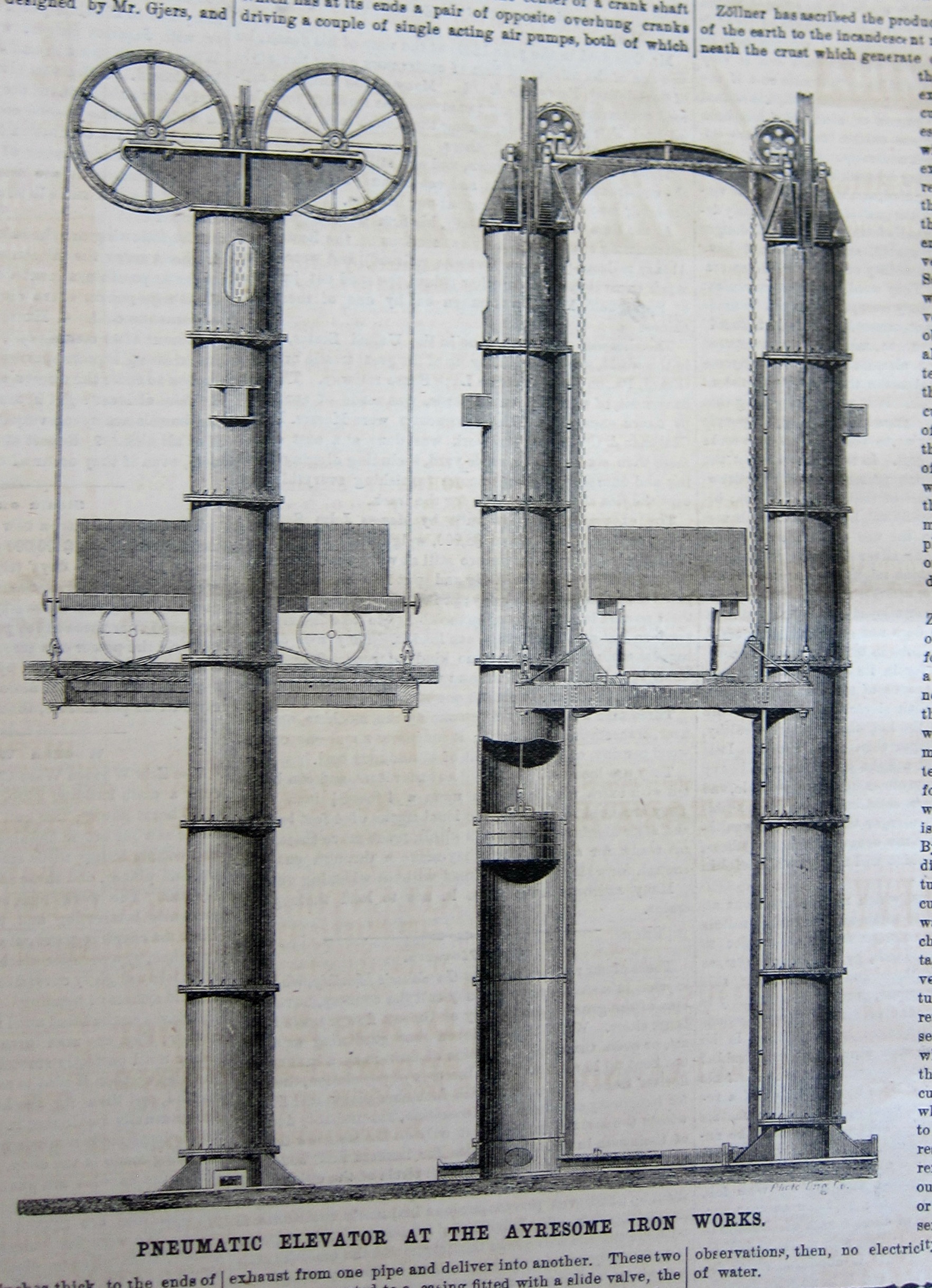
    And from the Scientific American, 18 days before Christmas in 1872, comes this magnificent monster of an elevator that would raise and lower large carts from “the bunkers to the calcinating kilns” (which is almost the title for something). The lifting mechanism were a pair of giant cast iron cylinders 48″ in diameter constructed in 8′ lengths placed 14′ apart, designed to lift 15 tons per lift (6,000 tons per week), raised on a 15′ wooden platform with 14″ thick flooring.  It was a beast. 

    Sci Am 1872 massive elevator


    ·Posted by :

    ·in: