A Daily History of Holes, Dots, Lines, Science, History, Math, Physics, Art, the Unintentional Absurd, Architecture, Maps, Data Visualization, Blank and Missing Things, and so on. |1.6 million words, 7500 images, 4.9 million hits| Press & appearances in The Times, Le Figaro, Mensa, The Economist, The Guardian, Discovery News, Slate, Le Monde, Sci American Blogs, Le Pont, and many other places… 5000+ total posts since 2008.

Author: JF Ptak

  • On Freedom of the Press and Attacking Censorship from Prison, 1812

    JF Ptak Science Books   Quick Post

    1812572

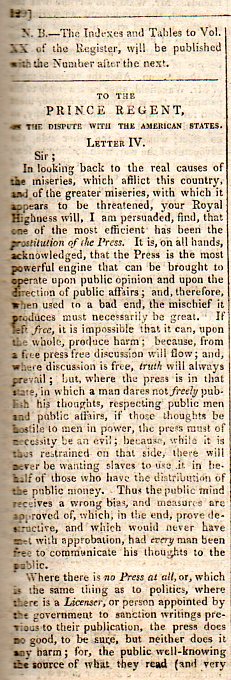
    This is really very good:  on distinguishing the free press with what it is and what it isn’t. The art icle appeared a few months before the official declaration of war between the U.S. and the U.K. (June 1812) in Cobbett’s Weekly Political Register. It was written by William Cobbett (1763-1835) and I think that this was a direct and very vocal reaction to the government’s instituting a tax on newspapers such as this–adding a tax made the journal not affordable to but a select class, thereby limiting circulation and being a de facto censor for the distribution of information. 

    He was also writing this from prison.  Cobbett was sentenced to a two years’ term in famous/infamous Newgate, sent their for treasonous libel after having written an anti-flogging article. He was also by that point a pain in the side of the government, and was paying for other perceived transgressions as well.

    Evidence of the ‘crime”–the limiting tax stamp:

    1812573

    And the article:

    1812571


  • “Teaching Britons When to Hide”, 1915

    JF Ptak Science Books  Quick Post

    Dirigible563
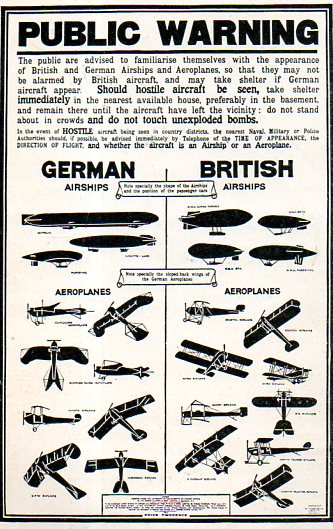
    This warning to the public appeared four months after Germany began to bomb the U.K. from the air using lighter-than-air airships. There’s also a section for identifying heavier aircraft, but bombing by that means didn’t start evidently until 1916. 

    Dirigible562[Source:  Technical World Magazine, May 1915, page 336.]

    “Zeppelins
    (airships) performed about 51 strategic bombing raids during World War
    I. These raids caused numerous civilian casualties, killing 557 and
    injuring another 1,358 people. More than 5,000 bombs were dropped on
    towns across Britain, causing £1.5 million in damage. 84 airships took
    part, of these 30 were lost, either shot down by enemy action or lost in
    accident. The raids, though disconcerting to civilian morale, were militarily ineffective.”–Wiki

    Bombing from Zeppelins was very problematic–in the beginning of the bombing raids, mostly throughout 1915, the Zeppelins were able to fly beyond the reach of anti-aircraft weapons, and at certain altitudes just beyond this reach they could carry a relatively heavy load of bombs.  The drawback was that bombing from this height was extremely haphazard, with little accuracy, which meant that most of the targets wound up being civilian areas, creating the term “baby killers” for the Zeppelins.  In the next year when British defenses against the machines improved, the Zeppelins flew higher, which necessitated oxygen and a lighter payload, and more inaccuracy.  Towards the middle/end of the war German command went more with bombing Britain from aircraft (like the Gotha) more so than Zeppelins.  The end result was not very militarily effective, causing 2,000 mostly-civilian casualties. I’m not so sure about the use of the word “strategic” in the Wiki description.

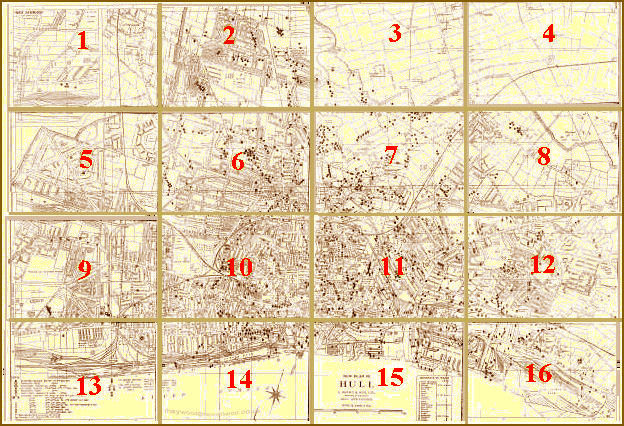
    Let’s remember the city of Hull, which received eight attacks during the Great War, only a prelude to the massive attacks it would receive during WWII. 

    Hull Blitz Map, WWII, here


  • “The Machine You Will Eventually Buy”: 12-ton Typewriter

    JF Ptak Science Books    Daily Dose from Dr. Odd  
    Follow Me on Pinterest

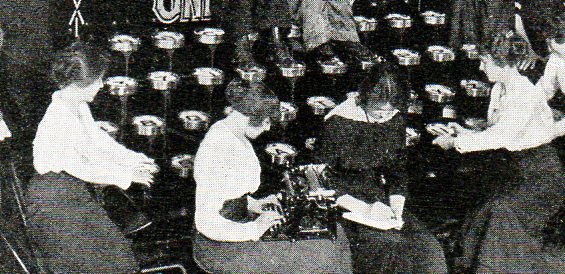
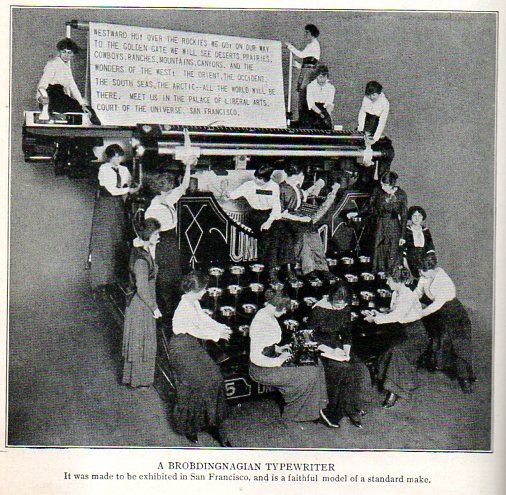
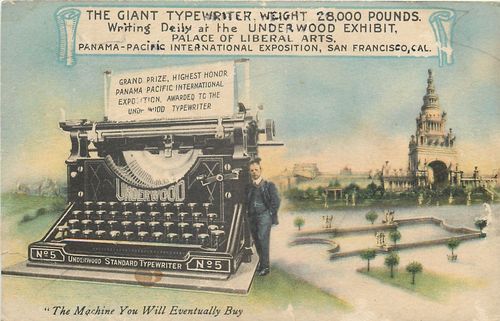
    These would certainly make nice counter stools, if they were a little bigger–but they not, and they weren’t, though they were just what they looked like–typewriter keys–and were part of a working 28,000-pound machine built for the San Francisco Exposition in 1915. 

    Dirigible565
    Evidently the machine was operated by using a regular -sized typewriter, the keys working in unison to produce a gigantic text on a big piece of paper.  It was an advertising vehicle built by the Underwood typewriter company, and seems to have been a star of the expo–it certainly got a lot of attention, and successfully delivered to itself plenty of hopeful buyers who would round-out the company motto about their product: “The machine you will eventually buy”.

    Dirigible564[Source:  Technical World Magazine, May 1915, page 346.]

     
    Typewriter giant

    ·Posted by :

    ·in:


  • A Mathematical Anti-Triumph from Beyond: Lewis Carroll’s Last Work, on Long Division

    JF Ptak Science Books   Post 2095

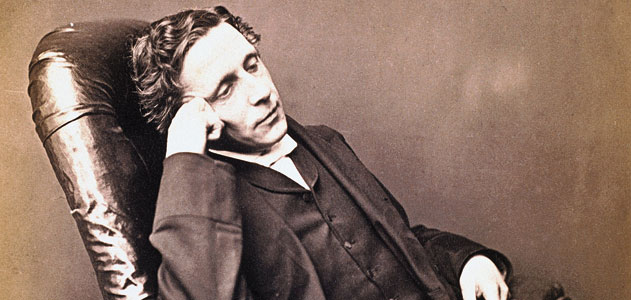
    I am probably not understanding this wonderful effort1 by the dead Lewis Carroll, establishing a new algorithm for doing long division.  It came into view while I was looking for a paper in Nature by A.A. Michelson on his analog computer, the harmonic analyzer, a fantastic device that he used to help measure the speed of light back in 1898.  Carroll (as Dodgson) appeared just a few pages away2; his obituary appears not much after the division article, thus making the paper the last of his career here on Earth. 

    Presence-Lewis-Carroll-Charles-Dodgson-631
    It is a very interesting effort, and it perhaps is even brilliant and of a wonderful construct, but the bottom line is that it makes the process of division harder to do–perhaps it is mire understandable as a process, but the process itself is decidedly not a preferred one.  Perhaps it is appropriate for his last work to have been on mathematics, since the majority of his 20 published books relate to mathematics or logic.

    Notes

    1.  DODGSON, Charles Lutwidge (‘Lewis Carroll’). “Abridged Long Division”, in Nature, page 269, in the weekly issue for 20 January 1898, with the original outer wrappers removed from larger bound volume. Very good copy. It is here that Carroll announces (in a long 3pp letter to the editor) his implementation of a new algorithm for division–it makes the process longer and more difficult, unfortunately.

    The article is abstracted here, a few weeks after publication:

    Article abstract:  Nature 57, 390-391 (24 February 1898), “Abridged Long Division” abstracted by ROBT. W. D. CHRISTI:

    “HAVING been working on similar lines for some years, I was very much interested in the late Mr. Dodgson’s letter on abridged division in NATURE of January 20, and I should like to offer a few observations and to give a variation of the method which appears much simpler. It will be admitted that Mr. Dodgson’s plan is of limited application, and rather complicated for general use. There is nothing to hinder the method given below from being universally used, though it may not in all cases be the shortest. It also has the merit, I think, of directness and uniformity.”

    2. This is one of three publications of Carroll’s mathematical works that appeared in Nature, being “Abridged long division”, Nature 57, 269-271; “Brief method of dividing a given number by 9 or 11”, Nature 56, 565-566; “Pillow problems. Curiosa mathematica. Part II”, Nature XLVIII. 564. 

    The following list of Carroll’s mathematical works is taken from the table of contents of The mathematical pamphlets of Charles Lutwidge Dodgson and related piece, compiled, with introductory essays, notes, and annotations, by Francine F. Abeles. (New York : Lewis Carroll Society of North America ; Charlottesville : Distributed by the University Press of Virginia, 1994.)

    Geometry

    • 1. Notes on the First Two Books of Euclid (1860)
    • 2. Enunciations of Euclid, Books I and II (1863)
    • 3. Fifth Book of Euclid (1868)
    • 4. Enunciations of Euclid I-VI (1873)

    Trigonometry

    • 5. Formulae of Plane Trigonometry (1861)
    • 6. Formulae (Group C) (undated)
    • 7. Simple Facts about Circle-Squaring (1882)
    • 8. Proof Sheets: Propositions I, II (undated)
    • 9. Question 11530 (1893)

    Algebra

    • 10. Condensation of Determinants (1866)
    • 11. Algebraical Formulae for the Use of Candidates for Responsions (1868)
    • 12. Formulae in Algebra (1868?)
    • 13. Algebraical Formulae and Rules for the Use of Candidates for Responsions (1870)
    • 14. Algebra (1877)
    • 15. Formulae (1878)
    • 16. Question 9995 (1889)

    Probability

    • 17. Note on Question 7695 [including Question 7695 and its solution (1885)]
    • 18. Response to “Infinitesimal or Zero?” (1886)
    • 19. Something or Nothing? (1888)
    • 20. Question 9588 (1889)

    Arithmetic Computation and Theory

    • 21. Arithmetical Formulae and Rules for the Use of Candidates for Responsions (1870)
    • 22. Examples in Arithmetic (1874)
    • 23. Arithmetic I (1870-74?)
    • 24. Arithmetic II (1870-74?)
    • 25. Arithmetic (undated)
    • 26. Practical Hints on Teaching. Long Multiplication Worked with a Single Line of Figures (1879)
    • 27. Divisibility by Seven (1884)
    • 28. To Find the Day of the Week for Any Given Date (1887)
    • 29. Question 9636 (1888)
    • 30. Question 12650 (1895)
    • 31. Number-Guessing (1896)
    • 32. Question 13614 (1897)
    • 33. Brief Method of Dividing a Given Number by 9 or 11 (1897)
    • 34. Variant of Item 33 (same title, date)
    • 35. Rule for Finding Easter-Day for Any Date till A.D. 2499 (1892-97?)
    • 36. Abridged Long Division (1898)

    Cryptology

    • 37. Key-Vowel Cipher (1858)
    • 38. Matrix Cipher (1858)
    • 39. Alphabet Cipher (1868)
    • 40. Telegraph Cipher (1868)

    Curriculum

    • 41. Circular to Mathematical Friends (1862)
    • 42. Proof Sheets Accompanying the Circular (undated)
    • 43. Guide to the Mathematical Student (1864).


    ·Posted by :

    ·in:


  • The X-Ray of the Imagination: Internal Dialog, Demons, Humors, and Picturing the Stuff of Thought–On the outer shapes of the inner container

    JF Ptak Science Books   Post 1094

    In an earlier post I wrote about what I thought was the first graphic representation of  the process of forming and imaging a complex thought (found in Francis Galton’s Visualizing Numeracy).
    It is interesting how people tried—over a long period of time—to get at
    exactly that, the inner process, via some sort of external means, which
    is almost entirely left in the not-so-exclusive world of the
    science-like.Blogxrayfludd
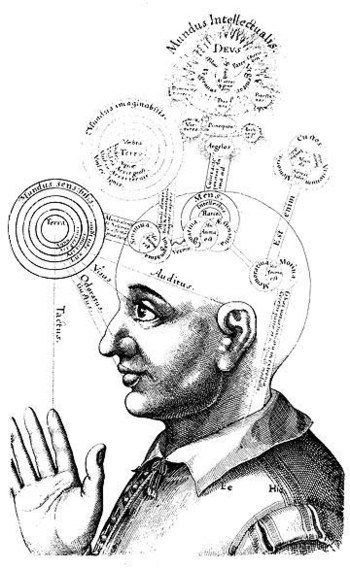
    Perhaps the greatest early effort (and certainly the most beautiful yet) to ascribe physical locations and attributes to the mind was the work and drawings of Robert Fludd.  That would be Dr. Robert Fludd (1574-1637), occultist/philosopher, randy logician and hermticist astrologer pseudo-scientist; and maybe the best of his work is found in his fabulously titled work Utriusque Cosmi, Maioris scilicet et Minoris, metaphysica, physica, atque technica Historia (The metaphysical, physical, and technical history of the two worlds, namely the greater and the lesser…), published in Germany between 1617 and 1621.  Things get very deep and complex and confusing, even in the illustrations; so as far as being a key to human knowledge, Fludd probably relaxed the confusion boundaries more than he strengthened insight—but maybe that was supposed to be his job, what with supposedly being a Grandmaster of the Priory of Sion

    Another great effort in the attempt to physically determine what might be going on inside someone’s brain and mind were the physiognomists. Physiognomy (does it really matter how it is spelled?  I should think that if I was to try and determine how I should spell the word using the very methods its practioners employed that the spelling might change daily…) from the Greek, basically meaning “nature” and “interpret”, claimed an ability to judge the scope of a brain by the shape of its container—the skull.  If a skull was sunken or distended or high or pretty or what have you then this shape in some way related to the development of that area of the brain.  So a high forehead could mean great insight or knowledge or intellectual ability; a low, sloping forehead meant, well, not, and to steer clear of such people with yourBloglavater
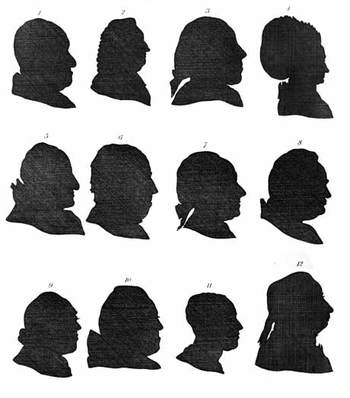
    hand firmly on your purse.  An early practioner was the very formidable Thomas Browne (1605-1682) (in the Religio Medici), but the powerhouse thinker (as it were) was Lavater (1741-1801), who caused and challenged all manner of mischief. The democratic nicety of this pseudo-science is that you didn’t really need to be associated with any extended scientific thought to engage in its application—a nice silhouette-maker would do, along with a series of interpretive and a decent personality was about all you needed.  A nice clear forehead would help.

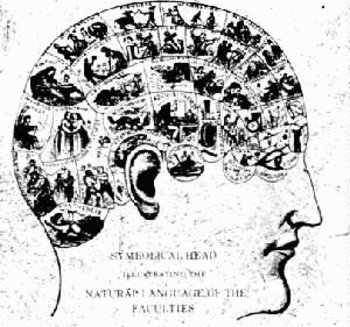
    Nipping at the heels of Johann Caspar Lavater and company was Franz Gall (1758-1828) and the Phrenologists (from the Greek again, “mind knowledge”), who made a slight step beyond simple head shape by “reading” the bumps and indentations of the skull.  Their educated fingers were in this way were supposed to have the capacity to feel the special elements of that part of the brain manifesting itself via cranial nodules or something.
    Blogphren
    Pathognomy was yet another step in the stairs to the flooded basement, where passions and emotions resident in the voice, or gesture, or facial expression, would somehow reveal the structure of the mind.  I found this one pretty curious because it concentrated on the motions of the physical ramifications of the brain, which somehow seemed very elegant in a ghost-like, narcotized way.

    But this is just the attempts to ascertain thought—actually picturing it, literally, was not all that common.  Dreams,Blogxraycruikshank
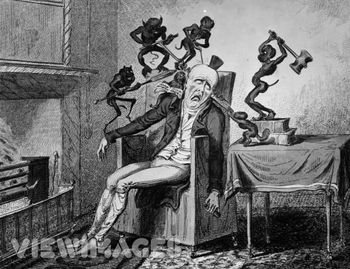
    fears, thoughts, pain, interpretative inner dialog—seems to have occupied artists far less than love or creed or ambition or devotion.  Being able to “see” someone’s pain, or nightmares, was really quite special.

    Thomas Cruikshank made this a sub-specialty for himself, depicting people suffering extreme anguish as a result of gout, or delirium tremens, or fear, and anthropomorphizing them, giving these concerns/fears/pains a human-like quality.  So instead of seeing  a badly inflamed gouty ankle and imaging its pain, we see anti-cherubs, demons, spikey creatures at work on the ankle, pricking it, setting it on fire.

    Bosch of course performed miracles in setting out the fear of the Lake of Fire in very explicit, basic, understandable ways.  In my opinion though the Chinese Hell Screens (as a genre) have Mr. Bosch beat by a long mile, as they were terminally specific in elucidating even what might seem to be trivial transgression for the casual viewer.  (For example, a person who wasted paper would, according to one scroll, spend eternity in a lake of flaming feces, bobbing to the surface occasionally to be stuck in the face by a flaming spear.  Now THAT’S Hell!)

    We have certainly seen people in the throes of nightmare in art, but the relative subtlety of the visions of HenryFuseli

    Fueli (The Nightmare, 1782) and William Blake (“Jeruslaem”, 1820, for example) and of course Fransico de Goya’s “The Sleep of Reason Produces Monsters” (from Los Caprichos) really do wane in comparison to some of the highly explicit horrors of Cruikshank and James Gillray and Thomas Rowlandson.  Perhaps this is so because the later group seems to address the masses and making the nightmare more universal, visiting the ample-butted poor as it would the couch-bound Faintress of the Upper Classes. (I guess I should really remove Goya from the former class, as he really did intend to reach the working poor as much as anyone else.)

    I’ve wondered about the artist Arcimbaldo—the genius portrait painter whose artistic palette was fruits and vegetables—and whether his use of various types and shapes of foods were supposed to correspond to any internal dialogs in the person sitting for him but, well, I think not.  Nice thought, though.

    Most effective though in graphically revealing the inner workings of someone’s mind is, yes, the word balloon, which takes a second seat to its younger sibling, the glorious thought balloon.

    What a fantastic creation!

    The word balloon, or the idea for it, exists for quite some time in Mesoamerica, incised in sculptures from 1000 yearsBlogxrayyellow_kid
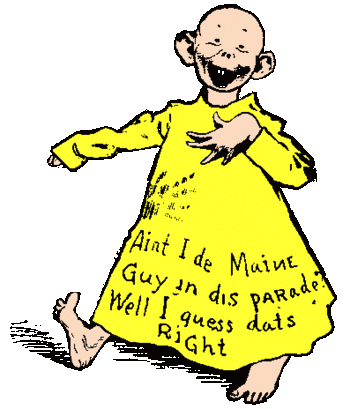
    ago.  (See Hull, Kerry Michael (2003). “Verbal Art and Performance in Ch’orti’ and Maya Hieroglyphic Writing”).    Something that we begin to recognize in a more modern form comes up in the 12 th century with word scrolls—elegant, flowing, appealing bits of fabric upon which the words of the person in the painting are written.

    Word balloons really come into their own in political art in the 18th century (and do have a very curious, artistic affect in their longish, elongated appearance with tiny 3-point type inside).  Sometimes the word balloons look like smoke with words in it—these might be my favorite, as they give the clear impression of the immediate and dissipating nature of most speech.

    The Yellow Kid, generally acknowledged as the first “cartoon character”, at first had his speech written directly on his flanged shirt.  It was around 1896 (I think!) that the words moved from his apparel and into a balloon over his head.

    The most beautiful innovation though came a little later (exactly when I’m not sure, I’m sorry to say) with the invention of the thought balloon.   What a magnificent idea!  Why hadn’t this concept been employed earlier, anyway?  How come it took until that unparalled period of time—1895-1915, when virtually everthing became “modern”, when just about everything (save politics, unless you include the creation of the concentration camp) experienced a paradigm shift—and not earlier?  Certainly it is common and debased, and runs amok with the very idea of art and its attempt to show the viewer the inner machinations/beauty of its subject; but wouldn’t it be interesting to have the thought balloon for Lisa Gheradini (the wife of Francesco del Giocondo, “Mona”)?

    Well, probably not.

    But the thought balloon–bubbly, cloud-like apparitions above its thinker’s head—certainly has it place, and isBlogthought_bubble
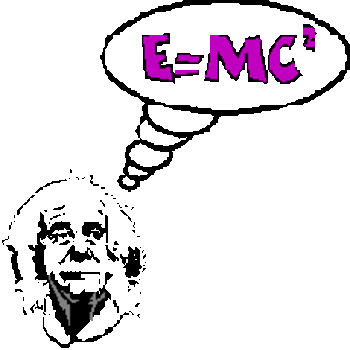
    absolutely a more elegant invention discerning thought than Lavater or even the lovely Mr. Fludd could ever dream.


  • Underwhelming the Overwhelming: Nuclear Holocaust and Dental Care, 1956

    JF Ptak Science Books   Post 2093 
    Follow Me on Pinterest

    “What is the appropriate behavior for a man or a woman
    in the midst of this world, where each person is clinging to his piece
    of debris? What’s the proper salutation between people as they pass each
    other in this flood?” Siddhartha Guatama Buddha (thanks to Patti Digh for the quote).

    Mass casualty561

    See also the related post, “Ueber-spectacular Understatement“.

    In a world where mass extinction of human beings by nuclear weapons was hypothesized, theorized, and nearly implemented, there was certainly a lot of room for discussion about what would come after the Big Event.  Great and massive and insignificant and small were all on the board for conversation and study; in a new world of hyper-change, anything and everything could be an issue–well, everything and nothing, nothing and everything, because in an exchange of a million megaton, everything starts to look like nothing.  But be that as it may, planners needed to plan for eventual changes in what we humans would call “daily life”. Sometimes that everything was big, sometimes not, and sometimes the big stuff just looked little.

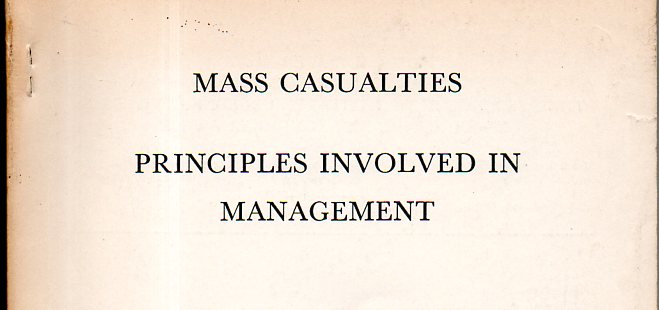
    For example, the pamphlet Mass Casualties, Principles Involved in Management, published as an offprint from the journal Military Medicine (April, 1956), is filled with numbing categories of thought, and doubly-numbing sub-categories, all of which needed a thinking-out, because when you have to make plans for the destruction of all things, there must be some sort of planning for what happens when the fires go out.

    There were the cautious introductory overviews, chapters on casualty estimates, initial aid and rescue, effects of fallout, emergency medical care, and the like. The work starts to get a little less oblique when the chapters become  a little more detailed, like that one devoted to “Mass Thermal Burns”. But what happens in these more-detailed headings is that the treatment of its subject gets less-detailed.  (“…the thousandfold increase in power and relative increase in radiant energy considerably enhance the burn hazard with the fusion bomb”  “…although the ideal treatment must be somewhat compromised in handling massive numbers of burn patients…” (page 319)).

    Ditto the chapter for “Management of Mass Psychiatric Casualties”. And “Public Health and Sanitation Problems of Nuclear Warfare”. These topics sound a little not-quite-right, and almost like a bad joke, but they are deadly serious. 

    “Organization for the Sorting of Casualties” is another.  Now even in this pamphlet the authors/editors were talking about massive exchange, which means that the “sorting” process would be involving tens of millions of people.  And who knows who would be the sorting stuff in such a situation, or if there would be a sorting place or doctors, or hospitals.  Nevertheless, this chapter underwhelms the overwhelming, which is a common occurrence in works like this. 

    • “A wide disparity will in all probability exist between  the patient and the medical resource”.
    • “All available medical forces will be used to the maximum for the care of the wounded”. 

    And so on. 

    It wasn’t just the care of human survivors that came under auspices of this work–there was also the matter of the social structure, which is what happens in “Welfare Problems in Nuclear Warfare”. In four short pages the chapter addresses the need to deal with the care of the survivability of the social network. And money.

    • “Ordinary jobs as people knew them would be nonexistent. Income from private investments, private insurance, social insurance, public assistance, government employment or any other source will be disrupted.  A whole income maintenance system will need to be developed and be ready so that income will either be in cash or in kind and be available when it is needed.” (Page 389)
    • “Any attack will bring in its wake a multitude of personal rehabilitation problems”.

    The author does get to the crux of the biscuit, finally, saying that after everything was said and done, that “much either medical or social care would have to be self-care in so far as humanly possible…” (Page 388).

    So what can one say to as a drowning person to another drowning person in a flood?  Best to look for higher ground?  There’s really not much that can be said, and I am sure that at the end of the day that these well-meaning contributors knew that there would not be much working following the nuclear dumpster fire–but I guess you have to plan for it anyway, just in case. 


  • A Great Letter to the Editor & a Major Advance in Particle Physics

    JF Ptak Science Books   Post 2091

    James Chadwick–the discoverer of the neutron and leading Brit investigator in the Manhattan Project–announced his great discovery in the form of a letter-to-the-editor.  Of course, this was a letter to the editor of Nature–not exactly the Billboard Breeze of Sumpin’, Montana, or the NYT or WSJ for that matter–where letters like this were more a quick way to get experimental results announced quickly, a rapid-publication device in the days when the scientific weekly was the quickest way of getting news out the fellow researchers. 

    But, no matter–it is still a short introduction to a long idea, not quite as romantic as the lede implies.  Chadwick’s  “Possible Existence of a Neutron”, appeared in Nature on 27 February 1932. It takes up a tidy and compact  1.25 columns, all on one page (312) of this issue of the journal. It is in a sort of imaginary “tradition” of great letters-to-the-editor, like the Alpher-Bethe-Gamow paper (“The Origin of Chemical Elements”, on the stuff of the Big Bang, a 1948 paper published in the journal Physical Review that worked out the basis for the formation of particles in the universe), another instance of a major scientific announcement being made as a “simple” presentation to the journal’s editor. 

    ·Posted by :

    ·in:


  • Stephens’ Nuclear Fission Bibliography, 1946

    I’ve found this to be a very useful tool in the past and decided to strip it out of the Internet Archive copy of the 1946 book and post it separately.

    Bibliography of 
    
    NUCLEAR FISSION 
    and 
    ATOMIC ENERGY 
    by 
    WILLIAM E. STEPHENS (editor) 
    
    and PARK HAYS MILLER, JR. BERNARD GOODMAN, KNUT KRIEGER, WALTER E. MEYERHOF, 
    MARGARET N. LEWIS, BERNARD SERIN, SIMON PASTERNACK, ROBERT H. VOUGHT Members of the Staff of the University of Pennsylvania THE SCIENCE PRESS Lancaster, Pa. 1948 Source: Internet Archive

    PARTIAL BIBLIOGRAPHY ON NUCLEAR FISSION AND TRANSURANIC ELEMENTS

    ·Posted by :

    ·in:


  • Turner’s Bibliographic Review of Nuclear Fission 1934-1940

    Louis Turner’s Review of Published Work on Nuclear Fission, 1934-1940.

    With a List of Turner’s References (Below)

    JF Ptak Science Books  Reference Tool

    I’ve found this article1 by physicist Louis A. Turner to be very helpful over the years. He was an I-was-there guy (and actually an I-am-here guy) who wrote a stuccato article on the history of nuclear fission which was top heavy in references, and did so in 1940, just before the clamp came down on publication on the topic. Certainly there are other more modern efforts in this area that are far more detailed, but few have managed to do so good a job in as limited space as Turner, which the fabulous John A. Wheeler recognized as a “great and timely” review2.

    Notes:

    1. Louis Turner. “Nuclear Fission.” Lancaster: American Physical Society, 1940. An article in the Reviews of Modern Physics, vol 12/1, January 1940, pp 1-30 of an issue of 85pp Original orange wrappers. Fine condition. Also contains articles by Seaborg and Zwicky.

    2. J.A. Wheeler, “Fission in 1939, the Puzzle and the Promise ” Annual Reviews, 1989.


    His 133 references can be read as a succession of one-line histories of the subject (barring the permissions to reproduce the entire article):

    1. E. Fermi, Nature 133, 898 1934.

    2. E. Amaldi, O. D’Agostino, F. Rassetti and E. Segrè, Proc. Roy. Soc. A146, 483 1934.

    3. I. Noddack, Zeits. f. angew. Chimie. 37, 653 1934.

    4. O. D’Agostino and E. Segrè, Gaz. Chim. Ital. 65, 1088 1935.

    5. I. Curie, H. von Halban and P. Preiswerk, J. de phys. [7] 6, 361 1935; C.R. 200, 1841 1935; 200, 2079 1935.


  • The Future of Sucking, Part II–Supersonic Travel Tunnel

    JF Ptak Science Books    Post 2090 (continuing an earlier post)
    Follow Me on Pinterest

    I found a report by John Prather in 1945 continues a sluggish history of underground high-speed travel. There’s a scifi story by Jules Verne’s son, Michael, Un Express de l’avenir (An Express of the Future), written in 1888, and a 1913  novel Der Tunnel by Bernhard Kellermann, and a very pretty example, a New York-Los Angeles bullet train as found in Modern Mechanix in 1948:

    Tunnel NY LA 1948

    There’s also a very fine effort described in the wonderful Improbable Research website, an 1825 effort, describing a 5-minute ride from London to Edinburgh.

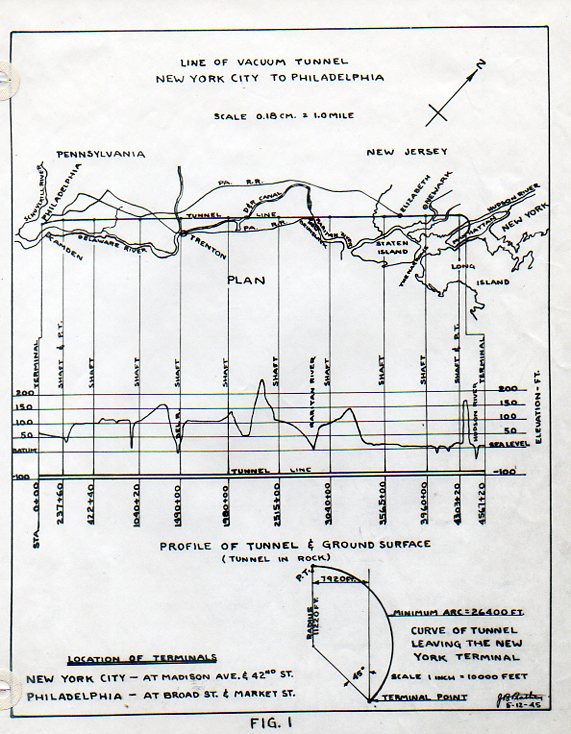
    John B. Prather launched an idea in 1945 for building a high-speed pneumatic passenger/freight train connecting New York City to Philadelphia.  His New York-Philadelphia Vacuum Tunnel, Preliminary Design Features and Economic Analysis (the original available on our blog bookstore) was exceptionally hearty. The idea is interesting in a removed, lets-not-do-it way because, well, it just doesn’t seem to make sense in the long run, at least beyond the building of the thing to show that it could be done.  And I don’t doubt that could be the case–I just don’t know why it was necessary. 

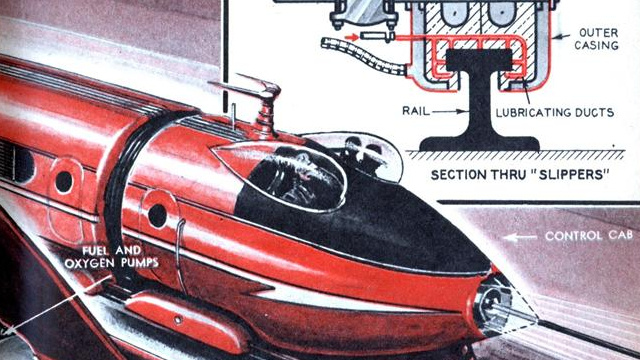
    Vacuum tunnel318 Mr. Prather’s approach seems to be the work of an engineer, or at least he had some help.  I doubt though that he had any help from a structural engineer or site geologist–his proposal was to build this tunnel 100′ down through bedrock when it could be found, a level hundred-feet  below the surface, from NYC to Philadelphia.   The tube would accommodate an aluminum-shelled  400′-long train that would be hauling 350 people and 175 tons of freight at speeds of 400-600+ mph, making the run between the two cities in about 20 minutes.  Not bad.  He figures too that all of the freight could be offloaded in 7.5 minutes.  This would make for  a very busy train, though Prather doesn’t tell us how many runs a day it would be making. This was all preliminary.

    The 16.2′-wide  tunnel would be 456,720 feet long, and would cost $173 million to excavate and $41 million to line with cement–according to the author.  The total cost for the ordeal would be about $334 million and would take 6 years, start to finish–that includes all of the tunneling, which would swallow/excavate/face 300′ per day. 

    I don’t see, really, how this could be so narrow a tunnel–I’m not an engineer but it would seem that wear, heat and the abuse and so on that a massive and dense 400′-long missile going 400+mph would require something that was more than 125% of the width of its trains. 

    There is however  precedence for a massive tunnel of something like this size being built in something like this time–the Delaware Aqueduct is 82 miles long and 13 feet wide, and was built during the Second World War (1939-1945) , so, perhaps if enough people and money were thrown at a project like the vacuum tunnel could actually be built (barring geological problems). 

    But it would all be worth it:  Prather suggests that the overall revenue from the operation of the train to be $196 million/year with $32 million in yearly operating expenses.  Which means that the whole thing could be paid for in three years or thereabouts.  So if the things was started in 1946, it would all be finished and paid for by 1956.

    I can understand his thinking, though, especially when you consider the impact of the year (1945) in which this paper was written.  The U.S. was came away from WWII by far more strong than any country on Earth, with its GDP being about 50% of that of the entire world–on the other hand, the federal deficit was 125% of the GDP, so perhaps in addition to being in an extraordinary position, investment was also somewhat gunshy.  And of course there’s the problem of whether Prather’s idea made any sense at all.  But I can understand the high times during which his project was announced. 

    I’ve looked at a number of proposals like this over the course of this blog–like almost filling up the Narrows between Staten Island and Manhattan with an airport and seaport, and making a series of transoceanic airports for flights between the continents, and dropping a gigantic shell filled with people from the top/interior of the Eiffel into a narrow hole filled with water, and covering Midtown Manhattan with a rooftop airport, and covering Midtown Manhattan with a glass-ish dome, and so on–and I know that it is good for at least one thing:  superb classroom discussion fodder of why something like this does or doesn’t make good physical/economic etc. sense.


    ·Posted by :

    ·in: