A Daily History of Holes, Dots, Lines, Science, History, Math, Physics, Art, the Unintentional Absurd, Architecture, Maps, Data Visualization, Blank and Missing Things, and so on. |1.6 million words, 7500 images, 4.9 million hits| Press & appearances in The Times, Le Figaro, Mensa, The Economist, The Guardian, Discovery News, Slate, Le Monde, Sci American Blogs, Le Pont, and many other places… 5000+ total posts since 2008.

Category: Zoomology

  • Zoomology: Beautiful Ruination at the Beginning of Photography

    JF Ptak Science Books   Quick Post

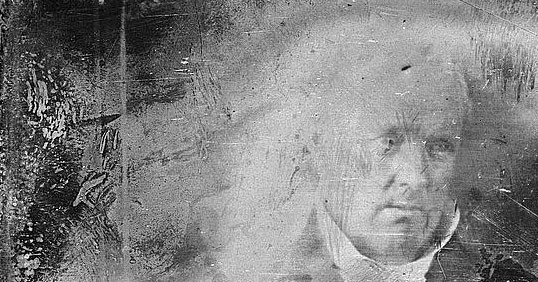
    This is a continuation of sort of this morning’s post, “Massive 500-Daguerreotype Mosaic“, though this one concentrates on the sumptuous ruination and decay that has occurred within and to some of these photographic images.  I’ve looked closely at only five of these images, and within each of these five images there are five more. And, if you manipulated the largest downloadable file of these (which range up to about 150 megs), there are five more within the five within the five. And all that before you start to imagine the artistic fantasies int he non-representational forms, and that before adding color.  So five is all that will be here, for the present.

    
    Ruination old dags detail 1


  • On Antique Waves and Dropping Your Hat in Them

    JF Ptak Science Books   Post 1737  (Expanding post #850, On Dropping Your Hat in the Punic Wars)
    ++ Nov 24 dropped

    There is a particular class of illustration in which, among the secondary figures of the image, there is a small happening, an everyday trifle, that has been captured by the artist and included in the overall communication for no necessary reason. (for example, see here and below1). I’ve written about this a little before on this blog in posts about finding images-within-images: the unecessaries among the unnecessaries, the bits and pieces of everyday human existence that in and of itself is not worth commentary but which nearly everyone experiences.  Small bits, they are, of a tremendous human nature, the things that are done in private, or are so universal but inconsequential that they are shocking to see when illustrated in print.

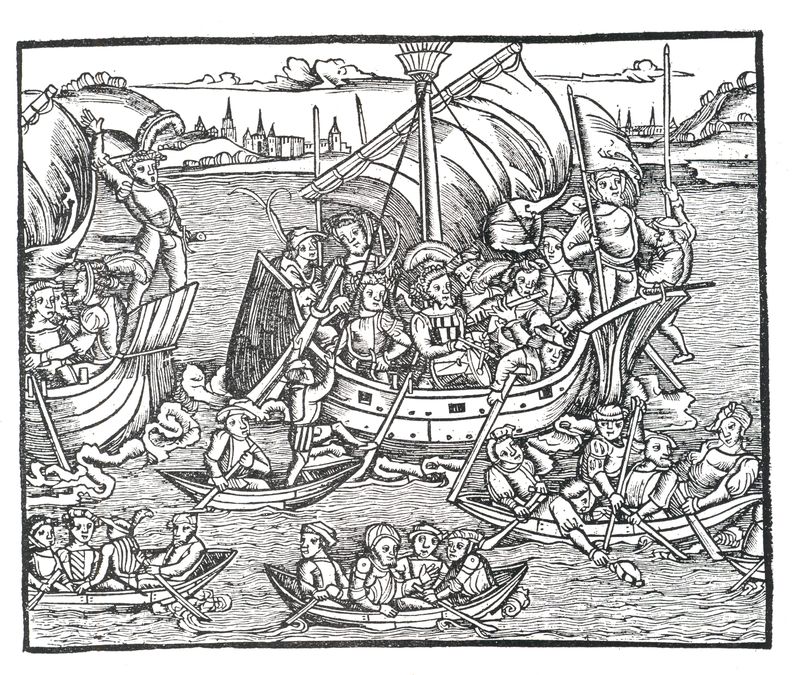
    Titus Livius (59 BCE-17 ACE), better known to the English-speaking world as Livy, was a superior among superiors of Roman historians, writing on the history of his city and country.  His work, Romische Historie…, published in Mainz by Johann Schoeffler 1450 years later in 1514, was one of the most beautifully illustrated books ever produced in that city.  This is a considerable statement, as Mainz was the birthplace/hotbed of moveable type printing, being home to Johann Gutenberg and a number of other early presses. 

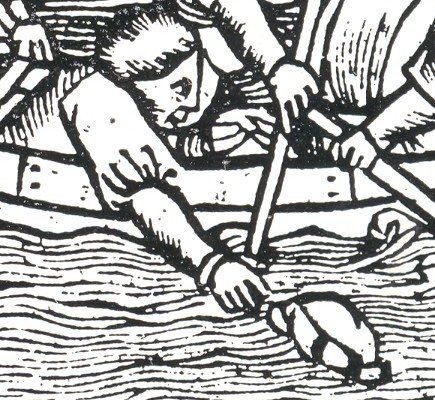
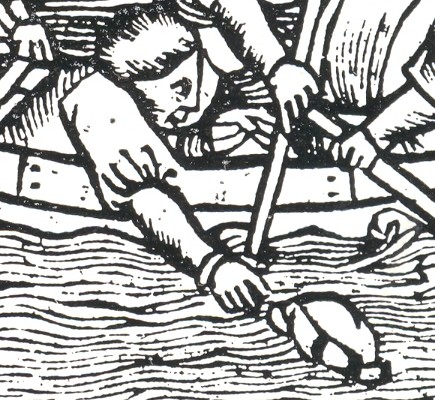
    And in looking at this fantastic work by Livy, I am a little embarrassed to find this spectacular bit of human tendency displayed in this woodcut depicting a naval engagement during the Punic Wars.  It is a beautiful thing, this scene of warfare depicted on tranquil seas and ribbony waves, determination in every face.  But what I noticed in the small boat at bottom right is a man reaching out into the water—not for a dropped oar, or to help a man overboard, or to catch his falling sword. 
    ++ Nov 24 dropped det
     He was reaching for his dropped hat. 

    I have reason to doubt that during the Punic Wars there may have been an unwritten chapter, “On the History of Dropped Hats During Warfare”.  Surely soldiers dropped their hats during the history of roman conquest, but I’d say that retrieving the headgear was more important at the Battle of the Bulge in protecting your noggin from badly splintering trees traveling at you at 180 mph and other such places than a wool cap dropped from a ship in pitched battle two hundred meters from shore. 

    I like this so because it is probably the first reaction that most of us would have—just a habit, battle raging or not—and just utterly human.  Just a little piece of back-history that doesn’t go anywhere and is lost to experience.  I’m sure that Herr Gutenberg dropped his hat at odd times, as did the unknown artist of this print.  Just an odd bit, like the first things printed on Gutenberg’s press being religious indulgences for people paying their way past Purgatory (and worse).  The fact that the indulgences preceded the great bible by several years doesn’t really matter, and neither does retrieving a dropped hat in a sea battle—but they do make interesting stories.   

    The only thing that I’d rather have the artist improve in this print were the waves–the ones on exhibit here weren’t very saucy.  Admittedly, waves were a large problem so far as depicting them goes, what with the whole vast subject of fluid dynamics so little known at the time.  THe person who would know this phenomenon best at this point–Leonardo–was thinking and working but wasn’t sharing. His “Studies of water Formations” (c. 1507-09)? and the later, magnificent “Deluge” (1513, nearly the year of publication of the above) would stay hidden for centuries, the big step forward in the West having to wait for another 120 and 140 years (respectively) for the works of Benedetto Castelli, and Evangelista Torricelli, 

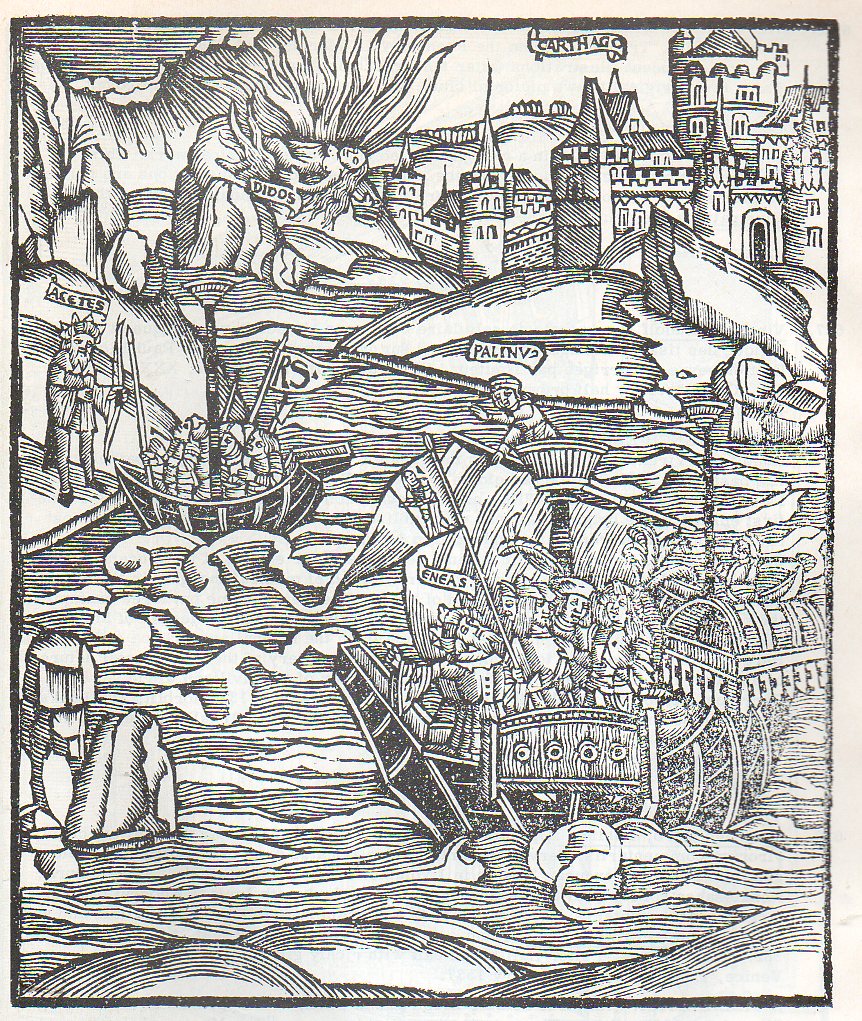
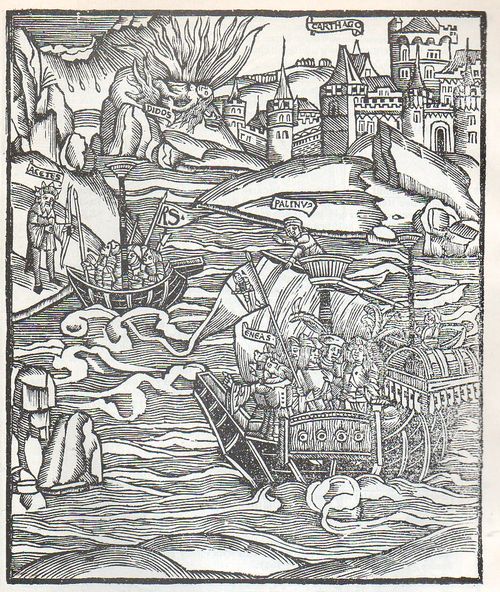
    This aside, I think that I’d rather see heavier lines in my Renaissance waves, more in line with we find in Publius Virgilius Maro Oper accuratissime castigata…, a richly illustrated (104 large woodcuts) work published in 1537, even though the artwork (evidently) appeared in an earlier edition of 1502.  No matter, “The Master of Grueninger’s Workshop” created some beautiful waves:
    Wave301
    There’s nothing “wrong” of course with the Livy waves; the Virgil though has sharper, darker, blacker and stronger contrasts in the water. Of course, the Livy has that incredibly human act of the man reaching for his fallen hat int he heat of battle, and that’s something that rarely seems to happen in prints of the Renaissance. 

    Notes:

    1.  Some other Found Images posts:

    Found Images: Penny Lane and the Inexpensive Treat, London, 1896

    Found Images of the Great Wheel, 1895

    Finding Hidden Images in Antique Prints: 18th Century Forensic Social X-Rays of Florence by Guiseppe Zocchi


  • Zoomology–the Paper Microscope and Hidden Children in Antique Prints

    JF Ptak Science Books       Post 1668  

    Part of Paper Microscope and  Zoomology  series.

    Hidden_children_graveyard153

    [Detail from the image immediately below, the small scene immediately in the foreground.]

    Images hold selective secrets for different people of divergent interests.  Sitting through a motion picture, for example, shows a series of still images flashed before us—in a single scene people bring to bear their own ways of experience and observation.  A forensic pathologist will see things shown within their specialty different from someone with a chemical explosives background who will see a bomb differently from an ER doc who would respond to an emergency room differently from a bookseller who might notice in the scene that the paperback edition of a Tree Grows in Brooklyn being read by an American G.I. in 1944 didn’t exist yet, and so on.  A single image can hold a tremendous variety of depth and interpretation depending on the observers’ perspective. 

    Most of the time when I look at prints now I am looking at the extraneous “stuff” that is used as filler to the print’s purpose. I’ve written about this a few times earlier in this blog under the (bad) general title of Prints—Looking HARD at…), and I find the uncommitted art just fascinating, sort of like “loose”, unnecessary snapshots of common life, everyday life, of people walking by. 
    Hidden_children151
    The two prints today that I stumbled upon have a particular interest—they depict semi-hidden children in the foreground-filling detritus of the architectural marvel that is the subject of the artwork.  Children really don’t appear too terribly often in art from 1500-1850, so it is especially interesting to look really hard at these prints and pick out the kids and what they were doing.

    Of course this begs the question of “why?”—why would the artist bother with such detail in the foreground, let alone bring children into the picture?

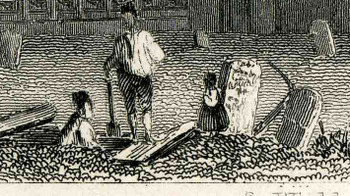
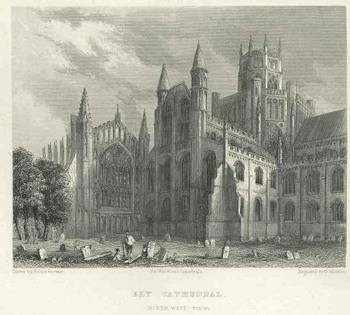
    The first image is the gorgeous Cambridgeshire Medieval cathedral at Ely.  This is an engraving showing the north west view of the cathedral, and it is of course grand and imposing.  The curious foreground shows a somewhat dilapidated-looking cemetery, and looking further still we see two men digging a grave, and to the right of them, a small child, seemingly pointing and reading a gravestone.  What an unusual detail this is, what with it occupying less than 1% of the area of the image in general.
    Hidden_children_two152_2

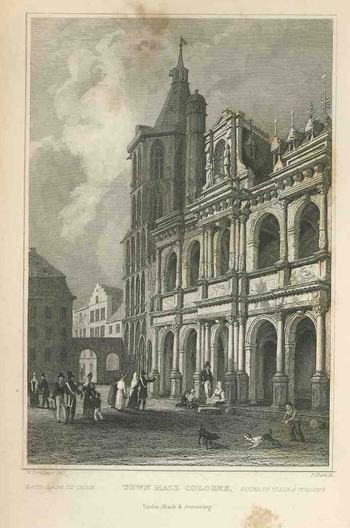
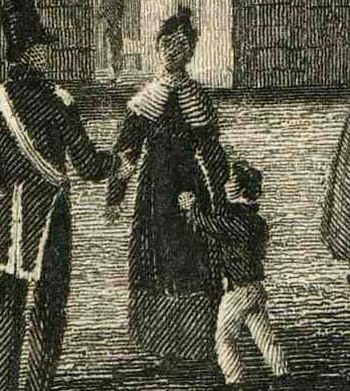
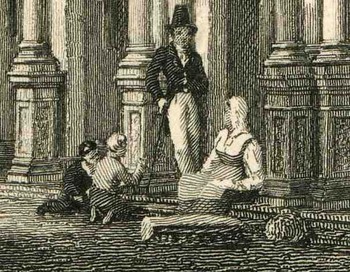
    The second image (above) shows the façade of the Town Hall at Cologne.  Of the twenty or so people in the street in front of the building, four are children (there’s also a pair of fighting/playing dogs).  One of the miniatures scenes seems to show a boy in a “pick me up” pose.  To the right of this is another, odder, scene, showing a woman—possibly a street food peddler—with her two boys(?), the children kneeling in front of a gentleman who is in turn leaning against a pillar of the Town Hall.  What the boys are doing is a mystery, as is the intention of the artist in including them.
    Hidden_children_streetpick_me_up .

    Unfortunately these “microscope” studies reveal only the basic forms of the semi-hidden, and really don’t ever seem to offer us a reason as to why they were preserved.  Presently I’m happy enough to just recognize them and appreciate their small saved existence.

    Hidden_children_street_kneeling  


  • Zoomology: a Paper Microscopic Look at Prints.

    JF Ptak Science Books   Quick Post

    Zoomology--vermes b032


    There’s a track on this blog located in the feebly-named category “Looking Closely/Deeply at Prints” were tiny bits and pieces of engraved artwork are exhumed for closer story, like passing a paper microscope over the image to draw out the semi-invisible and show the secret life of prints.  Often what this entails is some very curious work by the artist and/or the engraver as they sought to spice up a rudimentary architectural assessment of Salisbury Cathedral, or the town hall in Munich, or some sort of ruin in Surrey, or a street scene along old Broadway in NYC–and they would do this sometimes by including something artful and small, and completely unnecessary to the primary image on which they were working.

    See this post for a good example (with other links) of this.

    So, instead of having a few people in the street outside of Cathedral X to show the building to some sort of scale, the artist/engraver might include in their very tiny detail images of children fighting, or a legless beggar, or a pocket-thief, or a tripping aristocrat.  Or a man rounding a corner with a baby coffin on his shoulder. 

    Zoomology--vermes b034
    What happens here then is an intended-unintentional, sort of like an 18th century snapshot of Something that captures stuff of the daily grind in the process–and as it happens it is this stuff, the activities and the people doing the mundane chores of the 18th century that turn out to be the very interesting bits of the artwork.  After all, it was this sort of invisible activity that would tend not to be preserved in artwork or other visual documentation–but here it is, locked away in an architectural appreciation of some building Y in some city Z.  And we are lucky for the contrivances of those long-asleep artisans.

    But the Zoomology posts are something a little different than this–they simply are a deep observation of an interesting detail in an antiquarian print or photograph that shows an artwork in and of itself, a sort of descending fractal of appreciation.  And simple.

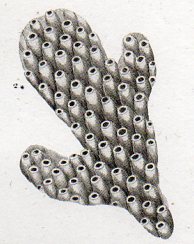
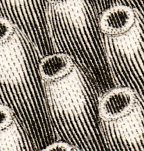
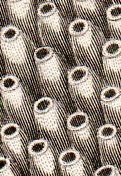
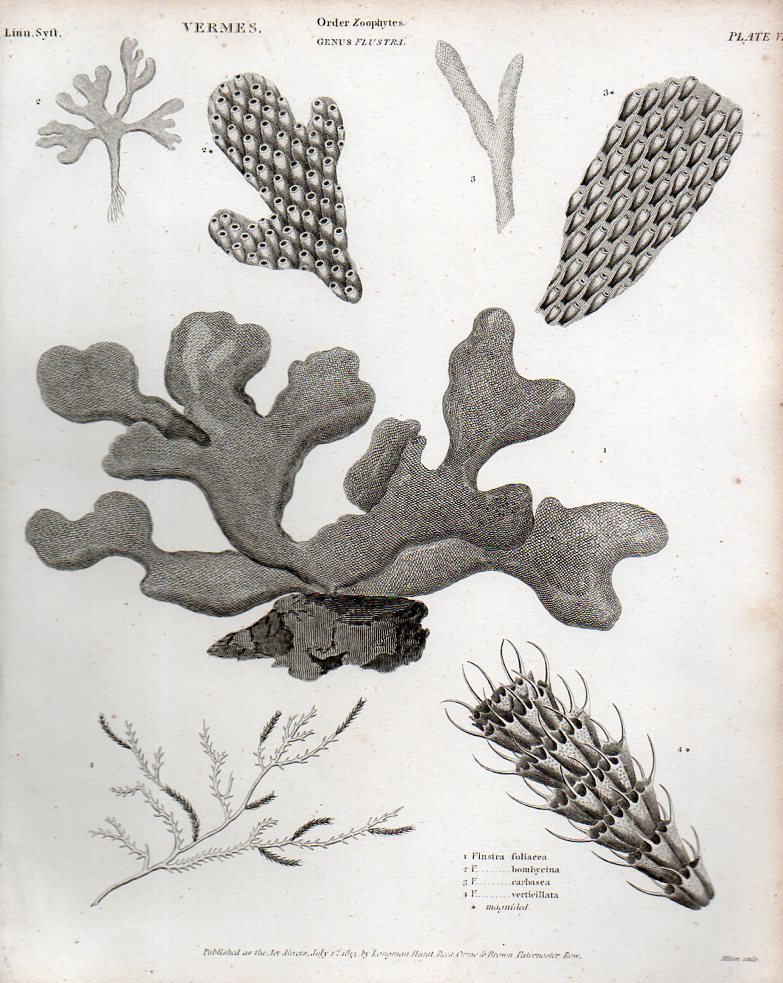
    The first sample in this quick-posting category is the sea anemone, or Zoophyte (old school classification), that we see in this series of images (above and below) from the great and prolific Abraham Rees (who must have had a team Rees, a group of scholars like the Bourbaki who worked together mostly anonymously save for the (in this case real) man whose name is given credit for the entire work) and engraved in 1813.  The image in question is a flustra bombycina, a Verme (according to the obsolete Linnaen taxonomy), and it just called out for deeper inspection:

    Zoomology--vermes b033

    And the zoom-out to the full image:

    Zoomology--vermes031


  • A History of Blank, Empty & Missing Things: Lipless Kissing in the Golden Age of Comics

    JF Ptak Science Books   Post 1077

    [A History of Blank, Empty & Missing Things, #78]

    Kiss 185
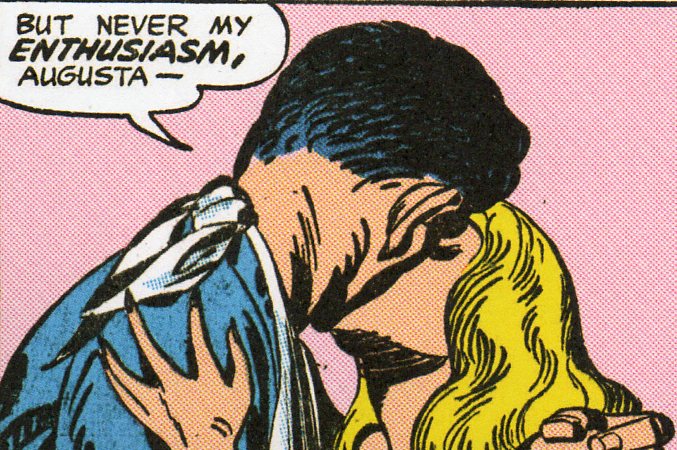
    The indefatigable team of Joe Simon and Jack Kirby (Joseph H. Simon, born 1913 and still going and Jacob Kurtzberg,1917-1994, respectively) produced some of the enduring heroes and ideas of the Golden Age of Comics. In capacities as comic book writers, artists, editors and publishers they knocked the bottom out of the creativity bin, affecting all manner and aspects of that industry, as well as  introducing the genres of horror and modern romance comics.

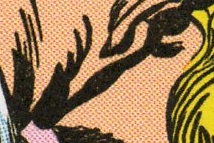
    And as necessary as it is scary, the nearly unrecognizable forensic pathology of the kiss in pink (above):

    Kiss--pink kiss det

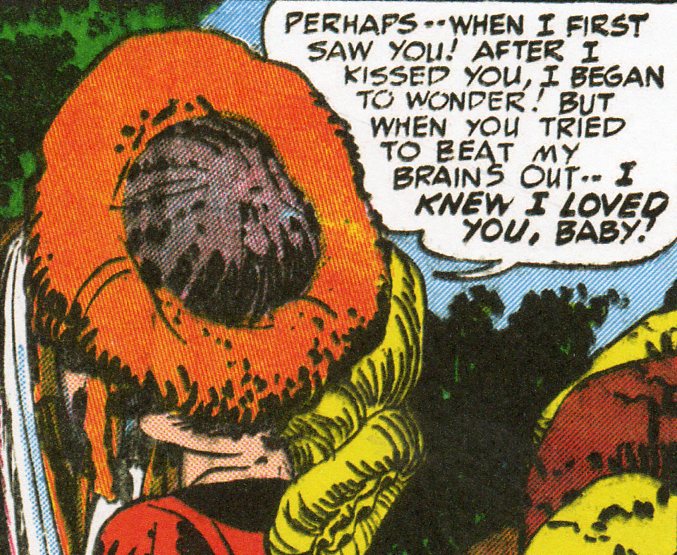
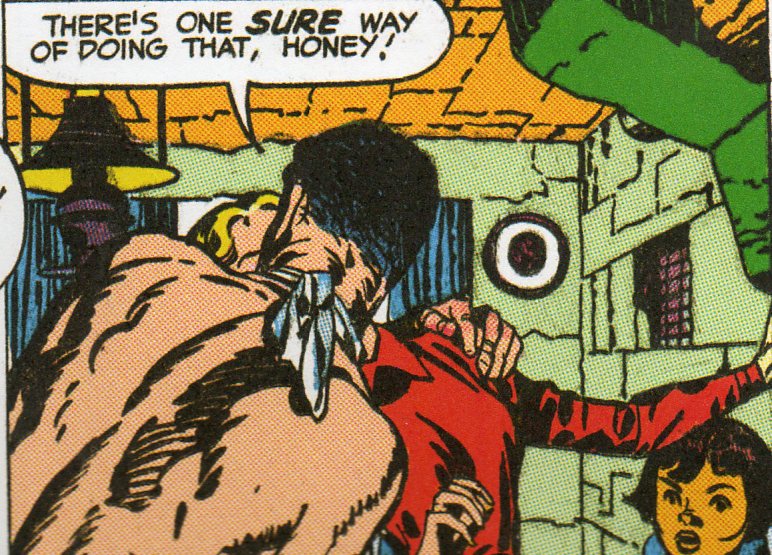
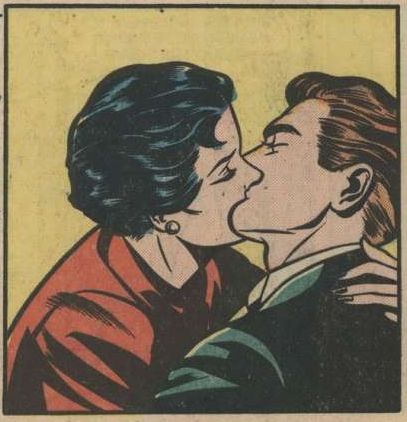
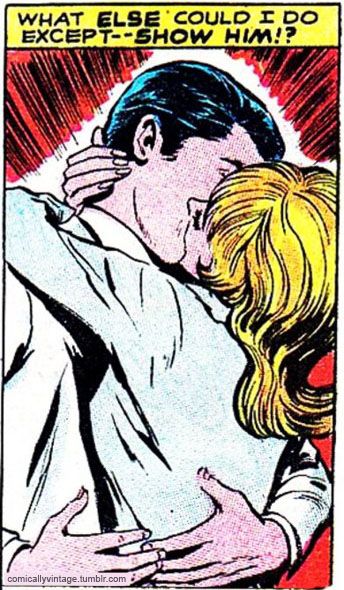
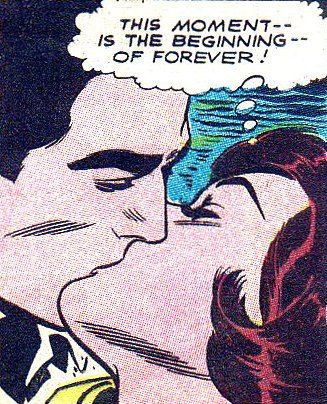
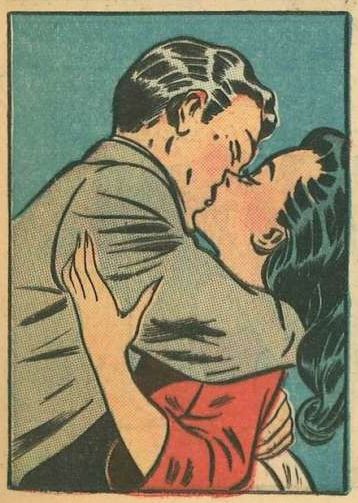
    I was initially drawn to their harsh colors,  blocky characters and un-magnificent dialog looking for wonderbits of non sequitor images and thought/word balloons populated with broken english.  They’re marvelous and easy to find, though I did get distracted by the unexpected part that I’m posting about right now–the missing, blank kiss.  Since they started the romance comics angles there’s plenty of 1940’s kisses to be found, but what I found was that although the kissing aspect wasn’t missing, the act of kissing was.  There’s plenty of heads smashed together that don’t leave a lot of room for faces, and in general it might be the sensitivities of the Golden Age’s age that cast away the kiss itself, their characters rushing face first into bad screen kisses. 

    Kiss 186

    There’s nothing wrong with this, and perhaps the kids never really noticed this, rushing to get ahead to the end of the confusing romantic interests.

    Kiss 187


    Kissing--comic book kiss

    Kissing--what else could I do

    Kissing--begining of forever

    There is a hint of a lip in this one, below, though it wasn’t supposed to be a passionate cheek kiss.

    Kissing in teal

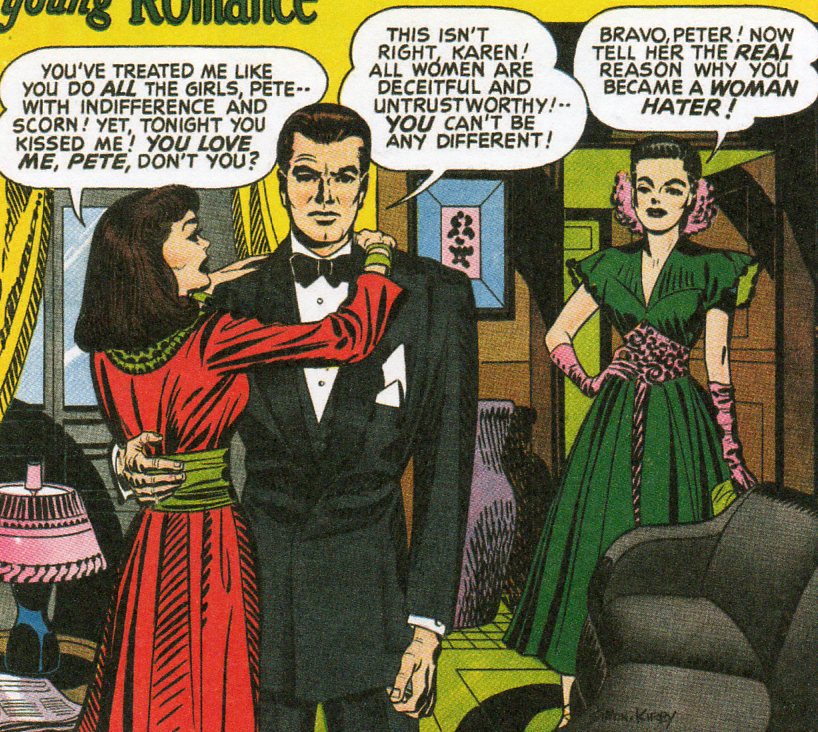
    This one has more to do with anti-kissing than anything else; I’m sorry that I don’t know what the “real reason” was….

    Kiss 189