A Daily History of Holes, Dots, Lines, Science, History, Math, Physics, Art, the Unintentional Absurd, Architecture, Maps, Data Visualization, Blank and Missing Things, and so on. |1.6 million words, 7500 images, 4.9 million hits| Press & appearances in The Times, Le Figaro, Mensa, The Economist, The Guardian, Discovery News, Slate, Le Monde, Sci American Blogs, Le Pont, and many other places… 5000+ total posts since 2008.

Category: Social History

  • “Two Disastrous Failures” for the German Army, January 1945

    JF Ptak Science Books   Quick Post

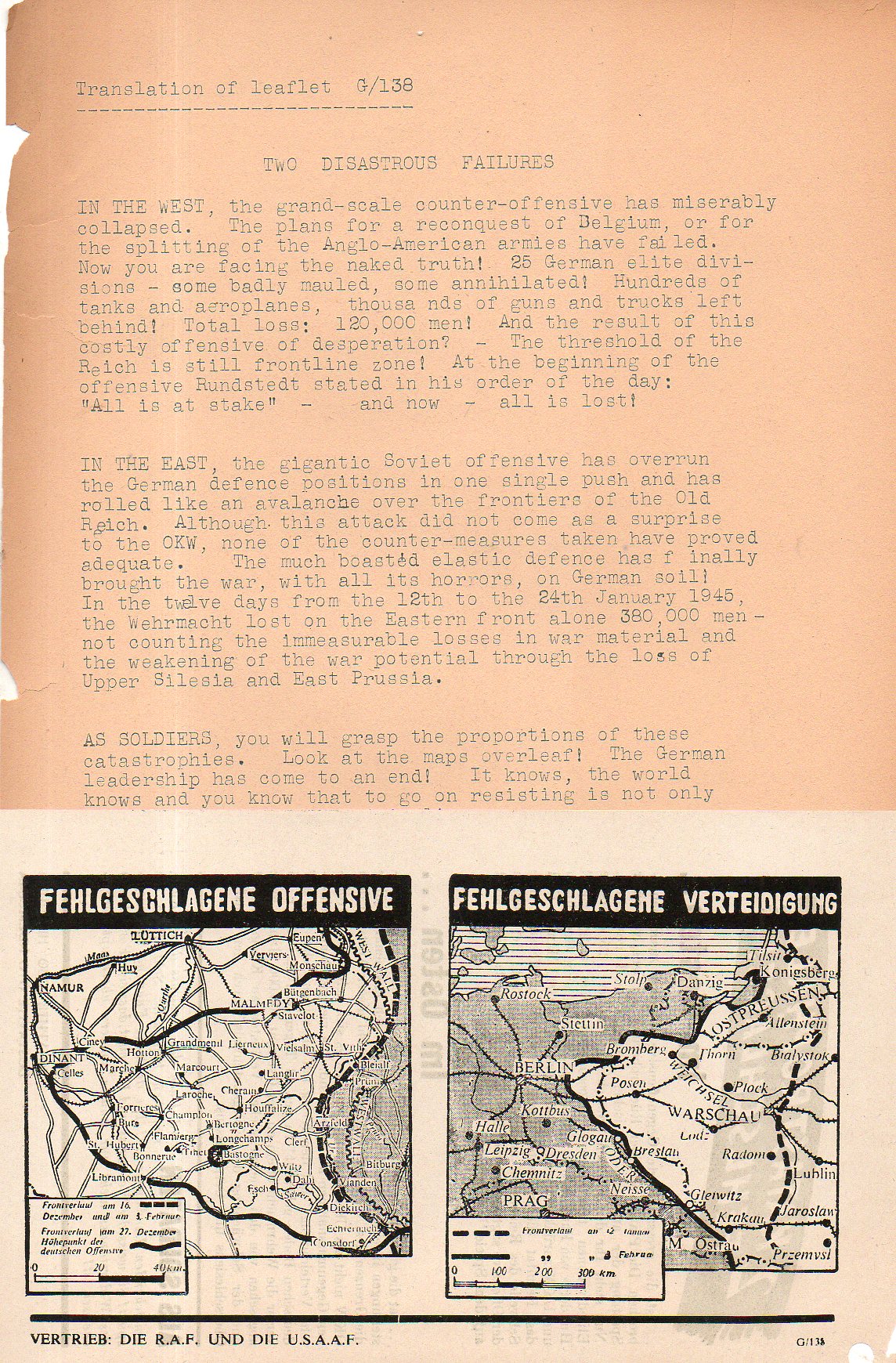
    This leaflet was dropped on German forces by the R.A.F. and the U.S.A.A.F. soon after the breakout of the Battle of the Bulge/Ardennes in the end of January 1945, which is one of the two failures that this propaganda sheet screamed about. It is a little odd though that in the map it would show the German offensive at its worst for the U.S. troops, with the bulge extending far west and Bastogne being surrounded. Yet the leaflet told of the German losses of its failed offensive (“Operation Watch on the Rhine”) though it did not show the progress of the month-long battle on the map, which should have shown the battle line back to its more-or-less original position by 25 January.  In describing the catastrophe of the German position in the east (leading with the loss of “380,000 soldiers”) the date of 24 January is mentioned, which supports the late January estimate for a printing date. This was of course the Vistula-Oder Offensive. which saw the Soviet Army advance more than 300 miles in a month, right to the Oder, only 40-odd miles from Berlin.  In that campaign the German Army Group A was just about killed–of the 450,000 soldiers in retreat along this long and disastrous front during the month of January, the overwhelming majority were casualties, including nearly 300,000 killed. The wounded and other survivors became POWs.  The bottom line of course was that the winter of 1945 for the German soldier was bitter and deadly, and was leading nowhere except defeat–there was no doubt what lay ahead after seeing that map of the Eastern Front. 

    Leaflet two disasterous failures468


  • “The Reich is Split Up/Further Resistance is Senseless” 1945

    JF Ptak Science Books   Quick Post

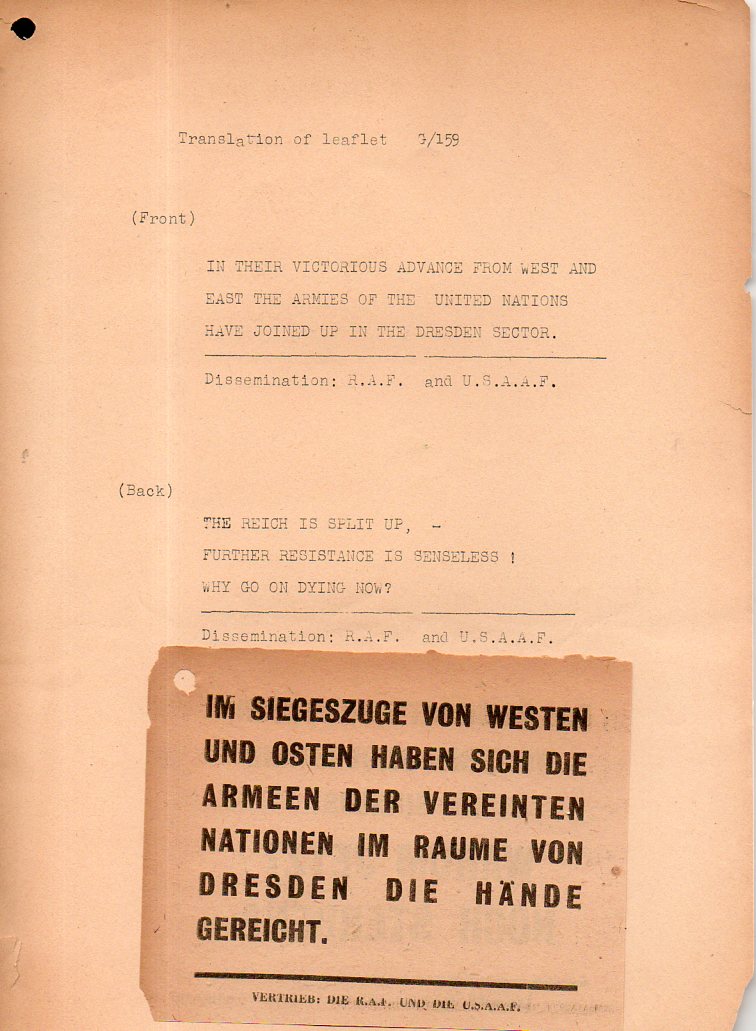
    I’d hate to have been in some Wehrmacht hellhole foxhole in March 1945 and have this fall on me from the sky–I imagine there was little doubt that even the lowest ranking soldier knew that they were in the grip of some enormous vise.  

    Leaflet reich is split up467


  • Acknowledging the Murder of 4 Million Jews, 1944

    JF Ptak Science Books   Quick Post

    Uhl 400k _4_

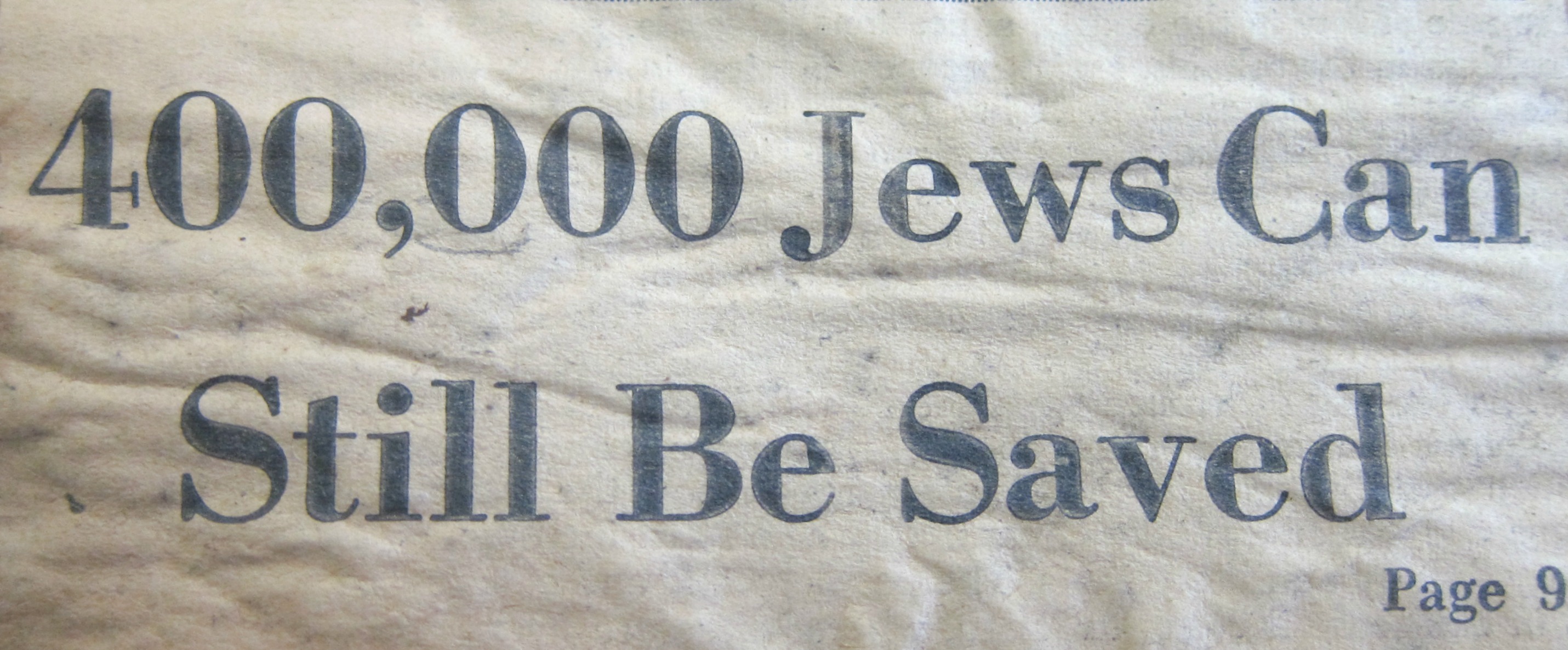
    I have posted on this blog many times on the Holocaust, and in my reading travels in that area I do not often see contemporary reporting using massive numbers to describe what was happening to the Jews. I own a part of the archive of Alexander Uhl, a superior reporter who had seen fighting in the Spanish Civil War while covering the war there for Associated Press, and who had also covered  WWII in Europe, reporting for the great PM newspaper and for which he was awarded the French Legion of Honor medal.  As I was looking through a collection of his snipped articles from PM for 1943 and 1944 I came upon this, on coming to the rescue of 400,000 Jews who could “still be saved”, which for some reason appeared on page nine of the old-line Leftie newspaper.  

    Uhl opens the July 31, 1944 article talking about having covered the Bermuda Conference  (“a most unhappy conference if there ever was one”, in late April, 1943), where U.S. and U.K. representatives (of not particularly high standing) met to discus how to save the remaining Jews of Europe. Uhl reports that affairs were no closer to a solution 14 months later than at Bermuda, where the conduct of the war was of primary importance and the “refugee problem” not. (There are many variations and interpretations of the Allied response at this conference,  though from my reading the majority approach a withering appraisal of the thing.1)

    Uhl then goes on to cite the Jewish Agency for Palestine that two-thirds of the 6.5 million Jews of Europe (in 1939) have disappeared, “either killed by the Nazis or died of suffering and privation”. That is a big number. (I am in no way saying that this is an historic assessment, as there were numerous other reports on the murder/disappearance of millions of Jews, examples of which can be found in contemporary newspaper accounts relating to the Bermuda Conference. I am stopping here today because it still seems to me to be a rare-enough discussion of a large number of murdered Jews to make notice of it.) 

    Uhl gets to the point of his story, which is to say that there were 400,000 Jews in Hungary can still be saved if there were enough ships to transport them and enough places to accept them. “If not, they will be doomed to the same fate as the rest of Europe’s Jewry”.  Uhl makes note of the 1500 entry permits allowed for Jews  into Palestine as dictated by the government of Great Britain, which as Uhl reported showed no inclination to change anything.

    I reprint the article below for the rest of the story.  (I ma told by someone who knows that PM is a rarely-held newspaper in institutions and does not often show up online.) 

    ·Posted by :

    ·in:


  • “Franco in Power is the death of Spain…”: Rare Anti-Franco Circular, 1943

    JF Ptak Science Books  Post 2621

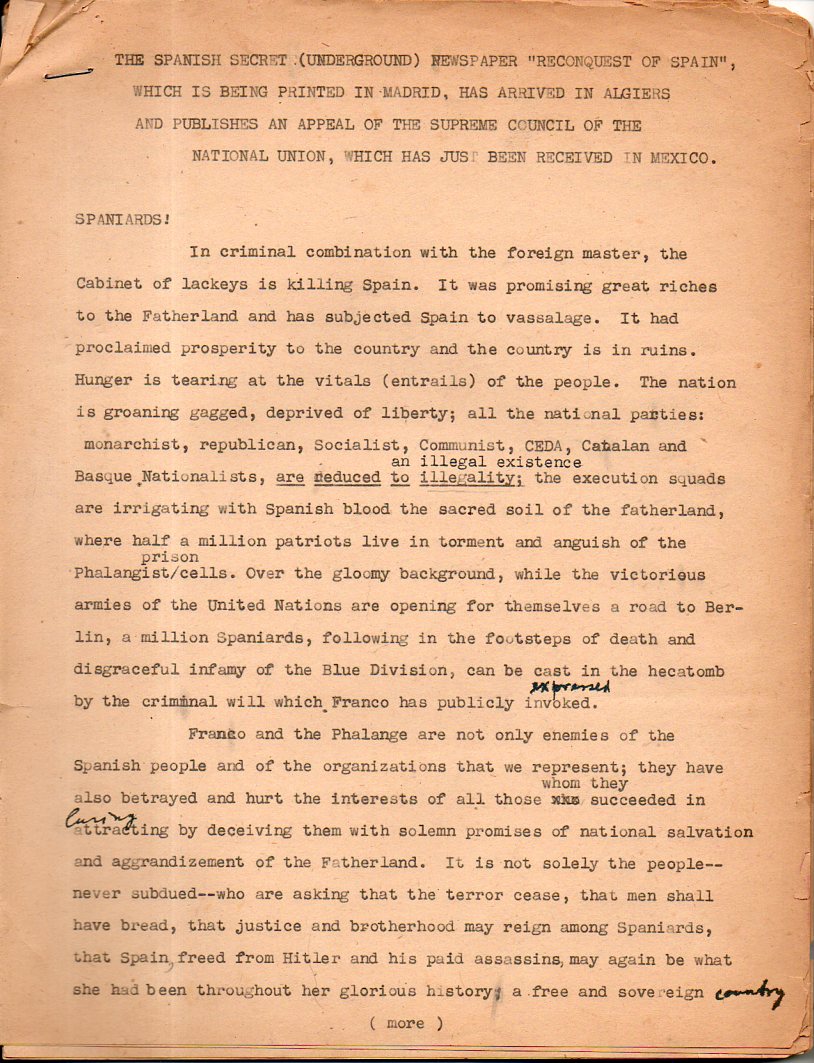
    The Spanish Secret (Underground) Newspaper “Reconquest of Spain”, which is being Printed in Madrid, Has Arrived in Algiers and Publishes an Appeal of the Supreme Council of the National Union, Which Has Just been Received in Mexico, is a rare offset publication–five leaves long and approximately 1500 words–was which published in  December 1943, and which seems to be a general call-to-arms to overthrow the Spanish right-wing leader Francisco Franco (still dead after all of these years). The Spanish Civil war was overwhelmingly over by 1939, though there was still considerable resistance to Franco–much of that at this point (1943) not in Spain. The Spanish government for their part were busy trying to keep their non-neutral neutrality at an optimum price and profit, selling material to the Nazis, and holding out for a more-beneficial payout to themselves from Hitler for joining the Axis outright, which never did happen.    The publication refers to an underground secret newspaper called the “reconquest of Spain”, which I guess would be simply called the Reconquista, which in recently history would have referred to the fight against Franco from 1936 to 1939, and also ()in the deeper past) the 700-year-long fight to establish a Christian kingdom in Spain free of Islamic occupation (ca. 700-1500). Unfortunately my knowledge of Spain during WWII regarding the Republican fight is extremely limited, and so I can’t say anything further about the newspaper–I’m not even sure if this publication below is a reprint of the text of the newspaper (which it seems to be, perhaps) or not.  In any event, here’s some samples from the publication:

    • Spanish civil war

    [Provenance: from the estate of Alexander Uhl,  Associated Press reporter in Spain during the Revolution. WorldCat/OCLC locates 0 copies.]


    “We are uniting to fight, to mobilize the Spanish people in the defense of its very life, to radically extirpate the foreign domination from the soil of Spain…”

    “Franco in Power is the death of Spain…”

    “This is a wartime call to Spaniards to honor their fatherland and overthrow the Nazis and Franco…”

    “Spaniards! In criminal combination with the foreign master, the Cabinet of lackeys is killing Spain. It was promising great riches to the Fatherland and has subjected Spain to vassalage. It had claimed prosperity to the country and the country is in ruins… “

    “The nation is groaning, gagged, deprived of liberty…”

    “…the execution squads are irrigating with Spanish blood the sacred soil of the fatherland…”

    “Over the gloomy background, while the victorious armies of the United Nations are opening for themselves a road to Berlin, a million Spaniards, following the footsteps of death and disgraceful infamy of the Blue Division, can be cast in the hecatomb by the criminal will which Franco has publicly invoked…”

    “We are uniting to fight, to mobilize the Spanish people in the defense of its very life, to radically extirpate the foreign domination from the soil of Spain…”

    “It is not a fight of internal tendencies, but a united attack of the entire nation in order to recover its independence and its sovereignty…”

    “We are inviting publicly, solemnly, the Spaniards who profess other political creeds and most especially the Catholics of the two branches and the army, to participate with us in the Supreme Council of the National Union…to overthrow Franco and the Phalange…”

    “No honorable Spaniard can fail the call of his Fatherland…and can honor themselves by taking part in this genuine crusade of liberation which today demands unanimous national effort. No desertion will make us lower the colors…”

    ·Posted by :

    ·in:

    —

  • Soviet Investigation of Nazi Atrocities, 1943

    JF Ptak Science Books  Post 2620

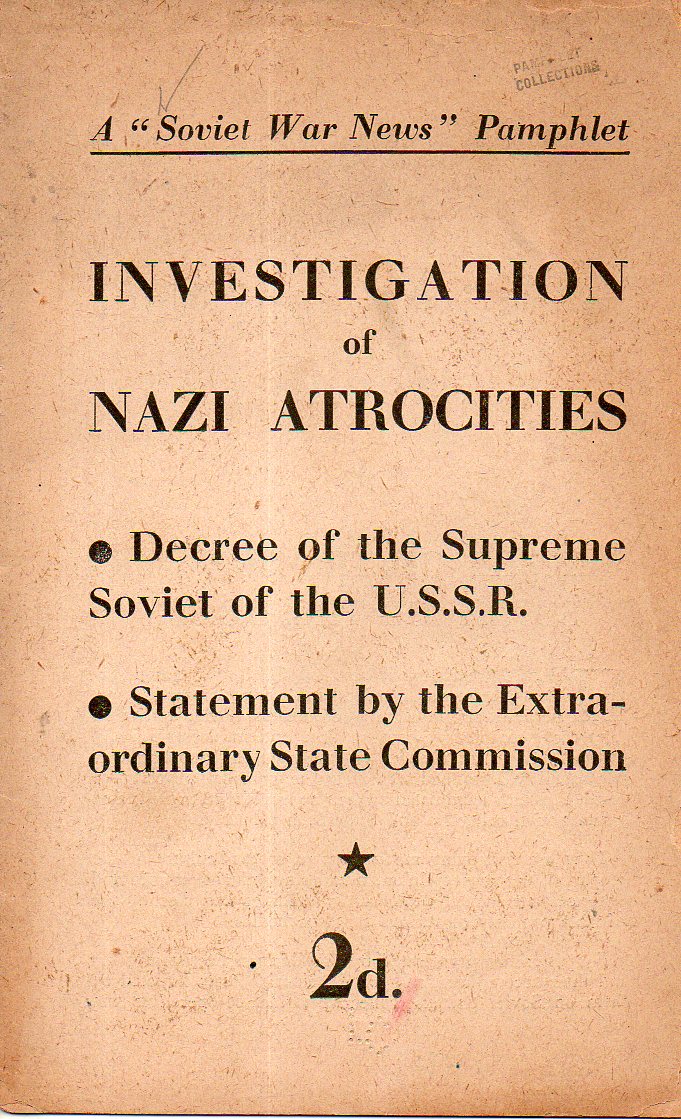
    Nazi atrocities423This rare report asserts and outlines all manner of Nazi war crimes committed against the Soviet Union to April 1943 and issues an official call to keep track of every horror in the form of the  Extraordinary State Commission to Investigate Nazi Atrocities via a decree of the Supreme Soviet. At this point the German attack against the U.S.S.R. was nearly two years old and involved the majority of the German army; in April 1943 nearly 4 million German soldiers were waging war against about 10,000,000 Soviets in the largest military campaign in history, ultimately costing the lives of 10 million Soviets and 5 million Germans, with millions more on each side being MIA and captured–staggering numbers.In the midst of all of this the Germans flayed the Soviet Army, people, and land, and the Russians were very highly decided that now that the turning of the offensive was in sight (now just a few months after the great victory at Stalingrad),that they would absolutely not forget anything that the Germans did there.  This fragile pamphlet was one announcement of this intention.

    I’ve attached the full pamphlet, below, a text-only reproduction from the Internet Archive–I would reproduce my copy with the full flavor of the original except that it might not survive being opened and folded flat over the scanner.  

    Some of the prominent statements in the pamphlet include the murder of the civilian population as well as their enslavement. Lastly, at the end of this grim spectacle, there is a section naming the German officers responsible for the mass of killing and torture. 

    • “the murder of peaceful citizens and the violation of defenceless citizens, women, children and old folk by the
      invaders, and also of facts relating to the exportation of Soviet people into German slavery”
    • “destroying monuments of art and culture of the plundering valuable artistic and historical documents,
      demolishing buildings and stealing the valuable property of various religious bodies.”
    • “losses inflicted by the marauding and plundering activities of the German Fascist invaders on collective farms, co-operatives, trade union and other social organisations by the plunder and destruction of buildings, devices and equipment designed for production and cultural purposes, by the plunder or destruction of stores of raw and other materials, products and goods, agricultural crops, forests, fruit, vegetables, etc., and other collective farm and co-operative property”
    • “…torturing and murdering peaceful citizens. They are plundering wholesale the population of towns and villages and exporting the personal property of Soviet citizens, accumulated by their honest labour, to Germany, together with collective and State farm property.”

    And this incredible statement of truth:

    • “the German-Fascist Army mercilessly destroys Soviet towns and villages, engages in violence, torture and the tormenting and murder of non-combatant citizens as well as of Soviet war prisoners. History has never before witnessed such mass extermination of human beings as that perpetrated by the German-Fascist invaders. ” There is a full section on the “Murder and Torture of Soviet Civilians”.

    There’s much more if you give the work a full reading.  

    [Source: Internet Archive, https://archive.org/stream/investigationofn00unse/investigationofn00unse_djvu.txt]


    ·Posted by :

    ·in:

    —

  • How a Trade Union is Run–in Bright Red (1932)

    JF Ptak Science Books  Quick Post

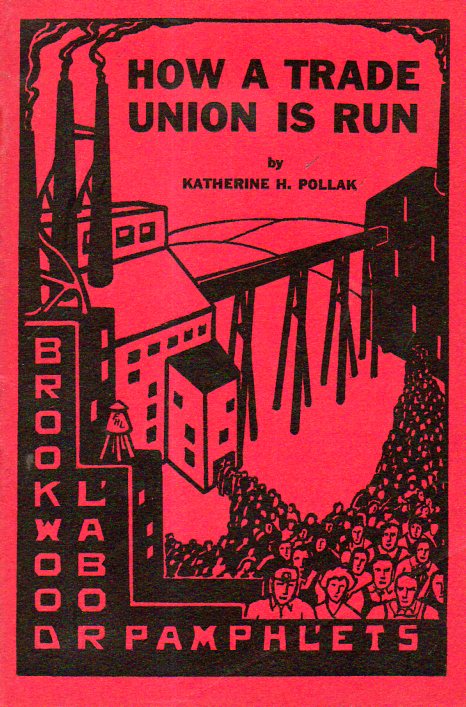
    Katherine Pollack (b 1905) wrote this informative pamphlet in 1932–it is red though Ms. Pollack wasn’t.  She did have a solid and liberal background–Ethical Culture School in NYC, economics at Vassar, grad work at Columbia, “tutoring, teaching and writing for the Bryn Mawr Summer School for Women Workers (1927-49), Brookwood Labor College (1929-32)…field work in Southern textile mill towns and West Virginia coal camps…”1, and then on to national offices for the CIO and then the AFL-CIO.  

    I hate to say it, but I was drawn to the pamphlet for the design.  It turns out that Ms. Pollack had the Right Stuff, and knew her business, and lived that life.  I’m glad to have made her acquaintance.

    The pamphlet was published by the Brookwood Labor College (1921-1937) evidently the first U.S. college devoted to the study of labor, and published in 1932.


    How a trade union is run348

    Notes:

    1. Katherine Pollack Elikson papers:  https://reuther.wayne.edu/files/LP000321.pdf


  • On the History of Tenderness to Children

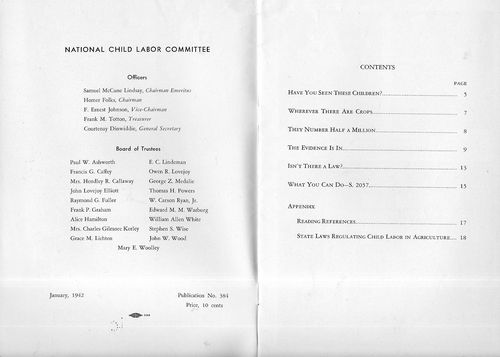
    JF Ptak Science Books   Post 712 (from 2011, extended, with a full text scan of  Children Who Work in the Nation’s Crops by Gertrude Folks Zimand, National Child Labor Committee,  1939.)

    “The history of childhood is a nightmare from which we have only recently begun to awaken…” Lloyd Demause

    “Give me other mothers and I will give you a better world.” St. Augustine, (who does not mention fathers in this context). 


    The history of kindness to children is a wicked road to tread—I’m not sure why I’m even thinking about it had I the subject not been awakened by bumping into the map seen below.  Without any real directed reading on the topic  I’ve intuitively felt that “childhood” as an idea, as a part of human development in the Western world, was a young, newish innovation.  The simplest way to perhaps measure this is looking for representations of children as children in Medieval and Renaissance art—that is to say children drawn not as little/miniature adults, but drawn as children actually appear.  This does not happen very much at all in the early Renaissance, and virtually never happens in the Medieval.  Even when looking for images of Christ as a baby in early art it is far more likely to find him depicted as a little man than it is to see him as a child.  Children certainly seem to make more appearances as themselves in book illustration (excepting the obvious works on anatomy and childbirth) beginning in the early 16th century, and I’ve a number of reproductions here of children with learning-to-walk walkers and toys from this period. So at the very least the recognition of  the concept of difference in very very young adults as “children” in art took a much longer (and unexpected at least to me) time to develop as a concept.   And this is only the barest concept, at least recognizing childhood as a stage of development, which doesn’t necessarily say anything about the aspect of kindnesses expressed to them simply because of this stature.  That’s an entirely different story.

    One way  to measure this aspect of childhood–the history of kindness towards children–is in terms of how much work society allowed them to perform in the adult world—and again, it would be shown that it was discovered only recently.  As an issue of moral and responsibility, child labor was regulated first in England in a long series of Factory Acts  (13 separate acts from 1819 to 1961, including 1819, 1831, 1833, 1844, 1847, 1850, 1874, 1878, 1891, 1901, 1937, 1959, 1961) .  That first breathe of morality and responsibility towards happiness (where happiness means not being exploited) codified that children younger than nine were not allowed to work,  and that kids between the ages of 9 and 18 could only work up to 72 hours in a six-day week1.  Children were used freely and copiously for work in fields, in chimneys, in mines, and in tough bugger places that couldn’t be reached by full-grown adults, as well as in places that could use little hands, or suspended in places where a lightweight helper could be slung, and so on.

    Historically speaking, controlling children seems to have been the major part of dealing with a child:  from controlling its body function (with enemas and such), to movement (swaddling to completely restrict motion), to crying (dunking a crying infant in a pail of ice cold water to stop it from crying),and to mood (feeding fussy children liquor and opiates to make it docile. ) The severe beating of children was the great “other” option in dealing with all manner of childhood issues, the thorny crown of behavior modification. On this point Lloyd Demause in his “The Evolution of Childhood” examines 2000 statements of advice on child rearing prior to the 18th century and found that most  advocated severe beatings.  He noted that the severity of the beatings was common and “a regular part of the child’s life.” The instruments of behavior advocacy here included “whips of all kinds, the cat o’nine tails, shovels, iron and wooden rods, bundles of sticks, the discipline—a whip made of small chains–, and special school instruments like the flapper, made to induce raising blisters.” (Demause, page 41.) Rousseau—hardly alone among the great philosophers—advocated whippings and beatings from infancy; plenty of the great social thinkers from this period and earlier had little use or accommodation for children, even their own. 

    There’s also the controlling of the mind via images and fear and promise of retribution of hell, as well as the introduction of spooks, ghosts, goblins and other sorts of child-stealers and –eaters.  You’d think that the rough and tough and pretty scary stories of Brothers Grimm would be enough, but it doesn’t come close to the really scary guys:  Mormo, Canida, Poine, Sybaris, Acco, Empuss, Gorgon, Ephiatles and others were brought in to do the job of control that spanking and beating and hell couldn’t modify. 

    Then there’s the sexual misconduct and abuse, which was evidently deep and well practiced for thousands of years, with older Roman men and Athenian rent-a-boy being famous examples of something wider and established.  Just from reading a bit through some of the standard histories of childhood it is very easy to see the vast amount of sanctioned abuse that seems to constitute one of society’s many sorely soft and cancerous underbellies.
    ===blog==augu 12==hine

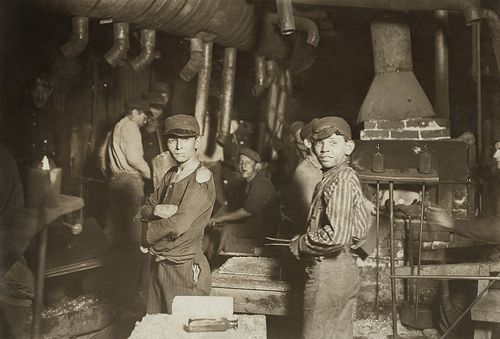
    Returning to child labor, for most people in the United States the grotesque nature of this activity was finally revealed to the great masses through the work of the legendary photographer Lewis Hine, whose documentary images of the conditions of children and the laboring classes was an extraordinary dose of reality.  It took the unimpeachable foundation of the photograph to hammer home to people that children were being subjected to rigorous labor abuse. (The photo above shows children working in a glass factory at midnight.)
    ===blog==aug 12--child work

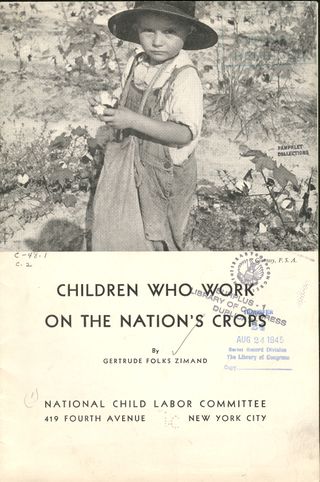
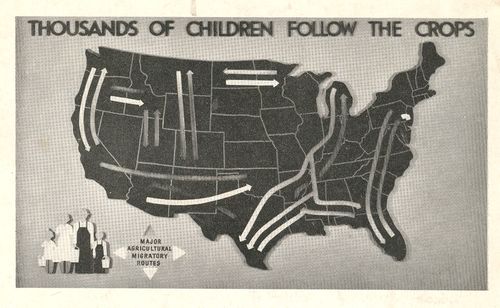
    But Factory Acts and Lewis Hine et alia made only incremental change in the exploitation of the very young–evidently economies large and small were addicted to the idea.  Which brings us to the map that started this thought: it appeared on the back cover of Children Who Work in the Nation’s Crops,  written by Gertrude Folks Zimand, and published by the National Child Labor Committee (NCLC) in 1940.  The map on the back cover shows the migration routes of the young workers:
    ===blog==aug 12--child work map
     

    There’s no surprise to what the map showed, though it was a surprise to see the map itself.  The NCLC is still around, and so are the children working in the fields.  The map has stayed pretty much the same. 

    The rest of the pamphlet does not pamper the brittle semi-hidden world of the child laborer.  I’ve included the entire work, below.  

    UNICEF states that there are still hundreds of millions of children being worked illegally throughout the world, and I can’t help but wonder who it is that assembles those free Happy Meals toys (watch that copyright!) which are purchased in the millions for a penny or so apiece.  When things like that are as cheap as they are, as impossibly cheap as they are, there must be someone, somewhere, paying the price.


    NOTES:

    1. The high points (taken from Wiki) of the Factory Act of 1833 stated:

    • Children (ages 14–18) must not work more than 12 hours a day with an hour lunch break. Note that this enabled employers to run two ‘shifts’ of child labour each working day in order to employ their adult male workers for longer.
    • Children (ages 9–13) must not work more than 8 hours with an hour lunch break.
    • Children (ages 9–13) must have two hours of education per day.
    • Outlawed the employment of children under 9 in the textile industry.
    • Children under 18 must not work at night.
    • provided for routine inspections of factories.

    Also, good reads on the history of childhood:

    G. Rattray Taylor, The Angel Makers
    David Hunt, Parents and Children in History
    George Payne, The Child in Human Progress
    Philippe Aries, Centuries of Childhood

    and

    Lloyd Demause,editor,  The History of Childhood.


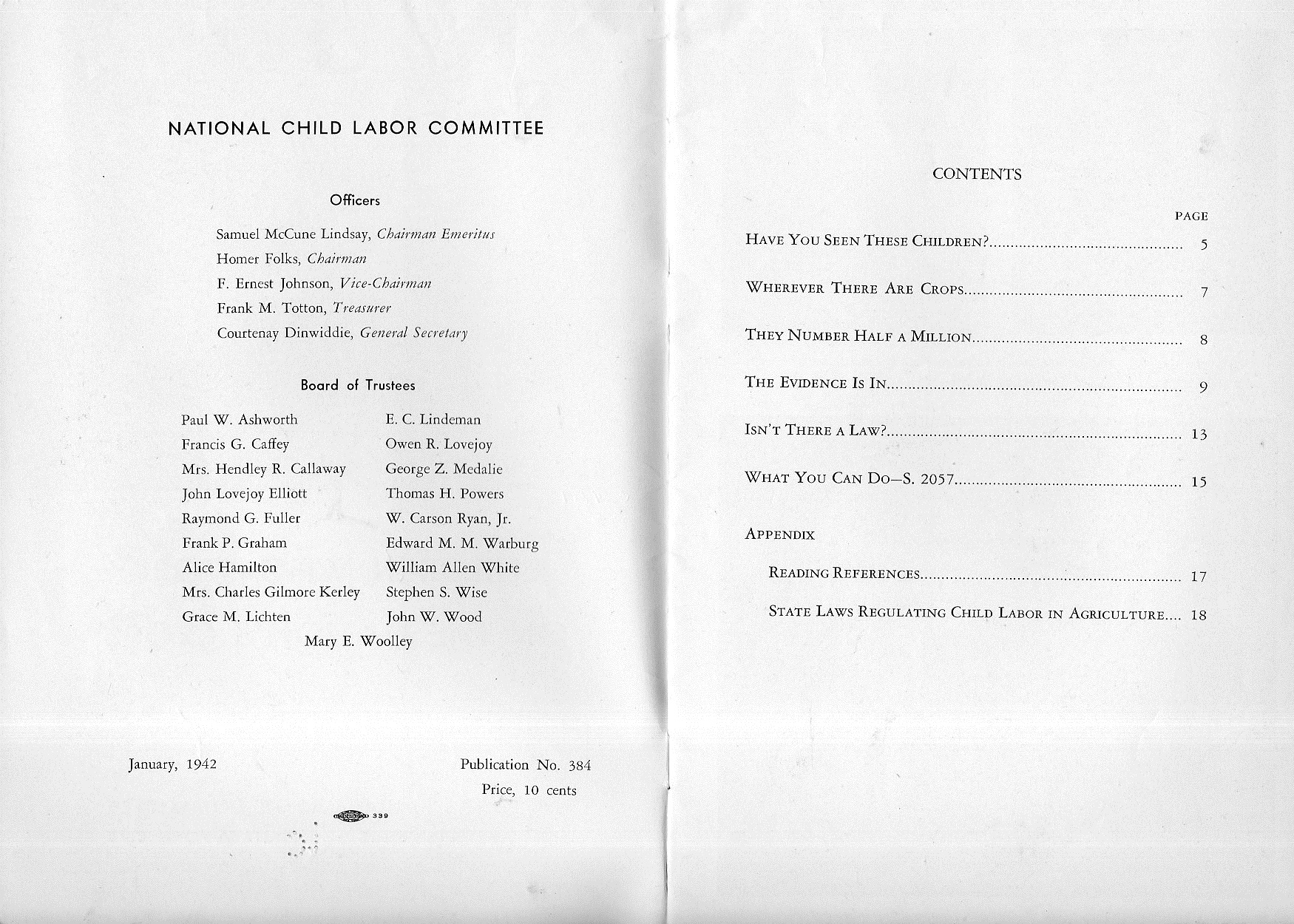
    Children Who Work in the Nation’s Crops 

    by Gertrude Folks Zimand, National Child Labor Committee, New York City  January 1942
     

    ===blog==aug 12--child work

    Children who work 1349


  • Opposing Nativist Immigration Policies, 1910

    JF Ptak Science Books   Quick Post 

    I have a pamphlet here issued by a furrier union around 1930 which vehemently denounced immigrants coming from a particular country, and described them in racist and bigoted detail for a half-page before another general rant against immigration in general; it was only after turning the page that I found out who the furriers were attacking–the Greeks.  It could have been just about anyone–especially if the printing date was unknown.  There are a number of pamphlets like that here in a small “misguided social movements” collection–it would be interesting to post a collection of the statements to see how much havoc the entry of Poles and Irish and Catholics and Jews and Greeks and Quakers and Chinese and Japanese and Koreans and Vietnamese and Italians and so on has been caused to the greatness of the United States. It might be sobering for some Wall-Builder types and stop-all-Muslim-immigration folks to read the history of anti-immigration movement and legislation and see how much of that impacted the lives of their forebearers, It may be impossible for people to believe that in certain sections of NYC in the 1920s that there were movements afoot to restrict further settlement of Norwegians, but it is true. 

    And so the reason for this recollection: the appearance of the pamphlet, An Appeal to American Citizens, published by the National Liberal Immigration League in New York City in 1910). This group was in favor of equality and acceptance of immigrants at a time when there were many very active nativist, restrictive, racist, and anti-immigration groups (and legislation), and laid out their conviction and approach very simply in this six-page pamphlet. It discusses the “victim of…prejudice” at the hands of “persons who, disregarding the teachings of religion that men should love their neighbor and welcome the stranger”. They made good arguments, and given the brevity of the publication I reprint it in full:

    ·Posted by :

    ·in:


  • Unusual Q and Unexpected A (1947)

    JF Ptak Science Books   Quick Post

    NO

    Russia expansionist223

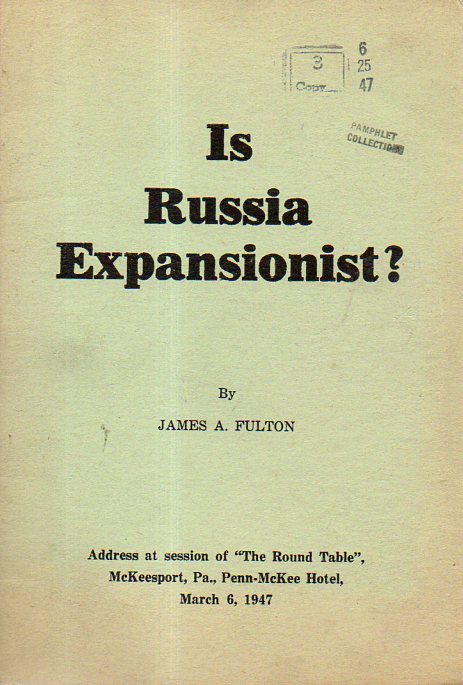
    James A.  Fulton (b. 1874) asks Is Russia Expansionist? Address at session [sic] of “the Round Table”, McKeesport, Pa and his answer is very much to his own liking: NO! No doubt self-published and then printed in 1947 Mr. Fulton asks his long-sentenced question in the first few pages and then answers it in the remaining text–his evidence is that Russia and its territories have “ups and downs” over the centuries, citing gains/losses in Turkey, Finland (somehow!), Poland (ditto!), Ukraine, and such.  It is a difficult argument to read–not doubt Mr. Fulton had his sympathizers, though in 1947 I doubt that he had many.  (The pamphlet is not “around”, and given everything going on in 1947 I don’t doubt its unpopularity–WorldCat/OCLC locates 3 copies.)


    ·Posted by :

    ·in:


  • Warsaw Uprising(s), 1943. And 1944.

    JF Ptak Science Books

    This is bound to be a great smoothing-out of a complex issue, but, well, that’s okay: I think that in spite of the simplification the result is the same. The bottom line of the Second Warsaw Uprising (August/September 1944) is that the Soviet Union allowed the Polish Home Army to fail, watching from its position across the Vistula as the Nazis and Poles slugged it out, both exhausting themselves, the Nazis ultimately defeating the Poles, eliminating most of the Soviet concern for the Polish military and government, allowing the Soviet Union to take the country over more completely when the time came a few months earlier.  It was the Soviet’s choice to see two enemies annihilate themselves to have more control over Poland and immediately turn it into a vassal state when it rolled into Warsaw in January, with 85% of the city destroyed and 600,000 of the city’s population  dead.

     Warsaw774

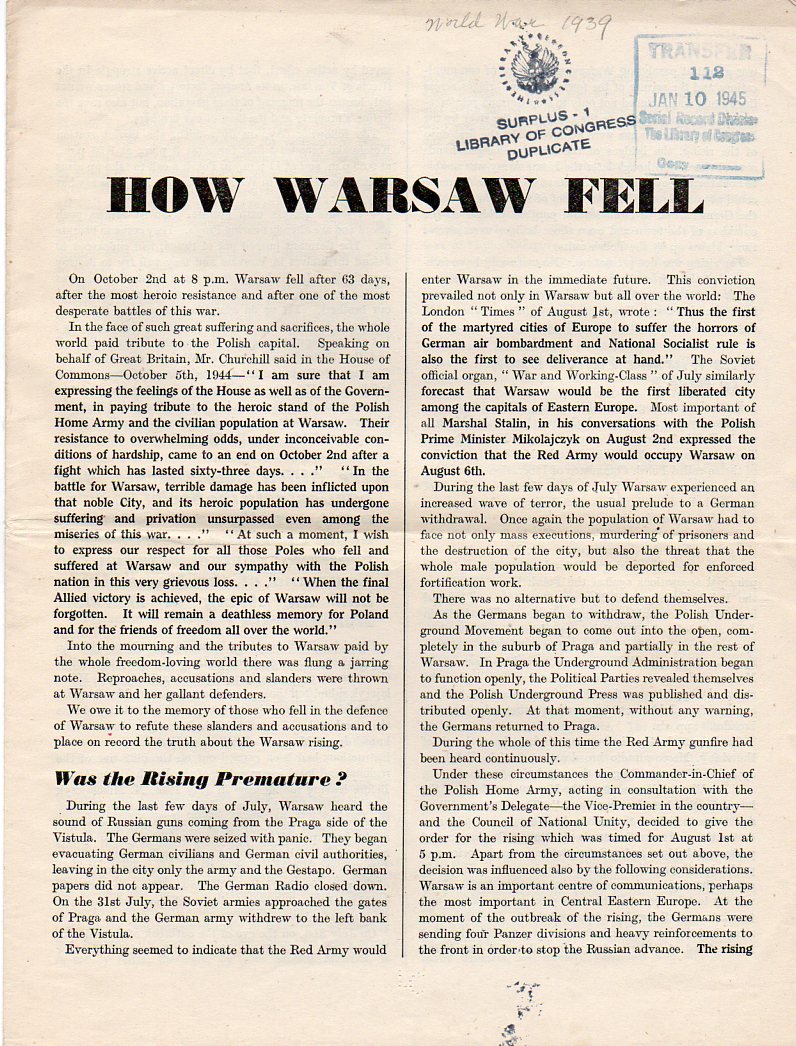
    With this in mind,  where was the Polish Home Army or the Americans or the Brits-or anyone–when the first Warsaw Uprising occurred? Absent.1 This battle–generally known as the Warsaw Ghetto Uprising–took place about three years after the Nazis established it as a means of control for the city’s 400,000 or so Jews. In the intermediary years hundreds of thousands of Jews had been “deported” (that is, sent to the concentration camps to be exterminated or worked to death), so that by the time of the Uprising only 60,000 people remained in the Ghetto.  And by this time there was no doubt in anyone’s mind who lived there (and perhaps too in Warsaw as a whole) what the euphemism of “deportation” actually meant.  The battle started off well for the home defence (the ZOB2) but, ultimately, with little access to resource and with nowhere to actually retreat or regroup in the few acres that remained of the original Ghetto, whoever was left in the Ghetto were either killed or captured by 16 May.  The German commander, SS Brigadefuhrer Jurgen Stroop reported on that day that “the former Jewish quarter in Warsaw is no longer in existence”:

       “Progress of large-scale operation on 16 May 1943, start 1000 hours.
       “ 180 Jews, bandits, and subhumans were destroyed. The former Jewish quarter of Warsaw is no longer in existence. The large-scale action was terminated at 2015 hours by blowing up the Warsaw Synagogue.
        Total number of Jews dealt with 56,065, including both Jews caught and Jews whose extermination can be proved. “

    Stroop was arrested and hanged in Poland, in Warsaw, in 1952.

    Warsaw775

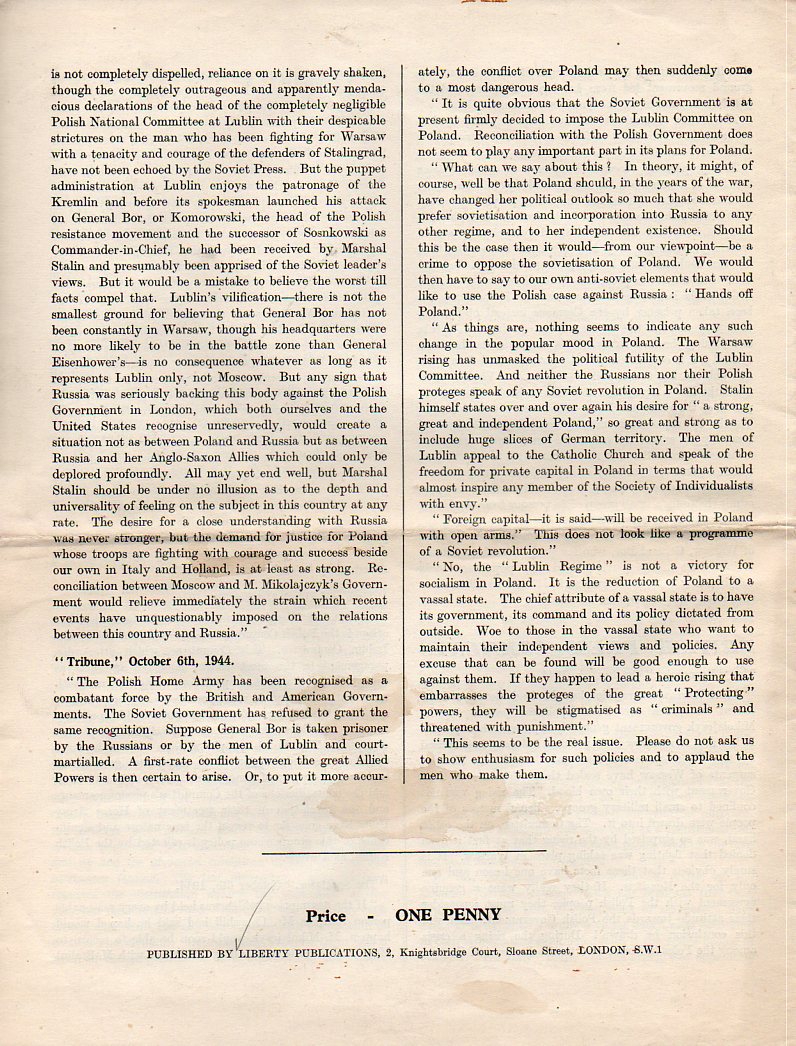
    So, this 6-page pamphlet, published by Liberty Publications in London at the end of 1944 (and received by the Library of Congress on 10 January 1945), detailed the misery of the non-recognition of the second Warsaw Uprising and the reason(s) for it. It details the travesty, the disinterest, and the political accomplishment of the Soviet Union gained by its criminal inaction. There is of course no mention whatsoever of the first Warsaw Uprising.  Selfish inaction breeds itself, consumes others and then–like yeast–consumes itself.

    Notes

    1. “WHEN THE revolt in the ghetto broke out in April 1943, all of Warsaw was aware of the fighting. The news of the revolt was transmitted to the Allied capitals by the Polish underground, but no help came for the Jewish fighters – not from the US or England, nor from the Soviet Union; not even a sign of recognition or an acknowledgement by the Allies of the battle raging in the ghetto. The Jewish fighters in the Warsaw Ghetto were unknown soldiers, isolated from the world. Only two years later, after the end of the war, did their valiant battle receive universal recognition.”–“Who Defended The Warsaw Ghetto?”, by Moshe Arens, in the Jerusalem Post, 29 April, 2003.

    2.  The ZOB  was the Zydowska Organizacja Bojowa, led by Mordechai Anielewicz, and ZZW (Zidowski Zwiazek Woskowy) led by Pawel Frenkel.

    ·Posted by :

    ·in:

    —