A Daily History of Holes, Dots, Lines, Science, History, Math, Physics, Art, the Unintentional Absurd, Architecture, Maps, Data Visualization, Blank and Missing Things, and so on. |1.6 million words, 7500 images, 4.9 million hits| Press & appearances in The Times, Le Figaro, Mensa, The Economist, The Guardian, Discovery News, Slate, Le Monde, Sci American Blogs, Le Pont, and many othr places… 5000+ total posts since 2008.

Category: Industrial & Technological art

  • Found-Art in a Beautiful Book about Pipes

    JF Ptak Science Books  Quick Post
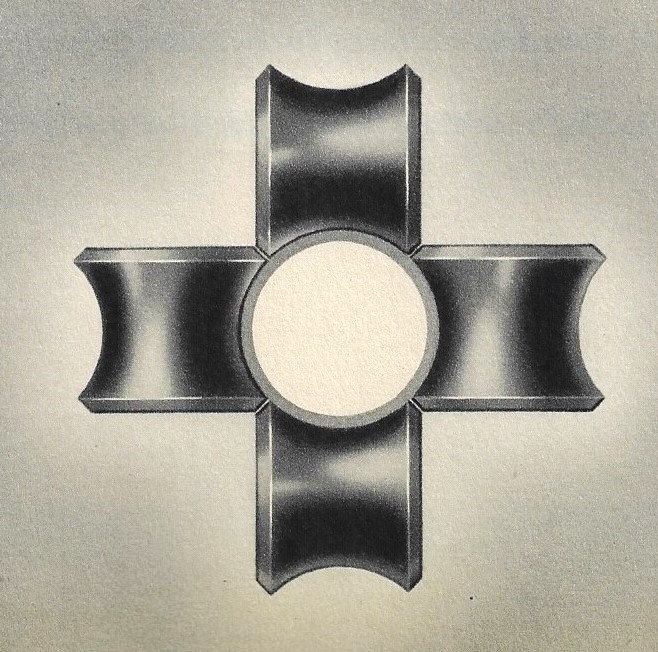
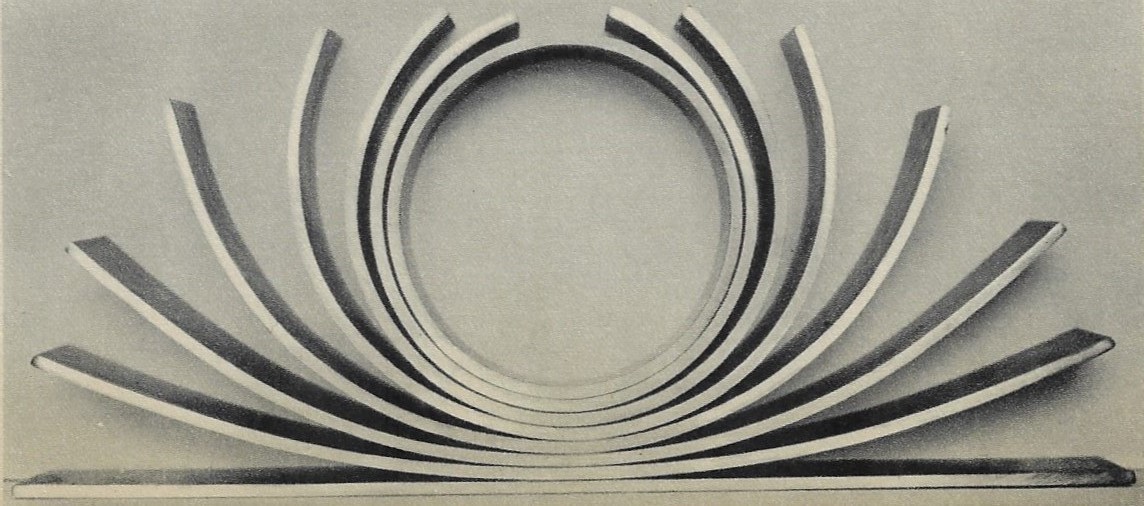
    In the long-developing series on Found Art (categorized here under “Absurdist, Unintentional”, a header that certainly needs changing) is today’s entry: two designs in the unintentional abstract, like a sort of colorless color school Barnett Newman…or perhaps not, maybe they’re more like Duchamp readymades, though heavier. In  any  event,  The  Pipe  of  Progress,  published  by  the  advertising  department  of  Republic Steel in  1940,  is unexpectedly  quite  lovely,  which  a number  of  Bernice-Abbott-like photos  plus  the  already-mentioned  Found  Art.  For  example,  here’s  a cross  section  of  pipe  in  the stages  of  pre-wielded  shaping:                

    Books covers pipes _2_

    And another image showing a cross section of  pipe as it is cold-shaped to its final diameter by one of the series of rollers

    Books covers pipe detail roller

    And the cover of the work:


  • A Giant Metal Kraken Worm, Beast Among Beasts: a Tunneling Machine, 1862

    JF Ptak Science Books  Post 2790

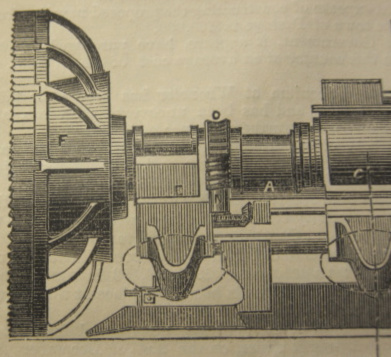
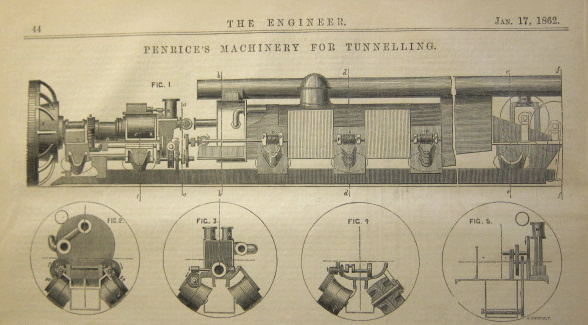
    This enormous  piece of machinery was designed and patented by Hubert Newton Penrice (of Norwich1) in 1862 for “tunneling and driving through rock and other strata”. The section labeled “F” is obviously the grinding business-end of the beast, meant to turn with a “variable” speed–what we see here is the outermost set of teeth which surrounded an unspecified number of smaller concentric cutting plates.  I imagine that if you looked at this machine straight-on from the front you’d see a number of concentric rings of hundreds of steel teeth, which immediately makes me think “Kraken!”, though this one is underground, boring its way through rock. No specifics are given for dimensions, though my guess would be that the cutting face had to be at least 8′ (?), meaning that the entire machine was on the order of about 50′. 

    Originally the steam-driven machine was powered “at a distance” though in this version the boiler and engine are right there behind the cutting face and a  car powered to inch froward as the tunneling is done.  The boiler would supply several engines–one to drive the cutting wheels, another to feed the machine that “swept” up the cut stone and directed them towards the back of the outfit another to power the forward motion of the whole thing to put pressure on the cutting face, and I think several more.  That long shaft along the top of the unit is for “waste steam” that would direct (some!) of the smoke and heat towards the rear and eventually out of the tunnel, somehow. 

    I don’t know how many workers it took to operate this thing and make it all work, and I find it difficult to imagine working in a cramped, hot, loud, dangerous and uncertain situation as this, and have it all underground and powered by steam. 

    The only thing worse that I can think of–outside of pure disaster–is failure: what happened if the thing got “stuck”?  

    • “On each axle is a screw or worm wheel and there are two parallel shafts one on each side of the boiler with worms or screws thereon there being one worm for each of the wheels by this means a slow motion may be given to the wheels and the machinery may thus be moved towards the face of the work. The speed at which the screw shafts are driven is capable of being readily varied in order to suit the varying strata and in order to be able readily to adjust the progress of the machine to the quantity of work which the cutters are enabled …”–from the article.

    Engineer 1862 tunnel cutter detail

    [Source: The Engineer, volume 13, January 17, 1862, p 44.]

    Engineer 1862 tunnel cutter full copy


    And by the way, the article identifies Mr. Penrice as being “of Wilton House, Norwich”, and so I looked that up:

    Wilton house

    Source: http://wiltontown.com/feature/wilton-house/


  • Submarine Cross Sections

    JF Ptak Science Books   Quick Post

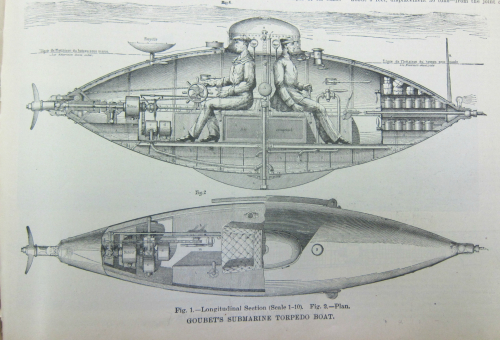
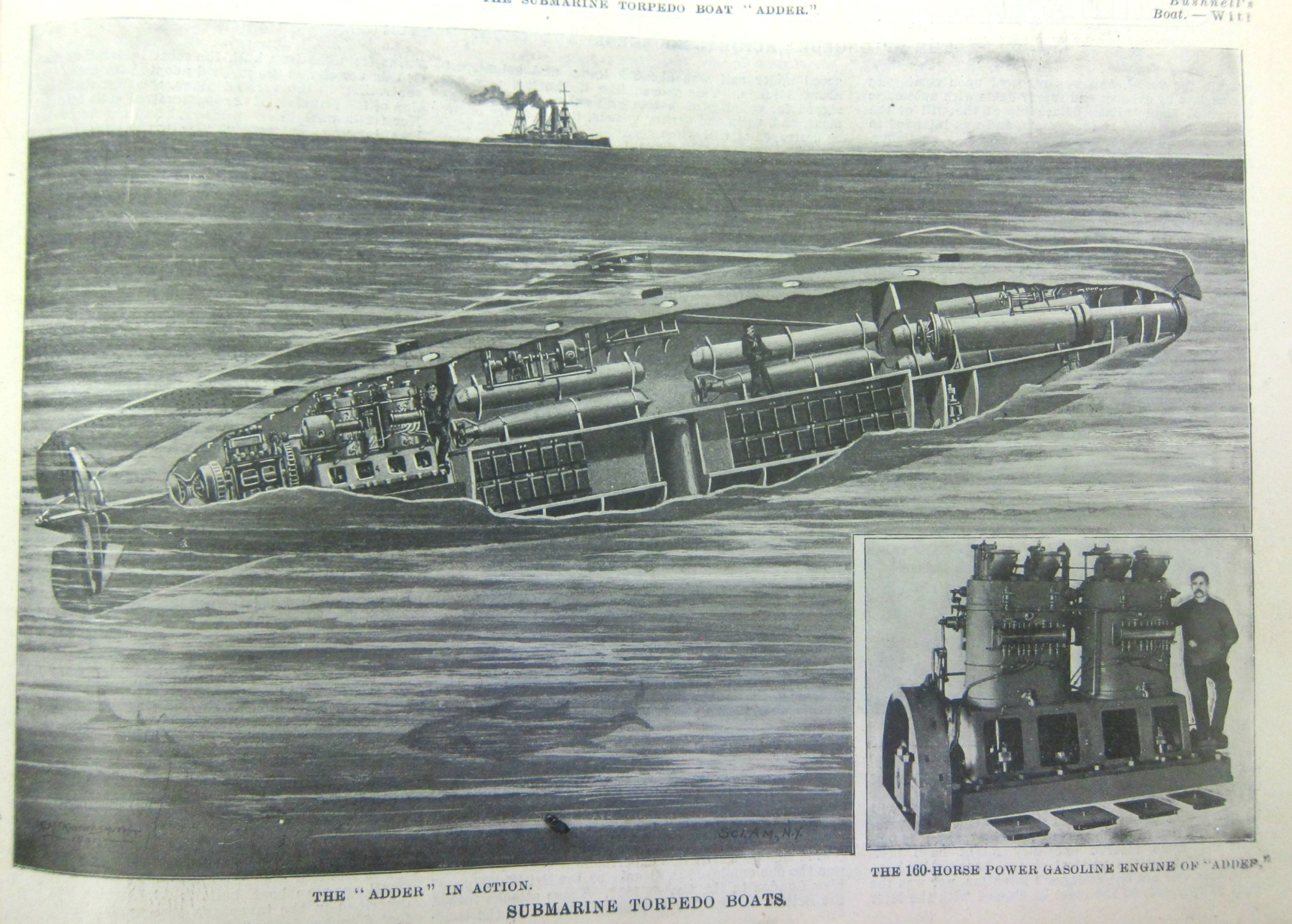
    This is a simple post adding to the collection of cross-section and cutaway images on this blog (see  https://historyofideasblog.com/thesciencebookstore/crosssections/ ). All of the images below are found in the February 15, 1903 edition of Scientific American Supplement: 

    Subnarine 4

    Subnarine 4


  • The Luminous Electric Flux at the Beginning of the Tunnel (1849)

    JF Ptak Science Books  

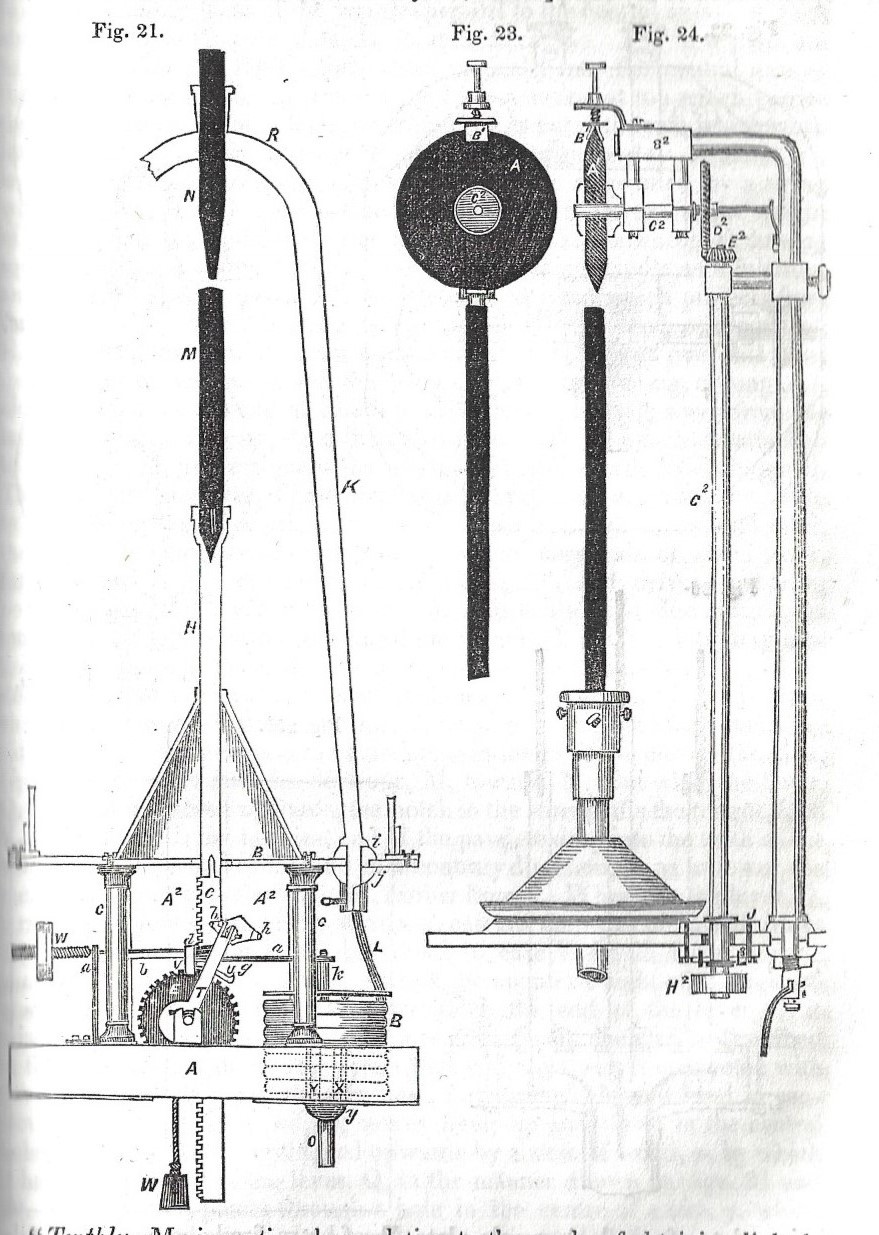
    JFI 1849 electric light StaiteOil lamps and candles are ancient, with candles being the junior in age at about 5000 years old compared to oil’s 6500 or thereabouts. So the introduction of an artificial source of light that was not based on these technologies and which took, basically, thousands of years to come to was an extraordinary occurrence.

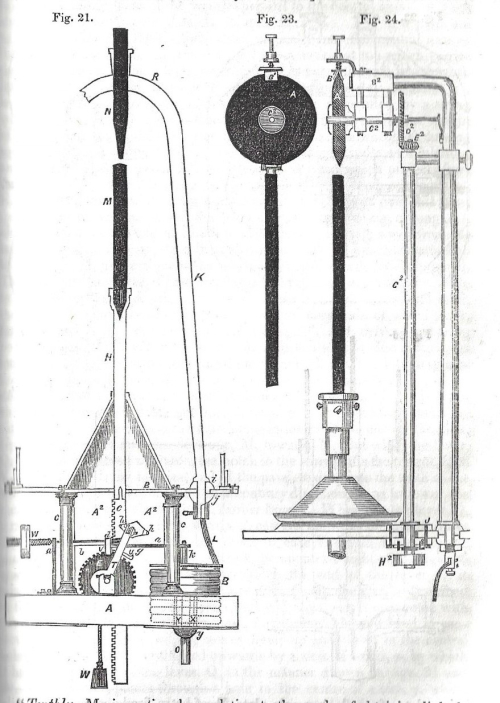
    Humphrey Davy introduced the idea of the carbon arc electric light in the first decade of the 19th century. His light was successful if not practicable, as the electric source was a battery made of a series of a thousand or two liquid cells, though there was a much more practical public display of the idea in the ‘teens. The subject of this short post, William Staite1, enters the electric light arena in the 1840’s with no real scientific background and proceeded to make some impressive improvements, proving himself a thinker with the ability to design and construct the precision elements.

    Like all the others at this time he achieved very limited success given the problem of the electric power source—that would not be solved for another couple of decades with electric generators.

    Anyway I’m stopping by here to share the fine and beautiful drawings from Staite’s patent. Basically the light was produced in the gap between the electrodes (between N and M in the first figure) right there in the open air (as well as the ends of the electrodes/carbon rods that became heated and glowed, though this light source was minor). This actually looks a lot like some of the arc lighting used presently in projectors and searchlights and such, though with far more efficiency and lumens—also the arc is passing through a gas, like xenon, under high pressure to produce “sun-like” light.

    Staite tried to monetize his idea but with little success, and was dead by 1854…and seems to have passed into obscurity. His name is seldom mentioned, it seems, in any of the popular timelines/chronologies/histories that I’ve pecked around with online. But he was certainly there and made valuable contributions to that technology, though the effort would soon switch in the 1870’s to the incandescent bulb, and by 1880 Edison would introduce a successful little number who filament would burn for 1500 hours, and then the race was on.


    Notes:

    1. (William E. Staite), “Specification of Staite’s Patent Electric Light, [Patent dated July 13, 1847—specifications enrolled July 13, 1848.]” in the “Specification of English Patents sections, in Journal of the Franklin Institute of the State of Pennsylvania, devoted to the Mechanical Arts, Manufactures, General Science, and the Recording of American and other Patented Inventions, printed in Philadelphia at the Franklin, 1849; volume 17, third series, whole no. 47, pp 263-268, with 8 small woodcut figures of the apparatus.

    “W.E. Staite (1809-54) and W. Petrie (1821-1904) were pioneers of electric lighting who received little recognition for their work. Although a satisfactory self-regulating arc lamp was developed, commercial success was not achieved owing to their reliance on primary batteries as the only source of power. Numerous demonstrations were given throughout England, and serious interest in their system of electric lighting was shown by railway companies and dock authorities. The death of Staite in 1854 brought to an end these early attempts to use electricity for illumination.” And: “The pioneers…were finally defeated by the limitations and the expense of the primary cells which were their only source of electrical energy. –“Staite and Petrie: pioneers of electric lighting”, G. Woodward, in IEE Proceedings A – Physical Science, Measurement and Instrumentation, Volume: 136 , Issue: 6 , Nov. 1989.

  • How to Straighten the World’s Tallest Chimney (1860)

    JF Ptak Science Books   Quick Post

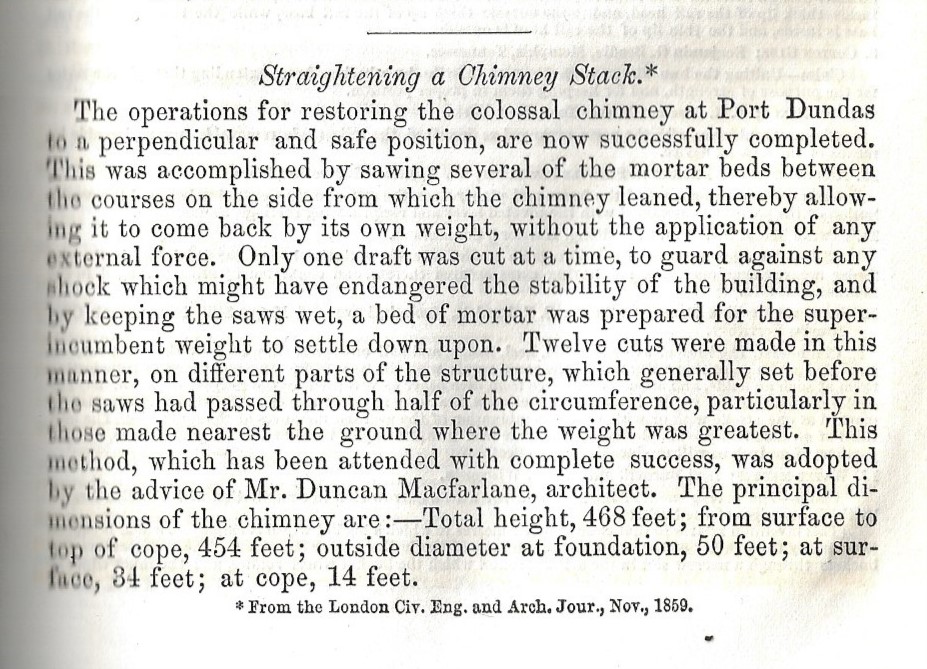
    JFI 1860 straightening chimneyThe running title at the top of the page in the Journal of the Franklin Institute (September 1860) reads “Straightening a Colossal Chimney Stack”, which attracted my immediate attention. It was constructed in 1859 in Port Dundas, near Glasgow, Scotland, and evidently needed some help in being straight-out perpendicular. The chimney was 454′ tall, and the tallest in the world–it was also one of the tallest masonry structures in existence. And it needed straightening. 

    “The tallest chimney was built at Port Dundas, Glasgow, Scotland, 1857 to 1859, for F. Townsend. It is the highest chimney in the world, (454 feet,) and one of the loftiest masonry structures in existence. It is, independent of its size, one of the best specimens of substantial, well-made brickwork in existence.”-­September 8, 1895, Page 17, The New York Times Archives

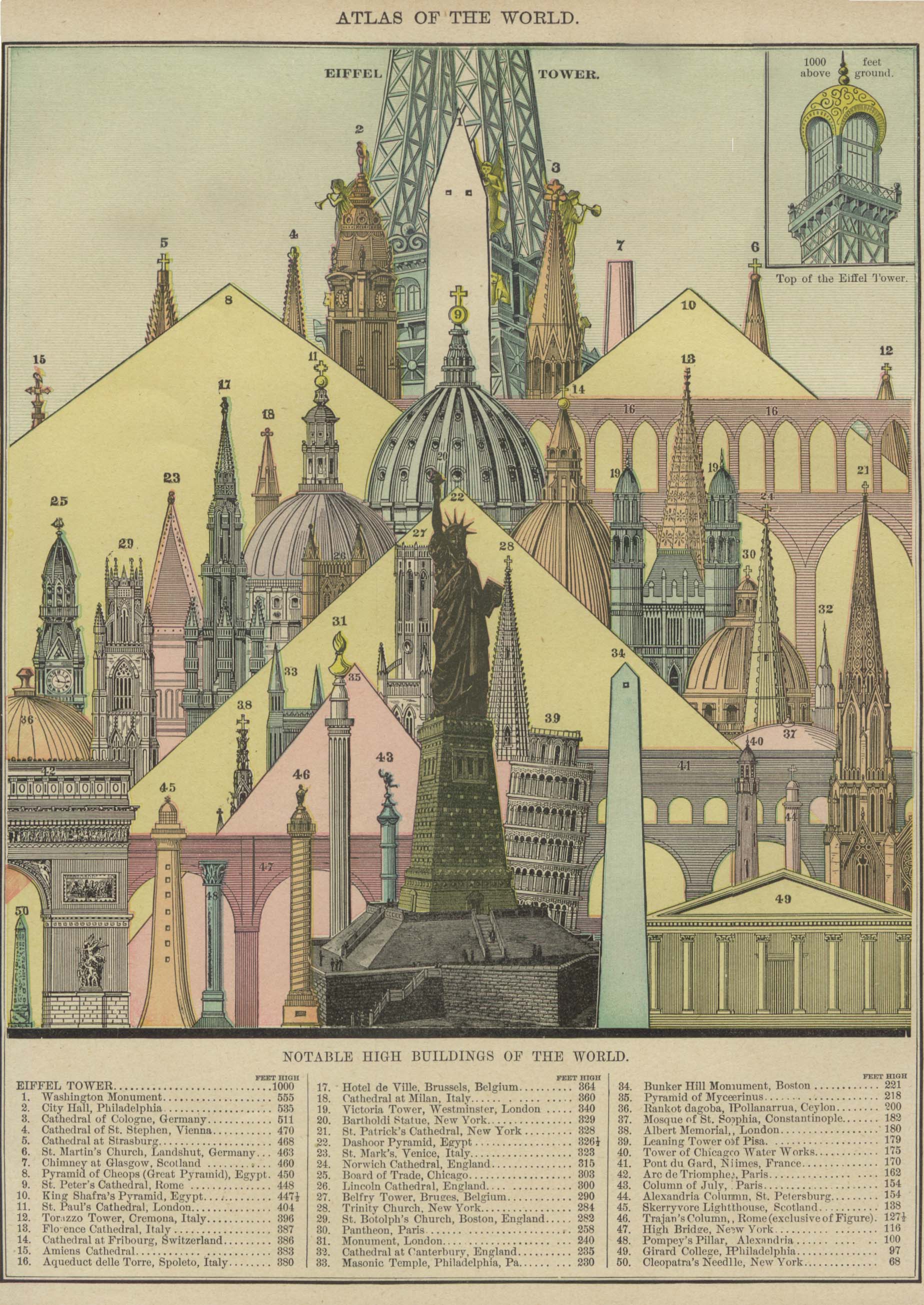
    The structure turns up in this delightful illustration of the world’s tallest structures in  Rand, McNally & Co.’s Universal Atlas of The World. Edition 1896 (as #7):

    Dataviz tallest buildings


  • The Fossil Record of Duchampian Motion–an Early Image in Spatial Time (1884)

    JF Ptak Science Books   Post 2747

    MArey May 1884_2_

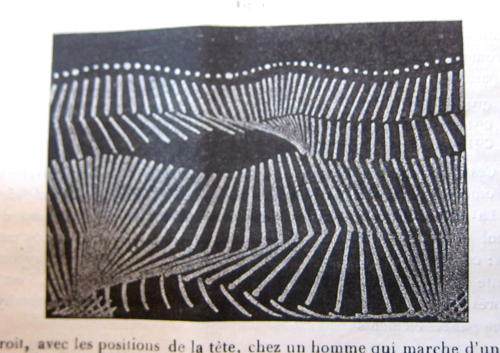
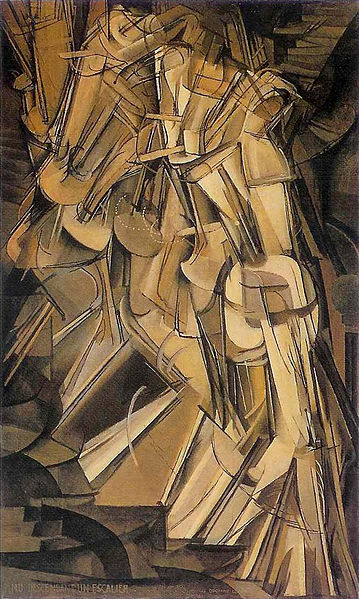
    This is one of those times where science precedes art–that’s the least significant aspect of this image, as the folks seeing it in 1884 couldn’t see into the future didn’t know that they were looking at what may pass for prehistoric fossil record of Duchamp’s 1912 Nude Descending.  The Duchamp would cause trial and occasional outrage in much of the artworld due no doubt to it challenging aesthetic–I don’t know what the readers of the Compte Rendus thought when they saw this image, but I suspect it did not involve evaluating its artistic impact.

    This is the work of Etienne Marey (who has made a number of appearances on this blog), a very smart and versatile guy who would go from physiology to cinematography to aerodynamics in the course of his life and be a leader/pioneer in each field.  Marey published this “strobophotograph” in his article “Analyse cinematique de la marche” in the Comptes Rendus on 19 May 1884–this was a brilliant effort in the analysis of human locomotion by making a dozen or two exposures on a single photo sheets of a reflective-outlined walking figure. This was different from Marey’s birthyear and deathyear buddy, the other motion picture pioneer, Eadweard Muytbridge (1830-1904 for both). Marey introduced his “chronophotography” and studied aspects of movement and motion that had been dispersed to human history because of the inability to observe and record them–with Marey, that issue necessary for the beginning of real scientific discourse was to a large extent solved. 

    Duchamp_-_Nude_Descending_a_Staircase

    Marcel Duchamp’s Nude Descending a Staircase, 1912, via Wikicommons

     There are more applicable Marey images for the Duchamp–for example his series on a single sheet of a naked woman descending a short set of stairs–but the image above has more aggregated motion in a confined space sense to it, so I’ll stay with the sense-impressions than the more-visual ones. 

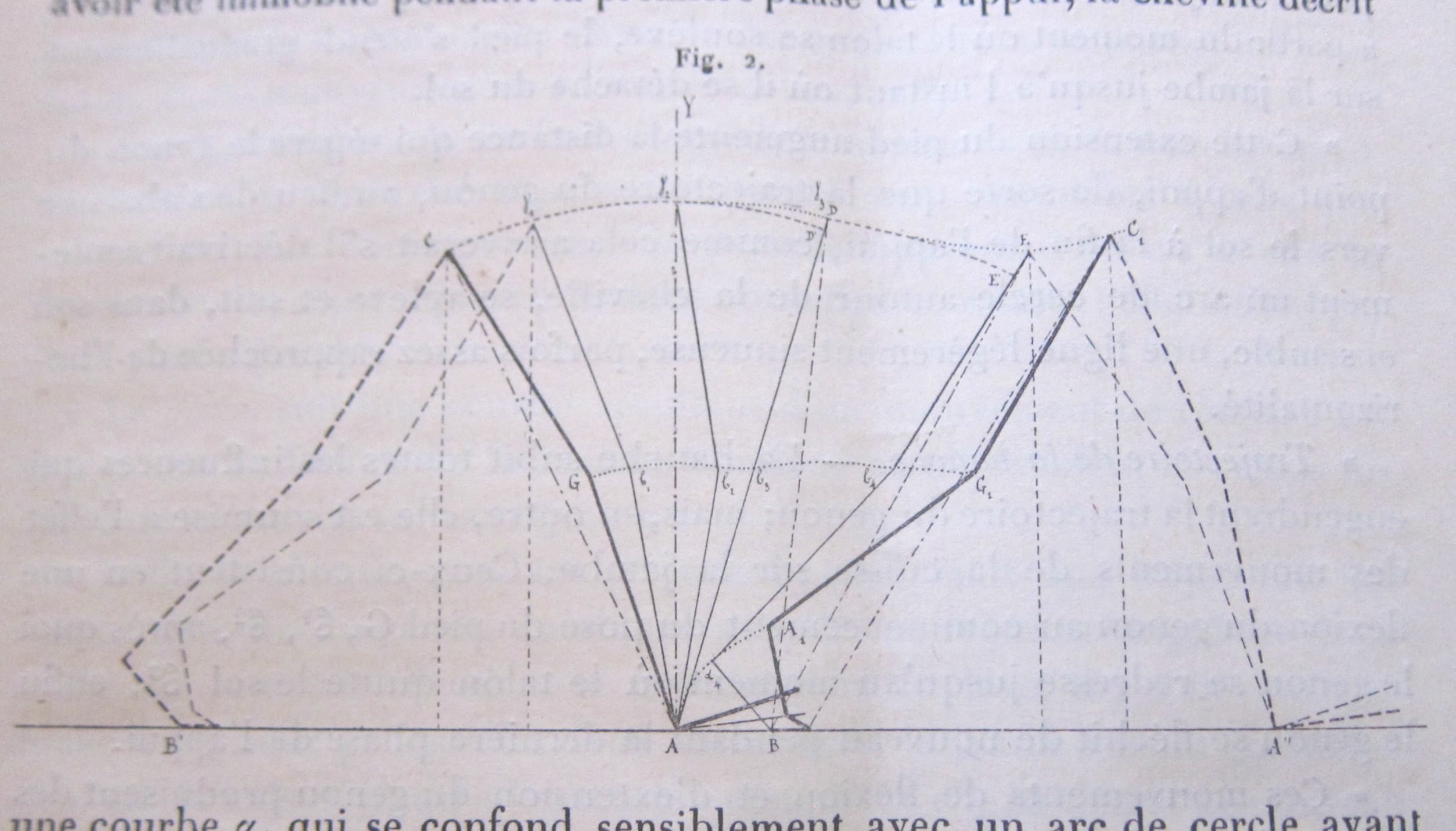
    And here’s Marey’s  modeling of the action:

    Marey May 1884

    In any event, I just wanted to pass on this quick note on some seldom-seen Marey images…


  • Found-Art in Scientific Journals–Lonely Little Light (1926)

    JF Ptak Science Books  Quick Post

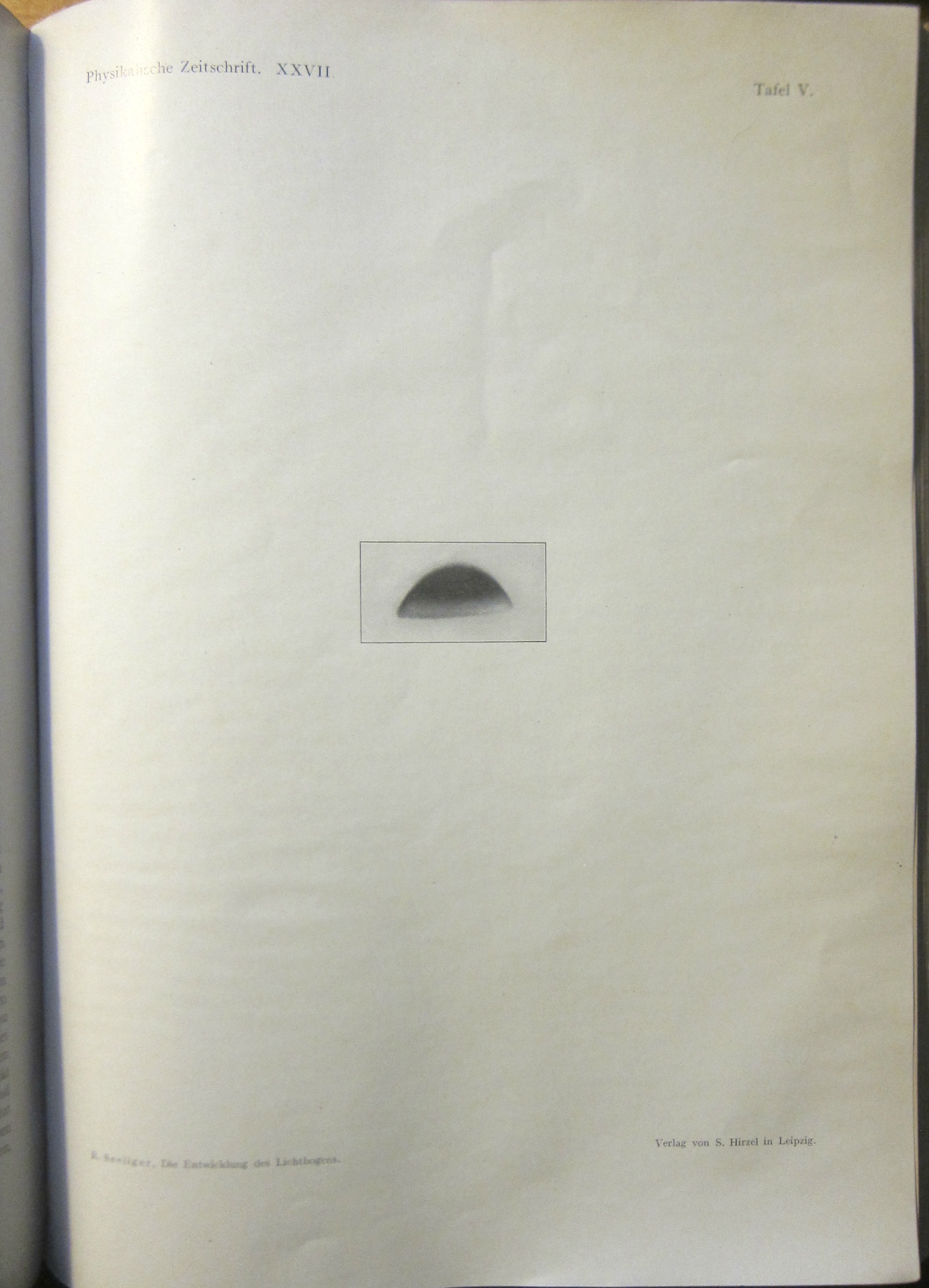
    There haven’t been that many entries in the scientific journal found-art category on this site, and it seems that mainly the artworks found/noticed have occurred in the Annalen der Physik, Scientific American,  and Nature. Hunting for something else (as is usually the case) I found this lovely bit of design in Physikalische Zeitschrift, volume 26, 1926 (page 731, plate 5), illustrating an article by R. Seeliger on the electric arc, “Die Entwocklung des Lichtbogen”. It isn’t so much that the image itself is interesting for the sake of found-art–rather it is its placement, and the lack of almost anything else, and the pleasure of it being surrounded by pretty much nothing that makes this image so artful (or at least noticeable) to me. 

    Phyz Zeit 1926 arc

    There is a bit of an unusual history about the priority of discovery of the electric arc, though that notice usually goes to Humphrey Davy in 1802 and 1809. There was earlier work in 1802 by Vasily Petrov (d. 1834), but even at the time his experimentation was obscure and not much shared. I only mention this because of the line that leapt from the “page” of the Wiki entry for him, saying  “…soon after his death he fell into oblivion in Russia”, which seems pretty harsh to me, however true it may be.


  • The Great Passaic Textile Strike of 1926–H.L. Mencken’s copy

     JF Ptak Science Books   Post 2705

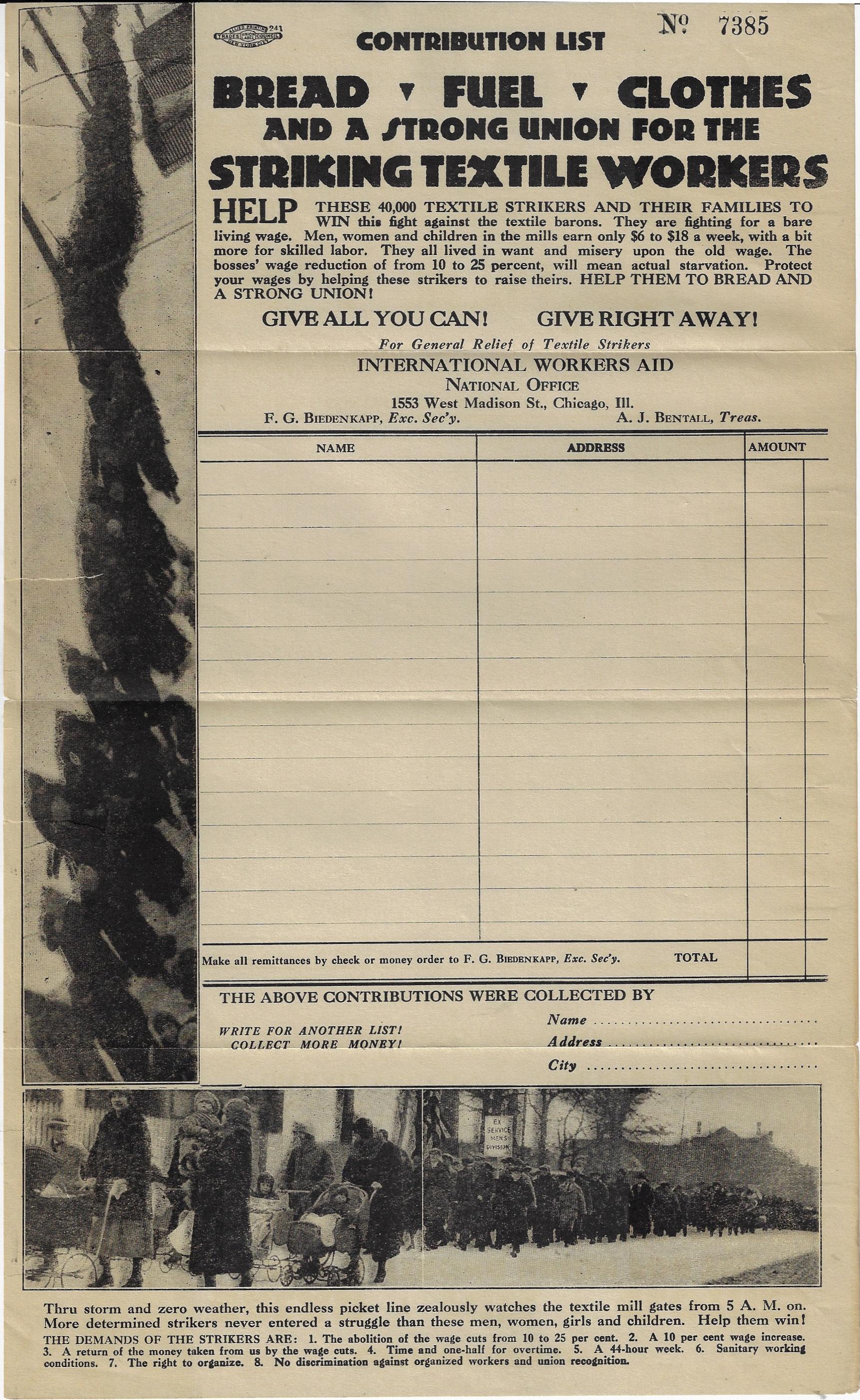
    This broadside was an appeal to like-minded people to contribute to a fund to help relieve thew dire conditions of textile worker strikers in Passaic, New Jersey, in 1926.  There were more than 16,000 people involved in this sometimes-brutal strike, people who were trying to stay even in their lives, looking for a little more money and a little better working conditions than what they had.  The Passiac (a working city just south of Patterson in an industrial triangle section of the state) strikers were moving against a number of textile (wool and silk) mills there, trying to force management to pay them something closer to the $1400 annual income for a family of four to survive. \

    Most workers there were making $1,000-$1,200 a year ($800-$1,000 if the worker was a woman, and about half of them were) for 50+ hours of labor per week.  The result was that the workers could not afford good housing and food, and those disadvantages paid off in high rates of tuberculosis, very high incidence of child mortality, and a low average life expectancy.  The strike began slowly in January 1926, with the mills responding with vicious attacks by paid thugs and by police. 

    Passaic Strike

    [Measures 8.5×14″]

    There’s quite  a bit written on this strike, and most seem to say that it was an important event in the history of “labor relations”, and that it was the first time that a Communist-led strike succeeded in the United States, (There is a complex legacy as to who the leadership was for this strike, but the end result is that, at the end, the Communists were in charge.)

    But what I wanted to say here about this broadside was the communal effort involved with keeping the strikers (and the strike) going.  The strikers needed money to live, as there was certainly no money coming in, and since there was obviously no union, there was no general fund from which any of these families could draw food money from). they needed money just to buy food and pay for housing.  SO the call for “Give all you can!” and “Give right away!” were as desperate as they sounded.  My guess is that there would be a representative of the International Workers Aid society national office going from factory to factory, or door-to-door, soliciting for money for the Passaic workers’ relief.  The strike was no doubt a very nasty business, with a victory only a victory once there was more food on the table, less illness, and far fewer babies dying from preventable causes. Probably this looked like a victory to others so far as the future of fair labor/pay was concerned, but not so much for the strikers who brought this about. 

    It is also interesting to note that this copy was given at some point to H.L. Mencken, who gave it right away to the Library of Congress, where it wound up in a forgotten “Pamphlet Collection”, and then sold to me (years afterwards).

    Passaic strike279


  • TubePunk–Electronics Returns from War (1946)

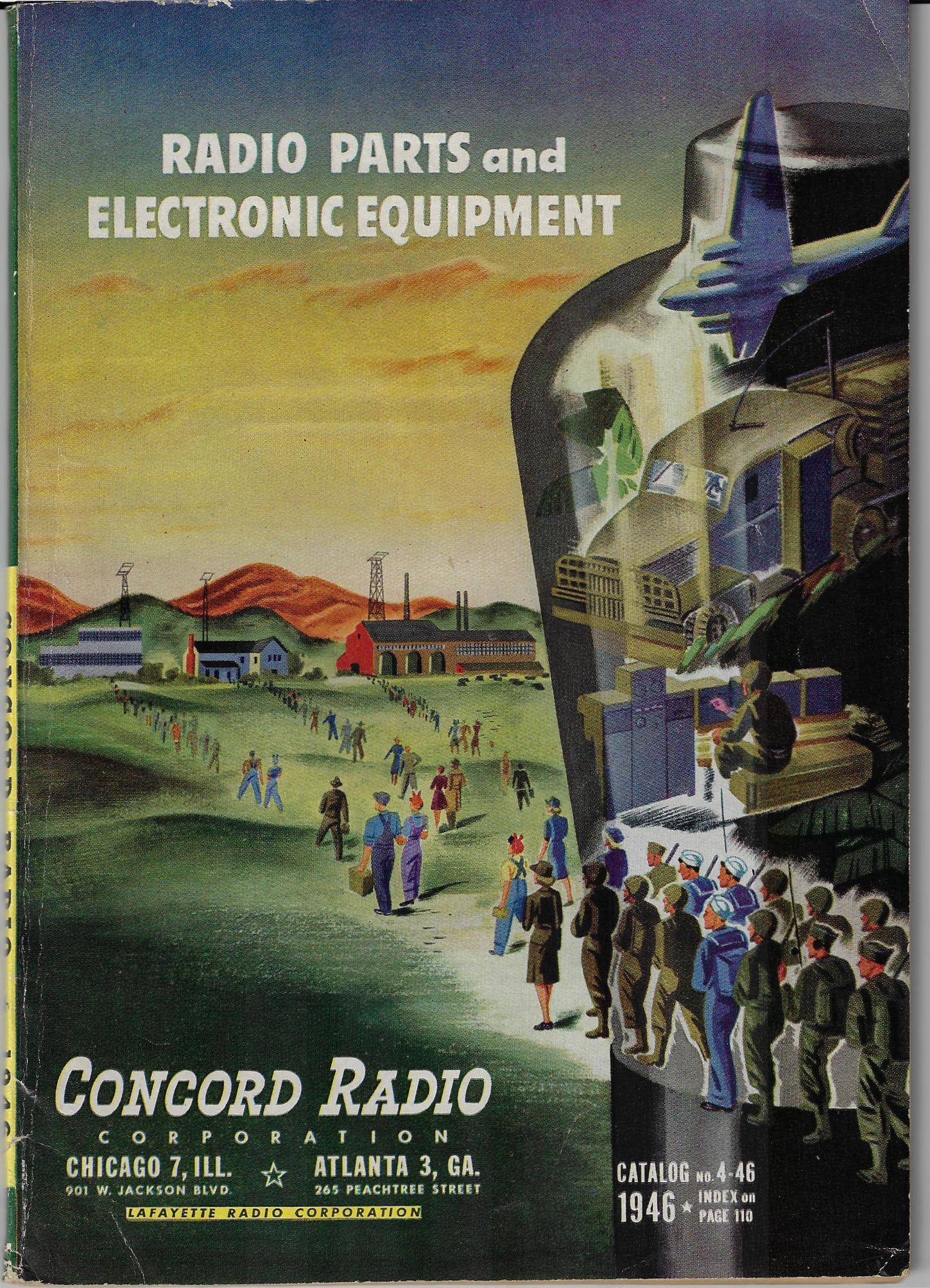
    Book covers electronics reutn from the war 1946JF Ptak Science Books  Quick Post

    Of the numerous things that “won the war” for the Allied forces–besides Churchill, and Roosevelt, and millions of Soviet soldiers, and Eisenhower, and V Bush, and cracking Enigma and MAGIC, and the enormous production capacity of the U.S., and so on–there was “also” the warm electrical/dusty scent of active vacuum tubes, which somehow always remind me of “precision”. The importance of RADAR I think cannot be overstated, plus SHORAN, and the Harvard Mark I, directional finders, and etc., all combined into a massive electronic war-winning effort that certainly helped define victory in WWII.  

    This is sorta what I was thinking about when I saw this lovely Concord Radio catalog for 1946–the enormous vacuum tube in which various military ops were happening, and then the troops marching out of it on the bottom, back into civilian life, carrying the promise of the new electronic world with them to home, industry, and business, and that electronics was here to stay.  Another “here to stay” thing here was the female worker–if you look closely at the crowds returning to their lives-left-behind there is no shortage of women, which I think was pretty progressive for 1946.  


  • Dramatic Cutaway / Cross Sections of Two Great RAF Fighter Planes (1939)

    JF Ptak Science Books   Quick Post

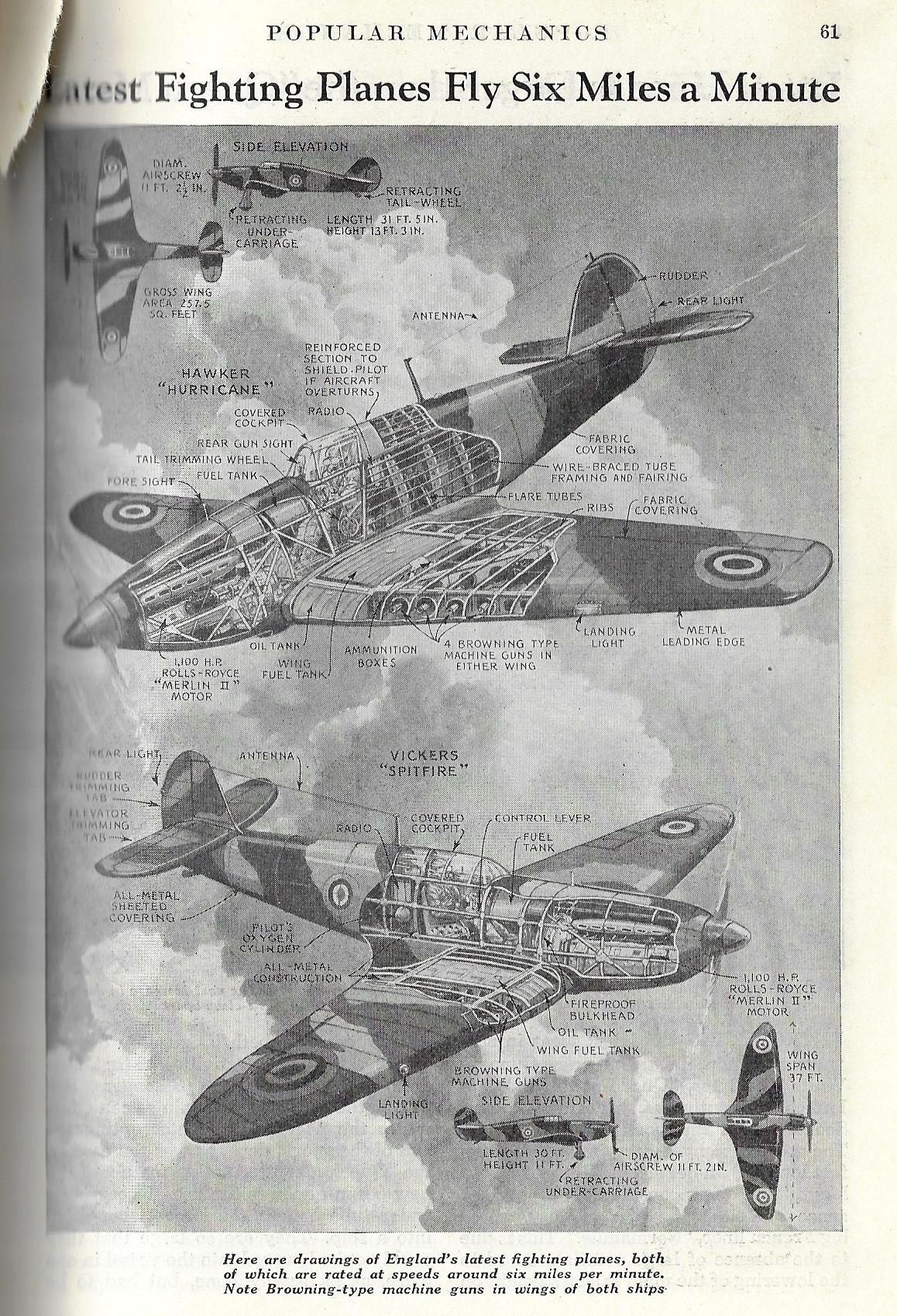
    Here’s an interesting and artistic cutaway of two of the great planes of the R.A.F., the Hawker “Hurricane” and the Vickers “Spitfire” (appearing in Popular Mechanics, 1939):

    Cross section 1939 Spitfire Hurricane