A Daily History of Holes, Dots, Lines, Science, History, Math, Physics, Art, the Unintentional Absurd, Architecture, Maps, Data Visualization, Blank and Missing Things, and so on. |1.6 million words, 7500 images, 4.9 million hits| Press & appearances in The Times, Le Figaro, Mensa, The Economist, The Guardian, Discovery News, Slate, Le Monde, Sci American Blogs, Le Pont, and many other places… 5000+ total posts since 2008.

Category: Questionable Quidity

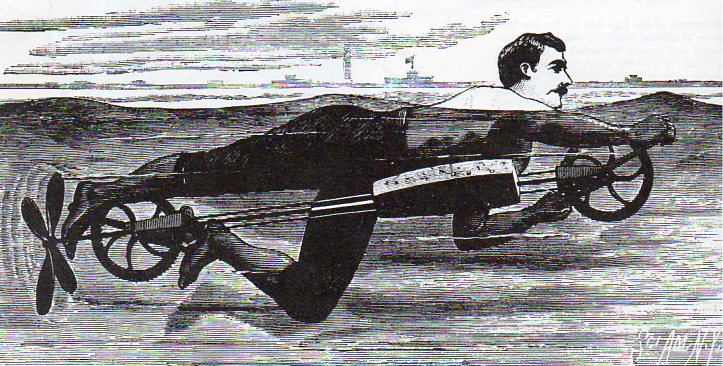
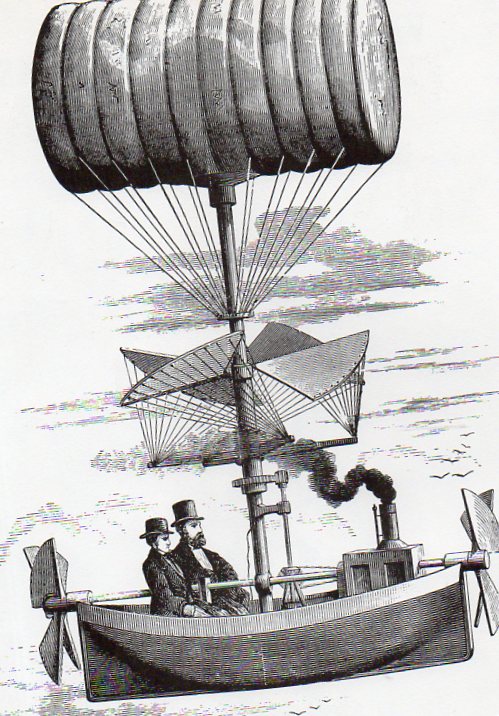
  • A Few Examples of “Heavy Stuff”: Patent Drawings for Flying Machines, 1877-1900

    JF Ptak Science Books  Quick Post

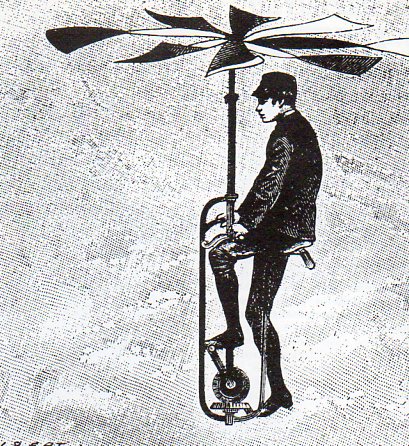
    This is as beautiful as it is heavy; and it is in its way very beautiful, so I guess that also means that is is very heavy…

    And speaking of heavy, this balloon doesn’t seem large enough to lift the very heavy ship-like carriage:

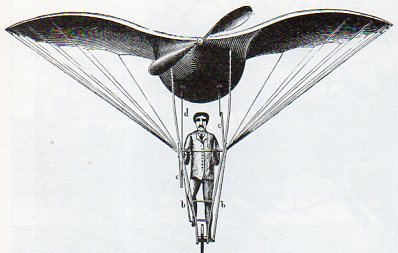
    Another flying boat:  I don’t see a power source to drive the “fans”/propellers on this one, though there is a tail for its “kite” body:


  • Child Straigtener & Other Edwardian Cyborg Bits: Patent Reports

    JF Ptak Science Books   Post 1549

    (The following images are taken from the U.K. Intellectual Property Office Espacenet patent search page, here. The quotations following the illustrations for the patents are from that page.)

    Close Straightening Encounters for Children of the Reading Kind

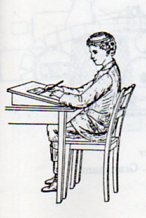
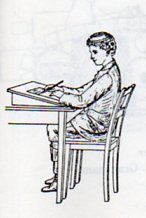
    Here’s an interesting implement that no doubt brought secondary thoughts about reading to any child made to wear this thing–the unhappy child is at left, and the skull-cap, at right.
     
    Yborg578

    First page clipping of GB 190421618 (A)

    Abstract of  GB 190421618  (A)

    “Lorenz, H.. For indicating when wearer deviates from an upright position; caps.-A cap I is made in the form of an inverted bottomless saucer with holes 3 in the side for lightness and ventilation. It is intended to be worn by school children to prevent stooping, inasmuch as it only remains on the head so long as the wearer remains in an erect posture…”


    Hand Guard for Cutting Things


    First page clipping of GB 190402703 (A)

    Francis John Crell: GB190402703 (a) “A Hand Guard for use in Cutting Bread and for Other Like Purposes”.  I’m not sure how this works as a glove-protective unit  given the spaces in-between the springy fingers–mostly it seemed to increase the cutter’s grip rather than protect them for accidental cutting.


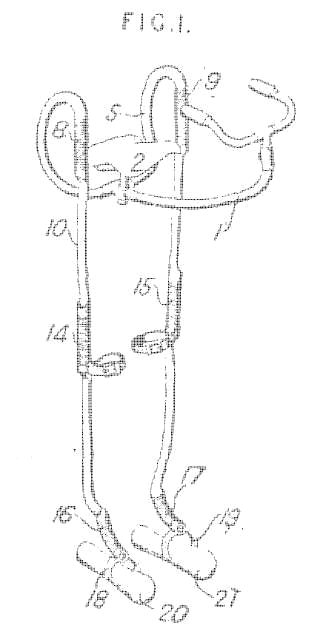
     Walking and Running Anti-Deformation Appliance
    Patent Brit walking running machine

    Abstract of  GB 190414477  (A)

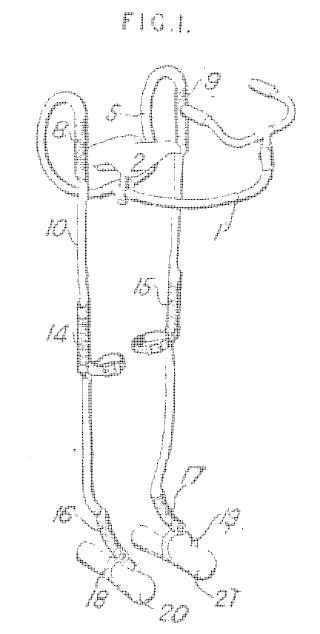
    “Skorzewski, Comte V. Walking and running, appliances for aiding.-A n appliance for aiding walking and running is adapted to store up, and to give up at the required moment, the energy resulting from the alteration in height of the centre of gravity of the body. The user sits on a saddle 2 adjustably attached to a tube 1 provided with handle – bars. The tube 1 branches into two tubes 5, which are connected by joints 8, 9, 14, 15, 16, 17 to other tubes of narrower crosssection, conforming in shape to the legs of the wearer, who is strapped to the appliance. The joints 16, 17 are connected by means of stirrups 18, 19 to soles 20, 21, or to straps by means of which soles may be attached to the appliance. The tubes are filled with compressed air through a suitable cock or valve. The joints are preferably formed of armoured rubber tubes, coated or not with para rubber.”


  • Duelling Propulsion Systems: Patents for Swinging on a Swing, Sushi Boats and Retro-Pseudo-Mayan Space Ships

    JF Ptak Science Books   Quick Post in the Questionable Quidity series

    I came across these bits looking for spacecraft propulsion systems, and was surprised to find so many, well, “questionable” applications of brain power and time. Sushi boats for lazy eaters? Non-proto-Mayan naive electromagnetic spacecraft?  Swinging (on a swing)?

    I thought the swinging patent was a joke; it seems not to be.  Isn’t this like, say, patenting walking by using shoes?

    The least and the most one might say for the sushi boat is that it is powered by water, though I’m not entirely sure what else there is to be said; seems a little close to being a trough for my taste, though I have to admit that I’ve never had an experience where I pluck my food froma  moving object.  Perhaps if the little boats were on fire it would be more attractive?  Or if there were submarines? 


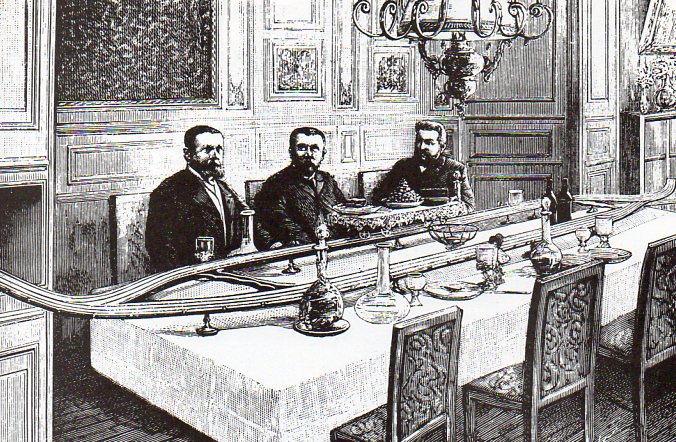
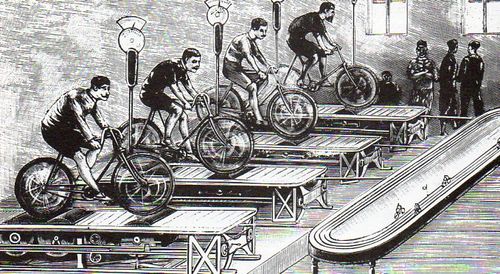
    An earlier version of this idea from 1887, showing the use of “midget electric trains” “at the kitchen and dinner-table of M. Gaston Menier”–somehow this is a little more appealing, though the prospect of eating on a miniature railway track is not all that appetizing:

    Propulsion536

    This is an interesting variation of the two bits above, though (surprisingly!) there is no food involved:


    Propulsion531

    Back to sushi:   evidently a much bigger idea than I gave it credit for: 


    And from America:


    There were many other novel and noble efforts in the area of propulsion, particularly in the late 19th century, a few lovely examples of which can be seen here: 

    Propulsion532


    Propulsion533

    Propulsion534


    Propulsion535


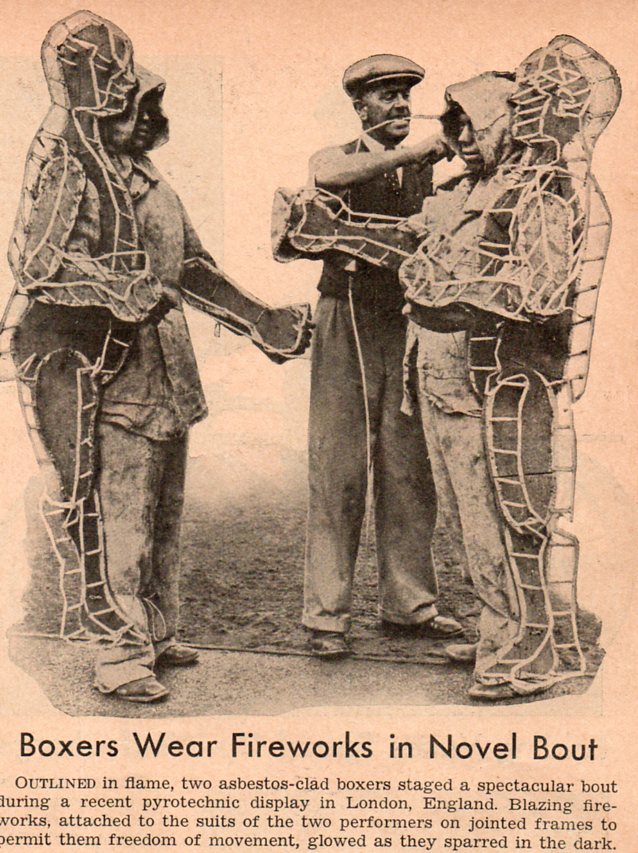
  • Questionable Quidity: Fireworks Boxing

    JF Ptak Science Books   Quick QUIDITY Post

      Quidity514
    Certainly in the history of creative chemistry there were more reasonable things to do than this.  But perhaps not, perhaps the folks in 1934 had come to the realization that the idea of creativity was spent, that there were not going to be any new, good ideas, that the era of reasoned inquiry was gone–and to celebrate, the sport of fire boxing was born. 

    These realizations came in 1934, and 1935, and every year, before and since.  The struggle with or for creativity and genius is a second-by-second bout, and there is no doubt that the quidity of what passes for a “good idea” for x^x ideas must surely fill the middle of the infinite Encyclopedia of Stuff that Doesn’t Make Sense. 

    My guess is that the number of bad ideas stays a relative constant among humans.  The only difference over time is the number of humans having the bad ideas and the ways in which everyone hears about them. 

    Note:

    The guy on the left bears a small resemblance to Augustus Saint-Gauden’s Adams Memorial (sometimes called “Grief”). 

    Quidity515 Adams-memorial-2


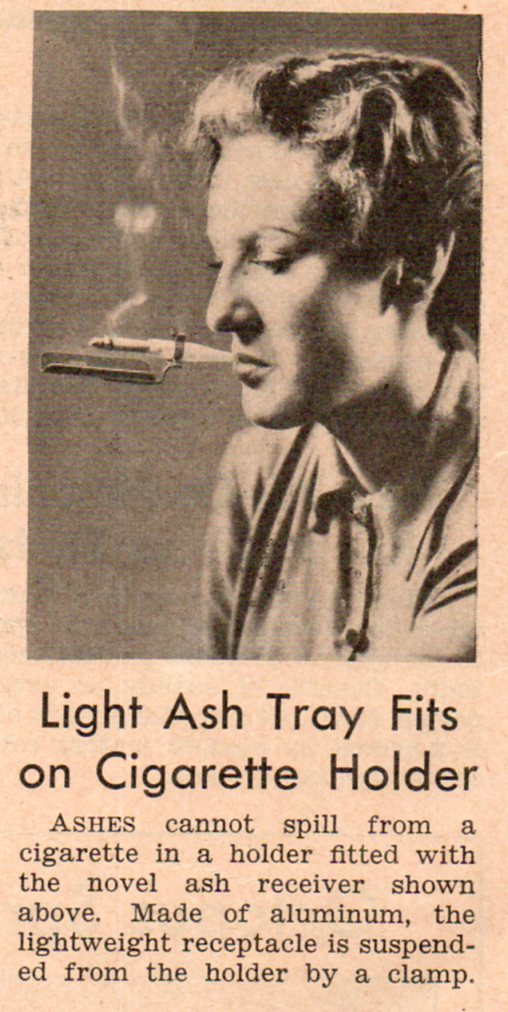
  • Questionable Quidity Department: Cigarette-attached Ash Tray

    JF Ptak Science Books  Quick Post

    In the entire invento-sphere of things crying out for suitable invention, this “innovation” in smoking is surely not one of them.  Perhaps if you needed an additional bit of strangeness in developing the quirkyness of an impossible boss for a character in a movie–someone who needed to be able to be free of the responsibility of flicking the ashes from their ciggie as they screamed at a subordinate, or a cook using the device to free up both hands while preparing a meal, or etc.–then I guess this invention could be part of the genius of a role.   Beyond that, I don’t know…particularly if there was a smoke-in-bed version.

    Perhaps the downfall of such a device is seen in the eyes of the model, which are transfixed on the ashes in her nose tray.  Maybe the settling of the ashes two inches from your nose would be a hypnotic event, altering the wearer’s sense of place and attention, giving you poor vision, and a certain sense of smoky sullenness.

      Bizzaro 509


  • Questionable Quidity Department: Cow Pants

    JF Ptak Science Books   Quick Post Quidity

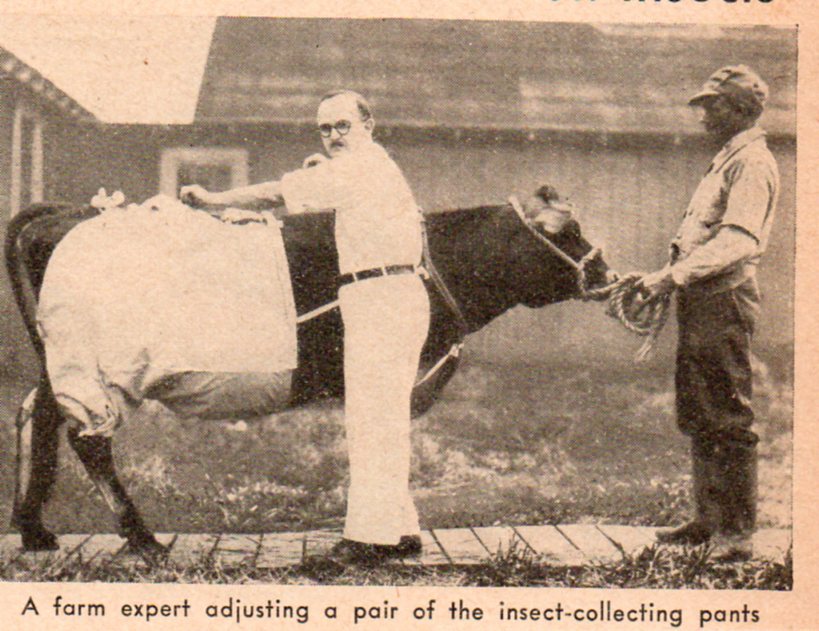
    This image comes from a stockpile of loose bits that have fallen out of various magazines–this one from Popular Science for October, 1937.

    Bizzaro cow pants'511