A Daily History of Holes, Dots, Lines, Science, History, Math, Physics, Art, the Unintentional Absurd, Architecture, Maps, Data Visualization, Blank and Missing Things, and so on. |1.6 million words, 7500 images, 4.9 million hits| Press & appearances in The Times, Le Figaro, Mensa, The Economist, The Guardian, Discovery News, Slate, Le Monde, Sci American Blogs, Le Pont, and many other places… 5000+ total posts since 2008.

Category: Uncategorized

  • Housekeeping and Categories

    JF Ptak Science Books

    We’re in the midst of having a new blog site! In addition to the new big coming changes, I’ve been told for the first time how many posts are in my various categories. And that there are 6,630 images posted in the blog. 

    So, the 2,400 posts (including 1902 full-blown “posts” and nearly 500 “quick posts”) break down in the following way…some of the 96 categories are clearly just under-employed (like “Art” and “Zoomology” and “Contraries”), but that I think is my own sloppy categorization hurriedness:


    Absurdist, Unintentional (474) 
    Alphabets (14) 
    American History: Western Exploration & Native Americans (37) 
    Anticipation, History of (118) 
    Architecture and Building (123) 
    Art (32) 
    Art History (256) 
    Astronomy (68) 
    atomic and nuclear weapons (101) 

    ·Posted by :

    ·in:


  • Truman and the “Cry-Baby Scientist”: Oppenheimer in the Oval Office, October 1945

    JF Ptak Science Books   Post 1875  [Part of a long series on Atomic and Nuclear Weapons]

    There was a short period in July 1945–right after the atomic bombs were detonated over Nagasaki and Hiroshima–that a pervasive, acceptable logic took hold of the minds of many at Los Alamos and Washington D.C. that the  bomb might actually work to prevent war.  Loosely put, the bomb was too terrible to use, too lethal, too destructive, too fantastically bad in its earliest stages of design to actually become part of the world’s military arsenal.  If that feeling was widespread, it lasted abut 72 hours.  Oppenheimer had it for a little while for a few days, until he realized that his expectations were unfounded and that he saw the situation in reverse.  

    It is interesting to set the meeting with Oppenheimer in the course of Truman’s daily day, a pretty busy day, a day filed with stuff and fluff and a meeting with Oppenheimer about the future of the arms race.  Turns out that the meeting with Oppie went as scheduled, ended perfectly on time to accommodate the next Oval Room visitor, the postmaster from Joplin, Missouri.  It must’ve been important to the Joplin man, and I guess to Truman, but not too many others. 

    The meeting between Oppenheimer and Truman did not go well.  It was then that Oppenheimer famously told Truman that “I feel I have blood on my hands”, which was unacceptable to Truman, who immediately replied that that was no concern of Oppenheimer’s, and that if anyone had bloody hands, it was the president.  Oppenheimer felt as though the future was in the balance, and that the American government was using/would use the bomb as a political tool against the Soviets. Actually, the employment of the bomb as a part of American foreign policy was–obviously–a new affair, and the application of it as a sort of Pax Atomica in the early years following the end of the war was a wholly new development.  And applying the threat of the use of the weapon against the Soviets was a natural state, as many military figures (including, for example, General Leslie Groves) considered them as an enemy right from the start.  The fight between the U.S. and the U.S.S.R. started pretty much in 1944, when (with General Groves, again) there was a spearhead movement to control all of the world’s supplies of atomic-bomb-related natural resources.

    That is just a little of the background to the meeting in the Oval Office back there in October 1945.  Truman had very little use for Oppenheimer then–little use for his “hand wringing”, for his high moral acceptance of question in the use of the bomb, for his second-guessing the decision.  Cold must have descended in the meeting, as Truman later told David Lillenthal of Oppenheimer that he “never wanted to see that son of a bitch in this office again”.  Truman would retell the story in different waysm, but with generally the same result, waxing about how he dismissed the “cry-baby scientist”.   

     
    Thursday, October 25, 1945
       
    Executive Orders:  [9646 COAT OF ARMS, SEAL, AND FLAG OF THE PRESIDENT OF THE UNITED STATES]
    Executive Orders:  [9647 REGULATIONS RELATING TO THE GIVING OF PUBLIC NOTICE AND THE PRESENTATION OF VIEWS IN CONNECTION WITH FOREIGN TRADE AGREEMENTS(1)]
    Executive Orders:  [9648 DISCONTINUING THE MATAGORDA BAY DEFENSIVE SEA AREA(1)]
    10:00 am Congressman Carter Manasco, Alabama
    (The President sent out word wanted to see him)
    10:15 am Mr. James S. Lillis of Kansas City
    10:30 am The Secretary of War [Robert P. Patterson]
    (Dr. J. Robert Oppenheimer of University of California
    (Re atomic bomb)
    11:00 am Mr. Leslie L. Travis; Mr. George Spiva.
    (Mr. Travis is Postmaster at Joplin – we wrote him
    the President would be glad to see him when he came
    to Washington)
    11:15 am Hon. Raymond M. Foley, Commissioner, FHA
    11:30 am Congressman William M. Whittington, Miss.
    (The President sent out word wished to see)
    11:40 am Mr. Leon Reliford of Hickman Mills, Mo.
    (With Metal Workers International Union, and knew the
    President in Kansas City at which time he was
    connected with Building Trades Union)
    11:45 am General Henry H. Arnold
    (Re a note which Secretary Stimson left for him to take
    up with the President)
    12:00 pm The Secretary of Labor [Lewis B. Schwellenbach]
    12:30 pm H.E. Hon. Sergio Osmena, the President of the Philippine
    Commonwealth
    The Secretary of the Interior [Harold L. Ickes]
    Hon. Paul V. McNutt
    (Mr. McNutt urged that this appointment be made, as
    he felt it important that they talk to the President)
    12:45 pm The Secretary of the Interior [Harold L. Ickes]
    (Mr. Ickes had earlier asked and secured this appointment
    alone)
    1:00 pm (LUNCH)
    4:00 pm Press and Radio Conference [Public Papers]

    ·Posted by :

    ·in:


  • Trinity+67 Years: the Explosion of the First Atomic Bomb, Alamogordo, New Mexico, 1945

    JF Ptak Science Books

    I’m listing a few links to some posts that I’ve done on the first and successful test of the atomic bomb in the Alamogordo Desert, July 16, 1945.  They are also part of a much larger (75+ posts) series on the history of nuclear weapons, found here. (This series also includes posts on social/popular aspects of the bomb and atomic energy.)

    • Trinity + 64 Years: the Explosion of the World’s First Atomic Bomb, Alamogordo, New Mexico, 1945 (here)

    • Atomic Bomb–Historic American Building Survey, Trinity Site (here)

    • Atomic Bomb Chronology (here)

    Oppenheimer_groves_090945

     Trinity Shot, 1945, Video via the Department of Defense, located at the Internet Archive, here.

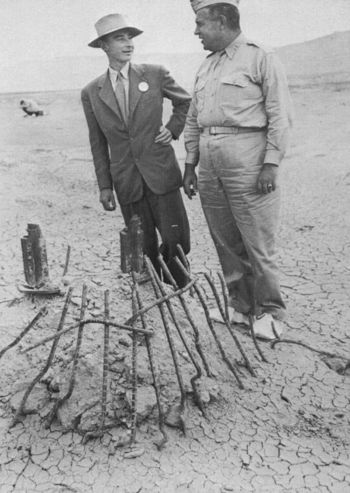
    [Pictured left are Robert Oppenheimer in his porkpie hat, in an odd leaning-away attitude towards General Leslie Groves–the two were largely responsible for the creation of the bomb.  They are picture in the desert at what was left of one of the tower foundations that held the bomb, suspended as ti was from the top of the structure.  Groves I must say has taken a lot of grief for his role, but I’ve got to say that the bomb may well have never been completed in such short order without him.]

    ·Posted by :

    ·in:


  • The 1877, 38-Star Flag Displayed for Independence Day

    Flag 38 star

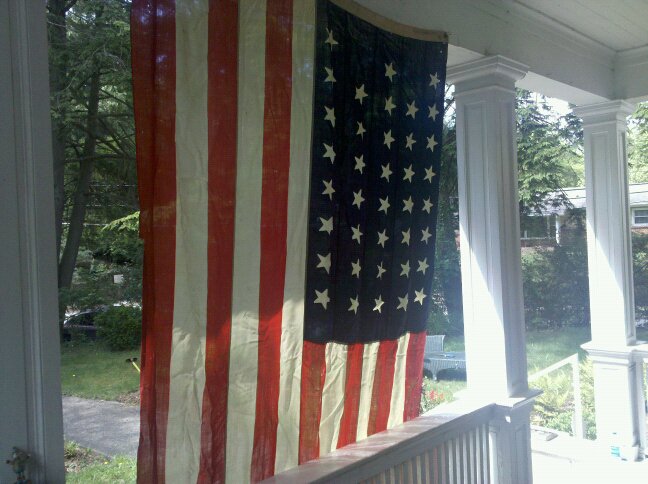
    That’s a big one, 12’x8′ or so. It’s beautiful. 

    This is the 20th (of 27) differently-starred American flags,gaining a 38th star after Colorado was admitted as a state on 1 August 1876. The 38-star flag became the official flag of the United States on 4 July, 1877, and stayed this way until 1889, when the 43-star flag replaced it. (This flag added stars for the admissions of five states: North Dakota (2 November 1889), South Dakota (2 November 1889), Montana (8 November 1889), Washington (not-D.C., 11 November 1889), and Idaho (3 July 1890).

    There were five Presidents who served under the 38-star:   Rutherford B. Hayes (1877-1881), James A. Garfield (1881), Chester A. Arthur (1881-1885), Grover Cleveland (1885-1889), and Benjamin Harrison (1889-1893).

    .

    ·Posted by :

    ·in:


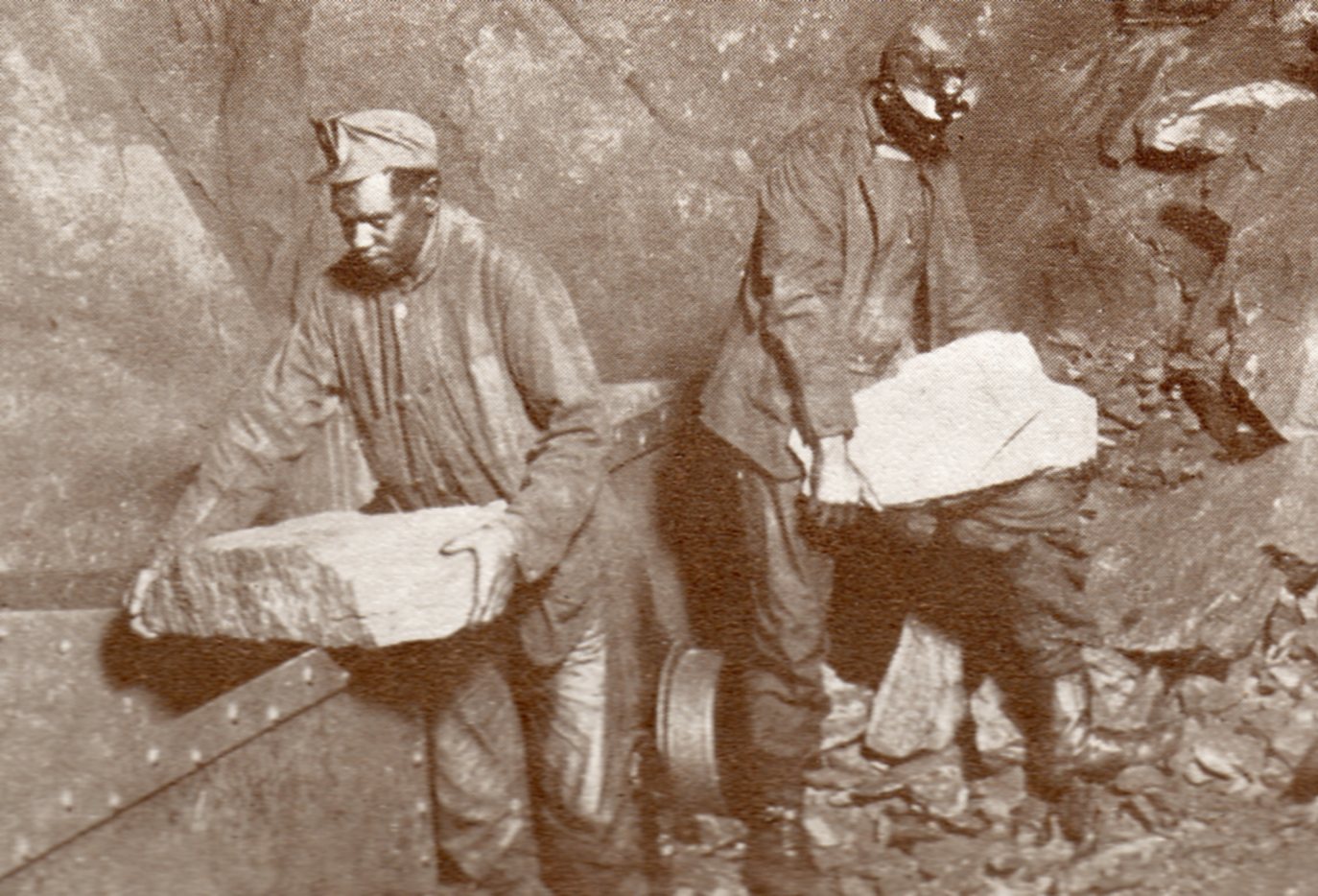
  • Black Iron Mine Workers, Birmingham, Alabama, 1918

    JF Ptak Science Books 

    I found this item today out in thye warehouse, mixed in for some reason with Hitler Jugend pamphlets and many issues of the 19th century Archiv fuer Anthropologie, just completely out of place.  It is an accordion fold multiple panel oversize postcard, I suppose, an advertisement for a meeting of the Rotary Club of Birmingham, Alabama, and probably for 1917/1918. 

    Lack birmingham'616

    Which is a detail of the image (below):

    Unfolded the obect is 25 inches long and about 9 inches wide, divided by five panels, seven of which have photographic images, one is for the contact information, and one for the addressing and mailing part.  It all folds nicely into a somewhat-larger-than-pocket-size object, printed on pretty thick, very thick stock.  (The original is available at our blog bookstore, here.)

    ·Posted by :

    ·in:


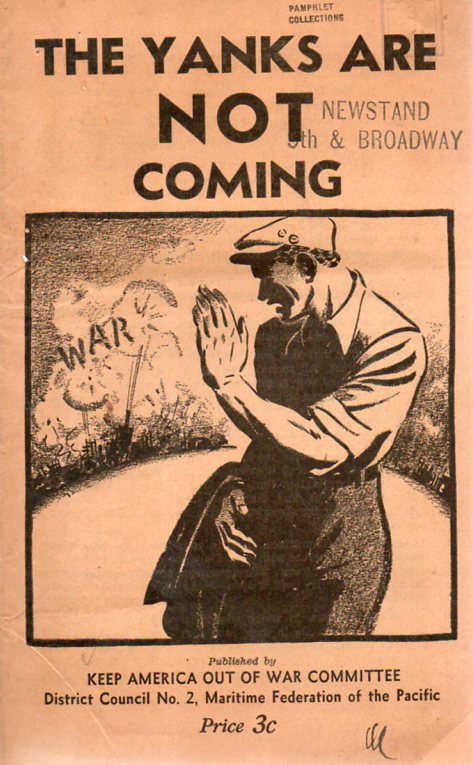
  • Too Busy for War: “Keep America Out of War”, WWII

    JF Ptak Science Books   Quick Post

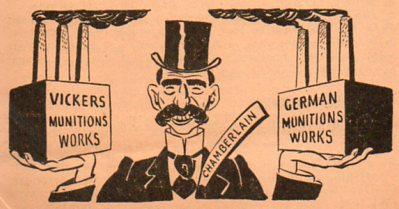
    This pamphlet is a reminder that it wasn’t simply right-wing groups (like the Lindbergh-sponsored “America First”) that sought to keep the United States out of the war in Europe in 1940.  It was a “European War” to these groups at this point–it was of course a World War, World War II, but it just didn’t involve the United States, yet.  The lefty “Keep America Out of War Committee” produced this vicious pamphlet, equating the war with the sole pursuits of “big business”, connecting the “filthy mess” of fighting to connected interest of Parliament and the Reichstag in producing a money-making scenario for the controllers of industry. 

    Anti-war no war484[The original is available from our blog bookstore.]

    Anti-war no war485
    Now there are plenty of ugly wartime relationships during WWII–and not just those that existed through December 1941, but were in place for the duration of the war.  But the arguments made in this pamphlet seemingly in support of the average working man protecting them from the multinational corporations who were conducting the war for the sake of profits takes the argument into an entirely different and bad place.  (“The best way we can help the people of Europe is to keep Wall Street out of it” claims the pseudonymous author, Mike Quinn.  Besides, as he continues in the section called “We’re Too Busy”: “We’ve got a first class job on our hands straightening out this civilization we have right here”.  Too busy for war.


    ·Posted by :

    ·in:


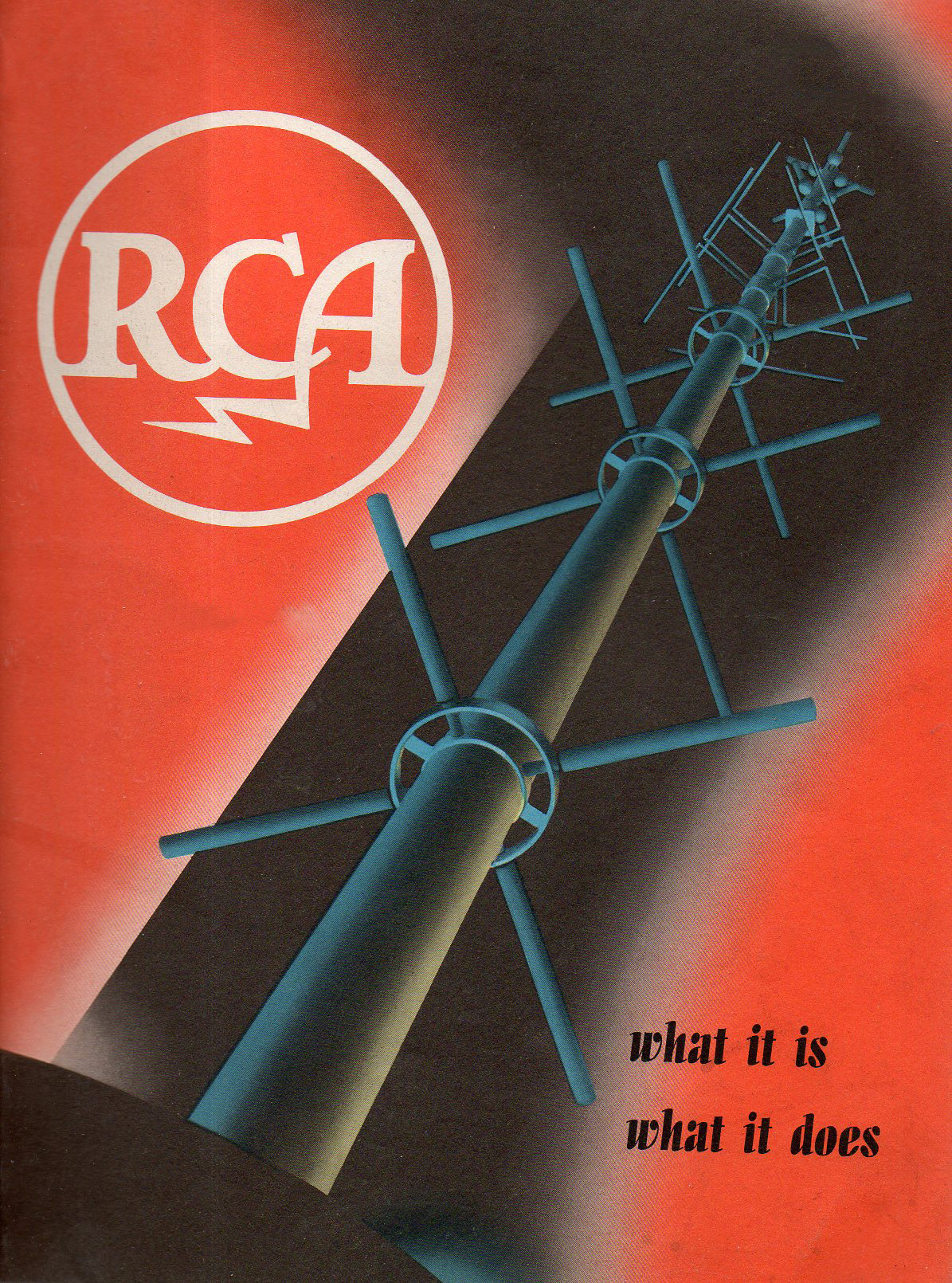
  • Fantastic Cover Art: a Picture of the Future of Television

    JF Ptak Science Books   Quick PostRca300

    This image is that of the television antenna of station WNBT and for many years it sat on top of the Empire State Building.  WNBT was the flagship station of NBC, which was owned by RCA (Radio Corporation of America, 1919-1986) which (according to its name) was really the first national broadcasting radio network in the United States, and which (as experimental station W2XBS) became the first to broadcast a television picture (of a papier mache Felix the Cat) in 1928.  This fantastic cover art for a 1947 promotional for the company pictured the famous antenna,  the great visual of the company’s external hardware, right there on top of the world’s tallest building. 

    This was really a picture of the future, and in 1947 the future of mass communications and entertainment (and in making money in the two) was seen in television, much more so than the formerly gargantuan radio. 

    I just really like the design of this pamphlet’s cover…A small poster-size reproduction is being sold (along with the original pamphlet) at our blog bookstore, here.

    ·Posted by :

    ·in:


  • The Obviousness of Oblivion

    JF Ptak Science Books LLC  [Post 1002 expanded from April 2010]                   

      [Another in a long series of post on atomic and nuclear weapons.]

    Perhaps nothing is obvious unless it is established or labeled so; perhaps the obviousness must be stated at least once before it can be officially, recognizably, the case.  And perhaps the greater the obviousness is, the more the need to make it officially so.  Perhaps nothing is so incredibly obvious that it can be studied and dissected and established.

    This seems to be more the case in more recent history than in time more further removed: that millions of dollars can be spent “proving” that children do not like to be separated from their mothers, or that cars will go faster downhill than up, or that people will respond to proper medication better than not, and so on, so on into the night, just seem not to need a vastly-funded proof.

    And so the case with nuclear warfare, people, and cities.

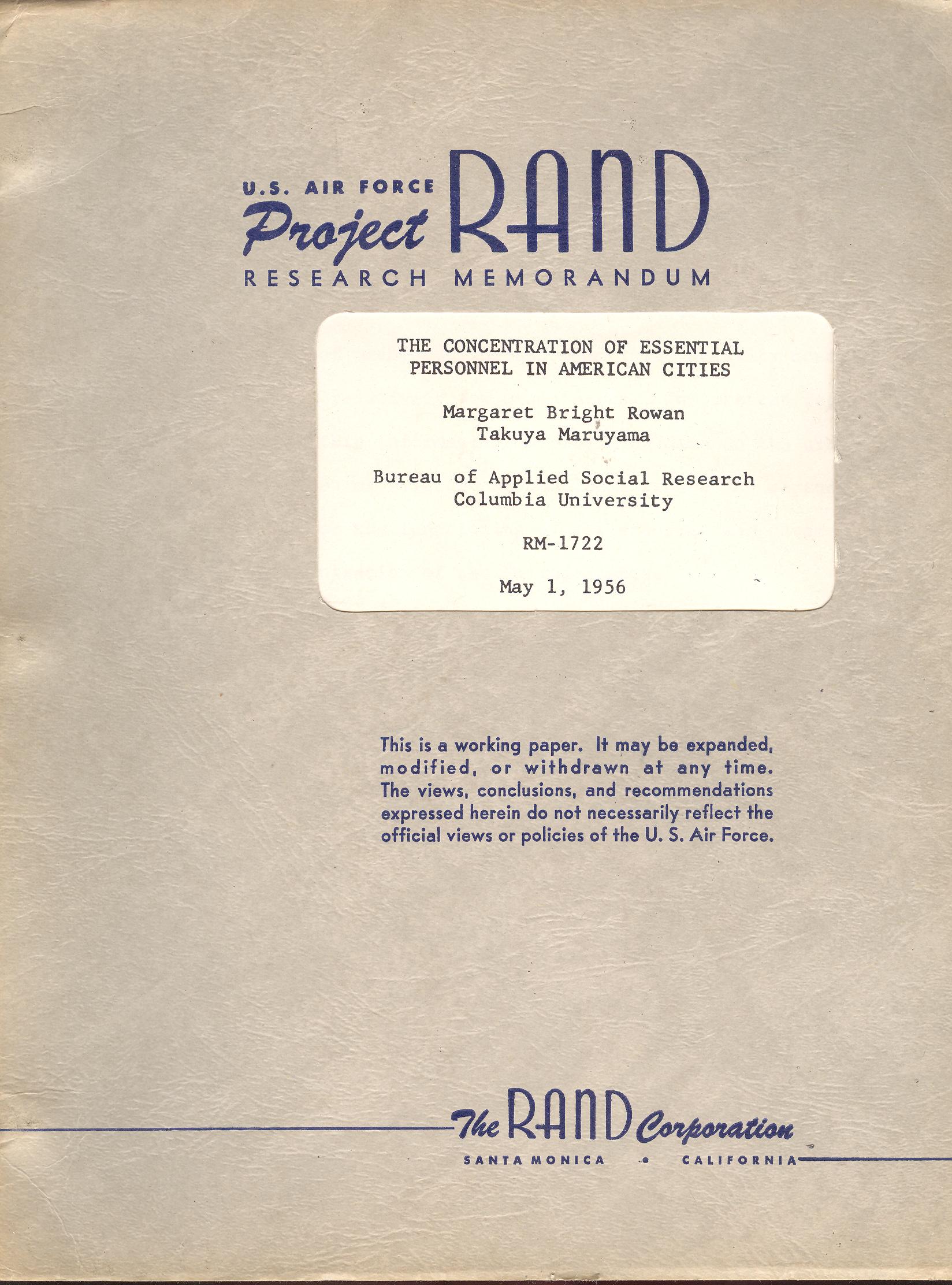
    In this RAND report from 1956, the great issue seems to be laid to rest, once and for all: the problem with nuclear weapons being exploded in/over cities is that since cities are filled with people, people will be killed.  And if those people in the cities are there because of professions that depend on city-settings, then more of those people will be killed than not.  

    Rand report

    But what this report was really about was the unfortunate aspect of the impact if nuclear warfare on leadership and working positions in significant and strategic industrial/business/government professions.  And what the report finds is this: since the vast majority of these positions are located in cities (defined as 100,000 population and above), and since cities will be the major targets in a nuclear “exchange”, the overwhelming majority of these people will be killed, thus leading to strategic human resource vacancies post-war. 

    It seems that 95% of aeronautical engineers in the U.S. would be killed in a nuclear war, which I guess would mean that it would be difficult to design new aircraft and such in the post apocalypse world.  Of course these people would be killed because it was their industrial base that was being targeted and they were collateral damage, so there wouldn’t be any industrial base to produce the components necessary to build, say, a B-52.  That part of the equation is not addressed here, though.  Nor is there any sort of recommendation presented to fix the problem.

    The RAND document just painfully points out the obvious, once and for all; no one really knew what to do with the information now that it was there, in black and white. Certain people could be evacuated, saved from the maelstrom; but saved for what?  There were other evacuation plans that were completely doomed from the beginning, sheltering plans, Dr. Strangelove arrangements, but all of that would come into their pitiful being later on.

    First, though, the bitter reality of what everyone already knew–one of the greatest of all obviousnesses–had to be make its appearance in print.  And so it did.

    ·Posted by :

    ·in:


  • Fantastic Cover Art: Young Communist League, 1937

    JF Ptak Science Books   Post 1728

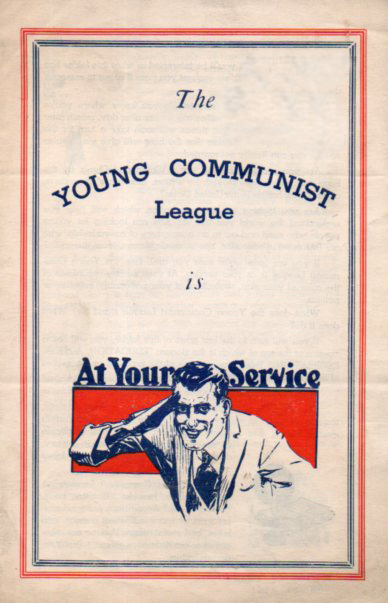
    In the wide and deep collection of social history pamphlets and ephemera that exists here cheek-and-jowl with the history of science material I have found one of the truly great pieces of cover art/design–it stands easily in the top percentile for overall design, and it does get its message across very quickly.  It is also evidently rare, as I can find no other copies of the thing.  It certainly seem to be the first time it has appeared on the intertubes.

    Young communist league little247

    The pamphlet was aimed at the “under 30” crowd, as we are warned right up front, in the first paragraph of the pamphlet, that if you are over 30, “we suggest you pass it along to someone under 30”–which is where the “Young” must come into play. 

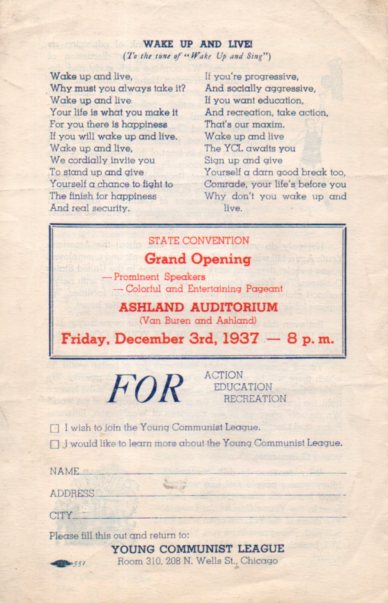
    The essence of the Young Communist League is “ACTION  EDUCATION  RECREATION” and of course to teach their “Comrades” to “help understand the world we live in”.

    Young communist league Big scan246_edited-1
    The bait was set for the young and restless–and probably unemployed–youth in the midst of the Great Depression of 1937.  War in Spain, a big war that not that many people were hearing about in China, a failing economy, falling prospects, and the rise of Fascism in Italy and National Socialism in Germany may have contributed to the growth in interest in this movement among the under-30 set in the great state of Illinois to attend the YCL state convention in Chicago.  There were a number of odd businesses located at “208 N. Wells St” in Chicago (the Loop), though fewer were less unusual than the Young Communist League in Room 310.  I’m sorry to say that I cannot determine how long they lasted there, though my guess is that Room 310 was occupied by someone else in 1942. 

    Young communist league little248


    ·Posted by :

    ·in:


  • Propaganda: Germany and the U.S. Together in Dual New Deals (1935)

    JF Ptak  Science Books  Post 1695                                                         

    “That was mere foreplay; Where books are burned, human beings are destined to be burned too. ” (In German: “Das war Vorspiel nur. Dort, wo man Bücher verbrennt, verbrennt man am Ende auch Menschen.”)
    – Heinrich Heine, Almansor (1821)
    0 blog dec 19 tnazi america301

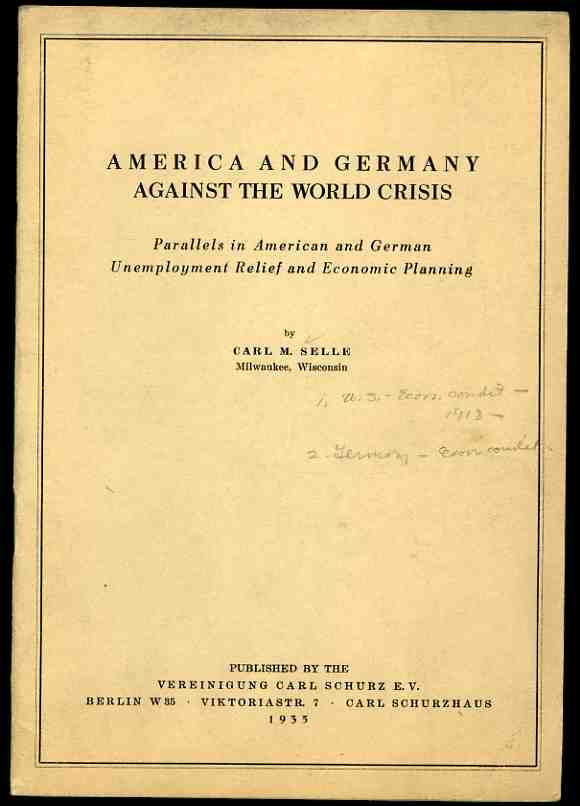
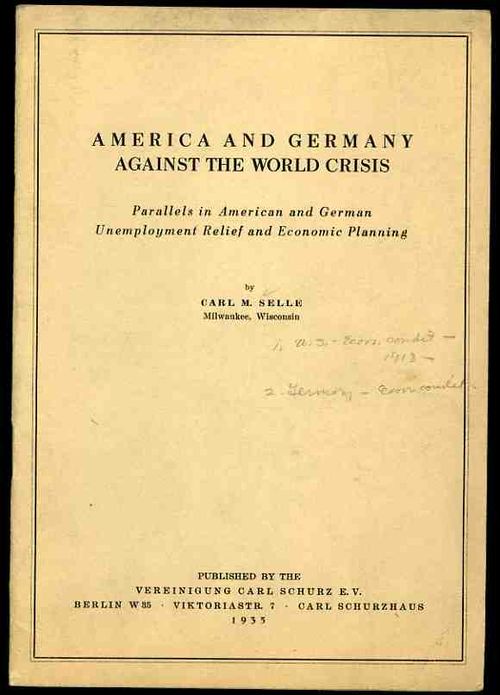
    This sickly pamphlet America and Germany Against the World Crisis, 1935), written by Carl M. Selle,  is a comparison of the “American and German New Deal”, and their joint effort in fighting the great depression as one of the “overwhelming catastrophe(s) of the Great War” by the “new governments” of the United States and Germany.  It is a ludicrous, damaging, offalous piece of Berlin-published propaganda aimed at winning soft hearts and minds in the U.S. and other English-speaking countries.

    “In Germany Hitler so augmented relief measures that a new note of hope as heard in that country”. These measures included—according to Selle, the Winterhilfswerk* which he equated with Roosevelt’s NRA, and the Deutsche Gesellschaft fier Offenliche Agbeiten (Oeffa) with the PWA (Public Works Administration). 

    What Selle didn’t mention is the story  here, and not the seeming correspondences between the economic policies of the two countries. 

    Principal in Selle’s Corrupt Memory Timeline (and this just dealing with the Nazis up until 1935) are the Nuremberg Race Laws, which were the principal step in outlawing the right of “human being” for a segment of the German human society.  “The Law for the Protection of German Blood and German Honor” (regarding Jewish marriage) and “The Reich Citizenship Law” (designating Jews as subjects) were the major components of these laws–there would be a dozen more which would classifying the Jewish people as subjects of the Reich and eventually, simply,  disposable “things”.

     On June 30, 1934, Hitler consolidated his power with The Night of the Long Knives, sealing his control of the Nazi army by ridding it of the “corrupt” influences of the SA, murdering the lice’s lice.

    In May 1933 was the first great Nazi book burning, which was a continuation of a tradition that spread across the continents and back through the millennia (and that’s another story for another day), destroying the ideas held in physical form of the works of H.G. Wells, Jack London, Sigmund Freud, Albert Einstein, and other “non-patriotic” and “anti-German, anti-Aryan” “degenerate” works.* Book burning was the visual record of a much deeper destruction of  the intellectual and cultural heritage of Germany, and was a very direct effort for thought and language control, autonomizing the creativity of an entire people (or at least those who were still considered to be “people”).  It was also one of the early steps in eradicating ideas that were dangerous to a fragile and highly suspect intellectual foundation of a movement; that led inexorably to the destruction of the people who would have those ideas.  It was also in this year that the Nazi Party was declared the only legitimate, political organization in Germany.  So, when Hindenburg dies in 1934 and Hitler is made Fuhrer, it is not surprising that Hitler receives a 90% “yes” vote in the national referendum of August 19, 1934..

    Earlier in the same year as the publication of this dirty little piece, January 26, 1935,  was the passing of a law for forced abortions for people with hereditary diseases.  

    And on and on.  The pamphlet was a meagre attempt to legitimize the cancerous growth of Nazism, equating it in whatever way possible with the efforts of the Roosevelt administration in order to give themselves some small washing of external friendly legitimacy. I don’t know anything about the author (though the name of the publisher related to a famous German American from the Civil War/Reconstruction period of U.S. history), but his efforts were soft, conservative, and embarrassing.  And nothing new, or original. 

    But this sort of activity–hearts and minds campaigns–is still the coin of the realm of aspects of political /power relationship interactions.
    ·Posted by :

    ·in: