A Daily History of Holes, Dots, Lines, Science, History, Math, Physics, Art, the Unintentional Absurd, Architecture, Maps, Data Visualization, Blank and Missing Things, and so on. |1.6 million words, 7500 images, 4.9 million hits| Press & appearances in The Times, Le Figaro, Mensa, The Economist, The Guardian, Discovery News, Slate, Le Monde, Sci American Blogs, Le Pont, and many other places… 5000+ total posts since 2008.

Category: Uncategorized

  • On the Universality of Stuff: Language and John Wilkins, 1668

    JF Ptak Science Books  

    John Wilkins’ construction of a new, theoretical language, a visual semantics of idea that was to be read and not spoken, a new international language to communicate thought, seems straight from the heart of the great Jorge Luis Borges.  And in fact, Wilkins does come from Borges, in a way–as part of a story Borges wrote in 1942, a fantastical semi-non-fictional account of Wilkins’ fabulous effort1.

    Wilkins was a 17th century figure with a sort-of 20th century idea, but even advanced to this point in time, and with actual mathematical and linguistic tools at his disposal, his work is still better as a sci-fi movie backdrop than anything else–not that there’s anything wrong with that.  The book of his in question, An Essay towards a Real Character, and a Philosophical Language, was published in London in 1668, and was an very interesting, Aristotelian non-standard approach to construct a universally understood language composed of characters which were in a way axiomatic of a developing system of genera, a taxonomy of ideas, that were somehow, fantastically, capable of expressing the foundations and flights of human thinking. 

    Borges’ presented Wilkins in a very Borgesian way in his  “The Analytical Language of John Wilkins“, mixing fact with creative fancy, exhibiting Real Character as though it was being re-discovered and studied by living academics. 
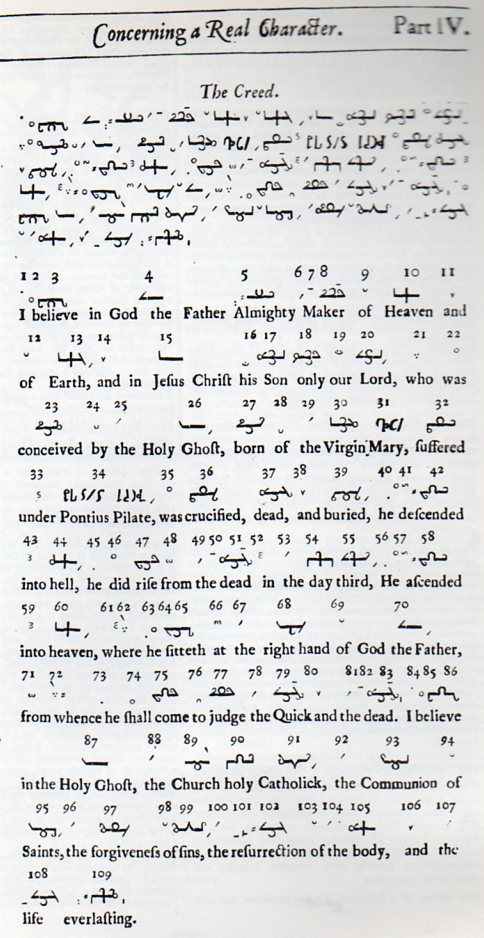
    Wilkins631

    It reminds me somewhat of other massive buit not-quite-nowhere-near-there efforts by people like Oliver Byrne and his color-coded approach to Euclid (1847), J.H. Woodger with his Axomatic Methods in Biology (1937), and Clark Hull’s Principles of Behavior (1944). Fascinating ideas, constructed with big brains, but which ultimately produce a product which more deeply confuses and obscures the subject matter it set out to explain–and which don’t really work, anyway.  But they are beautiful things int heir own right–Byrne’s work in particular also happened to be one of the most beautiful books produced in the 19th century–assemblies of bits and pieces that are occasionally magnificent but whose final destination was of course The Twilight Zone.

    They were in some way a Search for a Perfect Language (as in the work by Umberto Eco); they sought to step deeply outside themselves in an effort to grasp a higher knowledge, perhaps not much too unlike Isaac Newton and his  deep experimentation in alchemy, looking for the massive truths that were handed down to the few selected ancient ones.  They are beautiful things with a lot of very good thinking–they just weren’t right. 

    Notes:

    1.  “The Analytical Language of John Wilkins“, 1942, in which Borges presents an imaginary intellectual archaeologist assessing the work, comparing it in particular to the imaginary encyclopedia Celestial Emporium of Benevolent Knowledge.

    “He divided the universe into forty categories or genera, these being further subdivided into differences, which were subdivided into species. He assigned to each genus a monosyllable of two letters; to each difference, a consonant; to each species, a vowel. For example: de, which means an element; deb, the first of the elements, fire; deba, a part of the element fire, a flame. In a similar language invented by Letellier (1850) a means animal; ab, mammal; abo, carnivore; aboj, feline; aboje, cat; abi, herbivore; abiv, horse; etc. In the language of Bonifacio Sotos Ochando (1845) imaba means building; imaca, harem; imafe, hospital; imafo, pesthouse; imari, house; imaru, country house; imedo, post; imede, pillar; imego, floor; imela, ceiling; imogo, window; bire, bookbinder; birer, bookbinding. (This last list belongs to a book printed in Buenos Aires in 1886, the Curso de Lengua Universal, by Dr. Pedro Mata.)”–Jorge Luis Borges

    Borges described Wilkins’ taxonomy as follows, dividing it into 14 categories (compared to the original Wilkins list of 40):

    Those that belong to the emperor; Embalmed ones; Those that are trained; Suckling pigs; Mermaids; Fabulous ones; Stray dogs; Those that are included in this classification; Those that tremble as if they were mad; Innumerable ones; Those drawn with a very fine camel hair brush; Et cetera; Those that have just broken the flower vase; Those that, at a distance, resemble flies.

    ·Posted by :

    ·in:


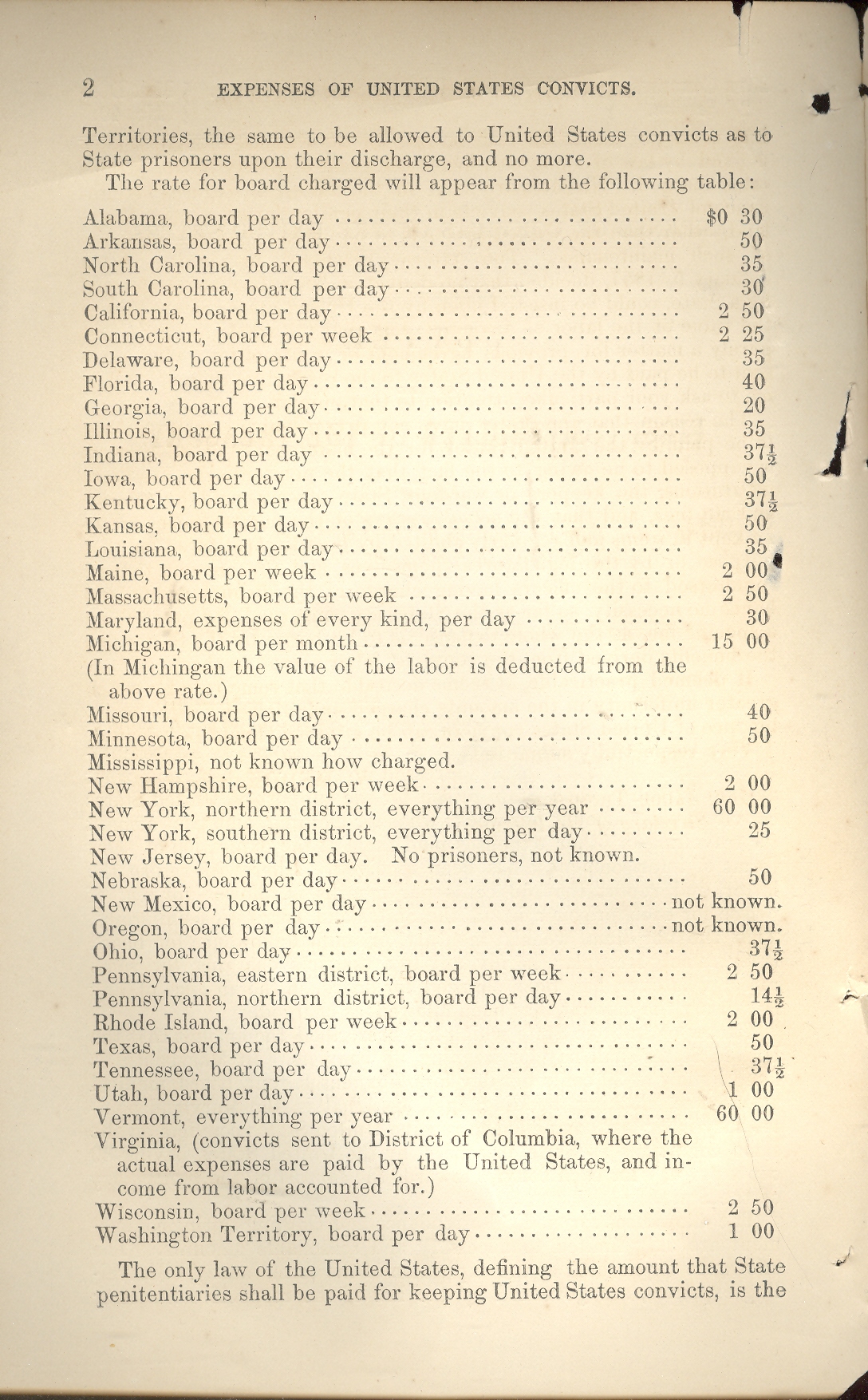
  • The Costs of Keeping U.S. Convicts, 1859

    JF Ptak Science Books  Post 2047   Blog Bookstore 

     
    Follow Me on Pinterest


    Blog--May 23--convict The fossil record is generally one of the richest and most
    compelling histories of the development of life on earth, a far-reaching,
    cumulative record of extraordinary importance. 
    There are the other, occasional, fossils that stand only by themselves,
    and seem to have almost no use in the current time, living almost entirely
    within themselves. The following statics seem to fall into that category—they
    seem to be only a tombstone for an era, providing nothing except to tell the story
    of what happened, existing only for that purpose, with no compelling
    utilization for anything outside understand a small piece of life for the year
    the stats were gathered. 

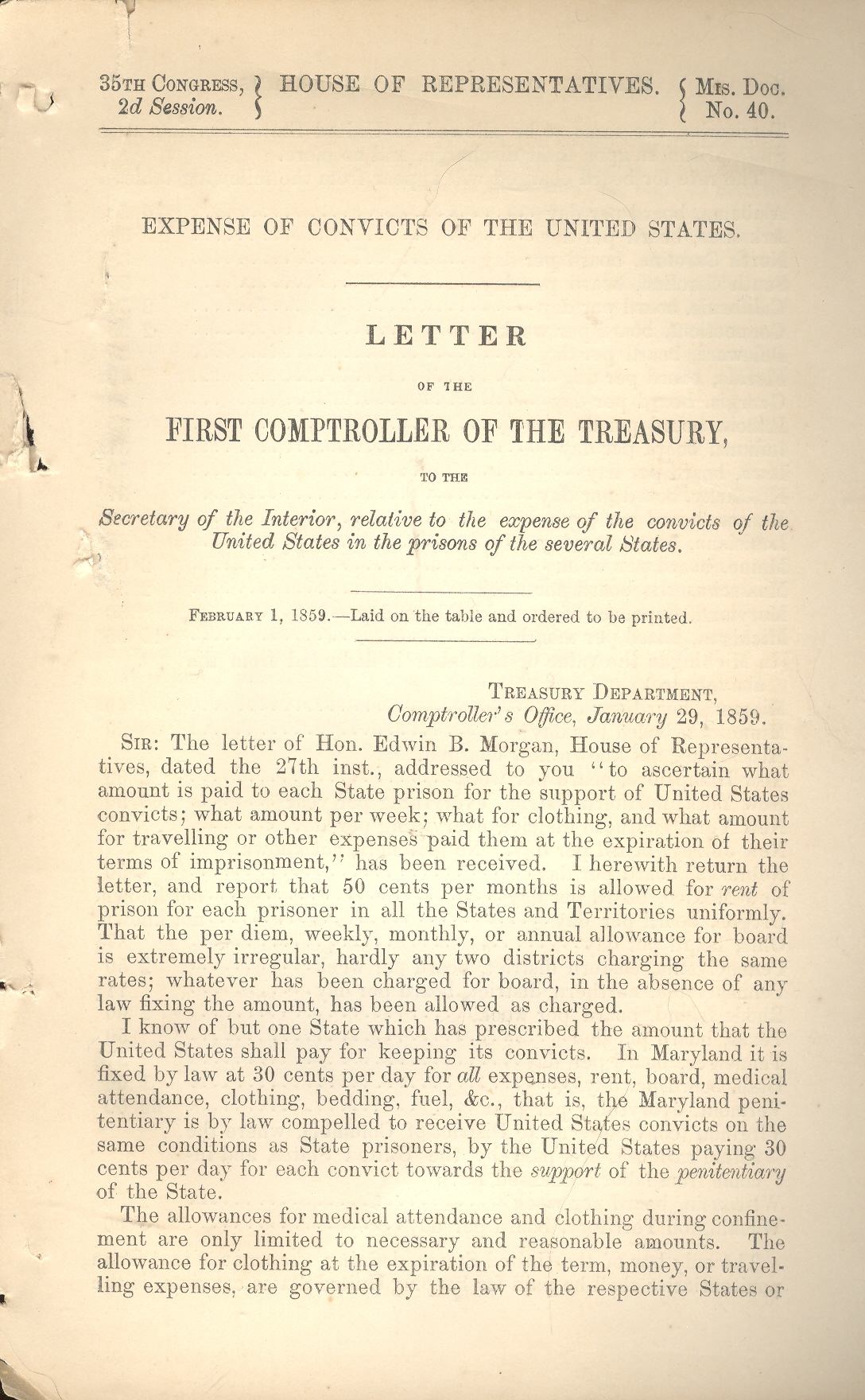
    The cause for this sentiment was found in a government
    publication called Expense of Convicts of the United States  (Letter from the
    Comptroller of the Treasury…)
    , 1 February 1859).  The following comes in the first paragraph:

    “I….report that 50 cents per months is allowed for rent of
    prison for each prisoner in all the States and Territories uniformly.”

    What this means is that the U.S. Treasury would pay 50 cents
    to the state for keeping a federal prisoner. 
    That is 50 cents per month, or about 1.7 cents per day. And that was
    also for rent of the cell, exclusive of all else, each state furnishing the
    government with the added cost, separately.

    Evidently the only state in the country that prescribed an
    exact amount for keeping a federal prisoner in a state institution was
    Maryland, “which received 30 cents per day for all expenses, rent, board, medical attendance, clothing, bedding,
    fuel, and etc” (italics in the original). 
    The rest of the states and territories had diverging and different
    expenses, from the southern district of New York at 25 cents a day for board,
    and ranging up to about 50 cents per day in  Michigan. Vermont charged an extra 60 dollars a year, in addition to the 6 bucks that they would
    get for the rent of a Vermont
    cell, to keep a prisoner—all expenses included—for one year, or about 18 cents
    per day, total. 

    Unfortunately I don’t have the stats of how many federal
    prisoner there were in 1859, so I don’t know how much of a percentage of the
    budget was occupied by prison expenses. 
    But what I do know is that even with tossing around the CPI with
    multiplier effects and so on the figures translate in no way to keeping a
    person in prison today.   The cost of
    housing someone in prison per year is around $35,000 a year, or $100 or so a
    day.  Adjusting the 1860 dollar via CPI
    for 2009 makes that dollar worth about 25 dollars today, which would be a
    doubling and a doubling again of keeping someone in prison. 

    I’m not so sure that those figures tell us much about what
    we pay, today. 

    Next, I was having a breeze through The Prison System of the United States by S.J. Barrows
    (Commissioner of Prisons for the U.S.) which was published in Washington  in 1900.  One particularly interesting
    section was the publication’s solitary statistical table, “Appendix A”, which
    detailed the crimes of the 625 men incarcerated in the state of Michigan  in 1900.  Well over half of all those in prison were
    there for larceny and burglary, while about 12% were in the big house for
    violent crimes.  (Evidently 95% of this
    number were literate and 70% could “cipher” (that is, produce basic arithmetical
    skills)).  The total crime list (such as
    it was) includes the following:

    Capital crimes (murder in the first and second degree) and
    manslaughter, along with murderous assault comprised about 1% of the total
    prison population.  Other violent crimes
    included assault with intent to do great bodily harm, rape, attempted rape,
    rape and assault composed another 3%. Further assaults were classified under
    (a) with intent to do great harm;  and
    then as assault on a female under 14 years; and on a female under 16 years  There were also the sexual assaults:  taking indecent liberties with female; with
    male child;  unlawful and carnal
    knowledge of a young child;   inducing female to enter house of ill fame.  These last two categories included about 5%
    of the prisoners.  Set aside form these
    were the crimes of adultery, abduction, incest and sodomy, which included
    another 3%.  So it seems that the violent
    offenders in prison in  Michigan 
    in 1900 totaled out at 12% or so. 

    Burglary and larceny were the  largest categories, being subdivided into (a)
    burglary accompanied by actual assault; (b) larceny; (c) larceny from a
    dwelling;  (d) larceny from a shop in daytime; (e) attempting larceny from
    the person; (f) entering a church in daytime to steal; (g) breaking and
    entering a store in daytime;   (h) breaking and entering a store in
    nighttime;(I)  breaking and entering a
    dwelling in daytime; (j)  breaking and
    entering a dwelling;  (k) breaking and
    entering a railroad car.

    Then there were a few largely vacant offenses:  Resisting an officer; Uttering and publishing
    a forged note, breaking out of prison, perjury, arson, false pretense, and
    malicious destruction of personal property, all combing for less than 2% of the
    jailed population.

    Blog--May 23--convict 001

    The vast majority of prisoners in Michigan were imprisoned for non-violent
    crimes.  The federal fathers, in the
    meantime, recognized that people in prison shouldn’t be idle while paying their
    debts to society, and should fill their time with work that would occupy the
    prisoner and bring some income into the prison system:

    “The moment we apply to the convict a
    different system of economics because he is in prison we go astray. When we
    subject to analysis the plans proposed for abolishing the competition of
    convict labor we find them based on false principles or expecting results not
    to be realized. The wiser way for the peace of society and the interest of the
    State is to place prison industries on the same ground as free industries, and
    defend that.
    It is also said in opposition to the contract system that
    contractors do not pay as much for the labor of convicts as free laborers
    command.”

    In 2005 the federal offenses for which people are incarcerated include: Drug
    Offenses 59.6%; Robbery 9.8%;  Property
    Offenses 5.5%;  Extortion, Fraud, Bribery
    6.8% ; Violent Offenses 2.7% ; Firearms, Explosives, Arson 8.6% ; White Collar
    1.0%; Immigration 2.8%;  Courts or
    Corrections 0.8%;  National Security
    0.1%;  Continuing Criminal Enterprise
    0.8%;  Miscellaneous 1.5% .  54% of prisoner in state custody for the same
    time were incarcerated for violent crimes, with drug offenses coming in at 20%
    and property crimes at 19%.  The racial
    breakdown of prisoners in the U.S. is another tragedy: of the prison population
    in toto of 2.3 million in 2008 there
    were 4,777 black male inmates per 100,000 black males held in state and federal
    prisons and local jails, compared to 1,760 Hispanic male inmates per 100,000
    Hispanic males and 727 white male inmates per 100,000 white males—that means
    that the black incarceration rate was double and then double and then
    half-doubled again that of whites.  What
    this also means is that there were more blacks in jail cells than in college
    dorm rooms in 2008.

    I’m not sure that any amount of creative statistical mathemartistry could bring these figures to life for some sort of practical application in 2009, the present situation in the prisons being so immense and pervasive.  Numbers and assorted data from the past usually have the capacity to help us see where we are today; as I said earlier, I think that these fossils are simply that:  dead.


    ·Posted by :

    ·in:


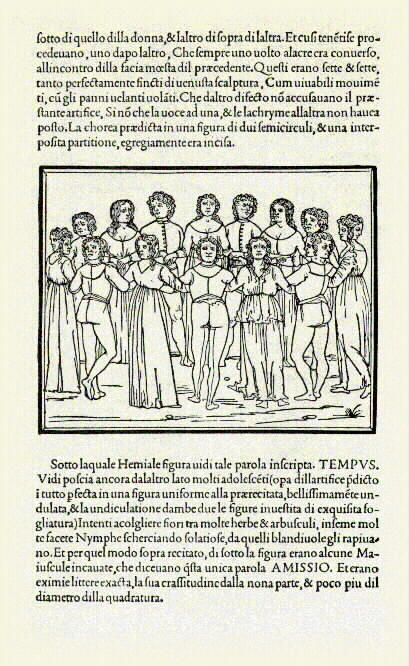
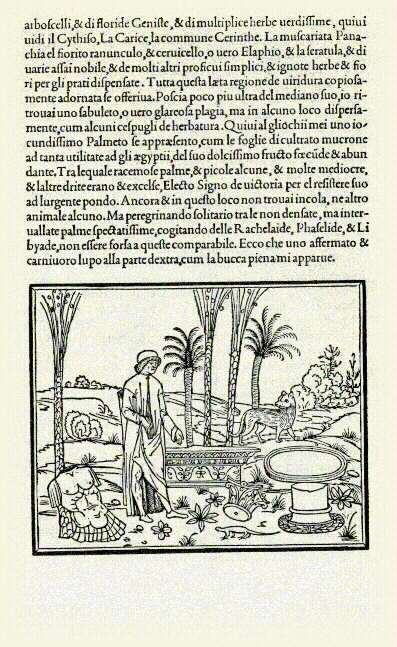
  • The Finnegan’s Wake of the 15th Century

    JF Ptak Science Books  
    Follow Me on Pinterest

    The Hypnerotomachia Poliphili (The Strife of Love in a Dream)
    by Francesco Colonna was the greatest achievement by the greatest printer of
    the Renaissance (Aldus Manutius in Venice), a
    spectacular combination of story and type and design and illustration; an
    imaginative, secular Humanist self-romance like no other printed to that
    time.  ) See the entire text HERE.)

    Blog may 30 philo

    Hypnerotomachia means “the strife of love in a
    dream”, and the reference to Poliphili refers to the narrator of the
    story, Poliphilo, telling of the love affair between Polia and Poliphilo—the
    master text of the whole story though is a description of ancient art and
    architecture,  all told in a wonderful
    ”macaronic mélange” of Italian and Latin, and which were the “exact accounts” seen
    in Poliphilo’s dreams about Polia.. It is a 
    modernist book for being printed in the last year of the 15th
    century (1499), and stands for vitality and grace and superb design, and
    according to George Painter was the Finnegan’s
    Wake
    of the fifteenth century.  Painter
    continues, and writing that “Gutenberg’s forty-two line Bible of 1455 and the Hypnerotomachia of 1499 confront one
    another from opposite ends of the incunable period with equal and contrasting
    pre-eminence.  The Gutenberg Bible is somberly and sternly German, Gothic, Christian
    and mediaeval; the Hypnerotomachia is
    radiantly and graciously Italian, classic, pagan and renascent. These are two
    supreme masterpieces of the art of printing, and stand at the two poles of
    human endeavor and desire! “(Cited by Alan Thomas, Fine Books, 1967, pp 71-4).

    Blog may 30 poliphilo dreams Martin Lowry in his The
    World of Aldus Manututus
     (Ithaca, New York, 1979) makes another
    interesting statement on this masterpiece: “(Hypnerotomachia) was a linguistic and literary debauch, choked with
    recondite imagery, erudite periphrases, and exotic verbiage: a work so bizarre
    that many critics have felt a certain uneasiness at Aldus’ agreeing to print
    it.”


    It is truly an astonishing accomplishment, and its significance in the design of type and of the book really cannot be underestimated.  As E.P. Goldsmidt stated (in The Printed Book of the Renaissance, 1950, p. 52): “In the North an astonishing proportion of all Renaissance ornament and accessory design can clearly be proved to derive from Colonna…”

    The book is summarized here and below:

    ·Posted by :

    ·in:


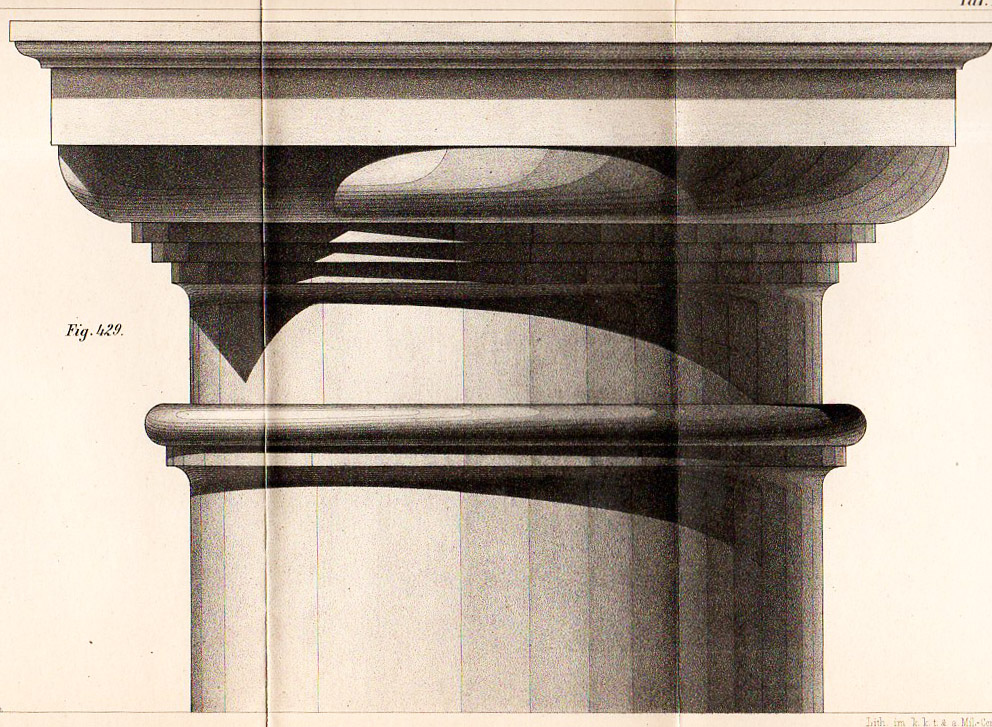
  • Superior Design: Shades of Gray, 1879

    JF Ptak Science Books  Quick Post

    Geometrische 2294This is perhaps one of the most beautiful engravings found in the military textbook by Johann Choura, Lehrbuch der Geometralzeichnens fuer id K.K. Militar-Realschulen, which is a work printed in Vienna in 1879. Its actually from the second volume, which is Darstellende Geometrie, a course on applied geometry for the engineering student in a military-minded advanced school.  It is not-so-simple and a lovely work of techArt.

    ·Posted by :

    ·in:


  • The Poetics of STDs and a Mountain of Truth, 1545

    JF Ptak Science Books Post 2023

    000-ebay--Oct 31 venereal disease poetry970
    The progress of man/humankind has, in our dim antiquarian past, been represented in art in stages of ascending a mountain.  The fine arts and sciences have been shown, in their various intellectual pedigrees, at various points on the mountain of the mind, usually with Philosophia sitting supremely at the top (with Astronomia and Mathematica generally not far underneath). This is mind, I came across another sort of progression to the Olympian heights, though it has no people in it, just the mountain, and a curious idea, ascending to faith, or truth. 

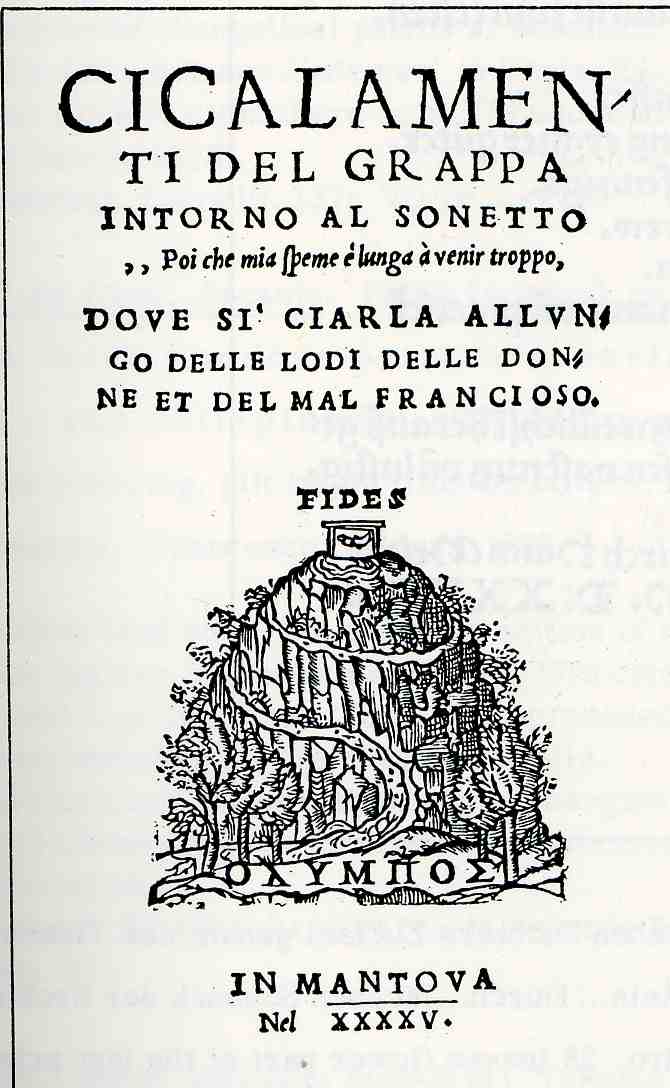
    The image is on the title page of a curious, little, early work by the pseudonymous  “Grappa” (well-named for the drink), Cicalamenti de Grapps intorno  al Sonetto…though its real nature is revealed in the subtitle,“dove si’ Cliarala allungo delle lodi delle donne et del mal francioso”, or “where one chats at length about women with The French [venereal] Disease”.  It is also dedicated to a non-existent courtesan who was heralded as being lovely, generous, and deep in the seat of this same disease.  Indeedy! This ribald, blustery, frank, coarse innuendo-laced tract (28 leaves long) was not terribly unusual when it was printed in 1545, celebrating as it does the low- and high-cultural private life of Renaissance Italy.  Doctors, poets, gluttons, cheats and of course lots of beautiful women romp around ostensibly in an attempt to prove the usefulness of their sinful vices, relating it all somehow to the disease-improved poetic capacities of the STD-bestowed Petrarch, master of forlorn and unrequited love poetry and the father of Humanism  (It relates in a way that I can’t explain to Petrarch’s Canzoniere, sonnet #88, mostly written, I think, about a  girl/woman that he fell in love with in church, which is why we can see he needed to invent Humanism. He seems to say that the needs of love are strong, stronger than he could stand, evidently, and that one should flee, renounce it; he seems to for himself, the girl across the pew or across the great open space in the cathedral never weakening to him a bit.  He pines over her, and announces his own amoroso intoppo, or “amorous fumblings”, and would take flight from himself as well. Evidently the people in this work by Grappa do not take his warnings to heart, though they do seem to renounce the “love” part but not the “sex” part. I could be really wrong on this god knows; all I wanted to do was look at the pretty picture on the cover!)

    Stumbling into things like this  makes you remember that the Renaissance wasn’t all stuffy and main-springy; perspective-this and techno-that; they had their fun, too, even in 1545, and put it into print.

    Back to the woodcut on the title page: it features a small, winding route up a mountain, the top of which is sanctified “fide”.  Now considering what these folks were doing in this work I wouldn’t necessarily christen the end of the adventure with this word, particularly if it meant (as it does) the name of the World Chess Federation (FIDE).  Seriously though fide means “faith”, as in bona fide (on good faith, by good authority), as opposed to mal fide (bad faith).  I cannot determine what in the world the structure is on the top of the mountain, or what is in it. 

    ·Posted by :

    ·in:


  • Justice and the Sign for Equality, ” = “

    JF Ptak Science Books     Post 2006

    
    Equal sign det


    Equal signWith the big discussion taking place at SCOTUS (rather, the same-ish big discussion taking place in two cases) and with the equality sign appearing everywhere, it might be interesting to take a look at when that symbol first came into use. 

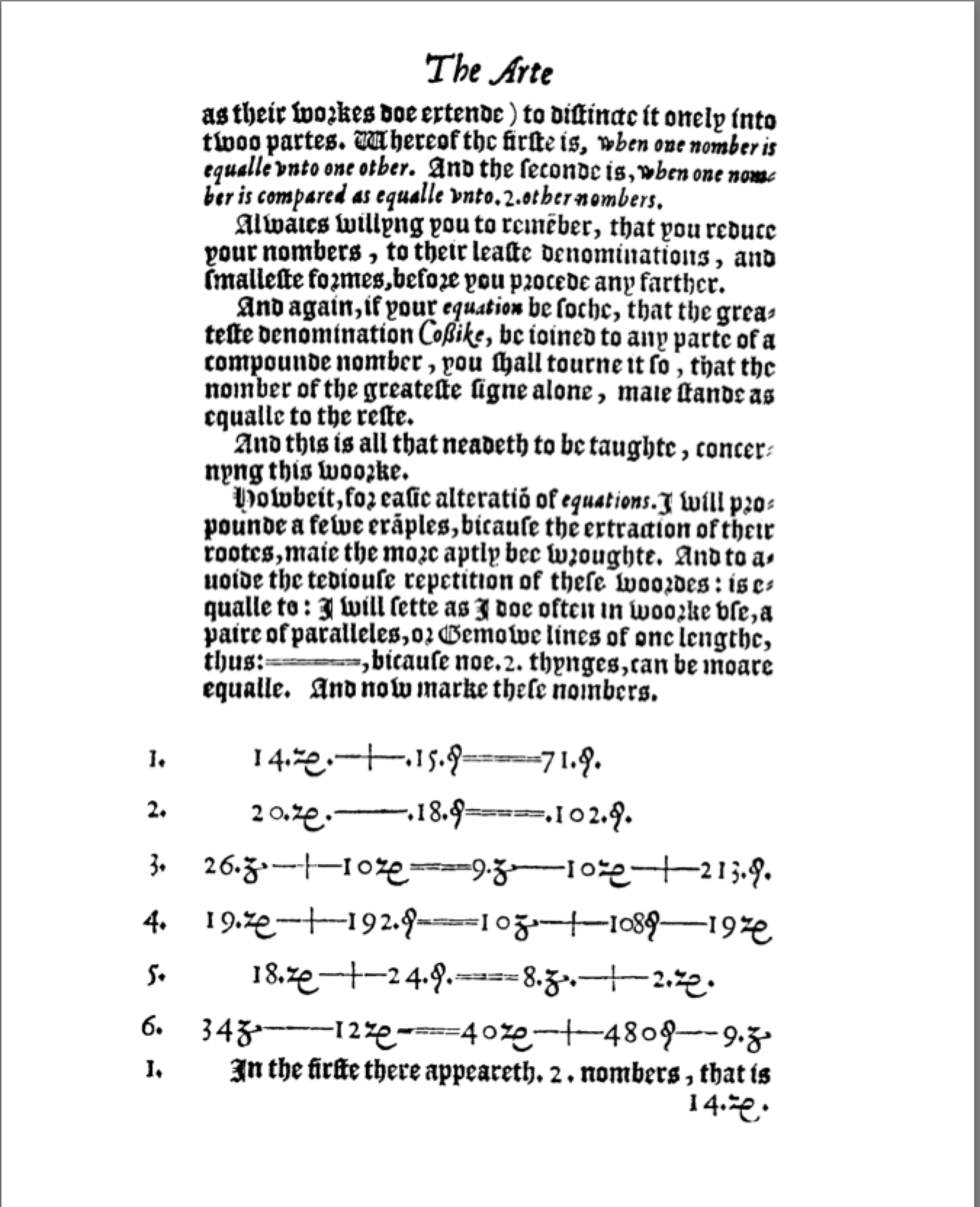
    It turns out that ” = ” makes its first appearance in print with the work of Robert Recorde (a Welsh mathematician and physician, who lived from 1512-1558), in his The Whetstone of Witte, whiche is the seconde parte of Arithmeteke: containing the extraction of rootes; the cossike practise, with the rule of equation; and the workes of Surde Nombers (printed in London in 1557). 

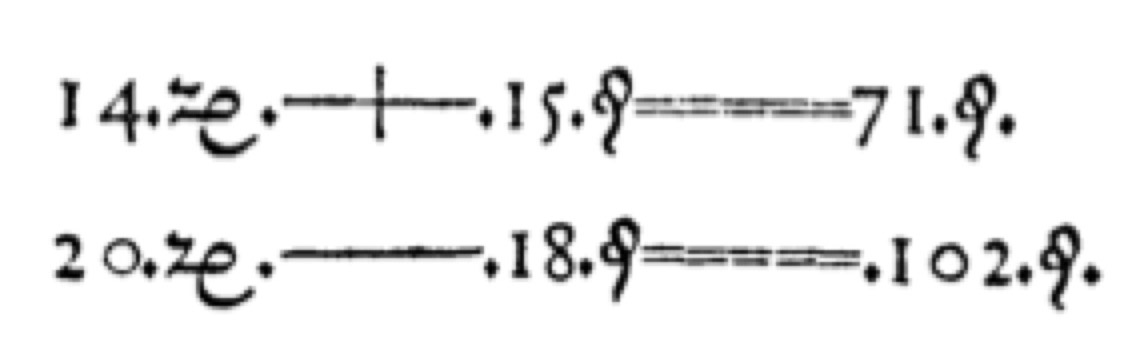
    In clear and concise language (in the fourth paragraph in the text at left) he introduces = = = = = to take the place of repeating the phrase “is equalle to”.

    Howbeit, for easie alteration of equations. I will propounde a fewe
    exanples, bicause the extraction of their rootes, maie the more aptly bee
    wroughte. And to avoide the tediouse repetition of these woordes : is equalle
    to : I will sette as I doe often in woorke use, a pair of paralleles, or Gemowe
    lines of one lengthe, thus: =====, bicause noe .2. thynges, can be moare
    equalle.

    [Page image via the MathMastery Blog, here.]

    The word “equal” comes from the Latin  aequalis, meaning “uniform, identical, or equal,” it also derives from aequus which perhaps more interestingly plays out as “level, even, just”.

    Either would do, for me, so long as the equality sign is put into play as the law of the land, and that this injustice and discrimination is brought to an end. At 456 years of age, = is far younger than the inequality it can replace.

    ·Posted by :

    ·in:


  • WIlliam Shockley on the Economics of Atomic Bombing, 1945

    JF Ptak Science Books  Quick Post

    • Background Documents on the Control and Proliferation Issues of the Atomic Bomb
    • Vannevar Bush Group, October 1945-January 1946
    • William Shockley.  The Economics of Atomic Bombing.
    • The original paper is available fo rpurchase at our blog bookstore, here.

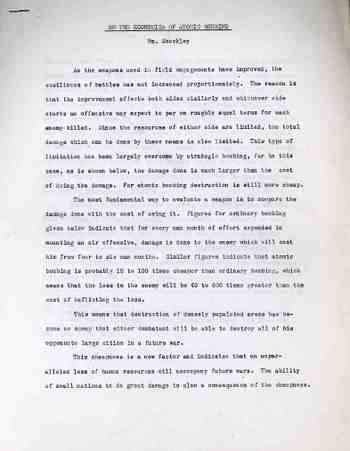
    Blogaug_6shockley_1361 (Click image to enlarge; the other four pages are located in the “Continue Reading” section, below.)
    William Shockley on the Economics of the “Atomic Bomb Art”

    This paper is one a small archive of background and draft papers and proposals by the Vannevar Bush group working on the question of the control of atomic weapons and the formalization of the American position regarding the use and control of atomic weapons, October 1945-February 1946. This archive consists of 38 documents relating to the development of U.S. atomic policy, with  contributions by President Harry Truman, Secretary of State James Byrnes, Dr. Vannevar Bush, (future AEC director) Carroll Wilson, Alger Hiss, I.I. Rabi, William Shockley, Frederick Dunn, Joseph E. Johnson, Leo Pasvolsky, Philip Morrison, Col. Nichols, William McRae, Admiral W.H.P. Blandy, George L. Harrison, and others.

    I have written elsewhere on this site about Vannevar Bush and the coming atomic/nuclear arms problem–as perhaps one of the pre-eminent scientific minds in the Roosevelt/Truman administrations, Bush and others foresaw the development of the atomic arms race in 1943, and by 1945 Bush became a  fundamental thinker and advocate on the problem. The items in this archive are low-formal background papers, drafts of proposals, informal studies, as well as mature statements of thought that would become implemented in the core of U.S. policy regarding the spread and control of atomic weapons. They are generally carbon typescripts and necessarily of extremely limited distribution, generally have no letterheads, occasionally carry the authors’ full names (although sometimes only initials are used).

    A note on William Shockley
    . The brilliant Shockley’s story is difficult and problematic: from the way in which he misused his interaction with the rest of his team at Bell Labs in the discovery of the junction transistor to his sinful racial and eugenic (and dysgenic) public persona later in life–it is a hard and long one to tell, and I’ll not try to do it here.  Suffice to say that I’m very aware of the very long shadows, and I think that other people should at least be aware of them as well, regardless of the staggering importance of “his” (with the wonderful Walter Brattain and John Bardeen) monumental discovery.  

    The William Shockley paper was written towards the end of 1945 and is on five pages and runs about 1500 words.  He begins the paper with a logical statement of the issue of the economics of conventional and atomic bombing, ending with the sentence “For atomic bombing destruction is still more cheap”.  What Shockley is getting to is the overall cost of the amount of destruction caused per square mile, and the conclusion that he draws over these five pages is the destruction caused by the atomic bomb is 1/100th the cost of conventional bombing per square mile destroyed (“atomic bombing is probably 10 to 100 times cheaper than ordinary bombing”).   

    ·Posted by :

    ·in:


  • Chewing Gum at War

    JF Ptak Science Books  Quick Post

    Follow Me on Pinterest


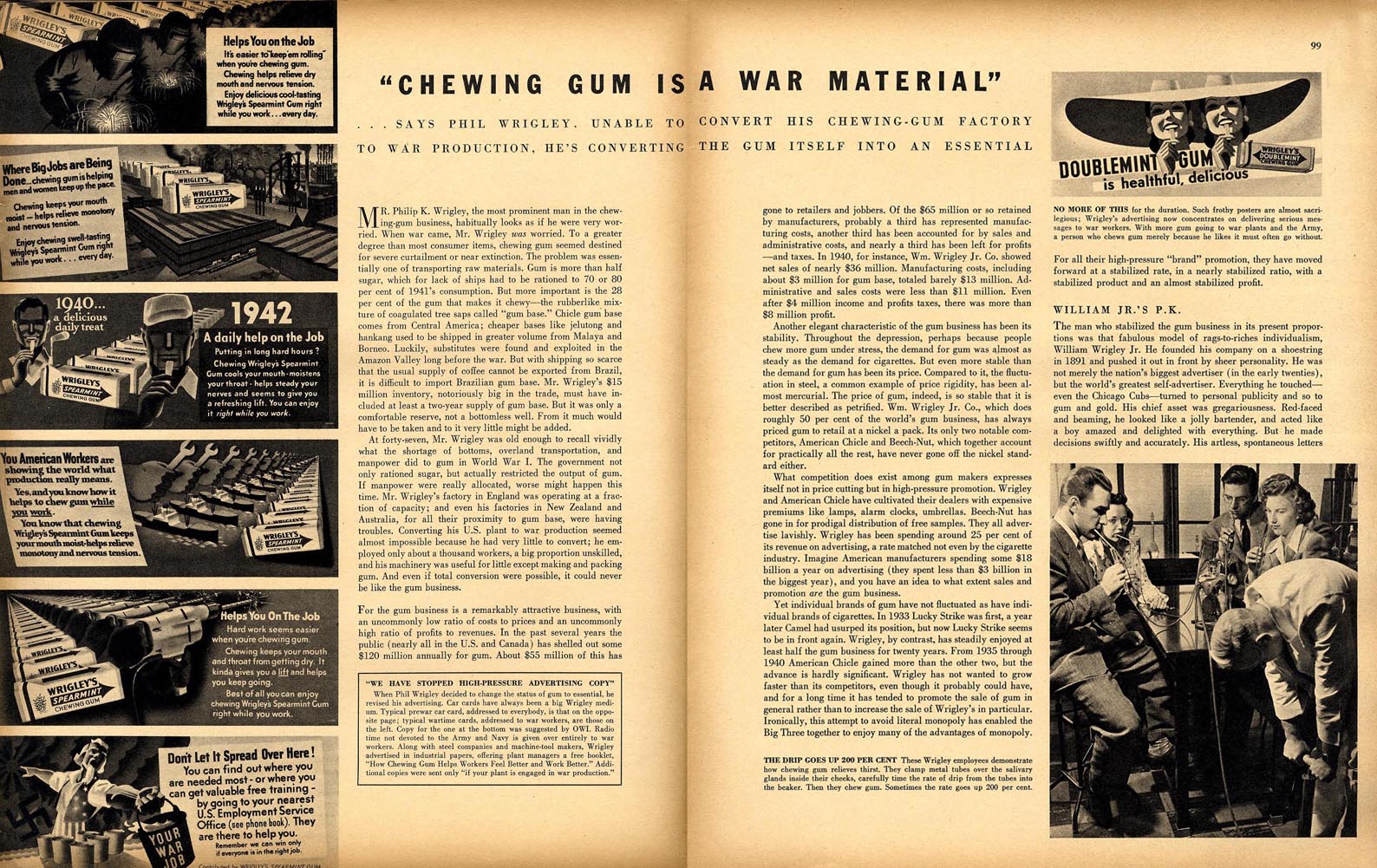
    From the wonderful Fulltable site, in a section dedicated to advertising art during WWII–an episode in the history of stuff that I have looked into before on this blog–comes this improbable two-pager, of combined absolution and advertisement, regarding chewing gum, of all things:

    Chewing GUm

    http://www.fulltable.com/vts/m/military/war/cg1.jpg

    ·Posted by :

    ·in:


  • Daily Dose from Dr. Odd: Outsider Logico-Economics and Free Steel Money

    JF Ptak Science Books  Quick Post   Daily Dose from Dr. Odd series

    Follow Me on Pinterest


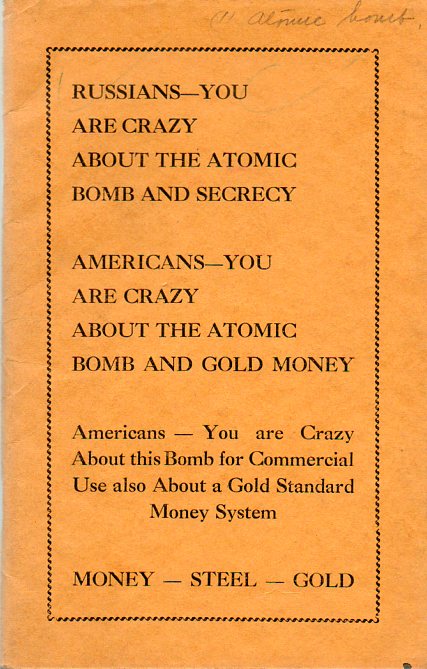
    Dr Odd series069I have rather deep well of sublimely different publications, some of which strain the merits of acceptable thought and the boundaries of logic; and some are filled with their own outsider logic, occasionally acting as a Black Hole of interpretation.  Some of these publications have incredible titles that obscure some good thinking in its pages; sometimes the title is bland or discerning but hide a text that is anything but that and sometimes nonsensical or outre. And sometimes the works have incredible titles with contents to match. Such is the case with Frank Freemont Frazee’s Russians You are Crazy about the Atomic Bomb and Secrecy; Americans, You are Crazy about the Atomic Bomb and Gold Money; Americans you are Crazy about this Bomb for Commercial use also about a Gold Standard Money System.  This work is certianly upper-drawer for publications with difficult titles. 

    And as it turns out, the content does not disappoint, if by “disappoint” we mean “confuse”–I’m still uncertain about what the man was saying in his Fabius, New York publication.  But after much talk of god and Henry Ford and bimetalism and fire and “cost and storage” and Moses and barter and “epitomes and repetition with inflation” and the like, it looks like the author presents a monetary system based on anti-atomic-bomb fear and freedom from major enterprises, along with steel dollars, which “would be a sound valuable dollar, because made of enough rust-proof sttel to be worth a hundred cents internally”.  He terms it “free steel…to be acutally produced competitively new dollars necessarily made of steel”, though by “free” he means “competitively produced and accepted by us and our government as money, freely and without limit”, which really doesn’t have anything to do with “free”.  And so it goes, on and on. 

    ·Posted by :

    ·in:


  • Nixon’s Speech for an Apollo 11 Disaster on the Moon

    JF Ptak Science Books   Quick Post

    Say what you will about the man–I have said a lot in my time since 1970–Richard Nixon was ready to appeal to compassionate hearts in America and around the world had the Apollo 11 lunar mission ended in tragedy on the Moon. The speech (“In the Event of Moon Disaster”) was written for Nixon by speechwriter William Safire (1929-2009, later NYT columnist and social recorder and lexicographer) and delivered to presidential assistant H.R. Haldeman (1926-1993, and White House Chief of Staff, 1969-1973) a few days before the lunar landing, 18 July 1969.  It was the contingency address, written for Nixon to address the nation in the event that Apollo 11 had a fatal accident on the Moon or couldn’t return to Earth.  Its a very good speech.

    Fate has ordained that the men who went to the moon to explore in peace will stay on the moon to rest in peace.

    These brave men, Neil Armstrong and Edwin Aldrin, know that there is
    no hope for their recovery. But they also know that there is hope for
    mankind in their sacrifice.

    These two men are laying down their lives in mankind’s most noble goal: the search for truth and understanding.

    They will be mourned by their families and friends; they will be
    mourned by their nation; they will be mourned by the people of the
    world; they will be mourned by a Mother Earth that dared send two of her
    sons into the unknown.

    In their exploration, they stirred the people of the world to feel as
    one; in their sacrifice, they bind more tightly the brotherhood of man.

    In ancient days, men looked at stars and saw their heroes in the
    constellations. In modern times, we do much the same, but our heroes are
    epic men of flesh and blood.

    Others will follow, and surely find their way home. Man’s search will not be denied. But these men were the first, and they will remain the foremost in our hearts.

    For every human being who looks up at the moon in the nights to come
    will know that there is some corner of another world that is forever
    mankind.


    ·Posted by :

    ·in: