A Daily History of Holes, Dots, Lines, Science, History, Math, Physics, Art, the Unintentional Absurd, Architecture, Maps, Data Visualization, Blank and Missing Things, and so on. |1.6 million words, 7500 images, 4.9 million hits| Press & appearances in The Times, Le Figaro, Mensa, The Economist, The Guardian, Discovery News, Slate, Le Monde, Sci American Blogs, Le Pont, and many other places… 5000+ total posts since 2008.

Category: Uncategorized

  • A Good 37

    JF Ptak Science Books   Quick Post
    37704
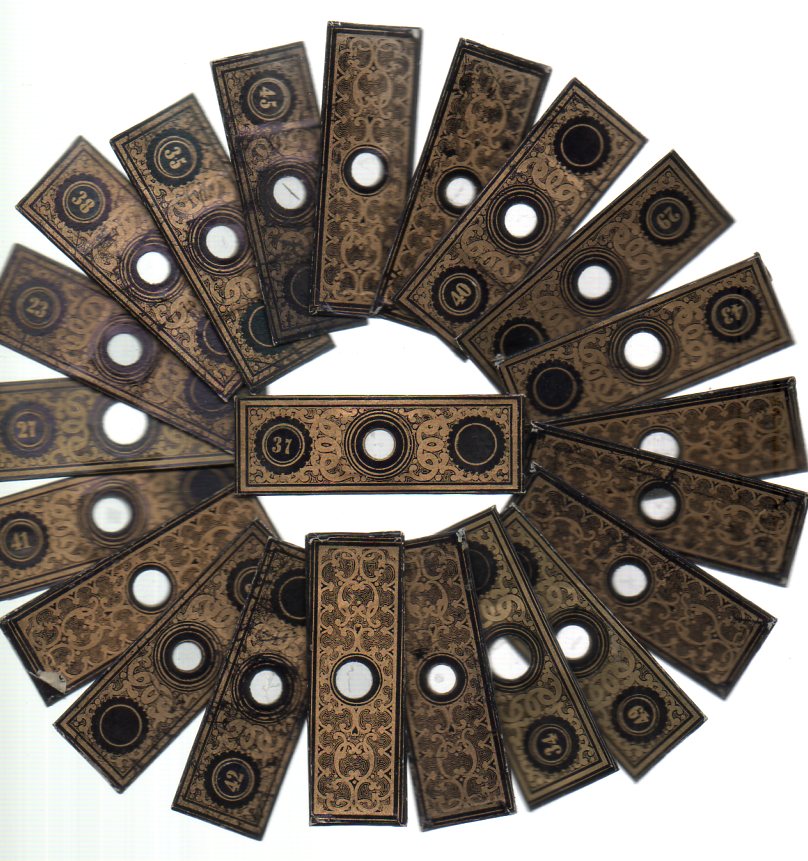
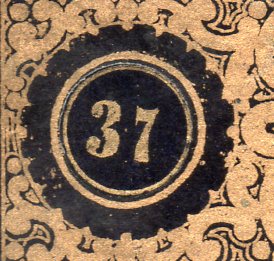
    My wife, Patti Digh, has a big thing going with the number 37.  It forms the kernal of her eight-year-old social memoir and applied memory blog, 37days.com, which has led to her seven books (with only thirty more to go). As a result, we see 37s where we can, which when you’re looking for them is not that hard to do.  I found a rather nice one tonight on one in a set of 19th century microscope slides.  In general, slides and other preparations from this period can be incredibly beautiful things.  These are quite nice, and have the printed number on them, which is not common to my experience.  Anyway, this is for Patti: 

    37703

    ·Posted by :

    ·in:


  • For Kids: Who is STUMPY PITYPRANCE STUBBYPENCIL?

    JF Ptak Science Books   Quick Post

    (I know, I’ve been on a bit of a fictional non-science bender–please bear with me.)

    Amazing Name Masticating Namonamemaker

    How do you change your bland,
    old-fashioned everyday name into an EXCITING, NEW, FRESH and ENTIRELY
    ORIGINAL title? Hmm? It is as simple as falling down. Just take
    the first letter of your first name and the first AND last letters of
    your last names, find them in the columns below, and, PRESTO, your
    new name appears. For example, we’ll use the name of a happy dog,
    say, Blue Ptak, so, take the “B” in column 1 (“StumpY”) and
    the “P” of column 2 (“Pityprance”) and the “K” of column
    3 (“Stubbypencil”) and you get Blue’s new non-secret name,
    Stumpy Pityprance Stubbypencil.


    ·Posted by :

    ·in:


  • Some Great First Lines in Literature

    JF Ptak Science Books   Quick Post

    • I put these together a while ago, and then didn’t do anything else with them.  I’m not sure what I was up to, so I’m posting what I have, simply because it is a niuce read.   A Tale of Two Cities is still a stellar entrance.

    All
    children, except one, grow up. Peter Pan

    In
    an old house in Paris that was covered with vines lived twelve little
    girls in two straight lines. Madeline/Bemelmans

    The
    Mole had been working very hard all the morning, spring-cleaning his
    little home.Wind in Willows/Grahame

    In
    the great green room, there was a telephone and a red
    balloon.Goodnight Moon/MW Brown

    Alice
    was beginning to get very tired of sitting by her sister on the bank,
    and of having nothing to do: once or twice she had peeped into the
    book her sister was reading, but it had no pictures or conversations
    in it, “and what is the use of a book,” thought Alice
    “without pictures or conversation?” Alice in Wonderland


    ·Posted by :

    ·in:


  • The Grand Luxe of Candy Stores

    JF Ptak Science Books  Quick Post

    1blogsept_23_candy_cvr649

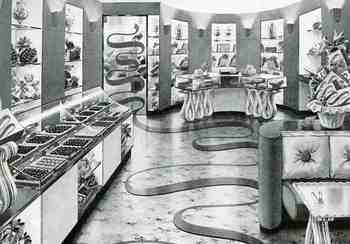
    Well now–this is a candy shop

    It is positively dripping with evil,  its luscious display  in a soft pre-chewed-like environment, as in a chocolate dream in someone else’s head.  (Chocolate dreams are good to have, just ask poor old dead Hans Sloane, the man whose chocolate-based fortune and bequest formed the basis of the British Museum.)  The ribbon design in the floor continuing up the wall just past the display is an invitation to getting totally lost in sugarly beauty, a swirling trail to a confectionary Ravena.
    1blogsept_23_candy_cvr648

    All of these images come from the pamphlet published by the Associated Retail Confectioners of the United States:  Meet the Foods Candy is Made Of, made to accompany their annual meeting of 1946 at the Drake Hotel in Chicago.  (There must’ve been an awful lot of these folks to book the Drake.)  The cover does seem somewhat on the desperate side, trying to convince anyone who would have a look that candy–since it is made of all that good looking stuff–was indeed FOOD (“no wonder candy is so good to eat!”)
    1blogsept_23_candy_cvr647

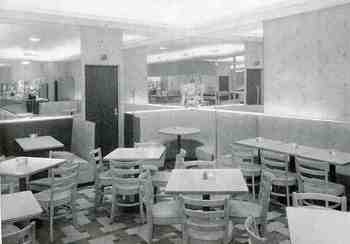
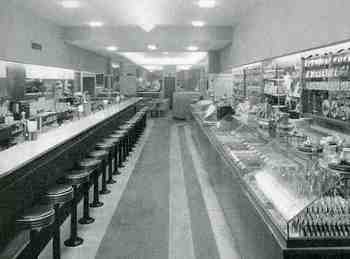
    The next image is the “Table Service” area of Wieda’s Incoporated, (a fine, large candy store in Patterson, New Jersey) , “located in the rear”, where I guess the serious stuff is done, when you needed a table to consume your goodies with a wholesome cup o’ Joe.

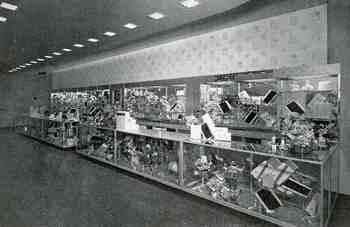
    The third image is again from Wieda’s–perhaps a little bit of payoff to Mr. Wieda for his (presidential) service to the association.  The black and white image does absolutely nothing to address it fabulously colored interior, with its lemon yellow ceiling, with the upper walls and curtains a burnt orange and the lower walls “a soft light green”, all surrounding a terrazzo floor of maroon and gray.  The woodwork was all walnut, and the mirrors were “tinted flesh color, which is more flattering to the customer than the usual untinted mirror”.  Oh my.

    1blogsept_23_candy_cvr646

    There was all sorts of information-sharing in the conference, evidently:  the best way to package and display candies, convincing mothers that candy was “food” after all and good for the kids, packaging candy so that it appealed to children, wrapping candy around other small gifts and trinkets, luring the customer into the candy store with more elaborate displays to pull you deeper inside, and so on.  There was allot of thinking going on here about sweets, which seems pretty inconsequential until you think about the fortunes made by Hans Sloane and the Wrigleys and Mars, especially with the later too, what with the gum company being purchased by the Mars family for billions of dollars–which is a lot of money for gum, which of course is hardly a candy.

    In any event these stores are just gorgeous, and gorgeous in a way that their gorgeousness can never again be achieved–and I’m not sure why.  Maybe its because I’m not wearing one of those fabulous double-worsted suits that Bogey used to wear, not that he’d be found in one of these places.
    1blogsept_23_candy644

    ·Posted by :

    ·in:


  • Definitions of “Multiverse”

    JF Ptak Science Books   Quick Post

    I just wanted to include a few more definitions of “multiverse” after having just read “Parallel Worlds (If human history turns on the tilt of the multiverse, can we still trust our ideas of achievement, progress and morality?)” by Andrew Crumey on Aeon.  It’s a very good article. 

    Multiverse via the Oxford English Dictionary

     a. The universe considered as lacking order or a single ruling and guiding power.

    1895   W. James in Internat. Jrnl. Ethics 6 10  
    Visible nature is all plasticity and indifference, a multiverse, as one might call it, and not a universe.
    1899   F. W. O. Ward Eng. Roses iv. 433  
    Within, without, nowhere and everywhere; Now bedrock of the mighty
    Multiverse, And then the thinnest wreath of thinnest cloud Inpalpable.
    1904   Daily News 11 Oct. 3  
    [Reporting Sir Oliver Lodge] The only possible alternative was to
    regard the universe as a result of random chance and capricious
    disorder, not a cosmos or universe at all, but rather a ‘multiverse’.
    1957   Times Lit. Suppl. 11 Oct. 602/1  
    It is precisely Mr Powys’s ever-present contact with the vital, or
    spiritual, principles within the universe which enables him to
    explore..the deeper problems of that comparatively small section of the
    universe—or as he would say multiverse—which constitutes man.

    ·Posted by :

    ·in:


  • An Electrical, Script-Writing Telegraph, 1879

    JF Ptak Science Books  Quick Post

    Coper telegraph469For some reason this short article–found in Nature for 6 February 1879–was titled “A Real Telegraph”. “Real” telegraphs were in existence for quite some time, more than 30 years at this point. What the author meant in this case was that rather than have a key operator tap out the message in Morse Code, the sender would be writing out the message in long hand, and the receiver would gather up the message so that it appeared in recognizable letters and words rather than dots and dashes.  The inventor’s name was E.A. Cowper, and he brought to the telegraphic art something as “startlingly” as the “marvels” of the telephone, which had been invented just three years earlier. [This paper is offered for sale at our blog bookstore, here.]

    The author describes the appearance of the script on the receiving end seeming as though to have been guide by a “spirit hand”, such as the highly unexpected result even to the trained scientific reporter. 

    A somewhat longer article appeared in the New York Times a few weeks later, the full text of which is here.

    According to William Maver jr. American telegraphy and encyclopedia of the telegraph: systems, apparatus … By William Maver (jr.) this was the first successful attempt at producing susch a machine. 

    ·Posted by :

    ·in:


  • The Faces–and Hats–of Texas Poker, 1930

    JFPoker584 Ptak Science Books   Quick Post

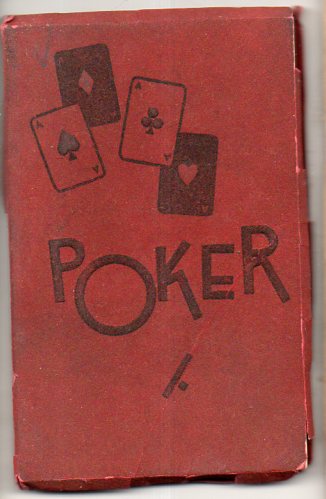
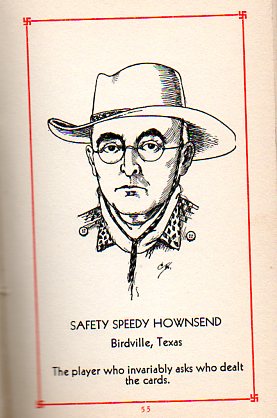
    I found a wonderful bit from 1930, a less-than-pocket-sized book on winning and losing in poker1–it has a fair amount of what might be either good or bad information, but mostly what it has of interest are 21 portraits of mostly Texas poker players from the late 1920’s.  I have no idea if these are real people, or not–but they come from real towns (Like Spur, Lufkin, and Birdville), and the one-line descriptions of them are wonderful and semi-priceless.  The portraits both have and lack a certain something–and at the very least everyone is pictured in a hat.

    And yes our Texas poker aces are featured in a design highlighted with swastikas–but this is before the world outside of Germany in 1930 knew what the NSDAP was doing with this ancient symbol. 

    Poker585A full list of the portrait entries may be found below.

    Also, if you wanted to own the original it is available from our blog bookstore.

    ·Posted by :

    ·in:


  • On the History of Wide Things: Cars, 1941

    JF Ptak Science Books     Post 2086

    Chrysler Motors was really on a hayride when their New Worlds in Engineering (1941) booklet hit the presses in 1940. From about 1930 to 1940 they produced about 8 million automobiles—more than a million in 1939 alone. 

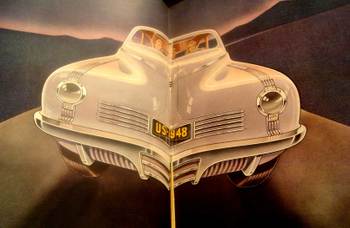
    Blogwide1948

    Their cars got bigger, heavier, and of course, wider–on a course with the rest of the American automobile industry to secure their shiney spot in the Manifest Destiny of Wide. This ultra-wide model (above) was a bit of a peek into what the future might hold for the automotive company—the license plate says “1948”, and the car is definitely, defiantly, prodigiously, wide.  Those three heads peeping up above the dash really are sitting in a front seat front seat that looks as though it still held room for one more.  The razor-cheeked platinum blonde behind the wheel look as though her pencil fingers were just able to wrap around what looks to be a gigantic steering wheel.  –the two women actually look like they have the situation under control, while the eyebrow-arched male passenger looks to have something on his mind.  Perhaps his 1948-future self was thinking about the sweepingly sleek “Chrysler Royale”, which is not only wide but also very long, though it unfortunately has not dated license plate out front to give him any hope of when he might be able to expect to see this futurmobile.

    Blogwidedetail48 In this picture (below) we get another glimpse of the wide future over the shoulder of a Chrysler designer.  Still another look-at-wide is this fellow in the purple smock from the art and design department who was molding new instrument display panels in clay—they seem long enough for this man to lay out in fron of and still have plenty of room left over.
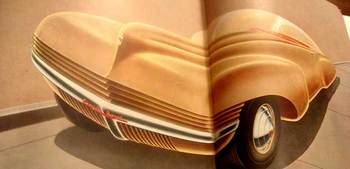
    Blogwidefuture It seems to me that all of these cars are wider than the widest of the wide production vehicles, including the unstoppably wide North African dune vehicle, the Unimog 5000, which measured in at 247 cm for its 2002 model. 
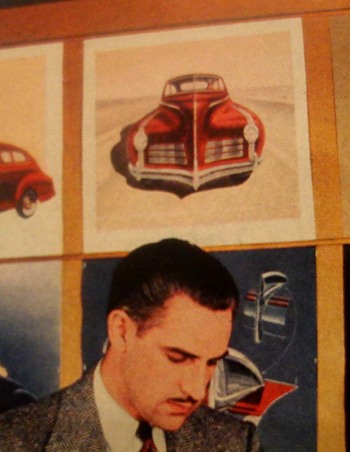
    I’m not sure where the roads were that these wide cars were going to travel on—but since they were future cars I guess they were all going just one way, so two-way streets could become one-ways, double-wide…
    Dsc00018

    [“Tomorrow department” is taken from the Chrysler Corp’s  “Chrysler Junior Craftsmen” department for the 11-16 year old sons of Chrysler employees, and which was nicknamed the “Tomorrow Department”. ]

    Blogwidedash

    ·Posted by :

    ·in:


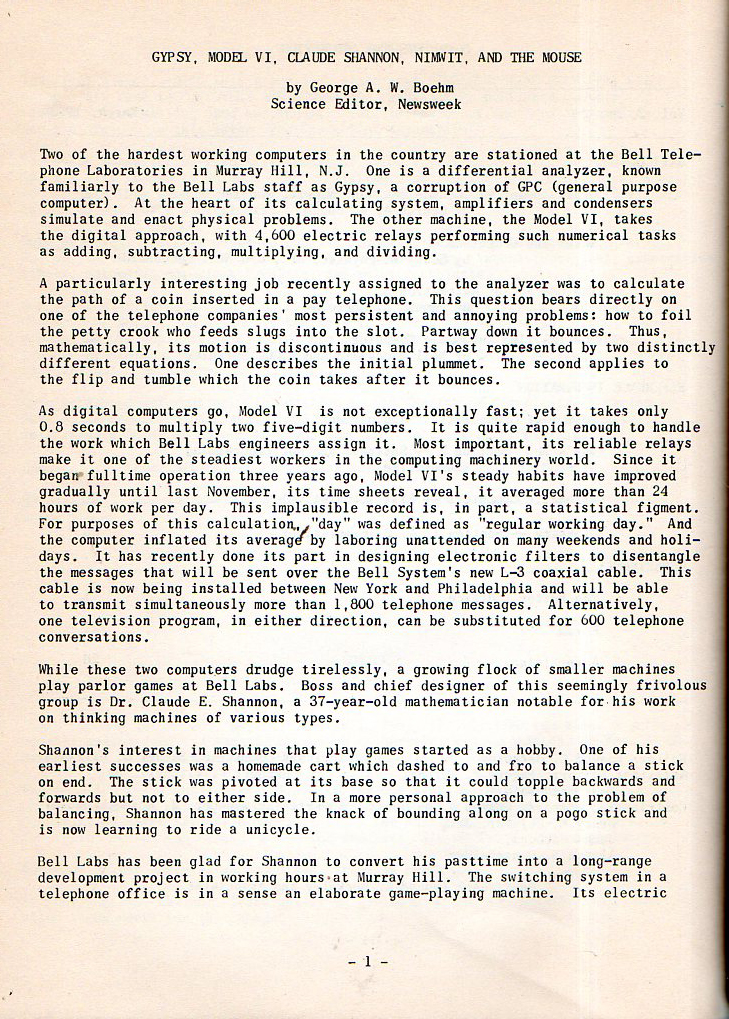
  • Good, Early Review of Some of the Fine Work of Claude Shannon

    JF Ptak Science Books   Quick Post

    I just read an interesting “review” of sorts of the mechanical and electronic automation/robotic work of the great Claude Shannon–it was in George Boehm’s  “Gypsy, Model VI, Claude Shannon, Nimwit, and the Mouse” and published in Computers and Automation, volume 2, number 2, March 1953.  Shannon (1916-2001) is widely seen as being the “father of information theory” though it might be more accurate to refer to him as the ‘father of the information age”. 

    Shannon basically established the foundation of the digital circuits in his 1937 A Symbolic Analysis of Relay
    and Switching Circuits,
    which was also one of those great dreams-come-true parts of graduate school, when your masters’ thesis is actually a very important work–this was the case for Shannon, who actually did it with this paper at the age of 21. In the midst of a brilliant young career he also produced (in 1948) another great landmark,  A Mathematical Theory of
    Communication
    , which is the pioneering paper on information theory and which was so brilliantly composed that its framework is still in place after 65 years. A year later came Communication Theory
    of Secrecy Systems,
    a work which established cryptography as a science more than a system. And on and on. 

    I like that Shannon was born in Petosky, Michigan, up there on the choppy Little Traverse, and all of those big-pebble Petosky fossil/stones.

    The Boehm article is very insider-y semi-offhand but solid review of some of the gadgetry and robotic work of Claude Shannon–it is only four pages but it is four good pages, which I reproduced below.  Enjoy. [The original is actually available for sale at the blog’s bookstore, here.]

    Shannon512

    ·Posted by :

    ·in:


  • An Elementary and Perhaps Useful Cheat Sheet for Names of Big Numbers

    JF Ptak Science Books  Quick Post

    I thought to include this little cheat sheet for the names of large numbers—I didn’t know the name for some big number, and had to go and find it. Here’s a bunch that I cobbled quickly together to serve as a recipe should you ever need a big-number-name and not know it.

    I’ll save the suspense—the largest number identified here is 1×10^3003, which is a millinillion, and it looks like this (and for some reason typepad insists (!) on returning the commas to periods, apologies):
    100,000,000,000,000,000,000,000,000,000,000,000,00 0.000.000.000.000.000.000.000.000.000.000.000.000. 000.000.000.000.000.000.000.000.000.000.000.000.00 0.000.000.000.000.000.000.000.000.000.000.000.000. 000.000.000.000.000.000.000.000.000.000.000.000.00 0.000.000.000.000.000.000.000.000.000.000.000.000. 000.000.000.000.000.000.000.000.000.000.000.000.00 0.000.000.000.000.000.000.000.000.000.000.000.000. 000.000.000.000.000.000.000.000.000.000.000.000.00 0.000.000.000.000.000.000.000.000.000.000.000.000. 000.000.000.000.000.000.000.000.000.000.000.000.00 0.000.000.000.000.000.000.000.000.000.000.000.000. 000.000.000.000.000.000.000.000.000.000.000.000.00 0.000.000.000.000.000.000.000.000.000.000.000.000. 000.000.000.000.000.000.000.000.000.000.000.000.00 0.000.000.000.000.000.000.000.000.000.000.000.000. 000.000.000.000.000.000.000.000.000.000.000.000.00 0.000.000.000.000.000.000.000.000.000.000.000.000. 000.000.000.000.000.000.000.000.000.000.000.000.00 0.000.000.000.000.000.000.000.000.000.000.000.000. 000.000.000.000.000.000.000.000.000.000.000.000.00 0.000.000.000.000.000.000.000.000.000.000.000.000. 000.000.000.000.000.000.000.000.000.000.000.000.00 0.000.000.000.000.000.000.000.000.000.000.000.000. 000.000.000.000.000.000.000.000.000.000.000.000.00 0.000.000.000.000.000.000.000.000.000.000.000.000. 000.000.000.000.000.000.000.000.000.000.000.000.00 0.000.000.000.000.000.000.000.000.000.000.000.000. 000.000.000.000.000.000.000.000.000.000.000.000.00 0.000.000.000.000.000.000.000.000.000.000.000.000. 000.000.000.000.000.000.000.000.000.000.000.000.00 0.000.000.000.000.000.000.000.000.000.000.000.000. 000.000.000.000.000.000.000.000.000.000.000.000.00 0.000.000.000.000.000.000.000.000.000.000.000.000. 000.000.000.000.000.000.000.000.000.000.000.000.00 0.000.000.000.000.000.000.000.000.000.000.000.000. 000.000.000.000.000.000.000.000.000.000.000.000.00 0.000.000.000.000.000.000.000.000.000.000.000.000. 000.000.000.000.000.000.000.000.000.000.000.000.00 0.000.000.000.000.000.000.000.000.000.000.000.000. 000.000.000.000.000.000.000.000.000.000.000.000.00 0.000.000.000.000.000.000.000.000.000.000.000.000. 000.000.000.000.000.000.000.000.000.000.000.000.00 0.000.000.000.000.000.000.000.000.000.000.000.000. 000.000.000.000.000.000.000.000.000.000.000.000.00 0.000.000.000.000.000.000.000.000.000.000.000.000. 000.000.000.000.000.000.000.000.000.000.000.000.00 0.000.000.000.000.000.000.000.000.000.000.000.000.


    000.000

     And the rest (I’m sorry to say that one cannot make columns in typepad posts):

    106 Million

    109 Billion


    ·Posted by :

    ·in: