A Daily History of Holes, Dots, Lines, Science, History, Math, Physics, Art, the Unintentional Absurd, Architecture, Maps, Data Visualization, Blank and Missing Things, and so on. |1.6 million words, 7500 images, 4.9 million hits| Press & appearances in The Times, Le Figaro, Mensa, The Economist, The Guardian, Discovery News, Slate, Le Monde, Sci American Blogs, Le Pont, and many other places… 5000+ total posts since 2008.

Category: Uncategorized

  • The String of Empire

    JF Ptak Science Books    
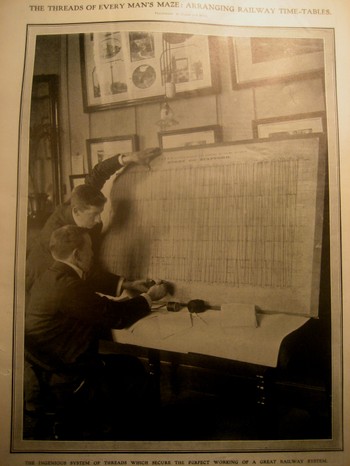
    String_big_board It is astonishing sometimes to think about how much was accomplished with so little.  This photograph, found in the 6 June 1908 issue of the Illustrated London News, entitled “The Threads of Every Man’s Maze:  Arranging Railway Time-Tables” (sub-titled “the ingenious system of threads which secure the perfect working of a great railway system”) is just such a case in point of wonder.  Each section of the board represents one hour, top to bottom; these are further subdivided by thinner lines representing 5-minute intervals; the horizontal lines representing the distances between stations.  And the guys in the foreground are keeping the whole thing up-to-minute, using string and tacks, running the rails of Great Britain.

    This was the British Empire at about its loftiest heights, with a spectacular internal railroading system, kept all in line and on time and correct with the help of heavy thumbs.  Can you think of a better way to display all of this complex data (with 1910 technology)  in real-time so that it is all intelligible–and to be so instantly?  I can’t.  This was just sheer, simple, brilliance.

    (I know, I know, this is actually “thread”, but so it goes.)  If you elongated and strengthened this concept just a bit you’d come up with rope and wire, and chains–the most simple metallic form of which was used by surveyors for hundreds of years to help map our earth.  And I won’t even get close to the String Theory stuff here, or stringed instruments–but if I did, I would want to talk a little about perhaps the ultimate string/cosmology image in the history of science, which would be Robert Fludd and his fantastical thought-experiment  called “Monochordum mundi”. from his Utriusque cosmi maioris scilicet et minoris metaphysica, physica atque technica historia, printed in 1617.
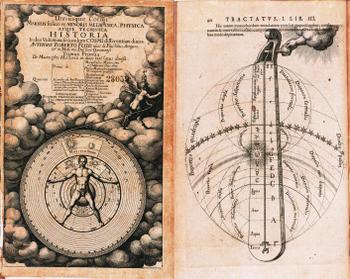
    Robert_flood Fludd makes an elaborate and beautiful stab at understanding the deepest aspects of an imagined supramusical relationship between the order and rationality and mathematical aspects of music and the functioning of the universe—based on sound itself.  These ideas come up time and time again, most visually pleasing in Fludd, but most dramatically argued by Johannes (Harmonicae Mundi, “Music of the Spheres”) Kepler.  But Fludd trumps with god’s graphical intervention.

    The hand of god makes an appearance here as it adjusts the magic monochord of creation–a Pythagorean monochord of two octaves which are then divided into harmonic intervals.  But god’s hand is definitely there, doing some sort of adjustment (or perhaps even holding the slipping peg in place?), which is actually a little bit late in the history of the mechanical universe being turned by the hand of the creator, with the hand actually depicted doing the job.  In general the hand stopped making appearances by this point in the history of science, but did manage to linger on in the work of Fludd.
    ·Posted by :

    ·in:


  • The Square Root of Beautiful

    JF Ptak Science Books  Post 2367

    309 193

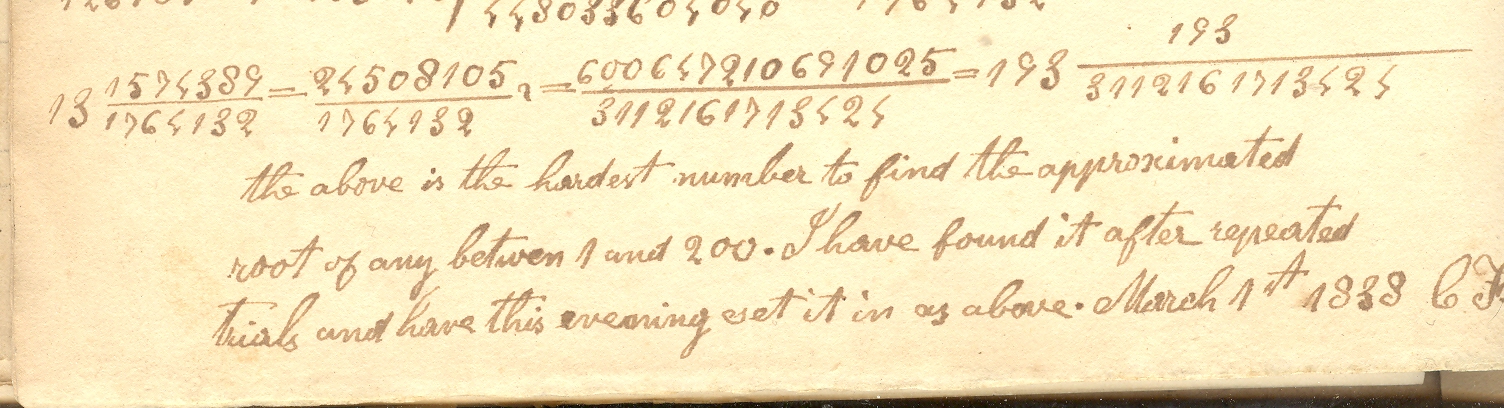
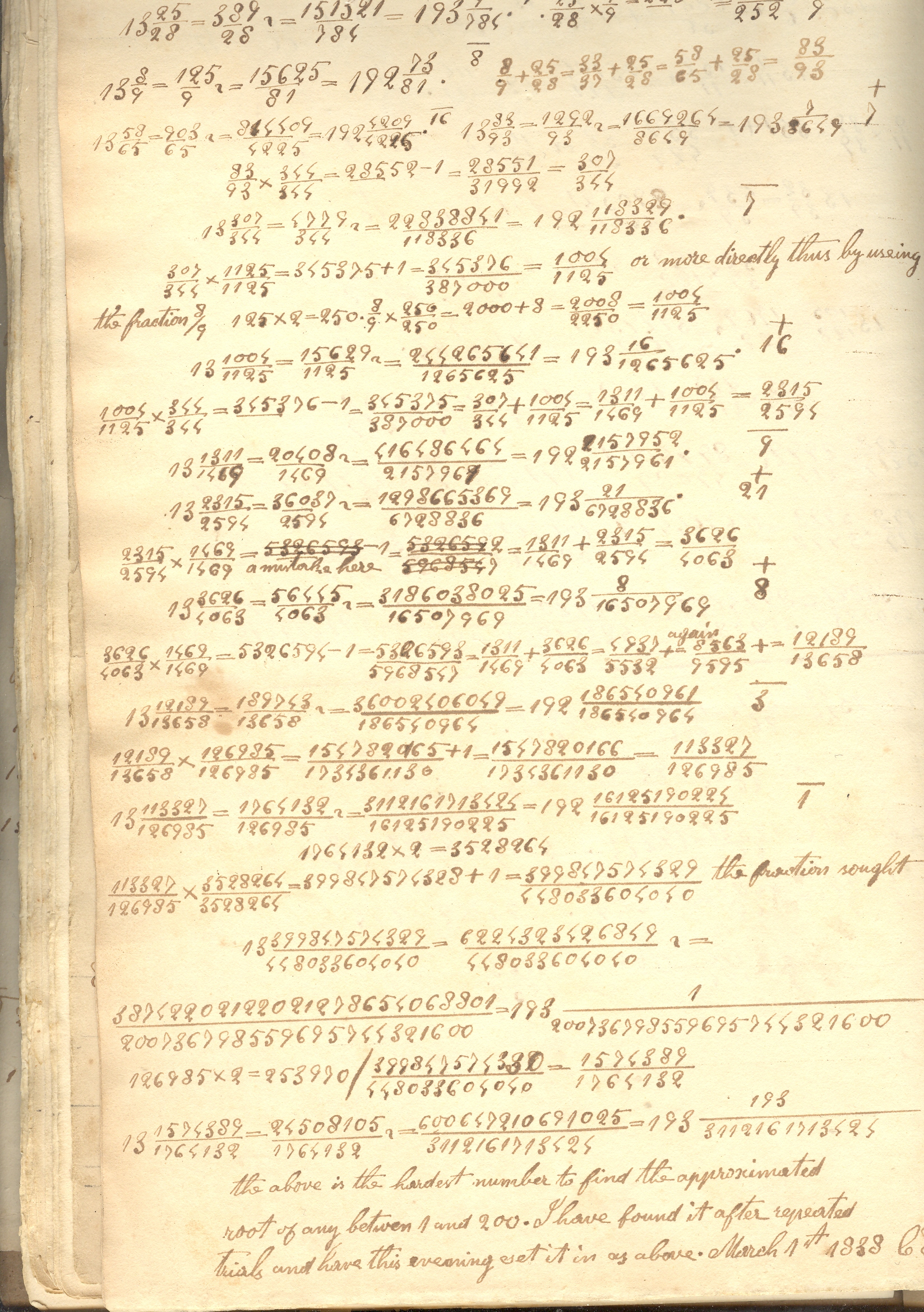
    The author of this manuscript, Charles Fisher, took a solitary pleasure in calculating the square roots of numbers from 2  to 589, not bothering to write down the 24 perfect squares to 576.  (The sqrt being r2 = x for every non-negative real number x.) From the few bits that I have checked the man seems to have done a good job back there in the 1830’s. 

    I cannot determine where this book was written or who Mr. Fisher was, though it is possible that he was a (Baptist) Minister from the few short textual notes that pop up here and there.  

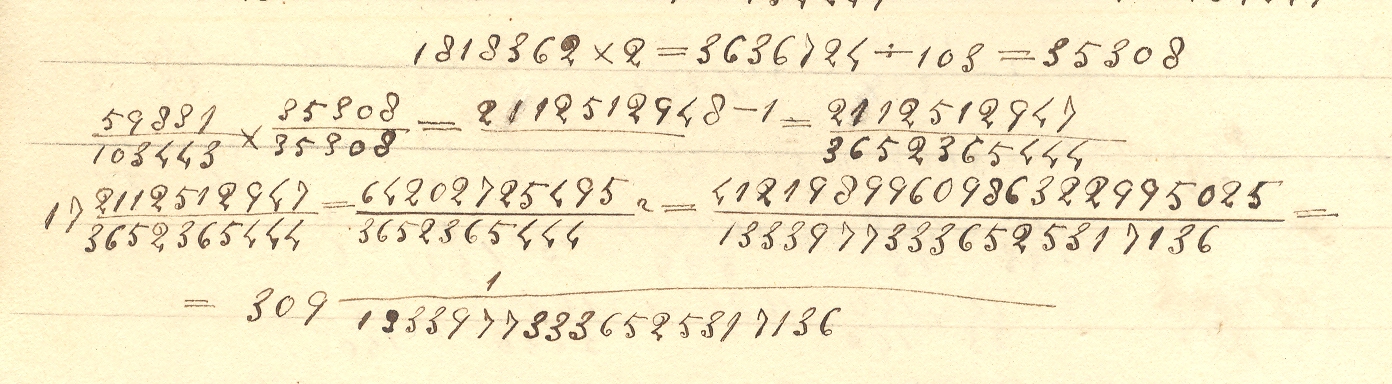
    His work is pretty elegant.  Take for example his solution (and proof) for the square root (hereafter sqrt(x)) 309,

    309 det

    which the calculator living under this page says is 17.578395831246947    Mr. Fisher’s answer is 17 10/17 = 799/17=89401/989=309 100/989, and after some more involved arithmetic comes t the lovely proof number of   

    4121989960986322995025 /13339773336525317136 or

    309.00000000000000000007496379247

    Which is getting pretty close.  

    The only note that Mr. Fisher makes on his calculations is for the sqrt(193), which he notes as “the hardest number to find the approximate root of any between 1 and 200. I have found it after repeated trials and have this evening wrote it in as above. March 1st, 1833. CF.”

    309 193 det

    ·Posted by :

    ·in:


  • Labor Unions as Red-Commie Battalions of Death (1940)

    JF Ptak Science Books   Post 2165

    Battalions of death064

    Representative Clare E. Hoffman wrote (or lent his name to) this insane and blistering attack on the CIO (the other half of the AFL-CIO) which was the Congress of Industrial Organizations founded by John L. Lewis in 1928.  Hoffman (1875-1967) was a conservative “Republican” from the 4th District/Michigan, who was pretty much an outsider to either major party, making and destroying his own roads and bridges in a long Congressional career. He was a recognized anti-Semite, a race-baiter, a leading exponent in the Impeach Roosevelt movement (publishing and distributing by Congressional franking privileges “Roosevelt is Judas”), and a person who supported and spoke for a number of “isolationist” and national socialist-supporting groups.  He saw Soviets/Communists everywhere, including his campaign against polio immunization, which he feared was too heavily influence by commies and Jews.  

    In addition to saving America from Communists and Jews, saving America for the “true American”, Hoffman was strongly aligned with the Constitutional Educational League, which published this pamphlet. The CEL was indicted in 1942 with 27 other groups for sedition and conspiracy and working to aid Nazi Germany and the Axis Powers–which is a tough business, but not too tough for Hoffman.  The CEL and Hoffman and the associated ilk and cancers were associated with a panoply of other Isolationist/Fascist groups operating int he U.S. during the war including such wincingly-named groups as the Christian Mobilizer, Christocrats, American Destiny, National Workers League, Black Legion (perhaps the most infamous of these groups), National American, Silver Shirts (started by bizarro local boy Pelley and very nasty), Citizens USA, and a host of others.  And of course America First, which may have been the most well known of these groups, having the famous affiliation and support of Charles Lindbergh (until Pearl Harbor at which point the Colonel back away).  

    Getting back to the pamphlet–it has the feel of old bad fetish porn, and makes endless claims that the trade unions were thuggy Communist–and even worse, “red Communist”– and would wind up controlling and destroying the U.S., putting the country under control of the U.S.S.R.  The aim seems to be equating the CIO with Communism, and so to stop Communism you must stop the CIO, the great destroyers of the American way.

    I can’t help but seeing many similarities between some current right-wing attacks against unions and pieces of the Hoffman piece–we’ll see how silly/abhorrent these claims really are with historical perspective in another few decades.

    Sources:  Ellen Parsons, “Anti-Jewish Manifestations” in American Jewish Yarbook, 1945/6, pp 135-143; Glen Yeadon, Nazi Hydra in America, p. 151.

    ·Posted by :

    ·in:


  • Found-Poetry in a Quibbling “Electro-Biologic” Early Computer Work, 1851

    JF Ptak Science Books   Post 2158

    Alfred Smee’s Process of Thought Adapted to Words and Language, Together with a Description of the Relational and Differential Machines1… is an extraordinary book, an “electro-biologic” work of superior thought and organization, and which is seen as being the first work theorizing the possibility of information storage and retrieval via a machine.  I’ve not yet read this book through though the book is long known to me–now, sitting down with it, finally, I was instantly drawn to its high possibilities because of the structure of its table of contents.  It–the table– simply is a beautiful read. [Source: here.]

    There have been times on this blog where I have created some bits of found poetry from mostly densely difficult passages–generally the process seems to diffuse the maledictus confutatis, and becomes some sort of pretty. (See Found-Poetry of Accumulations, Found-Word Bibliopathology, “Hog-Bound”, a Found-Poem in a FBI Dposition, for example.) In this instance–using the description of Chapter XI (“On Logic or the Art of Quibbling”) in the table of contents–the found poetry is made from some incredible fragments on the order of Piranesi’s imago frammenti  and lovely in their own way and found in situ, lovely in their original setting, and still more attractive set as poetry, I think:

    Frammenti

    ON LOGIC OR THE ART OF QUIBBLING

    Logic applicable to Quibbling, Quibbles by Puns, By Qualified Nouns,

    By Variations in Number,  

    By the Question involving Two Answers, By Constitution of Words, By the Verb,

    By General Principles, with Exceptions.

    By Two Words for the same Thing

    By Cause and Effect, By using Words contrary to well-known Principles, By Action conjoined with the use of Words,  By Variations of Emphasis.

    By Exalting a Probability, By Circular Reasoning.

    By a Question involving a False Premiss.

    By reasoning upon that which may be known.

    By changing the Word for the same Thing.

     By a Variation of Punctuation,

    By Begging the Question.


    Re-setting Chapter XI seems to be more of a result of exploration in the more-densely arranged original–setting out in the book’s version one is more like an explorer, finding bits and chunks here and there, and then simply placing them in a more orderly fashion, as in the case of Piranesi’s bits and pieces. 

    The text of Chapter XI might also be read as a street map, and the reader, in this case, could be attracted to it as a flaneur, roaming its twists and turns in a casual but observational way, strolling into the most interesting and attractive parts.  An urban garden of words. 

    ·Posted by :

    ·in:


  • The Greatest Invention in the Distribution of Knowledge?

    JF Ptak Science Books   Post 2156

    A week ago I made a post here on the impact of the invention of eyeglasses in the history of art (“Robot Art of the Future and the Far-Sighted Past”).  What I didn’t address was considering eyeglasses as one of the greatest inventions in the history of the distribution of knowledge.  Certainly there was th invention of paper, and the inspired creation of Gutenberg–and the Internet, which may be the greatest democratizer and distributor of them all.  But what about the legions of people over thousands of years who had poor/disturbed vision and couldn’t read at all? Granted for the great majority of that time there really wasn’t much for the vast majority of people to read–literacy was not high, books/etc. were expensive and mostly for the privileged and ruling classes, but still, if you’re eyesight was bad you had you get along with peering through emeralds or other crystals or pinhole lenses or squinting or extra-large type to make anything legible.  

    Glasses

    [Image: the earliest-known depiction of reading glasses in art occurs in this depiction of the studious Cardinal Hugh of Provence, sporting rivet specs, painted by Tommaso da Modena (1325-1379) in 1352, in a fresco at the Basilica of San Niccolõ in Treviso. The interesting bit here is that the Cardinal died in 1263, well before the earliest acknowledged appearance of spectacles. Adding spectacles was not an uncommon practice, as many academic/medical/scientific types who appeared in pre-spec era paintings and frescoes received some reworking to depict them with glasses for a more authoritative/scholarly look.]

    Glasses magnifying

    [Another portrait in the same fresco depicts the French Dominican Cardinal Nicolas de Fréauville (1250-1323), and is the first depiction of teh use of a magnifying glass.]

    Spectacles still weren’t in universal use until relatively recently in the history of reading, not appearing far and wide until deep into the 19th century.  There is an encyclopedia of people-of-supra-achievement with bad eyesight ((Aristotle, Borges, Goedel, Homer, Sam Johnson, Joyce, Keats, Kipling, Lear, Luther, Milton, Pope, Schopenhauer, Thurber, so on)–and it makes me wonder about all of the near-sighted folks who just couldn’t make a go of it but for the want of spectacles or magnifying instruments. 

    ·Posted by :

    ·in:


  • History of Physics Timelines from the Web, 1.0

    JF Ptak Science Books     Reference Post

    I never did collect any of these useful sites of timeslines/chronologies in the history of physics–here’s a first installment of them:

    ·Posted by :

    ·in:


  • 900 WPA Poster Mosaic

    JF Ptak Science Books   Quick Posts

    900+ images of posters produced by the Workers Progress Administration (WPA) during the Depression.

     This is a simple picture dump–all of the material and links are from the Library of Congress: 

    digitized item thumbnail digitized item thumbnail digitized item thumbnail digitized item thumbnail digitized item thumbnail digitized item thumbnail digitized item thumbnail digitized item thumbnail digitized item thumbnail digitized item thumbnail
    digitized item thumbnail digitized item thumbnail digitized item thumbnail digitized item thumbnail digitized item thumbnail digitized item thumbnail digitized item thumbnail digitized item thumbnail digitized item thumbnail digitized item thumbnail
    digitized item thumbnail digitized item thumbnail digitized item thumbnail digitized item thumbnail digitized item thumbnail digitized item thumbnail digitized item thumbnail digitized item thumbnail digitized item thumbnail digitized item thumbnail
    digitized item thumbnail digitized item thumbnail digitized item thumbnail digitized item thumbnail digitized item thumbnail digitized item thumbnail digitized item thumbnail digitized item thumbnail digitized item thumbnail digitized item thumbnail
    digitized item thumbnail digitized item thumbnail digitized item thumbnail digitized item thumbnail digitized item thumbnail digitized item thumbnail digitized item thumbnail digitized item thumbnail digitized item thumbnail digitized item thumbnail
    digitized item thumbnail digitized item thumbnail digitized item thumbnail digitized item thumbnail digitized item thumbnail digitized item thumbnail digitized item thumbnail digitized item thumbnail digitized item thumbnail digitized item thumbnail
    digitized item thumbnail digitized item thumbnail digitized item thumbnail digitized item thumbnail digitized item thumbnail digitized item thumbnail digitized item thumbnail digitized item thumbnail digitized item thumbnail digitized item thumbnail
    digitized item thumbnail digitized item thumbnail digitized item thumbnail digitized item thumbnail digitized item thumbnail digitized item thumbnail digitized item thumbnail digitized item thumbnail digitized item thumbnail digitized item thumbnail
    digitized item thumbnail digitized item thumbnail digitized item thumbnail digitized item thumbnail digitized item thumbnail digitized item thumbnail digitized item thumbnail digitized item thumbnail digitized item thumbnail digitized item thumbnail
    digitized item thumbnail digitized item thumbnail digitized item thumbnail digitized item thumbnail digitized item thumbnail digitized item thumbnail digitized item thumbnail digitized item thumbnail digitized item thumbnail digitized item thumbnail


    ·Posted by :

    ·in:


  • Found-Poetry of Accumulations

    JF Ptak Science Books    Post 2149

    I have found sometimes that books aren’t necessarily badly written when they’re written badly, especially when there’s good content hidden under the layer(s) of unfortunate wordly insulations, so the job of the reader which such a thing is to either read half of what is written, or approach the thing full-on by reading it as an archaeological found-poem expedition.  This sounds horrible, but sometimes it actually works (or so it seems to me), as in the following examples.  I was looking for something entirely different when I opened the creaking old door to a Dickensian world of books and letters in James C. Fernald’s (1838-1918) Scientific Sidelights, which feels much more Victorian than its 1903 date of publication. (Fernald was educated in the 1850’s and 1860’s and that and along with his reading carried over solidly into this work.)

    Cracking the book a bit I found a fabulous heading,

    “Accumulation of Ethical Forces”

    for a short two-paragraph screed from a mid-19th century German source, quoted in the very sniffy Psychology of Henry James,. It was followed by another beauty,

    “Accumulation of Excitements”

    and then, another:

    “The Accumulation of Small Impulses” 

    All of these were entries on the same page. The titles were terrific and inviting and called for a little reading–which was defeated by indifferent text.  But the titles had a life of their own, independent (and in spite of) their articles, and called for assistance, and they found some, by simple re-arrangement of the visual aspects of the piece–this changed the metre and timing of the reading, making everything different, and perhaps better. (All that was done with the text was to alter the spacing–everything else remains the same.)

    And so, in the first case, the realignment reads:

    ·Posted by :

    ·in:


  • The First Personal Computer (?)–“Simon”, 1950


    Berkeley simon915

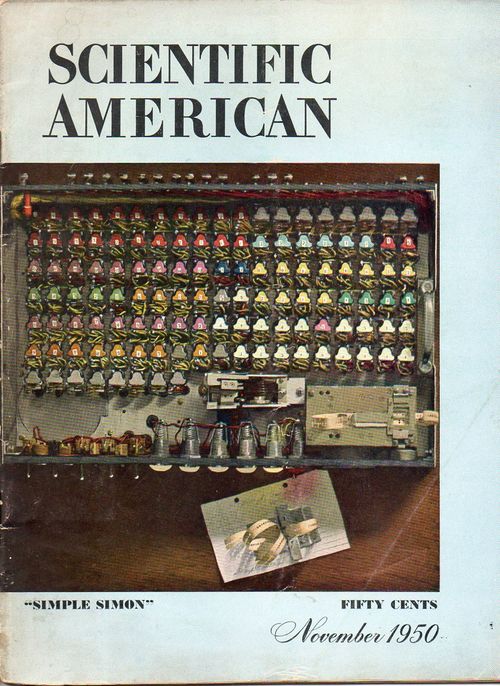
    The first exposure of the American public in general to a “personal computer” may have been in this issue of the Scientific American for November 1950–an article called “Simple Simon” by the very busy Edmund Berkeley.  (Amidst much else, Berkeley also wrote a book called Giant Brains, which seems to me to be the first mass-consumption book–written in terns for the general public–on how the computer works, and the design of “how a machine will think”.  Berkeley looks at the MIT Differential Analyzer #2, the Moore School ENIAC, Bell Labs’ General-Purpose Relay Calculator, and the IBM Automatic Sequence-Controlled Calculator.) 

    The Simon was a five-hole paper tape (which was its data entry and memory) 2-bit storage relay-based computer that could use numbers from 0 to 3.  It was extremely limited, but it worked, and it was real.  And affordable.  And a baseline for things to come.

    Berkeley introduced the idea for Simon in Giant Brains:

    “We shall now consider how we can design a very simple machine that will think. Let us call it Simon, because of its predecessor, Simple Simon… Simon is so simple and so small in fact that it could be built to fill up less space than a grocery-store box; about four cubic feet….It may seem that a simple model of a mechanical brain like Simon is of no great practical use. On the contrary, Simon has the same use in instruction as a set of simple chemical experiments has: to stimulate thinking and understanding, and to produce training and skill. A training course on mechanical brains could very well include the construction of a simple model mechanical brain, as an exercise…”–Edmund Berkeley, in Giant Brains, 1949, p. 22 

    In the Scientific American paper Berkeley introduced the machine and how it functioned; he also described three  three outcomes for Simon:

    First: “Simon itself can grow.  It possess all the essentials of a mechanical brain…”

    Second: “It is likely to stimulate the building of other small mechanical brains.  Perhaps the simplicity and relatively low cost of such machines may make them attractive to amateurs as the radio set and the small telescope.”  [The “low cost” in 1951 was $600–equal to about $4000 today.]

    Third:  “It may stimulate thought and discussion on the philosophical and social implications of machines that handle information…”

    Berkeley finishes the three-page article with the following paragraph, looking into the not-too-distant future:

    “Some day we may even have small computers in our homes, drawing their energy from electric-power lines like refrigerators or radios … They may recall facts for us that we would have trouble remembering. They may calculate accounts and income taxes. Schoolboys with homework may seek their help. They may even run through and list combinations of possibilities that we need to consider in making important decisions. We may find the future full of mechanical brains working about us.”

    ·Posted by :

    ·in:


  • A Fine Astronomical Engraving

    JF Ptak Science Books  Quick Post

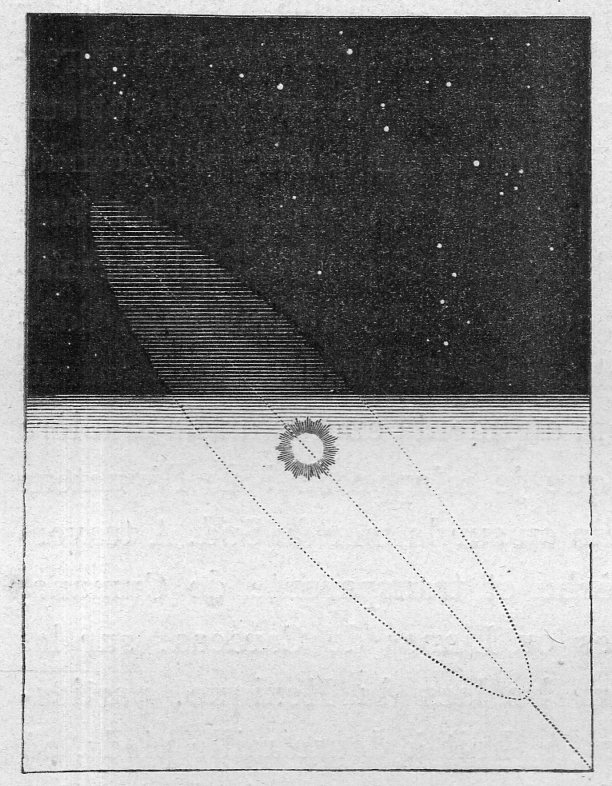
    This beautiful engraving (and its detail) comes from A. Guillemin’s (1826-1893) Le Ciel, Notions Elemenatiares d’Astronomie Physique ... (fifth edition, 1877) in the section “Lumiere Zodiacale”. (Full text available via the Internet Archive, here.) It is one of a series of very popular books that Guillemin wrote and edited in the last part of the 19th century, and in truth it is a small text illustration, barely three inches long–but the artistry for such an image as this is very high.

    Monde SOlaire683

    And the detail:

    Monde SOlaire685

    ·Posted by :

    ·in: