A Daily History of Holes, Dots, Lines, Science, History, Math, Physics, Art, the Unintentional Absurd, Architecture, Maps, Data Visualization, Blank and Missing Things, and so on. |1.6 million words, 7500 images, 4.9 million hits| Press & appearances in The Times, Le Figaro, Mensa, The Economist, The Guardian, Discovery News, Slate, Le Monde, Sci American Blogs, Le Pont, and many other places… 5000+ total posts since 2008.

Category: Uncategorized

  • On the Continued Rediscovery of the Horizontal Pendulum

    JF Ptak Science Books   Quick Post    

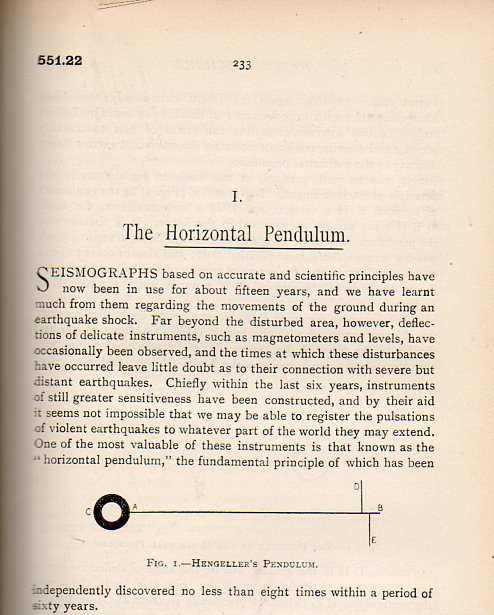
    I found this lovely little article in the not-terribly-common Natural Science for April 1896 while looking for an article on the nearly still brand-new discovery of X-rays. “Natural Science” was really more like natural philosophy than the biological stuff, as a quick breeze through any of its volumes shows, though there is plenty of high-Victorian interest in all aspects of living sciences found here. What was so interesting about the horizontal pendulum was how the author (C.Davison of “King Edward’s High School, Birmingham”) traced down its history of having been independently discovered (and forgotten) “no less than eight times within a period of sixty years”. As with other inventions that were “in the air” (like the telephone, and the electric telegraph, and the television, and so on, where a number of people were working independently at the same time) the horizontal pendulum was that too–except that the process of discovery continued for quite a long time.  

    Pendulum096

    I don’t mean to go into this at all–I just liked the wonderful research and presentation in this little five-page article.  And for anyone who cares, C. Daivson’s (not C. Davisson as in Daivsson and Germer) references are included below.

    ·Posted by :

    ·in:


  • Early Bibliography for the History of Relativity, 1921

    JF Ptak Science Books     Reference Tools series

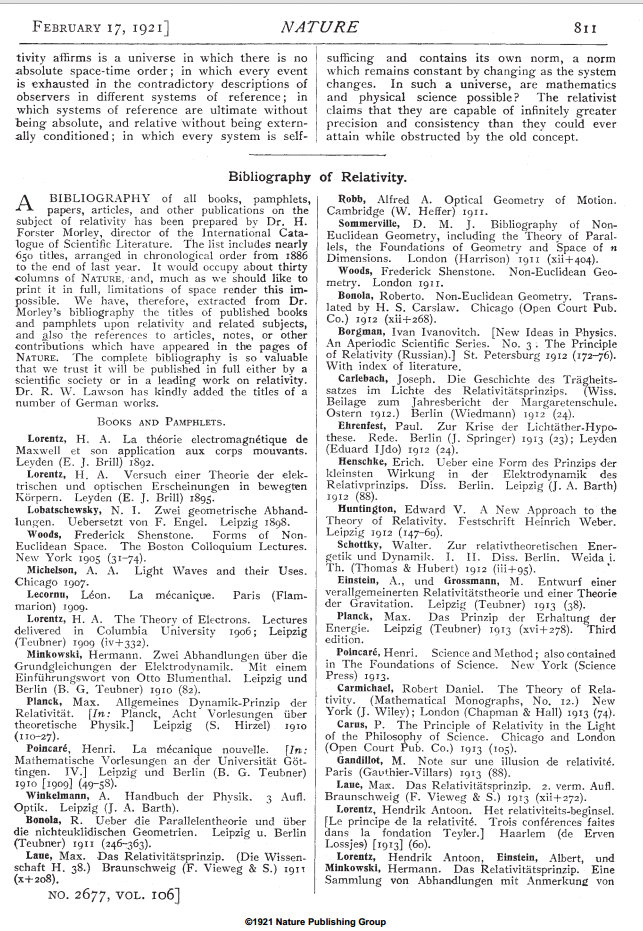
    This is a very unexpected find in the journal Nature for 1921–a selection from a bibliography by Forster Morley for early works in relativity, in this case limiting the number of selections from the full 650 Morley numbers to only those that appeared in some way in Nature.  Truncated or not, it is an interesting and early read in the area.  

    Relativity Nature Bibliog 1

    ·Posted by :

    ·in:


  • The Smell and Cheapness of Communist Dreams, 1942

    JF Ptak Science Books Post 2243

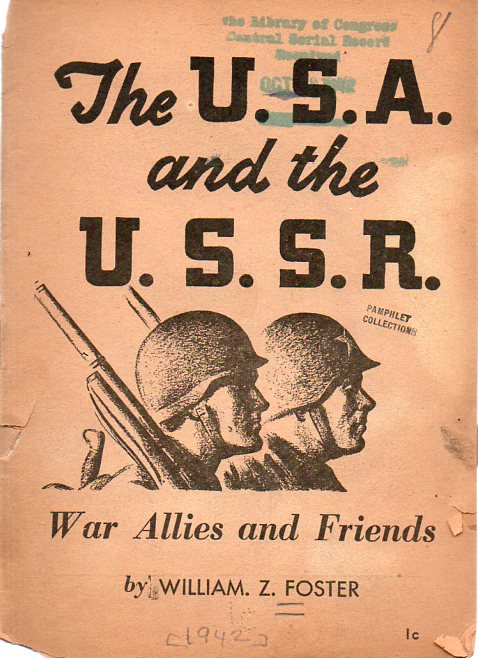
      Foster082

    William Z. Foster. Great name, interesting history, but also Joe Stalin supporter of high order who ran for president of the U.S. in ’32 as a Communist (and got 100K votes). Foster does have organizational chops, working for unions and union organizing for several decades. In the mid-1920’s and beyond he was interested in the Soviet Union and Communism, and published many small works of wonder, many of which had interest cover illustrations, pushing the penny publication.

    Many of these publications also had that particular feel of cheapness to them, as well, as with the pamphlet I’m sharing above. They feel cheap because they were cheaply printed, written bits made to be whispers into any listener’s ear, and then dissolve after the need was perhaps filled and perhaps not.  They turned brittle after just a little while, and nowadays just crumble into flaking slivers of bad paper that suck the moisture right out of your fingers.  

    This hopeful pamphlet addressed the very tenuous amity between the United States and its mew-ish ally, the Soviet Union. This was printed in 1942, a third of the way through the Nazi invasion of the Soviet Union, an operation that caused the deaths of about 5 million Soviet soldiers and dozens of millions of civilians. Of course the Soviets weren’t always on the side to the U.S. And the Allies, far from it. 23 August 1939 is when Stalin signed the Non-Aggression Pact with Hitler (the Ribbentrop-Molotov Pact) , foreign up Hitler to move against Poland, which is did on the first of September. On the third the British declared war on Germany, and on the 17th The Soviets rolled into the eastern part of Poland, taking what it wanted, as per the agreement in divide and conquer.

    The honeymoon between the two states wasn’t to last long, because Hitler could not stand the Russians, who he felt were an inferior, servile people, holding much-needed natural resources for the Reich, deserving death or slavery. And so on 22 June 1941, the agreement was annulled when the Nazis undertook a full-out-mega-frontal attack on the Soviet Union called Operation Barbarossa. It was a massive campaign, and the Soviet Union reacted slowly to it, given Stalin’s insistence that such a thing as Nazi subterfuge and betrayal was not possible.  The plan was quite nearly successful, with tremendous progress made in the first few months (due to Nazi strategy and surprise as well as Stalinist purges of top Soviet military figures and mismanagement) but then the Soviet Union grew into the necessity of stopping the onslaught, and wound up destroying the German capacity for the two-front war.

    In any event in 1942 Foster made a play for American-Soviet friendship just at the time when the Nazi invasion was being turned around, falling short of Moscow, engaged in awfullness in Crimea, and just about to get into Stalingrad (mid-’42), Hitler’s dream repackaged by an extraordinary effort by the Soviet army. We absolutely needed each other at this point in the war, because the Soviet Union basically killed much of the Nazi war effort, and the U.S. was the seat of fantastic resources. But before the war was out, the Foster’s plea for the beacon of light of Super Friends was not much more than a wet stubby candle in a closet.

    ·Posted by :

    ·in:


  • The World Going On Underground: Miners, Sappers, Tom Waits

    JF Ptak Science Books 

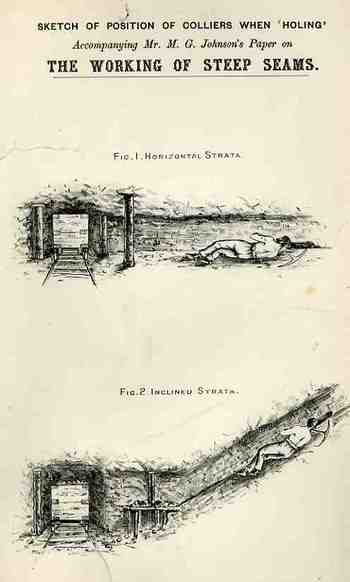
    Underground working steep102

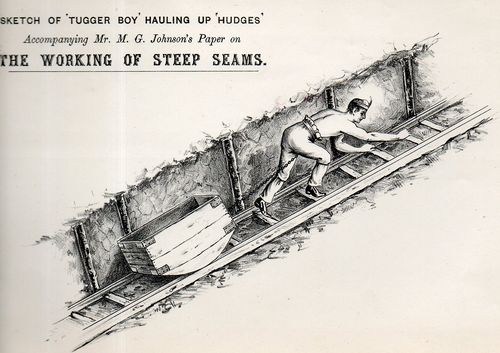
    Looking at these two images of the shirtless miner laying down and working on his side in the semi-dark way underground in what looks to be a tunnel about twice the width of his shoulders makes you wonder about how in the name of great bog could people have done this, day in and day out.  The fact that the appearance of these images were both essential and mundane further tells us—as we sit here in a comfortable chair in the print’s future—that this is, simply, what people did, and what they had to do.

    Blogjuly_17_work334

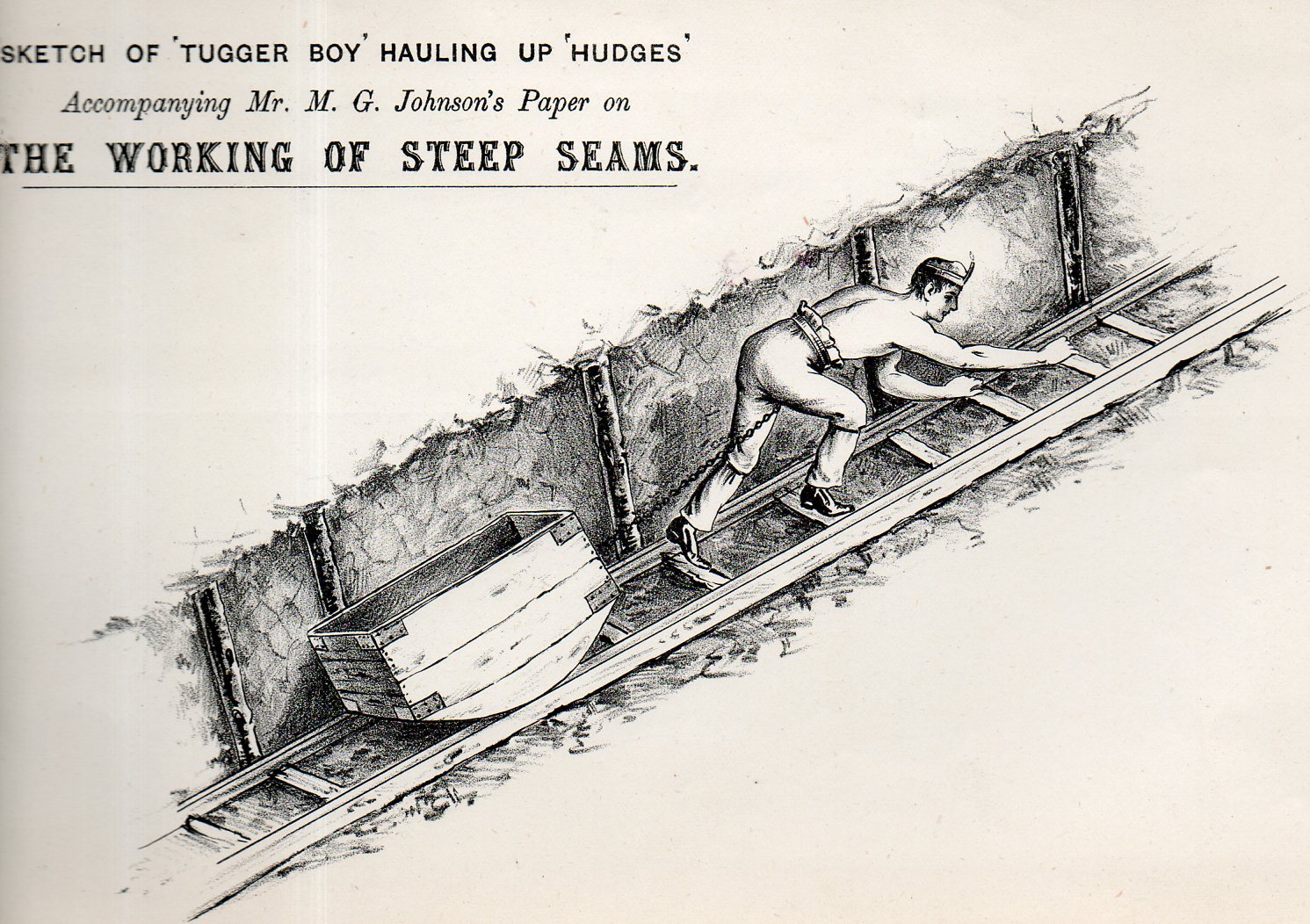
    This was “holing”, as in working in a hole, and served to illustrate a point in Mr. M.G. Johnson’s paper “The Working of Steep Seams”, which I think appeared in a West Australian mining journal around 1900.  So, it seems, the guy, the worker, in the picture would spend his day chunking coal from a hard vein, laying down, scrapping (I think) away at the coal in a too-tight tunnel.  Did he do this for hours?  Days?  Weeks?  I guess the bad answer is that he did this as long as the coal could be followed.   (Also, it looks as though that the major tunnel in which the coal car is located may be 4 or 5 shoulders high—certainly not tall enough to walk in, which means that this guy could’ve crab-walked to this position for a half mile or more, just to get to work.  The tenacity of this worker to do his work and collect his pay to feed his family was just incredible. 

    The first image really doesn’t need much commentary, though calling the worker a “tugger boy” pulling up a “hudge” was probably a bit of sardonic camraderie–except that the doing of the job would distance you from its folksy name. Well, that, or the “tugger boy” really is referring to a boy, as we see in the followlign mining definition: “Tugger boy (Brist). One who draws small tubs or sleds underground by
    means of a tugger. Called Tugger-work. (Gresley), 1883).  The depiction of what seems to be a mature man in the image might be a piece of propaganda. In any event,  the Tugger Boy carries his own flame on the top of his headgear, and the chain that attaches him to the heavy coal bucket runs from his waste down the front of his body and through his legs.  Very hard work needless to say–harder yet done by a child.

    George Orwell wrote perhaps one of the most brilliant descriptions of the mining environment in his superb The Road to Wigan Pier. (It is well worth reading all of Orwell’s books at this point—his insights almost never looked so fresh.)

    He  describes the crab-walk from the elevator to the place of work, telling how difficult and exhausting the process was of just getting to the place where you would then begin your difficult workday.  Of the miners he says at one point:  “Watching coal-miners at work, you realize momentarily what different universes people inhabit. Down there where coal is dug is a sort of world apart which one can quite easily go through life without ever hearing about. Probably majority of people would even prefer not to hear about it. Yet it is the absolutely necessary counterpart of our world above.”  Read more here.

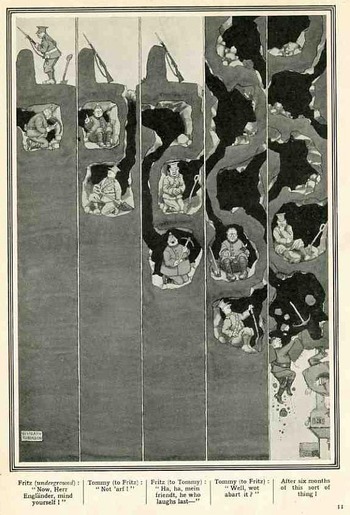
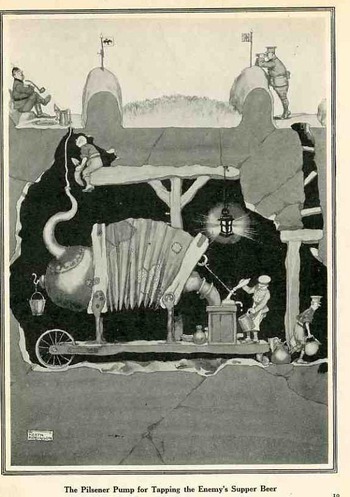
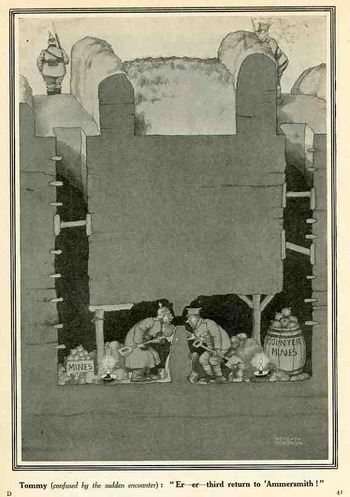
    The next series of images come from the pen of W Heath Robinson (1872-1944) who was a lovely, quirky, charming, skewed, dark, stiff-bouncing and creative illustrator capable of considerable whimsy (light and complex) and deep skepticism.  The images I’ve selected are from one of his three WWI books, Hunlikely, published in 1916 (Some “Frightful” War Pictures (1915), and Flypapers (1919), were the other two) and depict scenes from the intra-trench tunnel wars, which were battles fought in the midst (or, actually, beneath) other battles.  This was a savage, grueling, post-adjectival affair—exceedingly dangerous, difficult, awful.  And it happened a lot during the war, given the experience of stalemates between vast armies sunk into mole city trenches, with no one going anywhere for long periods because there was nothing in between the two impervious lines but a death vacuum. 

    Blogjuly_18_mining_robinson338

    So one of the solutions was to try and tunnel underneath the opposing army’s defenses, fill the far end with high explosives, and blow them up.  The other side was doing it too, and in the middle of it all was the incorporation of newer/better listening devices to detect forces rummaging around underneath your position dozens of feet into the ground.  It was a bad business. (One of the other means of breaching the trench lines was aerial combat, but bombers carrying tons of HE were still yet to be invented; poison gas was another.  Most of the time the armies would just meet in the middle  in wide plains of nothingness in a sea of hot, expanding metal,  where to this day in many of those places nothing can live).

    Robinson’s illustrations are odd, and oddly funny, the dark humor coming at the expense of both sides of the conflict, piercing each.   

    Blogjuly_18_tunnel_2_robinson340

    This puts me in mind of Tom Waits’ concrete-toothed “There’s A world Going On Underground” song from the Swordfishtrombones album. 

    Rattle big black bones in the danger zone
    There’s a rumblin’ groan down below
    There’s a big dark town, it’s a place I’ve found
    There’s a world going on underground
                
    They’re alive, they’re awake
    While the rest of the world is asleep
    Below the mine shaft roads, it will all unfold
    There’s a world going on underground
                
    All the roots hang down, swing from town to town
    They are marching around down under your boots
    All the trucks unload beyond the gopher holes
    There’s a world going on underground

    Blogjuly_18_tunnel_3_2_robinson341

    ·Posted by :

    ·in:


  • The Aeronaut as Improbable Panhandler, 1785

    JF Ptak Science Books   Quick Post    Aviation and Flight series

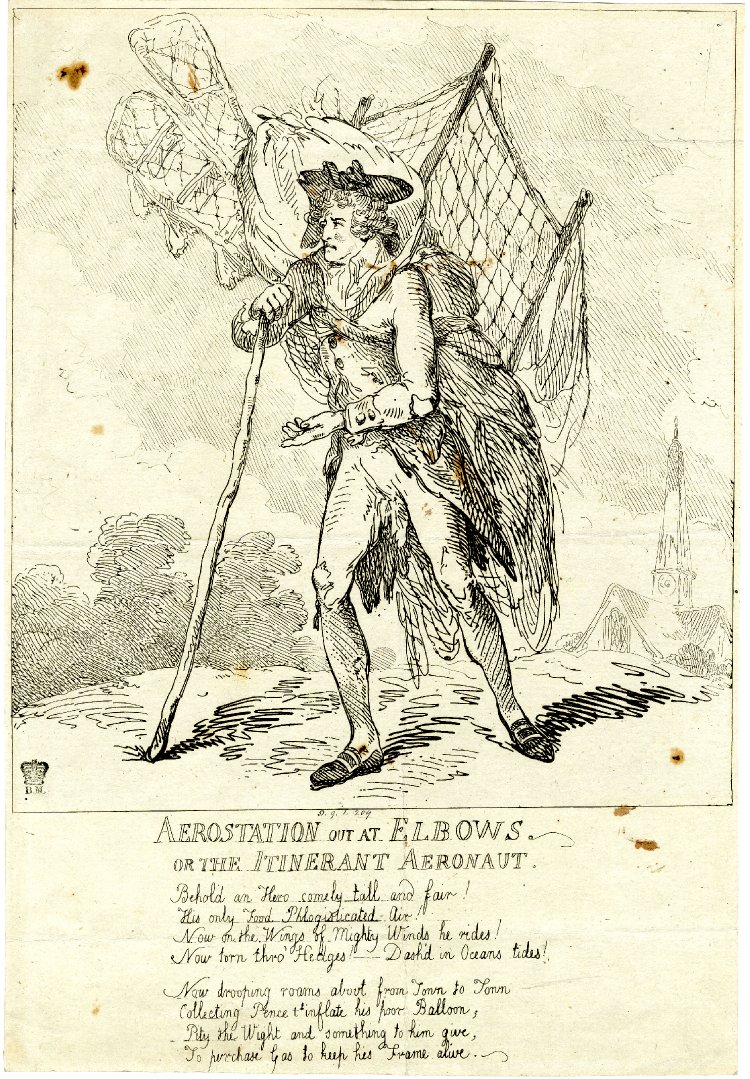
    Flying wasn’t always depicted as a mythic or glamorous or future-inspirational, as we can see in this 1785/6 etching by social memoralist and caricaturist Thomas Rowlandson:

      Aerostation out at elbows  BM[Image source: the British Museum.]

    “Lunardi, slim and handsome, walks diagonally towards the spectator from the right, supported on a staff, his left hand held out as if begging…”(–LOC) is one description of this print, though Lunardi himself seems to have been an upper-crust Frenchman of Italian lineage who made a number of successful ascents in 1784/5, or at least enough success to write a book about them. He did suffer a few tragedies, one of which did put him into a rescuable position in the sea. Currently, though, I’m not sure why this image came into being–perhaps he asked one too many times the wrong person for help with funding his project.  Nevertheless it is interesting to see such a grounding image of the enterprise of flight just a few years after the first Mongolfier flight.  

    The legend beneath the image is reproduced more legibly in Joseph Greco, Rowlandson the Caricaturist, 1880 (below, and here), revealing a Rufus Thomas-like versifying (Thomas would rhyme “Sidewalk” and “BAltimore” and make it work) by same-self-singing “town” and “balloon”:

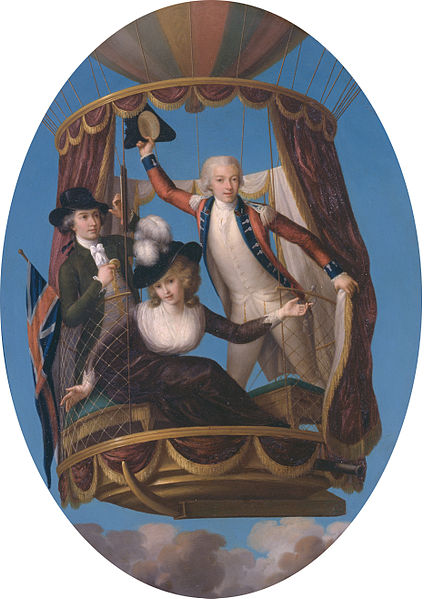
    And Lunardi depicted in happier circumstances (“Captain Vincenzo Lunardi with his Assistant George Biggin, and Mrs. Letitia Anne Sage, in a Balloon, by John Francis Rigaud”, via Wikipedia), which seems to be more the case in his making it into print than the panhandler image above:

    Lunardi


    ·Posted by :

    ·in:


  • Can Anyone Identify this Unusual Image?

    JF Ptak Science Books
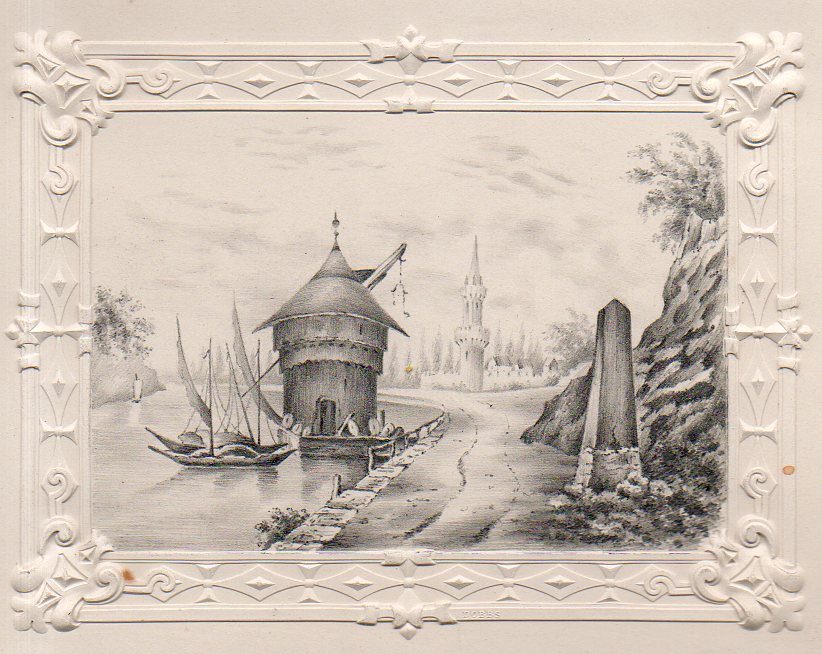
    I’ve owned this print for many years, and it has just recently returned from storage and is hanging up. I found it in a frame that seems to fit it perfectly, and the original paper seems not to have been cut to fit the frame.  The frame is old, perhaps 175  years old, with hand-forged nails and imperfect glass.  That really doesn’t help much, though.  I’m fairly certain that it is a print though I’m not 100% convinced it is not a drawing, and I feel as though the embossed border will be the biggest help.  The image is on a heavy card stock, and the embossed part is signed/printed “Dobbs”, the name of a manufacturer of embossed blanks and images and greeting cards and such, operating in the mid-19th century, though it looks like an earlier iteration of the firm (“Dobbs & Kidd”) was around at least from 1821.  So I guess the age of the image is pretty much half-guesstimated–I just haven’t a clue about the image, though it reminds me of several things…

    Odd print039
    And the detail:

    ·Posted by :

    ·in:


  • British Prisoners of War Calling! (1940)

    JF Ptak Science Books  Quick Post  See also an earlier post (with further links Humanitarian Propaganda–the Hope for those at Home.

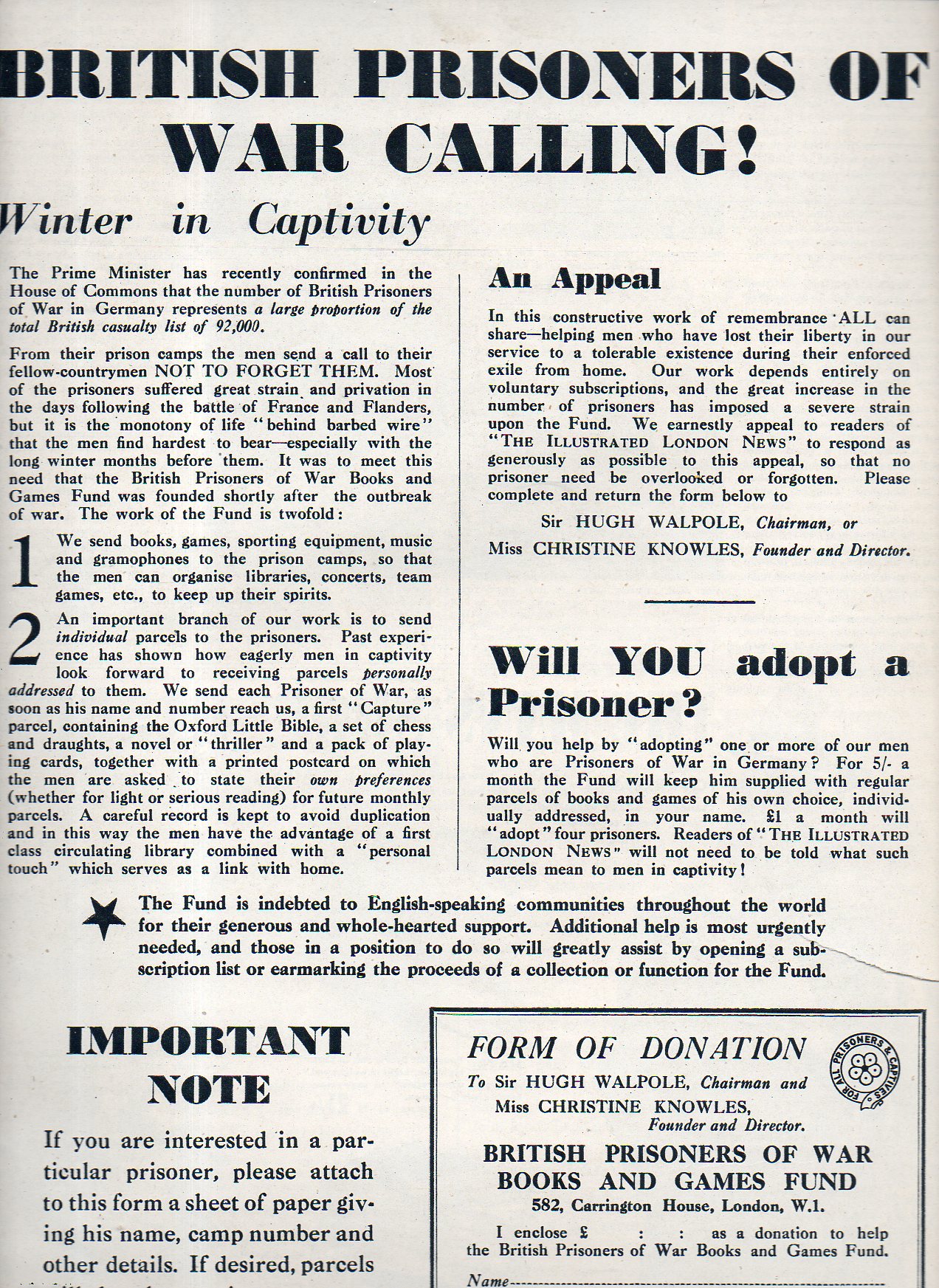
    This was certainly a civilized format to solicit sympathy and money for British P.O.W.s being held by the Germans, 13 months into a war that would force its way on for another 43 months.  It appeared as a bold full-page ad in The Illustrated London News on 16 November 1940, and it asked readers–who were now in the final phases of the Battle of Britain after full-on aerial assaults for through the summer months costing dozens of thousands of deaths–to think about the soldiers who had made the great sacrifice in protecting their country and being taken captive for it, and to give money so that some sort of comfort and aid could be sent to them in POW camps.  

    The goal from the outside seems reasonable enough–it remains to be seen how much of the million tons of good shipped to the POW camps by the Allied Forces ever made it to the prisoners. 

    I’ve included this short post in the History of Empty, Blank and Missing Things series not because of the hopelessness of delivering modest relief, but for a much more simple reason–exhibiting the unused coupon for sending funds to make that happen.  It has a certain emotional power to it that is difficult for me to identify.  

     “Communications have been reopened and it is the aim of the fund to equip every prisoners’ camp in Germany with a library, indoor and outdoor games, sporting gear, musical instruments and other goods. As a result of the debacle in the Lowlands and France the demand upon our resources has been very great and we are therefore issuing an appeal to Britons all over the world to help us in this work.”

    POW 1940037

    The donation form is a detail from thi sbig, full-page ad from the Illustrated London News for November 16, 1940: 

    POW 1940036

    The West Australian (Perth), 30 October 1940:

    “PATRIOTIC EFFORTS.PRISONERS OF WAR.A Books and Games Fund.Information was received yesterday concerning the formation of a British Prisoners of War Books and Games Fund in England, under the chairmanship of Sir Hugh Walpole. “As you know, there are now many thousands of British prisoners of war in German camps,”states Mr. J. A. Sinclair Pooley, of the appeal section of the fund, in a pamphlet received in Perth. “Communications have been reopened and it is the aim of the fund to equip every prisoners’ camp in Germany with a library, indoor and outdoor games, sporting gear, musical instruments and other goods. As a result of the debacle in the Lowlands and France the demand upon our resources has been very great and we are therefore issuing an appeal to Britons all over the world to help us in this work.”Owing to stringent Government regulations no books, games or other goods can be accepted by the fund, but monetary donations may be forwarded to the British Prisoners of War Books and Gamesfund, Carrington House, Hertford-street,London W.1, England.Under the scheme a prisoner can be adopted by any person so that, on receipt of donations, he will be supplied with books, puzzles and games in the name of the donor. The fund does not duplicate the work of the Red Cross Society in supplying food, clothing and educational literature.”

    ·Posted by :

    ·in:


  • “What the Frog’s Eye Tells the Frog’s Brain” and Walter Pitts

    JF Ptak Science Books  Post 2210

    I was walking around a 1959 issue of the Proceedings of the Institute of Radio Engineers I found this fantastic article by the great Walter Pitts.  What was Mr. Pitts and a frog’s brain article doing here?  Well, it all makes sense, really, and I was very happy to unexpectedly find Pitts here when I was looking for something else.  Walter Pitts (1923-1969) is one of those very important but now somewhat faded names in the history of American science.  He was a brilliant young man turned into a brilliant mature one, a logician/cognitive psychologist who corresponded with Russell on the Principia at age 15 and who went on to develop (with Warren McCulloch) some of the fundamental ideas in what would be known as neural networks.  The work was really much more far reaching, touching work in the fields of artificial intelligence, cybernetics, neuroscience(s), philosophy, cognitive sciences and of course computer science.

    https://historyofideasblog.com/a/6a00d83542d51e69e201156f67025e970c-piPitts was a genius I’m sure,  a sort of Matt Damon-type character from the movie Good Will Hunting1. He was offered a chance to study with Russell in the U.K. at 15, but refused and wound up running away from home to go to the University of Chicago to listen to Russell lecture, and where he stay on, finding another great logician, Rudolf Carnap (then at Chicago) and offering him critiques on his new work.  Pitts would blow like the wind in and out of Carnap’s office, the logician spending months trying to find out who and where Pitts was–and what he was was a homeless teenage boy.  Once found, Carnap got Pitts a low-level maintenance job.  I’m not sure what Pitts was doing before he switched ships and jumped (still homeless) to MIT in 1942, where he was introduced and was impressive to the not-to-be-impressed Norbert Wiener, and where he also met Warren McCulloch, with whom he would work on the Leinbizian idea of the nervous system as a sort of universal computer, publishing their outstanding “A Logical Calculus of Ideas Immanent in Nervous Activity” in September 1943.2

    Right before this paper–which is considered to be a founding effort in the field of neural networks–Pitts published three other papers of interest in this same area (and in the same journal)–all published when he was 19 years old. “Some observation on the simple neuron circuit”,    “The linear theory of neuron networks: The static problem”, and “Some Observations on the Simple Neuron Circuit” were all efforts leading up to his paper with McCulloch one year later.   Impressive work, especially for a 17-year-old, and particularly for a new, high entry point journal published by the University of Chicago, entertaining the logical structure of neural nets as coded circuitry, a new way of looking at the mechanistic view of philosophy of mind. 

    Things however really didn’t go well for Pitts: he was fiercely, probably tragically “shy” or demanding of his own attention, exceptionally modest, and with very few personal relationships.  Just a few years later, a rift developed between the wife of Norbert Wiener and McCulloch, and was of such vehemence that anyone maintaining a friendship with McCulloch would be shunned by Mrs. (and therefore, necessarily in this case, Dr. )Wiener.  And thus Pitts remained friends with McCulloch and lost contact with just about everyone else, making his working/contributing life quite difficult.  Little is known about what happens to Pitts in the 1960’s, but it wasn’t good, and he wound up dead, featuring symptoms indicative of severe alcohol abuse, in 1969.  He was 46, and his best work was already 25 years old. 

    _______

    Notes:

    1. We read in this  wonderful account of Pitts from Neil R. Smalheiser’s  appreciation, Walter Pitts ( found in: Perspectives in Biology and Medicine – Volume 43, Number 2, Winter 2000, pp. 217-226):
    [Introduction ] “The movie Forrest Gump made the point that the greatest, most heroic Americans are people of extraordinary character who flicker briefly into public consciousness and are quickly forgotten. Walter Pitts was pivotal in establishing the revolutionary notion of the brain as a computer, which was seminal in the development of computer design, cybernetics, artificial intelligence, and theoretical neuroscience. He was also a participant in a large number of key advances in 20th-century science. Yet while his contemporaries Alan Turing, Ludwig Wittgenstein, and John von Neumann entered the pantheon of fame, Pitts remains a shadowy folk hero. Stories about Pitts have circulated among the cognescenti for years, but almost nothing has been written about him. Here, I have collected reminiscences from his friends and associates to provide a unique insight into a remarkable life; if some exaggerations and embellishments have crept in, they only underscore the basic truth that Pitts was a man with Gumption ability…”

    2. Warren McCulloch remembers Pitts in this way:  “In 1941 I presented my notions on the flow of information through ranks of neurons to Rashevsky’s seminar in the Committee on Mathematical Biology of the University of Chicago and met Walter Pitts who then was about seventeen years old.  He was working on a mathematical theory of learning and I was much impressed.  He was interested in problems of circularity, how to handle regenerative nervous activity in closed loops. …   For two years Walter and I worked on these problems whose solution depended upon modular mathematics of which I knew nothing, but Walter did. “ (McCulloch, 1989, pp. 35-36, cf. McCulloch, 1965a, pp. 9-10).


    ·Posted by :

    ·in:


  • An Addition to the Series on Early Mechanical People

    JF Ptak Science Books   Quick Post

    Frankenstein


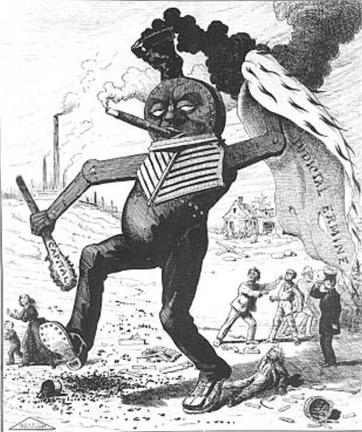
    I found this nice addition to a series of posts that I’ve made on this blog on early (pre-1930) mechanical people and robots. Here’s a selection of some of the other finds in this area on this site: 


    A Few Mechanical Men: Antique Anthropomorphic SteamPunk

    An Early Robotic Steam-Driven Society-Scrubber

    Robot-Man, 1915

    An Acrobatic Non-Semi-Robot, 1876

    An Edenless World: the First (?) Metalic Woman Robot

    Robot Roundup

    There are many others–just pop in “robot” in the Google search for this site and have at it.  I wanted to get this posted here before I lost it.  Again.  

    ·Posted by :

    ·in:


  • When was the First Computer-Generated Poetry?

    JF Ptak Science Books   Post 2202

    All I have in this question is the question, and one that I believe I have not seem before. There are certainly much earlier ideas published on writing machines–Lemuel Gulliver encounters such a beast in Laputa in his third voyage, and there’s also Ramon Lull’s writing device–but they were more popularly published. In this case I’m referring to poetry made by a computer that is composed by the machine, not hypertext mark-up digital poetry, and not a poem-generator, nor code poetry, nor visual programming, but a computer Poe, and published in a technical journal.  It is unknown to me when this first happens, though I did find an unusual and very early appreciation of such a thing in the May 1956 issue of Computers and Automation.  A snippet from this early effort is here:

    Computert poetry003

    Computers and Automation is the first semi-popular magazine dedicated to the computer (the first professional computer journal was Mathematical Tables and Aids to Computation, begun in 1943) and this bit appeared in its fifth volume, in a story called “The Mechanized Muse” written by Elizabeth W. Thomas.  It is a sci-fi/speculative story, which makes what seems to be an odd appearance in a journal such as this, which is the reason why this is a “semi-popular” mag. (As it turns out there are a number of other sci-fi pieces in here over the years, including Arthur Clarke’s “The Nine Billion Names of God”, which appeared in the sixth volume in 1957.)

    So this is a satirical story about the possibilities of computer intelligence, told mostly tongue-in-cheek, resident in a machine called the YERP, built by a 67-year old scientist from Austria named Carl Jonus Yaffee, who built a number of other electronic devices all using a piece of his name in their’s. In any event the YERP was designed to treat solutions of words rather than mathematical equations, and was composed of “500 vacuum tubes, 10,000 transistors, 30,000 crystal diodes, 350 pluggable units, 1,356 miles of wiring, a magneto-electronic storage unit with a 5,000,000 word capacity…with a 1,500,000 word vocabulary all of which are punched on cards” and operated by a team of 56 technicians.  

    The machine worked to some degree and was seen as a success, and would be made available to poets and writers after it was installed in the New York Public Library, though it seems from the results that as remarkable as it was to be envisioning  a writing machine  in 1956, that it was really not a necessary addition to the cultural canon. At least not yet.  


    ·Posted by :

    ·in: