A Daily History of Holes, Dots, Lines, Science, History, Math, Physics, Art, the Unintentional Absurd, Architecture, Maps, Data Visualization, Blank and Missing Things, and so on. |1.6 million words, 7500 images, 4.9 million hits| Press & appearances in The Times, Le Figaro, Mensa, The Economist, The Guardian, Discovery News, Slate, Le Monde, Sci American Blogs, Le Pont, and many other places… 5000+ total posts since 2008.

Category: Uncategorized

  • A Mosaic of Panels of Railroad Freight Cars

    JF Ptak Science Books   Quick Post

    There’s something about the design of the kettering on the sides of railway cars that is very attractive–for the most part, the lettering just looks “correct”.  I’ve collected a few examples, used librarlly from the University of Pennsylvania library, and tiled them below, and are from a series of photographs made in the 1880’s of the Harrisburg Car Co (established 1853).


    ·Posted by :

    ·in:


  • Postcards Then-and-Now

    JF Ptak  Quick Post

    Before-and-after–I’d like to see more of these, even the contemporary postcard image versus documentary photograph would do, as I suspect virtually no postcard of a motel ever made would look of a lesser quality than a true representational photographic image of the place. Sixty years certainly makes the difference, especially with the bypassing of what used to be important thoroughfares and what happens nest.  There is still a mountain view,though I can’t tell which mountain it is, though for Alabama it does get hilly in Fort Payne.  

    I’d love to stay in a motel like this.  Then.  

    Post cards--Mountain View AL original

    And today:

    Post Cards--Mountain View, ALabama

    ·Posted by :

    ·in:


  • Digital “Computers” 1450-1750: Memory and Calculating on the Fingers and Hands

    JF Ptak Science Books      Post #81(from 2008, expanded)

    Bloghands_memory072_2
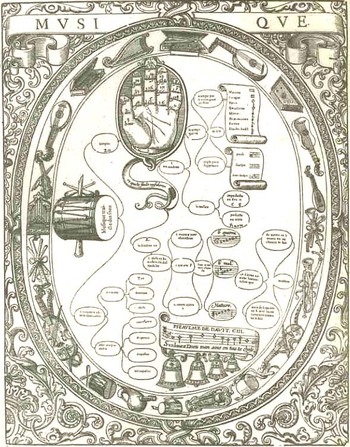
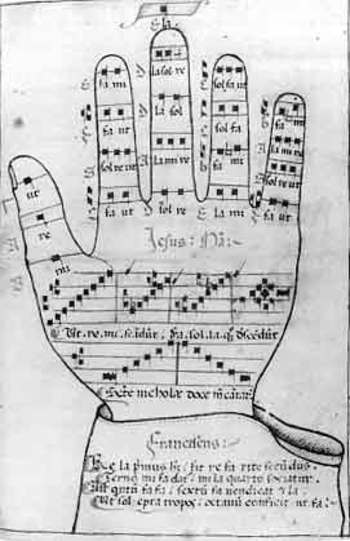
    These lovely images weren’t intended to show people living in the Renaissance and Baroque eras how to actually record data on their hands—they were intended rather as templates to show how they could use their fingers and hands for calculating and as memory devices.  Much like Frances Yates has shown us so beautifully in The Art of Memory and how info and data was stored in imagined and compartmental palaces in the mind (relying upon images), the hands were also used as a theatre of memory in addition to extended calculation. 

    These mnemonic devices were necessary—especially during the Renaissance—because of the general lack of and access to affordable vellums or paper and writing instruments.  Having notebooks filled with memoir or history of calculation was generally not something that was happening for even the not-wealthy but not struggling class.  These mental images were used widely in the areas of religion, palmistry, astrology mathematics, astronomy, astrology, alchemy, music, and other such fields. 
    Bloghands_big074_3

    The first image (from a German manuscript) of the hand-theatre was found and deciphered by Claire Richter Sherman (Folger Shakespeare Theatre) and is religious in nature, an intentional piece of memory for the devoted and for devotions.  The needs of religion were splayed out as the hand was opened and fingers flexed, and working from thumb to pinkie, from finger tip and joint—“do God’s will, examine  your conscience, repent, confess”, and so on, and above all be content with your lowly penitente stature.  If there were 28 of these admonitions or reminders at different points of the hand and you memorized them all, it would be a much simpler time to recall and keep them in order if you merely had to touch a part of your hand where that memory should be to invoke what it was you were supposed to do.  Therefore you could theoretically cast about with your creator with your hands in your pockets—if you had pockets. 

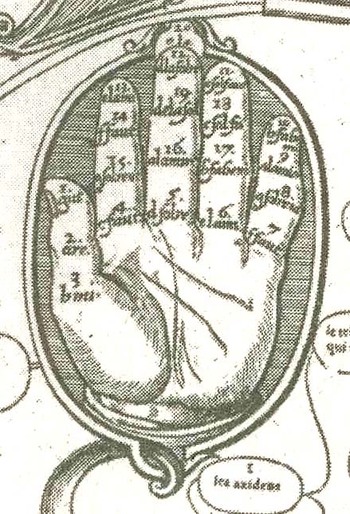
    The next two images (including the enlargement of the hand section) are from a work from 1587 entitled Musique and are attributed to John Cousin the Younger (1522-1597).
    The basic premise for this device—it seems to me—was to be able to order the different chords of 20 different instruments. 
    Bloghands070_2

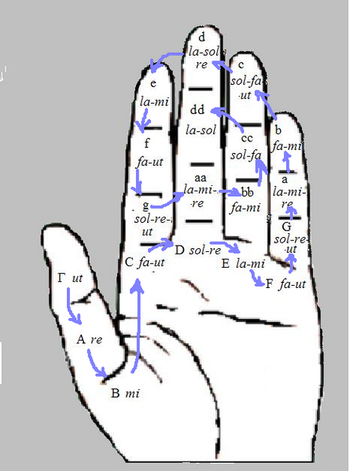
    Another musical hand mnemonic was the Guidonian hand, a survivor of Medieval times, and possibly named after Guido of Arezzo (a musical theorist), and was an aid to singers learning to sight sing.   

    The entry for the Guidonian hand in Wiki explains it use rather well:  “The idea of the Guidonian hand is that each portion of the hand represents a specific note within the hexachord system, which spans nearly three octaves from “Γ ut” (that is, “Gamma ut”) (the contraction of which is “gamut”, which can refer to the entire span) to “E la” (in other words, from the G at the bottom of the modern bass clef to the E at the top of the treble clef). In teaching, an instructor would indicate a series of notes by pointing to them on their hand, and the students would sing them. This is similar to the system of hand signals sometimes used in conjunction with solfege…”
    Bloghands_bodies071

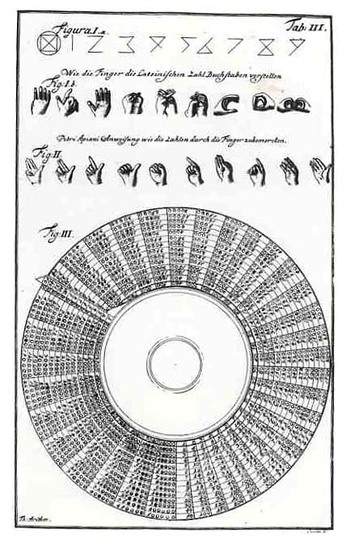
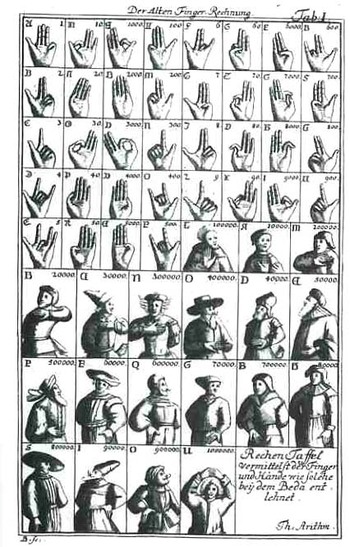
    The final two examples come from Jakob Leupold’s  (1674-1727) Theatrum Machinarum (1724)—this was a complex work involving nine sections and addressed the theoretical  aspirations of engineering (load, flexure, that sort) and its applications to its daily practitioners.  In one section of the book he sought to explain the connections (and correlations) of hand motion and symbolism to the origins of the number systems, carrying it out further still into body language, so that two people conversant in these symbols could talk and bargain between themselves in economic/body terms.  Barbara Maria Stafford, in her Artful Science, Enlightenment,

    Bloghand_guido

    Entertainment and the Eclipse of Visual Education (1994) points out the long history of this tradition, and that it reached far back into misty time:  Leupold knew that Appian, the Venerable Bede, and Aventinus had been fascinated by manuloquio, or natural language with the hands.  He thus linked counting to a global….medium of prearranged gestures…”

    Bloghandguido_2_2


    ·Posted by :

    ·in:


  • A Very Early Nighttime View from a Balloon (1838)

    JF Ptak Science Books  Post 2264

    Balloon night161

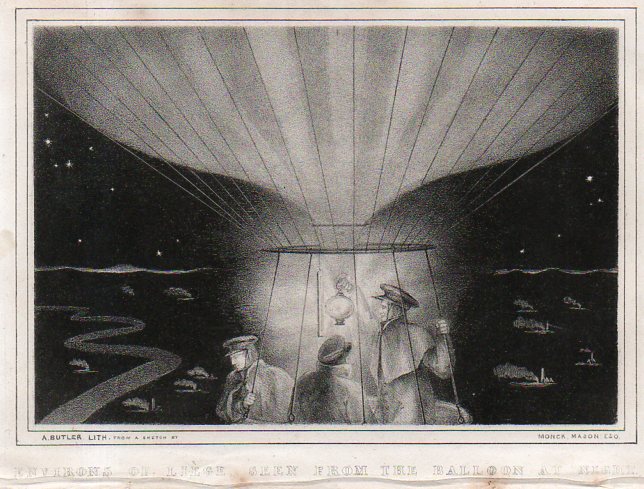
    “WHEN man reaches the Pole and when he has learnt how to fly he will almost have exhausted the list of his aspirations. The fascination of both exploits is endless. So far the art of flying has not been a success…”–English Illustrated Magazine, volume 18, no. 169, October 1897.  

    And so starts the chapter, “The First Long Voyage in a Balloon”, which in a remarkably boring way relates the story of the flight of Monck Mason, Charles Green, and Robert Hollond.  It is also a little bizarre because this was two years into the discovery of x-rays which revealed unseen worlds far more vast than the North Pole.  Plus there was George Cantor’s papers on transfinite numbers in ’95, and then Minkowski’s geometry of numbers and Becquerel’s radioactivity and the Zeeman effect and the opening of the Yerkes Observatory  in ’96.  There was a LOT going on in ’95-’97 to show how much we didn’t know and so how much more could be achieved, so it is a mystery why the writer thought that Human Endeavor was done.  

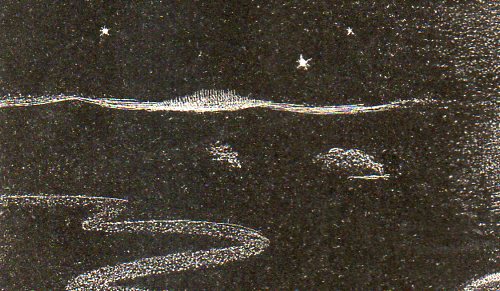
    But back to Monck: in 1836 his was indeed the longest voyage achieved by any human in flight, covering some 500 miles. An account of the voyage was written by Monck in 1838:  Aeronautica; Or, Sketches Illustrative of the Theory and Practice of Aerostation: Comprising an Enlarged Account of the Late Aerial Expedition to Germany, with the illustrations published at Indiana here.  I’m calling this out because I have a lovely lithograph, a night-time image of the three balloonists, that is most unsuaul I think because it seems to me to be a very early night-time oblique image of the Earth seen from above.  

    Balloon night162[A detail of the landscape from above]

    The artwork is by one of the ballooists, Monck Mason, who as it turns out in addition to this great voyage took another, this time making it across the Atlantic in an incredible three days. Well, that was the report of it, anyway–the article was a hoax, written by Edgar Allen Poe, and based somewhat on the real adventures of Mason.  The story appeared April 13, 1844 in the New York Sun, and attracted a lot of attention, lasting as a hoax for a few days.  The story was “retracted” on the 15th, withg the following announcement: “BALLOON – The mails from the South last Saturday night not having brought a confirmation of the arrival of the Balloon from England, the particulars of which from our correspondent we detailed in our Extra, we are inclined to believe that the intelligence is erroneous. The description of the Balloon and the voyage was written with a minuteness and scientific ability calculated to obtain credit everywhere, and was read with great pleasure and satisfaction. We by no means think such a project impossible.”–(source, Wiki, Balloon Hoax.)

    ·Posted by :

    ·in:


  • A Note on When Literally is Figuratively

    JF Ptak Science Books   Post 2263

    [My thanks to Patti Digh for finding the article that started this small exploration.]

    In the new world of words that is Webster’s dictionary, we find “literally” meaning something less that it has never meant since the beginning of Webster’s in 1828. Evidently the new definition is made to accommodate the slanging/slangy use of this fine word in magazines and television, and especially not-good television. 

    I don’t see the need for screwing this word up, particularly when it comes to mean something completely different, just to pacify a current and goofy usage. Not having see the new Websters, I quote Dana Coleman, from Salon Magazine online, in the article that may be titled “According to the dictionary, “literally” now also means “figuratively”)” on the new definitions of “literally”: “In the first definition of the word,“in a literal sense or matter; actually. Its second definition is, “in effect; virtually.”

    “Virtually” is not “literally”, which is very weird, because Webster’s is messing around with something that defines the ‘is-ness” of language, a word that tells us precisely that something that is supposed to be something actually is that something, though now they tell us that “is” = “maybe”.  

    It is just a bad practice. Literally (old sense). I doubt that the OED will follow in these footsteps, unless Webster’s changes the meaning of “follow” to include things that don’t follow.  

    ·Posted by :

    ·in:


  • Women in the Kingdom of Clothing, 1918

    JF Ptak Science Books   Quick Post

    This is another in a long series of posts on my collection of WWI news service photos–there’s 75 or so up already though mostly in the WWI photography part of the blog’s bookstore.  Mostly the images were very heavily controlled by censers as to what content was allowable or not, and there was also very strict control of access to battlefield actions.  Simply put there was a long hearts & minds campaign of positive reinforcement exercised by allied high command in controlling wartime images–with the deaths of tens of millions of people there was simply no room to be let for any chance illustration of the great bleakness of this war to escape a censor’s detection.  Imaging the war would come in due course, but not necessarily during the fighting; and the coverage wasn’t necessarily “imaginative”, as it tended to be more exclusive and myopic. 

    This photo is pretty upbeat, full of positive energy and life, and shows a group of female volunteers in a sea of clothing, having created the articles they are now folding the jerseys for shipment.  The faces are fresh, inviting, full, hopeful. 

    WWI--e--women pants683
    WWI--e--women pants det682

    The original photograph is available here.

    ·Posted by :

    ·in:


  • Small, Compact, Unusual Comparative Heights of Mountains Map

    JF Ptak Science Books    Quick Post

    Mountains185

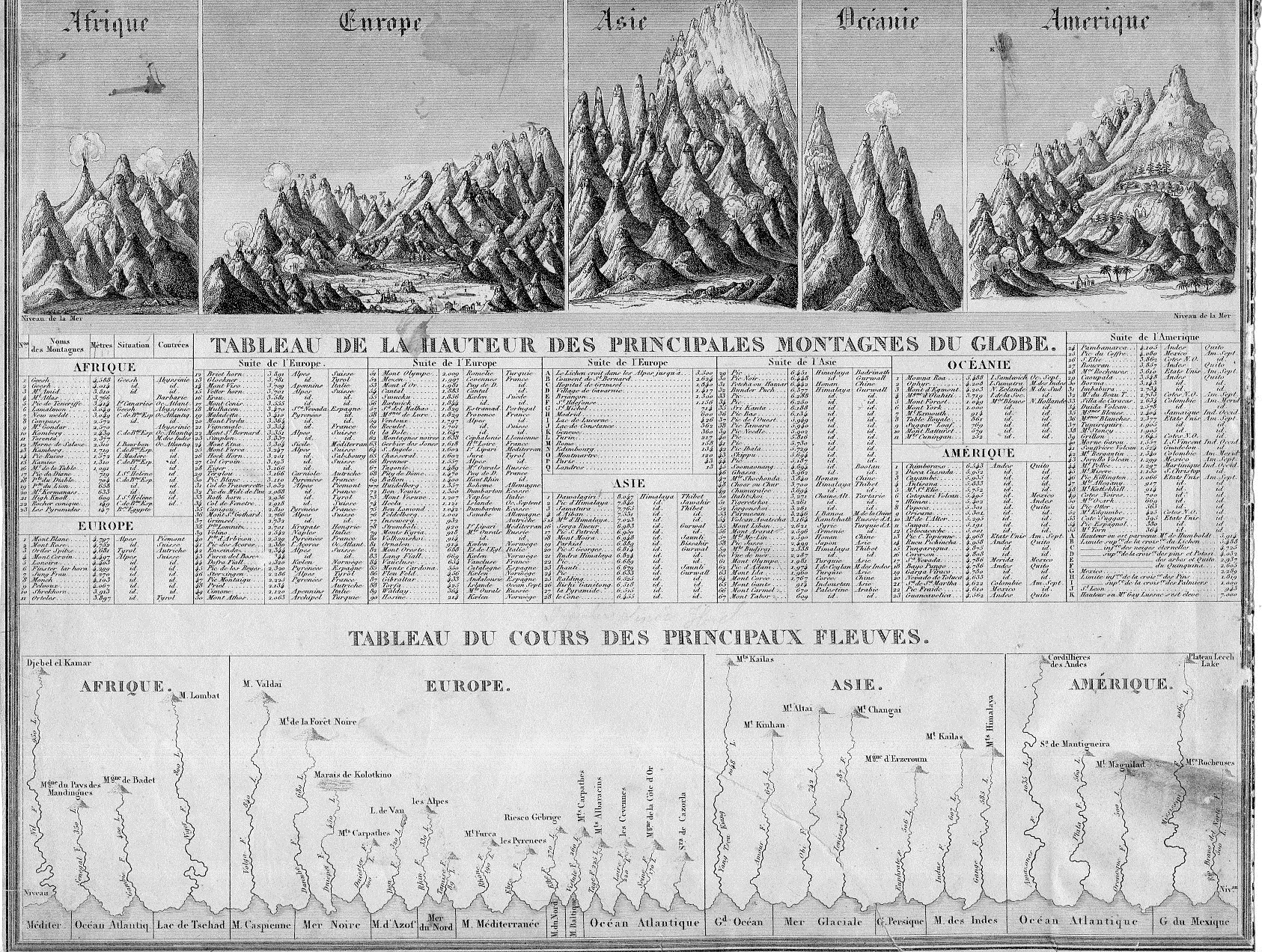
    Generally the dozens of maps/charts showing the comparative heights of mountains and lengths of rivers maps that have come through the store part of this blog have been somewhat large–or at least larger than the present example, which may be about the smallest (at about 11×8″) detailed representative of this genre that I have seen. 

    “Tableu de la Hauteur des Pricnipales Montagenes du Globe” was published in Guillemin’s Atlas universel de Geographie Ancienne et Moderne, and published by Langlume in 1845.  It is also at the beginning of the more-modern heyday for publishing maps and charts such as these.  (The practice began modestly at the end of the 18th century, came into a high tide in the 1850’s/1860’s or so, and then pretty much disappeared by the 1880’s.)

     There’s a lot of comparatively-displayed information presented on 88 square inches, including the lengths of 30 rivers and the heights of about 500 mountain peaks distributed over Africa, Europe, Asia, Oceania, and the Americas.  And for as much imagery and data there is on this sheet, the whole is very nicely designed, a real success in the display of quantitative data.  

    ·Posted by :

    ·in:


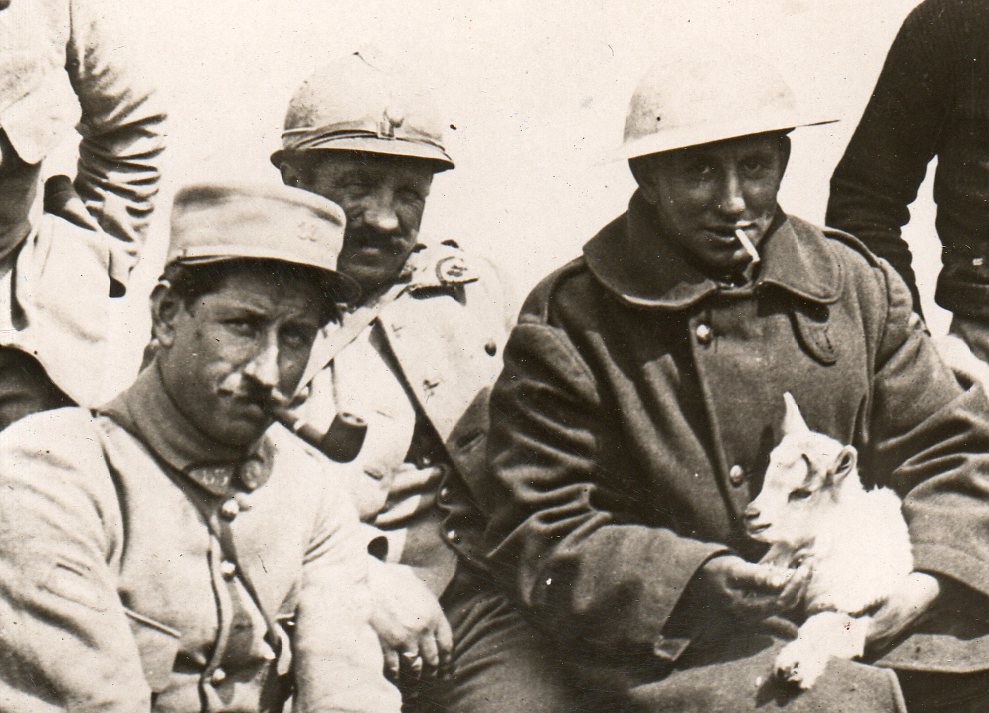
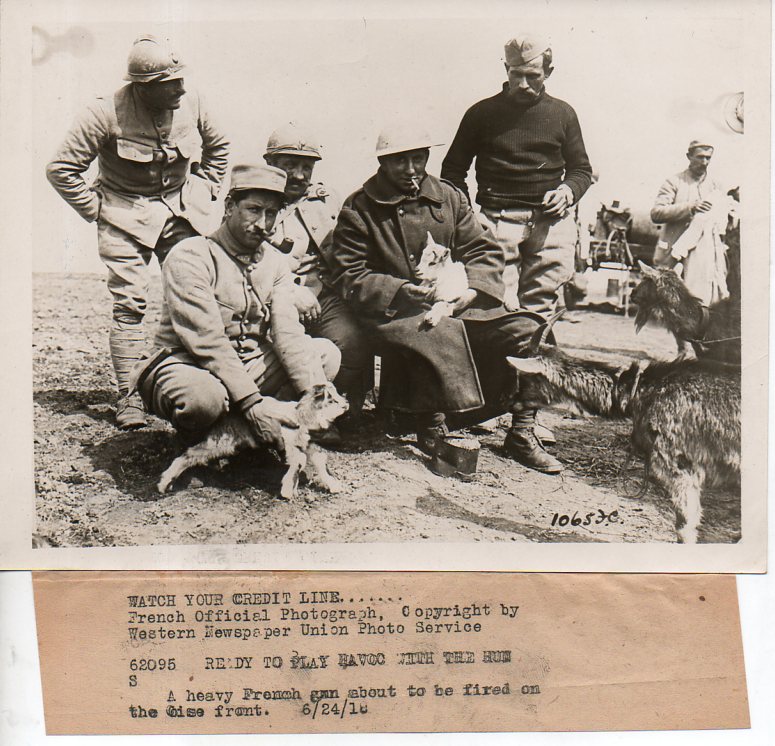
  • World War I Photography: Soldiers, Big Guns, Lambs

    JF Ptak Science Books  Quick Post 

    WWI Dogs182

    Which is a detail from:

    WWI Dogs181


    This original photograph is available for purchase via our blog bookstore, here.

    ·Posted by :

    ·in:


  • On Historical Equalities of Garbage

    JF Ptak Science Books   Quick Post

    I wonder if we can speak of units of measurement for the stuff that we throw out in terms of some amount of industrial production of a country for a given period of time?  Like, do we here in the U.S. throw away enough stuff in one day/week/month to equal the total yearly production of some/all (?)  manufactured goods produced in fill-in-the-blank-country in 1850?  A figure such as this probably does not add to our understanding of, well,  anything at all–but maybe the discussion of what that number might be could be interesting. Or perhaps the very notion of even entertaining that such an equality is possible is enough for that unit of measurement to have done its job without even being established by simply bringing up the subject of vast waste.

    Our vast waste is vast.

    There are estimates that the average person (excluding businesses and corporations and such, strive as they may for personhood) in the U.S. throws away between 4 to 7 pounds of garbage a day.  (This according to Edward Humes in his new book, Garbarology–the author believes that the lower estimate by the EPA of about 4 pounds/daily is too low, and prefers the numbers of BioCycle magazine and Columbia University’s Earth Engineering Center, which give us the 7 pound figure.) Given, say, 300 million people in the U.S. that makes for about 7.6 trillion pounds a year, or about 2.1 billion pounds per day.  

    7.6 trillion pounds of garbage is more than double the world production of steel in 2011.(Source.)  

    This is also more than ten times the amount of all food produced in the U.S. per year. (Source.)

    But getting back to the historical aspect of the original question, in 1913 the total amount of pig iron produced by the chugging mills of the United States and Great Britain was about 84 billion pounds.  That’s 40 days of garbage today.  

    So, I’m not sure how many decades we need to go to get close to the Tonnage of All Manufactured Good in One Year = The Amount Americans Throw Out Each Day. My off-the-shelf approximation gets us close to the first industrial revolution period, which probably makes sense, but is difficult to imagine.

    It would be better for everyone involved if garbage was treated more as an energy source than it is, rather than shipping off huge tonnage of scrap iron and waste paper in enormous cargo ships to China, or burying it.  

    It seems incredible that in our enormous consumption of stuff that in the end the most popular thing to do with the shells of our wants is to make mountains of waste with it. 

    ·Posted by :

    ·in:


  • A Big Popular Statement on How Small Small Is (1883) (2)

    JF Ptak Science Books   Post 2255

    In three issues1 of Nature (London) magazine in 1883, William Thomson (Lord Kelvin)–polymath of a great and inquisitive mind–tried to create a good reference point for the size of atoms, mainly to establish that their size while being incredibly small were not unimaginably so, and that even objects of this minor magnitude could be approximated and studied.  And he did so with great ease and in a popular general-audience sort of way.

    All told, this was a very good piece of thinking, especially referencing the estimates of Niels Bohr 30 years later, publishing in the Philosophical Magazine (volume 26, pp 1-25, 1913) and calculating the size of an atom at .5 x -10 meters. And even though Thomson is talking about his estimates in terms opf science in a post-Dalton and post-Mendeleyeef world, he is also pre-Stoney, and Roentgen and Curie and Soddy and everyone else, especially pre-atomic-nucleus, and pre-proton (1919/20 with Rutherford and Moseley) and pre-neutron (Chadwick 1932), which are smaller still than the atom. Way smaller.  It is difficult to put into understandable terms on how “small” that small is:  the atomic nucleus is sort of 1/10,000th of the atom, and a proton or neutron smaller still, and then the quark smaller than that, until perhaps it becomes a Seussian exercise with future discoveries showing that after everything is said and done that it is turtles all the way down.  

    But Thomson managed to put an understandable assessment on a very difficult visualization, talking in terms of an atom being “1/10,000,000 or from 1/10,000,000 to 1/100,000,000 of a centimetre in diameter”, or 1×10⁻⁷meters, which is just about the size of a cell nucleus or DNA; that’s in the neighborhood, especially if you look at the smaller number which is 10-8 meters, which starts to close in on the size of the massive carbon atom (10-10), but sorta not so close to the electron (10-12) , or carbon atom nucleus (10-14) or proton (10-15).  Small, hazy stuff indeed, filled with nothing.  On the other hand, if you proceeded in a space vehicle 1014 meters from Earth our Solar System would appear as just another fuzzy splotch in the sky.  1016 meters is about a light year, and then it would taken 10,000 of those “just” to get slightly outside our galaxy.  And then there’s the rest.  

    In any event, Thomson did okay. And as it turns out (as I just now learned) there was an earlier Nature article in 1870 (the inaugural year of the journal) by its editor Norman Lockyer who estimated the size of atoms at just about the Thomson scale.  

    "FOUR lines of argument founded on observation have 
    led to the conclusion that atoms or molecules are 
    not inconceivably, not immeasurably small. I u;e the 
    words " inconceivably" and "immeasurably" advisedly. 
    That which is measurable is not inconceivable, and there- 
    fore the two words put together constitute a tautology. 
    We leave inconceivableness in fact to metaphysicians. 
    Nothing that we can measure is inconceivably large or 
    inconceivably small in physical science. It may be diffi- 
    cult to understand the numbers expressing the magnitude, 
    but whether it be very large or very small there is nothing 
    inconceivable in the nature of the thing because of its 
    greatness or smallness, or in our views and appreciation 
    and numerical expression of the magnitude. The general 
    result of the four lines of reasoning to which I have re- 
    ferred, founded respectively on the undulatory theory of 
    light, on the phenomena of contact electricity, on capil- 
    lary attraction, and on the kinetic theory of gases, agrees 
    in showing that the atoms or molecules of ordinary matter 
    must be something like the 1/10,000,000, or from the 
    1/10,000 000 to the 1/100000,000 of a centimetre in dia- 
    meter."--Thomson, below. 

    Notes:

    1. William Thomson,  The Size of Atoms, I pp 203-205, June 28, 1883; Size of Atoms II, pp 250-254, July 12, 1883; Size of Atoms III, pp 274-278, July 19, 1883, earlier presented before the Royal Institution, beginning February 2, 1883.


    ·Posted by :

    ·in: