A Daily History of Holes, Dots, Lines, Science, History, Math, Physics, Art, the Unintentional Absurd, Architecture, Maps, Data Visualization, Blank and Missing Things, and so on. |1.6 million words, 7500 images, 4.9 million hits| Press & appearances in The Times, Le Figaro, Mensa, The Economist, The Guardian, Discovery News, Slate, Le Monde, Sci American Blogs, Le Pont, and many other places… 5000+ total posts since 2008.

Category: Uncategorized

  • America’s First Race Riot, 1935

    JF Ptak Scence Books  Post 1255–expanded

    “The Harlem riot of 1935, now the subject of a comprehensive report, demonstrated that ‘the Negro is not merely the man who shouldn’t be forgotten; he is the man who cannot safely be ignored’.” Alain Locke,  Survey Graphic, 1936.*


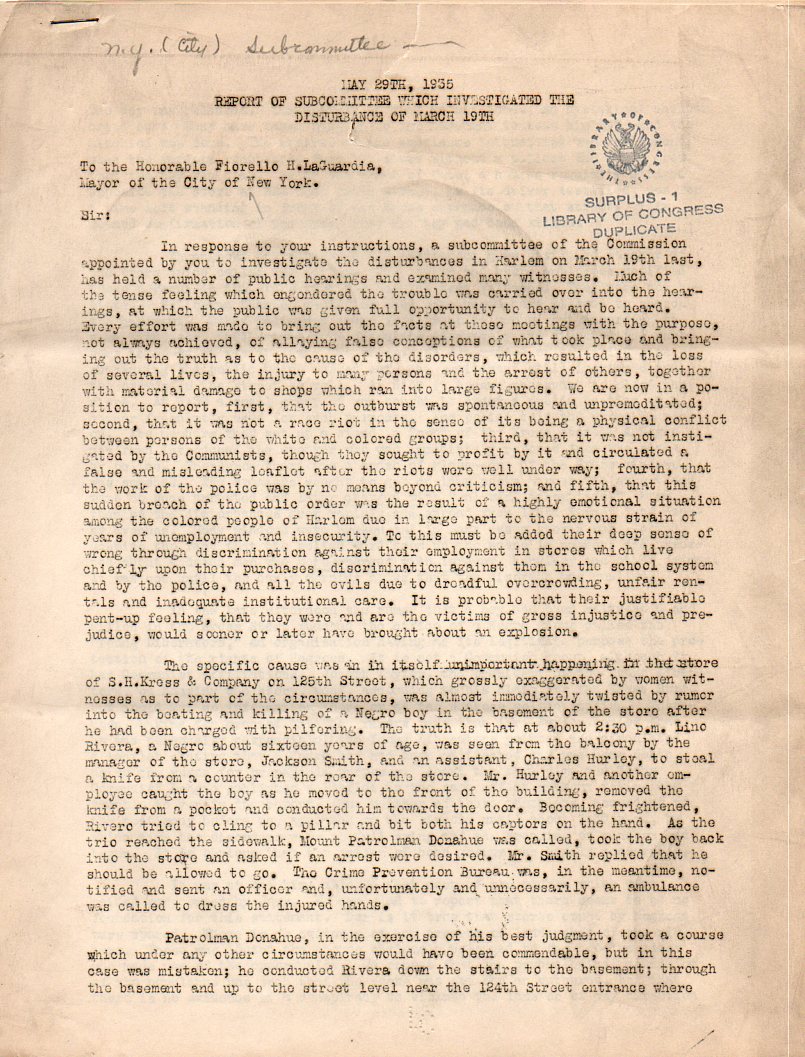
    This is a report to Mayor Fiorello LaGuardia (mayor of NYC from 1934-1945, a liberal Republican who was exactly what was needed in the city at exactly the right time) on what has come to be recognized as America’s first race riot.1 The damage was widespread, with hundreds of people injured, three killed, and $2 million 1935 dollars lost in during the Harlem event.   The action started at the S.H. Kress dime store on 256 W. 125th St. (just across from the Apollo Theater)   in Harlem, where a 16-year-old boy named Lino (described int his report as a “young Negro” though he was Puerto Rican) was detained by authorities in the store for shoplifting.  He was taken to the store’s basement and released to the backstreet unharmed, but a rumor spread violently and quickly that a young child had been taken to the basement of the store and beaten (or killed) for stealing a piece of candy.  Complications arose when the police arrived and when civic leaders’ questions went unanswered.  An odd and unfortunate twist of faith placed a hearse in front of the store during this build-up (from the business across the street from the store), inspiring outrage and “proof:” that the boy had been killed.2
    Race riot259

    In addition to the missing boy, the hearse, the police, and bad communications, were handbills distributed in the neighborhood printed by the Young Communist League and the black semi-militant Young Liberators, all helping to fan the flames of the crowds by the Kress store, which had swelled to several thousand people after just two hours–the riot came soon thereafter.

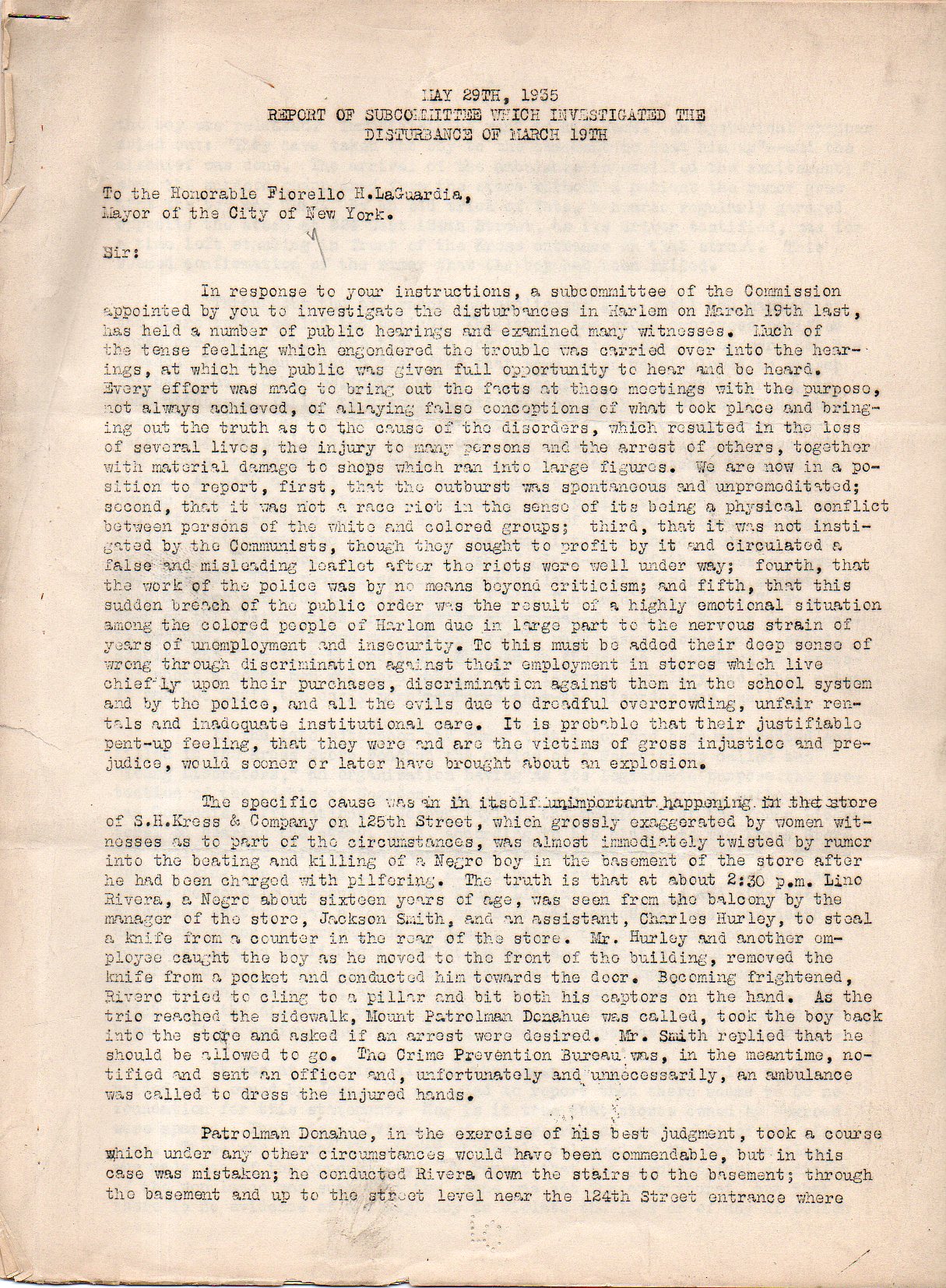
    The Report of Subcommittee Which Investigated the Disturbances of March 19th3 (and issued before August 15, 1935), was chaired by Arthur Garfield Hayes,analyzed the event in a surprisingly sympathetic way, recognizing that there was no organized response to the event, and finding that the response was understood to be a reaction to the long history of abuse of African Americans and poor governmental/police relations–and this all in eight quick pages.   LaGuardia said “We cannot be expected to correct in a day the mistakes and omissions of the past fifty years. But we are going places and carrying out a definite program. While the critics have been throwing stones, I have been laying bricks.”  It was surprising top me that the report was bi-racial, and that there was some real attempt to understand the problem and “do” something about it, rather than just chalk the whole thing up as something that could be simply solved with pure force.  [The original report is available for purchase from our blog bookstore.]

    As Locke wrote (below) the Riot of 1935 was the end of the Harlem Renaissance, and that a new era had begun.  For his part, LaGuardia at least opened a way to communicate about how to address the causes of such vast and repellent circumstances that eventually turned into the riot.

    Notes:

    * Locke continues: “Eleven brief years ago Harlem was full of the thrill and ferment of sudden progress and prosperity; and Survey Graphic sounded the tocsin of the emergence of a “new Negro” and the onset of a “Negro renaissance.” Today, with that same Harlem prostrate in the grip of the depression and throes of social unrest, we confront the sobering facts of a serious relapse and premature setback; indeed, find it hard to believe that the rosy enthusiasms and hopes of 1925 were more than bright illusions or a cruelly deceptive mirage. Yet after all there was a renaissance, with its poetic spurt of cultural and spiritual advance, vital with significant but uneven accomplishments; what we face in Harlem today is the first scene of the next act—the prosy ordeal of the reformation with its stubborn tasks of economic reconstruction and social and civic reform…” 

    1. Sociologist Allen D. Grimshaw called the Harlem Riot of 1935 “the first manifestation of a ‘modern’ form of racial rioting,” citing three criteria: “violence directed almost entirely against property”;  “the absence of clashes between racial groups”, and “struggles between the lower-class Negro population and the police forces”. “Harlem Renaissance”. Online Newshour Forum. PBS. February 20, 1998. http://www.pbs.org/newshour/forum/february98/harlem5.html.

    Another commission set to investigate the riot was headed by E. Franklin Frazier which produced a report, “The Negro in Harlem: A Report on Social and Economic Conditions Responsible for the Outbreak of March 19, 1935,” which found that the riot was not a controlled event and had happened spontaneously as a result of prolonged “injustices of discrimination in employment, the aggressions of the police, and the racial segregation”.

    2. Locke continues his observation on the Riot: “Curtain-raiser to the reformation was the Harlem riot of March 19 and 20, 1935; variously diagnosed as a depression spasm, a Ghetto mutiny, a radical plot and dress rehearsal of proletarian revolution. Whichever it was, like a revealing flash of lightning it etched on the public mind another Harlem than the bright surface Harlem of the night clubs, cabaret tours and arty magazines, a Harlem that the social worker knew all along but had not been able to dramatize—a Harlem, too, that the radical press and street-corner orator had been pointing out but in all too incredible exaggerations and none too convincing shouts.”

    3.  The commission was headed by Arthur Garfield Hayes and Charles H. Roberts, and was a bi-racial affair. “IMMEDIATELY after the March riot, Mayor La Guardia appointed a representative bi-racial Commission of Investigation, headed by an esteemed Negro citizen, Dr. Charles H. Roberts. After 21 public and 4 closed hearings conducted with strategic liberality by Arthur Garfield Hays…”

    4. Recommendations from the report:

    Increased hospital and health clinic facilities to combat disproportionate disease in the densely populated Negro areas.

    Recommended reorganization of Harlem hospitals and wider admission of Negro physicians to staff appointments, internee’ posts and educational facilities at all other municipal hospitals.

    New health center for Central Harlem District similar to East Harlem Center and a Negro supervisory health officer [the latter already agreed to by Commissioner Rice].

    Additional school buildings and extra educational facilities for vocational guidance, visiting teachers, and playgrounds. [The comparative absence of racial discrimination in the school system is one of the bright features of the report.]

    Housing legislation and additional low cost housing projects in line with recommendations of the report. Additional PWA and federal grants must be sought for such projects.

    Relaxing of the present tension in public opinion about the policy and attitude of the police in Harlem. The report recommends a Citizens’ Public Safety Committee not only to cooperate with the Police Commissioner as an advisory body but as a board of complaint in cases of suspected police brutality or reputed violations of citizens’ rights.
    ·Posted by :

    ·in:


  • An Harmonic Analyzer, 1916

    JF Ptak Science Books    Post 2290

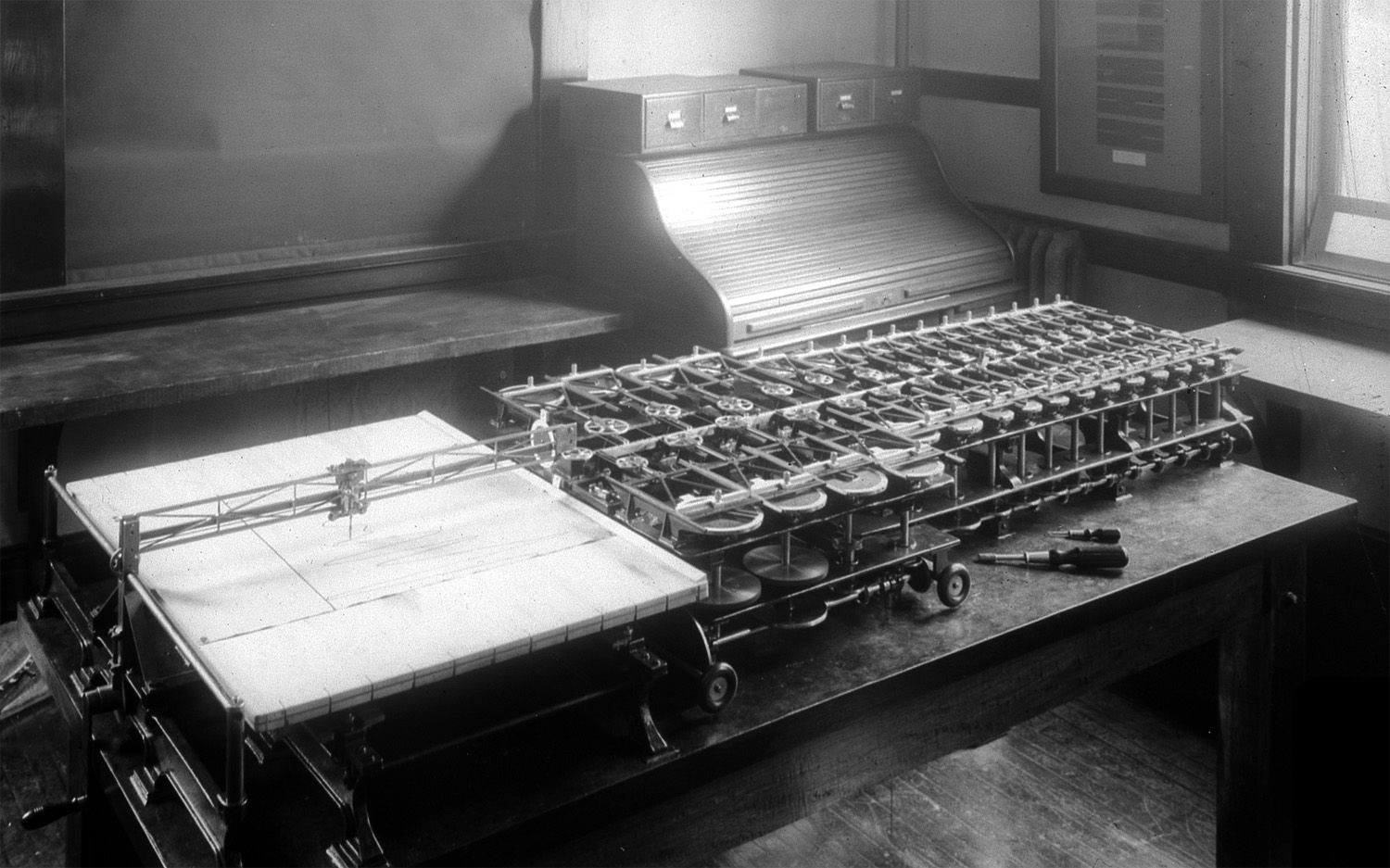
    It isn’t really an onomatopoeia, but the harmonic synthesizer at least feels like itself in the mouth as the two words are spoken. try it: h a r m o n i c   s y n t h e s i z e r.  The name does feel as though it touches the boundaries of most of the mouth, and that is basically what this analog computer does, analyzes sound, and record it in lovely waves (the plotter on the left in the photo).   http://www.phys.cwru.edu/ccpi/Harmonic_synthesizer.html

    32_component_synthesizer

    It is also a beautiful machine. The one above is by Dayton Miller of Case Western Reserve, and it is described in a 1916 publication from the Journal of the Franklin Institute. 

    “As described on the Case Western Reserve University website, “Lord Kelvin’s harmonic synthesizer is basically Henrici’s harmonic analyzer in reverse. Originally designed as a tide predictor in 1873, the system can combine numerous component waves—in some devices, up to 64 separate components—into a single curve. It is based on the earlier pin-and-slot device, which produces simple harmonic motion with the turn of a crank.”

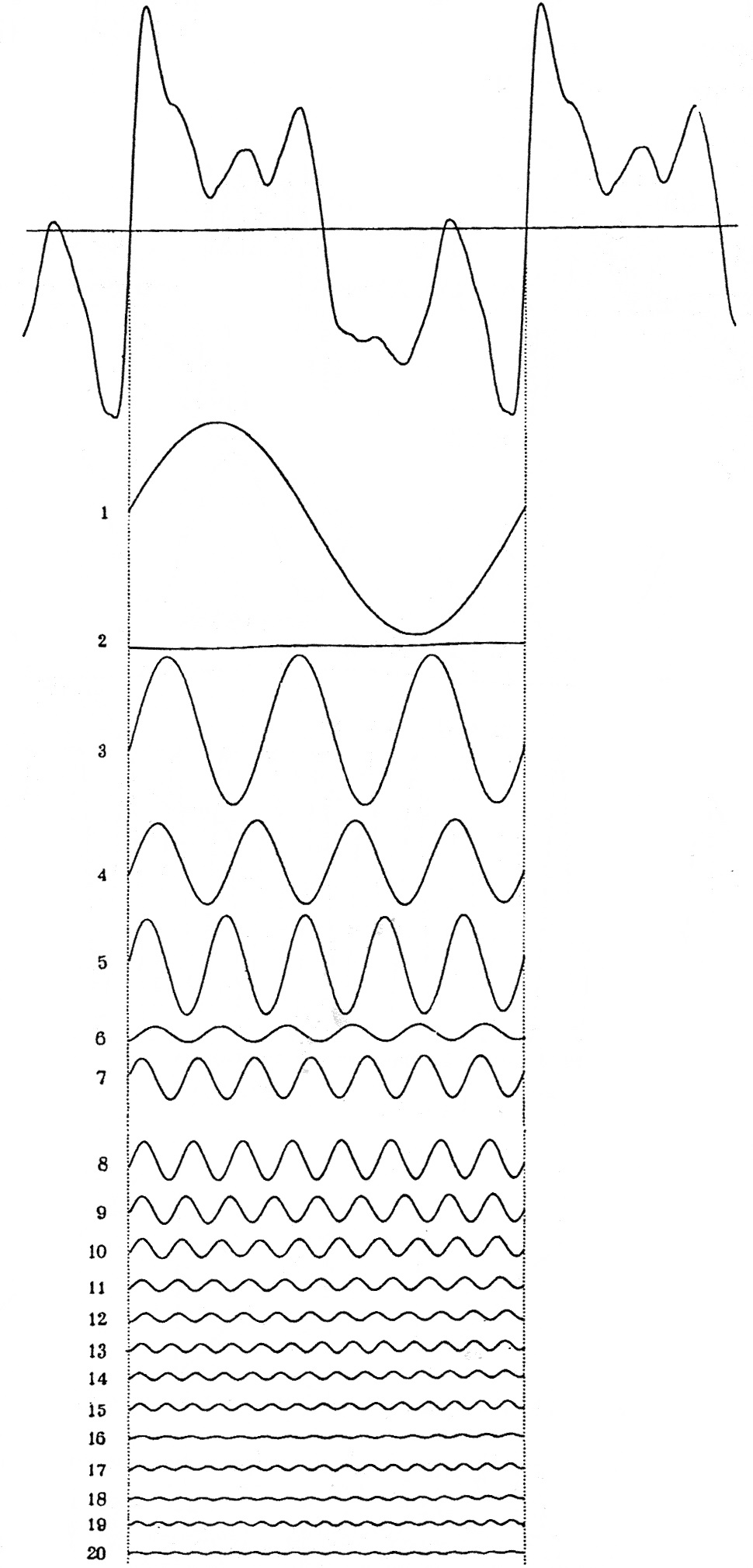
    And one of the results as it appeared on page 73 of the Journal of the Franklin Institute,  a curve representing the sound wave from a clarinet and twenty of its harmonic components: 

    32--big--Harmonic_synthesizer_diagram

    “The version used by Dayton Miller was designed and built in the laboratory and instrument shop of the Physics Dept. of the Case School of Applied Sciences. It consisted of 32 rotating pin-and-slot devices (see diagram below), each of which produced simple harmonic motion with a specified amplitude and phase; these 32 elements controlled the motion of a single cable that traced out the combined wave with a stylus and sliding drafting table. It was used by Dayton Miller to check the results produced by the harmonic analyzer against the original phonodeik curve…” http://www.phys.cwru.edu/ccpi/Harmonic_synthesizer.html

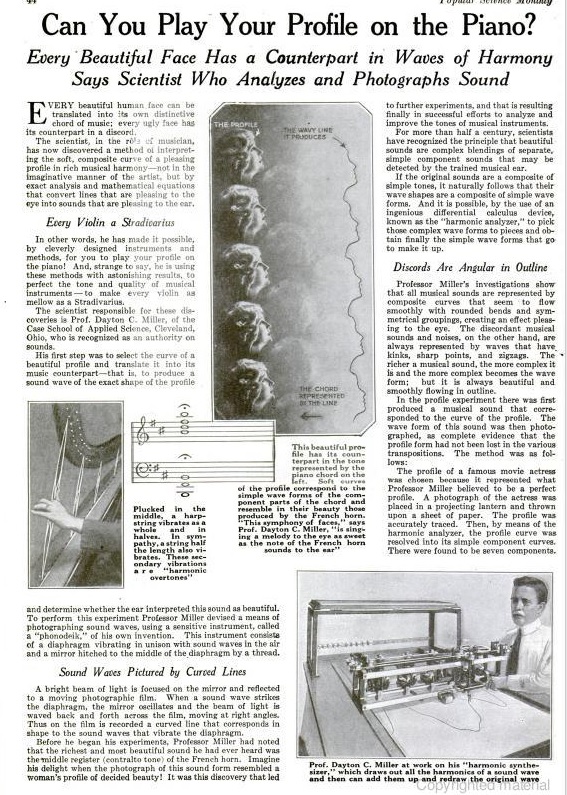
    And from the magazine Popular Science for Augusat, 1921, we find the following article:

    Dayton harmonic

    [Source:  Google Books]


    ·Posted by :

    ·in:


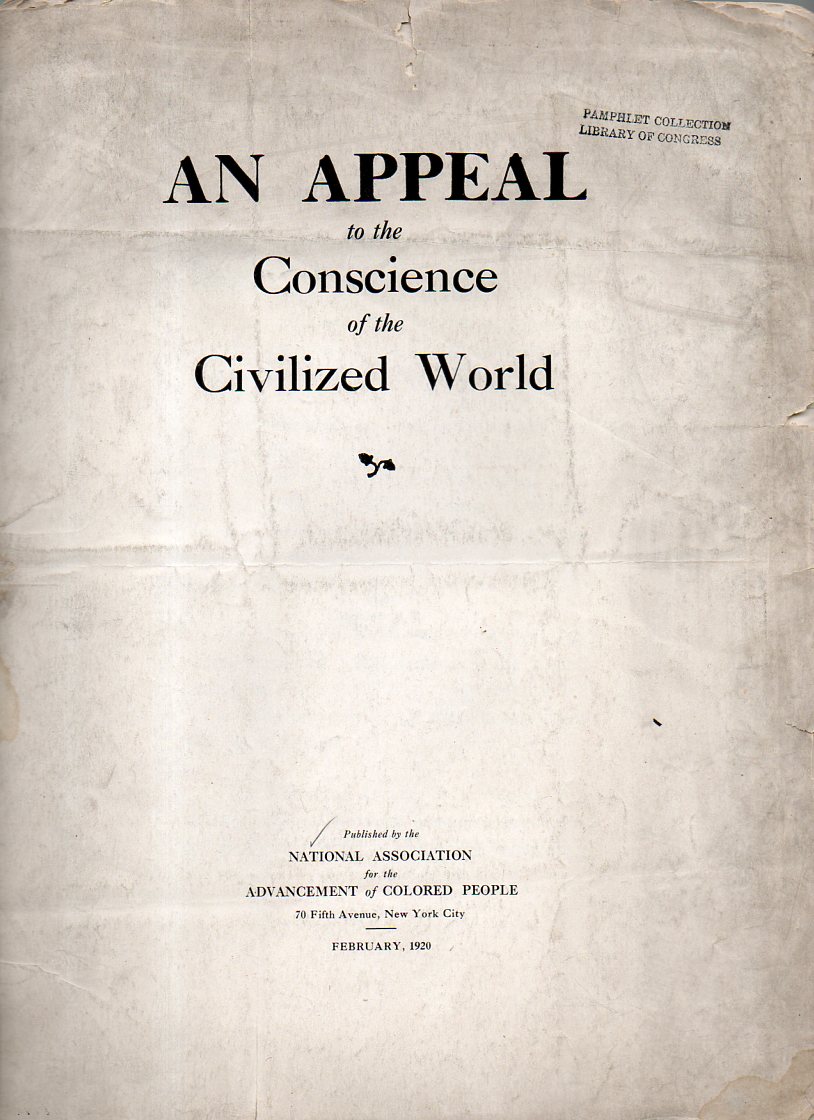
  • An Appeal to the Conscience of the Civilized World–Anti-Lynching 1920, FULL TEXT

    JF Ptak Science Books   Post 2288b

    I’ve recevied several requests for the full text of this document, which is now found below.


    Appeal213

    This truly is an appeal “to the world” for there to be an understanding about what was happening to African Americans in the United States in 1920–and this appeal wasn’t about unequal access to education or jobs or Jim Crow laws or any of the social assaults made on those people; it was more basic than that. It was a statement of how thousands of African Americans were being lynched, and murdered, and burned.  The appeal was extremely basic–to let it be known that these horrors were being committed against a class of people with little capacity to defend itself legally. 

    It is a roll call of terror, listing “barbarous” practices against “colored Americans”, citing 84  persons “murdered or ‘lynched’ . 

    Warning: Graphic material below


    ·Posted by :

    ·in:


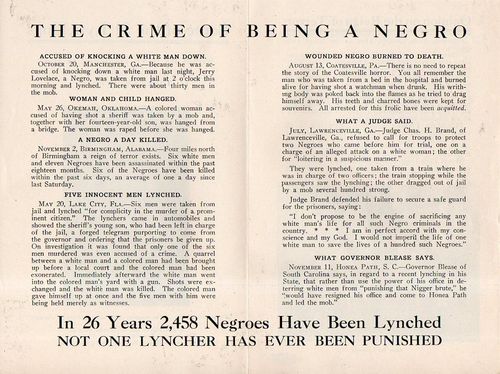
  • The Crime of Being a Negro

    JF Ptak Science Books   Quick Post

     This extraordinary handout–a small broadside, printed on both sides–in very short order gets to the heart of a compelling epidemic, a gruesome single-sheet epic.

    Lynching4

    [No real title on title page] “Some of the 51 Lynchings [dropped title] which have occurred during the last Six Months—and there are others”, printed by the NAACP, NYC (20 Vesey Street) ca. 1912.


    ·Posted by :

    ·in:


  • Warsaw Ghetto Uprising–Full Text of a Rare 1944 Pamphlet

    JF Ptak Science Books  

    “There will be a dawn.”–Dorothy Thompson, 1943

    “The former Jewish quarter in Warsaw is no longer in existence”–Jurgen Stroop, liquidator of the Warsaw Ghetto.

    Dorothy Thompson got that one wrong–or so at least got the “dawn” wrong when it comes to the Jewish uprising in theWarsaw Ghetto in 1943.  There wouldn’t be a dawn, there, mainly because there would be hardly any Jews, or Warsaw.  [This battle took place about three years after the Nazis established it as a means of control for the city’s 400,000 or so Jews. In the intermediary years hundreds of thousands of Jews had been “deported” (that is, sent to the concentration camps to be exterminated or worked to death), so that by the time of the Uprising only 60,000 people remained in the Ghetto.  And by this time there was no doubt in anyone’s mind who lived there (and perhaps too in Warsaw as a whole) what the euphemism of “deportation” actually meant.  The battle started off well for the home defence (the ZOB) but, ultimately, with little access to resource and with nowhere to actually retreat or regroup in the few acres that remained of the original Ghetto, whoever was left in the Ghetto were either killed or captured by 16 May.  The German commander, SS Brigadefuhrer Jurgen Stroop reported on that day that “the former Jewish quarter in Warsaw is no longer in existence”.]

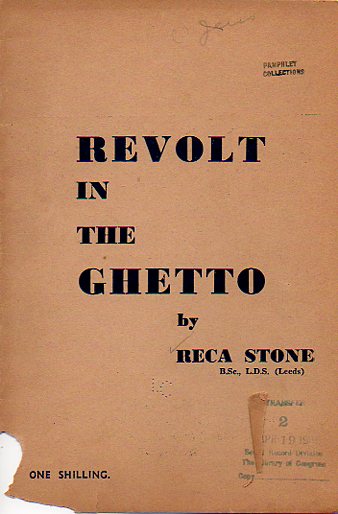
    This small pamphlet was written by Reca stone in 1944 on the Jewish counter-attack against the Nazis in the ghetto of Warsaw. It is one of not-many that documented not only the resistance in Warsaw, but also of the wholesale liquidation going on in that city and in the concentration camps. in general.  (Again, this was written in 1944. )

    There weren’t many accounts like this, but there were enough, certainly enough to have made a difference, I think, in how the leaders of the war effort approached whether concentration camps existed or not.  Franklin Roosevelt had exactly one meeting on this topic (which I wrote about here), while many others decided that the idea of exterminating all of European Jewry was so enormously bad and so gigantic that it could not possibly be true.  

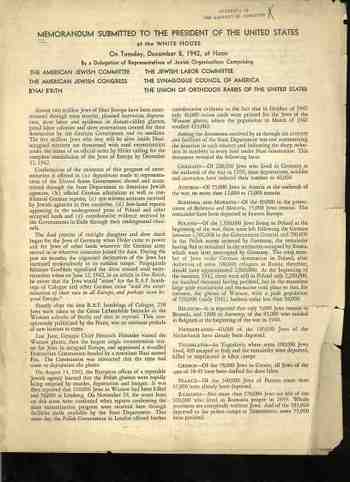
    Felix Frankfurter famously replied to a first-hand report on the extermination from the great Jan Karski that he just couldn’t “beieve” Karski’s story–not because the Supreme Court Justice (and Jew)  thought Karski wasn’t telling the truth, just that the story itself was unbelievable.  And whether people thought that the stories were the truth but unbelievable (like Frankfurter) , or whether they thought they to be exaggerations, or whether they thought it was impossible, the responses and the subsequent actions mostly seem to have come to the same end of nothingness. Even after years of reports of extermination and brutalities and millions of people missing (as FDR was warned of in that1942 meeting), the actual eyewitness accounts of the concentration camps were still received as being unbelievable.

    Blogsept5_memorandum_1494_2

    This is one of the reasons why General Eisenhower–when viewing the  concentration camp at Ohrduf in April 1945 with Generals Patton and Bradley–suggested that world leaders and other high-rankers come to the camps to bear witness so that future generations would know that such a thing actually existed.  And so we come to the Reca Stone pamphlet.  There are many other accounts of course of the uprising, and many of those are available on-line–but the Stone account, which is a rare thing in itself (only seven libraries worldwide having a copy of the work) is not on-line, but it is now.  I think that it is a significant report, and it should have a wide audience–things like this should reach as large a readership as is possible. 

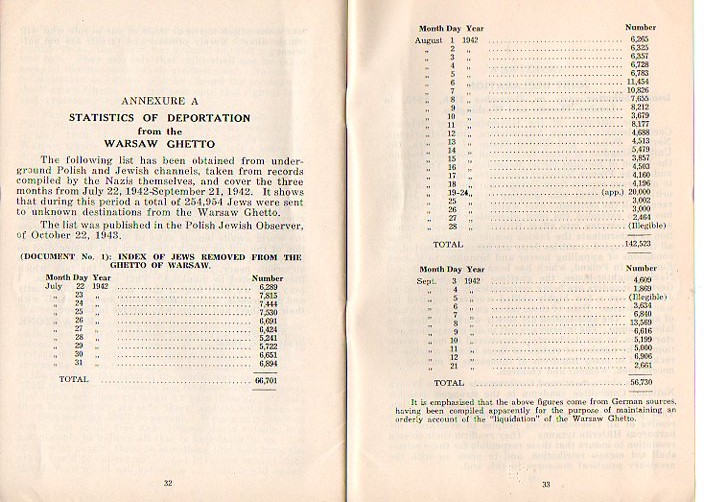
    An example of Stone’s reporting, coming from Underground sources and the Polish Jewish Reporter, on the number of Jews “removed” from the Ghetto of Warsaw between July 22 1942 and September 21, 1942–254,954 over a period of about three months:

    A--warsaw ghetto213

    But Stone gives no sentiment to the idea of Jews “perishing”.  On page 20 she describes the death camp Treblinka, and how thousands and thousands of Jews met their death in the gas chambers, or by suffocation and scalding, or by execution, or by live burial.  

    She writes boldly: In this manner 250,000 Jews were transported from the Warsaw Ghetto…and in this manner tjhey met their death”.  Period.  No euphemism here.

    She also quotes Washington sources that “two million” Jews had “perished” (the Federal term, not Stone’s), and that “five millions were imminently threatened with death”.  She pretty much got everything correct, as unbelievable as it sounded, then.  Or now.  

    A--warsaw ghetto196


    ·Posted by :

    ·in:


  • On Einstein Not Being in the Popular Press Before the Great Eclipse of 1919

    JF Ptak Science Books  Post 2311

    Between the Eighth Avenue Line and Julius Einstein in the New York Times Index for April-September 1919, there is nothing.  No Albert. No Albert Einstein.  At least in the newspapers followed by the Index.  

    Abraham Pais mentions in his wonderful intellectual biography of Einstein Subtle is the Lord that there was no mention of Einstein in this index until after the famous 1919 measurements confirming his theory–this to huge popular acclaim. (This was a months-long series of work on the light rays passing through the gravitational field of the Sun, the Einsteinian theory of gravitation fitting the results rather than the Newtonian, thus determining the soundness of E’s theory of relativity.) The paper1 announcing that was read in the Royal Society in November 1919, and then published in the first issue of the Philosophical Transactions in January 1920…and other places.  But the reports started appearing in the press before that, the scientific reports lagging just a little.  

    I never checked it out until I stumbled upon a 1920 issue of Popular Astronomy, with a January 1 issue reporting on the great expedition.  

    Anyway, its true.  The popular mentions of Einstein just aren’t there.  After the reports from Dyson/Eddington though Einstein begins his journey as a household name, blown out of the relative general obscurity of popular acknowledgment (in spite of his gargantuan year of 1905 and the other great papers of 1907, 1911, 1915, and 1916). 

    Notes, with the Times index following:

    1.  F.W. Dyson, A.S. Eddington, C. Davidson, “A Determination of the Deflection of Light by the Sun’s Gravitational Field, from Observations Made at the Total Eclipse of May 29, 1919”, in The Philosophical Transactions of the Royal Society of London. Volume 220, pp. 291-333 (January 1920).

    New York Times Index, Oct-Dec 1920


    ·Posted by :

    ·in:


  • Human-Powered Flight of an Antique Nature, 1893

    JF Ptak Science Books  Quick Post

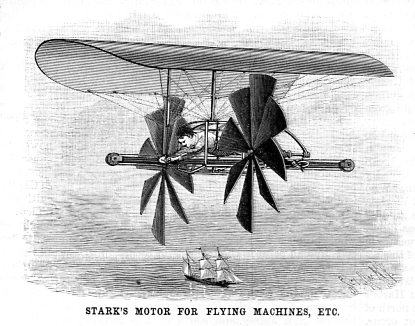
    “A Light and Simple Motor” is the title for this short article in Scientific American (February 11, 1893).  It is the work of Theodore A. Stark of Ottawa, Illinois, for the use on flying machines–it is a odd contraption that is suspended from an “aeroplane” (in this case the word is used to describe only the wing of the flying machine and not the flying machine itself), functioning like a push/pull device by arms and legs, powering the two large propellers that was supposed to keep the aircraft moving and aloft.  This has a curious feel of greater age to it, being only ten years before the powered Wright flight. 

    Ulra light motor flying machine304

    And the detail:

    Ulra light motor flying machine detail305

    ·Posted by :

    ·in:


  • Postcards Then-and-Now

    JF Ptak  Quick Post

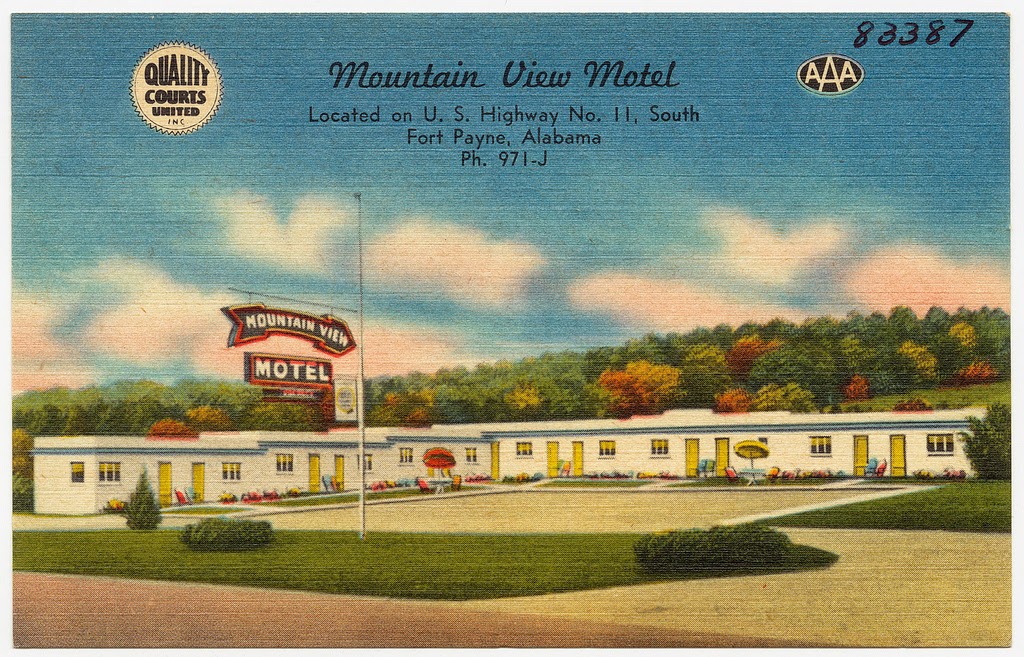
    Before-and-after–I’d like to see more of these, even the contemporary postcard image versus documentary photograph would do, as I suspect virtually no postcard of a motel ever made would look of a lesser quality than a true representational photographic image of the place. Sixty years certainly makes the difference, especially with the bypassing of what used to be important thoroughfares and what happens nest.  There is still a mountain view,though I can’t tell which mountain it is, though for Alabama it does get hilly in Fort Payne.  

    I’d love to stay in a motel like this.  Then.  

    Post cards--Mountain View AL original

    And today:

    Post Cards--Mountain View, ALabama

    ·Posted by :

    ·in:


  • Digital “Computers” 1450-1750: Memory and Calculating on the Fingers and Hands

    JF Ptak Science Books      Post #81(from 2008, expanded)

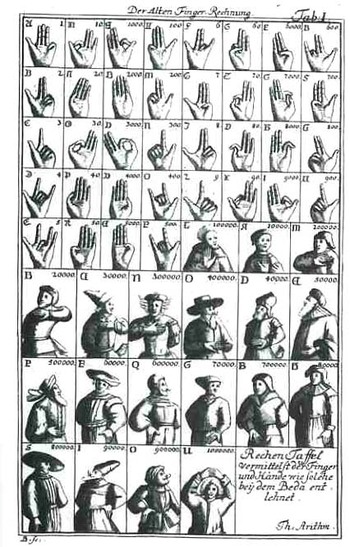
    Bloghands_memory072_2
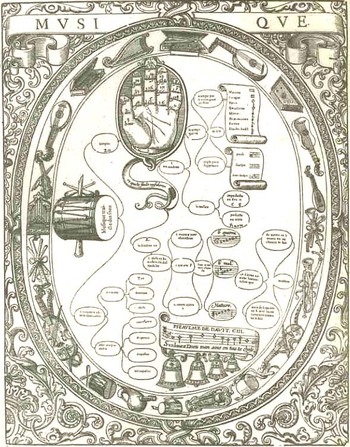
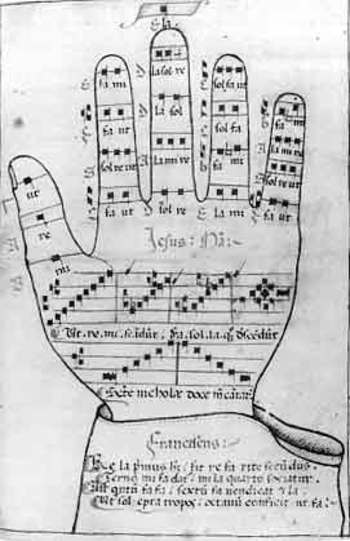
    These lovely images weren’t intended to show people living in the Renaissance and Baroque eras how to actually record data on their hands—they were intended rather as templates to show how they could use their fingers and hands for calculating and as memory devices.  Much like Frances Yates has shown us so beautifully in The Art of Memory and how info and data was stored in imagined and compartmental palaces in the mind (relying upon images), the hands were also used as a theatre of memory in addition to extended calculation. 

    These mnemonic devices were necessary—especially during the Renaissance—because of the general lack of and access to affordable vellums or paper and writing instruments.  Having notebooks filled with memoir or history of calculation was generally not something that was happening for even the not-wealthy but not struggling class.  These mental images were used widely in the areas of religion, palmistry, astrology mathematics, astronomy, astrology, alchemy, music, and other such fields. 
    Bloghands_big074_3

    The first image (from a German manuscript) of the hand-theatre was found and deciphered by Claire Richter Sherman (Folger Shakespeare Theatre) and is religious in nature, an intentional piece of memory for the devoted and for devotions.  The needs of religion were splayed out as the hand was opened and fingers flexed, and working from thumb to pinkie, from finger tip and joint—“do God’s will, examine  your conscience, repent, confess”, and so on, and above all be content with your lowly penitente stature.  If there were 28 of these admonitions or reminders at different points of the hand and you memorized them all, it would be a much simpler time to recall and keep them in order if you merely had to touch a part of your hand where that memory should be to invoke what it was you were supposed to do.  Therefore you could theoretically cast about with your creator with your hands in your pockets—if you had pockets. 

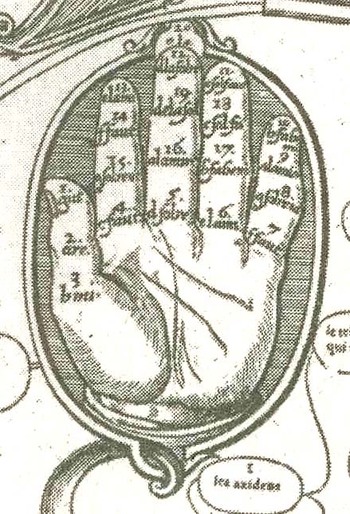
    The next two images (including the enlargement of the hand section) are from a work from 1587 entitled Musique and are attributed to John Cousin the Younger (1522-1597).
    The basic premise for this device—it seems to me—was to be able to order the different chords of 20 different instruments. 
    Bloghands070_2

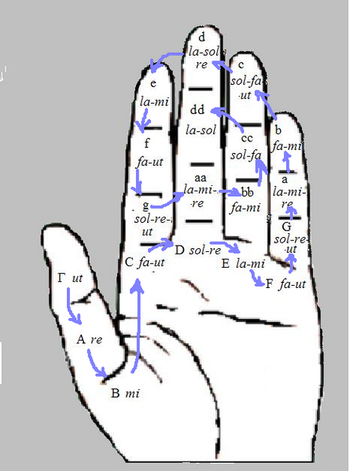
    Another musical hand mnemonic was the Guidonian hand, a survivor of Medieval times, and possibly named after Guido of Arezzo (a musical theorist), and was an aid to singers learning to sight sing.   

    The entry for the Guidonian hand in Wiki explains it use rather well:  “The idea of the Guidonian hand is that each portion of the hand represents a specific note within the hexachord system, which spans nearly three octaves from “Γ ut” (that is, “Gamma ut”) (the contraction of which is “gamut”, which can refer to the entire span) to “E la” (in other words, from the G at the bottom of the modern bass clef to the E at the top of the treble clef). In teaching, an instructor would indicate a series of notes by pointing to them on their hand, and the students would sing them. This is similar to the system of hand signals sometimes used in conjunction with solfege…”
    Bloghands_bodies071

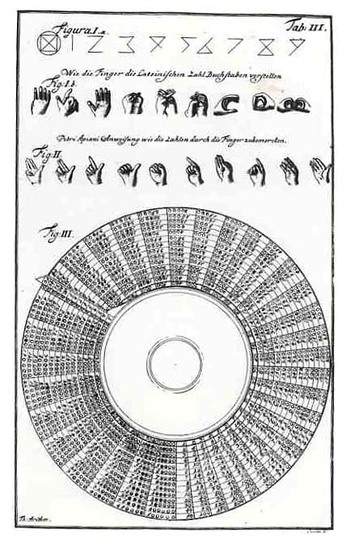
    The final two examples come from Jakob Leupold’s  (1674-1727) Theatrum Machinarum (1724)—this was a complex work involving nine sections and addressed the theoretical  aspirations of engineering (load, flexure, that sort) and its applications to its daily practitioners.  In one section of the book he sought to explain the connections (and correlations) of hand motion and symbolism to the origins of the number systems, carrying it out further still into body language, so that two people conversant in these symbols could talk and bargain between themselves in economic/body terms.  Barbara Maria Stafford, in her Artful Science, Enlightenment,

    Bloghand_guido

    Entertainment and the Eclipse of Visual Education (1994) points out the long history of this tradition, and that it reached far back into misty time:  Leupold knew that Appian, the Venerable Bede, and Aventinus had been fascinated by manuloquio, or natural language with the hands.  He thus linked counting to a global….medium of prearranged gestures…”

    Bloghandguido_2_2


    ·Posted by :

    ·in:


  • A Very Early Nighttime View from a Balloon (1838)

    JF Ptak Science Books  Post 2264

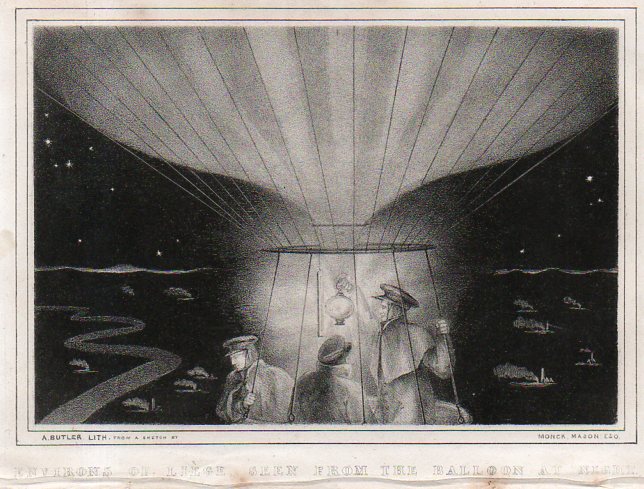
    Balloon night161

    “WHEN man reaches the Pole and when he has learnt how to fly he will almost have exhausted the list of his aspirations. The fascination of both exploits is endless. So far the art of flying has not been a success…”–English Illustrated Magazine, volume 18, no. 169, October 1897.  

    And so starts the chapter, “The First Long Voyage in a Balloon”, which in a remarkably boring way relates the story of the flight of Monck Mason, Charles Green, and Robert Hollond.  It is also a little bizarre because this was two years into the discovery of x-rays which revealed unseen worlds far more vast than the North Pole.  Plus there was George Cantor’s papers on transfinite numbers in ’95, and then Minkowski’s geometry of numbers and Becquerel’s radioactivity and the Zeeman effect and the opening of the Yerkes Observatory  in ’96.  There was a LOT going on in ’95-’97 to show how much we didn’t know and so how much more could be achieved, so it is a mystery why the writer thought that Human Endeavor was done.  

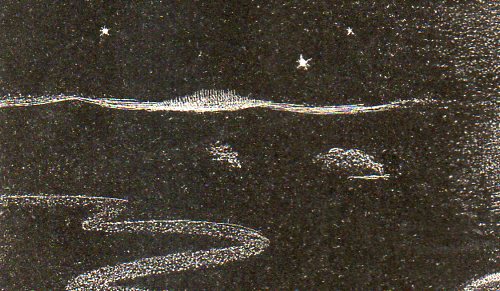
    But back to Monck: in 1836 his was indeed the longest voyage achieved by any human in flight, covering some 500 miles. An account of the voyage was written by Monck in 1838:  Aeronautica; Or, Sketches Illustrative of the Theory and Practice of Aerostation: Comprising an Enlarged Account of the Late Aerial Expedition to Germany, with the illustrations published at Indiana here.  I’m calling this out because I have a lovely lithograph, a night-time image of the three balloonists, that is most unsuaul I think because it seems to me to be a very early night-time oblique image of the Earth seen from above.  

    Balloon night162[A detail of the landscape from above]

    The artwork is by one of the ballooists, Monck Mason, who as it turns out in addition to this great voyage took another, this time making it across the Atlantic in an incredible three days. Well, that was the report of it, anyway–the article was a hoax, written by Edgar Allen Poe, and based somewhat on the real adventures of Mason.  The story appeared April 13, 1844 in the New York Sun, and attracted a lot of attention, lasting as a hoax for a few days.  The story was “retracted” on the 15th, withg the following announcement: “BALLOON – The mails from the South last Saturday night not having brought a confirmation of the arrival of the Balloon from England, the particulars of which from our correspondent we detailed in our Extra, we are inclined to believe that the intelligence is erroneous. The description of the Balloon and the voyage was written with a minuteness and scientific ability calculated to obtain credit everywhere, and was read with great pleasure and satisfaction. We by no means think such a project impossible.”–(source, Wiki, Balloon Hoax.)

    ·Posted by :

    ·in: