A Daily History of Holes, Dots, Lines, Science, History, Math, Physics, Art, the Unintentional Absurd, Architecture, Maps, Data Visualization, Blank and Missing Things, and so on. |1.6 million words, 7500 images, 4.9 million hits| Press & appearances in The Times, Le Figaro, Mensa, The Economist, The Guardian, Discovery News, Slate, Le Monde, Sci American Blogs, Le Pont, and many other places… 5000+ total posts since 2008.

Category: Uncategorized

  • Controlling Space and Time–Early Human-Replacement Robotics

    JF Ptak Science Books 

    “When I call a business, I like to talk to a human” – Gordon Matthews (Inventor of “voice mail”, patent # 4371752, “Electronic audio communication system”, “An advanced electronic telecommunication system is provided for the deposit, storage and delivery of audio messages”. See here.)

    I can understand Mr. Matthew’s frustration, even if he was the co-inventor (along with Thomas Tansil and Michael Fannin) of one of he great time manipulators in history. Speaking to a robot is a disconcerting thing. 

    Is the telephone answering machine the greatest non-transportation contributor to expanding human motion and time in the 1850-1950 century?  Certainly photography (from an earlier period, invented in 1839 and more or less popularized by the mid-1840’s) should be considered in this category, what with the visual capture of a moment in time and all; Marey/Muybridge and their primitive photographic motion studies is another; George Carey’s prehistoric selenium/light sensitive “seeing by electricity” invention and the more modern television by Jenkins and Farnsworth are others. And of course there is the invention of the telephone itself by Alex Bell  in 1876 (and a man whose house and lab was only a few blocks removed from where my store used to be on Volta Street in Georgetown DC many years ago) as another paramount example.
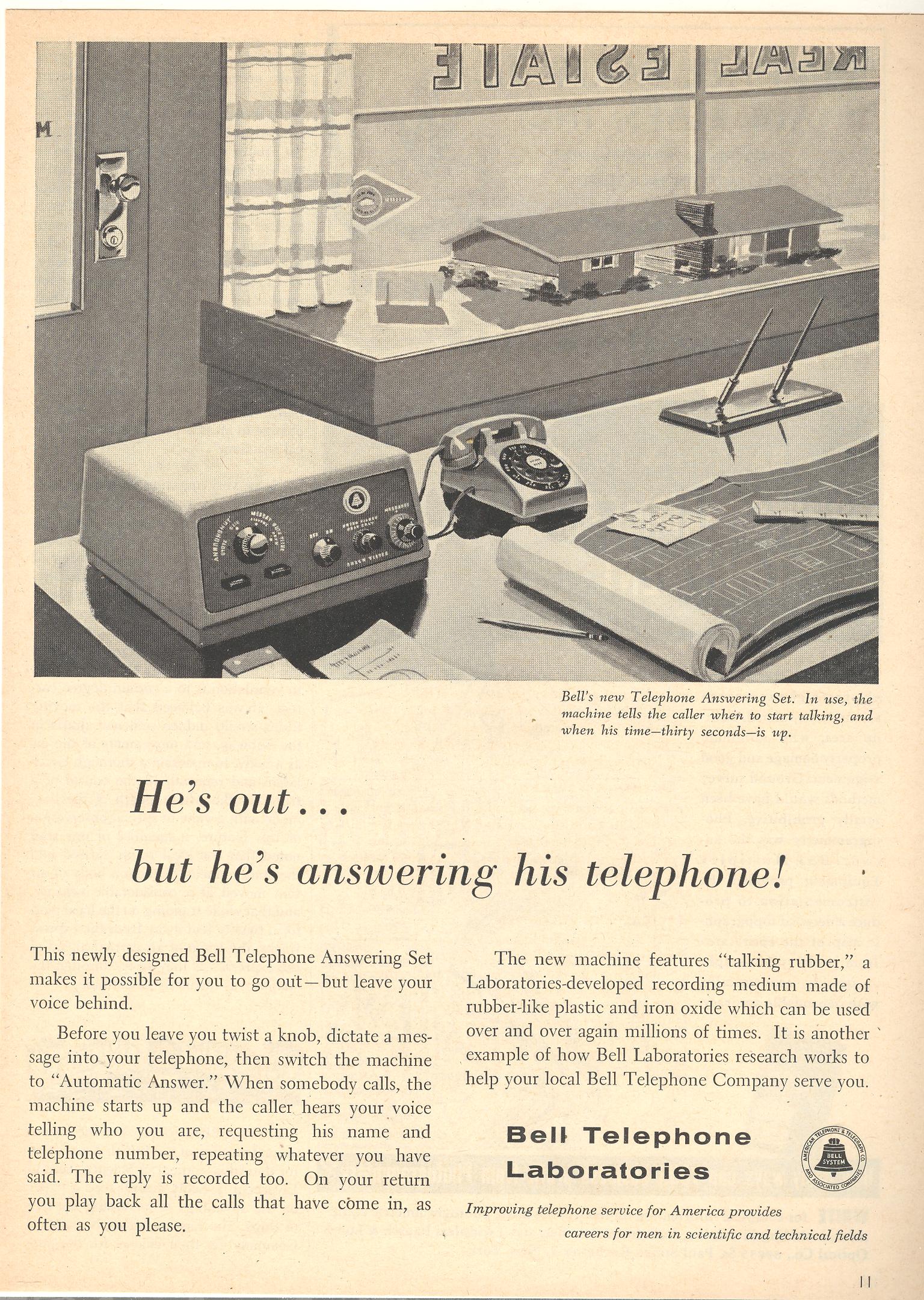
    Telephone answering

    But I think the telephone answering machine is certainly one of them, I think, and not a modest example either.  The answering machine (for “him”, of course) allowed a person to be in two places at one time, allowing the telephone to function not only as a communication device but as a secretary, liberator, device as well.  Now (in 1958, when this ad appeared) that people had completely embraced the phone for business and for pleasure, it added immeasurably to the well of free time.  The telephone enabled immediacy; but for that immediacy to work, a person had to be there to tend it.  With the answering machine, however, a person could in a way save that immediacy for a more convenient time, liberating their necessary presence the telephone experience. 

    The telephone allowed as person to instantaneously be in two places at the same time, basically; the answering machine contributed a third (or more) place, and freed up the time element. 

    In effect the thing was/is a time machine, making it possible to either instantly speak with someone 12,000 miles away, or save the conversation for a more convenient time, sort of going back into the past to replay the communication..(Or dump it, extracting the necessary info or whatever without having to actually interact with the caller. ) 

    Its easy to slip and refer to the machine as simply “an answering machine”, leaving out the “telephone part; it would be nice to have a machine that could reliably answer questions like that (though I think that this is what Google imagines itself to be).  The “answering machine” four generations or whatever from now may be something that is today unimaginable.  Maybe there will be a general death of the question, because everything has been answered.

    Maybe the greatest machine in the future will be the questioning machine, something that skirts all of the known answers in whatever earth-sized database exists at the time.  Something that asks for information or for a synthesis of answers that doesn’t (yet) exist. 

    Anyway, I like what I think is the great importance of the telephone answering machine.  And I don’t know how The Rockford Files would’ve functioned without one.  Actually old Jimmy used a very early device, coming just a few years after the first successful mass-marketed device hit the streets in a wooden box and weighing ten pounds–the PhoneMate Answering Machine Model 400, which started to appear in 1971.


    ·Posted by :

    ·in:


  • The Language of Tree Structure

    JF Ptak Science Books 

    Messages and information, silently displayed data and the announcements of the state of all things are everywhere, all of the time:  these things only become part of the language and systematically codified once they are recognized and understood, or at least once the thrust of the message becomes distinguished from the surrounding noise. 

    Blog--jun 8 tree
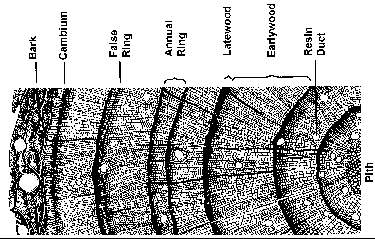
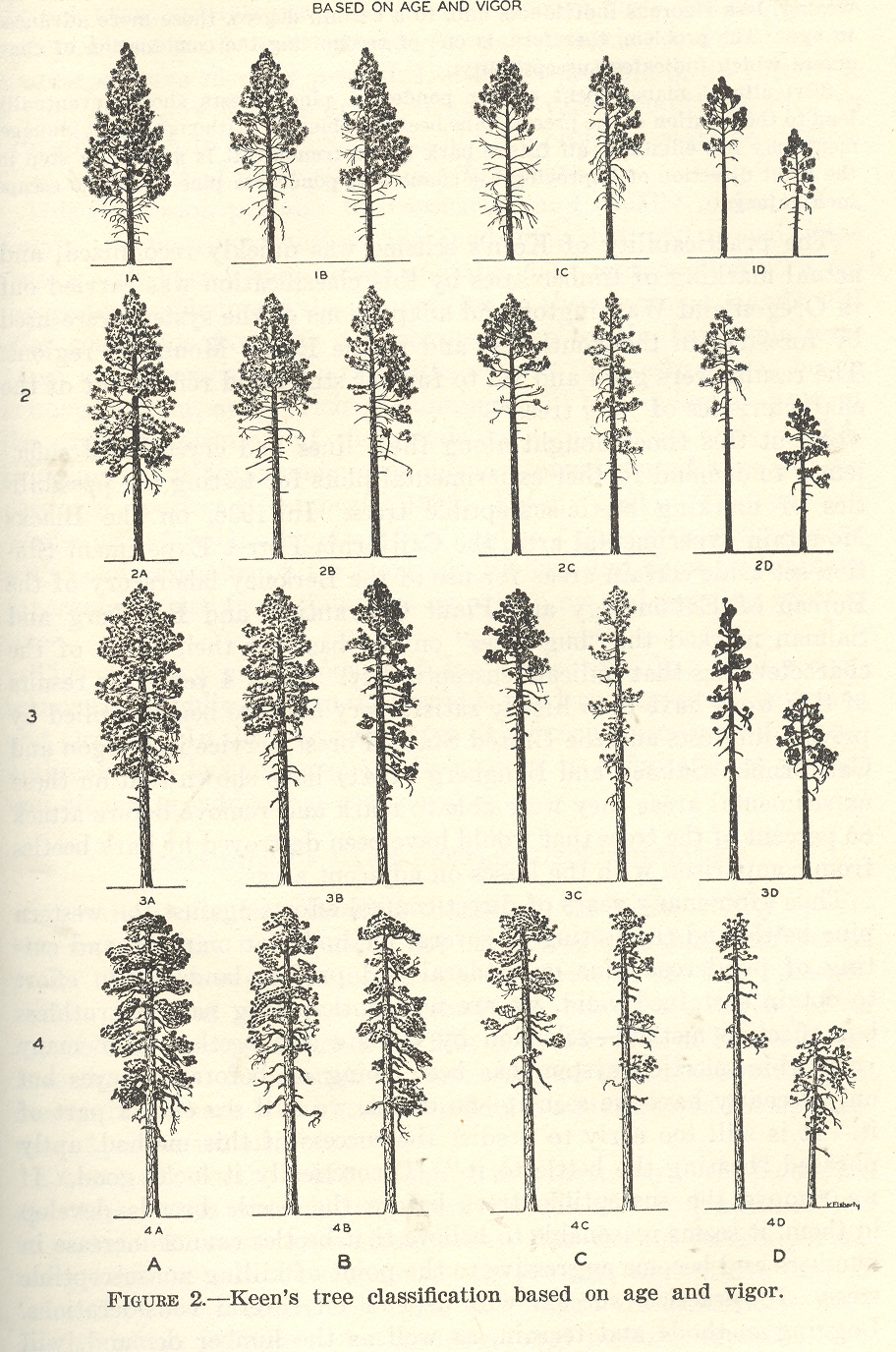
    One elegant interpretation of above-the-noise display was made by E.P. Keen in 1936 (“Relative susceptibility of ponderosa pines to bark beetle attack”, published in the Journal of Forestry)  who established a simple and practicable standardized vocabulary for the discussion and communication of tree health.  It is a relatively straightforward idea–based upon many years of keen observation and understanding–which used a pictorial schematic to establish a common baseline for the discussion of tree health/growth. Later on Keen would pioneer the use of aerial photography using various films and filters to determine the extent of damage done to stands of trees (and forests) brought about by drought, pests, diseases and other harmful stimuli–especially when the damage was done not in the visible spectrum. 

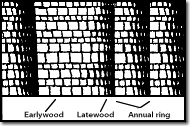
    The Blank & Empty part of tree language comes in the form of cells in the trunk of the tree which reveal–in cross section–the age of the tree and some climatic indicators of during the tree’s growth.  This comes in the form of tree rings–the rings are formed by the growth of the cells, the first of which in a new season respond with expansion, and depending upon water conditions will either grow somewhat less slowly than at first or stop growing altogether at the end of the season, and die; the new cells growing in the new season, and the demarcation being what we call a “ring”.  This was a fantastic idea, the brainchild of A.E. Douglass at the University of Arizona.  
    Blog--june 8--tree cell
    Andrew Ellicott Douglass (1867-1962)  was , ironically, an American astronomer at work at the Lowell Observatory in Flagstaff when, in 1911,  he began his experimentation with tree rings.. (I believe that he came to this end trying to ascertain terrestrial climatic conditions in his sunspot research.) The resulting effort was the clarification and near-founding of dendrochronology, with the resulting climatic understanding applicable across many different fields, and all from expanded/contracted cells.  Douglass perfected his observation and theory in a three-volume masterwork Climate Cycles and Tree Growth, which was published in 1936.
    Blog--june 8--tree 2

    For an interesting appraisal, see George E.Webb  Tree Rings and Telescopes, (the University of Arizona Press), Tucson, Arizona, 1983.


    ·Posted by :

    ·in:


  • Pig Iron vs. the Eiffel Tower

    JF Ptak Science Books   Quick Post  

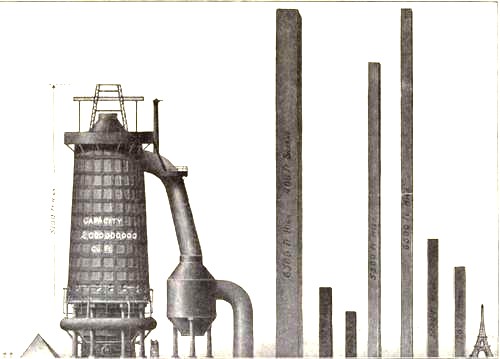
    Several years ago I wrote about some triumphantly unusual images (plus one on the 1891 10-ton Eiffel Tower bullet) of the Eiffel Tower–today I’d like to add another, a queer image which manages to loose the Eiffel Tower (and the Great Pyramid) in representations of pig iron production.

    Diagram steel eiffel 

    I love comparison like this, representing big, hard-to-associate  numbers of something against another quantity that can be instantly understood–the relationship between the two might be tenuous and complex, but at least it can give you some sort of handle on what would normally be an inaccessible, stand-alone number. Plus, any time that you can show what an ungraspable concept might “look like” and be explainable to a 10-year-old, well, you’ve got something. 

    ·Posted by :

    ·in:


  • A Deep and Happy Red–the Young Communist League, 1937

    JF Ptak Science Books   Quick Post–Poster Series

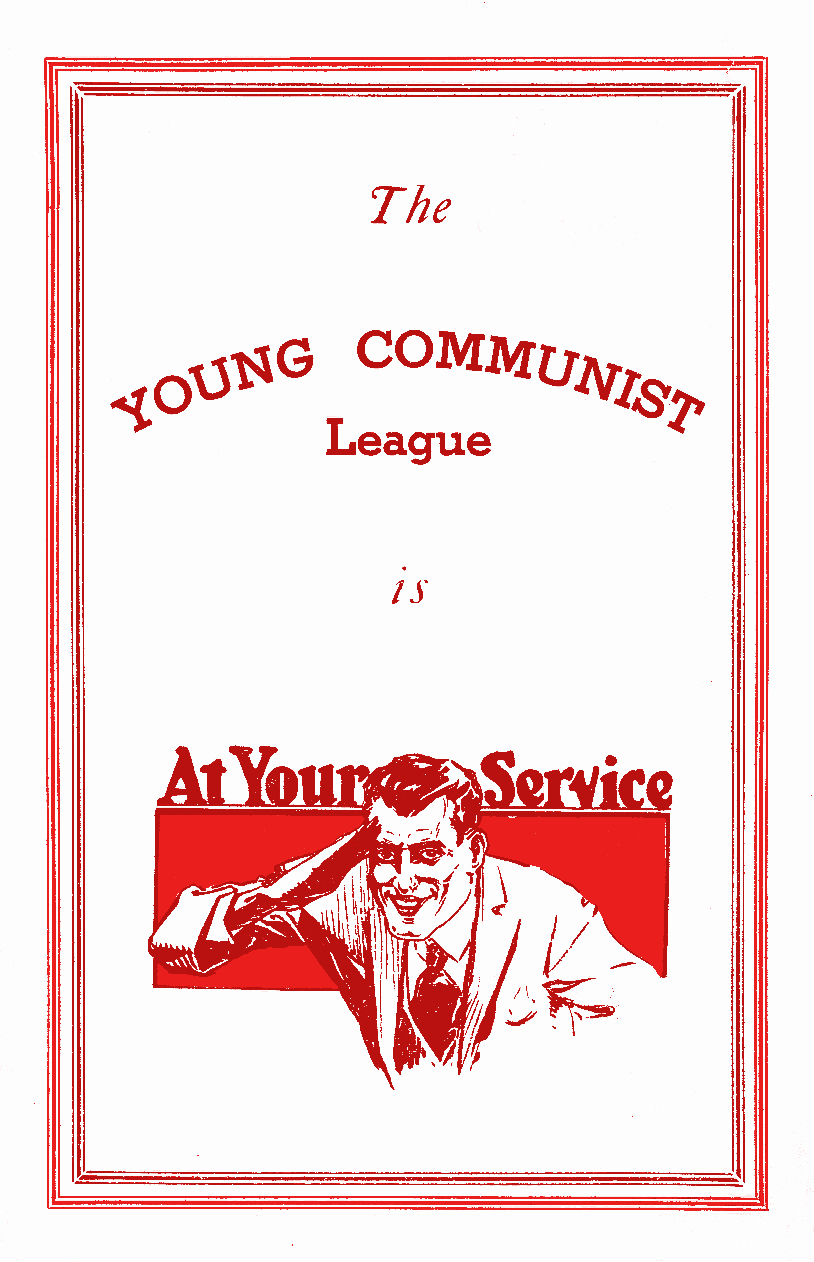
    In the wide and deep collection of social history pamphlets and ephemera that exists here cheek-and-jowl with the history of science material I have found one of the truly great pieces of cover art/design–it stands easily in the top percentile for overall design, and it does get its message across very quickly.  It is also evidently rare, as I can find no other copies of the thing.  It certainly seem to be the first time it has appeared on the intertubes.

    Poster Reprint Young Commie 150 dpi white 359

    [A fine 13×19 inch reproduction is available for purchase here.]

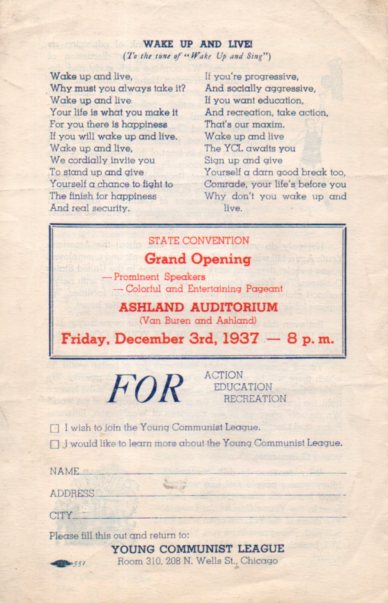
    The pamphlet was aimed at the “under 30” crowd, as we are warned right up front, in the first paragraph of the pamphlet, that if you are over 30, “we suggest you pass it along to someone under 30”–which is where the “Young” must come into play. 

    The essence of the Young Communist League is “ACTION  EDUCATION  RECREATION” and of course to teach their “Comrades” to “help understand the world we live in”.

    The bait was set for the young and restless–and probably unemployed–youth in the midst of the Great Depression of 1937.  War in Spain, a big war that not that many people were hearing about in China, a failing economy, falling prospects, and the rise of Fascism in Italy and National Socialism in Germany may have contributed to the growth in interest in this movement among the under-30 set in the great state of Illinois to attend the YCL state convention in Chicago.  There were a number of odd businesses located at “208 N. Wells St” in Chicago (the Loop), though fewer were less unusual than the Young Communist League in Room 310.  I’m sorry to say that I cannot determine how long they lasted there, though my guess is that Room 310 was occupied by someone else in 1942. 

    Young communist league little248


    ·Posted by :

    ·in:


  • 12 Trillion Slices of Pi

    JF Ptak Science Books   Quick Post

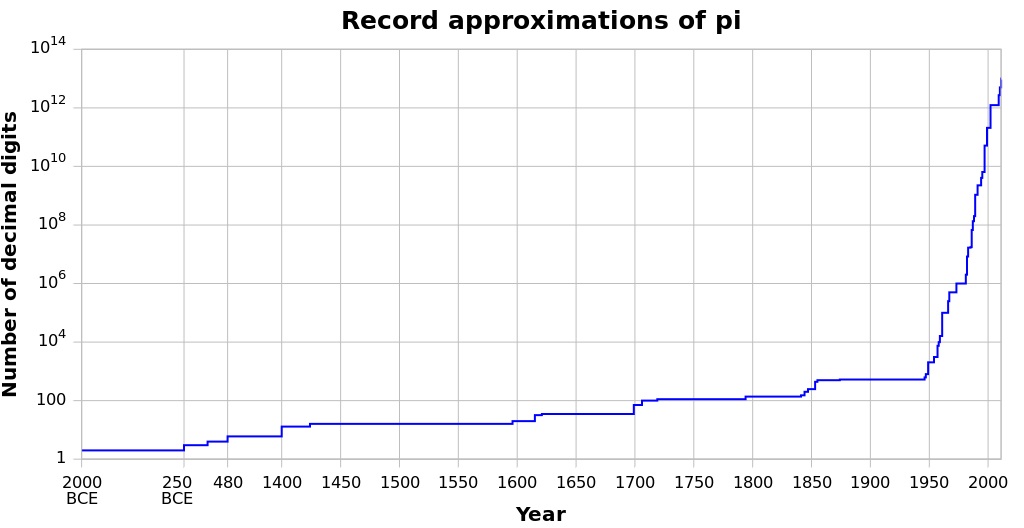
    The mathematician Hermann Schubert wrote in his 1889 text on the uselessness of calculating pi past 500 digits–I haven’t located a copy of the original 1889 publication though the story is often repeated: I’ve seen in in Petr Beckmann’s A History of Pi (1993 edition) on page 101 and also in Cliff Pickover’s Keys to Infinity (John Wiley, 1995).  

    “Conceive a sphere constructed with the earth at its center, and imagine its surface to pass through Sirius, whis is 8.8 light years distant from the earth [that is, light, traveling at a velocity of 186,000 miles per second, takes 8.8 years to cover this distance]. Then imagine this enormous sphere to be so packed with microbes that in every cubic millimeter millions of millions of these diminuitive animalcula are present. Now conceive these microbes to be unpacked and so distributed singly along a straight line that every two microbes are as far distant from each other as Sirius from us, 8.8 light years. Conceive the long line thus fixed by all the microbes as the diameter of a circle, and imagine its circumference to be calculated by multiplying its diameter by to 100 decimal places. Then, in the case of a circle of this enormous magnitude even, the circumference so calculated would not vary from the real circumference by a millionth part of a millimeter.”

    “This example will suffice to show that the calculation of to 100 or 500 decimal places is wholly useless.”

    Long before Schbert pi was being calculated to quite a degree: it was computed to 9 places  by Francoise Viete in 1579; 15 places by Adriaan van Roonan, 1593; 32 by Ludolph van Ceulen in 1596; 35 by Willebrord Snell in 1621; 38 by Christoph Grienberger; 75 by Abraham Sharp in 1699; 100 by John Machin in 1706; 137 by Jurj Vega in 1794; and 152 by Legendre in 1794, which is nearly 100 years before Schubert. William Rutherford came in with 248 in 1847, and then William Shanks with 527 places in 1874.  D.F. Fergusson would break 1000 places in 1949, followed by F. Genuys (using the IBM 704) breaking 10,000 i 1958.  Daniel Shanks reached 100,000 in 1961, Jean Guillyud finding 1 million in 1967, and then many others, right up to the 12 trillion mark by Shigeru Kondo in 2013.  

    All of which leave Dr. Schubert without very much crust.  


    Pi graph


    ·Posted by :

    ·in:


  • A Small Tale of Bibliographic Discovery–Figuring out a Medical Manuscript, 1895

    JF Ptak Science Books   Post 2326

    Most of the time my work in the book world is figuring stuff out, finding out where one paper influences another, what is important, or significant, and why, and where everything fits and makes sense.  These works are almost always published–today’s effort was not, and hardly identified, so before any of the research could be started the origin had to be figured out.  

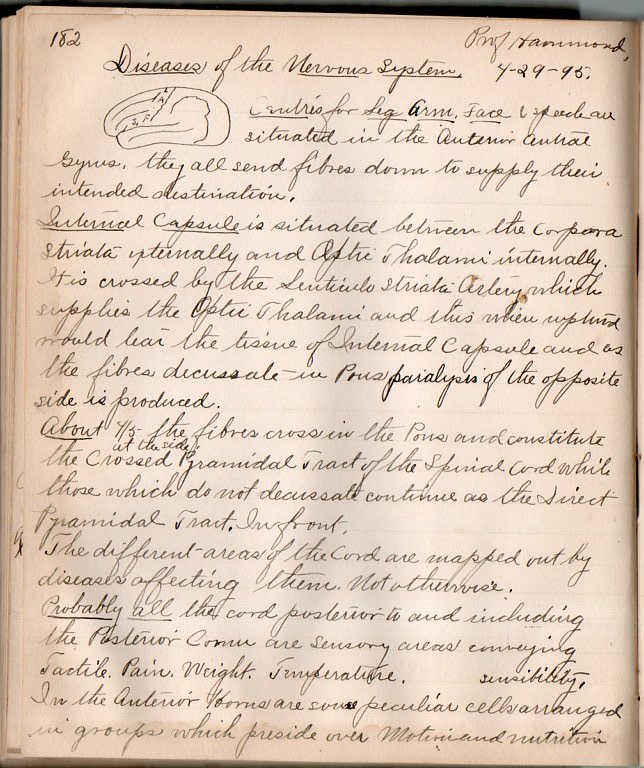
    First of all the work in question is a medical manuscript–the clues were a former bookseller’s date guesstimate (“1875?”) and a name, “Harold A. Fiske”. Now the name is a big deal, but it is not an uncommon name.  Then there was a third clue: after paging through the book’s 221 pages I found the only date (“4/29/95”) and a name, “Prof Hammond”.  Those were major clues, because now the book was definitely dated (1895) and that it was a medical notebook, and that there was a section on nervous diseases for a lecture given by a Prof Hammond in April 1895.  

    The work after this became a little easy–a google search found many “Harold A. Fiskes”, fewer physicians, and then fewer still in the 19th c.  Then a hit in the L.A. Herald for a marriage announcement in 1907, and an obituary in the L.A. Times for 1922, for a man by this name, a doctor, dying at age 49 (giving him a birth date for 1873, in line for being in school in 1895), and a note that he was born in Vermont.  Next to the University of Vermont, where a very helpful librarian suggested their Medical School catalog for 1895, and then, boom–finds for Hammond and for Fiske.  

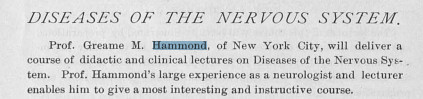
    There was a Dr. Hammond teaching there in 1895, and that Dr. Hammond was Greame Hammond, M.D., of New York City, and who was at one time president of the Neurological Section of the New York Academy of Medicine (and succeeded by the great Hillary Putnam Jacobi, reference the Chicago Medical Recorder, volume 4, January-June 1893). Dr. Hammond is listed as a “Professor of Special Subjects”, that being “disease and nervous system”.  

    Hammond

    Harold A. Fiske is listed as in the section on attendees of the school.

    Fiske

    [See the University of Vermont Medical School Catalog for 1895 online here:http://scholarworks.uvm.edu/cgi/viewcontent.cgi?article=1048&context=dmlcatalog [From the UVM Medical School catalog]

    And also lastly, in the text of the catalog occcurs a notice for Dr. Hammond, “A Clinic for Diseases of the Nervous System will be held during the course of lectures by Prof. Hammond, between April 29th and May 3d” (page 14) and on page 182 of Fiske’s notebook is the entry for the notes “Prof Hammond, 4-29-95, Diseases of the Nervous System”. So there really is no doubt about where the notes were made and by whom and when.  

    Medical ms pg 1339

    There are many times when I research things like this and come up with nothing about who the author was, or when (positively) it was written, or where. So it is a fine feeling when the little clues liek the ones above fall so nicely into place.  

    So: the medical notebook was written by Harold A. Fiske (1873-19221), the middle section of the work dated April 1895.  It is a concise and extensive work containing about 25,000 words, running 223pp, generally about 22 lines per page and eight words per line (conservatively).  The entries are generally made with the following guidelines: description, cause, symptoms, inspection, prognosis, treatment.  

    The work contains notes and observations with the following headings:  jaundice, coma, cetalepsy/hysteria, apoplexy, croup, stomatitis, chancrum oris, ptyalism, quinsy, diphtheria, goiter, capilary bronchitis (pp 40-43), asthma (44-46), pneumonia (the disease which would kill Dr. Fiske in 1922, pp 46-51, emphysema (52-3), whooping cough (54-5), tuberculosis (60-3), empyema (64), pneumo-hydro-thorax (65), acute gastritis (66-7), dyspepsia (68-9), cancer of stomach (70-72), inflammation of instestine  (74-5), acute anticular rheumatism (78-9), gout (80), arthritis (81), muscular rheumatism (83), typhilitis (86), perityphlitis (88-9), dysentary/blood flux (90-2), cholera morbus (93-95), Cholera (96-9), Perionitis (103), intestinal worms (104-107), trichinae spiralis (108-9), lead poisoning (110-111), Cirrhosis of the liver (112-115), jaundice and hepatic colic (116-117), diabetes (118-121), eczema (122-4), fever (122-7), grip (128-131), typhoid fever (134-139), Bright’s disease (140-5), [various/sundry, 146-9], variola/small pox (150-3), epilepsy (154-5), [156-161 blank], diphtheria (162-5), diarrhoae (166-176), chronic constipation (176-7), adenoids (178), acute shingles (179-180), diseases of the nervous system (181-186), locomotor ataxy (187-191), polio (192-195), sciatica 196-7), athetosis (198), traumatic epilepsy (199), hysteria, neurasthemia (203-205), sexual neurasthemic (205), epilepsy (206-209), coebral Haemorrage (210-212), St. Vitus Dance (216-216), facial paralysis (215-216), neuralgia (217-218), paralysis (219), hypnosis (221). 

    ·Posted by :

    ·in:


  • “Render the Light Soft and Cool”–Found Poetical Bits in Scientific Advertising, 1899

    JF Ptak Science Books   Quick Post

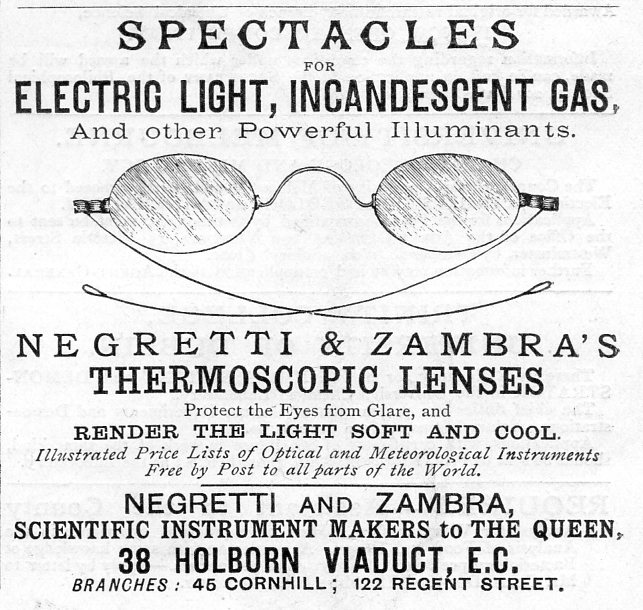
    I have seen many thousands of pages in the populist hard-science journal, Nature, from its opening volume in 1869 through WWII–at least those are what I have in the studiom ready for a browse. (In recent years even a good share of the titles in Nature are mysterious to me–I’m more able to do cover-to-cover grazing before WWII.)  In any event I have notice many times certain poetical phrasing in the ads of the later issues (adverts coming into being a few decades after the first by-subscription issues) and I’m a little sorry now for not saving or noting them.  This ad for lab specs is a decent example: it is a nicely designed bit, and small (less than two square inches int he original issue in 1899), and has the nice turn, “render the light soft and cool”, a line that could be used anywhere.  But here it is, selling specs by the redoubtable Negretti & Zambra.  

    NAture Spectacles286

    ·Posted by :

    ·in:


  • The Minority Speaks: F.D.R. as Boondoggling Demagogue (1936)

    JF Ptak Science Books  

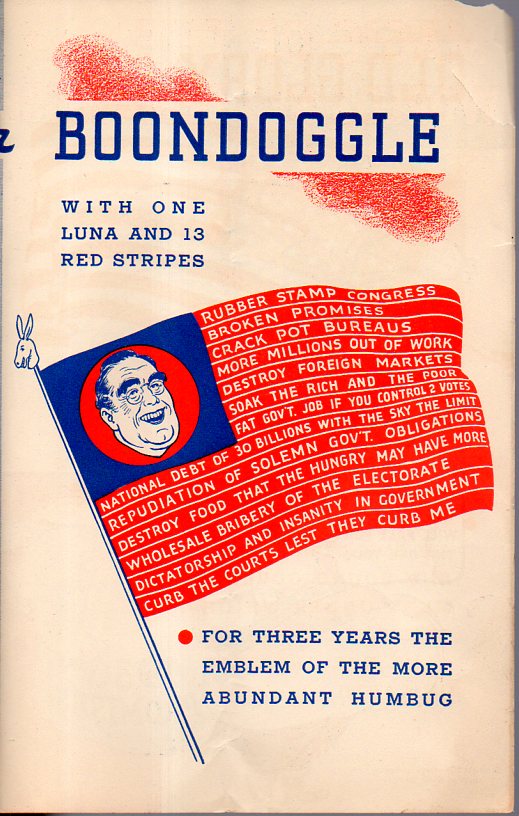
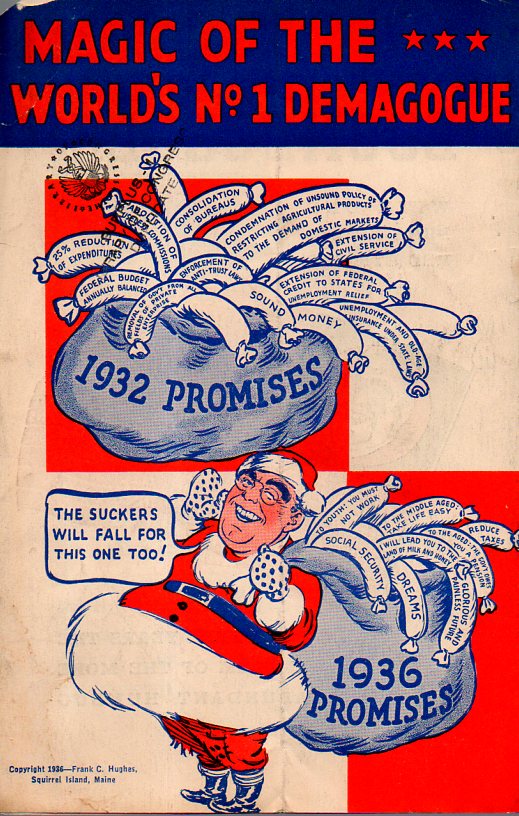
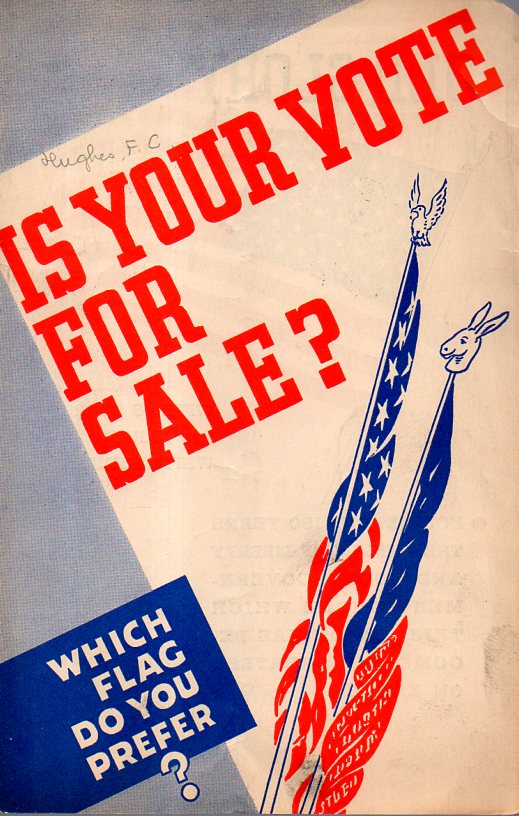
    This is quite a flag being flown by Republican interests, waving in a relatively non-existent lunar breeze prior to the 1936 election. That was a lot of discrimination leveled on FDR in that flag, which is particularly disdainful given the successes of the administration in its first term.  (Of course FDR would go on to win in the mother of all landslide, beating Alf Landon and Frank Know 523 to 8 in the electoral college).   The electoral map has seldom been so monochromatic as in ’36, though George McGovern took only a single state in his bid against RMN in ’72.  Landon took Vermont and Maine, and Maine (Squirrel Island) is where the holder of the copyright on this pamphlet–Frank C. Hughes–was from.  Hughes was, um, not a fan of the administration, and seems to have written a number of little pamphlets proclaiming himself as the dire opposition, the ruined associate of democracy, the injured party…a gadfly.

    FDR279


    Anyway I guess some of the meaty stuff that could be the cause of some of the stripes on that flag are the occasional favorite of revised opinion and theory nowadays, that FDR messed around with taxes and wages when he shouldn’t have, and imposed the tariff that some think pushed the country further/deeper into Depression. Bottom line is that he saved us all.  

    FDR278

    FDR277


    By the way, that’s pretty much the whole pamphlet–there’s one more image, but the whole of it was one sheet of paper, folded.  

    ·Posted by :

    ·in:


  • Superior Cover Design, Chem Industry, Nazism, and “Race Suicide” (1944)

    JF Ptak Science Books   Post 2301

    Bob Edwards, MP (1905-1990) was a trade unionist and socialist who wrote a particularly savage appraisal of the British chemical industry during WWII.  The pamphlet stopped me because of the cover design, and then of course by its subtitle:  War on the People, an Exposure of the Chemical Kings and their Nazi Associates.  And the big deal about this was that it is the second edition, and it was printed in 1944.  

    War on the People273

    I don’t want to start even just a little on the matter of American/Allied multinationals  (like Brown Brothers, Standard Oil, Renault, I.C.I., Ford) doing business with Nazi-controlled companies and concerns, mainly because it is a very deep story and a simple scratch reveals too much and it sounds too odd to be true, but it all seems to be so.  Edwards though concentrates on the British chemical industries, and in particular the Imperial Chemical Industries (I.C.I.), which Edwards has a long association with as his personal labor affiliations in general have been with the chemical trade.

    This is already the “third edition” in two years for Edwards, so the pamphlet must have proved (a) interesting  or (b) printed in very small runs allowing for corrected bits here and there.  He addresses the “Chemical Kings” and how much  they effect local and international communities, and extend their political power, and about unfair labor practices, and large profits, swindles, and in one three-paragraph section the association of I.C.I. and I.G. Farben–Edwards concentrating on business arrangements and profits, though at this point there is no mention of any of the Farben connections to the Holocaust.  He moves on to chemical warfare, the “prostitution of science” , poison gas, a magnesium conspiracy with Hitler, and other bits…and allows himself the position of having a solution for it all–the socialization of the I.C.I.  

    It is unclear from this pamphlet how Edwards stood on the war, or what it would mean to socialize the massive chemical industry, though it seems at least that the reorganized industry would not be doing business with Hitler, though it is unclear if there would be any involvement with the war beyond that.  

    ·Posted by :

    ·in:


  • An X-Ray of Hate: a Bitter, Biased, Horribly Racist Pamphlet (1936)

    JF Ptak Science Books   Post 2300

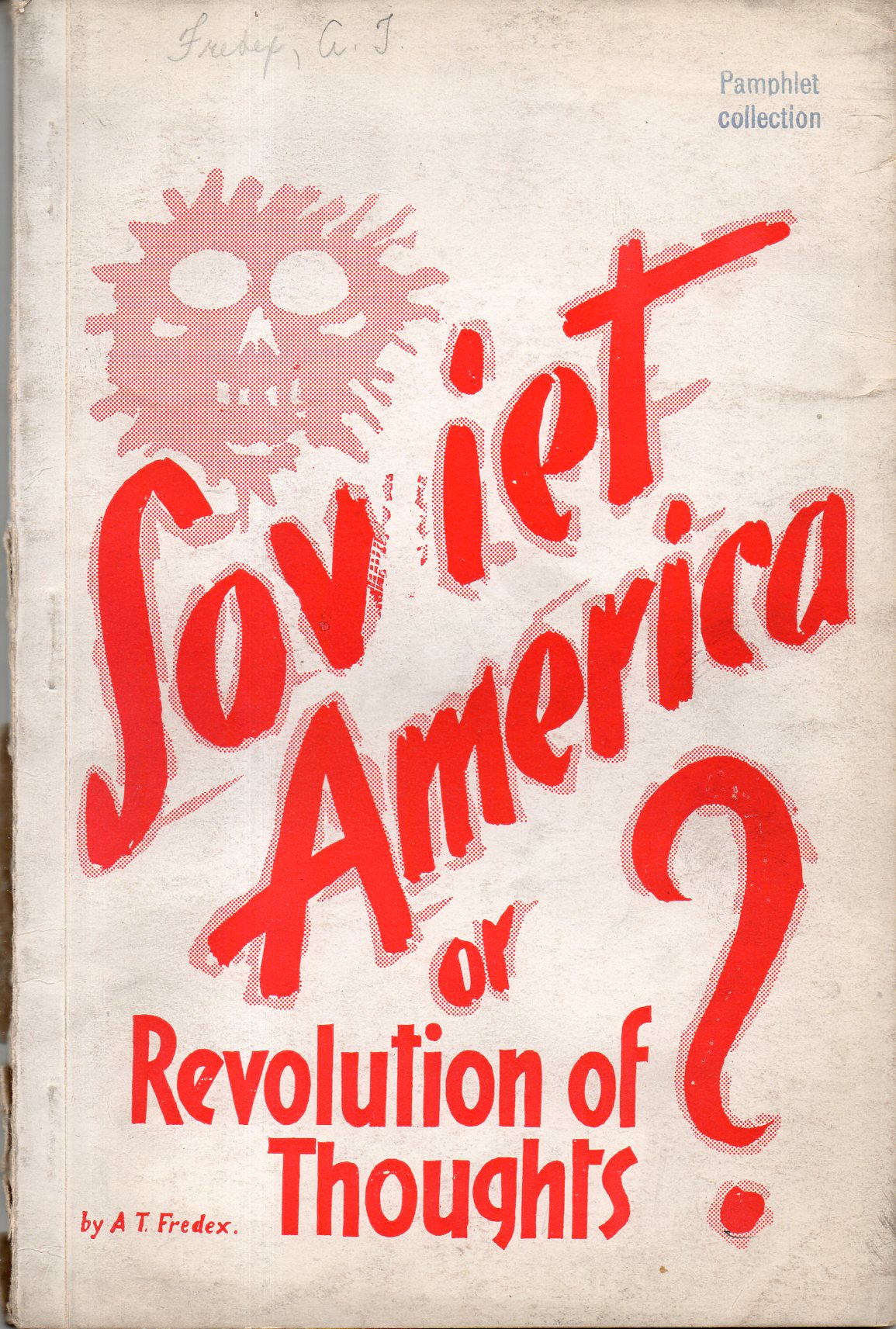
    I wondered about this pamphlet, with the odd cover design, odd question, odd feel, odd smell, odd paper.  It turns out that it is a raving, sodding racist work of low order and high hate.  

    We are told that Democracy is a menace in the United States now, with an uncontrolled melting pot, being overtaken by “inferior raced hodge-podge”, “inferior human material”, ranting against Democracy and Communism (as written and “contrived” by “the Jew” Marx and the “Half-Jew” Lenin), while the press continues to put out its “stupid emanations” and “poison” against the German government and the “tormented” German people.  

    And this is just from two paragraphs.  Quite remarkable, and about as bad as I’ve read. 

    Bottom line seems to have been that the U.S. is headed towards an unspeakable betrayal without a revolution of thought aligning the Anglo-Saxon elements against all of the other “filthy elements” of society.  Well.  ALl of these people are dead now, and the U.S. is doing okay, while the  dream-date Nazis of ’36 were gone nine years later.  

    Soviet America272

    ·Posted by :

    ·in: