A Daily History of Holes, Dots, Lines, Science, History, Math, Physics, Art, the Unintentional Absurd, Architecture, Maps, Data Visualization, Blank and Missing Things, and so on. |1.6 million words, 7500 images, 4.9 million hits| Press & appearances in The Times, Le Figaro, Mensa, The Economist, The Guardian, Discovery News, Slate, Le Monde, Sci American Blogs, Le Pont, and many other places… 5000+ total posts since 2008.

Book Category: Technology, History of

  • A Very Early U.S. Printing of the Calotype Process (1842)–the Introduction of the Paper Negative Process

    Journal of the Franklin Institute, Philadelphia, Vol 3 (third series) vol 33 overall, January-June 1842, with text illustrations, folding charts, one engraved plate. 430 pp. Half-calf, with raised bands. Ex-library, with some scuffing on the spine and leather cover tips; front joint sprung though binding still tight; also a few stamps on the title page. The front board unfortunately is almost entirely detached, held on by two tie at top and bottom joint. In solid GOOD condition. $1500

    (Talbot, H.F.) “Calotype.” This is a  very early printing in the U.S. of the new process, introducing the major improvement of the paper negative. This printing seems to be done in the same year or is slightly earlier than what is possible the first Calotypes made in the United States (between 1842-4), according to G. Smith in “The First American Calotypes?” in History of Photography, vol 6/4, 1982. “Calotype, also called talbotype, early photographic technique invented by William Henry Fox Talboto f Great Britain in the 1830s. In this technique, a sheet of paper coated with silver chloride was exposed to light in a camera obscura; those areas hit by light became dark in tone, yielding a negative image. The revolutionary aspect of the process lay in Talbot’s discovery of a chemical (gallic acid) that could be used to “develop” the image on the paper—i.e., accelerate the silver chloride’s chemical reaction to the light it had been exposed to. The developing process permitted much shorter exposure times in the camera, down from one hour to one minute. The developed image on the paper was fixed with sodium hyposulfite. The “negative,” as Talbot called it, could yield any number of positive images by simple contact printing upon another piece of sensitized paper. Talbot’s process was superior in this respect to the daguerreotype, which yielded a single positive image on metal that could not be duplicated. Talbot patented his process in 1841.”—-Ency Britannica

    Some of the other articles of interest:

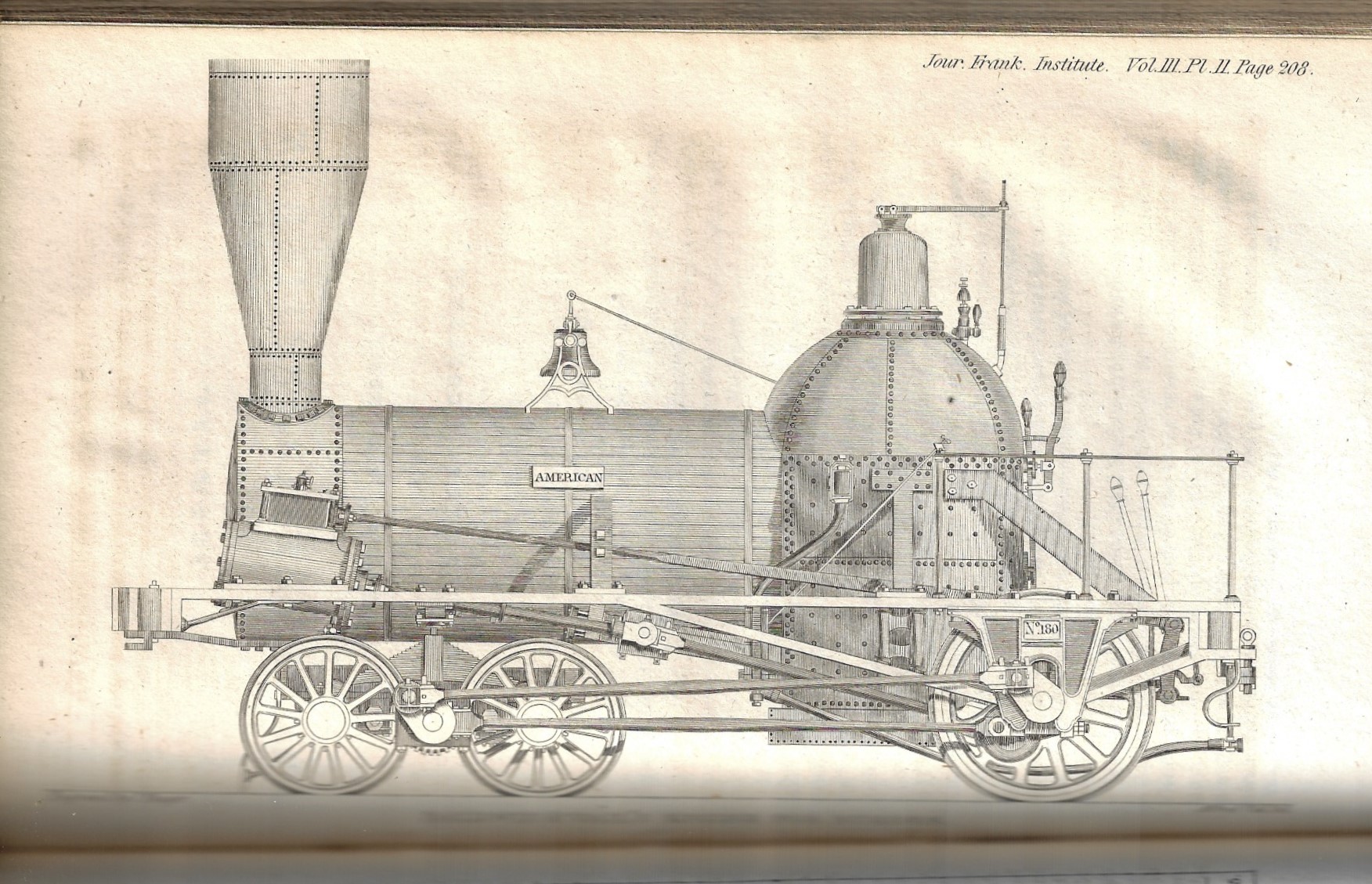
    “Baldwin’s Geared Truck Locomotive Engine”, pp 208-209 (with a lovely full page elevation of the Baldwin machine).

    Louis Daguerre, “New Photographic Discoveries”, translated from the French by Prod. F. Frazer (a half-page article on pg 109.

    Ellwood Morris, “On the Force of the Wind and Sea…”pp10-21;

    John Herapath, “Facts and Observations on Four and Six-Wheel Engines”, pp 244-249; W.A. Provis, “Effect of Wind on the Menai Suspension Bridge”, pp 210-214;

    T.R. Robinson, “History of the Reflecting Telescope”, pp392-398

    JFI 1842 Baldwin

    ·Posted by :

    ·in:


  • Embroidery by Machinery, Hughes’ Typewriting Telegraph, Submarine Cables, and more (1859)

    Journal of the Franklin Institute, Philadelphia, Vol 38 (third series), July-December 1859, with text illustrations, and one (movable) plate, 430 pp. Half-calf, with raised bands. Ex-library, with some scuffing on the spine; also a few stamps on the title page. Nice copy. $150 The volume has many dozens of articles, including the following:

    “Supply of Coal”, an interesting approximation of the life of the coal supply, though the common denominator is badly defined. Anyway, the writer was thinking about the future supply of coal, reckoning it at 36,000 years.

    Alfred Varley, “On the Physical Theory of Electricity in Submarine Telegraphy, the Electrical Difficulties in Long Circuits…” (on submarine cable communications), pp 52-61, 132-138, 199-206, 259-267;

    J.P. Espy, “Joule’s Unit Verified”, pp 254-6;

    James H. Warner, “Mechanical Expansion Table”, pp 4-5, with a plate exhibiting the table with a 6” long moving indicator affixed by string, in good working order. (This seems to be the only movable table in the whole of the journal.)

    “Fog Signals by Sounds”, pp 61-2;

    H. Hyde, “On Professor Hughes’ System of Type-printing Telegraphs and methods of Insulation, with Special Reference to Submarine Cables”, pp 44-51, with a text illustration of the instrument; continued on pp 125-131 (concluded).

    George Wallace, “On Embroidery by Machinery”, pp 181-188 (3 text illustrations), 273-277, 337-340 (concluded).


    ·Posted by :

    ·in:


  • One of the First Journal Appearances of the Successful Demonstration of the Morse Telegraph and Very Possibly the First Appearance of the “Dots” of the Morse Code (February 1838)

    JF Ptak Science Books 
    Morse dots _2_

    “Report on Prof. Morse’s Electro-Magnetic Telegraph“,  in Journal of the Franklin Institute, pp 106-108, Philadelphia, 1838; volume 21 (new series) and volume 25 overall, with text illustrations and one folding plate, 442 pp.  Half-calf, with raised bands. Ex-library, with some scuffing on the spine and with the ghost remnants of a call number label at spine bottom; also a few stamps on the title page. As a whole the book is fresh and tight. Good/Very Good condition. $750

    This may well be the one of the two earliest journal appearances of the successful demonstration of the Morse/Vail electromagnetic recording telegraph (it was not the first demonstration of an electric telegraph nor an electromagnetic telegraph, priority of which belong to Gauss and Wheatstone and others), and is perhaps the very first appearance of the “dot” part of what would become known as the Morse Code.

    This was a significant report. As it turns out Morse makes the first public demonstration of his and Alfred Vail’s recording electromagnetic telegraph on January 6 1838 at Speedwell Ironworks near Morristown, New Jersey, just weeks before this JFI appearance.  On this success, Morse went south to Philadelphia and demonstrated his invention to the Franklin Institute on February 8, 1838 (summarized in the present report), appearing two weeks later on February 21 1838 midway between Phila and home in Washington D.C., demonstrating the apparatus to President Van Buren and members of the Congressional Committee on Commerce.

    This may well be the one of the two earliest journal appearances of the successful demonstration of the Morse/Vail electromagnetic recording telegraph, and is perhaps the very first appearance of the “dot” end of the Morse Code.

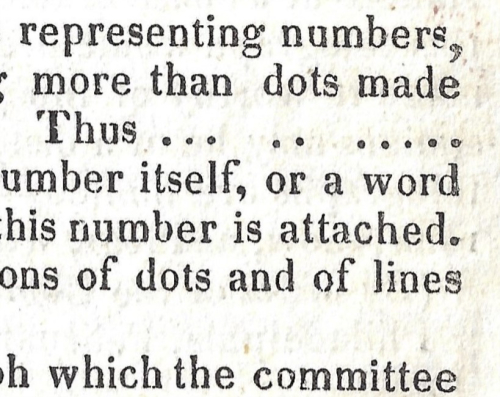
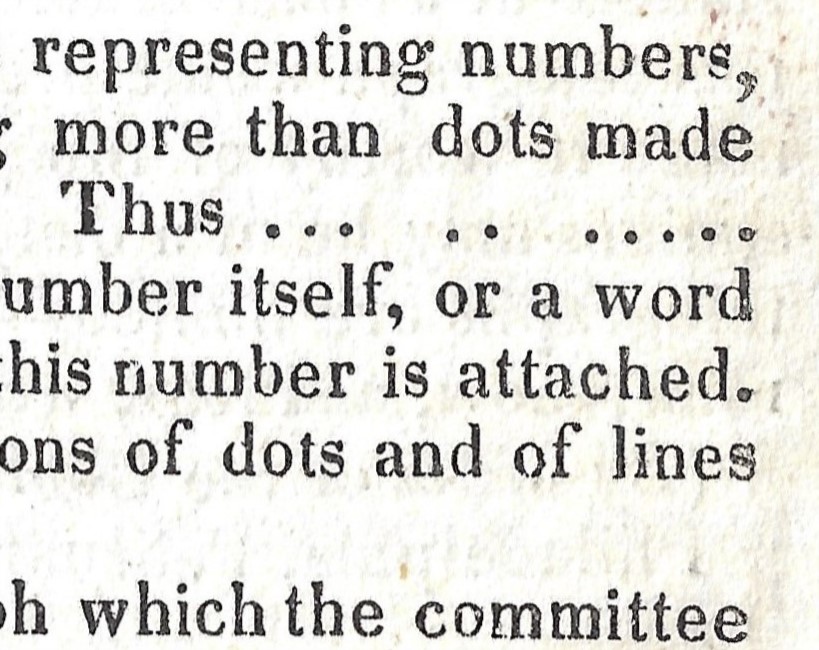
    The narrative identifies two systems of signals (“…one representing numbers, the other letters”) that were displayed in the demonstration. The first “representing numbers” were a series of dots. This is perhaps the first publication in a journal of the dot method of transcribed signals of a recording electromagnetic telegraph. The dots are pictured “…   ..   …..” on page 107, representing the number “325” or as explained could also mean the word represented by the number “325” in Morse’s code book (“indicate…a word in a dictionary, prepared for this purpose…”). The second, “alphabetical signals are made up by a combination of dots and lines of different lengths”), an example of which is not shown. 

    I have only been able top locate a symbolic system of the code in published journal reports (and a newspaper article) showing a “V” system, as in the American Journal of Science and the Arts (vol 33 #1, 1838), which prints an image of the register, and shows a “specimen of telegraphic writing” using this “V”: so, “V   VV   VVV” governed by spaces of long and short intervals,  would stand for 1,2,3 or 123, or to some word designated “123” in a code book. (I should point out that this article is about half the length of the JFI article.) 

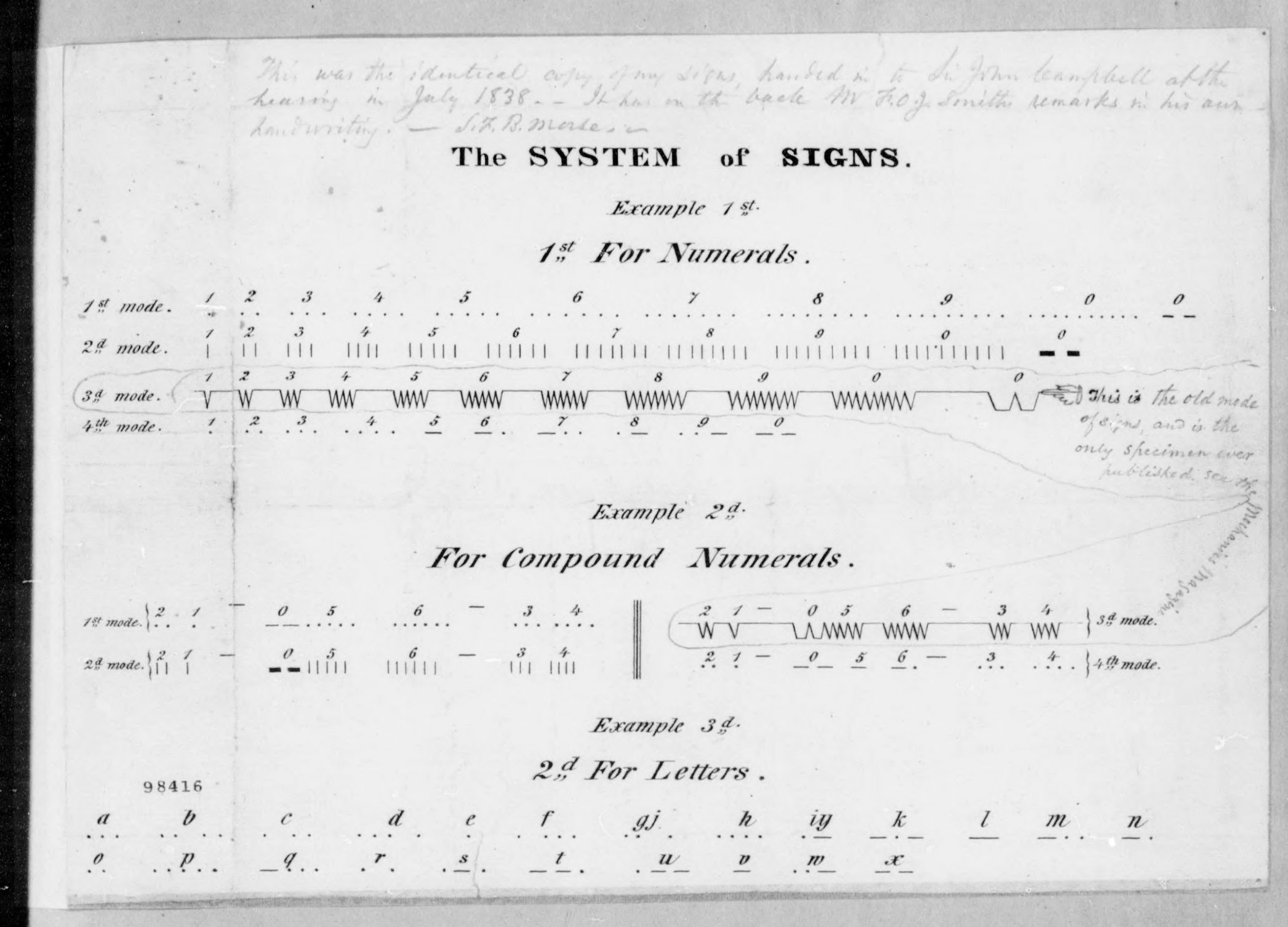
    What is surprising is to see what Morse himself had to say on this issue. Here are his notes on the system of notation, from the SFB Morse papers at the Library of Congress, Manuscripts Division, bound volume 28 November 1835-18 April 1838, page 154 (“Drawings to Accompany Copy of Caveat of Oct 6 1837”). The penciled note states “this is old mode of sign and is the only specimen ever published. See the Mechanics Magazine”.  It was also evidently published in the American Journal of Science and Arts at about the same time. There is no reference to the JFI report or the “dots” (or “1st Mode”).  It may simply be the case that at the time of his writing this that Morse was simply unaware of the JFI report, as the three appearances were all published at about the same time (within weeks of one another). 
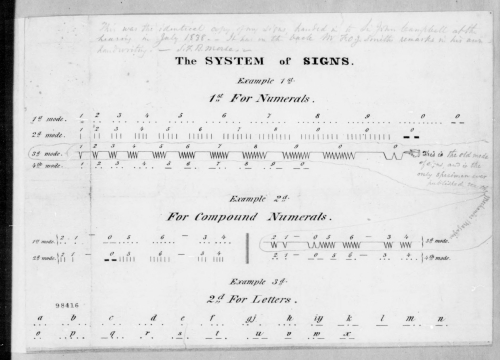
    Morse system signs _2_

    Source: LOC.gov, Manuscripts Division, Samuel F.B. Morse papers. 

    The famous “first” telegraph “What Hath…”1  transmission (at least seven years after the true “first”) was made of a series of raised symbols corresponding to Morse’s dictionary. 

    Also bound with:

    Charles Goodyear, “Specification of a Patent for divesting Caoutchouc, or India Rubber, of its adhesive properties…” in the March issue, reporting on patent of June 17, 1837, pp 186-188. (Goodyear gets closer to his great and happenstance discovery and innovation the following year, 1839, in which he finally figures out how to prevent rubber from melting in the summer and cracking in the winter.)

    “Of Sand, and Hydraulic Sand”, pp 89-94;

    Thomas Elliot Harrison, “Specification of a Patent for an Improvement in Locomotive Engines…”, pp 122-123; Hall, “Abstract of the Specification of Mr. Samuel Hall’s Patent Paddle Wheel”, pp 124-5;

    J. Reade, “Method of producing a Permanent Soap Bubble, illustrating the colors of thin plates”, pp 65-66;

    “On Concrete, Circumstances in which it is advantageous to use it”, pp 145-153;

    “Alexander’s Electric Telegraph”.

    Notes:

    1. The full quote, suggested by a young girl, was from Numbers xxiii, 23:

    “22…Surely there is no enchantment against Jacob, neither is there any divination against Israel: according to this time it shall be said of Jacob and of Israel, What hath God wrought!

    24 Behold, the people shall rise up as a great lion, and lift up himself as a young lion: he shall not lie down until he eat of the prey, and drink the blood of the slain.”
    ·Posted by :

    ·in:


  • On Hot Air Balloons, Marbled Paper, Lithography, Rotary Engines, and Much More (1829)

    Journal of the Franklin Institute, Philadelphia, 1829; volume 3 (new series) and volume 7 overall, with text illustrations and four plates, 438pp Half-calf, with raised bands. Ex-library, with some scuffing on the spine; also a few stamps on the title page, and a library card pocket at the rear endpaper. Good/Very Good. $145

    G. Cumberland, “On the Origins of Air Balloons” pp 20-24.

    “On improvements in Marbling the edges of Books and Paper” , pp 246-249, (from the French, which also has been reprinted in limited editions);

    Followed by:

    “On Morocco Leather Dressing”, pp 250-254 and 297-302;

    “An Historical Account of Lithography…” pp 279-282 and 302-306;

    George Cayley, “On the Natural Zero, according to Fahrenheit’s Scale”, pp 389-392;

    William Howard, “Specification of a patent for an improved Rail-way Carriage”, pp66-68, with three copper plate engravings;

    “Observations upon Rail-roads, and the Adaptation of Carriages in such as are curvilinear”, pp 68-70

    Mark Watt, “Abstract of a Memoir…on the Principles of Attraction and Repulsion in the Lunar Rays”, pp 24-29

    “On the Natural History of the Honey Bee”, pp 36-42 and pp 81-92;

    “Observations on the connexion of Mechanical Skill, with the highest attainments in Science…”, pp 153-159, and

    “On the Rotary Steam Engine”, pp 179-184;

    And lastly, of higher interest:

    John Fleming, “On the Value of the Evidence from the Animal Kingdom, tending to prove the Arctic Regions formerly enjoyed a milder climate than at present”, pp 382-389 (or rather the “insufficiency” of evidence that is).

    And here we go:

    “Innocuous Nature of Putrid Exhalations”, p. 35

    “On the Art of the Liquorist”, pp 369-375;

    “An Account of the Fire of St. Elmo”, pp 111-113;

    “On the Spontaneous Combustion of the Human Body”, pp 31-34.

    ·Posted by :

    ·in:


  • Very Early Papers on Railroads, Including an Illustration of “The Rocket” (1830)

    JFI 1830 the RocketJournal of the Franklin Institute, Philadelphia, 1830; volume 5 (new series) and volume 9 overall, with text illustrations and five plates. Half-calf, with raised bands. Ex-library, with some scuffing on the spine; also a few stamps on the title page, and a library card pocket at the rear endpaper. Very Good copy.  $225 

    This volumes includes many articles of interest, including a longish early article on railroads:

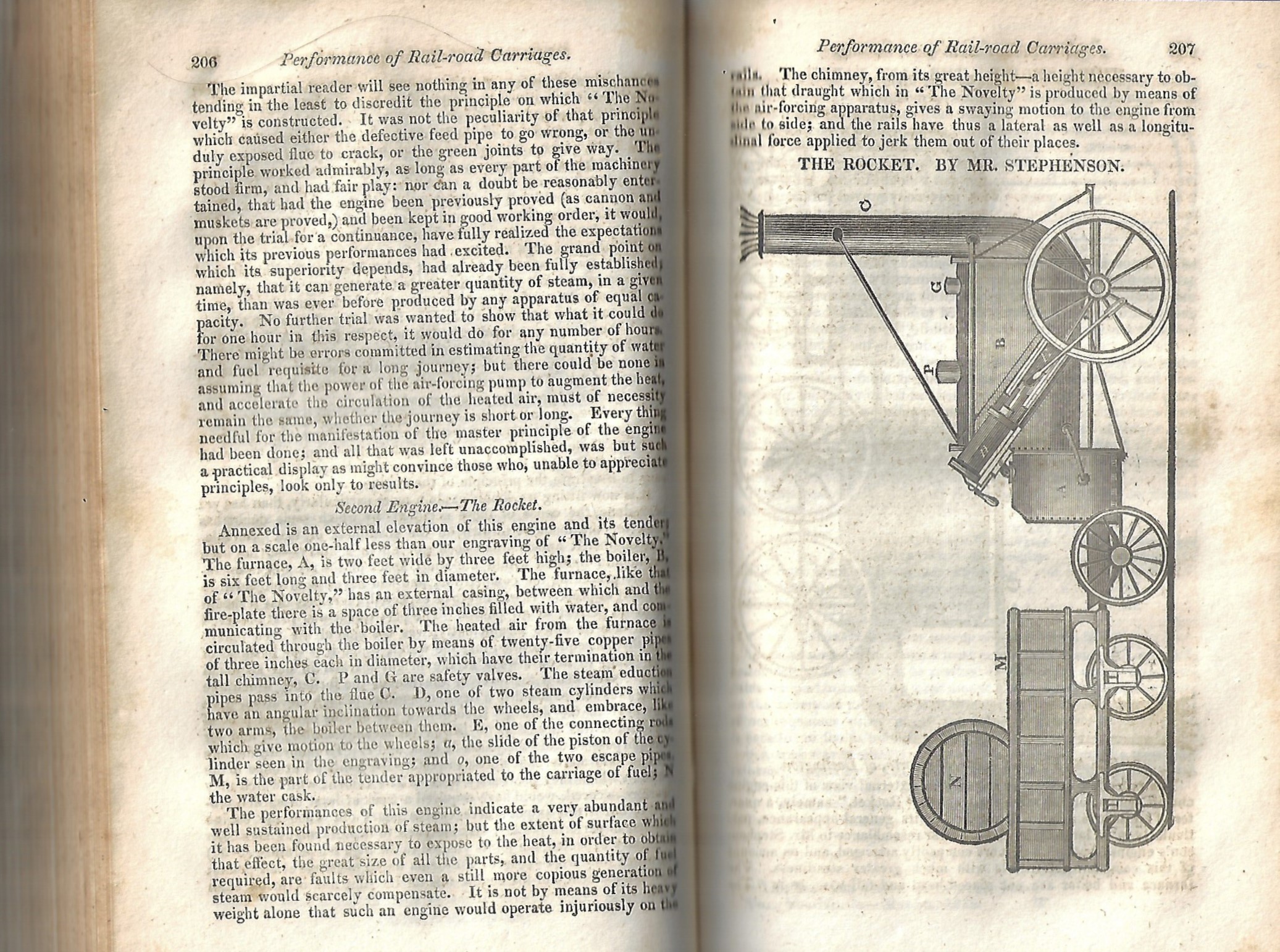
    “Account of the Performance of Various Rail-road Carriages on the Liverpool and Manchester Rail-road”, pp 186-210 and pp 257-267; featuring nearly full-page illustrations of (William) Stephenson’s “The Rocket”, “Novelty No. 1” of Braithwaite & Ericsson (along with a schematic for “Novelty No 2”, and the Sans Pareil”. Note: “The Rocket” was designed by Stephenson only a year earlier, the very early locomotive appearing in 1829 (in England). The “Sans Pareil” was design by Timothy Hackworth and was first presented in that same year of 1829.

    Also the following railroad papers:

    “On the Power required to Propel Carriages on Rail-roads, compared with that for moving boats in Canals”, pp 140-141;

    “Modes of Adopting Rail-way Cars to Roads &c.” pp 151-154;

    “Remarks on the Pendulous Rail-road Car, and on the adapting Railway Cars to run on common roads”, pp 237-239;

    Also:

    Walter Johnson, “On the Relation between Rolling and Dragging Friction”, pp 57-69;

    This piece is followed by the first in what was intended to be a series by the editor called “Modern Antiques”, (pp 69-70)where the journal would “furnish, occasionally, some palpable evidences of the forestalling disposition of remote answers…who have deprived us….off the honor of being the true and original inventors, or discoverers, of various improvements in mechanics, and other useful arts; and who even peep from their graves to dispute the rights of those who have issued to the world their new born projects in the forms of letter patents…”

    And:

    “On the Preparation of Crayons, or Pastels”, pp 94-99; ;

    [Henry M. Western], “Specification of a Patent for a Tide Power…for the Purpose of Applying Power to Machinery…”, pp 154-155;

    ·Posted by :

    ·in:


  • David On Natural Magic and Automata; Lumber for Ship Masts, Hydrostatic Beds, and other Articles (1833)

    JONES, Thomas P., editor.  Journal of the Franklin Institute, Philadelphia, 1829. Volume 11 (new series), volume 15 overall. 8.5″x5.5″, 4301, 12pp.. Bound in half-calf, with gilt stamping and raised bands. Ex-library, with evidence of spine label removal on spine bottom, scuffing on the spine edges, and a few stamps on title page, plus a call slip envelope at the rear pastedown and endpaper–other than some foxing, the book is very tight and crisp, a very nice copy.  Good copy.  $175.00  Some of the articles in the volume include:

    David Brewster, “Selections from Letters on Natural Magic…Illusions of the Eye”, pp 138-144 and continued for “Spectral Illusions”, pp 210–215 and  “deceptions with the Concave Mirror” pp 282-287, and “Acoustic Mechanism–Automata”, pp 354-359, and “decomposition of Light by Absorption” pp 417-420. 

    Robert Hare, “Apparatus for evolving Silicon from Fluo-silic Acid Gas”, pp 289-296 (with illustrations of the instruments). Robert Hare, “remarks on the error of supposing that a communication with the Earth, is necessary to the efficacy of Electrical Machines”, pp 297-299;  “Practical Observations on the Power Expended in Driving the Machinery of a Cotton Manufactory at Lowell”, pp 6-15; “W. Baddeley, (Alfred)Cannings Life Raft”, pp 59-61 (published months earlier in London); “Dr. Arnott’s Hydrostatic Bed for Invalids”, pp 61-66; “(W) Symington’s Steam-Boat”, with a full page cross section, pp 68-9; “Effects of Trades on Health and Morals” (full title being “Are there any trades so injurious to health, or so hazardous to morals, that they ought, for that reason, to be discouraged, or abandoned?”, pp 78-84; John Fincham, “On the timber used for the Masts of Ships”, pp 135-137 and pp 196-200; Lafonde, “On the Art of Glass Blowing”, pp 254-260 and 327-336; Robert Eastman, “Specification of a patent for an improvement in the Reacting Water Wheel…” with two copperplates, pp 320-322.

    Also: full page engraving with a short description of “Mr. Symington’s Steam Carriage, 1784-6”.

    ·Posted by :

    ·in:


  • Humphry Davy, History of the Steam Engine, Perfumery, the Greenland Whale, and more (1829)

    JONES, Thomas P., editor.  Journal of the Franklin Institute, Philadelphia, 1829. Volume 4 (new series), volume 8 overall. 8.5″x5.5″, 430pp, 5 plates. Bound in half-calf, with gilt stamping and raised bands. Ex-library, with evidence of spine label removal on spine bottom, and a few stamps on title page–other than some foxing, the book is very tight and crisp, a very nice copy.  VG $125.00  Some of the articles in the volume include:

    Humphry Davy, “On the Phenomena of Volcanoes”, pp 154-161; “On the Manufacture of French Articles of Perfumery”, pp 295-302; ;A. Ainger, “On the Early History of the Steam Engine”, pp 319-327, (concluded), pp 361-370; “On the Advantages of Machines (from Marratt’s Mechanical Philosophy)”, pp 162-164; “On a mode of Rapidly Sketching effects in Chiaro- scuro, and its applications to Lithography”, pp 371-3; Richard Walker, “On the Artificial Production of Cold”, pp 396-400; J. Harwood, “Structure and Economy of the Greenland Whale…”, – 21-31; Memoir of the Life of Joseph Frauenhofer…”, p 96-103. Lastly, “Description of a MAchine for Scattering Manure”, pp 277-8, with two illustration.  

    Here’s a little spin on the “Manure Scattering Machine”

    ·Posted by :

    ·in:


  • A Very Early Appearance of the Famous Wimshurst Machine

    “Recent Influence Machines”, in Nature, May 3, 1883, pp 12-14 in the issue of pp 1-24, with two drawings in text featuring the Voss machine and then a larger 6”x4” engraving of the Wimshurst machine.  Offered here is the weekly issue, extracted from a larger bound volume, in Very Good condition. $100

    Also of interest is the four-page lead article “Life of Sir William Rowan Hamilton”, a biography by Robert Perceaval Graves and published by the Dublin Press the year earlier in 1882.

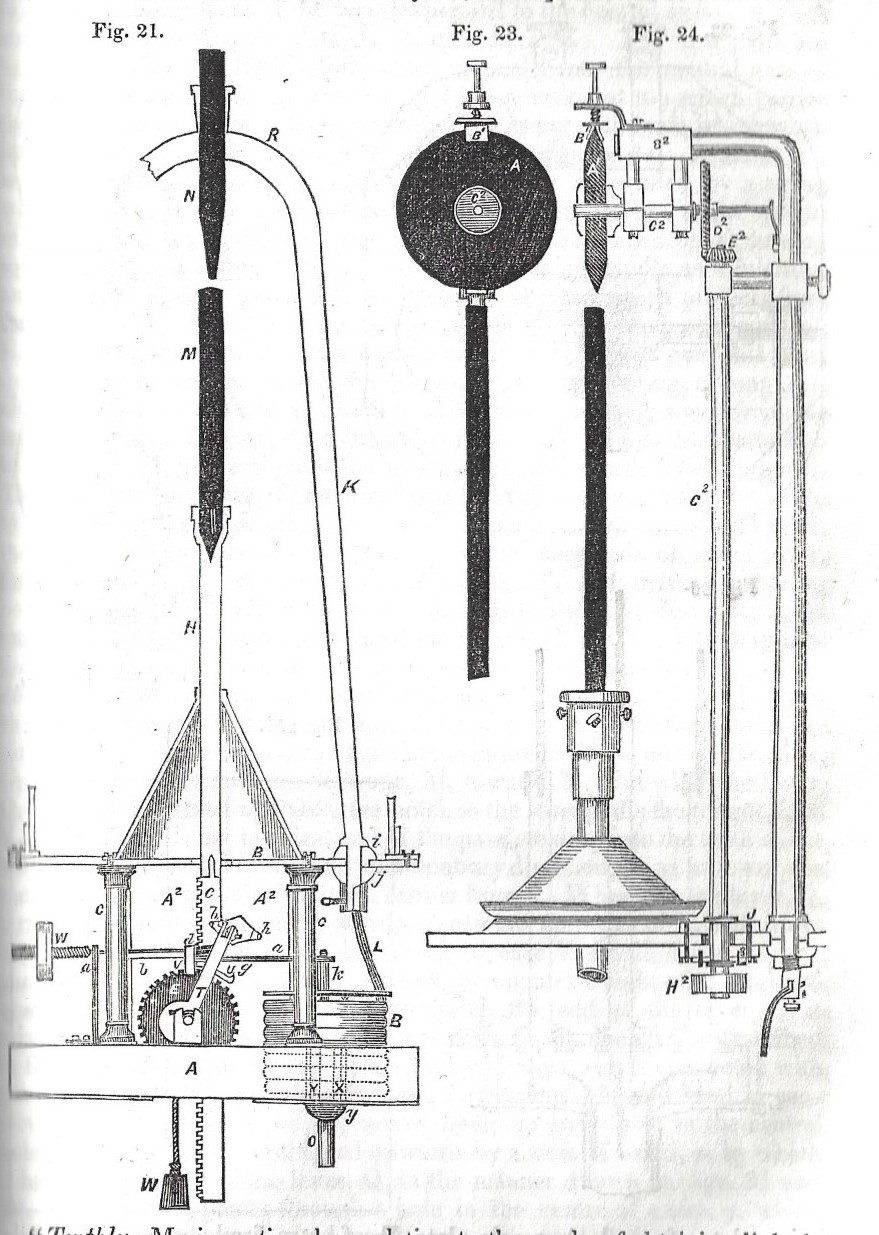
    “These machines belong to a class of electrostatic generators called influence machines, which separate electric charges through electrostatic induction, or influence, not depending on friction for their operation. Earlier machines in this class were developed by Wilhelm Holtz (1865 and 1867), August Toepler (1865), J. Robert Voss (1880), and others. The older machines are less efficient and exhibit an unpredictable tendency to switch their polarity. The Wimshurst does not have this defect.

    In a Wimshurst machine, the two insulated discs and their metal sectors rotate in opposite directions passing the crossed metal neutralizer bars and their brushes. An imbalance of charges is induced, amplified, and collected by two pairs of metal combs with points placed near the surfaces of each disk. These collectors are mounted on insulating supports and connected to the output terminals. The positive feedback increases the accumulating charges exponentially until the dielectric breakdown voltage of the air is reached and an electric spark jumps across the gap.”—Wiki

    I’ve seen that Wimshurst introduced his machine for the first time in 1883 but I cannot determine exactly when or where, though this seems Nature issue seems to be a good possibility.

    ·Posted by :

    ·in:


  • An Electric Light, 1849

    (William E. Staite), “Specification of Staite’s Patent Electric Light, [Patent dated July 13, 1847—specifications enrolled July 13, 1848.]” in the “Specification of English Patents sections, in Journal of the Franklin Institute of the State of Pennsylvania, devoted to the Mechanical Arts, Manufactures, General Science, and the Recording of American and other Patented Inventions, printed in Philadelphia at the Franklin, 1849; volume 17, third series, whole no. 47, pp 263-268, with 8 small woodcut figures of the apparatus. Offered in the volume of 498pp. Half-calf and marbled boards, raised bands, gilt dentelles. Good/VG condition, with a ghost-appearance of a spine label at bottom and rubbing along spine edges, ex-library stamps on title page, and a large (and not very attractive) bookplate. Crisp copy. $150

    JFI 1849 electric light Staite“W.E. Staite (1809-54) and W. Petrie (1821-1904) were pioneers of electric lighting who received little recognition for their work. Although a satisfactory self-regulating arc lamp was developed, commercial success was not achieved owing to their reliance on primary batteries as the only source of power. Numerous demonstrations were given throughout England, and serious interest in their system of electric lighting was shown by railway companies and dock authorities. The death of Staite in 1854 brought to an end these early attempts to use electricity for illumination.” And: “The pioneers…were finally defeated by the limitations and the expense of the primary cells which were their only source of electrical energy. —“Staite and Petrie: pioneers of electric lighting”, G. Woodward, in IEE Proceedings A – Physical Science, Measurement and Instrumentation, Volume: 136 , Issue: 6 , Nov. 1989.

    Also in this volume:

    Richad Clarke Burleigh, “Specifications…for Certain Improvements in Artificial Light”, pp 98-102;

    Robert Bunsen and Lyon Playfair, “Report on the Gases evolved from Iron Furnaces, with reference to the Theory of the Smelting of Iron”, pp 268-279, 338-344,387-393, and concluded in the next volume;

    George Buchanan, “On the Strength of Materials as Applicable to the Construction of Wrought Iron Bridges.–On the Traverse or Cross Strain”; 223-230;

    J.F.W. Herschel, “Description of a Lunar Rainbow”, p 123;

    Thomas Ewbank, “On the Paddles of Steamers…” pp 42-50, 107-114;

    and many others on railroads, bridges, steam, and so on.


    ·Posted by :

    ·in:


  • Railroads, Canals, Scientific Instruments, and Mechanical Food Production (1833)

    Richard Trevithick, “For Improvements on the Steam Engine, and its Application of Steam Power to Navigation, and to Locomotion”, in “Journal of the Franklin Institute of the State of Pennsylvania, devoted to the Mechanical Arts, Manufactures, General Science, and the Recording of American and other Patented Inventions”, edited by Thomas P. Jones, printed in Philadelphia at the Franklin, 1833; volume 16 (New Series vol 12), pp 111-112, in the volume of 438pp. Half-calf and marbled boards, raised bands, gilt dentelles. Very nice condition with a ghost-appearance of a spine label at bottom; ex-library stamps on title page. Very clean and crisp. $150

    Includes much else of interest, for example:

    A.D. Bache, “Experiments Made on the Navigation of the Chesapeake and Delaware Canal by Steam…”, pp 361-373;

    Robert Hare, “Apparatus for Transferring a liquid from a carboy, or cask, to bottles especially useful in the case of sulphuric acid…”, pp 226-228 (with two woodcuts of the instruments);

    William Scoresby, “On the Deviation of the Compass; with examples of its fatal influence in some melacholy and dreadful shipwrecks”, pp 40-43 and 121-124.

    “Undulating Rail-way” and “The Undulating Rail-way”, pp 45-52;

    Michael Faraday, “Practical Prevention of Dry Rot in Timber”, pp 346-351;

    E. Galloway, “On the Application of Steam, expansively, in Cornish Steam Engines”, pp 273-277 and 337-341;

    James Walker and A. Burges, “Report on the Sate of Blackfriars Bridge”, pp 283-286 and 342-346

    “Biscuit Making Machinery”,

    “Steam Carriages”, “Selections from (David) Brewster’s Optics”

    ·Posted by :

    ·in: