A Daily History of Holes, Dots, Lines, Science, History, Math, Physics, Art, the Unintentional Absurd, Architecture, Maps, Data Visualization, Blank and Missing Things, and so on. |1.6 million words, 7500 images, 4.9 million hits| Press & appearances in The Times, Le Figaro, Mensa, The Economist, The Guardian, Discovery News, Slate, Le Monde, Sci American Blogs, Le Pont, and many other places… 5000+ total posts since 2008.

Book Category: Technology, History of

  • Rare Chronology of Television Publication (1935)

    [TELEVISION]  Kersta, Noran E. Chronological Record and Index of Television Activities.  June, 1935.  11×8″, offset process, from the Library of Congress. 37 leaves. Brass gathers in a manila folder chipped at the corners and a bit of the spine–the contents are in fine condition, however.  Library of Congress surplus stamp on front free (onion paper) leaf. 

    • Rare.  No copies are located in WorldCat/OCLC.  $950  I cannot determine that this has seen publication beyond this seemingly low-distribution production.  

    This is a very nicely indexed chronology of television from 1920-1935, containing 878 entries which are referenced and cross-referenced in seven pages of indexes.  It is an unusual accumulation as Kersta uses nothing but the New Yrok Times as the source of the chronological development of television–although there’s a lot of technical information, using the Paper of Record gives the work an interesting insight from the public/popular point of view.  This seems to be a full and appreciative work by a present-at-the-creation person who was also an MIT Ph.D. 

    On Kersta (1911-2003), from his obituary in the Sun Sentinel: “…Chemical Engineering at Georgia Tech, a Masters in Electrical Engineering at New York University, and a PhD in Statistics at MIT. In 1932 Nick joined NBC as a clerk in the network’s mail division. In his spare moments at NBC, Nick was thinking about a new idea called television. He read all the published papers on the subject that were available. While still in high school, he had seen one of the earliest public video demonstrations in the country that was staged by AT&T’s Bell Labs. His duties with NBC had no immediate connection with television, as his job was to analyze the audience mail. At night he studied at NYU where he earned a graduate degree. He was subsequently offered a scholarship at MIT. While at MIT, he lectured on television at the university’s extension courses and joined with two other young video enthusiasts in founding the Television Research Institute. His work with the Television Research Institute prompted NBC to rehire him to develop plans for the commercial operation of television. When NBC established a separate television department in 1939, he became the assistant to the vice president in charge, and in 1941 was made manager of the department. NBC inaugurated commercial television on July 1, 1941. On that historic day, contracts of all four advertisers taking time on WNBT, NBC’s video station, bore the signature of Noran E. Kersta, who negotiated then for NBC…”
    ·Posted by :

    ·in:


  • Early Papers on the Telephone, Phonograph, and Liquefaction of Oxygen

    Ayres, Brown (Stevens Institute). “The Telephone”, June 1878, pp 378-393 in Journal of the Franklin Institute, Philadelphia, 1878; volume 75 (third series) and volume 105 overall, with text illustrations and several folding tables,  432pp.  Half-calf, with raised bands. Ex-library, with some scuffing on the spine; also a few stamps on the title page, and a library card pocket at the rear endpaper. Good/Very Good. $150

    Also in the volume:

    S.M. Plush, “Edison’s Carbon Telephone Transmitter, and the Speaking Phonograph”, April 1878, pp 266-271;

    Gustave Trouve, “Apparatus for Producing Electric Light”, Jan 1878, pp 44-47;

    Report of the Committee on Dynamo-Electric Machines”, May 1878, pp 289-303; continued as Edwin  J. Houston and Elihu Thomson, “Report of the Committee on Dynamo-Electric Machines  (continued from vol 85 pg 303). June 1878, pp 361-378.

    W.H. Greene, trans., “Liquefaction of Oxygen”, translating the famous report of Cailletet to the Academie des Sciences in December 1877.  February 1878, pp 119-129.

    “M. Cailletet’s Apparatus for Liquefying Gases” “In 1877 Louis Paul Cailletet in France and Raoul Pictet in Switzerland liquefied oxygen in the form of a mist. The liquefaction of the first of the so-called permanent gases heralded the birth of low-temperature research and is often described in the literature as having started a ‘race’ for attaining progressively lower temperatures. In fact, between 1877 and 1908, when helium, the last of the permanent gases, was liquefied, there were many priority disputes—something quite characteristic of the emergence of a new research field.”—Faidra Papenelopoulou,  “Louis Paul Cailletet: The liquefaction of oxygen and the emergence of low-temperature research”, Royal Society, 2013

    ·Posted by :

    ·in:


  • Edison’s Phonograph, 1878

    JF Ptak Science Books

    Edison’s name was not a popular item in the average American home before his invention of the phonograph.  It was actually some months later, after the initial announcement in 1877, that Edison became justifiably famous.  It is difficult today to place the amazement and astonishment that greeted the invention–there was nothing like it, before, ever–except for writing, of course, and then the recording telegraph.  It was a sensational piece of power, being able to record and save sound–and then play it back again.  It was the first time in human history that the auditory sense world could be audibly preserved.

    • Edison,  Thomas.  The Talking Phonograph.  London:  Nature,  January 3, 1878  Royal 8vo.  Original printed wrappers.  Very good condition. 

    This is a two-page report on Edison’s visit to the offices of  Nature and his very successful demonstration of his new phonograph  machine (the patent for which is applied for December 27, 1877). The editors  record their favorable impressions of the machine and describe it in some detail–there is even a small woodcut illustration of the device. In all the  article occupies pages 190-191 of the weekly issue. It is removed from a larger bound volume but does come with the uncommon front wrapper and rear ads. Uncommon.

    • Mayer,  Alfred M..  Edison’s Talking-Machine.  London:  Nature Magazine, vol 17 #441, April 11, 1878.  8vo.  Original printed wrappers.  Very good condition. 

    Alfred Marshall Mayer (1836-1897) was an American physicist and astronomer who at the time of publication was professor of physics at Stevens Institute of Technology (New Jersey), and concentrated during this part of the decade was on acoustics, and so was well-qualified to comment on the Edison invention. Mayer’s article stated that “Mr. Thomas A. Edison has recently invented an instrument which is undoubtedly the acoustic marvel of the century” and proceeded to discuss the composition of the  machine. Occupies pages 469-471 with three drawings in text–quite a long contribution by Nature standards. This seems to be the second earliest statement on the phonograph in Nature preceded only by Edison’s paper four months earlier–which seems to me to be a long period of silence on such an important invention.  Offered with the original front wrapper and five pages of ads; removed from larger bound collection. 

    Both: $450

    ·Posted by :

    ·in:


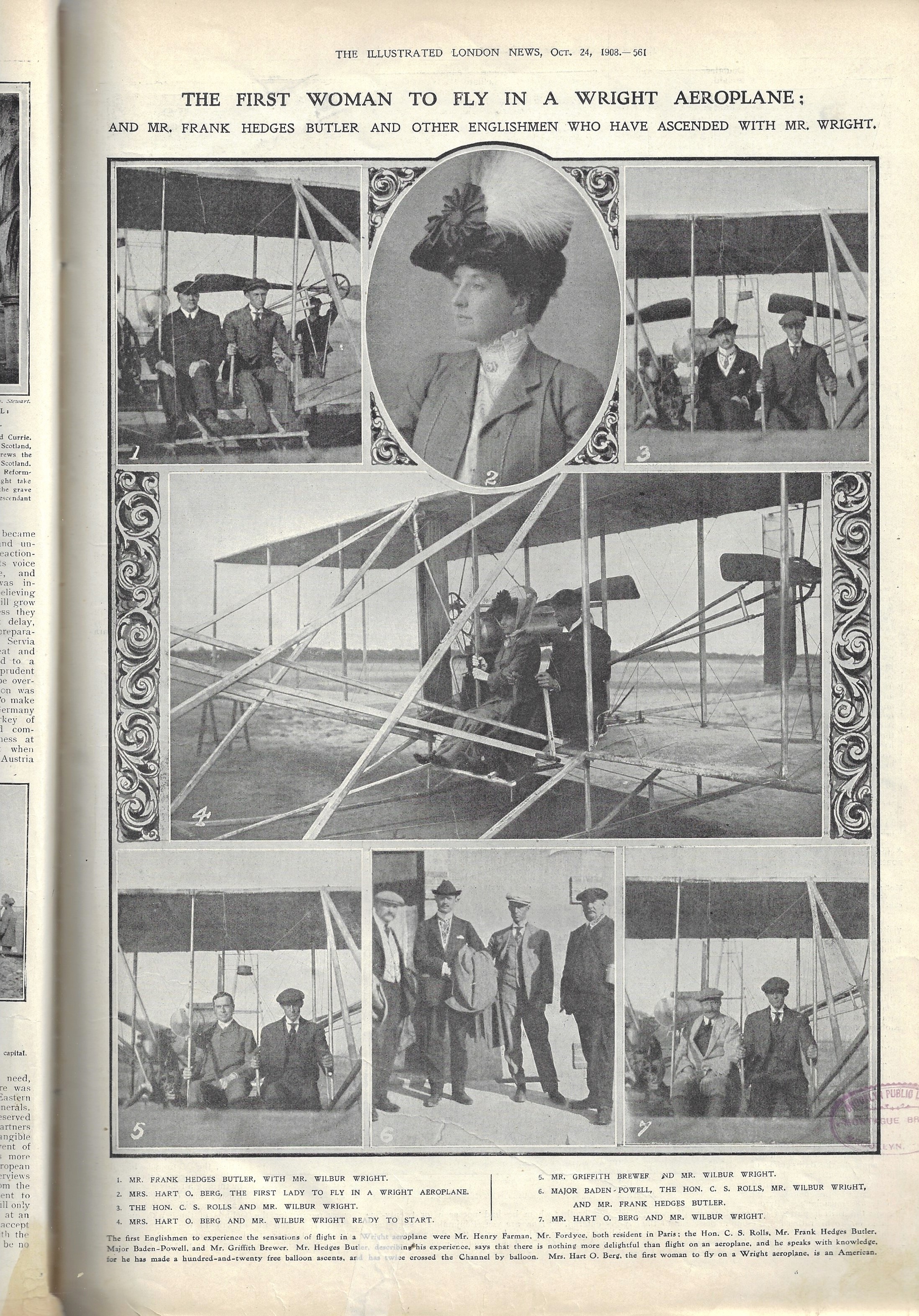
  • The First U.S. Woman to Fly as a Passenger in a Plane (1908)

    “The First Woman to Fly in a Wright Aeroplane”

    ILN 1908 wright flyer Mrs bergFull-page picture article “The First Woman to Fly in a Wright Aeroplane: and Mr Frank Hedges Butler and other Englishmen who have Ascended with Mr. Wright”, in Illustrated London News, October 24, 1908 issue (No. 3627 vol 133). The weekly issue of 30 pp printed on a heavier, semi-gloss paper, removed from a larger bound yearly volume, with the spine showing signs of the removal; also a small oval rubber stamp on page bottom right corner from previous owner. G-VG copy, otherwise.  $125

    The main subject here is Edith Berg, wife of Hart O. Berg, the European rep of the Wright’s  business interests  (and who helped Wilbur personally through his long stay on the continent). She was the first American woman to fly as a passenger in an airplane, and the first woman in Europe to fly in a Wright airplane. Lovely 6-photo full-page story on pg 561.

    “When Mrs. Hart O. Berg watched Wilbur Wright demonstrate the Wright Flyer at Le Mans, France, she was so thrilled by the performance that she asked Wilbur for a ride. Thus, in September 1908, she became the first American woman to fly as a passenger in an airplane, soaring for two minutes and seven seconds.”—National Air and Space Museum

    ·Posted by :

    ·in:


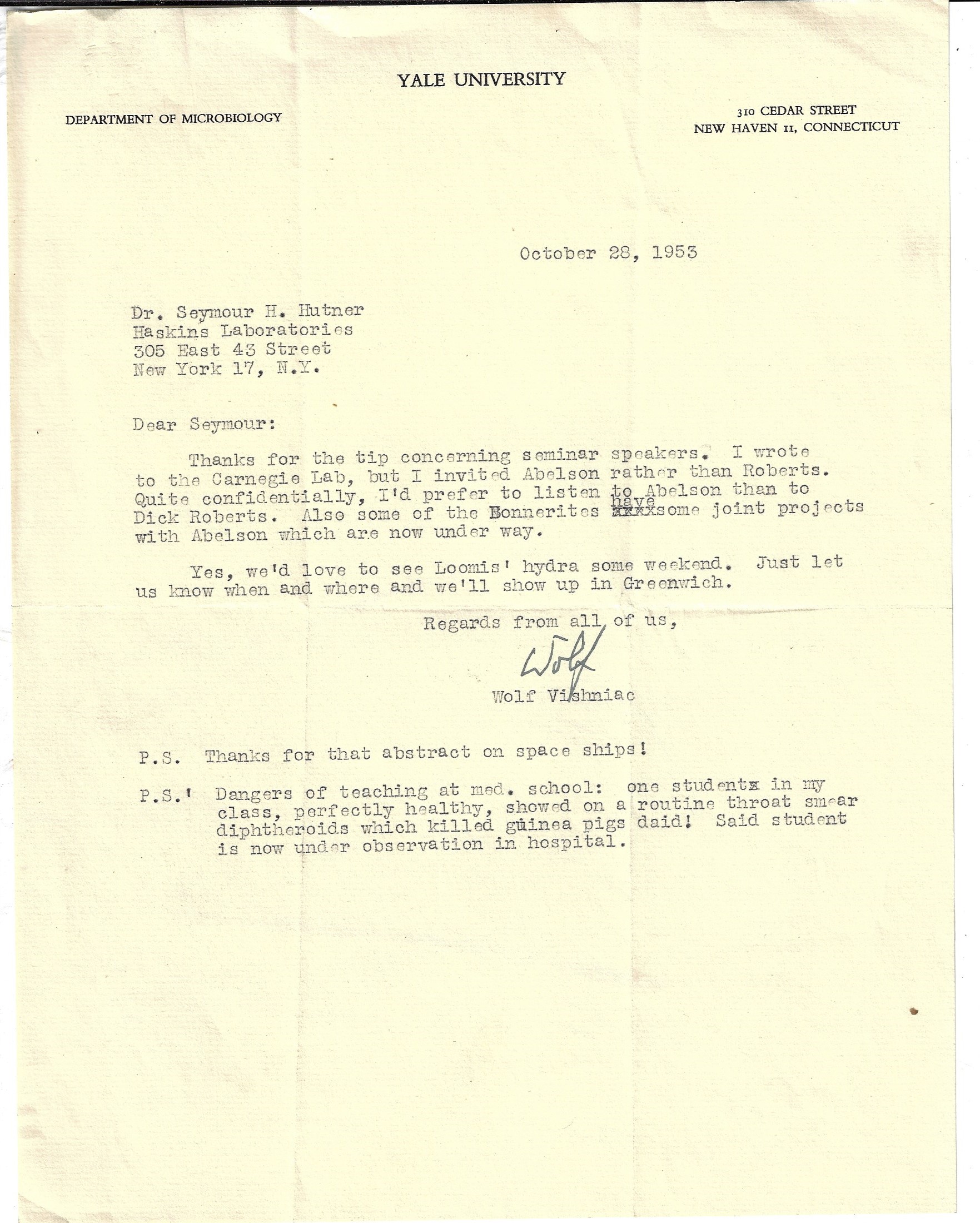
  • Typed Letter Signed by a Mars and Life-on-Mars Visionary (1953)

    VishniacWolf Vishniac. Typed letter signed, dated October 28, 1953, on Yale University stationery, department of microbiology. written to Dr. Seymour Hutner of the Haskins Labs (NYC).  $125

    “Wolf Vladimir Vishniac (April 22, 1922 December 10, 1973) was an American microbiologist, son of famed photographer Roman Vishniac [of Warsaw Ghetto photographs fame]. Educated at Brooklyn College and Stanford University, he was a professor of biology at the University of Rochester. He died on a research trip to the Antarctic attempting to retrieve equipment in a crevice. The crater Vishniac on Mars is named in his honor. Wolf Vishniac contributed greatly to the search for life on Mars by developing a special miniature laboratory that could be transported to that planet, known as the “Wolf Trap”. This research was supported by a NASA grant started in 1959, the very first ever for the biological sciences.” –Wiki

    In his obituary for Vishniac Carl Sagan remarked that the Wolf Trap was remarkable and the first of its type, being the leader of an evolutionary development of such microbiological instrumentation, particularly for the Viking landing mission (summer of 1976) on which Vishiac worked on from 1960 forward. 

    ·Posted by :

    ·in:


  • A Very Early U.S. Appearance of a Significant Instructional on the Calotype Process

    Journal of the Franklin Institute, Philadelphia, Vol 8 (third series) vol 38 overall, July-December 1844, with text illustrations. 430, 8 pp., and one folding plate. Half-calf, with raised bands. Ex-library, with some scuffing on the spine and leather cover tips nearly obscuring the gilt-stamped title. The boards are detached, though binding still tight; also a few stamps on the title page. Text is Good and crisp; binding is FAIR at best. $250

    Cundell, George S. [1798-1882, and one of four brothers who together made an impact in the early history of photography] “Extracts from an Article on the Practice of the Calotype Process of Photography”, pp 43-51 (in the July 1844 issue), an extract from his major paper in the Philosophical Magazine printed two months earlier (vol. .xxiv., No. 160. May, 1844) this being one of the processes earliest appearance in print in the U.S. (The essence of the article is very much a DYI/How-to instructional.) 

    • “George Cundell’s process was a significant step forward in making the Calotype accessible to the Amateur photographer. He was referred to as “Most Worthy Master” by the great engineer of the day James Nasmyth. And indeed his instructions were still being cited well into the 1850s. One contemporary quoted in Humphrey’s Journal in 1856 that “Amateurs date their success from the time Mr Cundell published. His comprehensive instructions were printed in the London, Edinburgh and Dublin Philosophical magazine in May 1844 “.—from the Papers, Shadows and Light website.  

    Another photographic item in the volume:

    “Robert Hunt, “Energiatype, a New Photographic Process”, 283-285, a ferrotype, and an early alternative process, (from the London Rep. Pat. Inventions).

    Also:

    “Mr. Bain’s Electric Printing Telegraph”, pp 61-65;

    H.M. Denham, “Description and Structure of the Wyre (Seward) Lighthouse…” pp 3-4 AND “Specification of the above Screw Pile Light-house…”, pg 5, with two plates accompanying the two short reports);

    And two short papers on the newly-implemented modern screw propeller:

    “Remarks on the Screw Propeller”, September 1844, pp 145-154;

    “Account of some Experiments on a Vessel called “the Liverpool Screw”, fitted with Grantham’s Engine and Woodcroft’s Screw Propeller…from the Minutes of the Proceedings of the Inst of Civil Engineers), pp 86-101.

    Plus:

    “Report on the Explosion of the Gun on Board the Steam Frigate ‘Princeton’”, pp 206-216;

    G.W. Hughes, “Extracts from a report…Relative to the Working of Copper Ore”, pp 31-43, 124-133,  194-202, 261-267 (including a section on Cornish pumps, concluded);

    Scoles, J.J. “On the Pyramids of Egypt”, pp 6-12, 81-85;

    “The Dipleidoscope” (a transit instrument);

    And last but hardly the least:

    John Leonard, “Report on the Atmospheric Railway”, pp 361-367 (from the Civil Engineers and Architects Journal), this being a stationary engine that would move rail cars in a pressurized tube).

    ·Posted by :

    ·in:


  • An Early Proto-Typewriter (1857)

    Journal of the Franklin Institute, Philadelphia, Vol 31 (third series), volume 61 (overall0, July-December 1857, 443 pp.,with text illustrations.  Half-calf, with raised bands. Ex-library, with some scuffing on the spine; also a few stamps on the title page. Nice copy. Good condition. $150.00 Includes such interesting works as:

    Report on J.H. Cooper’s Hand Printing Machine”., pp 213-215Being a hand printing press, invented by John H. Cooper of Philadelphia.  Here we have a lovely attempt at what is close to being a typewriter (a “hand-printing machine”), found in the Journal of the Franklin Institute for June 1857. The size isn’t given but my guess is that it would be about the size of foolscap paper, easily desk-top. It seems fairly simple in a slightly complex way, and I can easily see where it would serve as a stop-gap implement between what came before and the typewriter. 

    The short article introducing the workings of the machine is surprisingly, and very readable, even though it is brisk and sharp. It is just well done.

    It is difficult to see some of the annotations, even in the original, and even with a magnifying glass, but for that first indicator “H” you can find it just southward of the bell-like object (“M”, which turns out to be a handle for the paper roller), and “E” was another difficult one to find, and that one turns out to be the pivot in the center of the type circular.  In any event, the thing operates much like a typewriter, the lever “D” moved to the position of the letter needed, then pressed down, moving the type into place against the ink and the paper, which is loaded in rollers much like a modern typewriter. 

    Also:

    “Report on Gordon’s Card Printing”—a machine unique for its combination of capabilities in printing, cutting, and counting the cards it prints., pp 212-213;

    Milnor Roberts, “Practical Views on the Proposed Improvement of the Ohio River”,  a long article in parts pp 23-38, 73-85,  146-158,  217-231,  289-303,  361-372 (concluded).

    ·Posted by :

    ·in:


  • Saving the Lives of Miners Everywhere (1816)

    Davy, Sir Humphry, “On the Fire-Damp of Coal Mines, containing an Account of an Invention for Lighting the Mines, and consuming the Fire-Damp, without danger to the Miner” In: Edinburgh Review, or Critical Journal for June 1826…September 1816, Vol 26 No. Li, Edinburgh, printed by the Heirs of D Williams,1816; iv, 510pp, 8.25×5.5”. Rebound in modern cloth. Very tidy, in FINE condition. $250

    The Edinburgh Reivew was a sort of TLS and NYTBR for its day, with very long and penetrating articles reviewing books and reports on a very wide range of topics, as well as being one of the most popular journals in Great Britain for half a century.

    “On the Fire-Damp of Coal Mines, containing an Account of an Invention for Lighting the Mines, and consuming the Fire-Damp, without danger to the Miner” was published February 1816, was a review of the important discovery reported by Davy just weeks before in the Philosophical Transactions. Davy (1778-1829, knighted in 1812) already the most famous chemist in Great Britain, in 1815 attacked the subject of safety lighting in mines—this in response to ongoing problems and disasters in mine lighting igniting “fire-damp”. (“Fire-damp” or “damps”, perhaps deriving from the German “dampf” for “vapor”, correlates to a number of explosive gases found especially in bituminous coal mines, and particularly in reference to methane.)

    Following the catastrophic explosions at the Felling Colliery (May 25, 1812) in which 92 men and boys were killed there was a very general rush to concern all levels of society to find a solution to this dreadful problem. 

    The present (6pp) article appears in the Edinburgh immediately following Davy’s technical publication in the Phil Trans, for which, oddly enough, there is no reference, even though there are bits here and there in the ER that seem to me directly lifted from the PT paper.  In any event this must be about the earliest ‘popular” appearance announcing Davy’s very significant find. 

    The ER article is a fine summary of Davy’s experimental work—much deeper than I expected. It ends with a great series of compliments to Davy:

    “The result is as wonderful as it is important. An invisible and impalpable barrier made effectual against a force the most violent and irresistible in its operations—and a power that, in its tremendous effects, seemed to emulate the lightning and the earthquake—confined within a narrow space, and shut up in a net of the most slender texture—are facts which must excite a degree of wonder and astonishment, from which, neither ignorance nor wisdom can defend the beholder.”
    “When to this we add the beneficial consequences, and the saving of the lives of men, and consider that the effects are to remain as long as coal continues to be dug from the bowels of the earth, it may fairly be said, that there is hardly, in the whole compass of Art or Science, a single invention, of which one would rather wish to be the author. It is little that the highest praise, and that even the voice of national gratitude, when most strongly expressed, can add to the happiness of one who is conscious of having done such a service to his fellow men. We hope, however, that some distinguished mark of such gratitude will not be wanting, to a person, who, by disarming one of the most powerful agents of destruction, has so well merited a Civic Crown. In this, indeed, the honour of the giver is more interested than that of the receiver: The latter may not admit
    of much increase; but it nevertheless becomes those, who administer the affairs of a free People, to show themselves grateful for benefits conferred even on the humblesland most obscure of their fellow citizens.”

    Here’s the reference for Davy in the Philosophical Transactions, “On the fire-damp of coal mines, and on methods of lighting the mines so as to prevent its explosion. Read November 9, 1815. (And) An account of an invention for giving light in explosive mixtures of fire-damp in coal mines, by consuming the fire-damp.”

    ·Posted by :

    ·in:


  • Iron Lighthouses, Aluminum, Engineering and Farm Implements, Non-photographic Photographs, and more (1856)

    Journal of the Franklin Institute, Philadelphia, Vol 31 (third series), volume 61 (overall), January-June 1856, 443 pp.,with text illustrations, and three plates, including one folding.. Half-calf, with raised bands. Ex-library, with some scuffing on the spine; also a few stamps on the title page. Nice copy. $225 Contains many articles of interest, including an early report on industrialized aluminum, “nature printing”, the McCormack reaper patent case, lighthouses, the Suez Canal, and a lot more, including:

    “Aluminum, the So-Called New Metal”, pp 27-31 and “History and Properties of Aluminium”, pp 65-7. I’d like to point out that I rarely see the hyphenated word “so-called” in the JFI. That said, aluminum had been around for 100+ years at this point, and then first truly described by Wohler, though it wasn’t until the period of this vol of the JFI that aluminum was produced in such a way as to be industrially useful.

    Henry Bradbury, “On Nature Printing”, pp 37-39. This was a style of printing in which a sample was impressed on a sheet of soft lead and then electroplated and use as a printing block, the result being some very defined imagery. Bradbury perfects a style of this printing and found it very useful even in the early age of mass-produced photo images. 

    “The Canal through the Isthmus of Suez”, pp 150-155, with a lovely litho view of the canal;

    G. Herbert, “On the Construction of Buoys, Beacons, and other stationary floating bodies”, pp79-84;

    J. Vaughan Merrick, “On the History and Construction of Iron Lighthouses, with a description of Coffin’s Patches Light”, pp 145-150, with a lovely lithographic plate.

    George Simmons, “Method of Calculating Excavation and Embankment”, pp 1-4;

    Edward Allen, “Mechanical Engineering as applied to Farm Implements”, pp 41-45, 138-142 (with text illustrations), 186-190, 258-260, 334-338, 397-406 (to be concluded in the next volume)

    C.H. McCormick vs. J.H. Manny, “Law Reports of Patent Cases: the Reaper Case”, pp 176-186;

    David Stevenson, “Remarks on Floating and Fixed Lighthouses”, pp 221-227; John W. Nystrom, “Experiments on Sound for the Application of Ringing Bells”, pp 260-266; R.D. Thomson, “On the Condition of the Atmosphere during Cholera”, pp 202-204.

    Also:

    Erastus W. Smith, “United States Steam Mailer Fulton”, pp 339-340, with a beautiful folding plate of the ship.


    ·Posted by :

    ·in:


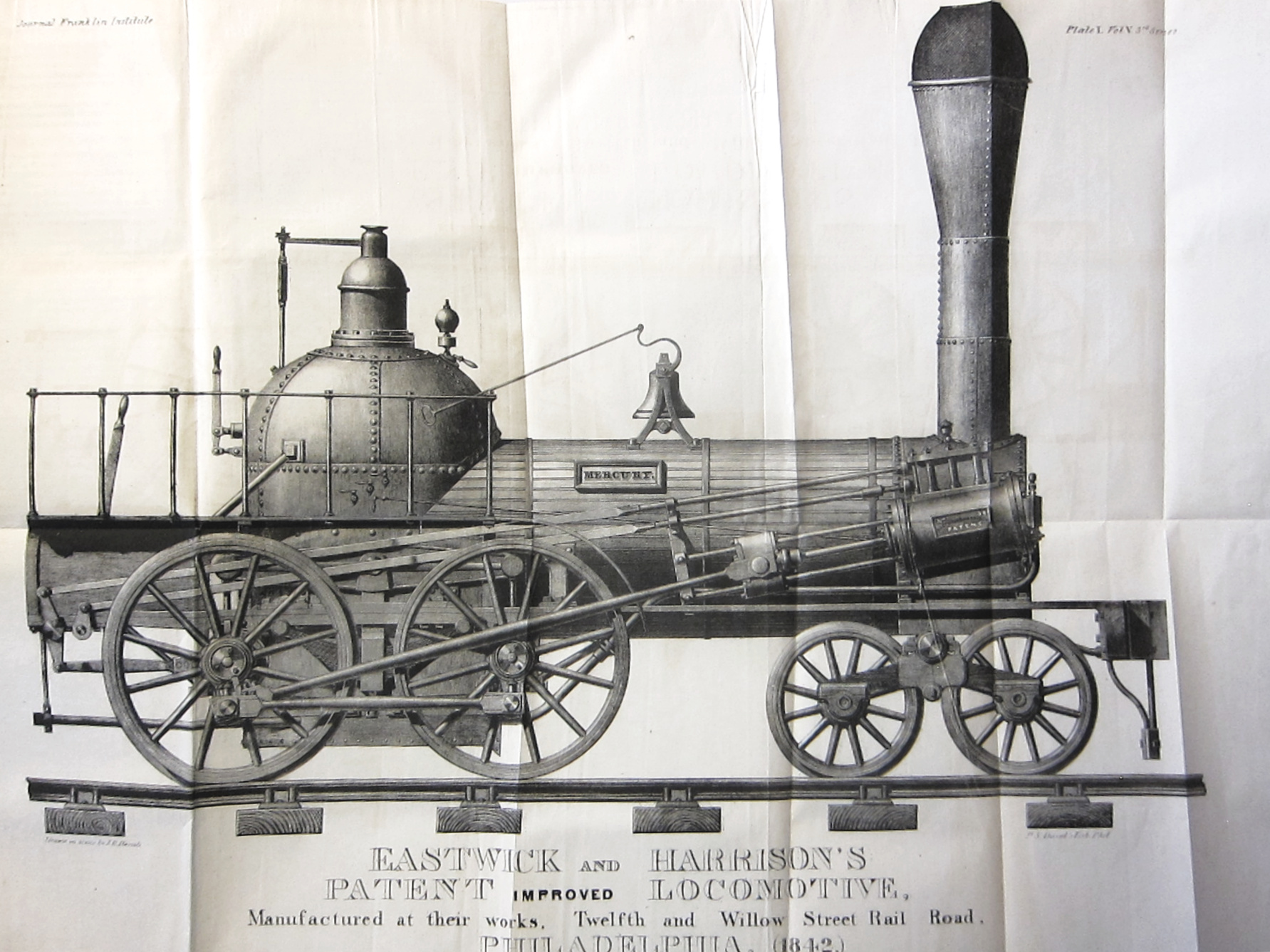
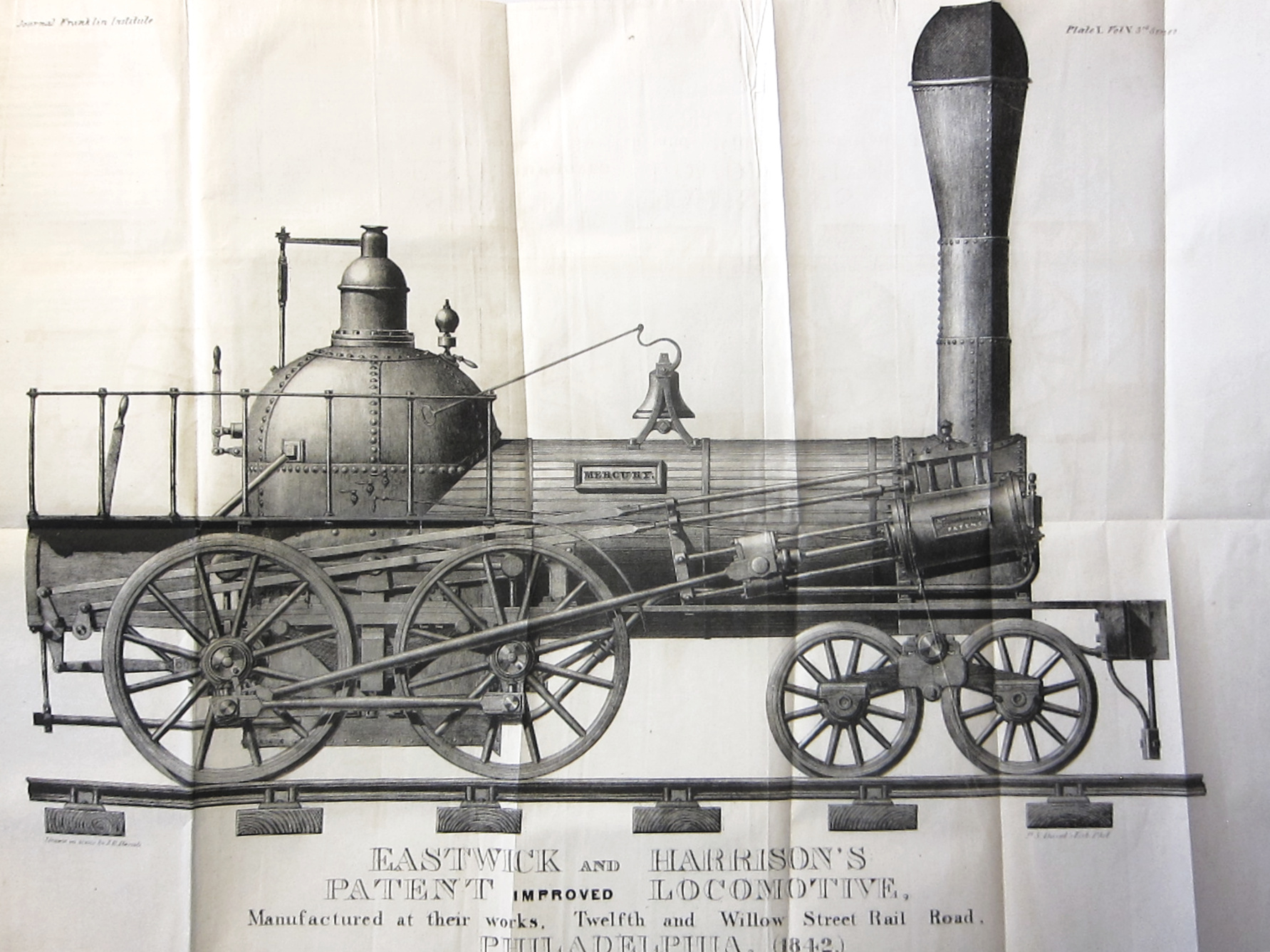
  • A Gorgeous Lithograph of a U.S. Locomotive (1843)

    Journal of the Franklin Institute, Philadelphia, Vol 5 (third series) vol 35 overall, January-June 1843, with text illustrations. 430, 8 pp., and one folding plate. Half-calf, with raised bands. Ex-library, with some scuffing on the spine and leather cover tips nearly obscuring the gilt-stamped title; front joint sprung, though binding still tight; also a few stamps on the title page. In Solid GOOD condition.

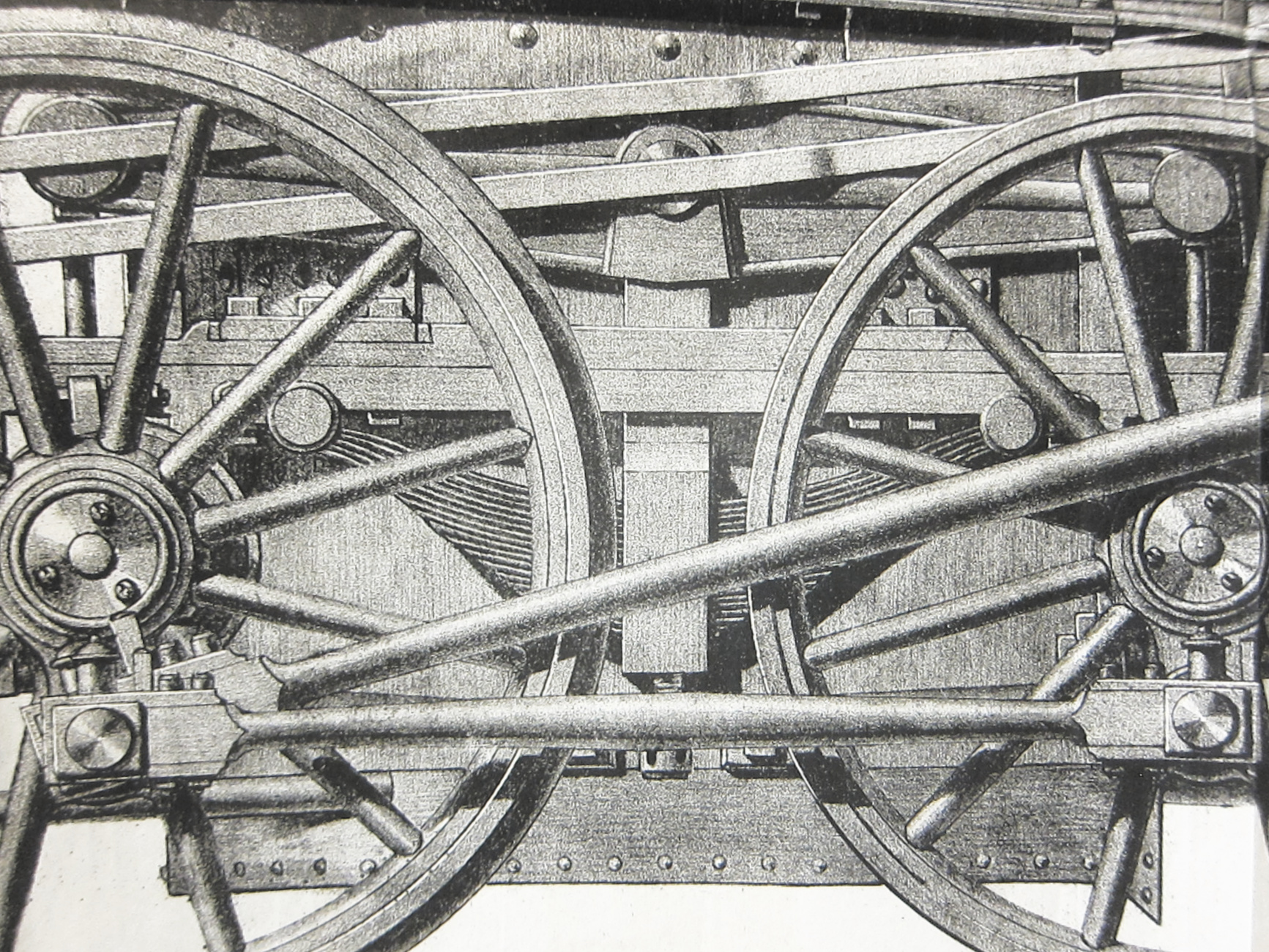
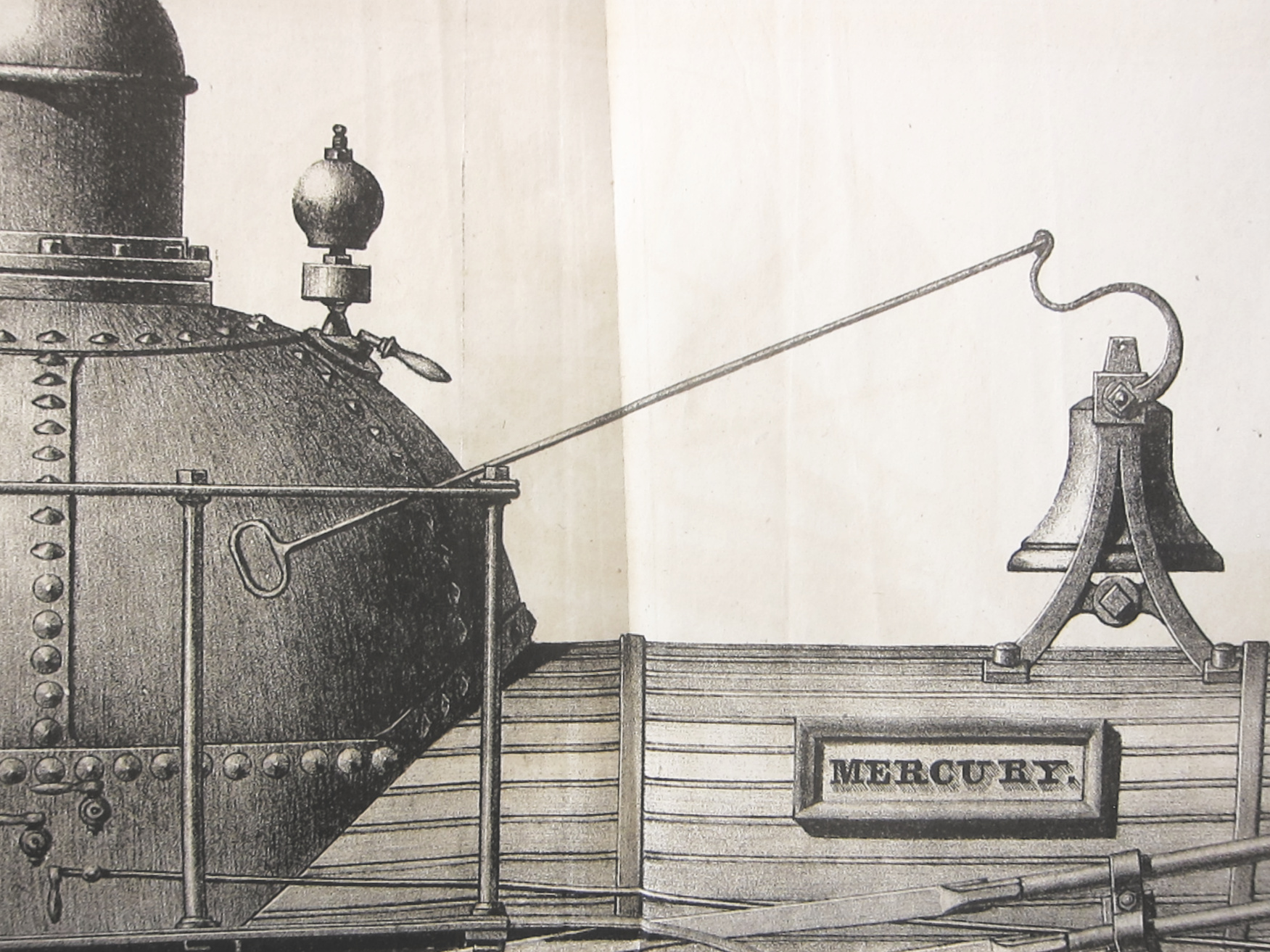
    The great attraction in this volume is the gorgeous lithograph of a steam railway locomotive illustrating “Letter from Charles Moering…to Messrs. Eastwick and Harrison, Locomotive Builders…Philadelphia”, pp 15-19. The illustration is 20”x 15” (folded), and titled “Eastwick & Harrison Patent Improved Locomotive”, lithographed by Duval of Philadelphia, drawn by J.R. Hoessli, and printed 1842. The name of the locomotive is “Mercury”. It is just a lovely things, nearly without blemish, with no tears along any folds.

    Poncelet, “Memoir upon the Stability of Revetments…” translated by John Sanders, long article pp. 1-11, 73-79, 217-225, 289-295, 361-371, and concluded in the next volume (available elsewhere via this store). Also an article on a modern steam shovel (with illustration), painting frescoes, plus articles on various railways, roofing for a diorama, concrete, batteries, astronomical clocks, preserving timber, and much else.

    The image is a little off-color in the left upper panel, though in reality there is no discoloration…I just couldn’t get the shadow problem tackled. 

    Locomotive 1843 detail _2_


    Locomotive 1843 detail _2_
    Locomotive 1843 detail _2_


    (Click to expand.)

    ·Posted by :

    ·in: