A Daily History of Holes, Dots, Lines, Science, History, Math, Physics, Art, the Unintentional Absurd, Architecture, Maps, Data Visualization, Blank and Missing Things, and so on. |1.6 million words, 7500 images, 4.9 million hits| Press & appearances in The Times, Le Figaro, Mensa, The Economist, The Guardian, Discovery News, Slate, Le Monde, Sci American Blogs, Le Pont, and many other places… 5000+ total posts since 2008.

Category: Uncategorized

  • Our Kind of Reader, Post 2; WITH: Our Kind of Donlanesque* Tea Drinker

    JF Ptak Science Books LLC

    0 ebay 13 reader270 copy
     
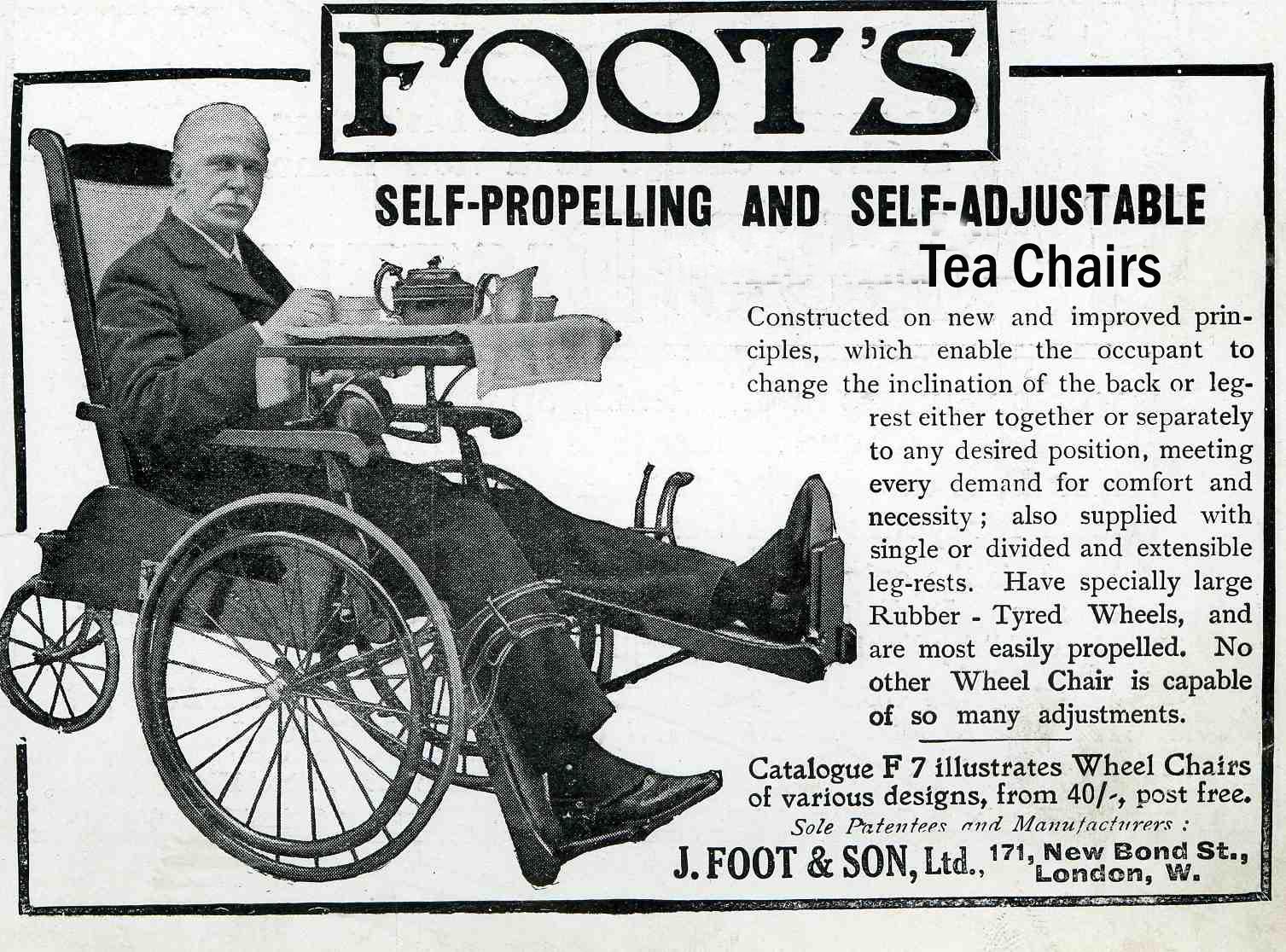
    In my Livres qui Rient collection are a number of pretty unusual book  images, including this lovely bit (from a 1910 or so issue of The Illustrated London News), the post-Victorian ultra-lux book-holder manufactured by Mr. J. Foots & Son of London.  Actually I substituted the word “book” for “foot”, not that an entire-body portable sauna named a “Foot Bath” isn’t smirky enough, and, anyway,  both have a double-“o” in the middle so they are nearly the same word, though not really).  I love that this guy is absorbing whatever that pipe (watch out!) is sending his way with a flourish in his hair, a tight and tidy smile on his face, and one free hand which snakes up and out of the hot box to steady his book and turn a non-sweattied page. 

    0 ebay 13 tea271 copy

    It seems that the Foots expanded their horizon from Sweating Books to
    their enormous, live-in Tea RV.  The only thing missing is a motor (advertised though not evident),
    but, since this fellow is English and of course a lover of tea, then as
    long as his caffeine delivery system is laid out properly in front of
    him and settled by a fine white linen, it really doesn’t matter if he
    goes anywhere at all.  Right, Jeff? 

    *(Donlanesque is an uncommon reference synonymically related to Lincolnesque.)

    ·Posted by :

    ·in:


  • A Forensic FoundWordist Poet’s House of Page Numbers


    We offer the following extract from a catalog of an obscure art gallery.  Our interest right now is drawn to Item 15 (below), on the found poetry of a man who derived that art from torn-off page numbers from books.  Enjoy!

    ___________________________________________________


    Wiltin & Wanton Gallery

    Archivist-Artists of Intellectual and Cultural Archaeology

    A Collection of Significant Materials and Artifacts in the History of Literature, Science and Intellectualiana

    The Catalogue of the Traveling Exhibit   June 2009 – January 2010

    Featuring the Following Installations


    • William Gaddis’ Martinis vs. the Slouchy Suburbanite
    • The United States in a Jar
    • The Real Pseudonym of America’s Most Famous Yellow-Backer Outlaw
    • The Sweny Chemist Door of Leopold Bloom
    • The St. Elizabeth Window of Ezra Pound
    • Virginia Woolf’s un-buoyant Friends
    • Thomas Wolfe’s Refrigerated Collectibles
    • Picasso’s Puzzle to Rimbaud
    • The Holy Pants of God
    • The Convict Letter Collection
    • Archive of the Great Shadow-Sickened and Pretended “Firsts Prioritizer”
    • Babe Ruth’s Post-Intellectual Hommage on Locating Lost Sound
    • The Stolen House
    • A Superb Broken Hanger Collection
    • The Great Shirt Diarist
    • Sigmund Freud’s Dream Book
    • Malevich’s Childhood Building Blocks
    • The End of Roundness in Van Gogh’s Eye
    • Bartleby’s Checker
    • Acoustic Museum of Childhood Sounds
    • Kurt Goedel’s Psychiatric Cheat-Sheet and the Formalization of Boredom’s Logic
    • The Transcripts of the Woman Who Spoke to People Only Once
    • Diary of the Man Who Forgot Nothing
    • Michel Foucault’s Word Engine
    • The Broken Correlation Poetry of Found-Wordist Hignatio Norme


    PAGE BREAK//Skip to pages 7-12 of the catalogue, items 14 and 15.


    Item 14.


    Warren Frieda Namaton, Shadow-Sickened Art Historian and Forger


    Obsessive Art Historian and Forger who altered Paintings to Suit his Theory and History

    On the first depictions of (a) shadows (b) stirrups © forks (d) reflected images


    Notices of  Namaton’s  (1930-1988) fame appeared in 1962 when he proved beyond a shadow of a doubt that he located the earliest depiction of a fork in western art (this in Ambo Boyz’ (Flemish, fl 1470-1520) “Mock Muscle Flag-in-Absentio”).  Namaton used a simple jeweler’s loop to discover what had already been apparent to the naked eye—that a fork was visible on the thigh of lazy gentleman in a protohammock.  This discovery fueled Namaton’s career.  In a career that rocketed through 12 suburban colleges in less than 15 years, Namaton went on to establish the vaunted “Firsts” priority in some 30 fields—a record in the art world until the recent troubles with authentication—including the recognition of the first depiction of broken spectacles,  faux agony, subtle grief, confused belief, bewilderment caused by pain and stupidity, and so on.


    His great recent work was on mirrors, reflected images, and, of course, his masterwork on the appearance of shadow and shadows. 

    Namaton’s fame fell when his estate was released from a cold-storage security locker in Alexandria,Virginia. The bulk of his notes, his collection of prints and many hundreds of small oil paintings were acquired by a resident bookseller who was struck by a bus and killed while removing the estate.  It was in the sale of the bookseller’s estate that the Namaton notes came to the attention of Quiver McQuimby, a noted but retired historian of art historians in the new mixed field of the Baroque Revitalizers of Pre-Deconstructionist Members of the Church of Jesus Christ of Latter Day Saints.  He was astonished to find many examples of famous works of art to which Namaton had playfully (?) added shadows.  (There are more than 2,322 works of shadow-adds in this category in the collection). 


    Item 15.


    Poetry from Found-Wordist and Book Pathologist Mr. Ignatio Norme


    Hignatio Norme, Found_Wordist and Page Number Collector (Boston, Mass.; 1923-1988)

    The man who found obscure phi-related connectivity between random word placement, page number and the poetic ideal.

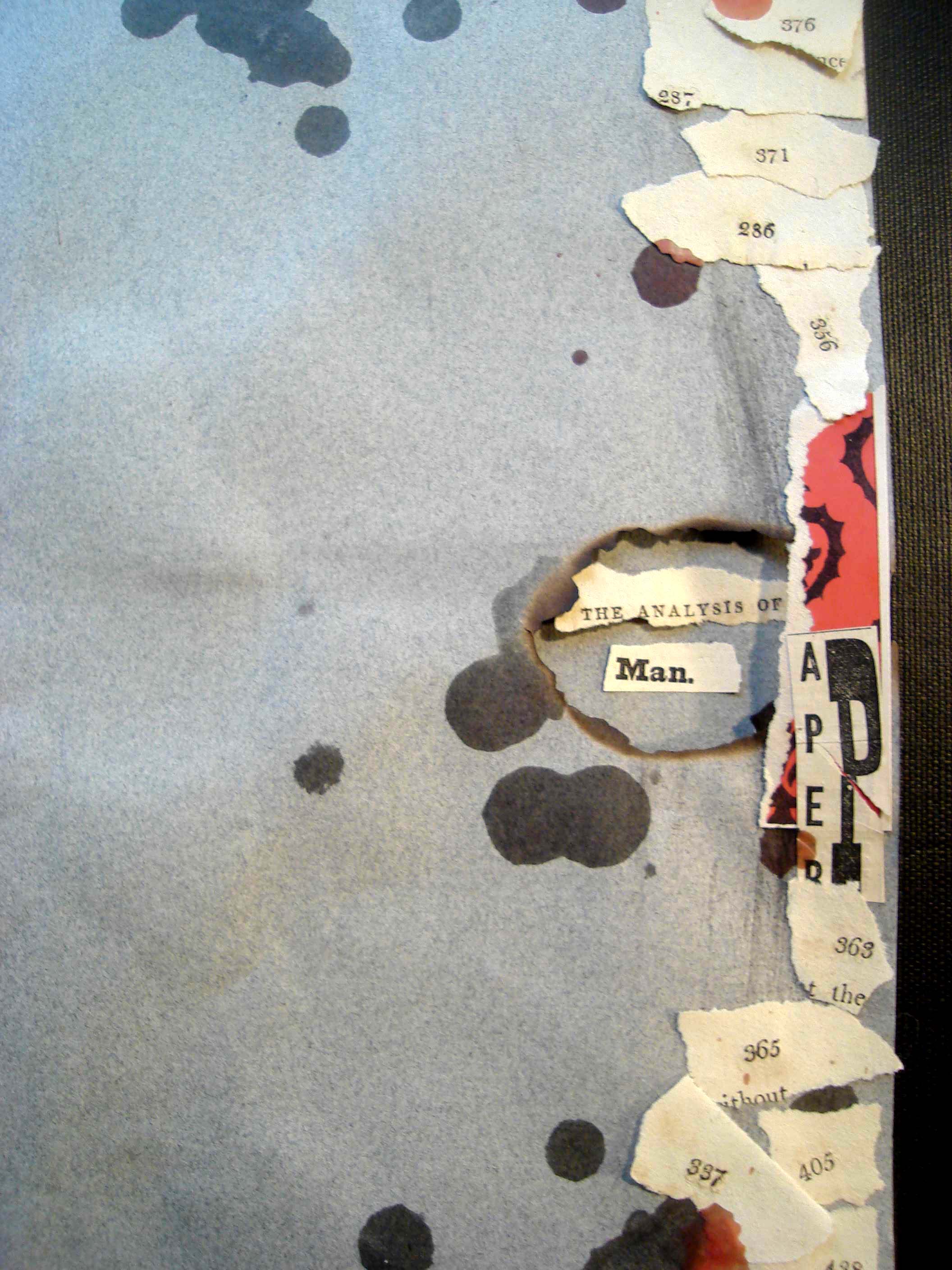
    0-blog-nov-20--norme-cvr


    Mr. Norme’s work first came to the attention of the literati in 1922 when Dallas Headman of Case Western described it as “a unique approach to creativity”; this would be the only phrase ever used to evaluate Norme’s efforts in every review from 1922 to 1975, when his work stopped being noticed.  In a spectacularly prolific career Mr. Norme produced some 8,000 poems, most of which were produced on broadside sheets of paper or large pieces of wood.  The combination of the materials of production and the many tens of  thousands of books led to Mr. Norme’s house being an internal castle, letting in neither visitor nor light, a friendly singularity for his pursuit.  As his utilities and taxes were paid decades in advance, Mr. Norme’s death, and the discovery of his corpse, was not discovered until 2005, seventeen years after his passing.


    According to his unpaginated journals, Mr. Norme’s pattern of poetic creativity and discovery involved removing all page numbers from the book he was reading and then choose a number of the “poem lugs” at random.  He would then reverse the number, go to that page of the book, and then add the page number and go to that line of the book, and tear out the number of words as indicated by the page numbers ending numeral.  The bits would then be assembled, and the page numbers glued to the walls of his house.  (We estimate that there were some 60 million page numbers glued to all surfaces of Mr. Morme’s home.  The house itself has been purchased by the
    Museum of American Art, a full room of which will be on display in that museum’s Outsider Art collection in the Henry Darger wing.)


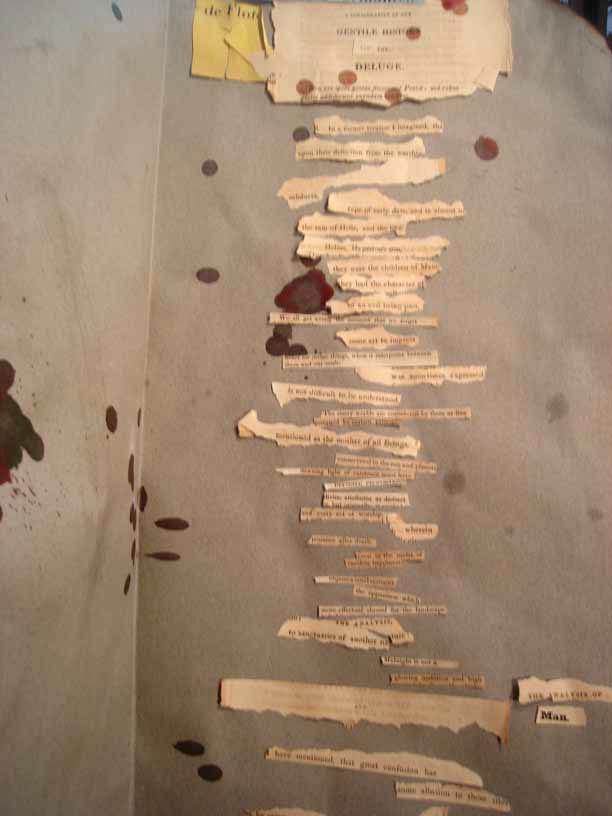
    0-blog-nov-20-norme-full-pa

    Mr. Norme found poetry everywhere he found it, seeing in the simplest verb the most compound noun; even when the poetry seemed not to find an external logical sensate, the internal phi-correlated word relations played in the mind behind all phases of knowledge, an unheard neuro-music that encapsulated the idea of unknown “correctness” in the vision of the poem.


    We are proud to offer this example, “Primo VI, the Analysis of Man//Fantasie brillantes” from 1945. 


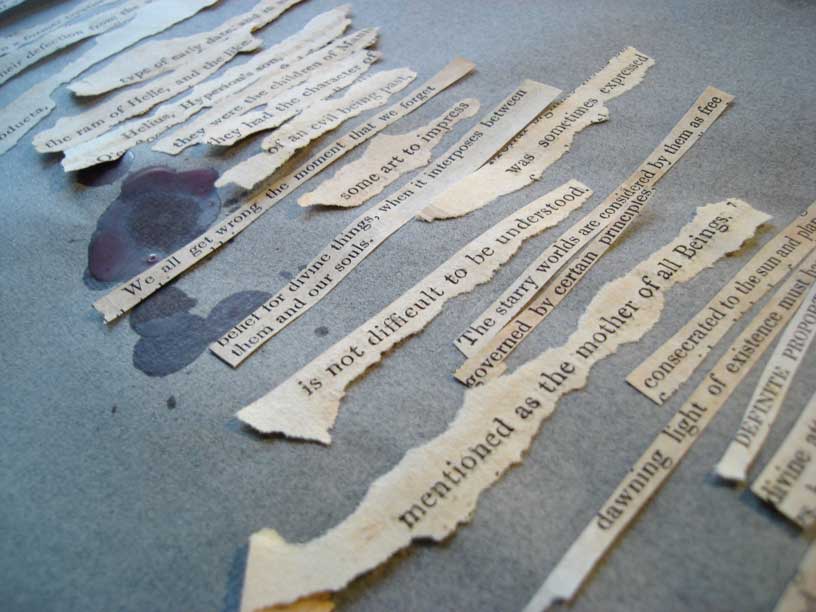
    The poem is transcribed below:


    0-blog-nov-20-norme-detail


    Primo VI, the Analysis of Man//Fantasies brillantes


    In a former treatise I imagined

     upon their reflection from worship

                                    Subducta

    be lost it might lie in oblivion.the ram of Helle, and the Life.

    *

    Helius, Hyperion’s sons

    were the children of Mania;

    they hjad the character of

    an evil being past.

    *

    We all get wrong the moments we forget

                    Some art to impress

    Belief for divine beings, when it interposes between them and our souls,

    was sometimes expressed

    and not difficult to be understood.

    *

    The story worlds are condemned by them as free

    governed by certain principles

    mentioned as the Mother of all beings

    consecrated to the sun and planets

    drawing light if existence, must have

    DEFINITE PROPORTIONS,

    *

    Divine attributes distinct

    At every act of worship

    Wherein

    Penance after death,

    Even in the midst of careless happiness

    Imposes a cruel restraint,

    The opposition which

    More effected , shroud for the landscapes;

    The analysis

    To sanctuaries of another nature.


    Midnight is not a Ambiguity,

    Glowing ambition and high.


    AND


    I have mentioned, that great confusion

    Has some allusion to those rites

    By some, were esteemed the offspring of

    Holy men.


    The analysis of a child;

    We may possibly discover their

    Means by saying

    Numberless absurdities arisen to the ruin of much good history. 


    —

    H. Norme, 1945.

    ·Posted by :

    ·in:


  • A Little Lost Piece of Apollonius and von Neumann Less an “N”: Found Stuff

    JF Ptak Science Books LLC  Post 332

     00-blog-Oct 23 apollonius910 det 2

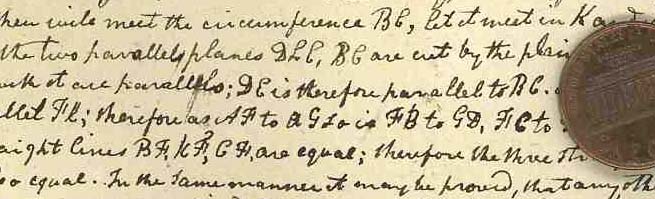
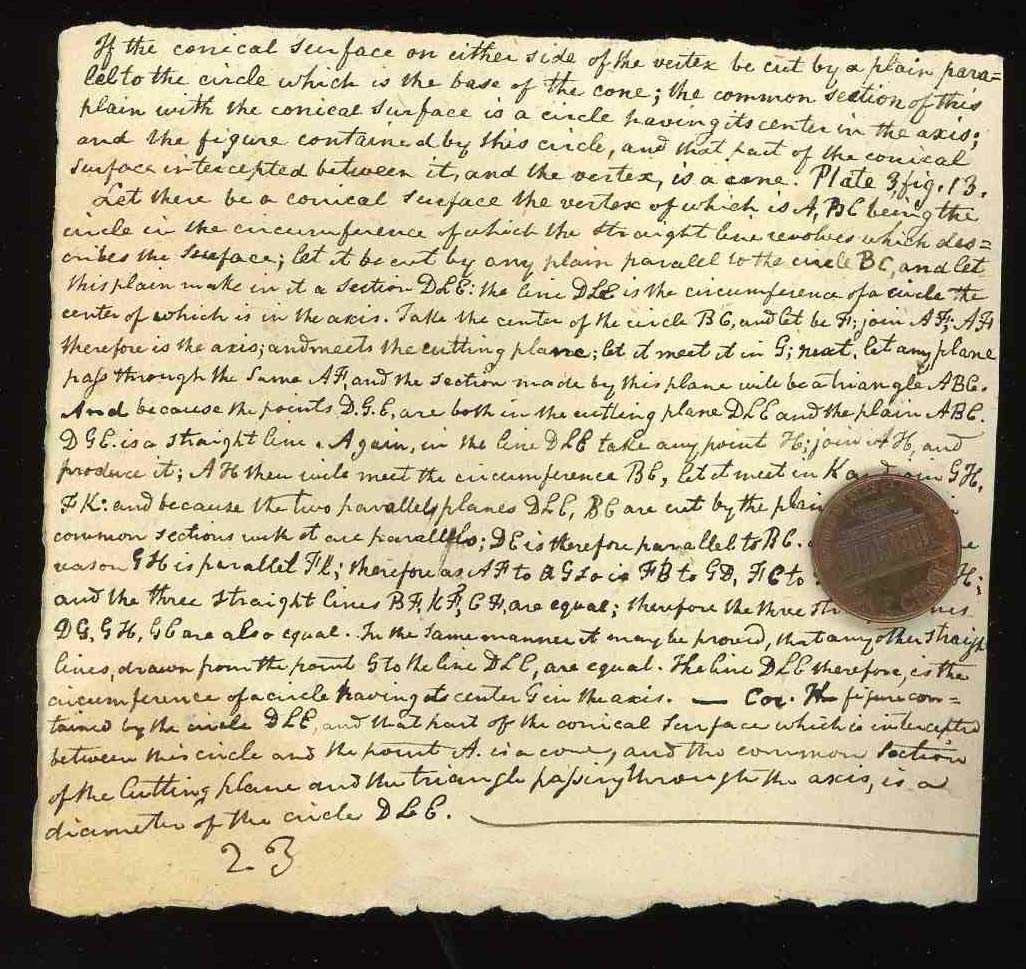
    I’ve long enjoyed paying attention to stray bits of paper, and books, and directions.  (My very first introduction to lovely lovely Ludwig (Wittgenstein) was by picking up his Tractatus from the floor of the library–I had never heard of him before that chance encounter.)  And so I’ve followed these threads for many years, pulling away at whatever was at their end–allot of times the only thing at the end of thread was the end of the thread.  On the other hand it has been a good practice and has led me far and wide.  This pursuit takes many other forms, but the finding-it-by-chance part can sometimes be exciting and extremely rewarding.

    00-blog-Oct 23 apollonius910 det
    Sometimes it is just satisfying to come to an end.  This is the case with this beautiful piece of paper which has come from god-knows-where.  Suddenly it was at the bottom of a box, and it didn’t even tug at a imitation of a lost memory as to how it got into that box in the first place.

    It is very finely written in a strong hand.  30 lines, about 500 words, all on a 4×4.5 inch piece of paper, from about 1775 I reckon.  There are plenty of hints about the origins of the text, which I suspected to be a quote; I didn’t think it was Euclid, though perhaps an early book on conic sections?  Then I looked at the “23” at the bottom and searched in google under “Proposition 23” and Euclid, and then, on only my second try, I had my answer, all in under a minute: Apollonius, the massively important 2nd century BCE geometer and astronomer and namer of the parabola and ellipse and parabola, and whose significance reaches forward 20 centuries. Now having the answer and doing something with it are two different things, and in this case there was no where else for me to go.  Sometimes just finding out what something *is* is enough. 

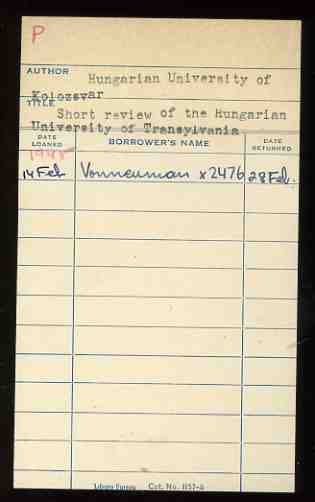
    Earlier this week I breezed through a pamphlet called A Short History of the Hungarian University of Transylvania (1943), published by the Hungarian University of Koloszvar, a thin, elegant and erudite work. It had been in the library of some offices of the old OSS (Office of Strategic Services), the forerunner to the CIA).  In the back was the borrower’s card, with a borrower’s name on it.  Generally when I find this stuff the card is almost always blank–but in this case, the little slip bore an important name:  “vonNeuman” it said.  The pamphlet was borrowed 14 Feb and returned 28 Feb, 1945.  It had von Neuman’s phone number on it too.  My initial reaction was fantastic--this was Johnny von Neumann’s name.  He defined “secret” work for the government during the war; he was Hungarian; I think he was with the OSS.  Von Neumann was probably the most fantastic mind of the century.  And here he was, in the back of this little pamphlet.
    00-blog-Oct 23 von neumann911

    And then it struck me. 
    This was von  Neuman, not von Neumann.  

    I was missing an “n”.  I wanted so badly for it to be there, but it just wasn’t going to happen.  In the small world category, I believe that this is Hans J. Neuman,  who worked at the OSS during the war and who went on to a distinguished career in computer science (and who made significant contributions to the creation of the first computer at the Moore School of Electrical Engineering at the University of Pennsylvania).  Some 20 years ago I appraised the library part of his estate.

    ·Posted by :

    ·in:


  • Advertising in 1568: Thongs, Shoes, Teeth and Urine

    JF Ptak Science Books LLC  Post 326

    00-blog-Oct 20--aman thong872
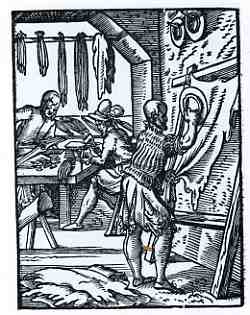
    I was much taken with the splendid woodcut illustrations by the prolific and erudite Jost Amman for one of a series of cycle books known as the Standebuch, or “Book of Trades”.  This work, printed in Nuremberg in 1568, contains 114 woodcut illustrations, and is one of at least fifty books illustrated by the (busy) artist.  Amman is particularly well known for his attention to detail  and factual portrayals–something that was not a particular characteristic of artists portraying the less-than-noble folks in the Northern high Renaissance–and especially for his attention to clothing and shoes. 

    At first what brought me to Amman for this post was listing the disappeared trades from his list of 114 different jobs–frankly, there weren’t all that many that have just completely disappeared, which i s a little surprising.  One example for this is found at left, with the thong maker–it is a little funny-sounding to today’s ears, but 450 years ago the thong was an essential piece of a man’s wardrobe.  00-blog-Oct 20--aman dentist876

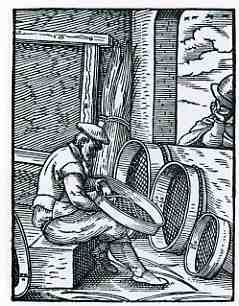
    (The most obvious basically-gone professions included typefounder, block cutter, illuminator, glass painter, coin stamper, gold leaf maker, bag maker, miller, dyer,hatter, bath house proprietor (in the old sense), barber-surgeon, thimble maker, brush and comb maker, cloth shearer, spur maker, scythe maker, nail maker, basin maker, pewterer, armorer, needle maker, crossbow maker, lantern maker (for everyday lanterns, large artistic church lanterns, dark lanterns…), mirror maker,. grinder, joiner, wagonwright, cooper, parchment maker, sievemaker, rope maker, oil maker, wire maker and thong maker. That makes about a third of the professions that are now almost entirely gone; more significant though is that two-thirds of the jobs listed in 1568 are still around.)

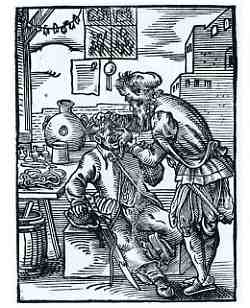
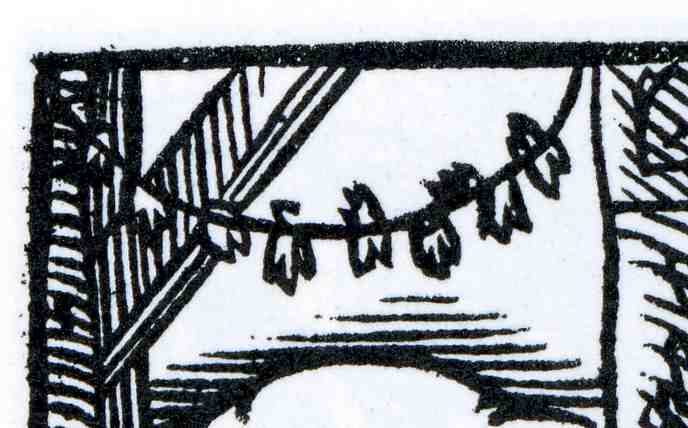
    Then I was drawn to the windows of the interior shops and the window design and glassware; and then from there I became interested in the goods that the tradesman hung in his open window as both finished product and advertising, a kind of calling card if you will.  So for example the thing maker of course had thongs hanging (like throttled chickens) in his window.   One particularly nice showing of goods was for the dentist (pictured at right)

    00-blog-Oct 20--aman dentist det877
     

    who even though he was operating  without walls hung up some teeth just to make sure that folks knew what he was doing, even though the “doing” stuff was happening right there in front of the casual passerby.

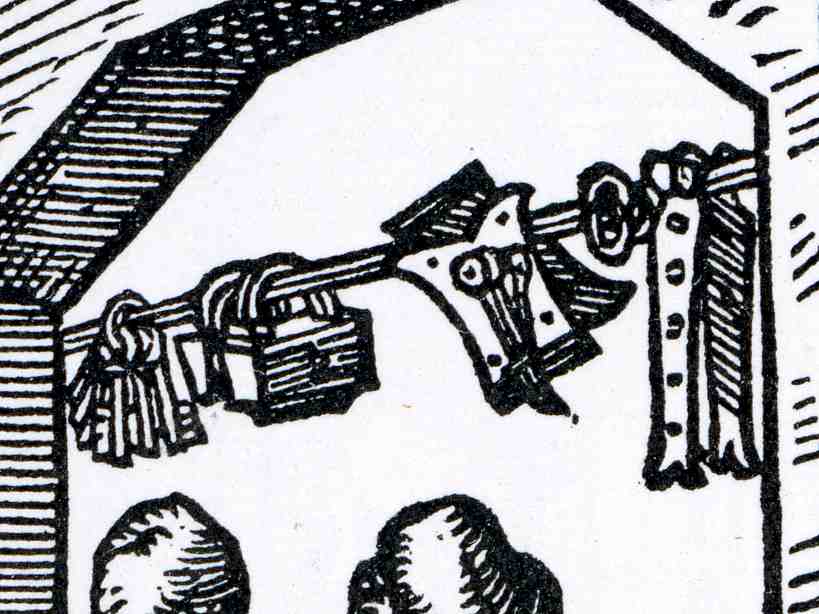
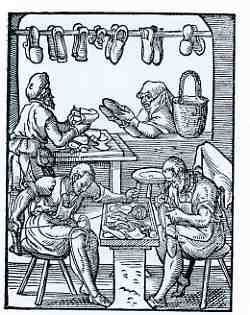
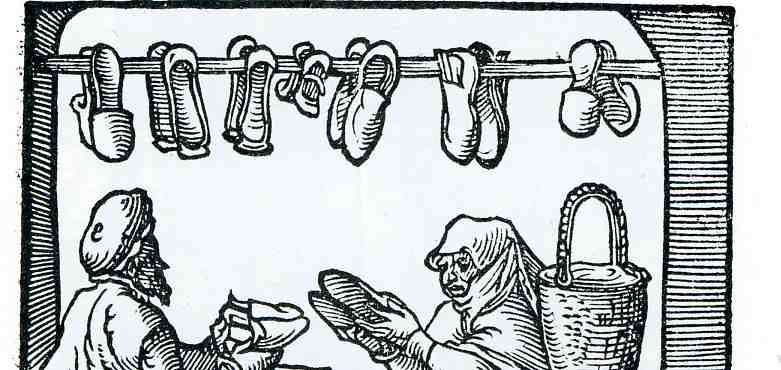
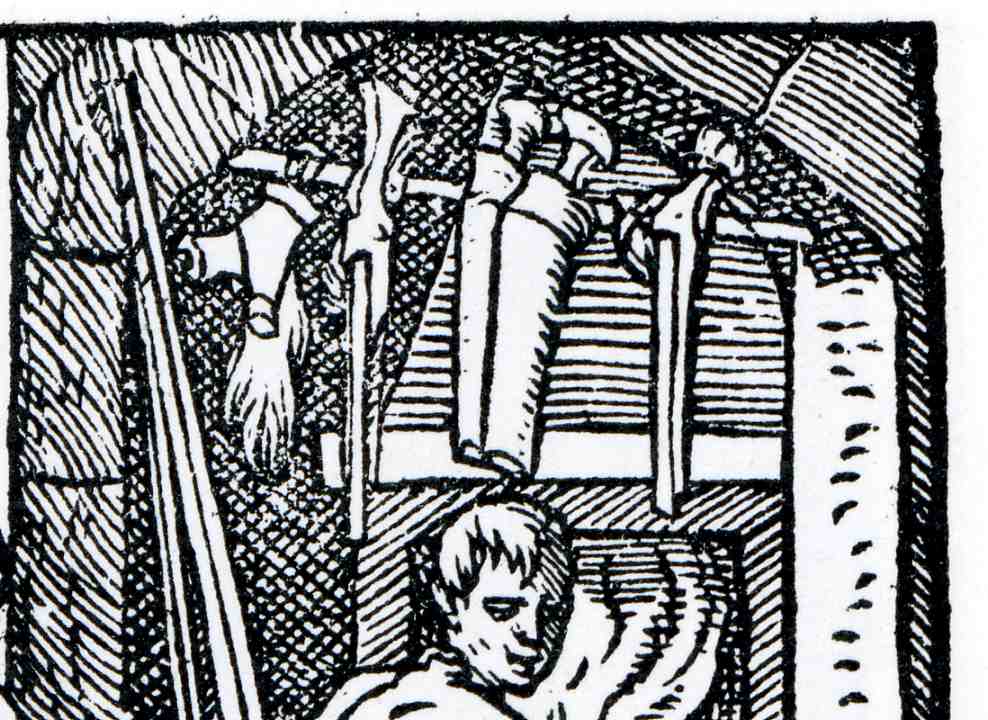
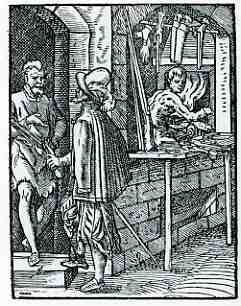
    The locksmith displayed hinges hinges and keys and locks from his rope00-blog-Oct 20--aman key det879, as did the shoe maker (fairly industrious with two helpers), who even displayed a pair of baby shoes.The image for the gunsmith is also interesting because of the detail of the front of the stall/window of the gunmaker–it has a fold-down ledge or table on retractable legs. 

                                                                                                                 00-blog-Oct 20--aman shoe873

    00-blog-Oct 20--aman shoe det874


    00-blog-Oct 20--aman gunsmith det881

    00-blog-Oct 20--aman gunsmith880

    And, well, I lied about the urine.  (Its not often you get to write a sentence like that, or, for that matter, say that you lied about it too.)
    Of the many images of physicians from this period that I have seen many do indeed show the doctor holding a flask of urine on high for inspection, but I never have seen one illustrating the flask for the doctor’s “offices”.  It was one of the principal duties of the Renaissance physician to inspect the urine of his patients, examining it for clues to ill humors and other persuasive unhealthy fortunes.

    One could put together the business section for a fair-sized Renaissance city with these images, assembling them side-by-side.  The Amman woodcuts even come with customers and layabouts–there are plenty of people who just “happen by” in these pictures, watching, passing the time of day, observing the tradesmen at work.  Much like today, these open windows beckoned o people in the streets much like a construction site calls out to old men, or an open car hood cries for its neighbors to come and take a peek.

    00-blog-Oct 20--aman basket882

    00-blog-Oct 20--aman basket883

    ·Posted by :

    ·in:


  • No Room for Eden–Annotation of John R. Cash’s “The Man Comes Around”

    JF Ptak Science Books   Post 311

    Cash_2( No Room for Eden —notes on Johnny Cash and the biblical and classical references in the text of “The Man Comes Around”, by John R. Cash (2002).

    This song was written by Mr. Cash for his American series (IV), and released in 2002.  This is a simply superb series of recordings, mostly coming from Mr. Cash’s final time.  The quality of his voice and his humanity is astonishing.

    Listen HERE (with static images).

     *** = annotation

    [Cash’s lyrics in italics.] 

    The Man Comes Around

    “And I heard, as it were, the noise of thunder:
    One of the four beasts saying: “Come and see.”
    And I saw.
    And behold, a white horse.

    ***“”And I saw when the Lamb opened one of the seals, and I heard, as it were the noise of thunder, one of the four beasts saying, Come and see.  And I saw, and behold a white horse: and he that sat on him had a bow; and a crown was given unto him: and he went forth conquering, and to conquer.”–Revelations 6:1-2 On  the opening of the First Seal (one of the four beasts) bids the Christ to come and see what was inside; the conquering figure on the white horse being Jesus, the white horse being purity of faith, etc. ***Seals referring to the 7 seals binding the great book in Revelations

    “There’s a man goin’ ’round takin’ names.
    An’ he decides who to free and who to blame.
    Everybody won’t be treated all the same.
    There’ll be a golden ladder reaching down.

    *** Jacob’s ladder is probably the most famous ladder in symbolism. Its story is found in the Old Testament [Gen 28:10-17]. Jacob, fleeing from the wrath of his brother, lay down to sleep with a stone for a pillow. During the night he dreamed that he saw a ladder or stairway reaching up into the heavens upon which were angels ascending and descending. At the head of the ladder was God the Father confirming the Patriachal blessing upon him and promising to protect him on his journey….

    St. Augustine  wrote that Jacob’s ladder represented the Church and the angels the patriarch saw ascending and descending upon it represented the evangelists or preachers of the Gospel ***


    When the man comes around.

    “The hairs on your arm will stand up.
    At the terror in each sip and in each sup.
    For you partake of that last offered cup,
    Or disappear into the potter’s ground.
    When the man comes around
    .

    ***welcome to the apocalypse, friends; drink from the everlasting or disappear into an unmaked grave in the pauper’s burying ground***

    Hear the trumpets, hear the pipers.

    ***7 seals, 7 angels given 7 trumpets rev 8:1

    One hundred million angels singin’.
    Multitudes are marching to the big kettle drum.
    Voices callin’, voices cryin’.
    Some are born an’ some are dyin’.
    It’s Alpha’s and Omega’s Kingdom come

    .***the beginning of the end, trumpets of the angels revealed in the first seal calling to the faithful or not so…***

    And the whirlwind is in the thorn tree.

    ***no whirlwinds or thorn trees in the B (thorn bushes, etc) Judgment approaches.

    The virgins are all trimming their wicks

    .***referring to trimming and caring for a torch,and later to the economy of a lamp. J refers the virgins to their chaste ways***

    The whirlwind is in the thorn tree.
    It’s hard for thee to kick against the pricks

    .***referring to kicking clods/dirt from an early sort of plow, a prick. Straight and narrow, the righteous way…

    Till Armageddon, no Shalam, no Shalom

    ***Armageddon: the geographic location given in the book of Revelation (16:16) for the climactic battle between Christ and Antichrist, with Christ’s victory ushering in his thousand-year reign on earth. Named after the hill near the town of in Megiddo,  Palestine, which due to its strategic location overlooking major military and trade routes was the site of many ancient battles.

    ***Shalam Acquaint now thyself with him, and be at peace (shalam)”; Psalms 4:8. also, to complete, or to finish. (Isaiah 33:1), and shalam Psalms; Shalom, Hebrew, peace. Perhaps Shalam was meant as “Shalaam”, which in Arabi cmeans “peace”.

    Then the father hen will call his chickens home.
    The wise men will bow down before the throne.

    And at his feet they’ll cast their golden crown

    .*** Crown The Greek word is stephanos, a garland of victory. He had worn the crown of thorns and was awarded the crown of glory j. John 19:01

    When the man comes around.

    Whoever is unjust, let him be unjust still.
    Whoever is righteous, let him be righteous still.
    Whoever is filthy, let him be filthy still
    .

    **** Rev 22:11 “He who is unjust, let him be unjust still; he who is filthy, let him be filthy still; he who is righteous, let him be righteous still; he who is holy, let him be holy still.”

    Listen to the words long written down,
    When the man comes around.

    Hear the trumpets, hear the pipers.
    One hundred million angels singin’.
    Multitudes are marchin’ to the big kettle drum.
    Voices callin’, voices cryin’.
    Some are born an’ some are dyin’.
    It’s Alpha’s and Omega’s Kingdom come.

    And the whirlwind is in the thorn tree.
    The virgins are all trimming their wicks.
    The whirlwind is in the thorn tree.
    It’s hard for thee to kick against the pricks.

    In measured hundredweight and penny pound.

    ***hundrewweight is 100lbs; 20 pennys to the ounce…all things measured large and small…

    When the man comes around.

    ****

    And I heard a voice in the midst of the four beasts,
    And I looked and behold: a pale horse.
    And his name, that sat on him, was Death.
    And Hell followed with him.

    End.

     ****  And I looked, and behold a pale horse: and his name that sat on him was Death, and Hell followed with him. And power was given unto them over the fourth part of the earth, to kill with sword, and with hunger, and with death, and with the beasts of the earth. Rev 6:8 The next two verses from revelation:    9.   And when he had opened the fifth seal, I saw under the altar the souls of them that were slain for the word of God, and for the testimony which they held:  10.   And they cried with a loud voice, saying, How long, O Lord, holy and true, dost thou not judge and avenge our blood on them that dwell on the earth?

    Revelation, the last book of the Bible’s New Testament, is the only one which is an Apocalypse, in the sense of the Greek word for “revelation.” Its author, described in the title as “John the Divine,” has traditionally been identified with St. John the Apostle, who is believed to have written the book of Revelation during his exile on the Greek island of Patmos. 

     

    ·Posted by :

    ·in:


  • Why Are Mailboxes So Ugly?

    JF Ptak Science Books  Post 288
     

    Blogtucholsky Really–how is it that such ubiquitous American objects are so ugly? Evidently the first public mailbox in the U.S. was a “street letter box” designed and patented by P.B. Downing, and African American inventor, 27 October 1891, 48 years after the first box appeared in Britain; and the design of these things has gone downhill ever since.


    I remember reading about this issue being addressed somewhere—I thought it might’ve been Walter Benjamin, buried somewhere in his weirdly beautiful Arcades Project; but, no, it was in Kurt Tucholsky’s Deutschland Deutschalnd Ueber Alles. The Tucholsky book originally appeared in 1929 (the same year the author dumped Germany for Sweden) and was illustrated by photo montage by the great John Heartfield.

    Tucholsky stated “for some unknown reason mailboxes have to be ugly. Why?” Addressing the German postal boxes he wrote “these mailboxes were designed in complete ignorance of the principle that simple things an be beautiful if their proportions are related. Because the post office mentality is limited. Because the post office has a monopoly. Because bureaucracies, in their limitless self-importance, will take a single step forward only when the technologies are miles ahead…because there is no reason in the world why the state should employ people for life. Because it is insane to breed apathy, and because the company needs interested workers, not an army of officials…any well run business moves faster. A multitude of bureaucrats is death to the taxpayer.”

    “And that’s why mailboxes are so ugly.”

    This was one of the least of Tucholsky’s biting, driven observations about his failing state. And still correct.
     

    ·Posted by :

    ·in:


  • History of the Future: Mammoth Flying Hotel Fueled by Seagram’s

    JF Ptak Science Books   Post 279

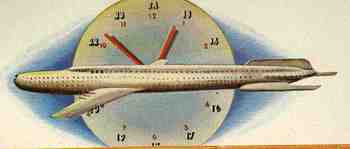
    Well, this jetliner which is actually a “flying hotel” really isn’t exactly “fueled” by six year old Seagram’s Canadian Whisky as is hinted in the advertisement, and truth be told the whisky has nothing at all to do with the plane, except for the in-kind use of the phrase “packaged luxury”.   Somehow the admen who came up with this bit for the October 1946 issue of LIFE equated the idea of flying hotels- ” steady and serene, will carry you to a ‘packaged luxury’ trip that girdles the world…”–and that “packaged luxury is another name for Seagram’s V.O.”

    It doesn’t quite compute that this modest beverage could achieve any heights, let alone make you feel as though you’ve been whisked away in a then-blistering record time to a remote vacation spot in a 800 foot long jet-sled-rocket.  Perhaps it depends on how much you drink. But I do like the plane–its twice as long as the width of its wings, very tall, and has no discernible power system, unless it has something stuffed into the stern. 

    Source:  LIFE Magazine, October 1946. 

    1ebay_sept_26_seagrams_plane_et682

    (Detail, above; full-page ad, below)

    1ebay_sept_26_seagrams_plane681


    ·Posted by :

    ·in:


  • About where the books and pamphlets I write about come from…

    JF Ptak Science Books LLC

    I’ve been asked a few times this week about the source of the materials that I write about.  The overwhelming majority of the books and pamphlets are right here, in my store or warehouse (see the above link for the science bookstore), so I see allot of this stuff everyday, currency of the realm and all that.  Most of the odd things that are found in my blog–flagpole painting, zipper repair, finding England in the Great Pyramid, building the Great Pyramid in Detroit, and so on) have come to me via the Library of Congress, where for many years I managed to purchase/trade for bits and pieces of their surplus.  One large purchase in particular from the LC–the 90,000-item “Pamphlet Collection–has provided thousands of the sublime mundane, naive surreal masterpieces that I’ve found so irresistible.  Most of this material hasn’t found a place in my store, which as you now know specializes in classics in modern physics and mathematics, but I do hope to be able to place them as a collection at some dim point in the future.  I would love to generate a few books out of them, and I think that a choice 500 of them or so would make a tremendous show somewhere (Brooklyn?) as a Found Art, Unexpected Dadaist, The Surprise of the Naive Surreal, show or some such thing, showing a marriage of design, outsider intellect and sublime mundane.   There are at the very least several thousands of these things from the Pamphlet Collection that are gorgeous and so unexpected, that are such intellectual (or non-intellectual) surprises, that they would (I think) make for a bang-up show. 

    And so that’s where these things come from.  They come to be posted by chance, generally because I bump into one of these things while looking for something else. 

    ·Posted by :

    ·in:


  • Popular Books on the History of Science–a Discussion on a Reading List

    JF Ptak Science Books LLC Post 239

    Here’s a list of books and a challenge to think about from Cocktail Party Physics by Jennifer Ouelette  It’s a good solid list of popular (save for
    the first two milestones) books in the history of science (mostly physics). Looks like I’ve read only a third of them—some
    just aren’t up my alley.

    So if any out there would like to participate, please do, and send back a
    link to your comments.

    Instructions:

    1. Highlight THE NUMBER  those you’ve read in full–comment if you’d like.
    2. Asterisk those you intend to read
    3. Add any additional popular science books you think belong on the list
    4. Link back to me (leave links or suggested additions in the comments, if you
    prefer) so I can keep track of everyone’s additions. Then we can compile it all
    into one giant “Top 100” popular science books list, with room for
    honorable mentions. (I, for one, have some quirky choices in the list below.) Voila!
    We’ll have awesome resource for general readers interested in delving into the
    fascinating world of science!

    Before I get to the CPP list, I’d like to suggest a few odd books that I quite like and don’t seem to see very often:

    A. Defining the Wind. Scott Huler.
    B.  Buried Alive, the Terrifying History of Our Most Primal Fear. Jan Bondeson.
    C.  A Social History of Madness, the World Through the Eyes of the Insane.  Roy Porter.
    D. Wanderlust, a History of Walking.  Rebecca Solnit.
    E.  The Strange Story of False Teeth. John Woodforde.
    F  Traces on the Rhodian Shore.  Clarence Glacken. 
    G.  Human Dissection, its Drama and Struggle.  A.M. Lassek
    H.  A History of Reading.
    I.  A History of Bombing.  Sven Lindqvist.
    J. The Elizabethan Zoo, a Book of Beasts Fabulous and authentic.

    There is above all the lovely work of Arthur I. Miller, who with Abraham Pais are my favorite semi-popular writers on the history of science. His works include:  Empire of the Stars: Friendship, Obsession and Betrayal in the Quest for Black Holes (Little Brown, UK edition; Houghton Mifflin, USA edition, 2005); Einstein and Picasso: Space, Time and the Beauty that Causes Havoc (Perseus Books, 2001). Nominated for the Pulitzer Prize; ***Insights of Genius: Imagery and Creativity in Science and Art (Springer-Verlag, 1996 cloth, MIT Press, 2000 paperback). Albert Einstein’s Special Theory of Relativity: Emergence (1905) and Early Interpretation (1905-1911) (Addison Wesley, 1981: new edition SpringerVerlag, 1998); ***Imagery in Scientific Thought: Creating 20th-Century Physics (Birkhäuser, 1984; MIT Press, 1986; reprinted 2003, Dover Publications) Frontiers of Physics: 1900-1911 (Birkhäuser, 1986); *Early Quantum Electrodynamics: A Source Book (Cambridge University Press, 1994) Editor, *Sixty-Two Years of Uncertainty: Historical, Philosophical and Physical Inquiries into the Foundations of Quantum Mechanics (Plenum Press, 1990)

    Lastly, before we get to Jennifer’s list, I must point out the work of archaeo-imagist Barabara Maria Stafford (U Chic) who has produced:  Symbol and Myth:
    Humbert de Superville’s Essay on Absolute signs in Art
    . Associated University Presses, 1979; Voyage into
    Substance
    : Art, Science, Nature and the Illustrated Travel Account,
    1760-1840
    .
    Cambridge, Mass: MIT Press, 1984;Body Criticism:
    Imaging the Unseen in Enlightenment Art and Medicine
    .
    Cambridge, MIT Press, 1991; Artful Science:
    Enlightenment, Entertainment and the Eclipse of Visual Education
    .
    Cambridge MIT Press, 1994; Good Looking:
    Essays on the Virtue of Images
    .
    Cambridge:
    The MIT Press, 1996; Visual Analogy:
    Consciousness as the Art of Connecting
    . Cambridge, MA: The MIT
    Press, 1999; Devices of Wonder:
    From the World in a Box to Images on a Screen
    , (coauthor:
    Frances Terpak) Catalog for an exhibition held at The Getty Research Institute
    for the History of Art and the Humanities, November 13, 2001 to February 6,
    2002. (Getty Research Institute, 2001); Echo Objects: The
    Cognitive Work of Images
    .
    Chicago,University of ChicagoPress, 2007.  They are luscious books and filled with extremely uncommon images. 

    And now the Cocktail Party Physics List.  (Thanks Jennifer!) 

    1. Micrographia, Robert Hooke [I’ve looked at the pretty pictures,
    but that’s not exactly “reading”] DITTO—the pictures were basically
    from outer space to the 17th century reader. Phenomenal.

    2. *The Origin of the Species,
    Charles Darwin
    3. Never at Rest,
    Richard
    Westfall

    4. Surely You’re Joking, Mr.
    Feynman
    , Richard Feynman. What we need is a stellar intellectual
    biography of the man… And also of Johnny
    von Neumann,m btw

    5. Tesla: Man Out of Time, Margaret Cheney—read a
    little, didn’t much like…

    6. The Devil’s Doctor, Philip Ball
    7. The Making of the Atomic Bomb,
    Richard Rhodes—Terrific accomplishment
    8. Lonely Hearts of the Cosmos, Dennis Overbye
    9. *Physics for Entertainment, Yakov Perelman
    10. 1-2-3 Infinity, George
    Gamow—Read this a long time ago, very subtle.
    11. The Elegant Universe,
    Brian
    Greene

    12. Warmth Disperses, Time Passes, Hans Christian von Bayer
    13. Alicein Quantumland, Robert Gilmore
    14. Where Does the Weirdness Go? David Lindley
    15. *A Short History of Nearly Everything, Bill Bryso
    16. A Force of Nature,
    Richard
    Rhodes

    17. Black Holes and Time
    Warps
    , Kip Thorne
    18. A Brief History of Time,
    Stephen
    Hawking

    19. Universal Foam,
    Sidney
    Perkowitz

    20. Vermeer’s Camera, Philip Steadman I kinda don’t like following this discussion on the use of the camera
    obscura by the greats. As my brilliant,
    very published wife has said, “so what?”

    21. The Code Book,
    Simon
    Singh.
    Okay book.

    22. The Elements of Murder, John Emsley
    23. *Soul Made Flesh, Carl Zimmer
    24. Time’s Arrow,
    Martin
    Amis
    Enjoyed this as the first to
    the trough.

    25. The Ten Most Beautiful Experiments, George Johnson
    26. Einstein’s Dreams, Alan Lightman
    27. *Godel, Escher, Bach,
    Douglas Hofstadter. Smarty pants.
    28. The Curious Life of
    Robert Hooke
    , Lisa Jardine Enjoyed this tremendously; maed me appreciate Sir Isaac ever more.
    29. A Matter of Degrees, Gino Segre
    30. The Physics of Star Trek, Lawrence Krauss Glad he did it; don’t wanna read it. Would be fun to teach it.
    31. E=mc<2>, David Bodanis
    32. Zero: The Biography of a Dangerous Idea, Charles Seife
    33. *Absolute Zero: The Conquest of Cold, Tom Shachtman
    34. A Madman Dreams of Turing Machines, Janna Levin
    35. Warped Passages, Lisa Randall
    36. *Apollo’s Fire, Michael Sims
    37. Flatland,
    Edward
    Abbott
    . Read it every ten years.

    38. Fermat’s Last Theorem,
    Amir Aczel
    39. Stiff, Mary Roach Wish I
    wrote it.

    40. Astroturf, M.G. Lord
    41. The Periodic Table, Primo Levi
    42. Longitude,
    Dava
    Sobel

    43. The First Three Minutes,
    Steven Weinberg
    44. The Mummy Congress, Heather Pringle
    45. The Accelerating Universe, Mario Livio
    *46. Math and the Mona Lisa, Bulent Atalay
    47. *This is Your Brain on Music, Daniel Levitin
    48. The Executioner’s Current, Richard Moran
    49. Krakatoa, Simon Winchester
    50. *Pythagorus’ Trousers, Margaret Wertheim
    51. Neuromancer,
    William
    Gibson

    *52. The Physics of Superheroes, James Kakalios
    53. Broad StreetThe Strange Case of the Pump, Sandra Hempel
    54. Another Day in the Frontal Lobe, Katrina Firlik
    55. Einstein’s Clocks and
    Poincare’s Maps
    , Peter Galison Like
    Gallison’s works allot.
    56. The Demon-Haunted World, Carl Sagan
    57. The Blind Watchmaker, Richard Dawkins
    58. The Language Instinct,
    Steven Pinker. He’s reading inAsheville in a few days
    and hope to hear him.

    59. An Instance of the
    Fingerpost
    , Iain Pears
    60. Consilience, E.O. Wilson
    61. Wonderful Life, Stephen
    J. Gould
    62. Teaching a Stone to Talk, Annie Dillard
    63. Fire in the Brain, Ronald K. Siegel
    64. The Life of a Cell, Lewis Thomas
    65. Coming of Age in the Milky Way, Timothy Ferris
    66. Storm World, Chris Mooney
    67. The Carbon Age, Eric Roston
    68. The Black Hole Wars, Leonard Susskind
    69.Copenhagen, Michael Frayn
    70. From the Earth to the
    Moon
    , Jules Verne
    71. Gut Symmetries, Jeanette Winterson
    72. Chaos, James Gleick
    73. *Innumeracy, John Allen Paulos
    74. The Physics of NASCAR, Diandra Leslie-Pelecky
    75. Subtle is the Lord,
    Abraham Pais. One of my favorite “popular” books on Einstein’s intellectual history. Inward Bound is another terrific work by Pais
    on modern phys
    . Also his Einstein Lived Here is excellent.

    Just for the record–for me–the best biography of a Manhattan Project member is Kai Bird’s Oppenheimer. 

    ·Posted by :

    ·in:


  • The Polish “Threat” to Germany, 1939: Nazi Propaganda on the Perceived Polish “Invasion”

    JF Ptak Science Books  Post 230

    Blogsept_1_poland476

    In memory of the German attack upon Poland on 1 September 1939 I’d like to share this stupendously-titled pamphlet. This is one of those times when a pamphlet has posed an idea that had never before occurred to me. This anonymous work produced by the German propaganda machine in May 1939 presents the incredible assertion that Poland did indeed have plans to continue to break the back of Germany over the pretty-much-forgotten Treaty of Versailles, and to also physically attack south-eastern Germany sometime in 1940.

    Again, the idea that Germany was defending itself against an imminent attack by Poland was completely novel to me.  There’s always a reason for these sorts of beginnings of wars (Gulf of Tonkin, WMD), but this one really is exceptionally removed.  Poland had just decided to defend its borders against the Germans following their conquest of Czechoslovakia the previous year–until then the Polish military’s biggest threat was the Soviet Union.  The German attack, the blitzkrieg (Fall Weiss) which would begin on 1 September 1939 involved 1.5 million German soldiers attacking two principal points in Poland. It was ostensibly launched in response to a suppoed “Polish” attack on the German border town of Gliwce–an attack orchestrated and simulated by Germany.   In the attack, the Germans unleashed 11 tank divisions versus Poland’s 1; sent in 1250 bombers and fighters to Poland’s (mainly obsolete) 360; rolled 4 motorized divisions against Poland’s, um, hat’s right, they didn’t have any.  And of course the Germans had a modern and vastly superior navy, compared with Poland’s 4 destroyers, five subs, and assorted smaller numbers of smaller and less-significant vessels. 

    The British and the French issued an ultimatum to Germany to cease and desist; Hitler had no intentions in stopping, throwing the five armies of von Rundstedt and von Block deeper into the country in a fast and (according to many German generals) breakneck manner.  The British and French declared war on the 3rd, by which time the war in eastern Poland was already almost over.  The Germans did respond to the ultimatum (see this in continued reading, below) in which it outlines some of their needs and Polish-inspired dears. 

    By 24 September the Germans had reached the formerly important geographic boundary of the Vistula and swarmed past.  Warsaw was bombed by some 1150 aircraft, and by the 27th, the fighting was almost entirely over. (Some divisions held out to 6 October, the invasion completed in 36 days). 

    It is sometimes forgotten in the quickness of this defeat that Poland inflicted some heavy losses on the German military machine:  8000 soldiers killed with 27,000 wounded and 5,000 MIA; 217 tanks were destroyed.  The Luftwaffe lost over 500 planes, either entirely destroyed or damaged to the point of uselessness.  Polish losses were greater.

    It was at this time that the first of my grandmother’s brothers, Raymond Dymek of Pittsfield, Massachusetts, would cross the border into Canada and volunteer, becoming a pilot in the Royal Canadian Air Force.  He would fly against the Nazis with the CRAF, then joined the RAF, until finally, when the U.S. joined the  European war 27 months later, would fly for the U.S. Army Air Force.  He had a very long career and made it through.  His five brothers would also enlist in the U.S. armed forces; all six brothers would return home. Fatherland and all that.   I know the vocabuarly for their response to the idea that Germany was responding to a Polish threat of invasion didn’t exist to them–it barely does for me. 

    ·Posted by :

    ·in: