A Daily History of Holes, Dots, Lines, Science, History, Math, Physics, Art, the Unintentional Absurd, Architecture, Maps, Data Visualization, Blank and Missing Things, and so on. |1.6 million words, 7500 images, 4.9 million hits| Press & appearances in The Times, Le Figaro, Mensa, The Economist, The Guardian, Discovery News, Slate, Le Monde, Sci American Blogs, Le Pont, and many other places… 5000+ total posts since 2008.
I’ve made a number of posts here about images-within-images, art found inside art, the increasing discovery as you look more and more closely at a complex scene. . Generally they deal with the inconsequential, ephemeral depictions of people in architectural engravings; tonight it is straight-out people panoramas with an exercise in zooming in to smaller sections of a large mass, and finding new less-vast subsets and their unexpected detail.
This enormous neon sign is the identifier chosen for our locally-owned chain supermarket here in Asheville, North Carolina. It signifies that the people who own the store are American; it certainly has nothing to say about the supposed American distribution of the money spent in that chain, or how much of it replaces money sent out (along the wholesale food chain) for all of the products sold in the store that come from not-the-U.S.A.
There’s nothing necessarily wrong with non-American products being sold in boldly-proclaimed “American Owned” store, the owners proud that the people giving them their money in this mountain town 450 miles from the ocean are giving it to a Native Son. The fact that this store is selling all manner of goods from all of the world seems to skirt the patriotic pronouncement of its pediment. Is it really necessary that they sell six brands of apple juice, four of which are manufactured with apples brought in god-knows-how from China? (Mott’s is one of these very national brands using Chinese apples–the country of origin is stamped in small blue letters near the mouth of the bottle.) Ditto for orange juice–there are more brands, but the percentages of national/international seem to be about the same. Even outside of fruits and veggies, it is very remarkable to me how many of the non-specialty products that line our supermarket shelves come are manufactured overseas, eating up shelf space for home-grown/produced/manufactured American products.
This little screed could go on and on–I really just wanted to visit the issue of apple juice–especially since we’re in the heart of apple country, and the distribution of these juices stays the same even when our apples are in season. It seems entirely wrong and suspect that by some great unknown mechanism it is cheaper to send a ship filled with apple-squeezings half-way around the world, only to bottle it with sugar and water and other stuff, and sell it cheaper than the juice grown/produced/packaged just 15 miles away. Somewhere along the food chain in this apple example must be a very weak link, which I guess must be the Chinese farmers and laborers, who must make–literally–nothing.
This store also used to sell American flags made in China–but they went away.
I am reminded that Wal-Mart originally distinguished itself as a “Buy American” store all those years ago, but that sentiment has long since passed into a dirt-filled bone-hole out there in red Arkansas clay, waiting for the time when it never existed.
“American Owned” does not make an American-goods-sold-here store, not by any means.
A friend of mine owns a clothing store with upper-end, better-made lines of outdoor wear. He has seen many of his top suppliers of American made goods take their business offshore. There is an appreciable difference in quality, and no difference in price–there is of course a greater profit to the owners who are banking on and exploiting the corporate brand. My friend won’t carry these goods anymore, for many reasons, not the least of which is the salty quality. He has gone so far as to include a large (tastefully designed) sign announcing “Not one thing here made in China”. Customers love the sentiment, and then most chase after wherever the cheaper-made Chinese variants made off to. Some things just aren’t right.
Repost of an earlier post here on the immortal The Cat in the Hat in honor of Dr. Suess’ birthday, today. (Full entry here).
I was reminded in my Asheville neighbor Marty Weil’s wonderful blog on all things ephemera of the importance and long-term significance
of Dr. Seuss
(Theodor Seuss Geisel, 1904-1991, and son and grandson of
brewmasters). I think that it is impossible to calculate the overall
impact of Seuss’ bringing young people to the joy of reading, and,
actually, to the familiarization of kids with the bare mechanics of
reading. Of course he told a great story, but his books were literally
page-tuners—they were simply written with words useful to children,
with few words per page, thereby allowing the child to see the
pictures, read all of the words, and turn the page, giving them a sense
of accomplishment along with enjoying a fine story. Perhaps it is
the getting-the-kids-used –to-reading that was his most fantastic
accomplishment—and something that few others have achieved, measuring
by just pure numbers.
And the way in which he did this was to artistically use an
extremely limited budget of words—Dr. Seuss used precisely 236
different words to write The Cat in the Hat…
Seeing the expanding number of sales catalogs arriving in the mail for the holiday season put me in the mind for this post.
In the Areopagitica John Milton reaches into the heavens to condemn the destroyer of all books, finding them soulless monsters who would destroy Reason itself. Well, there are monsters like this that may be demons, and monsters that may be anointed avengers, tunneling Milton or not.
Books have been destroyed for as long as they have been made, for reasons as varied as those for their writing: the motivations for biblio-devastation are ever-reaching. Perhaps the most astounding and appalling of them all resides in the fetid memory and fouled grave of the Chinese emperor Shi Huang Ti (third century BCE), who in his 49 years of life liquidated nearly every book in China, psychotically determined to make himself the most-remembered person in history by eliminating history itself. Not to be outdone by books, he eliminated authors as well. And scholars.
Authors not only have been killed for their works, some have followed them directly into the flames. Michael Servetus, who has a complicated history and who was found wanting in his relationship with church orthodoxy on many levels, met his end on a pyre with his books. One of those books, a medical text, challenged the (religious) orthodoxy of the brain being the seat of all power and wisdom of the body, stating that it was the heart that pumped the blood and not the head, providing another chink in the armor of theological doctrine. Pissed as the reigning Christians were with this belief, this book probably was not the thing that most annoyed them, but it also didn’t help his case, either. But no matter, he and his books were burned together to ashes for reasonable and logical thought.
But getting back to our Postman’s Dream: Ulysses, The Grapes of Wrath, Lettres d’un Provincial, Leaves of Grass, Analects of Confucius are all burned books, and books burned in massive, orchestrated displays, and all of which share the same incendiary thread with the postman’s nightmare, the Sears & Roebuck Catalog. It was the other wrist-bending catalogs too that wound up in various burning piles in America in the early 20th century, though they didn’t find their ways there like other burned and banned books–this wasn’t personal, just business. As it turns out local business throughout the country felt threatened by mail order businesses, and that these remotely-located companies were reaching into the local community and extracting the money that should’ve been going to local concerns. And so to fight this economic invasion there were town-wide book burnings of whichever of these extra-local catalogs could be found. These first mass book burnings in America was a completely unsatisfactory response to their threat, as townsfolk quickly voted with their pocketbooks, whether their shirtsleeves were burned in the catalog fires or not, the smokey burden of free enterprise. It was the least wise way of fighting this new wave of competition, obviously, but the idea held enough firey charm to have made itself felt in the pages of history. It was also just another short step in the continuing buy-local hardship that has been fought in this country since the Concord pin-maker was threatened by the larger pin-making factory in Boston in the 18th century.
And so far as the postman goes, burning the catalogs wouldn’t have helped them, either–they just would have had to deliver a replacement copy, adding to their work load, burdened further in the Christmas crush.
On Zero: “…a fine and wonderful refuge of the divine spirit – almost an amphibian between being and non-being. ” — Gottfried Leibniz
Zeros come in all shapes and sizes, at all places in the dictionary, formulary and levels of mind. The zero can denote the finite, infinite and the transfinite, as simple beginnings and endings. In set theory zero is the least cardinal number, in propositional logic it denotes falsity, in abstract algebra it is a neutral element. It has a funny place in describing temperature: in Kelvin it is really the end of cold, while in Celsius it sort of means the end though there are negative numbers below it—in Fahrenheit it is just another plain number, not really marking anything particular at all in the scheme of temperatures. It is the name of a plane, comic book character, fictional folks in books (one of my favorites being the appropriately-named “Zero” in the book Holes) or a Smashing Pumpkins song. In digital speak, it can simply be “off”. Zero is ancient and has different birthplaces, and has a long, varied and complex history.
We’ll leave differentiating “zeros” and “holes” and “nothing”—a problem that I’m already having in my thus far Zeronaughtless series of posts on “The History of Nothing” and “The History of Holes”—for another day.
Today for the first post in this series I’m interested in the Zero on a door—or, rather, the zero for a room if it had a door right on it, which it doesn’t, or didn’t. (And not the door behind which the Room Zero serial killer hid out.) The door to Room Zero is 875 away from its identifying point, and the door—-doors, actually—-can withstand 10,000 pounds of pressure per inch. The doors closing off the way to Room Zero are massively massive affairs, and can be explosively closed in .03 seconds.
Those are some doors.
But Room Zero is no ordinary room. It belongs to an idea that also carries a very weighty agony/ecstasy association. The “agony” part is the Room, which is where a nuclear warhead is exploded. The ecstasy part is the name of this particular explosion, one of 985 of such explosion documented in the Nuclear Weapons Archive in the Nevada desert. In this explosion Room Zero belonged to a test called “Misty Rain”.
The 875’ long tapered pipe—which was just a few inches in diameter at the explosion point, gradually becoming 10’ at the end—was fabricated into a thousand-foot long tunnel dug into the side of Rainier Mesa in Area 12 of the Nevada Test Site. It was basically a collection/direction device against which military communications/weapons/etc components were tested for the effects of radiation generated by the weapon exploded in Room Zero (which was also referred to as the “point room”, pinpointed at 37.120299 116.122583).
Reading about Room Zero and its tunnel and muffler and doors and shockwave and etc., I cam across something that braked my attention and rolled right into my imagination—on page 43 of The Containment of Underground Nuclear Explosions we read: “After the experiment [detonation], parts of the bypass drift will be reexcavated to permit access to the tunnel system to recover the pipe and experimental equipment.”
The pipe? 875 feet of massive piping? It was hard to imagine pulling out all of that metal—metal that was already, basically, buried. I called the Nevada Test Site Historical Foundation and spoke to its Archivist, Ms. Karen Green, who said, that, well, yes, in most cases the piping was removed. The pipe would then be decontaminated and buried, or recycled. This is massive, horizontal piping that we’re talking about here. Since there were 985 shots at NTS, that means that 500+ and more of them had piping of about this size that were not only installed, but removed and either cleaned or destroyed. The tunnels were rarely re-used (said Ms. Green) so there are something like 900 tunnels criss-crossing their way underneath the surface out there, most of which were lined with massive pipes that had to be taken out. The image of removing the hundreds (?) of miles of massive pipelines crystallizes the enormity of the experimentation going on out there in the desert.
Notes:
This is an example of what an underground nuclear explosion looks like topside.
Data from: The Containment of UNDERGROUND NUCLEAR EXPLOSIONS CONGRESS OF THE UNITED STATES OFFICE OF TECHNOLOGY ASSESSMENT U.S. Government, 1989. (U.S. Congress, Office of Technology Assessment, The Containment of Underground Nuclear Explosions, OTA-ISC-414 (Washington, DC: U.S. Government Printing Office, October 1989). http://www.archive.org/stream/containmentofund00unitrich/containmentofund00unitrich_djvu.txt
From The Containment of UNDERGROUND NUCLEAR EXPLOSIONS Chapter S — “Containing Underground Nuclear Explosions • 43 “
“The entire pipe is vacuum pumped to simulate the conditions of space and to minimize the attenuation of radiation. The bypass drift (an access tunnel), located next to the line of sight pipe, is created to provide access to the closures and to different parts of the tunnel system. These drifts allow for the nuclear device to be placed in the zero room and for late-time emplacement of test equipment. After the device has been emplaced at the working point, the bypass drift is completely filled with grout. After the experiment, parts of the bypass drift will be reexcavated to permit access to the tunnel system to recover the pipe and experimental equipment.
The area around the HLOS pipe is also filled with grout, leaving only the HLOS pipe as a clear pathway between the explosion and the test chamber. Near the explosion, grout with properties similar to the surrounding rock is used so as not to interfere with the formation of the stress containment cage. Near the end of the pipe strong grout or concrete is used to support the pipe and closures. In between, the stemming is filled with super-lean grout de- signed to flow under moderate stress. The super-lean grout is designed to fill in and effectively plug any fractures that may form as the ground shock collapses the pipe and creates a stemming plug.
The working point room is a box designed to house the nuclear device. The muffler is an ex-panded region of the HLOS pipe that is designed to reduce flow down the pipe by allowing expansion and creating turbulence and stagnation. The MAC is a heavy steel housing that contains two 12-inch-thick forged-aluminum doors designed to close openings up to 84 inches in diameter. The doors are installed opposite each other, perpendicular to the pipe. The doors are shut by high pressure gas that is triggered at the time of detonation. Although the doors close completely within 0.03 seconds (overlapping so that each door fills the tunnel), in half that time they have met in the middle and obscure the pipe. The GSAC is similar to the MAC except that it is designed to provide a gas-tight closure. The TAPS closure weighs 40 tons and the design resembles a large toilet seat. The door, which weighs up to 9 tons, is hinged on the top edge and held in the horizontal (open) position. When the door is released, it swings down by gravity and slams shut in about 0.75 seconds. Any pressure remaining in the pipe pushes on the door making the seal tighter. The MAC and GSAC will withstand pressures up to 10,000 pounds per square inch. The TAPS is designed to withstand pressures up to 1 .000 pounds per square inch, and temperatures up to 1,000T.
When the explosion is detonated radiation travels down the HLOS pipe at the speed of light. The containment process (figure 3-8(a-e), triggered at the time of detonation, occurs in the following sequence to protect experimental equipment and contain radioactive material produced by the explosion…
Some time ago—for reasons not clearly remembered—I looked up
prominent names in the history of science in a national (perhaps) telephone
database for their frequency of occurrence. It tells me nothing, really, but it was sort of interesting to see the
meaningless results.The first number is
for the number of people with telephones with that surname; the second is for
its rank (though I have no idea what the last/bottom number was).
Einstein: 2,751/27,842
Dirac:6/489,377
Bohr:577/14490
Tesla:58/100,064
Born: 2284/4,422
Rutherford:8,759/1124
Planck:338/23.480
Feynman:4/614,750
Oppenheimer: 856/10,746
Schwinger: 50/70,178
Wheeler:39,000/206
Maxwell:20,700/428
Galileo:3/712,622
Heisenberg:5,
550,000
And so there you have it. Now that I’ve posted it I can throw the scrap of paper away.
This is one of my favorite posts, published here last year on 3 November 2008. It is a fantastic idea, this memorial for lost and worn-out toys, and one which I think could work well in the U.S.
“No two toys are ever broken in the same way or with the same emotional results.” Robert Graves, Poetic Unreason
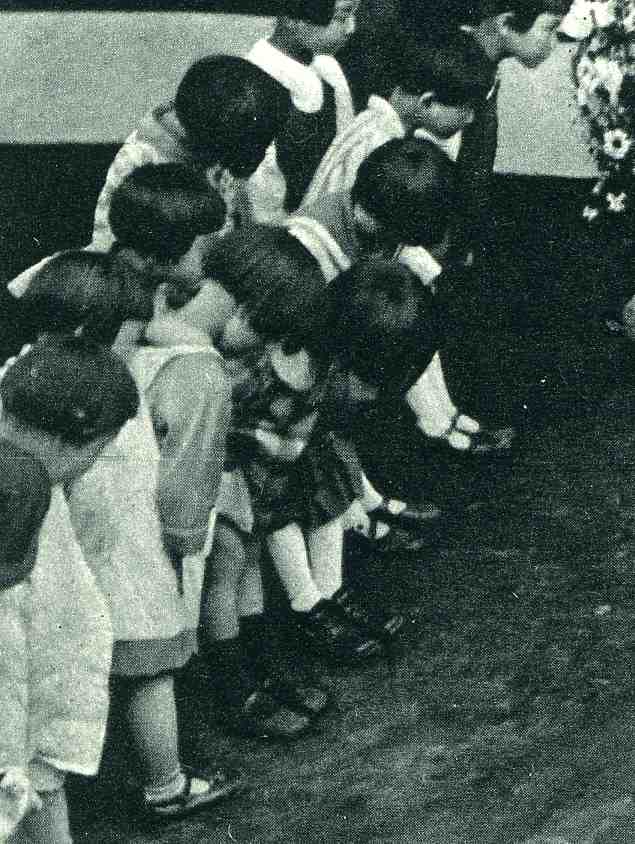
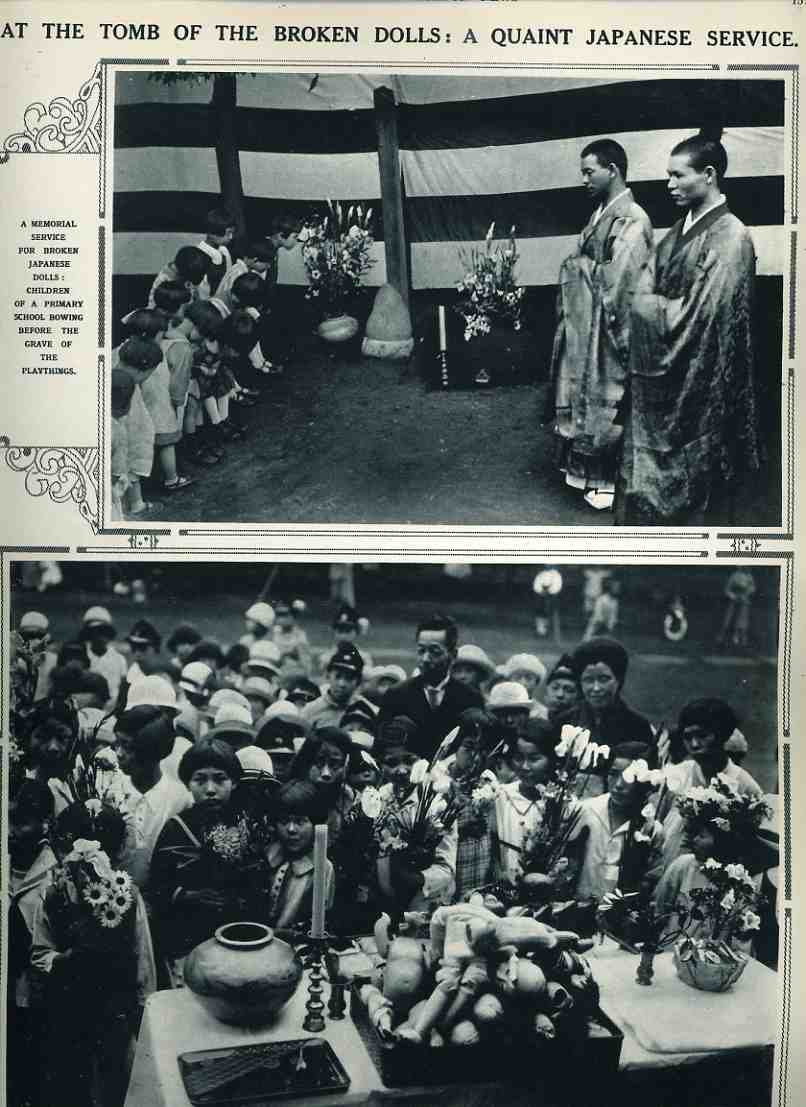
At the beginning of my 10th month of blogging I’d like to open with these images showing the practice of an utterly fabulous idea–an eternal resting place and shrine for broken playthings. This is an absolutely outstanding concept, and I simply have no notion as to why we don’t have such observations in the United States. (The following two details are from the larger images, below, found in the 27 July 1929 issue of The Illustrated London News, page 157.) The story provides these two pictures and unfortunately scant details of the ceremony which was held at the Imperial Primary School at Sugamo, Japan.
The first photo shows the detail of children offering flowers for the altar on which their tray of broken dolls is being venerated; and to the right is the detail of children bowing to the grave of “broken playthings”, though the markings on the (grave?) stone indicate that it is for dolls. It also seems to be a marker for a mass of toys, not that each toy would have its own marker; I suspect it to be enough to have a place where allot of kids could come to venerate objects in which they might have invested countless hours of their time, effort, attention and affection. That it is a shared place and experience makes the monument all the more so powerful.
There are few better things to teach a child than to pay respects for something that has given them pleasure or helped them, or, say, for returning the love which has been showed them from their doll or toy. It has always struck me as not-quite-right that a toy can be a beloved object one day and a dust-magnet the next, destined for the trash heap. Certainly these are holy objects in themselves, and deserve a better and more kinder fate than being mixed with broken glass and greasy unmentionables.
Are there greater things to be concerned with? Yes, of course, but only on the face of it–I think that helping kids understand the underlying dignity of inanimate objects such as their playthings could give them a greater awareness for the other seemingly invisible things that they will find throughout their lives. Further I think that a visible, constant reminder for these objects would be really more like a memory-monument for a period of time, a place in nearly everyone’s life in which held a certain purity and promise, a protected and beloved frailty of the human experience shared by all. I can honestly think of no other monument that could reach across religious or philosophical or belief systems to arouse a feeling of common goodness than this. Everyone has had a toy that they’ve loved, and I have no doubt that if remembered these would be powerful emotions, and could be about the most common denominator we have on the planet. I can think of no divisive element in such a monument of veneration.
The Elizabethan Robert Burton (1577-1640), in his supreme 1621 effort The Anatomy of Melancholy1 (“The best
book ever written. Period”)—ostensibly a quasi-medical book on depression/melancholy2 but
really about everything, not to mention the entirety of the sciences—called on
Galileo and Kepler in supporting his view that the “eighth sphere” (of Dante, containing
the starry realm and the abode of the Heavenly Father) was 170 million 800
miles away3 from the earth.
Burton
thought that if you were to drop a stone from that distance and have it travel
100 mph it would take “65 years or more”, [page 152 or so]) to reach the ground
here on earth.Heaven aside, something going
100mph for 65 years wouldn’t get but a third of the way to 170mil., though it
was interesting for
Burton to be thinking in terms of big distance like this at this time. There are by
the way other “eighth spheres” around in the history of science and literature,
from Sacrobosco to Copernicus, but Burton must absolutely be referring to Dante for this reference.
Well.There is of
course much of great interest in this book that wound up being correct, and
then there was the other stuff, like this, that just didn’t work. Overall
though it may be a book to be buried with; it is beautiful, complex,
deliberate, fantastic, horribly erudite, compelling, and sometimes unreadable.
Notes:
1.The full title of
the book, by the way, is: The Anatomy of Melancholy, What it is: With all
the Kinds, Causes, Symptomes, Prognostickes, and Several Cures of it. In Three Partitions with
their several Sections, Members, and Subsections. Philosophically,
Historically, Opened and Cut up. The book again was first published in 1621, and followed by revisions in 1624, 1628, 1632, 1638, and 1651; the 1651 edition was reprinted in 1660 and 1676, and then all was quiet until it was picked up again in 1800.
2. Burton identifies Melancholia as follows: “Melancholy, the subject of our present
discourse, is either in disposition or in habit. In disposition, is that transitory Melancholy
which goes and comes upon every small occasion of sorrow, need, sickness,
trouble, fear, grief, passion, or perturbation of the mind, any manner of care,
discontent, or thought, which causes anguish, dulness, heaviness and vexation
of spirit, any ways opposite to pleasure, mirth, joy, delight, causing
frowardness in us, or a dislike. In which equivocal and improper sense, we call
him melancholy, that is dull, sad, sour, lumpish, ill-disposed, solitary, any
way moved, or displeased. And from these melancholy dispositions no man living
is free, no Stoick, none so wise, none so happy, none so patient, so generous,
so godly, so divine, that can vindicate himself; so well-composed, but more or
less, some time or other, he feels the smart of it. Melancholy in this sense is
the character of Mortality. . . . This Melancholy of which we are to
treat, is a habit, a serious ailment, a settled humour,
as Aurelianus and others call it, not errant, but fixed: and as it was long
increasing, so, now being (pleasant or painful) grown to a habit, it will
hardly be removed.”
3. The quote for the 170 million mile high Heaven bit:“So that according to these men the number of ethereal spirits must needs be infinite: for if that be true that some of our mathematicians say: if a stone could fall from the starry heaven, or eighth sphere, and should pass every hour an hundred miles, it would be 65 years, or more, before it would come to ground, by reason of the great
distance of heaven from earth, which contains as some say 170 millions
800 miles, besides those other heavens, whether they be crystalline or
watery which Maginus adds,
which peradventure holds as much more, how many such spirits may it
contain? And yet for all this Thomas Albertus, and most hold that there
be far more angels than devils.”
A small bit of news: this blog has just received its 250,000th visitor, far more than I ever thought possible. The milestone comes on my 599th day of blogging and 757th post, some 400,000 words and 4,000 images or so after this all first started in February 2008. My thanks to everyone who has taken the time to stop by. This has been an enormous amount of fun, and I’m so very happy that someone is out there enjoying it.
I must also thank my brilliant, beautiful and always interesting wife, Patti Digh, who encouraged me to actually start writing and whose constant support and help has been the great difference for me in keeping this blog going. MMB.
*Patti is a professional writer and speaker and has a number of blogs of her own, including the very widely popular 37days.