JF Ptak Science Books Post 304
There have been many Kings of the Hobos, and Emperor of the Hobos, in the history of American Hobodom. The most widely recognized of all this royalty is, probably, Mr. Jeff Davis, who was elected King of Hobos each year from 1908 to 1935, until in 1935 at the Pittsburgh meeting of the annual “Hobos of America” his minions gave up elected him King for Life. Of hobos, that is, the Knights of the Road; he was also a real hobo, unlike the pretenders, who in general were not. (Nels Anderson in his Men On The Move, written just as the Depression was broken, (1940) observed: “Whatever else may be said of King Jeff, his romanticizing the hobo is not without a basis in reality, and his poetic interest in the species arose from experience. But King Jeff has placed on a pedestal a man who belongs to the past. The hobo belongs with the pre-Hollywood cowboy and the lumberjacks of the Paul Bunyan legends.”)
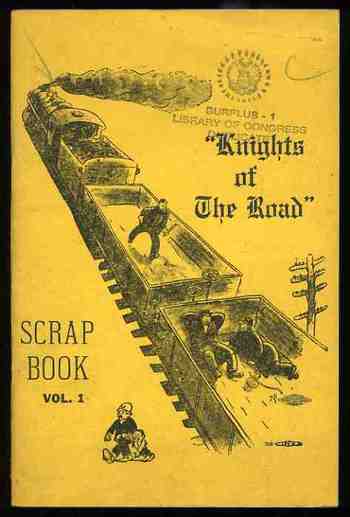
Mr. Davis was certainly very effective in getting the message out—on freedom and responsibility to irresponsibility—and was a great organizer and popularizer. He helped to establish hobo meetings, newspapers and literature (a sample of which is at left). He also had a few movie appearances: in The Arkansas Traveler, 1938 and The Bridge of Sighs, 1915, he ably played the role of a hobo.
And what about the missing counterpart of Jeff Davis–the Queen of the Hobos? There were certainly allot of women hobos during the Depression; Harry Hopkins estimated that there were something like 13,000 “sisters of the road” who were out and about in the 1930’s. I guess the most famous of them though was one who did not exist; and what parts of her that were real were mostly those of one man: Ben Reitman. Sister of the Road (1940) was supposed to be an autobiography of legendary Boxcar Bertha, but it was really an assimilation of Reitman’s own experiences sprinkled about those of women from his life. Reitman, who was described (by himself) as a “hobo, whorehouse physician, musician and tour manager/lover of Emma Goldman” (??) was probably not without enough experiences to float another character or two, had his story of Bertha wind up in the hands of exploitation movie maker Roger Corman. The good news about that though was that Corman gave the project to the very young Martin Scorcese who produced an odd and not bad film on no budget, and Boxcar got to live again.
But what brought me here to begin with was Davis’ breakdown of some very colorful hobo slang, all of which was found in the little yellow pamphlet (pictured above), and published as a “reference manual” in 1947. And so:
Gay Cat. Someone who “beats it from town”, settles down with a job and puts together some money so that he can get on the road again.
Gandy Dancer. “Is a hobo shovel stiff, a muck-stick artist”, a common laborer
Pearl Diver. A hobo dishwasher and who works for his meal.
Mush fakir. A hobo umbrella mender with a patch kit and a second-hand umbrella strapped to his back. (Evidently these guys were put out of business when larger stores began offering umbrella repair on their own.)
Bindle stiff. A hobo who carries his stuff in a sack on a stick, including toothbrush, “but he does NOT carry blankets”.
Kywah. An honest hobo pitchman peddling soap, perfume, jewelry, novelties, pens, knives and potatoes peelers.
Kewah. :Makes and sells articles such as willow stands…”
Scenery Bum. “A young tramp who bums it around the country, just for the fun of it.”
Ring-tail. “An ignorant, harmless tramp.
Fuzzy tail. “A smart aleck tramp, jack of all trades, a fourflusher, big bluff, false alarm, and piker of the worst sort, who most always carries a “punk kid” or “road kid” (a runaway boy).”
Dingbat. “An old tramp professional beggar who dings the main stem (begs on the main street).”
Stew bum. “An elderly tramp who wastes his time continually drinking rot booze.”
Jungle Buzzard. “A tramp who loves to eat but is too lazy to get the ingredients for a mulligan stew. He eats what is left when the gang leaves the jungle fire.” Yum.
Road Yegg. “A vicious tramp of the petty larceny type, a cheap crook.”
I like the collection—it has a high color, not terrible low cant at all.
Notes:
A Few Books on the History of Hobos:

Allsop, Kenneth  Hard Travellin': The Hobo and his History. 1967.
Black, Jack.  You Can't Win. 1926.
Bruns, A.  Knights of the Road. 1980.
Davies, W.H.  The Autobiography of a Supertramp. 1929.
Drew, Betina. The Texas Stories of Nelson Algren. 1995.
Etulain, Richard W.  Jack London on the Road: The Tramp Diary and Other
Writings. 1979
Flynt, Josiah. Tramping With Tramps. 1969 reprint.
Flynt, Josiah. My Life. 1908.
Graham,  "Steam Train" Maury   Tales of the Iron Road: My Life as King of the
Hobos. 1990.
Kemp, Harry.  Tramping On Life: An Autobiographical Narrative, 1922.
Kerr, Lenox.     Back Door Guest [Foreign Travelers in America
1810-1935].  1930
Kromer, Tom.  Waiting for Nothing. 1935.
Monkkonen, Eric H. Walking To Work: Tramps in America, 1790-1935.
Ormser, Richard.   Hoboes.1994.
Tully, Jim.  Beggars of Life: A Hobo Autobiography. 1924

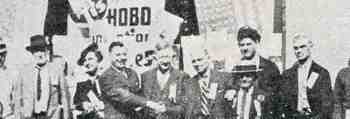
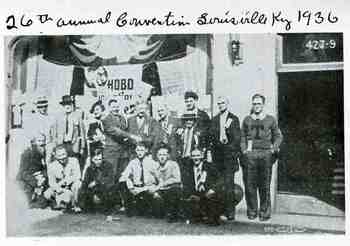
And, by the way, this detail of the photo in the Davis book for the 1936 Hobo meeting in Kentucky--
where, exactly, are the hoboes?  these people look pretty middle class.  And who is the lady?