A Daily History of Holes, Dots, Lines, Science, History, Math, Physics, Art, the Unintentional Absurd, Architecture, Maps, Data Visualization, Blank and Missing Things, and so on. |1.6 million words, 7500 images, 4.9 million hits| Press & appearances in The Times, Le Figaro, Mensa, The Economist, The Guardian, Discovery News, Slate, Le Monde, Sci American Blogs, Le Pont, and many other places… 5000+ total posts since 2008.

Book Category: Technology, History of

  • Contributions by Marconi and Poincare (1912)

    Revue Scientifique (Revue Rose), January-June, 1912. 832, (50)pp.  Bound in a sturdy red cloth, with former owner stamps on the title page of each weekly issue, as well as a nice bookpalte.  The text is a little brittle around the edges.  Nice copy.  $145 Includes contributions by:

    MARCONI, G. “La Radiotelegraphie”, 10 February, pp 161-170 (from an address at the Royal Institution on 2 June 1911);

    POINCARE, Henri. “L’Hypothese des Quanta”, 24 February, pp 225-232 (not the paper given in Journal de Physique Theor. App., 1912, pp 5-34)

    RAMSAY, William. “Elements et energie”, 27 January, pp 97-109;

    LORENTZ, H.A. .Quelques Remarques sur la theorie du magnetisme”, June 3,  (pp3-6)

    BERTHELOT, D. “Les Rayons Ultra-Violets et les Actions Vitales”, pp 353-356;

    RICAHARDS, Theodore William. “Les Proprietes Fondamentales des Elements”, 16 March, 321-327; 

    LOEB, Jacques. “La Vie”, 9 March, pp 289-298.


    ·Posted by :

    ·in:


  • Tesla’s London Lectures, 1892

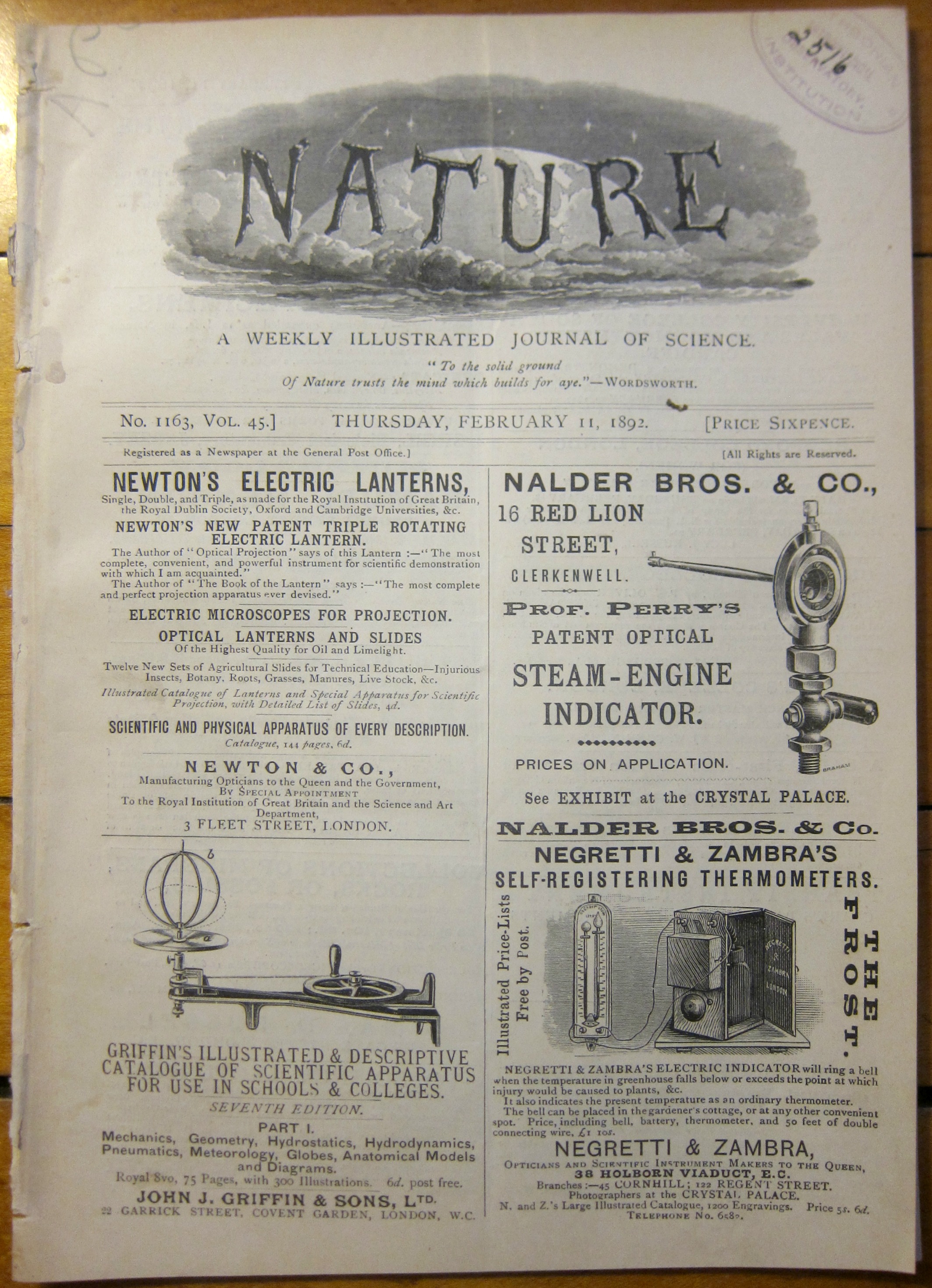
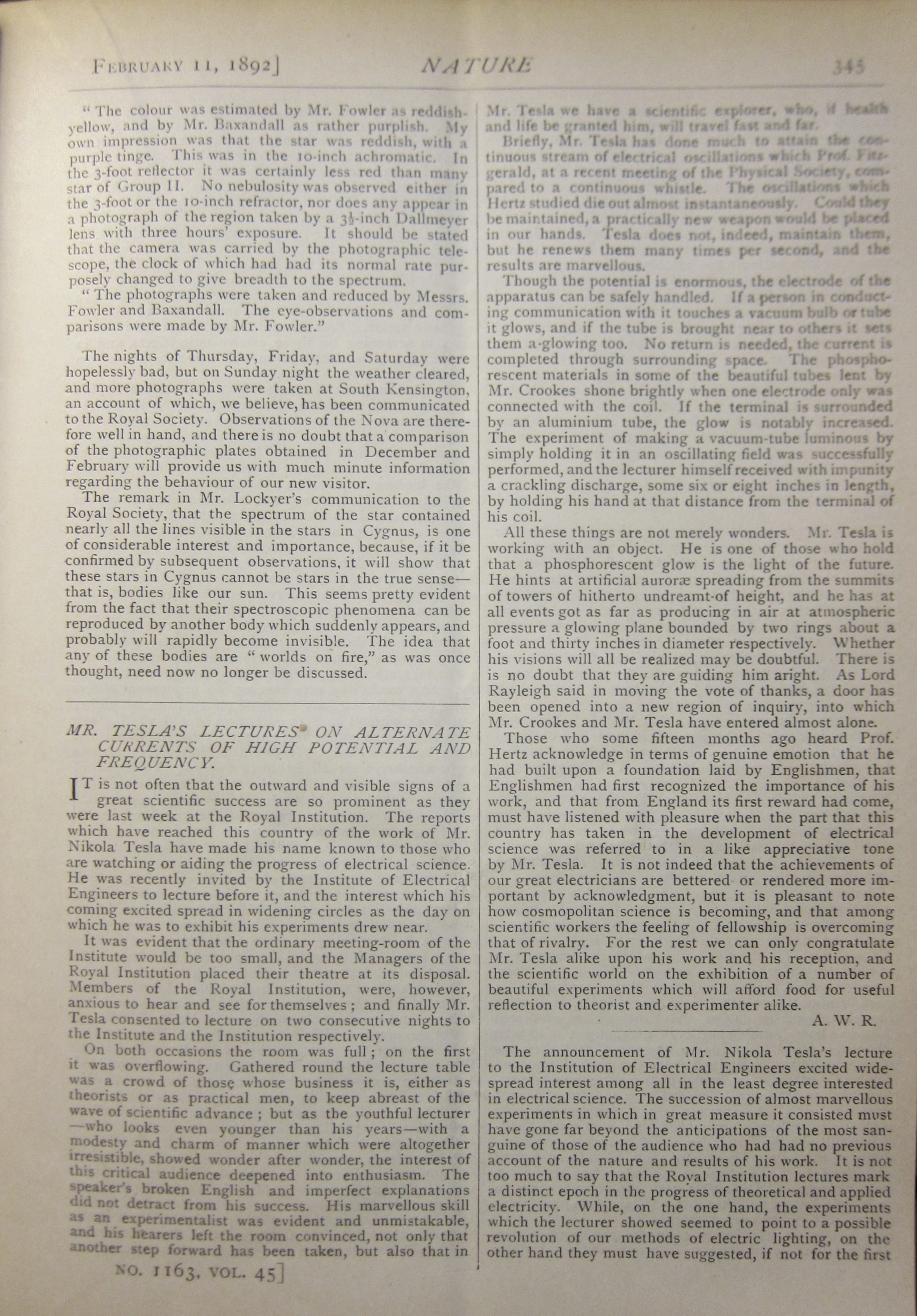
    [Tesla] “Mr. Tesla’s Lectures on Alternate Currents of High Potential and Frequency”, in Nature, volume 45, February 11, 1892, no. 1163, pp 345-7 in the weekly issue of pp 337-360. Offered with the original wrappers, including the cover plus 7pp of ads. This is extracted from a larger bound volume, ex-library from the Smithsonian Astrophysical Observatory , with their small oval rubber stamp in the upper corner of the front cover. Its a nice copy though it does have an old, mostly faded, vertical fold through the text.  The article runs around 2500 words and includes two reviews of the lecture(s), which overflow crowds enjoyed over two days at the Royal Institution.  Good, solid copy, with the uncommon wrappers.  $200

    TEsla 1892 cover

    Tesla 1892 text

    ·Posted by :

    ·in:


  • Early Balloon-Based Aerial Photography

    Two Early Papers on Successful Free-Balloon Aerial Photography (1880 and 1886)

    Desmarets, Paul. “Sur les moyens d’obtenir des epreuves photographiques en ballon libre. Note de P. Desmarets, presentee par M. Janssen (Extrait)”, in  Comptes Rendus, vol  91 no. 4,  26 July 1880, the article on pp 246-7  in the issue of pp 187-250. This weekly issue is extracted from a larger bound volume, but it does come with the front wrapper, which is fairly scarce.  

    Offered with:

    Tissandier, Gaston (1843-1899). “Nouvelle experiences de photographie en ballon; ascension de Mm A. and G. Tissandier et P. Nadar”, in Comptes Rendus 19 July 1886, vol 103 no 5, the article appearing on p 224-5 in the issue of pp 179-226. Offered with the original wrappers, extracted from a larger bound volume.  Good solid copy.  Tissandier discusses particulars of the work by photographer Jacques Ducom who took advantage of new photographic plate tech improvements to make a superb image of Paris in a free balloon at about 1200 metres.  (“Gaston Tissandier  was a French chemist, meteorologist, aviator and editor. Adventurer could be added to the list of his titles, as he managed to escape besieged Paris by balloon in September 1870. He founded and edited the scientific magazine La Nature and wrote several books.”–Wiki)

    The two papers: $400

    “The history of aerial photography began in 1858, when the photographer Nadar took the first photographs from a balloon. His results were only partially successful, as were those of other experimenters who followed him, and it was not until 1878, when factory-made gelatin dry plates were introduced, that aerial photography came into its own. Using gelatin plates, which were twenty times faster than the old wet-collodion plates, the photographer Paul Desmarets obtained two birds-eye views of Rouen in 1880 from a balloon at 4,200 feet. [the first paper offered above]. However, Desmarets’ results were surpassed five years later by Jacques Ducom, who, in a balloon navigated by Gaston Tissandier, was able to take superb aerial photographs of Paris from a height of 1,800 feet” [the second paper offered above]. –Jeremy Norman, from his excellent and highly useful History of Information site (section on Tissandier’s book on aerial photography, which was the first of its kind, and issued in 1886.)

    “Ducom’s view of the Ile Saint-Louis, Paris from 1,800 ft leaves absolutely nothing to be desired. Through a magnifying glass people can be counted on the bridge. The exposure of this and the other photographs taken on this flight was 1/50 second, using a specially constructed guillotine shutter which was opened pneumatically and closed automatically with a rubber spring” (Gernsheim & Gernsheim, The History of Photography 1685-1914 p. 508)–again quoting the very resourceful Mr. Norman (above).


    ·Posted by :

    ·in:


  • The First Record of the Electrical Activity of the Spontaneously Beating Heart (1876)

    Marey Etienne J. 3 foundation papers in the history of cardiology and the electrocardiogram, all from the same volume of the Comptes Rendus Hebdomadaires des Seances de l’Acadamie des sciences volume 82, 1876. All offered in their original weekly issues, removed from the larger bound volume.  Nice, crisp copies. The 3 issues: $400

    These issue include:

    (1) “Des Mouvements que produit le couer lorsqu’il est soumis a des excitations artificielles” in Comptes Rendus… vol 82 no. 7 pp 408-411 in the issue of pp 397-428.

    => In this same issue is bound:  Dmitri Mendeleeff, “Des ecarts dans les lois relatives aux gaz”, same issue, pp 412-415. This is one of the first papers written by Mendeleeff in the area of aerodynamics.

    It is fun to note that Marey and Mendeleeff are found on the same page of the index and just happen to appear one after the other in the 1550pp volume!

    On Marey:

    • “Marey (a superb instrumentalist and experimenter and physician who will in a few years make pioneering breakthroughs in the study of locomotion and become a founder of cinematography) was the first to record the electrical activity of the spontaneously beating (tortoise) heart”, a premier breakthrough in the long line of the history of this graphical presentation, leading to Willem Einthoven (1860 – 1927) who invented and published on the first practical electrocardiogram in 1902, and who began transmitting electrocardiograms from hospital to his laboratory in 1905, for which he received the Nobel Prize.
    • “Marey uses the electrometer to record the electrical activity of an exposed [frog’s] heart.”–“A (not so) brief history of electrocardiography”
    • “Discovery of the waveform of the cardiac signal is due to Marey in France in 1876. With the assistance of Lippmann, a physicist, Marey was the first to record the electrical activity of the spontaneously beating tortoise heart, for which they devised the capillary electrometer that consisted of a mercury–sulfuric acid interface in a capillary tube. A current traversing this interface altered the charge distribution and, therefore, the contour of the meniscus. Continuous photography of the change in the meniscus provided an analog record of the cardiac voltage.”–in Cardiovascular Engineering: An International Journal, Vol. 2, No. 2, June 2002, “The First Electronic Electrocardiograph”, by Geddes and Roeder.

    AND WITH:

    (2) “Des variations electriques des muscles et du couer en particulier etudies au moyen de l’electrometre de M Lippman”, in Comptes Rendus, 1876, volume 82, pp 975-977. The full weekly issue extracted from a larger bound volume. The Lippmann reference in the title is to the French physicist Gabriel Lippmann who in 1872 invented a capillary electrometer which Marey employed. “It is a thin glass tube with a column of mercury beneath sulphuric acid. The mercury meniscus moves with varying electrical potential and is observed through a microscope.” 

    AND WITH:

    (3) “Le Couer eprouve, a chaque phase de sea revolution, des changements de temperature qui modifient son excitabilite”, Comptes Rendus, vol 82, pp 499-501, with EKG illustration. 28 February 1876, vol 82 no. 9, in the issue of pp 469-528. 

    ·Posted by :

    ·in:


  • A Great Classic in the History of Superconductivity–the BCS THeory

    Bardeen, J.L., L.N. Cooper, and J.R. Schrieffer. “Theory of Superconductivity” in the Physical Review, volume 108, Number 5, 1957, p.1175-1204 in the issue of pp 1357-1682, in the bound volume for #108, pp 913-1696, for November-December 1957. In a sturdy and attractive red cloth. Provenance: National Bureau of Standards Library, with their name gilt stamped on the spine bottom. save for some remnants of the paper spine label, this is a lovely, fresh copy. Offered with the issues # 4, 5, and 6 bound together, with their original wrappers bound in at the end. Each wrapper cover has a somewhat faded and small rubber stamp of the NBS $750 . 

    The Nobel Prize in Physics 1972 was awarded jointly to John Bardeen, Leon Neil Cooper and John Robert Schrieffer “for their jointly developed theory of superconductivity, usually called the BCS-theory”, a classic foundation paper of superconductivity and referenced some 13,000+ times.

    “The Bardeen-Cooper-Schrieffer theory (BCS), published in July 1957, proved to be the triumphant solution of the problem which for four and a half decades had stumped all the best theorists in the world.”–Dictionary of Scientific Biography

    “BCS theory or Bardeen–Cooper–Schrieffer theory (named after John Bardeen, Leon Cooper, and John Robert Schrieffer) is the first microscopic theory of superconductivity since Heike Kamerlingh Onnes’s 1911 discovery. The theory describes superconductivity as a microscopic effect caused by a condensation of Cooper pairs into a boson-like state. The theory is also used in nuclear physics to describe the pairing interaction between nucleons in an atomic nucleus.”–Wikipedia

    “BCS theory, in physics, a comprehensive theory developed in 1957 by the American physicists John Bardeen, Leon N. Cooper, and John R. Schrieffer (their surname initials providing the designation BCS) to explain the behaviour of superconducting materials. Superconductors abruptly lose all resistance to the flow of an electric current when they are cooled to temperatures near absolute zero.” Encyclopedia Britannica

    “The turn in the team’s work on superconductivity came in the last days of January 1957, soon after Bardeen returned from Stockholm. While riding on a subway in New Jersey, Schrieffer wrote down a promising expression for the superconducting ground state wave function. Recognizing the implications, Bardeen moved the team into an intense period of work in which the three feverishly computed all the relevant experimental quantities, including the energy gap and the second-order phase transition. The Bardeen-Cooper-Schrieffer theory (BCS), published in July 1957, proved to be the triumphant solution of the problem which for four and a half decades had stumped all the best theorists in the world.”–Dictionary of Scientific Biography

    See also the very extensive BCS 50 Years by Leon Cooper and D. Feldman, from World Scientific. (Cooper recalls, for example, that when John Bardeen was looking for a post doc to work with him on superconductivity in 1955, that he had never heard of superconductivity before.)

    Also: Lillian Hoddeson, “John Bardeen and the Theory of Superconductivity: A Study of Insight, Confidence, Perseverance, and Collaboration”,  October 2008, Volume 21, Issue 6, pp 319–327|  Journal of Superconductivity and Novel Magnetism.

    ·Posted by :

    ·in:


  • An Early Printing In English of Alexander Graham Bell’s Account of the First Unmanned Heavier-than-Air Sustained Powered Flight, 1896

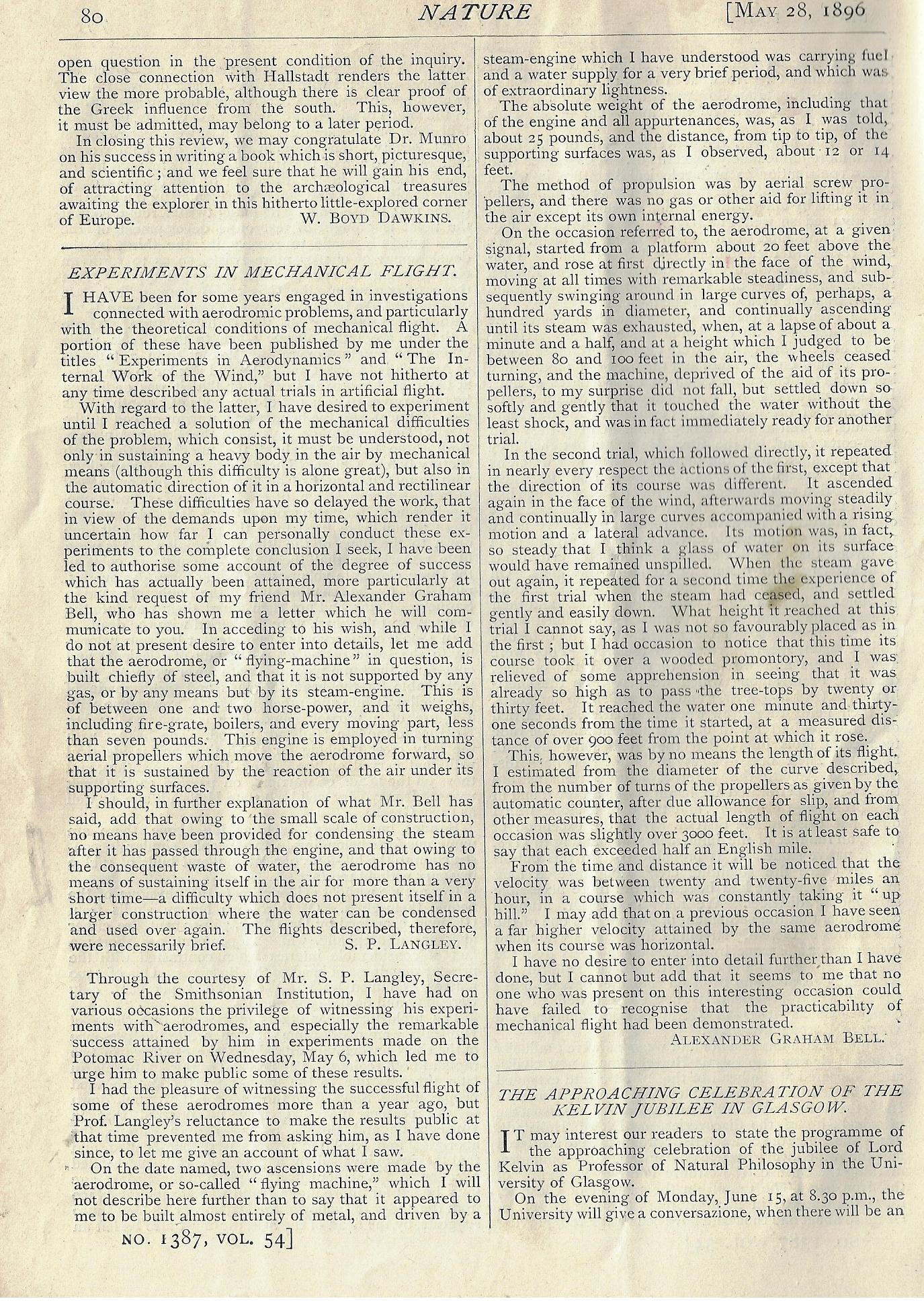
    Langley, Samuel Pierpont and Alexander Graham Bell. “Experiments in Mechanical Flight”, in Nature, volume 54, May 28, 1896, page 80 in the issue of pp 73-96. Offered is the weekly issue in the original wrappers (cover plus 3pp of advertisements), removed from a larger bound volume. Provenance: this is a good association copy as it comes from the Langley’s own Smithsonian Institutions’ Astrophysical Observatory, via the Library of Congress. Condition: there are two vertical pressure marks that run through the volume—they are very light, but they are definitely visible. GOOD+ copy  $250

    This is the first printing of the famous flight in English in Great Britain and Europe, appearing in Nature, May 28, 1896.

    • The first report on the flight seems to have been in Science, May 22, 1896, according to Brockett’s Bibliography of Aeronautics, #7160.
    • The first report of the flight to appear in Europe appeared two days earlier in Comptes Rendus, vol 122, May 26, 1896, p 1179. The contents of the report is mostly the same, though there are differences, particularly in the second to last paragraph, speaking of the gentleness of the plane gliding after the engine terminated. The last few sentences, with Bell’s famous statement, is pretty much the same. (“Il me semble que personne n’aurait pu assister à cet intéressant spectacle sans être convaincu que la possibilité de voler dans l’air à l’aide des moyens mécaniques venait d’être démontrée.”)
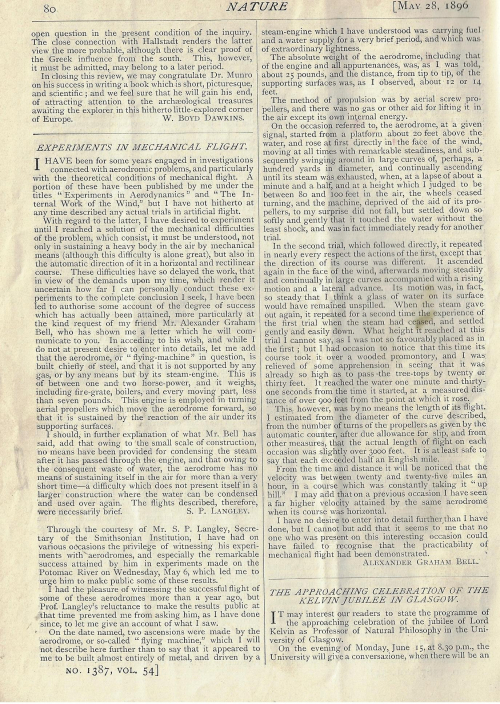
    Langley textI think most people remember Langley as the (Third) Secretary of the Smithsonian Institution and for his work in astrophysics and observational astronomy, but he was a significant figure in the history of aviation, publishing his first extended work in the field in Experiments in Aerodynamics in 1891, and became one of the first if not the first aerodynamics experimenter in the U.S. He was also the first government-sponsored in-house researcher in this field.

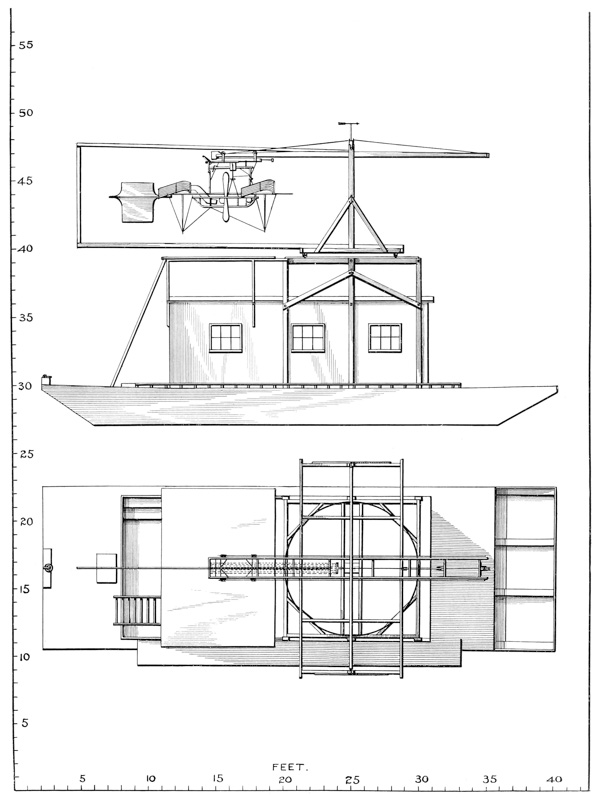
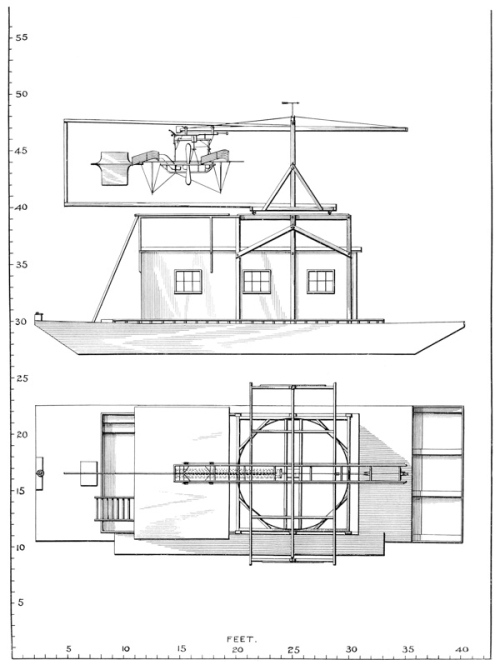
    Langley’s  historic experiments in May 1896 with his 13′-wide Aerodrome 5 took place on a makeshift “houseboat” (“…nothing more than a scow about 30 feet long by 12 feet wide, upon which a small house was erected, to be used for the occasional storing of the aerodromes…”)1 moored in the Potomac River a few miles south of D.C. near Quanitco, Virginia. There was one witness to this affair, Langley being very concerned for privacy, particularly not wanting news of failures to reach a general audience. His guest observer was his old friend, Alexander Graham Bell, who had already witnessed some of Langley’s earlier attempts with models and made monetary contributions to help fund the larger enterprises. Langley had no interest in making the report—though he did invite Bell to do so. And it is the second part of this short, two-part paper in which Bell’s observations appear.

    Langley’s own description of the aircraft appeared in his Mechanical Flight2 : “The aerodrome was built chiefly of steel, though lighter material entered into the construction, so that its density as a whole was a little below unity. No gas whatever entered into the construction of the machine, and the absolute weight, independent of fuel and water, was about 11 kilos (24 pounds). The width of the supporting surfaces was about 4 metres (13 feet), and the power was furnished by an extremely light engine of approximately one horse-power. There was no one to direct it on board, and the means for keeping it automatically in horizontal flight were not complete. It is important to remark that the small dimensions of the machine did not allow it to include any apparatus for condensing the steam, so that it could only carry water enough for a very brief course—a drawback which would not be encountered in one of a larger construction.”

    Bell’s description of the aircraft: “On the date named two ascensions were made by the aerodrome, or so-called “flying machine,” which I will not describe here further than to say that it appeared to me to be built almost entirely of metal, and driven by a steam engine which I have understood was carrying fuel and a water supply for a very brief period, and which was of an extraordinary lightness.” And “The method of propulsion was by aerial screw propellers, and there was no gas or other aid for lifting it in the air except its own internal energy…The absolute weight of the aerodrome, including that of the engine and all appurtenances, was, as I was told, about twenty-five pounds, and the distance from tip to tip of the supporting surfaces was, as I observed, about twelve or fourteen feet3.”

    The flying experiment began, and much to the delight of Langley, Bell, and the men who fished previous flying efforts from the Potomac, the two Aerodrome 5 flights for the day were successful. The first flight brought the steam-driven, one-quarter-scale model made a half mile at altitudes of up to 100 feet, marking it the world’s first flight of its type. The second flew longer, and faster, and Bell was much impressed by the serenity of the plane’s descent once the engine exhausted its fuel, turning the plane into a glider that touched lightly down onto the Potomac.

    Bell was thrilled with the display, and recorded what he felt:

    • The flying machine “resembled an enormous bird, swooping steadily upward in a spiral path until it reached a height of about 100 feet in the air.”

    And then, Bell famously observed:

    • “It seems to me that no one who was present on this interesting occasion could have failed to recognize that the practicability of mechanical flight had been demonstrated.”

    The once-reticent Langley himself writes an account of the event in “The Flying Machine” in the June 1897 issue of McClure’s (vol IX/2)–this was a very public article in a very popular magazine that also featured a drawing of the aerodrome right on the front cover.  The article also includes the Bell observations as well as the first printing of the photograph that Bell made of the second flight, the first of its kind, though it is really a drawing after the photograph, the photo itself used as proof of the event and the drawing done to enhance that. The coverage of the event and the Bell statement also appears in the Smithsonian Reports for 1896 (published in 1897). Later, Scientific American Supplement #1404 , Nov 29, 1902, reprints the Bell observations and other historical statements in “The Langley Aerodrome”.  
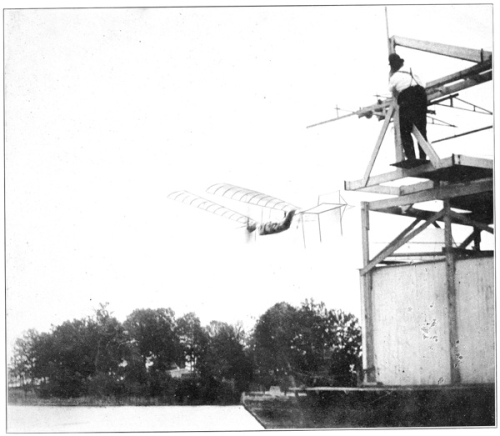
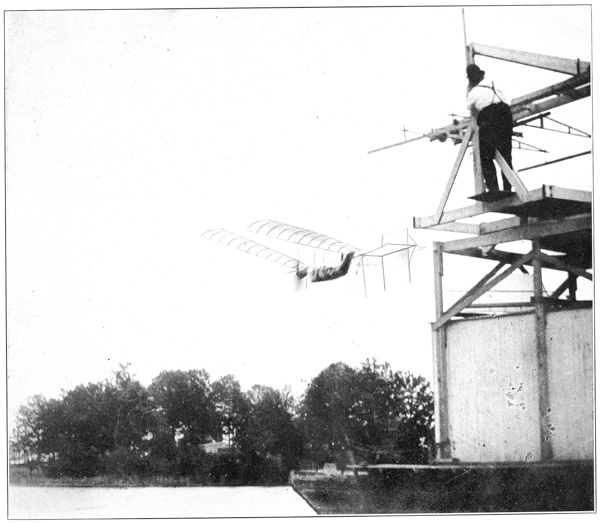
    Langley flightThe Aerodrome 5 in flight. Image via Langley’s 1911 Experiments…(see below; the image is not in the Nature article)

    Even in the face of support of U.S. presidents and stipends from the military, and with mounting successes, the public failures of his expanded, full-size Aerodrome 6 in 1903 proved to be too much for Langley and his supporters, and he retired from this field. Just two weeks later (December 17) the Wrights made their historic flight at Kitty Hawk–they were successful in many of the ways that Langley was not and made the first manned, powered, controlled, and sustained flight. Early aviation expert Tom Crouch of the National Air and Space Museum remarked that “The problem was the machine itself and Langley’s approach…he did just about everything wrong that the Wright brothers did right. “4

    That said, John D. Anderson Jr in the AIAA Journal states that it must not be overlooked that “[Langley] made extensive use of aerodynamic coeffcients and legitimately shares with Lilienthal the credit for introducing the concept of lift, drag, and resultant force coeffcients to the applied aerodynamics community. His data are the first substantive proof of the aerodynamic superiority of high-aspect-ratio wings over those with low aspect ratio; it is curious that Langley is not widely recognized for this important contribution.”  And significantly, “the work did serve a very useful purpose. The fact that a man of Langley’s stature believed in the possibility of the flying machine was enough to convince most laymen that aeronautics was no longer the pastime of fools.”5

    NOTES

    1. Samuel P. Langley and Charles Manly (editor), Langley Memoir in Mechanical Flight, Smithsonian Contributions to Knowledge, Washington, D.C., 1911. Part I (Langley), 1887-1896; Part II (Manly), 1897-1903. 
    2. _____. Langley, p. 123.
    3. From the Nature article, quoted above.
    4. Lee Wolff, “First in Flight (Almost)”, http://www.chopawamsic.com/First%20Flight.htm
    5. John D. Anderson Jr., “ Langley’s Aeronautical Research: A Modern Critique and Reassessment”, AIAA JOURNAL Vol. 35, No. 3, March 1997 Historical Review Paper.

    The extended  quote by Bell in the last three paragraphs from the Comptes Rendus:

    “La durée du vol, dans le second essai, fut d’une minute et trente-une secondes et la vitesse moyenne entre vingt et vingt-cinq milles à l’heure (soit dix mètres par seconde) sur un trajet qui fut constamment en pente ascendante.”

     “Je fus extrêmement frappé du vol aisé et régulier de la machine dans les deux essais, et du fait que lorsque l’appareil, privé de la force motrice de la vapeur au plus haut point de sa course, fut abandonné à lui-même, il descendit chaque fois avec une égalité d’allure qui rendrait tout choc ou tout danger impossibles.”

    “Il me semble que personne n’aurait pu assister à cet intéressant spectacle sans être convaincu que la possibilité de voler dans l’air à l’aide de moyens mécaniques venait d’être démontrée. “


    The “hosueboat”, with launching apparatus and with the aerodrome in place (from Langley, 1911):   Langley hosueboat
    ·Posted by :

    ·in:


  • Two Documents on the Apollo Lunar Descent Engine (1966)

    Two Documents on the Apollo Lunar Descent Engine (1966), both of which are scarce, and not located in WorldCat.

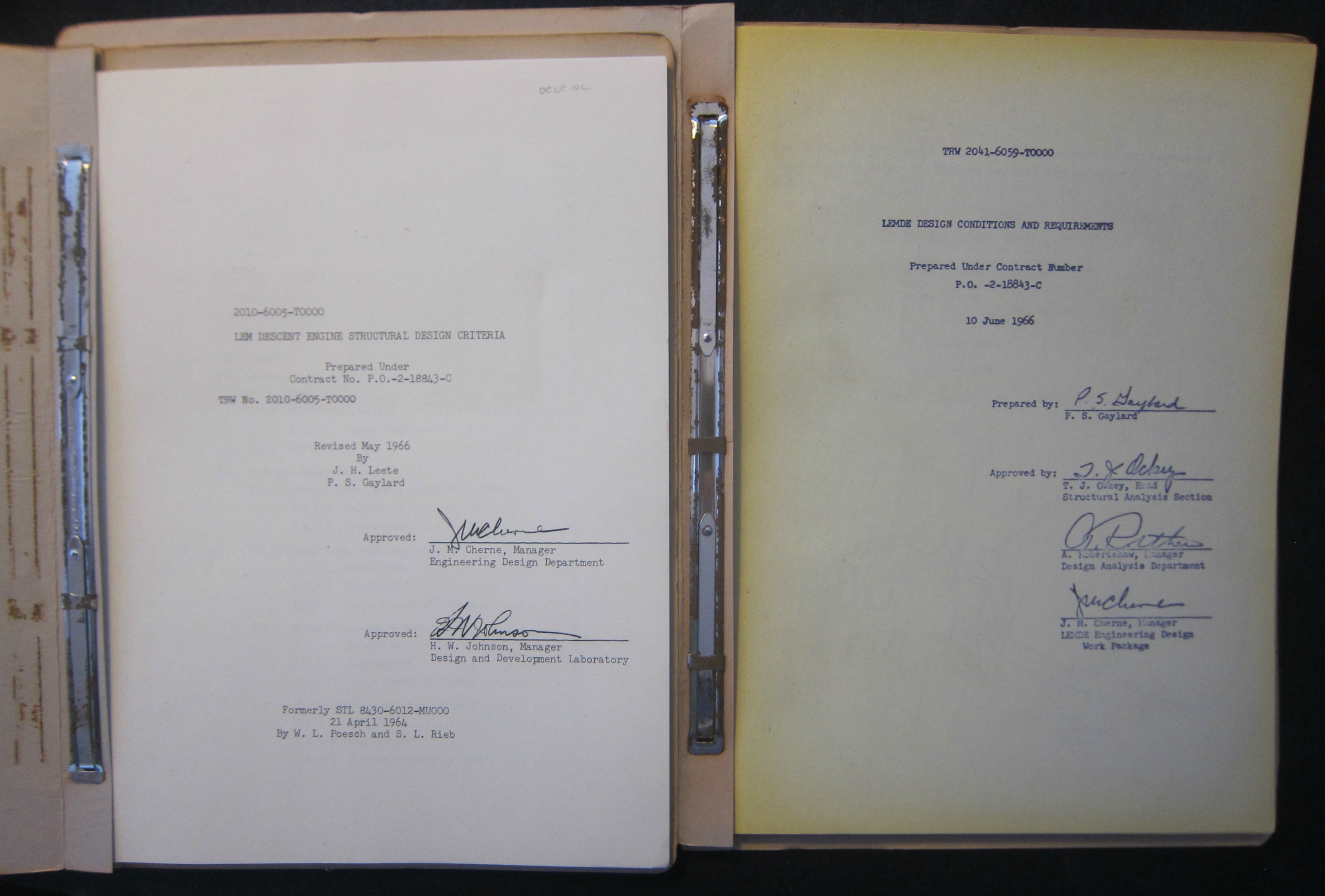
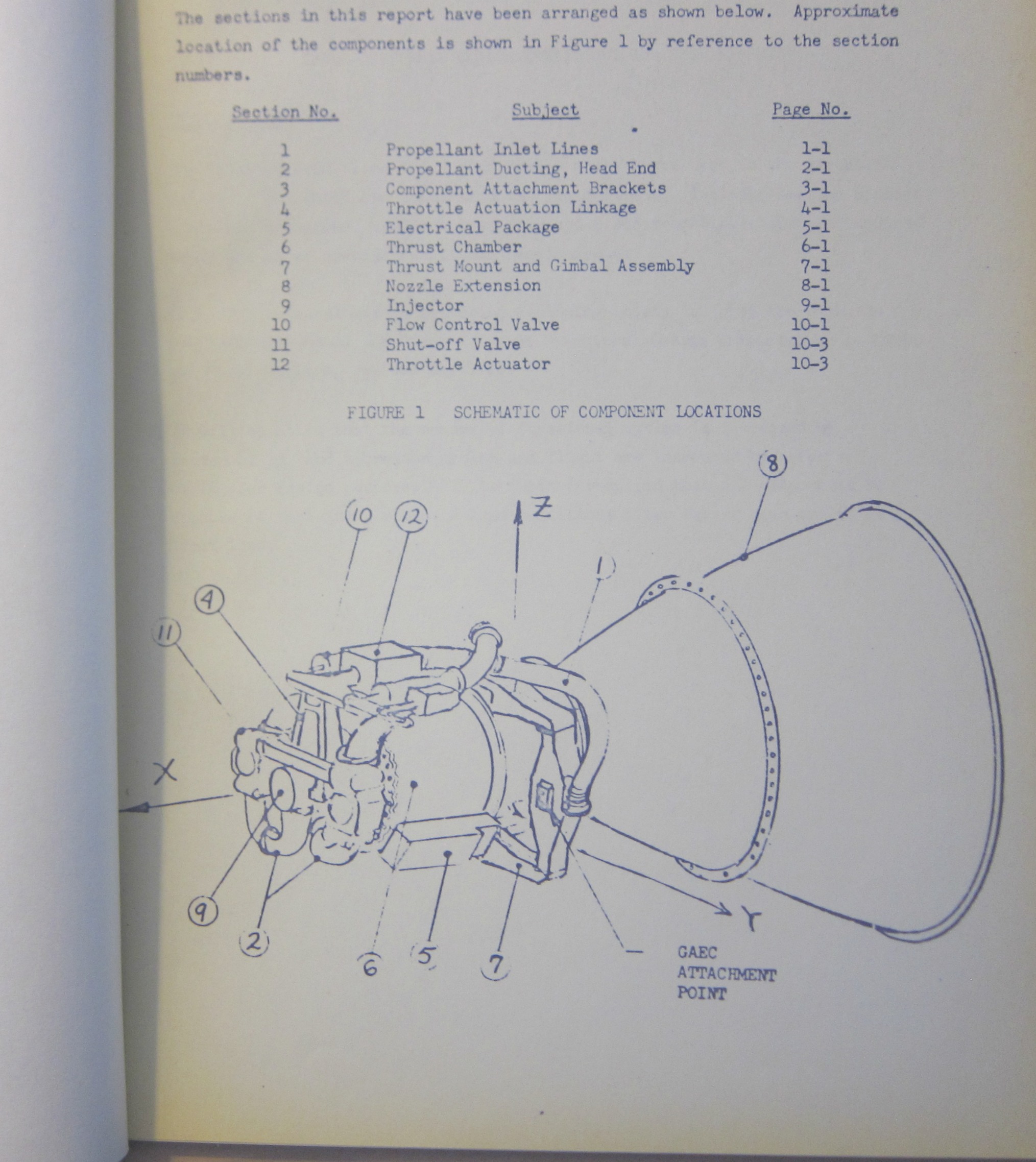
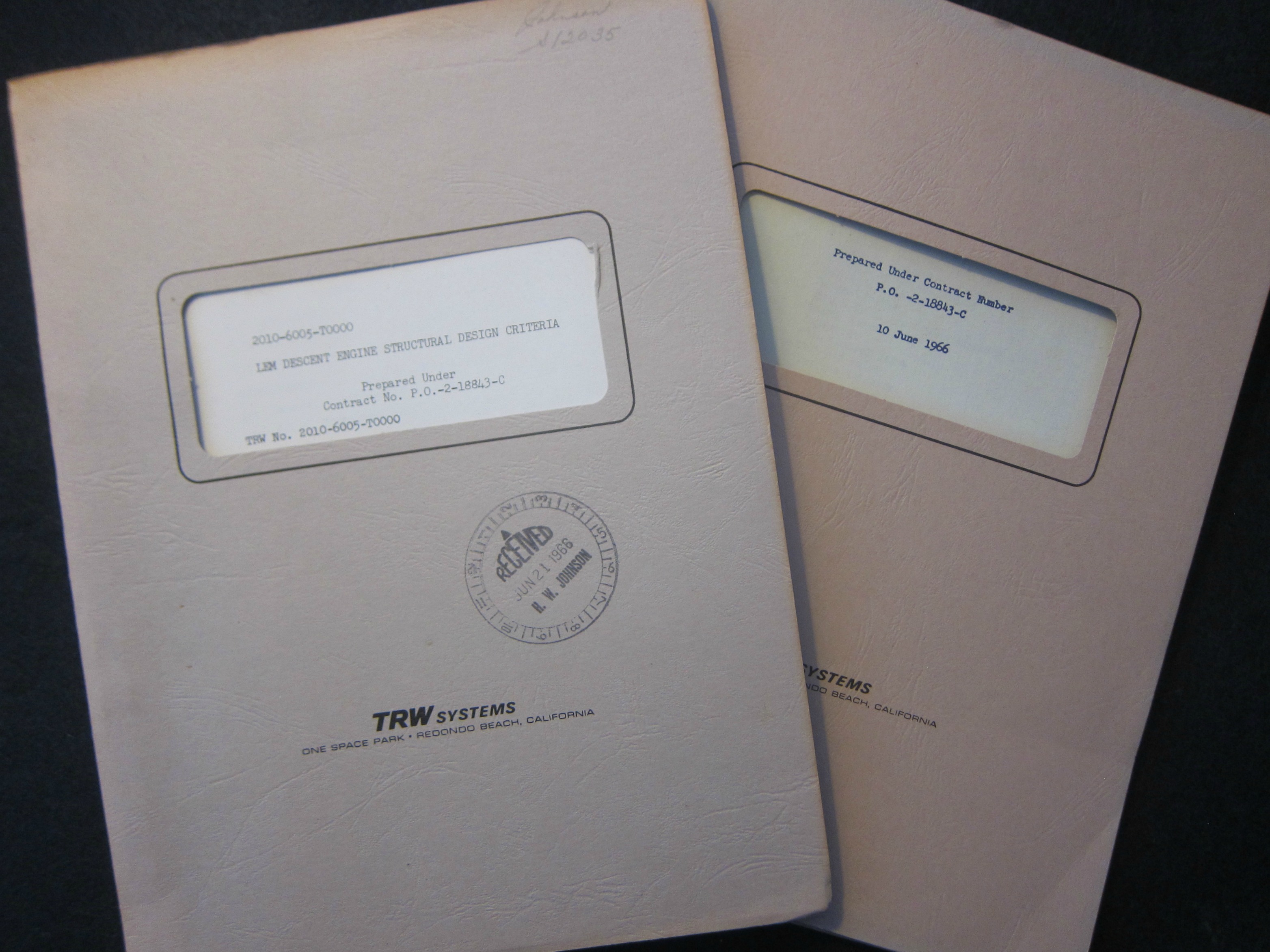
    (P.S. Gaylard)  LEMDE Design Conditions and Requirements. Prepared under contract number P.O. -2-18843-C, 10 June 1966.  11×8.5″, 42 leaves. Mimeograph product, punch bound in TRW Systems binder. Metal binder clasps are rusty, and the mimeo sheets are yellowing around edges, otherwise very crisp.  

    (J.H. Leete, P.S. Gaylard) LEM Descent Engine Structural Design Criteria, prepared under contract P.O. -2-18843-C, revised May 1966.  11×8.5″, offset printing, iv,30 leaves.  Punch bound in TRW Systems binder. Metal binder clasps are rusty, otherwise very crisp. 

    • “The Descent Propulsion System (DPS) or LMDE (Lunar Module Descent Engine) is a variable throttle hyperbolic rocket engine developed by Space Technology Laboratories (TRW) for use in the Apollo Module Descent Stage.”–Wikipedia

    SOLD


    Lemde _2_
    Lemde _2_
    Lemde _2_

    ·Posted by :

    ·in:


  • The Electric Candle, 1878

    Wm. Lucien Scaife, “The Electric Candle”, in Scientific American Supplement, January 26, 1878, pp 1720-1, a dense 1.5 column article of about 1200 words. In the issue of pp 1709-1724, with numerous illustrations throughout the issue. 15×11″. In the original blue wrappers, removed from a larger bound volume. Very Good condition.  $45

    “Jablochoff [born 1847] in 1876 introduced his well known electric candle a form of arc lamp in which cylindrical carbons are employed placed in a vertical position and held separated by a thin filling of refractory insulating material…” –(National Light Convention, Proceedings, 1892) This one one of several major improvements on the arc lamp introduced by Humphrey Davy as early as 1806, though none of these electric lights received much public use until the 1870’s. By 1881, Jablochoff’s electric candle had nearly 4000 emplacements, though his invention would soon be overcome by the incandescent bulb.

    • This article is preceded by Wm. F. Chaening, “Curious Facts about the Telephone”, about two columns of 2250 words on p 1720. The telephone had been patented by Bell only about two years earlier.  

    ·Posted by :

    ·in:


  • Otto Lilienthal and his Fabulous Ornithopter

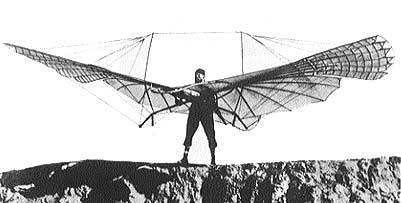
    LILIENTHAL, Otto.  “Lilienthal’s Experiments in Flying”, in Nature, 12 December 1894, pp 177-179, with four photographic illustrations; offered in the weekly issue of pp 169-192.  Removed from a larger bound volume, with the scarce original printed wrappers (and ads).  Nice copy.  $150

    Lilienthal was an international authority on human flight, and was known to many as The Flying Man, and The Father of Flight, because, well, he flew. And he flew more often and with more recorded/documented successes in his non-powered flying machines than any other aviation pioneer of the time. In fact, he had a major influence on the Wright brothers (though not necessarily for his experimental data, which they abandoned after a while to create their own in their wind tunnel), with Wilbur Wright saying: “Of all the men who attacked the flying problem in the 19th century, Otto Lilienthal was easily the most important. … It is true that attempts at gliding had been made hundreds of years before him, and that in the nineteenth century, Cayley, Spencer, Wenham, Mouillard, and many others were reported to have made feeble attempts to glide, but their failures were so complete that nothing of value resulted.” (From the Wikipedia article on Lilienthal.)

    Lilienthal was well into making successful jumps/flights by this time, but would suffer his fatal fall in about two more years, dying August 10, 1896, after a series of 850′ flights.

    This is an early appearance of Lilienthal in English, and also includes the famous picture of him with his ornithopter. 

    Lilienthal

    ·Posted by :

    ·in:


  • Early Steamboat Navigation, 1816

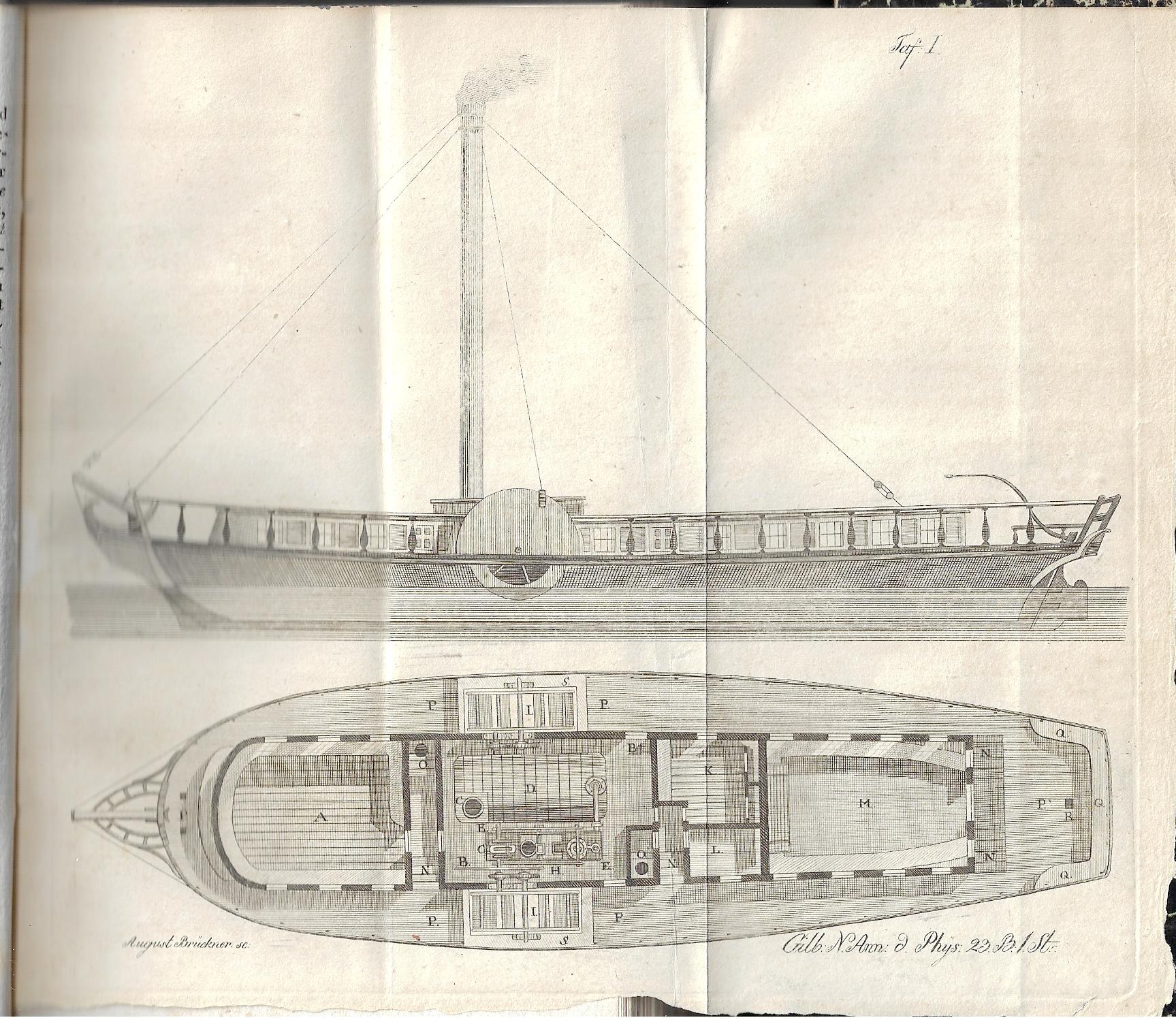
    [Steamboat travel] Five early articles on extensive steamboat travels as they appear in the Annalen der Physik, series I, vol 53; vi, 446pp.   Black cloth; dark marbled boards with cloth tips.  Ex-libris Deutsche Akademie der Luftfahrtforschung, then Wright Patterson Field Library (USAF), then Library of Congress.  Library markings:  small gilt-stamped “Akademie der Luftfahrtforschung”, page edges stamped “Wright Field Library/Dayton, Ohio” on top and bottom. Very good condition. $200

    Annalen 1816 steamboat


    Includes the following, among other papers in physics and chemistry:

    “Einige geschichtliche Nachrichten von der Erfindung der Dampf-Schisffahtr…” pp 63-70;

    Robertson Buchanan, “Ueber die sogennten Dampfboote…”, pp 70-77; 

    Isaac Weld. “Die erste Serreise mit einem von einer Dampsmachine bewegetn Schiffe, vom Glasgow in Schotland um Cap Landsend nach London”, pp 77-102;

    “Zwei schriben an Herrn Isaac Weld…die Dampf-Schiffharht und dem merkwurdigen…pp 102-110; 

    “Noch einige neuere Zeitungs-Nathrichten, Dampfshiffe betreffend… (with a small folding plate, with two views of the vessel), pp 110-119.


    ·Posted by :

    ·in: