A Daily History of Holes, Dots, Lines, Science, History, Math, Physics, Art, the Unintentional Absurd, Architecture, Maps, Data Visualization, Blank and Missing Things, and so on. |1.6 million words, 7500 images, 4.9 million hits| Press & appearances in The Times, Le Figaro, Mensa, The Economist, The Guardian, Discovery News, Slate, Le Monde, Sci American Blogs, Le Pont, and many other places… 5000+ total posts since 2008.

Book Category: Technology, History of

  • A Highlight of Circular Ships, 1880.

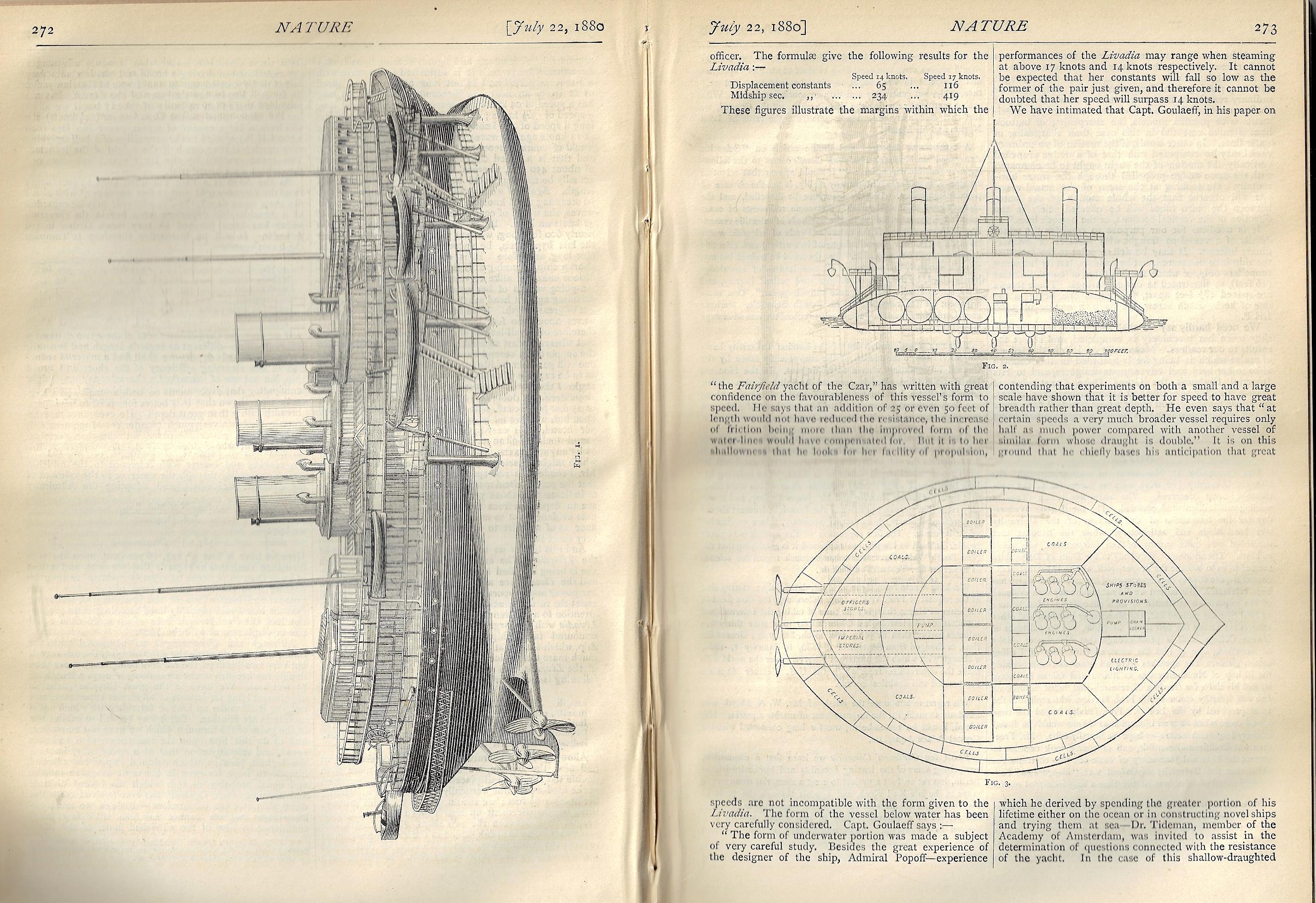
    “The Russian Imperial Yacht, ‘Livadia’”, an article in Nature, July 22, 1880, appearing on pp 270-274, with several large illustrations, including an elevation and a plan of the ship.  Offered in the weekly issue of Nature, with the (scarce) original front and rear wrappers, removed from a larger bound volume.  Very crisp copy, and an interesting assessment of this odd-looking ship.  Very Good copy. $45

    Nature 1880 Lividia

    “The Livadia was an imperial yacht of the House of Romanov built in 1879–1880…intended for service on the Black Sea…a radically novel ship conceived by Vice Admiral Andrey Popov, designed by naval architect Erast Gulyaev and built by John Elder & Co. of Govan on Clyde. The Livadia continued Popov’s line of circular shipsalthough this time Popov sacrificed geometrical perfection for seagoing capabilities. She had a beam of 153 ft (47 m) against overall length of only 259 ft (79 m). An extreme example of tumblehome architecture, she sported a conventionally shaped superstructure mounted on a wide, flat-bottomed, turbot-shaped submerged hull or pontoon. The Livadia turned out a surprisingly maneuverable and stable ship with a respectable maximum speed of 15.7 knots and her efficiency was comparable to conventional ships. Her performance at sea trials surprised most naval architects and was attributed to the favorable placement of the propellers.”–Wikipedia

    ·Posted by :

    ·in:


  • Bell’s Photophone–a Technology Decades Early from its First Practical Use (1880-1881)

     [Bell,  Alexander Graham.]  On the invention of Bell’s great invention, the photophone, as it was described in four issues of the journal Nature from 1880-1881 (including the weekly issues for  September 23,1880, November 4 & 18, 1880,  and February 10, 1881:

    (1) The Photophone, page 481, in the weekly issue of Nature, September 23, 1880;

    (2) Bell’s Photophone, pp 15-19,  in the weekly issue of Nature, November 4, 1880, with illustrations of the apparatus, running approximately 3000 words.

    (3) Shelford Bidwell, “Bell’s Photophone”, in in the weekly issue of Nature 18 November 1880, pp 58-9, approximately 1750 words.

    (4) “Photophone Experiments”, in  in the weekly issue of Nature 10 February 1881, page 354, approximately 400 words, two illustrations.

    These are among the earliest articles on Bell’s fantastic invention utilizing his discovery of the photoacoustic effect–basically, transmitting wireless telephone conversations on a beam of light, a feat that would not be utilized until the last two decades of the 10th century. Offered here are the four issues, the first in its original wrappers, cleanly removed from a larger bound volume with only trace elements of the removal visible at their spines. Nice copies. $450

    Alexander Graham Bell was already mega-famous by the time he unveiled what he considered to be one of his greatest inventions.  Working at his L Street lab as well as from his home (which was just a few blocks away from my store in Georgetown, which was at the 34th & Volta Place, also just a few doors away from Alger Hiss’ old place, and a few doors the other way from Warren Christopher’s house where he slipped and fell on his last day in DC on his snowy steps) he developed the photophone.  In the day, in 1880, when it was completed he considered the work so substantial and filled with so much potential that he left his plans on deposit in a sealed something-or-other until he announced the results for real, which came at a public lecture on August 27, 1880.  (This perhaps for the big taste of legal trouble he got into with his telephone–troubles and contentiousness that would continue for years. Also there was something in the air about this, so to speak, with an article in Nature attesting to rivals of the ingenious invention coming in the 23 May issue of the same year.) In any event, he found this invention to surpass his telephone and phonograph–except that few people today recall the instrument, much less what it did.

    It was a fantastic thing, an elegant device utilizing his discovery of the photoacoustic effect–basically, transmitting wireless telephone conversations, transmitting speech on light rays, a feat that would not be utilized until the last two decades of the 20th century, a precursor to fibre-optic communication–it was just decades away from practical application.  

    In his article in Nature of September 23, 1880, electrical pioneer Sylvanus Thompson writes (opening that weekly issue) that “sounds can be transmitted from one station to another wherever a beam of light can be flashed; …we may expect the slow spelling out of words in flashing signals of the heliograph to be superceded by the more expeditious whispers of the photophone” (page 481). Actually it seems that this paper beat the sponsor organization of Bell’s August address into general print, though The Electrician seems to have bested them both with an article on September 18.

    Bell was happy.  According to Ben Richmond (at Motherboard) Bell wrote a lovely note to his father on his success: 

    “I have heard articulate speech by sunlight! I have heard a ray of the sun laugh and cough and sing! …I have been able to hear a shadow and I have even perceived by ear the passage of a cloud across the sun’s disk.”

    • “The photophone is a telecommunications device that allows transmission of speech on a beam of light. It was invented jointly by Alexander Graham Bell and his assistant Charles Sumner Tainter on February 19, 1880, at Bell’s laboratory at 1325 L Street in Washington, D.C.”–Wiki
    • “Imagine a solar-powered telephone, and you’re close to understanding the important gadget Alexander Graham Bell invented on June 3, 1880, four years after he had patented the telephone. Bell considered the photophone one of his most important inventions. He’s probably right, since the technology behind the photophone led to the technology that helps computers send information around the world today…”–America’s Library
    • “Bell would have to modulate sound waves like electricity. The telephone transmitted sound through the modulated electrical current sent through telegraph wires. The Selenium receiver would then act like an optic version of the electric coil in a telephone receiver, converting the modulated light back into sound waves…Bell was absolutely correct. In February of 1880, using nothing more than a diaphragm attached to metal grating and a rudimentary selenium receiver, Bell listened as assistant Charles Sumner Tainter’s a cappella version of Auld Lang Syne came blaring through his headphones, transmitted through a single beam of sunlight.”–Inverse dot com
    •  “The photophone was in fact the World’s first device for wireless communications.  So optical wireless communications came first and wireless radio communications appeared some years later.  Bell did not just invent and patent the concept, he also built the Photophone and demonstrated it transmitting speech over distances of several hundred meters.”–Visible Light Communications dot com


    Bell’s photophone transmitter


    ·Posted by :

    ·in:


  • Airborne RADAR, 1945.

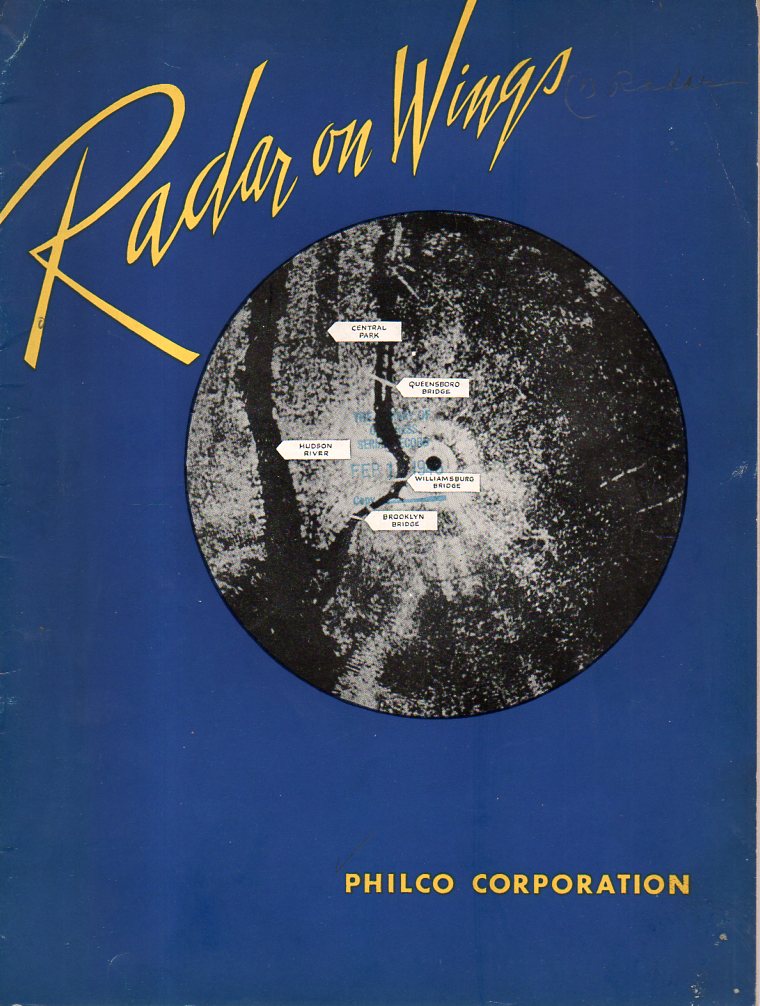
    RADAR on Wings, Philco, 1945.  10×8″, 30pp (unpaginated) with lots of photographs and an occasional schematic. Original wrappers.  Fine copy. Provenance: Library of Congress, with their very faded surplus/duplicate stamp on the front cover.  Only 7 copies located in WorldCat/OCLC.  $50

    Radar map nyc

    The history of RADAR (RAdio Deection And Ranging, and something I’ve always written in caps, for whatever that is worth) is absolutely not what I’m thinking about now–that is a long story with lots of twists and turns, complicated, complex–and it ranges depending upon location as for the most part RADAR (from the 1930’s anyway) was developed in secret, kept as a military secret.  And that’s because it was a very important development, with the victor of the Battle of the Beams being the possible victor, period.  

    Radar246

    All I want to do presently is note the significance of this particular pamphlet in the history of RADAR. This work was printed by PHILCO Corporation, (and dated January 4, 1946), and has an inserted leaflet stating that this “makes public for the first time the salient facts about the Corporation’s development and production of airborne radar equipment for the United States Army and Navy”.  PHILCO and other companies made significant contributions to the war capacity of the Allied forces, and–for this company in particular–much of that went unknown for quite some time afterwards, and of course there are some stories that just won’t get told. But for PHILCO the story gets told here.  

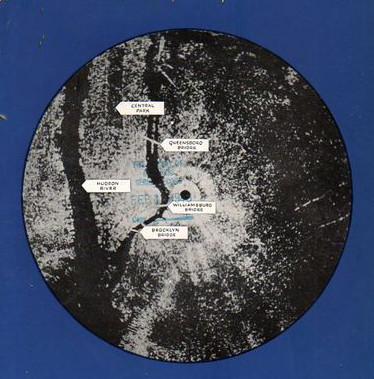
    This is also a fabulous nighttime map of NYC–produced by RADAR.  


    ·Posted by :

    ·in:


  • Early Work on the Telephone (1878)

     DUFOURCET, Eugene. Two very early papers on the telephone:

    Dufourcet218

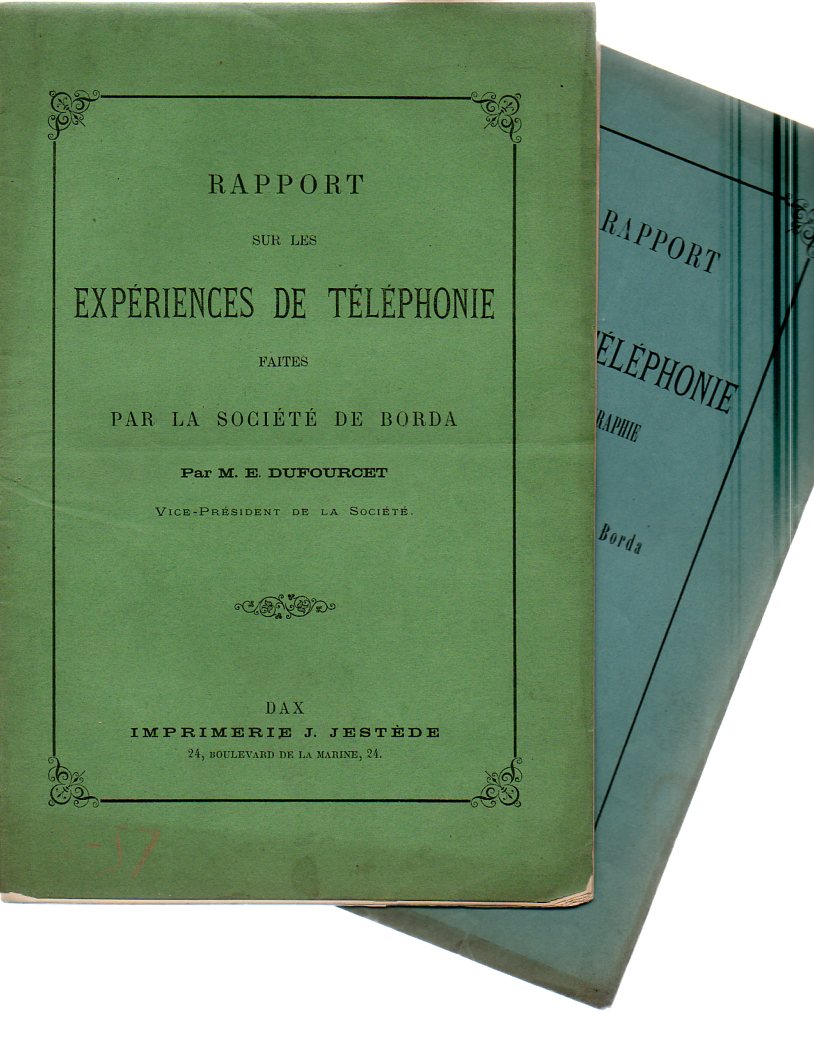
    _____. Rapport sur les Experiences de Telephonie…Dax, Imprimerie J. Jestede.  Printed ca. 1878.  14pp.  23x16mm.  Original printed wrappers. 

    with:

    _____. Deuxieme Rapport sur les Experiences de Telephonie, de Microphone et de Phonographie.  Dax:  Imprimerie J. Jestede,  ca1878.  1st edition. 23x16mm,  24pp, 2 plates.  Printed wrappers.  Very good copy; some evidence of a small tax stamp on front cover; small rubberstamped owner’s mark on rear wrapper.  Very scarce, early treatment on Bell’s telephone. Faites par Quelques Membres de la Societe de Borda.

    Both are signed presentation copy from Dufourcet, President of the Societie de Borda.  Nice copies, in Very Good condition.  

    Neither copy is located in WorldCat.   $750.00

    ·Posted by :

    ·in:


  • The World’s Most Beautiful 1930’s Work on Traffic Signals (?)

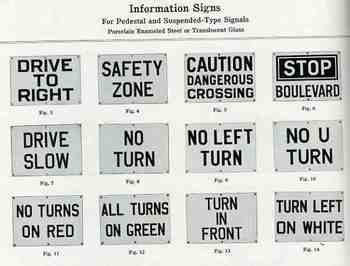
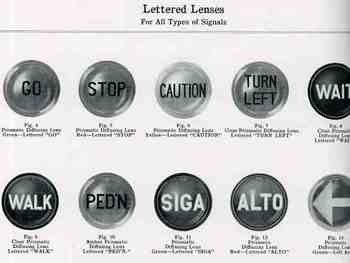
    • Is this *really* the most beautiful traffic signal catalog of the 1930’s? I don’t know, but it is (1) beautiful and (2) the only traffic signal catalog that I have ever seen.

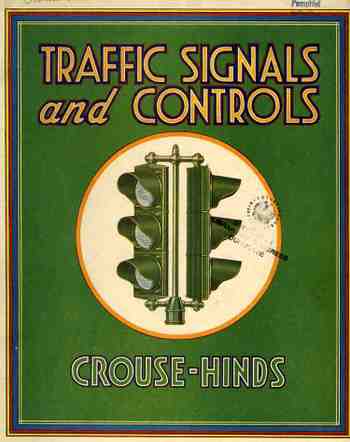
    Crouse-Hinds Company, Syracuse, NY: Traffic Signals and Controls. Catalog 226, December 1, 1936. 27x21cm, 130pp.

    Profusely illustrated. Includes the following section, each with a printed tab divider: traffic signals, 26pp; Beacons and Flashers, 6pp; timing switches, 16pp; traffic controls, 10pp; traffic flow regulator, 10pp; accessories, 12pp; ornamental poles, 10pp; signal replacement parts, 8pp; color sequences, 12pp;and two other sections for pricing.

    Heavy stiff decorated wrapper, brass tack bound, printed on glossy papers. Very Good condition. Provenance: Library of Congress, with their surplus rubber stamp on the front cover. Scarce: WorldCat locates 2 copies of this catalog; the next iteration (#227) has 14 listings in WorldCat; after this, there are no other listings for any other editions from Crouse-Hinds. Lovely! $250

    • These images are about as basic as it gets for the common, everyday, overlooked objects from the disappeared past. They come from the Course-Hinds manufacturer’s catalog for traffic lights and other control systems called, yes, Traffic Signals and Controls, published in Syracuse (NY) in 1936. It is a beautifully designed catalog—excellent illustrations laid out perfectly on their pages, with all of the data you’d ever need to order these things for your municipality. What I find so fascinating about the images here is that they depict ubiquitous objects that today would today—given their ephemeral nature—be exceptionally difficult to find. Given this catalog, today they are not. 

    Traffic signals

    Traffic signals _2_

    Traffic signals _3_

    ·Posted by :

    ·in:


  • Gilbreth on Making U.S. Hospitals More Efficient: “the entire structure upon which hospital management is built is wrong” (1914)

    Three rare papers by Frank Gilbreth and (the second) Gilbreth and his wife, Lillian .M. Gilbreth (Ph.D.). The three papers: $800

    First paper:

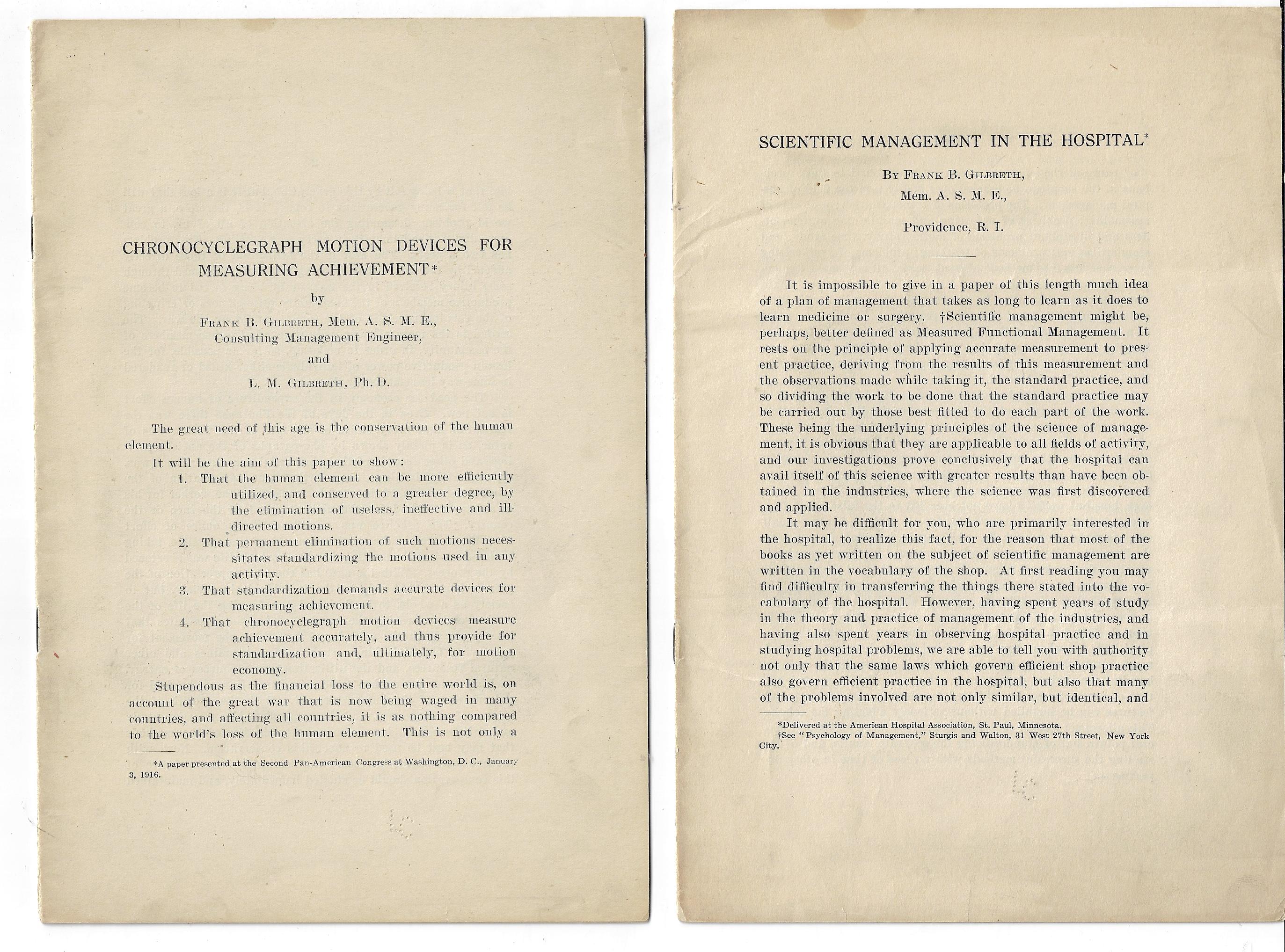
    Frank B. Gilbreth, “Scientific management in the hospital.” (“Delivered at the American Hospital Association, St. Paul, Minnesota”). 1914  (Scott Goodwin, in Mapping the Path to 21st Century Healthcare: The Ten Transitions Workbook, notes this paper as being published in 1914),  9.75 x 6.5″ , 10pp, paginated (1)-10. Original self-wrappers , with no “cover” per se. Condition:  There are two very old horizontal folds in the pamphlet, the indentation from which are almost indiscernible. Provenance: Library of Congress, with their 6mm “LC” perforated stamp on the front page, and the LC surplus/duplicate rubber stamp on the rear page. here is also a very faint and small rubber stamp on the bottom of page 2 stipulating “Gift/Author/[illegible]/191(6?)   There is no indication as to who published this paper, though I suspect it was by the Transactions of the American Hospital Association, vol. 16, for their Sixteenth Annual Conference, and printed on pp 483-492. This offprint version is mostly the same as the version that would be printed in the journal, except that the journal version has an organizational chart, and this paper does not. Overall, near-Very Good.  Scarce. 
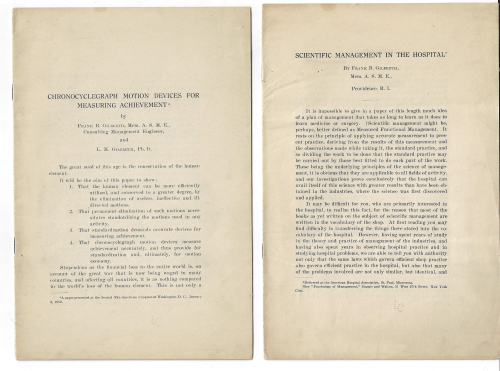
    Gilbreth paper

    Frank Gilbreth was a pioneer in scientific management–some think of him (and later, Gilbreth and his wife) along similar lines as F.W. Taylor, though the major difference that I can see is that Taylor would measure efficiency differently, using his methods to make the worker more effective by controlling his action; Gilbreth looked more at the methods and materials, and tried to achieve more or less the same results in efficiency though in a more worker-friendly attitude. 

    In this paper, Gilbreth makes a very very wide statement on how U.S. hospitals could benefit from his motion and materials analysis. His assertion was sort of remarkable, made in the closing sentences of the paper: 

    “Scientific Management will cause elimination not only of waste of materials, but of waste of human effort, which is, in the final analysis, the most pitiful waste of all.
    When your management becomes a science, there will result greater efficiency in you as individuals, and in the great work of the hospitals to which you all devote your lives.”

    “We have been very fortunate in obtaining the attention and interest of such well-known leaders as your President, Dr. Howell, and some of the other leading surgeons of this and other countries; but we have not, as yet, been able to obtain any action to amount to anything, because of the fact that the entire structure upon which hospital management is built is wrong. As the incentive, so will the result be, sooner or later. The incentive necessary to adopt the best from the industries does not exist at present.”

    Also from the Gilbreth paper:

    • ‘There are several concessions you must make at the outset before you can expect to do any valuable work in introducing the science of management into the hospitals. The first is you must submit to having accurate measurement applied to your present methods and practices. The second concession that must be made is the willingness to allow a man not trained in surgery to apply the measurement and determine the resulting standard. We can show you pictures which illustrate plainly the fact that standardization such as used under scientific management is today practically unknown…especially in the operating room.”
    • ‘When your management becomes a science there will result greater efficiency in you as individuals and in the great work of the hospitals to which you devote your lives’’.

    “The Gilbreths’ primary focus was on work performance and worker satisfaction. They conducted pioneering research in the fields of time and motion study. This covered the livelong search for ‘‘The One Best Way’’ in organising and executing work flows and processes…”  See: Frank and Lillian Gilbreth: scientific management in the operating room A Baumgart,1 D Neuhauser2 http://citeseerx.ist.psu.edu/viewdoc/download?doi=10.1.1.1023.2409&rep=rep1&type=pdf

    Second Paper:

    Frank B. Gilbreth and L.M. Gilbreth, “Chronocyclegraph Motion devices for Measuring Achievement” (“A Paper presented at the Second Pan-American Congress at Washington, D.C.m January 3, 1916″). 9.75 x 6.5”, 14pp.  Original self wraps (as above). This paper was written with Gilbreth’s wife, Lillian, who had just been awarded a doctorate in psychology and who was also one of the first women to practice in the U.S. with a doctorate in that field.) Condition:  There are two very old horizontal folds in the pamphlet, the indentation from which are almost indiscernible. Provenance: Library of Congress, with their 6mm “LC” perforated stamp on the front page, and the LC surplus/duplicate rubber stamp on the rear page. here is also a very faint and small rubber stamp on the bottom of page 2 stipulating “Gift/Author/[illegible]/1916”. 
    • “In the early 20th century, efficiency expert Frank Gilbreth used still and motion-picture cameras in place of a stopwatch to try to improve the efficiency, and thereby the effectiveness, of surgery.
    • “ One of its key figures was the industrial efficiency expert Frank Gilbreth (who) employed still and motion-picture cameras in his measurements, and he expanded his visual efficiency services — dubbed “motion study” — from industrial settings to the medical profession in the early 1910s. When he gained access to hospitals, Gilbreth transformed their operating rooms into efficiency laboratories, covering all available surfaces with gridded lines, and requiring the masked surgeons and nurses to don numbered or lettered caps to aid in his analysis of their movements across the axes of the surgical space…”
    • “Surgeons saw in motion-based efficiency study the potential to reduce, through faster operating procedures, their patients’ exposure to what was at the time a leading cause of patient deaths: ether. Furthermore, they found in the process both the challenge and assurance that the outcome of a surgical intervention lay quite literally in their hands. Improving the efficiency and precision of the surgeon was as important as ensuring the quality of the tools he held.”
    • Quotes from: Gainty, Caitjan, “Mr. Gilbreth’s Motion Pictures — The Evolution of Medical Efficiency”.The New England Journal of Medicine; Boston Vol. 374, Iss. 2,  (Jan 14, 2016): 109-111. 

    Third paper:

    Frank Gilbreth and Lillian Moller Gilbreth, “Motion Study and Time Study Instruments of Precision”. 9×6″, with 11 illustrations of the equipment and film samples. Printed 1915. Provenance: Library of Congress, with their 6mm “LC” perforated stamp on the front page, and the LC surplus/duplicate rubber stamp on the rear page. here is also a very faint and small rubber stamp on the bottom of page 2 stipulating “Gift/Author/[illegible]/1916”. 

    ·Posted by :

    ·in:


  • On the Creation of the NYC Subway System and the Urban Blight it was Supposed to Relieve (1884)

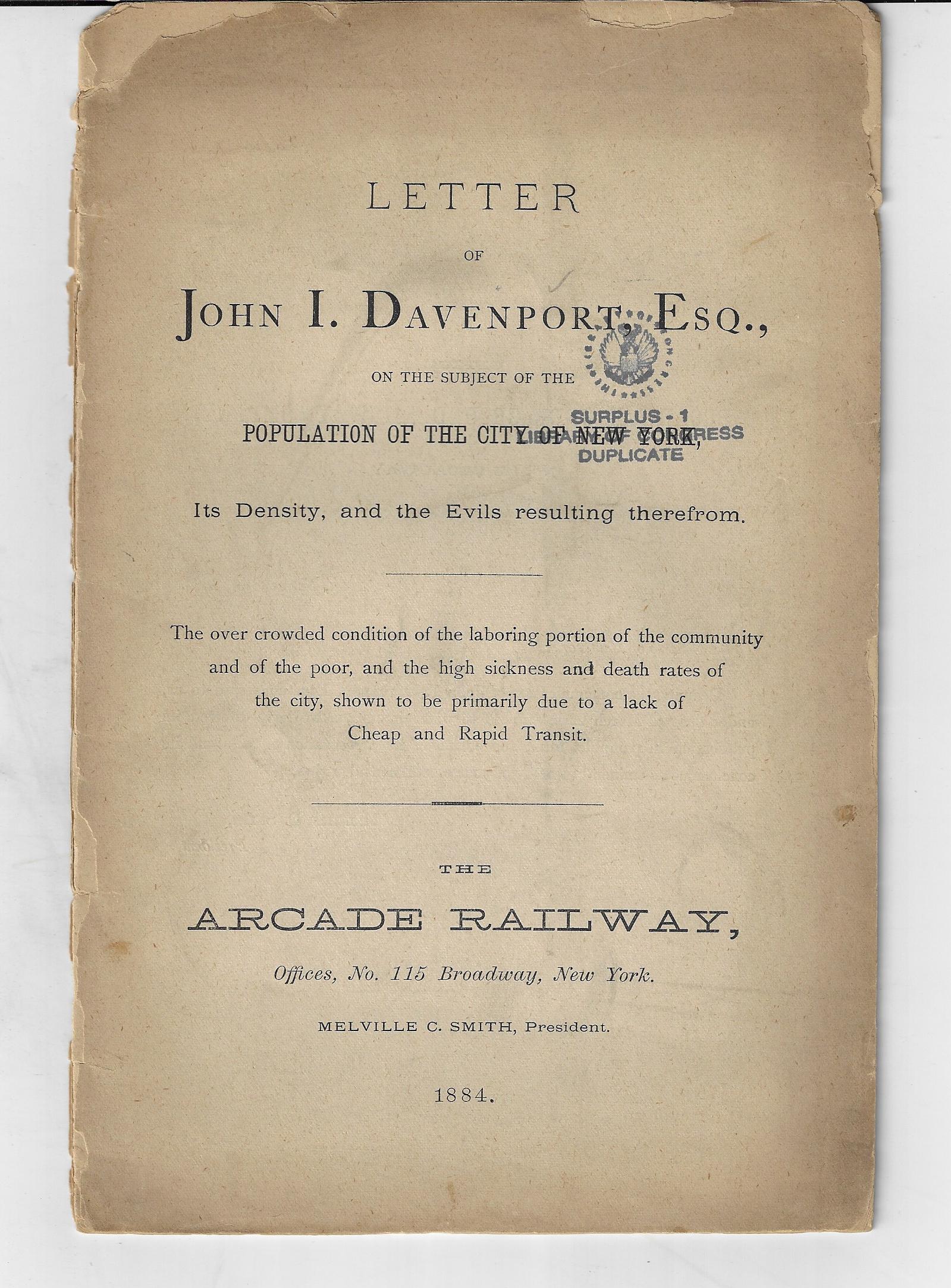
    Letter of John I. Davenport, Esq. : on the subject of the population of the city of New York, its density, and the evils resulting therefrom : the over crowded condition of the laboring portion of the community and of the poor, and the high sickness and death rates of the city, shown to be primarily due to a lack of cheap and rapid transit. The Arcade Railway, Melville C. Smith, President, 1884. 26x17cm, 23pp. Original wrapper. FAIR copy only, nearly disbound, with chips and browning, and some frailty to the text. On the other hand, this title does not show up very much at all, and is held  by only five WorldCat member libraries worldwide (LC, NYPL, NYHS, Columbia, Yale, Wisconsin Historical).  This document is interesting in its reporting of slum conditions in NYC (below 14th St., where almost half of the 1 million people of Manhattan lived), as well as being significant for its impact on urban planning. Again, this is a problematic pamphlet of some scarcity, so pricing is a little difficult–this is mind, I reckon $150.  

    Books davenport subway“Like almost all reformers of his time and social class, Davenport’s concern with the problem of the slums, creditable as it was, belied an even greater anxiety, indeed a fear, about the possible effects on the moral, social, and political character of American life of the “social disease” of the slum. As someone who devoted much of his life to the study and control of political corruption…And yet, in spite of his ideology, Davenport made a very good argument for a rapid transit underground railroad. In part, this was because he filled his pamphlet with a multitude of facts and figures about slum life… He knew all about the beginnings of the tenement-house slum in the early nineteenth century. He described how old single-family dwellings were converted into “tenant houses” for three or more families, and how, once landlords discovered that these converted houses yielded substantial profit in rent, they began to erect new houses designed especially as tenements — “buildings upon small lots, frequently two buildings, one in front and one in the rear of the lot, without the slightest attention being paid to the most simple and ordinary sanitary measures.” https://www.nycsubway.org/wiki/The_New_York_Rapid_Transit_Decision_of_1900_(Katz)

    “All of Davenport’s facts and figures were directed to the promotion of a subway. His thesis was both simple and true: that in New York public transit facilities always came too late to do any good. By the time they made their appearance — he had in mind the horsecars in the 1850’s, and the “els” in the 1870’s and 1880’s — rising land values, a further expansion of the business center, and a new and even more massive stream of immigration rendered these “improvements” useless with respect to the problem of the slums in the lower East Side. In the year he wrote, 1884, a subway was urgently needed, not only because the elevated trains did not provide true rapid transit, but also because a subway, if not built now but later, would be ineffective…”–Katz, again as above.

    ·Posted by :

    ·in:


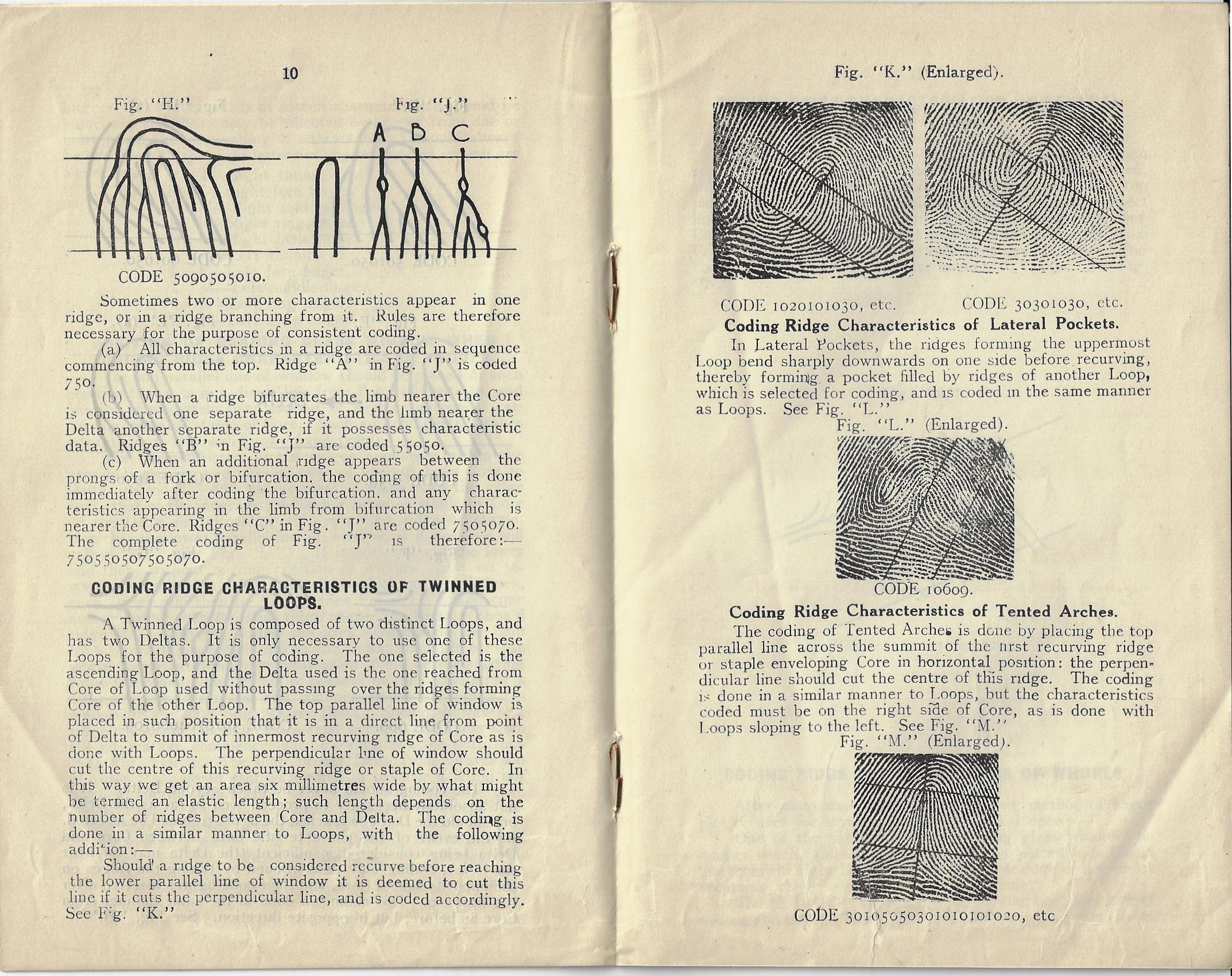
  • Early Electrical Transmission of Fingerprints in Crime Fighting (1921)

    Charles Stockley Collins. A Telegraphic Code for Finger-Print Formulae and a System for Sub-Classification of Single Digit Impressions. Published at the Office of the Police Chronicle, London, (1921).  9×6″, 17pp, with two plates and 15 illustrations/drawings in text.  Original wrappers. Provenance: Library of Congress, with their rubber stamp surplus/duplicate on the front cover, and their tiny 6mm perforated stamp on the title page.  A Very Good, crisp copy. 

    • There are only two copies of this work located in WorldCat/OCLC (Cornell and the British Museum); for all of what Mr. Collins accomplished, this seems to be his only publication outside of journals. $300

    The use of finger prints in identification is fairly old, used in Asia and India long before it became a popular practice in the West.  Also it seems that finger prints as forensic instruments occurs in literature before it occurred in actual police work. Mark Twain uses finger prints as essential legal elements (as well as comic relief) in his novels Life on the Mississippi (1893) and Puddn’head Wilson (1894), no doubt inspired by Francis Galton’s pioneering work on the subject (Finger Prints, published in 1892). Conan Doyle takes things a step further and describes the forging of finger prints, which I think was a brilliant idea.  All of this takes place before finger prints were more or less firmly established as an identifying tool, as the first conviction based on finger print evidence did not occur (in Great Britain) until 1902, while its weight in the conviction of murderers wasn’t felt until a first conviction was made using them in 1905 (and then 1910 in the U.S.). 

    Finger prints _1_

    Which brings us to these fascinating images of finger prints and their enumeration and transmission by wire,  which was the brainchild of the foremost finger print expert in the U.K., Detective Chief Inspector Charles Stockley Collins (M.B.E.), chief of the Finger Print Bureau at the New Scotland Yard.  I cannot determine how long in advance of this publication that he employed the idea of transmitting finger print data by telegraph, but it seems to be an excellent idea, sending important information relatively instantly over distances to help in conducting criminal investigation. It may be that this idea–far in advance of modern transmission practices, even though Arthur Korn’s first “facsimile” images were made as early as 1902–was seen at the time as both fantastic and obvious, the second impression coming almost immediately on the heals of the first, like one of those terrific ideas that seemed “obvious” once it was first stated. 


    ·Posted by :

    ·in:


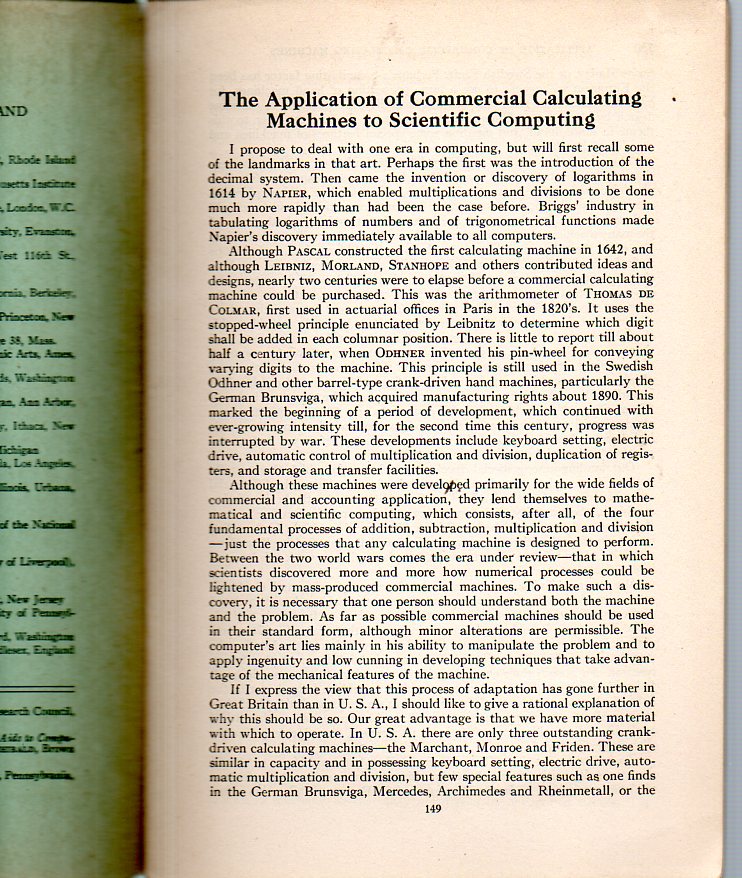
  • Early Paper on the Use of Commercial Calculators to Scientific Computing (1946)

    COMRIE,  Leslie.  “The Application of Commercial Calculating Machines to Scientific Computing”.  Washington DC:  National Research Council,  1946.  1st edition.  Mathematical Tables and other Aids to Computation, II/16  Pp 149-196  8vo.  Original printed wrappers.  Very good condition.  Original owner’s name has been rubber stamped twice on the cover.  $250

    Comrie MTAC449

    This pamphlet is offered in its original green wrappers for the month of October 1946.  “Comrie pioneered the use of commercial accounting machines in scientific applications, especially in the production of mathematical tables. The above article describes the first use of a punched-card tabulating system in a purely scientific application. The following on Comrie from Columbia University: Leslie J. Comrie, Ph.D, (1893-1950): astronomer and pioneer in mechanical computation, born in Pukekohe, New Zealand, and educated at Auckland University College, University College London, and Cambridge University, where he received a Ph.D. in astronomy.  Like his American contemporary, Columbia University Astronomy Professor Wallace Eckert, Comrie was a pioneer in the application of punched-card machinery to astronomical calculations and the production of astronomical and mathematical tables: the first scientific use of these machines, which had been designed purely for business use.”

    ·Posted by :

    ·in:


  • Hopkinsonjohnoriginal Papers By The Late John Hopkinson Volume I Technical Papers Volume Ii Scientific Papers Cambri

    HOPKINSON,  John.  Original papers by the Late John Hopkinson . Volume I: Technical Papers; volume II, Scientific Papers. 

    Cambridge:  Cambridge University Press,  1901.  294+390pp  8vo.  Cloth.  Very fine condition.  But for a small smudge on the spine of volume one, this is a superior set. $200

    “In addition to having been elected fellow of the Royal Society at twenty-nine, he was twice president of the Institution of Electrical Engineers. At the age of forty-nine Hopkinson, with three of his children [another, Bertram, wrote the 58-page Biography in this volume], was killed in a mountain climbing accident in the Alps” –Bern Dibner in D. S. B. VI: 504). Some of the contents of interest: On Electric Lighthouses, pp 6-33; On Electric Lighting, pp 33-56; and Dynamo-Electric Machinery pp 84-121.  

    ·Posted by :

    ·in: