A Daily History of Holes, Dots, Lines, Science, History, Math, Physics, Art, the Unintentional Absurd, Architecture, Maps, Data Visualization, Blank and Missing Things, and so on. |1.6 million words, 7500 images, 4.9 million hits| Press & appearances in The Times, Le Figaro, Mensa, The Economist, The Guardian, Discovery News, Slate, Le Monde, Sci American Blogs, Le Pont, and many other places… 5000+ total posts since 2008.

Book Category: Social History

  • A Pre-Marconi (?) Plan for Wireless Communication (1893)

    Nikola Tesla, “On light and other high frequency phenomena”, in Journal of the Franklin Institute, vol 136 #1, July-December 1893. The Tesla article appearing in six sections” pp 1-19, 81-98, 161-177, 259-279, 351-360, and 401-412. Altogether 93pp with 34 text illustrations. Offered in the full volume of 482pp (plus a number of folding maps and tables at the end for Pennsylvania weather records. Condition: bound in half-calf with considerable scuffing to the spine; also, the rear board is nearly detached. This is an ex-library copy, with stamps on the title page as well as a bookplate. Good, sturdy copy, with some good and attractive life left in the binding. $650

    • “This was a lecture delivered before the Franklin Institute, Philadelphia, February 24, 1893, and before the National Electric Light Association, St. Louis, March 12, 1893, republished many times after publication in the Journal of the Franklin Institute, July, Aug., Sept., Oct., Nov., Dec. 1893.”

    “What Tesla described in this lecture should be taken to be the foundation of radio engineering, since it embodied the following principles and ideas of fundamental importance, namely: the principle of adjusting for resonance to get the maximum sensitivity in a selective reception, inductive link between the driver and the tank circuit, an antenna circuit in which the antenna appears as a capacitive load…”–“Nikola Tesla and his Contributions to Radio Development”, in History of Wireless, by Tapan K. Sarkar, Robert J. Mailloux, Arthur A. Oliner, 2006; chapter 5. Wiley-IEEE Press.

    “In February 1893 Tesla delivered a third lecture on high-frequency currents before the Franklin Institute in Philadelphia and repeated it in March at the National Electric Light Association in St. Louis. In the first part of the lecture he described a ‘method of conversion of low fiequency AC or DC current into high-frequency currents, all based on using spark gap discharge’. Just as in the previous two lectures he performed again many experiments with high frequency currents and various resonant circuits, illustrating that the current can pass through an open circuit consisting of a coil connected to a terminal of a generator and an insulated plate. Today specialists can easily build circuits used in these experiments but in 1893 they were fascinating and novel. The most significant part of this lecture refers to a system for “transmitting intelligence or perhaps power, to any distance through the earth or intervening medium”.

    Sarkar then quotes Tesla from the lectures:

    “On wireless energy transmission, Tesla made the following remark in the demonstration of high frequency driven motors by a single wire:

    • ‘It is quite possible, that such ‘hot wire” motors, as they might be called, could be operated by conduction through the rarefied air at considerable distances. Alternate currents, especially of high frequencies, pass with astonishing freedom through even slightly rarefied gases. The upper strata of air are rarefied, To reach a number of miles into space requires the overcoming of difficulties of a merely mechanical nature. There is no doubt that with the enormous potentials obtainable by the use of high frequencies and oil insulation luminous discharges might be passed through many miles of rarefied air, and that, by thus directing the energy of many hundreds or thousands of horse-power, motors or lamps might be operated at considerable distances from stationary sources’.”

    “Before passing on to consider the final phase of wireless communication, as represented by Marconi, mention must be made of one other pioneer, Tesla, who worked perhaps in a less spectacular manner than those who gained a certain amount of publicity. Tesla ’s early efforts are often overlooked, and it is only fair that his name should be mentioned so that he may share in the credit due to the early investigators. TesIa experimented early in the problem of transmitting energy without wires. In February 1893 he advanced a plan of wireless transmission and expressed his conviction in a lecture at the Franklin Institution that “it certainly is possible to produce some electrical disturbance sufficiently powerful to be perceptible by suitable instruments, at any point of the earth’s surface” –Ellison Hawks, Pioneers of Wireless, London: Methuen & Co. Ltd, 1927, found in Sarkar “Nikola Tesla and his Contributions to Radio Development”, in History of Wireless.
    ·Posted by :

    ·in:


  • Circassia and Daghestan, 1919

    [Bammate, Haidar}  Circassia and Daghestan. Printed at Lausanne, Imprimeries Reunies, (1919). 9×6″, 15pp. Original wrappers. Good condition.  Scarce: it looks like there are only 3 print copies located by WorldCat. $125

    • Provenance: “Bureau de Presse Nord-Caucasien, Paris”, and then the Library of Congress (with the LC surplus/duplicate stamp on front wrapper upper right corner

    “Translated in part from the “Probleme de Caucase” in la Revue Politique Internationale, vol 10, Nov-Dec. 1918.”–Hoover institution on war, revolution and peace (Stanford, Calif.), A Catalogue of Paris Peace Conference Delegation Propaganda in the Hoover …”, p 30

    ·Posted by :

    ·in:


  • “Why Must the Agony of the Jewish People be Prolonged?” (1944) Another Episode in the Abandonment of the Jews in WWII

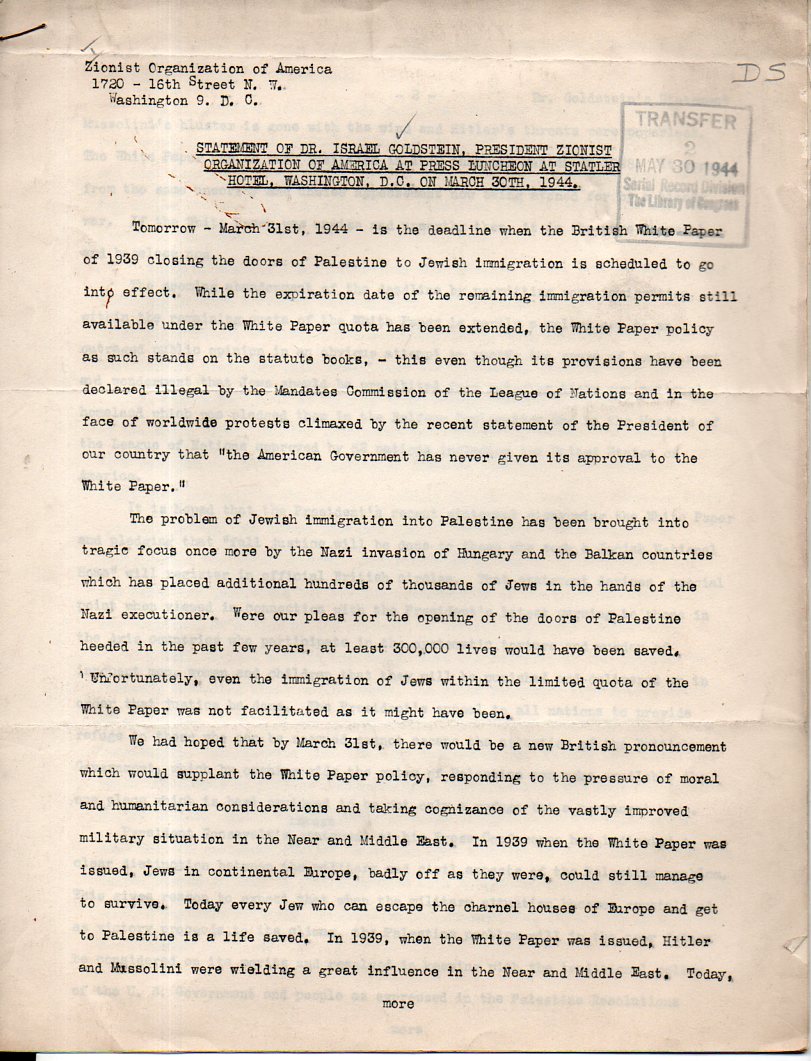
    Israel Goldstein. Statement of Dr. Israel Goldstein, President Zionist Organization of America, at Press Luncheon at Statler Hotel, Washington, D.C., on March the 30th, 1944.  Offset printed by the Zionist Organization of America, 1720 16th St, NW, Washington DC. 11″x8.5″, 4 leaves.  Provenance: Library of Congress. Two old horizontal folds. Rare.  $750

    Goldstein _1_543 detail

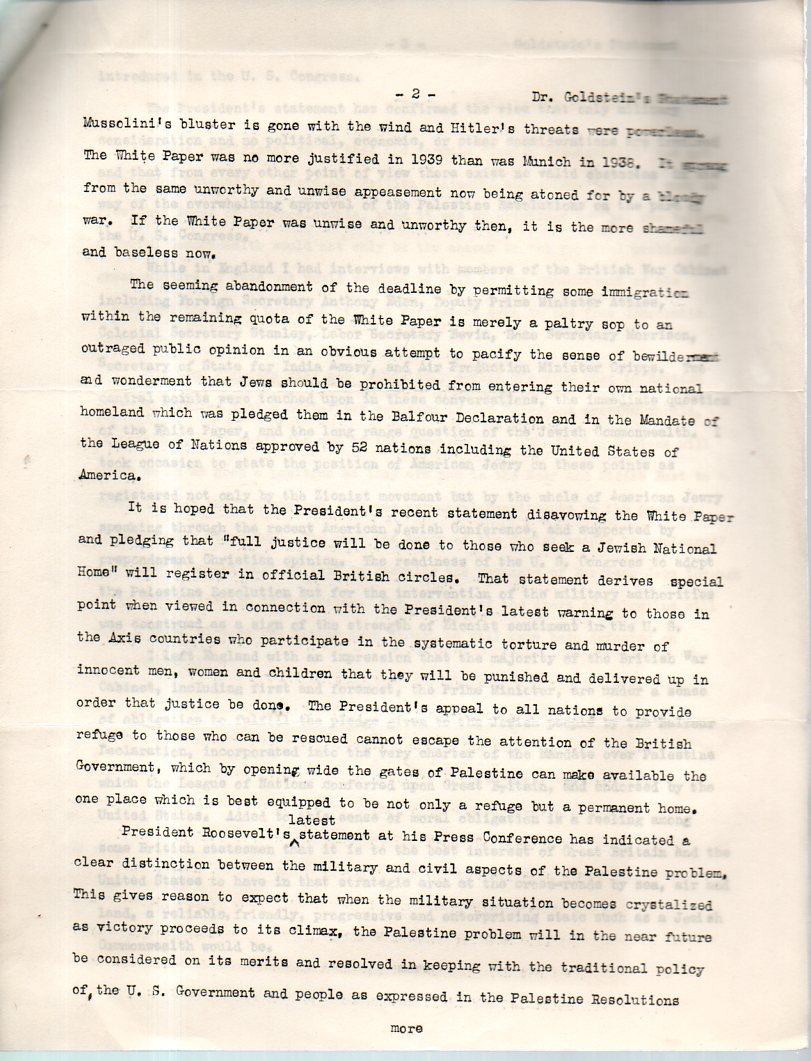
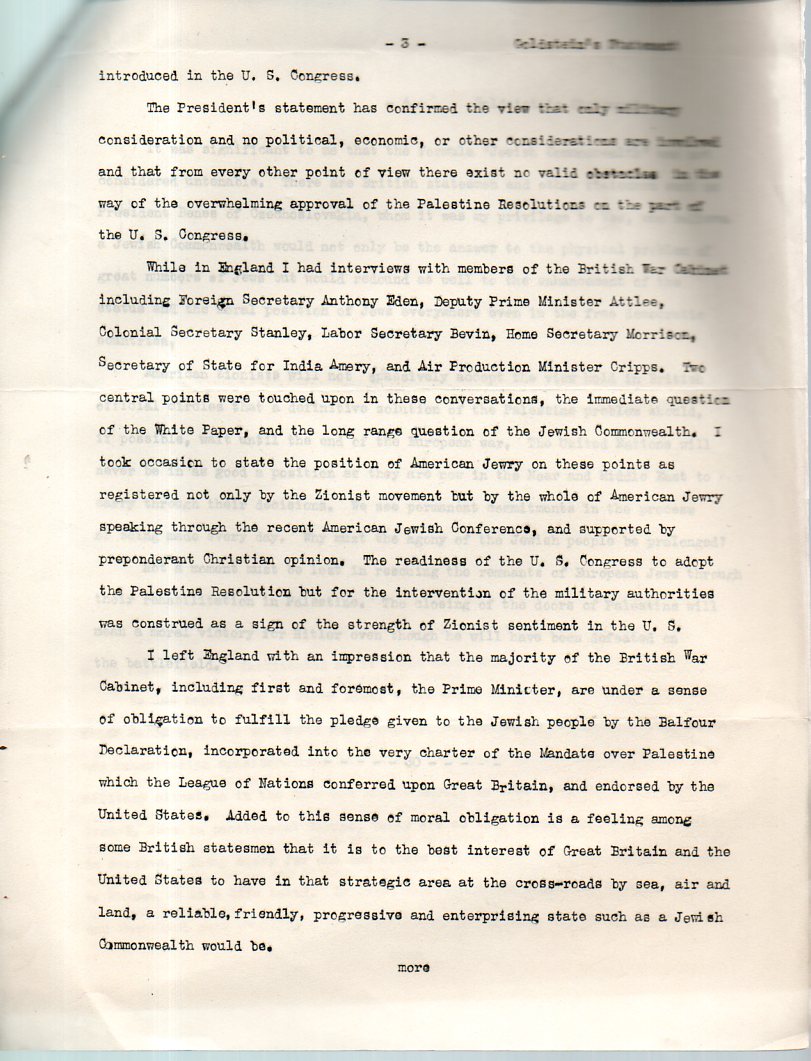
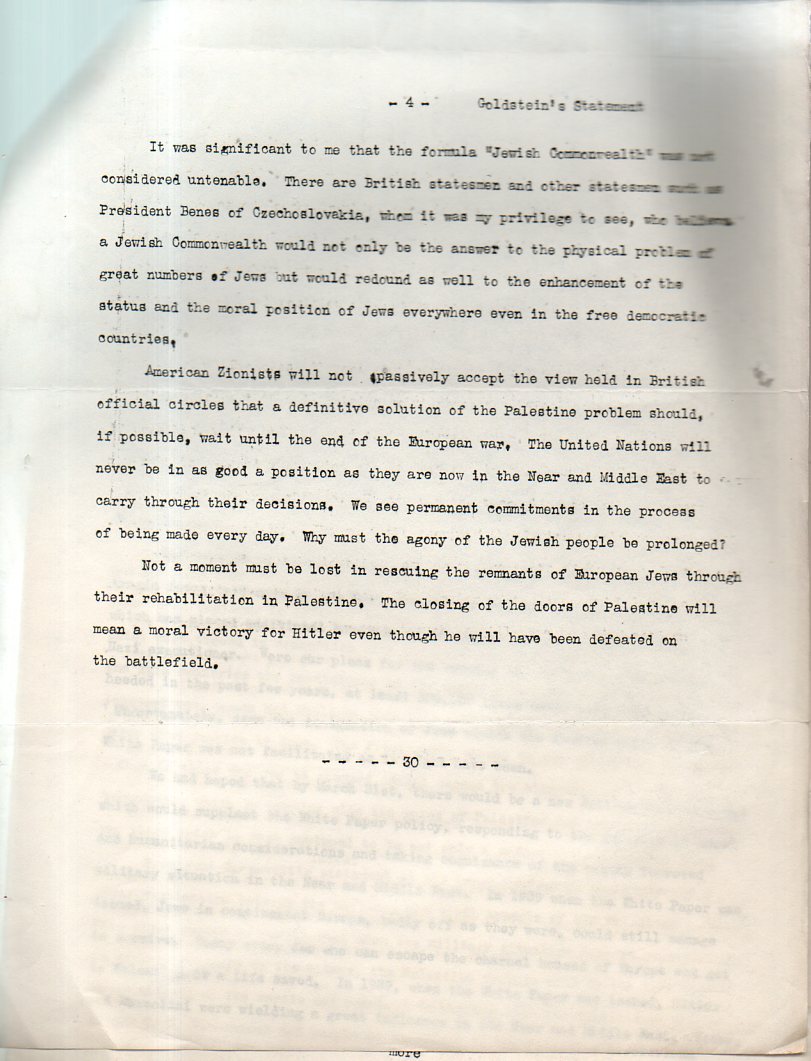
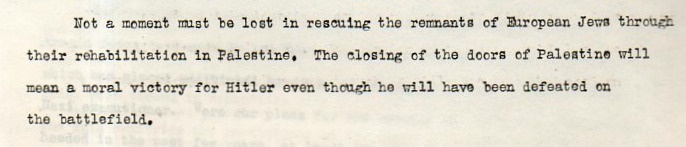
    This quote is from (Rabi) Israel Goldstein as head of the Zionist Organization of America appeal and addresses the British White Paper of 1939 on Palestine and allowing Jews to immigrate to escape “the hands of the Nazi executioner” in Europe, which amongst many other things  limited Jewish immigration to 75,000 for 5 years (1939-1944) with limits of further immigration to be determined by the Arab majority. “Were our pleas for the opening of the doors of Palestine headed in the past few years, at least 300,000 lives would have been saved. Unfortunately, even the immigration of Jews within the limited quota of the White Paper was not facilitated as it might have been” wrote Goldstein in this address.  

    There is a long and complicated history to the White Paper but suffice to say that while millions of Jews were being slaughtered in Europe the restrictive White Paper remained in place, which meant that the haven for escape to Palestine was largely closed relative to the numbers of people needing to be saved, and that at the end of the war there were still 3000+ visas that hadn’t yet been granted. Goldstein makes the case for the extreme peripheral usefulness of the Paper in 1939, but in 1944 when the Axis influence in the Middle East was  extremely minor adhering to the white Paper was a tragedy: “if the White Paper was unwise and unworthy then, it is more shameful and baseless now” he wrote.1 (“The Provisional Council of Israel’s first constitutional act [in 1948] was a Proclamation that “All legislation resulting from the British Government’s White Paper of May, 1939, will at midnight tonight become null and void.”–Wiki on the White Paper of 1939.) 

    Goldstein hoped for a change in the policy–there would be none.

    • Israel Goldstein (June 18, 1896 – 1986) was an influential Jewish leader in the U.S. and worldwide as a Rabi (and head of the New York Board of Rabis), head of the Jewish National Fund (elected in 1933), head of the Zionist Organization of America (elected 1943), and one of the founders of Brandeis University.  The full text of the publication–which was printed sometime between March 30, 1944 and May 30, 1944–is included below.  I can find no mention of the communication online.  

    Notes

    1. Goldstein wrote in his memoirs that the rules and restrictions of the White Paper on Jewish immigration were being “rigidly and brutally enforced”. —My World as a Jew: The Memoirs of Israel Goldstein, Volume 2, pg 47.

    [“Like another black curtain about to be rolled down upon the last hope of escape, the White Paper of 1939 ominously threatens to close all further migration to Palestine,”–Judge Morris Rothenburg, Jewish Telegraphic Agency, http://www.jta.org/1943/09/13/archive/dr-israel-goldstein-elected-president-of-zionist-organization-of-america]

    Goldstein _1_540

    Goldstein _1_541

    Goldstein _1_542

    Goldstein _1_543

    ·Posted by :

    ·in:


  • On the History of Kindness to Children (1687)

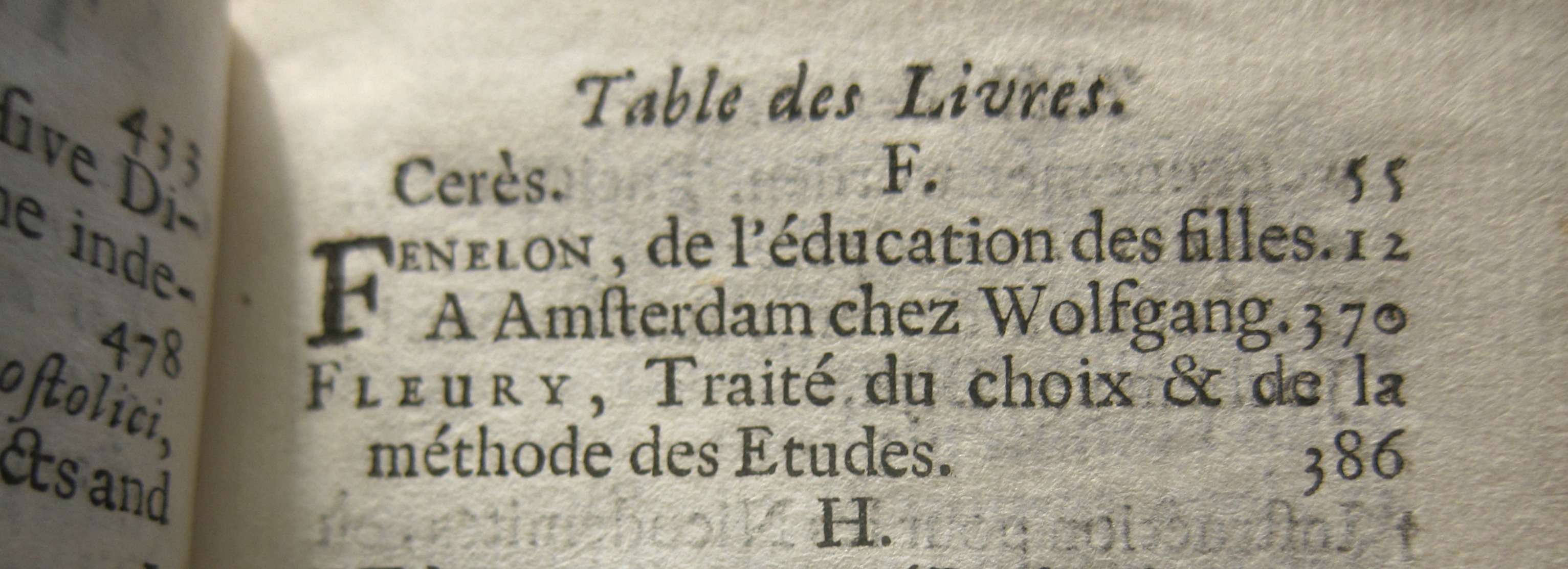
    Fenelon (François de Salignac de La Mothe- Fénelon) Education de filles, pp 37-378. In: Jean Le Clerc and Jean Cornande de al Crose, Bibliotheque Universelle et Historique de l’annee M.D.C. LXXXVII, volume 6. Published in Amsterdam; Wolfgang, Waesberge, Boom, & van Someren. 1687. 5.5”x3” (viii), 561, (28)pp, with one small folding plates. Nicely bound in full vellum Very good copy, with just a small chip in the vellum at spine bottom. SOLD

    Bibliotheque Universelle 1687

    Another piece of great serendipity fell from the sky, again this week, this time on the idea of the history of childhood–more accurately, it is on the history of kindness extended to children. The idea of looking at childhood in that way lies in the work, for example, of Phillipe Aires (Centuries of Childhood, first French edition 1960) and Lloyd deMause (The History of Childhood, 1974), among others, who maintain that kindness towards children is a modern invention. (This is kind of wildly brief statement of this idea–suffice to say though that the treatment of children through long history has not been necessarily “kind”. For example, the word “childhood” appears only twice in the Bible (KJV), and really only once in reference to what childhood might have been rather than a simple statement regarding a period of human life. That occurs in Ecclesiastes 11:10: “Therefore remove sorrow from thy heart, and put away evil from thy flesh: for childhood and youth are vanity.” This is in line with an older variety of that book, the Cloverdale Bible, in Ecclesiastes xii. “A   Childehode and youth is but vanite” which again makes the point of childhood being something to get away from rather than a chance to improve the life of the new person. The Oxford English Dictionary takes the word back to Middle English times, but even into the 19th century I can’t really point to an applicable use of the word in connection to this discussion.)

    The issue came up while listening to a public reading by my wife’s favorite living author, Richard Powers. He was taking questions after a lovely read from his newest, called “The Overstory”, when a question came to him regarding human-like senses in animals. Powers responded saying that all was possible, seeing as how people question those human qualities in other human beings. He used the term “Anthropomorphism of Man”, which I found fantastic, as he was correct. For centuries certain people simply weren’t regarded on the same human level as other people (those people doing the judging). For example, in the U.S., women, African Americans, the poor, Asians, and so on from a long list, have only recently been elevated to the prospect of “sameness” with those in power in this country. Before this, they were something “lesser”. And it was here that Powers offered “children” as not being children, not even a full human, for most of the history of humans, and so only recently come into their own as full humans.

    Then came the serendipity.

    I was browsing through one of the 30 volumes or so of an Amsterdam-published 17th century magazine/journal called Bibliotheque Universelle looking for articles of scientific interest. There’s a lot in these little bricks of books, and they do have some occasionally good (and great) scientific efforts in them, the one I was working on, one of several volumes for the Principia year of 1687 (July 5), yielded nothing of any great sci-interest in its 500+ pages. Then, I spotted it, just a simple four lines of 6-point type in the 5”-tall book: “Fenelon, de l’Education de filles…” That’s François de Salignac de La Mothe- Fénelon, of Telemachus (son of Ulysses, etc.) fame, and his book was on the education of daughters. It was published the year before, in 1686, and the editors of the Bibliotheque gave it eight pages or so of review and explanation.

    It seems to me from this reading that in this account—really on education of children in general–M. Fenelon was an advanced thinker, a human human-rights person, treating children and their education as individuals, with understanding, and kindness.

    Evidently the man speaks to curiosity and rational amusement in the book—that curiosity must precede the rational, and that one must be careful in doing that, because there is a danger of “imitation”–curiosity is the thing that banishes ennui.

    At the same time instruction must be realistic, so that once mature and grown that the real world is not a total shock, and that once subjected to the daily routine of “housewifery” there will be no denouement from the dreams of childhood—all of that seems like a pretty sticky wicket. Fenelon did seem to insist on the beginning of education from infancy, but not to overdo the instruction as that would “oppress the facilities”.

    Perhaps the most surprising positive thing of them all to me was Fenelon’s insistence on being careful with your words with the mature child, and to never be guilty of a falsehood with children, which is pretty good and sane advice.

    There’s other stuff that doesn’t translate any longer into where we are today, but there seems to be a lot of material that is timeless.

    On the Bibliotheque: “Like its great rival, Pierre Bayle’s Nouvelles de la re´publique des lettres, it [the Bibliotheque…] was a source of information and means of communication for members of the nascent Republic of Letters. It was also one of the remote ancestors of the modern academic journal, though much less specialised than most of its successors.”J.R. Milton, “Locke’s Publications in the Bibliothèque Universelle et Historique”, British Journal for the History of Philosophy, 05/2011, Volume 19, Issue 3

    Editors and contributors included: Jean Le Clerc et Jean Cornande de al Crose, vols 1-9; Jean Le Clerc, 10, 12, 14-19; Jean Cornand de La Crose, vol 11; Charles le Cene and Jean Le Clerc, vol 13; Jacques Bernard and Jean Le Clerc, vol 20; Jacques Bernard, vols 24-5. The journal was published every 4 months in vols 1-3; every 3 in 4-19, and then twice a year for 20-25.

    ·Posted by :

    ·in:


  • Rescuing the Fallen Women of London, 1851

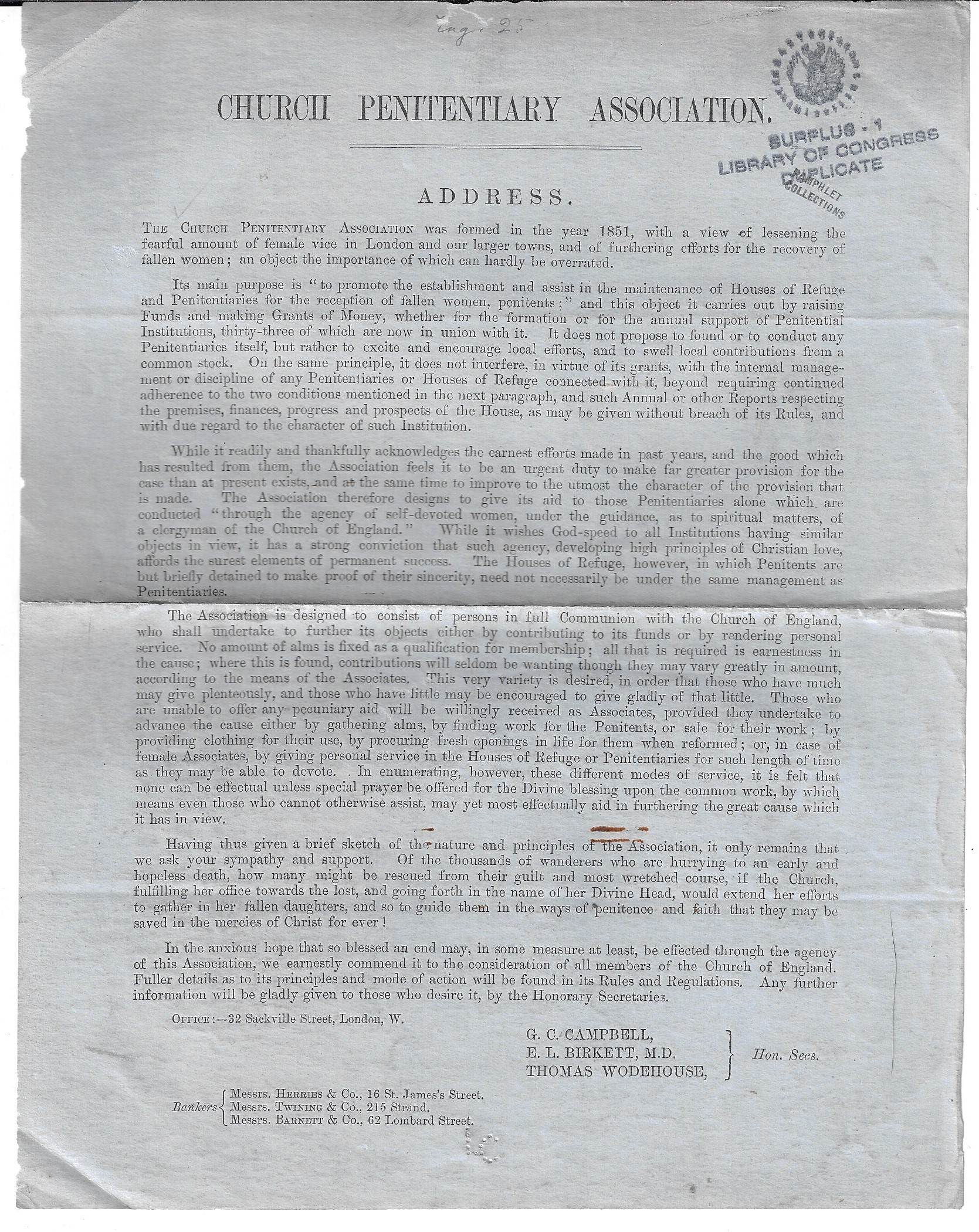
    Church Penitentiary Association, Address.  10×8″ leaflet, printed on one side only, folded. London, ca. 1851.

    Nice copy. Provenance: Library of Congress, with their tiny 6mm “LC” perforated stamp at bottom and the LC surplus/duplicate stamp on upper right corner.  (Given the library from the Philadelphia Free Library in 1943. $125

    This is a circular to introduce the association and solicit money for support. The Church Penitentiary Association was “…formed with a view of lessening the fearful amount of female vice in London and our larger towns…”

    • “…House of Refuge and Penitentiaries for the reception of fallen women, penitents…designed to consist of persons in full Communion with the Church of England”.
    • “Of the thousands of wanderers who are hurrying to an early and hopeless death, how many might be rescued from their guilt and most wretched course, if the Church, fulfilling her offices towards the lost…would extend her efforts to gather in her fallen daughters, and so guide them in the ways of penitence and faith that they may be saved…”

    Scarce.

    Church penitentiary

    “The original Church penitentiary for the reclamation of fallen women was founded in 1806 in London, the most well known centre was set up by former British prime minister William Ewart Gladstone in 1848. Its aim was the convent-based rehabilitation of women, including prostitutes, thieves, the homeless, alcoholics etc. They were charitable organisations and not in place for the punishment of crimes. The Church Penitentiary Association existed from 1852 until 1951. There are records on the association in the Library at Lambeth Palace, the seat of the Archbishop of Canterbury in London, and in the National Archives.”–Wikipedia

    “ The Church Penitentiary Association was founded in 1852 and affiliated with the Church of England.  The association was part of a movement to provide places of rehabilitation and shelter for destitute citizens such as prostitutes or homeless people. The penitentiaries were similar to Catholic convents in that the penitents were to remain celibate while they were in the penitentiary. As was evidenced by Rossetti’s “Goblin Market” there was a strong sense of sisterhood amongst the women and a mutual encouragement to keep from the temptation of the outside world. Often times the leadership of the penitentiaries would not allow women to leave the grounds of the institutions. The penitentiaries were met with some hostility from the English public. Most of the time their criticisms were informed by their anti-Catholic views, comparing the penitentiaries to Catholic convents. The movement helped extinguish the epidemic of prostitution in England and played a part in the larger reform efforts of the Victorian period.”–”Christina Rossetti and the Church Penitentiary Movement, November 22, 2013 by Chris Kennedy

    ·Posted by :

    ·in:


  • A Summer Camp for Brooklyn City Kids, 1908

    Brooklyn Italian Settlement, Conclusions on the Settlement Camp at New Canaan, Ct., 1908. Published at the Settlement House, front Street, Brooklyn, NY. 7×5″, 9pp. Original wrappers. Good copy, only. Scarce. $45 

    “WORK AT SETTLEMENT CAMP. Children for First Time Close to Nature ‘Is This the Same Sun That Shines on Front Street?’ A little pamphlet [the one described above] describing some of the work of the Settlement Camp at New Canaan. Conn., conducted by the Italian Settlement whose house is at 29 Front street, has been issued. It is an interesting interesting story, and one which will appeal to many persons. The settlement camp is an old farm of 45 acres, on which is an old barn half full of hay, a small new house, several apple trees, a big and interesting interesting woods, full of oak, ash and hickory trees, brooks and springs, berries and nuts, with a swimming pool, and various wood folk. Here the leader, Fred McCollum, erected four tents, while Miss Errlco had charge of the house and the girls. Between June 29 and September 2 there were 180 persons at the camp for a longer or shorter period. The average stay of the boys and girls was ten days. Here is a Quotation. amusing but pathetic: “From Stamford the trip to New Canaan was by train, and thence to the camp by wagon. At first the breadth of the sky, the panorama of the hills, the darkness of the night, the cries of the screech owl and… created an Impression too strong for comfort. It seemed to take jr the youngsters’ breath and rendered then strangely silent. For these children children knew nothing of nature; girls of 12 talked of picking up apples from the floor meaning the ground, and again and again asked: ‘Is this the same sun that shines in Front street?” —Brooklyn Eagle, October 1, 19078, pg 4, courtesy of the great Brooklyn Public Library.

    ·Posted by :

    ·in:


  • Booze and the Lack of It, 1931

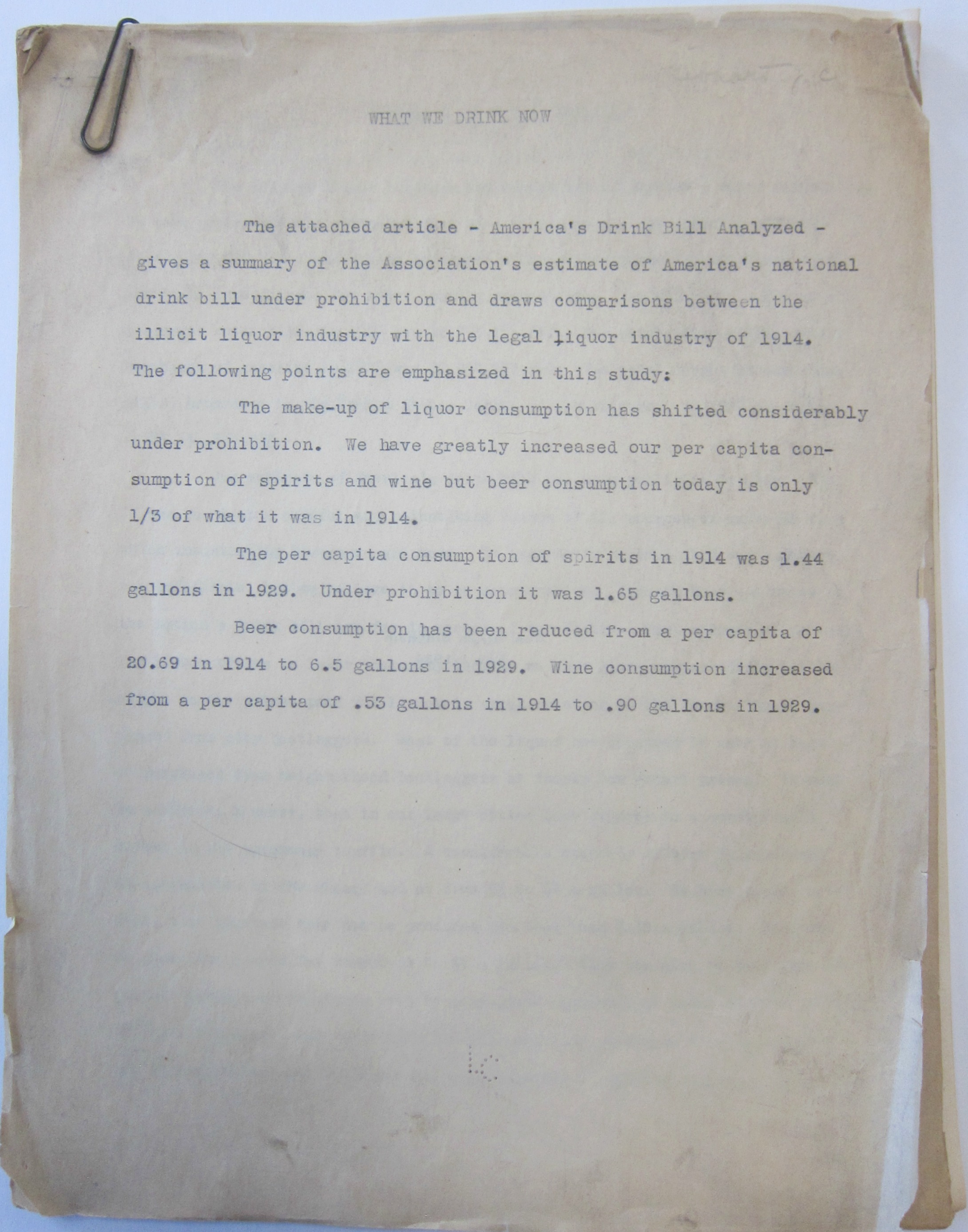
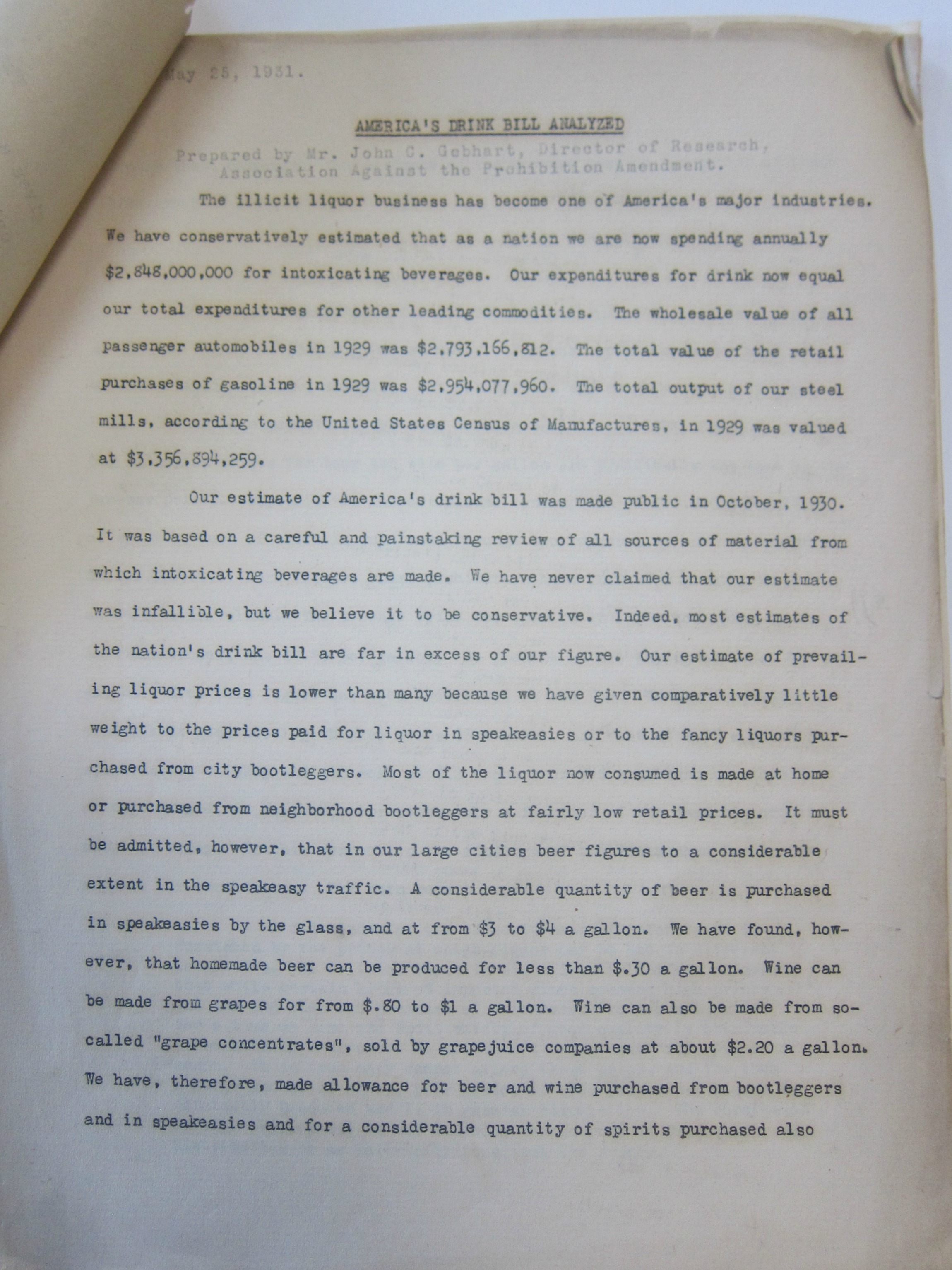
    John C. Gebhart. “What We Drink Now. America’s Drink Bill, Analyzed.”

    11×8.5″, offset printed on sheets, 14pp. Dated May 25, 1931.  Provenance: the copy of explorer, Senator (CT), and Mayan expert Hiram Bingham, via the Library of Congress; the paper-clip-bound sheets have a small gift notice from Bingham on the back of the first sheet, plus the LC’s surplus stamp on the back page, and the small perforated “LC” on the first/front leaf. Outside of  little edge wear and dusting to the first sheet, a VG copy.

    Americas drink bill _1_Gebhart was the Director of Research for the Association Against the Prohibition Amendment. Founded by William Slayton, the AAPA “…was the leading political pressure group helping to secure repeal of the Eighteenth Amendment to the U.S. Constitution. Historians credit the AAPA with fostering Republican-Democratic polarization on the issue, giving repeal greater respectability, and greatly speeding up the repeal process…The Association Against the Prohibition Amendment (AAPA) was the leading political pressure group helping to secure repeal of the Eighteenth Amendment to the U.S. Constitution. Historians credit the AAPA with fostering Republican-Democratic polarization on the issue, giving repeal greater respectability, and greatly speeding up the repeal process.”–Encyclopedia dot com

    Gebhart’s work was one of numbers, and didn’t concentrate at all int he reasons–many of which were sound–for the 18th amendment in the first place. He points out the U.S. alcohol consumption was actually up, from 1.44 gallons in 1929 to 1.65 gallons in 1931. In some compelling comparisons, he writes the illicit liquor produced more sales than wholesale auto sales figures (per year), and about 2/3 “the total output of our steel mills”, and that making booze was a flourishing industry that produced massive amounts of crimes (citing Al Capone) and no tax revenue. Anyway there’s 14pp of similar evidence, which I guess helped bring about the repeal of the 18th amendment with the adopted of the 21st in December 1933.  

    Americas drink bill _2_

    ·Posted by :

    ·in:


  • Report on Fire Conditions in the Dress and Waist Industry, NYC, 1913–Not So Good…

    “The matter of fire protection in loft buildings, it must be remembered, is only a recent problem…”

    [PRICE, George Moses] Special Report on Sanitary Conditions in the Shops of the Dress and Waist Industry, a Preliminary report made by the Joint Board of Sanitary Control in the Dress and Waist Industry. No date (but I assumed this to be 1913), published by the Board of Sanitary Control, New York City. 9×6, 24pp. Condition: supplied with original wrappers which are detached and chipped; the text block however is in Very Good condition, and relatively bright. Provenance: Bureau of Mines.

    There are 7 interesting tables on the area and location of shops, number of shops and people operating at the 6th floor and above; fire protection;light, ventilation, dressing, washing, and toilet facilities; and general cleanliness. 

    WorldCat/OCLC locates NO copies. $125

    This report was published two years after NYC’s still-worst industrial disaster, the fire at the Triangle Shirtwaist Factory, March 25, 1911 at Washington Place and Greene Street, in which 146 people were killed, and of course the board found many safety issues among the 700 businesses surveyed. It was found that there were 319 shops employing 18,417 people located on the 6th story and above of high rise buildings, with little attention spent to fire safety and egress–this was significant as NYFD ladders could only reach to about the 6th floor; it was in the Triangle fire where the fire started on the sixth floor and then trapped many people on the 9th and 10  floors of the building (10% of the works in 1913 worked above the 10th floor).

    That said, the report states that in general businesses in this sector were in better condition and more healthy than many, though that statement so far as I can tell was not substantiated. So far as responding to fire, though, the businesses were not at a “standard”, finding for example that in most shops there was no instruction on how to react to a fire and had no proper safeguards from panic, and that 30% had doors that opened IN, and that there were basically no fire drills, and so on. I don’t know how much change could take place in 700 days or so in the not-closely-regulated and highly combustible clothing industry in NYC in 1913, but it does seem as though some safety measures were taken.

    There is no mention whatsoever of the deadly fire of 1911.

    The overall statement on fire protection:

    • “The crux of the problem of the sanitation of the shops…is the protection of the workers from fire…It is with deep regret that we are compelled to make the statement that..if a fire should break out today …there would be great loss of life.”


    ·Posted by :

    ·in:


  • The Case for a 40-cent Hourly Minimum Wage, 193

    (40 cents in 1939=Federal minimum wage in 2018)


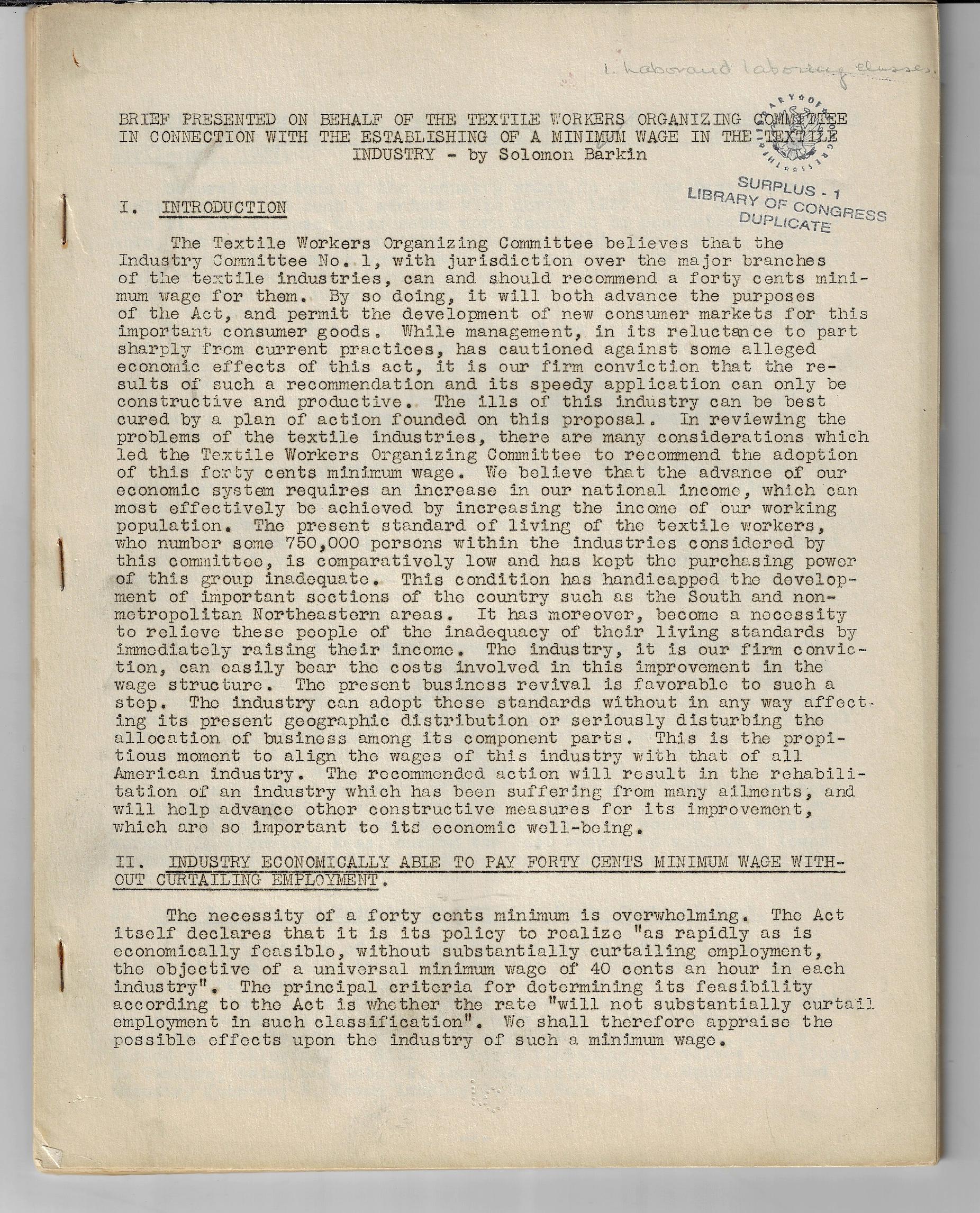
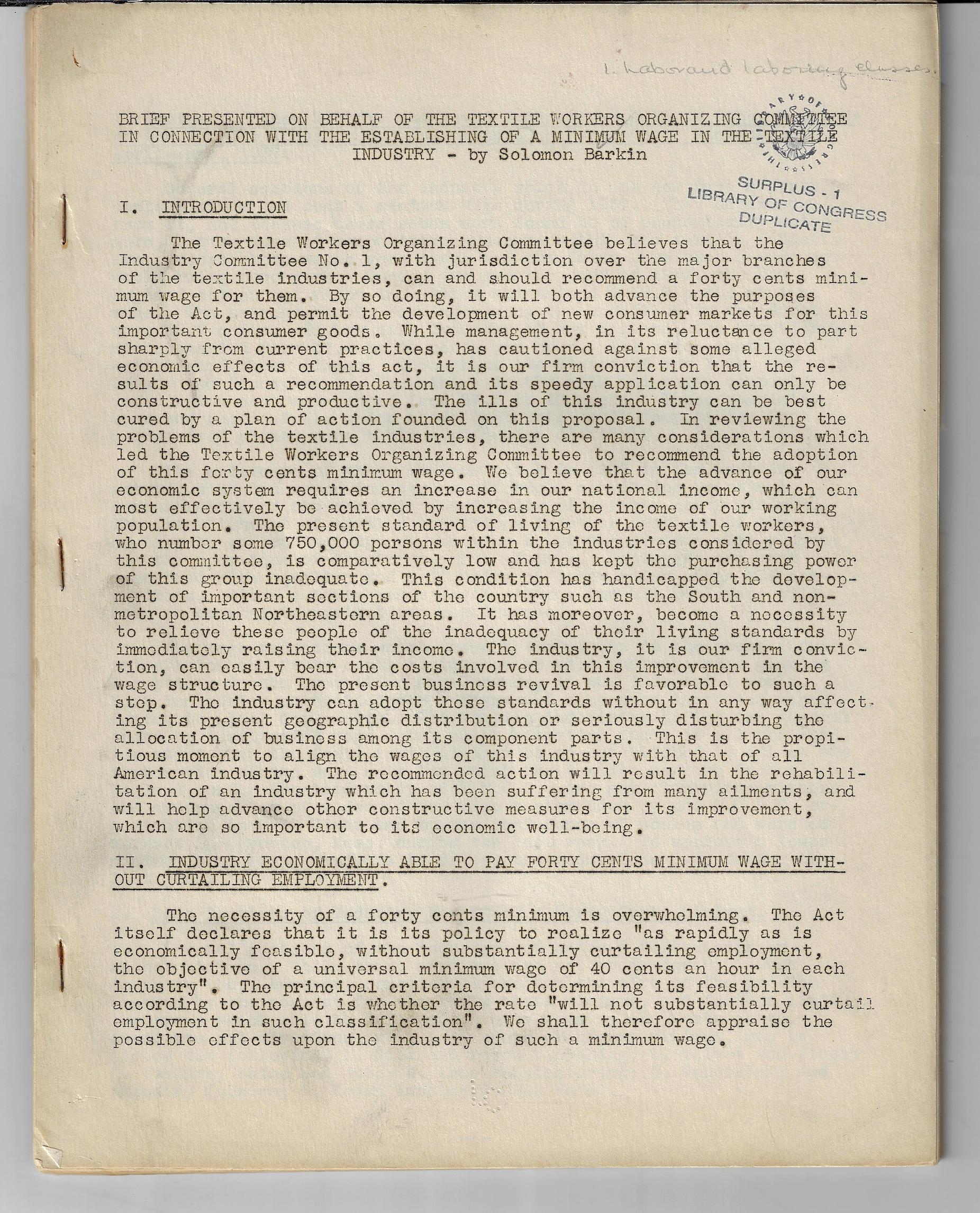
    BArkin documentSolomon Barkin (1908-2000), “Brief Presented on Behalf of the Textile Workers Organizing Committee in Connection with the Establishing of a Minimum Wage in the Textile Industry.” The Textile Workers Organizing Committee, 1939. 11×8.5”, 43 leaves (28 paginated plus 15pp of interleaved appendix pages). Offset production from typed original. Provenance: presented by the Textile Committee to the Library of Congress. Condition: small (6mm) perforated “LC” stamp at front page bottom; LC surplus rubber stamp at top right. Rare.  $150

    Coming a few years after what was basically the end of the New Deal as a result of a better economic climate, the textile worker reps were organizing around the minimum wage for the basic worker at 40 cents per hour. The idea behind the minimum wage would be beneficial to both worker and industry—it would allow more buying power resulting in more sales for industry.

    Adjusting for inflation, using the Bureau of Labor Statistic inflation calculator, 40 cents in 1939 would be about $7.09, which is very close to the current $7.25 federal minimum wage in 2018. The first federal minimum wage was set at 25 cents/hour in 1938, and then to 30 cents in 1940, 40 cents in 1945, and then 75 cents in 1950, which would be about $7.70 in 2018 dollars. This is the start of a period 26 years in which the contemporary minimum wage was higher than the minimum wage is now, adjusting for inflation. After the increase to $3.85 in April 1990 under Bush I, the minimum has been slightly sinusoidal above-and-below the current minimum—basically remaining very little changed in purchasing power for the last 28 years, and 20% or more weaker than the minimums from 1956-1990.

    The Barkin document is a compelling evidentiary presentation of the benefit to the textile industries in paying a higher minimum wage to its workers.

    “Professor Barkin spent 25 years in the labor movement, from 1937 to 1963, as director of research for the Textile Workers Union, now part of the Union of Needletrades, Industrial and Textile Employees. For the next five years, he was a manpower specialist and head of the social-affairs division of the Organization for Economic Cooperation and Development in Paris. He taught economics at Amherst from 1968 to 1978, when he was given emeritus status. Then he was a visiting professor of economics at Erasmus University in Rotterdam, the Netherlands, and a senior Fulbright professor at Victoria University in Wellington, New Zealand.”–NYTimes obituary for Mr. Barkin.

    ·Posted by :

    ·in:


  • Pledge Sheet for a Communist Organization Helping Political Prisoners. ca. 1925

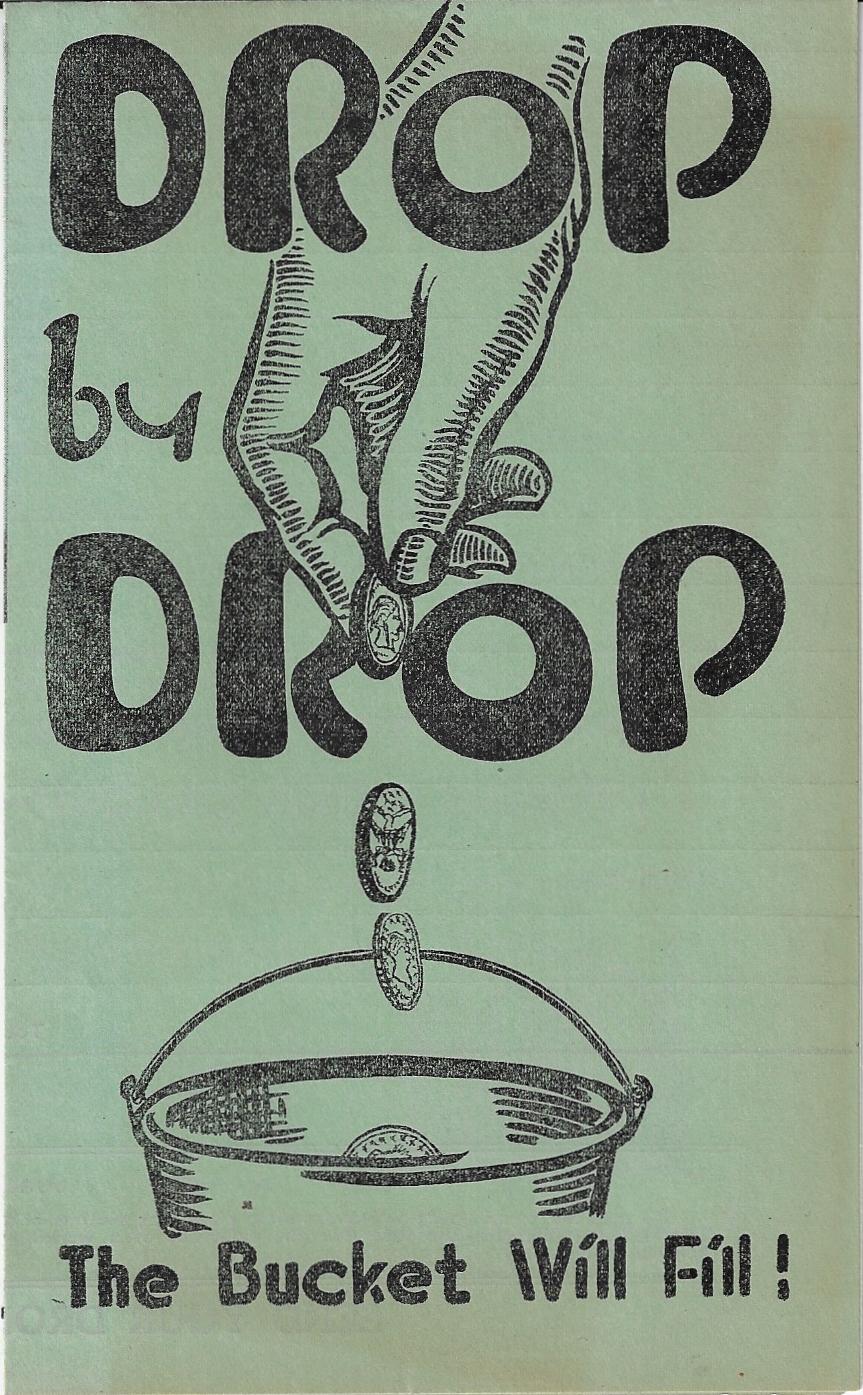
    Drop by drop _2_ JF Ptak Science Books  Quick Post

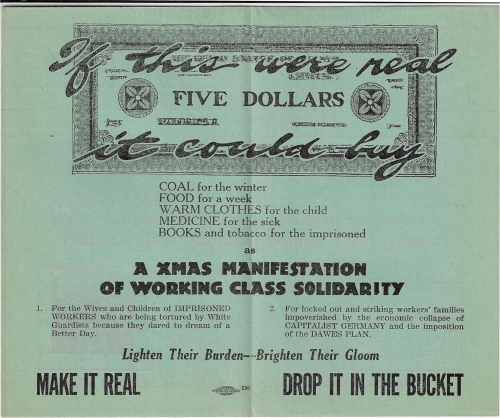
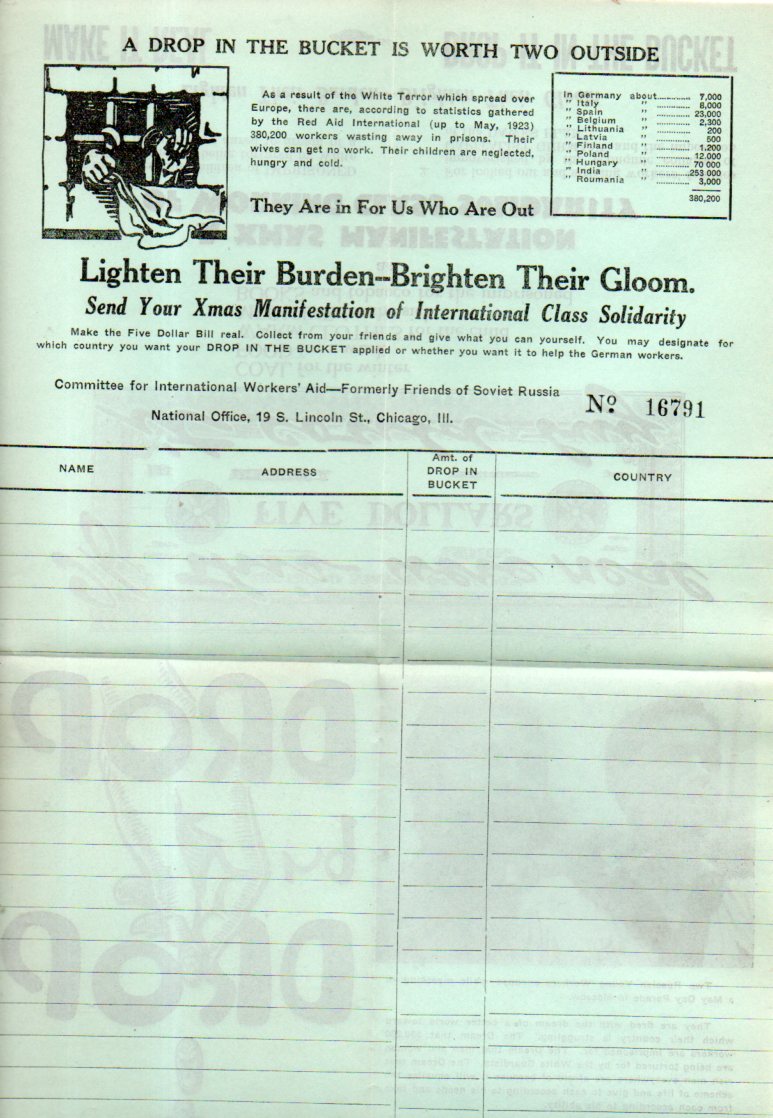
    Committee for International Workers Aid (formerly “Friends of Soviet Russia”) was a Communist organization created in Berlin in 1921 (as the International Arbeiter-Hilfe) to help raise money for famine and drought victims in Russia. It was evidently expanded to include collecting money to help victims and prisoner of Fascism, which seems to be the major target of this folding broadside. $200


    Drop by drop _3_

    The bucket here is a paper one, the pamphlet unfolding to be a broadside or broadsheet onto which you’d record peoples’ names and addresses and the amount of their contribution to help “class war victims of the laboring masses”, to help the imprisoned and their families (“they are in for us who are out”.  12.5×8 sheet folded into quarters. Fine condition save for a tear that I just made at the bottom center fold.  

    This is a scarce item–I could only find two copies (Yale and UC Davis) in WorldCat.  

    Drop by drop _4_

    ·Posted by :

    ·in: