A Daily History of Holes, Dots, Lines, Science, History, Math, Physics, Art, the Unintentional Absurd, Architecture, Maps, Data Visualization, Blank and Missing Things, and so on. |1.6 million words, 7500 images, 4.9 million hits| Press & appearances in The Times, Le Figaro, Mensa, The Economist, The Guardian, Discovery News, Slate, Le Monde, Sci American Blogs, Le Pont, and many other places… 5000+ total posts since 2008.

Book Category: Social History

  • Mayor LaGuardia’s Report on the Progress of the WPA in NYC (1938)

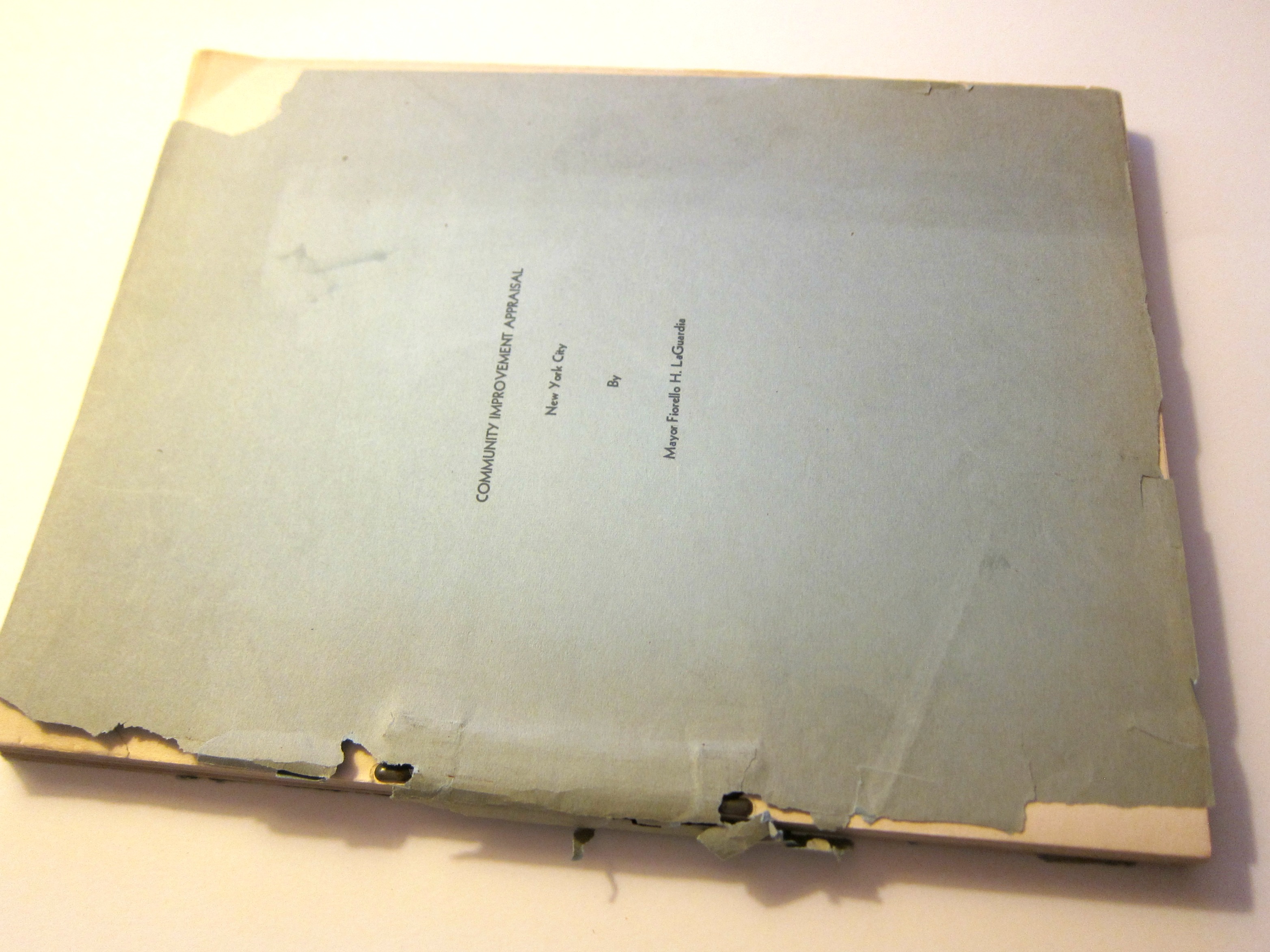
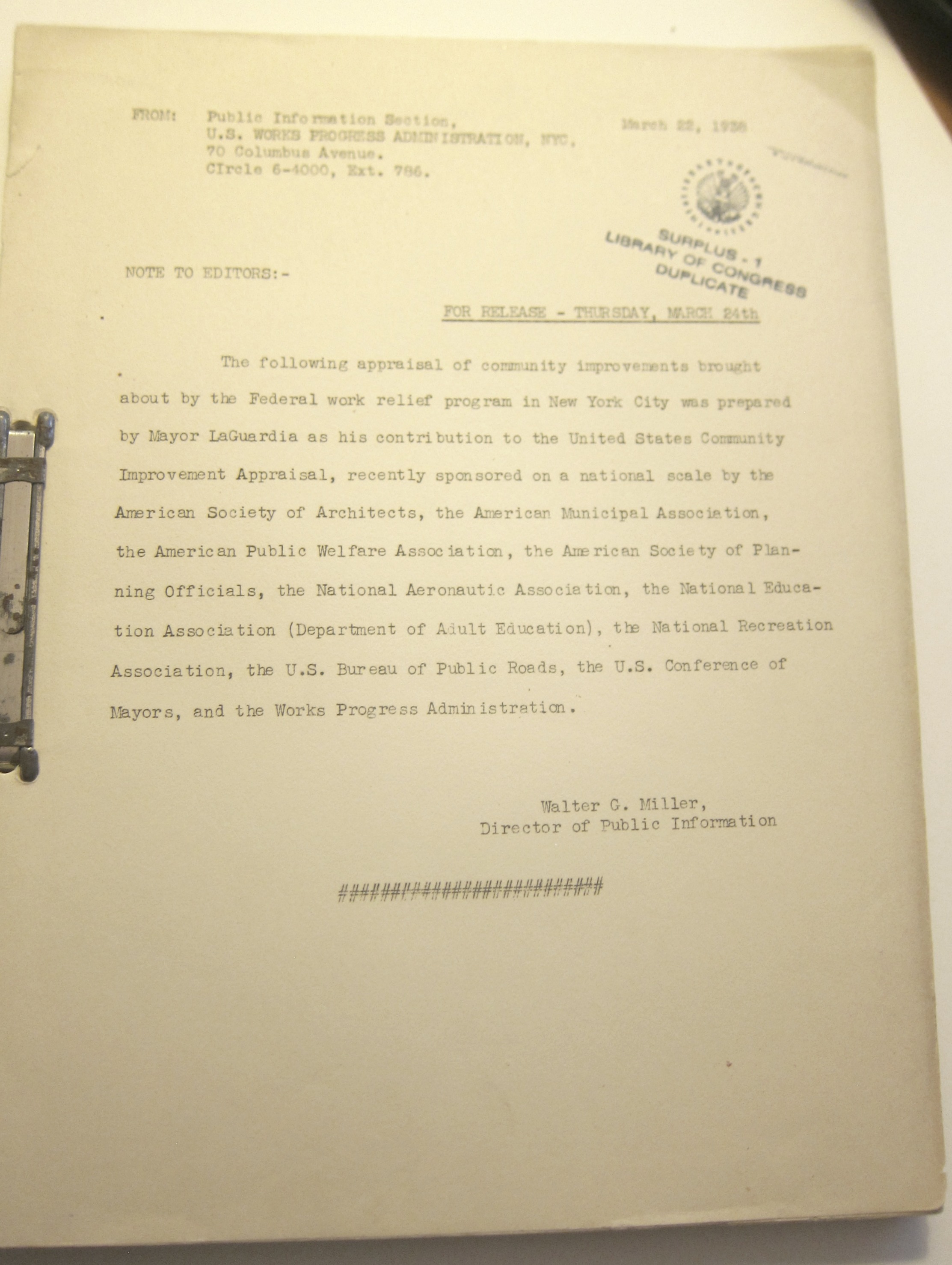
    Fiorello LaGuardia, Community Improvement Appraisal, New York City. Published by the Public Information Section, U.S. Works Progress Administration, NYC, March 22, 1938.  11×8.5″, 103 leaves, offset from typed originals.  Punch-bound with flexible metallic clasps. Provenance: Library of Congress. Condition: the original wrappers are somewhat chipped and in two pieces; the text, however, is still crisp and bright and in great condition. Also, there is a Library of Congress surplus stamp on the first page.  Raritythere are four copies of the printed version found in WorldCat/OCLC (opposed to holdings for a digital version), making this a scarce WPA collectible and an interesting document about the new public works in NYC constructed during the 1930’s.  $250

    LaGuardia improvement

    This document reviews new construction and improvements to existing structures  in the following areas: buildings (58 new large structures, 379 new buildings, 1,740 reconditionings) n schools and colleges, hospital, health centers, public libraries, public markets, prisons; parks (including 287 rehabilitate and 197 new playgrounds built); highways, sewers, water supply, bridges, tunnels, piers, “demolition and slum clearing”, marsh drainage, airports, police traffic signals, ferries, boardwalks, free lunches for schools, and educational programs.  

    LaGuardia improvement _2_

    ·Posted by :

    ·in:


  • Poster Advertising in Switzerland

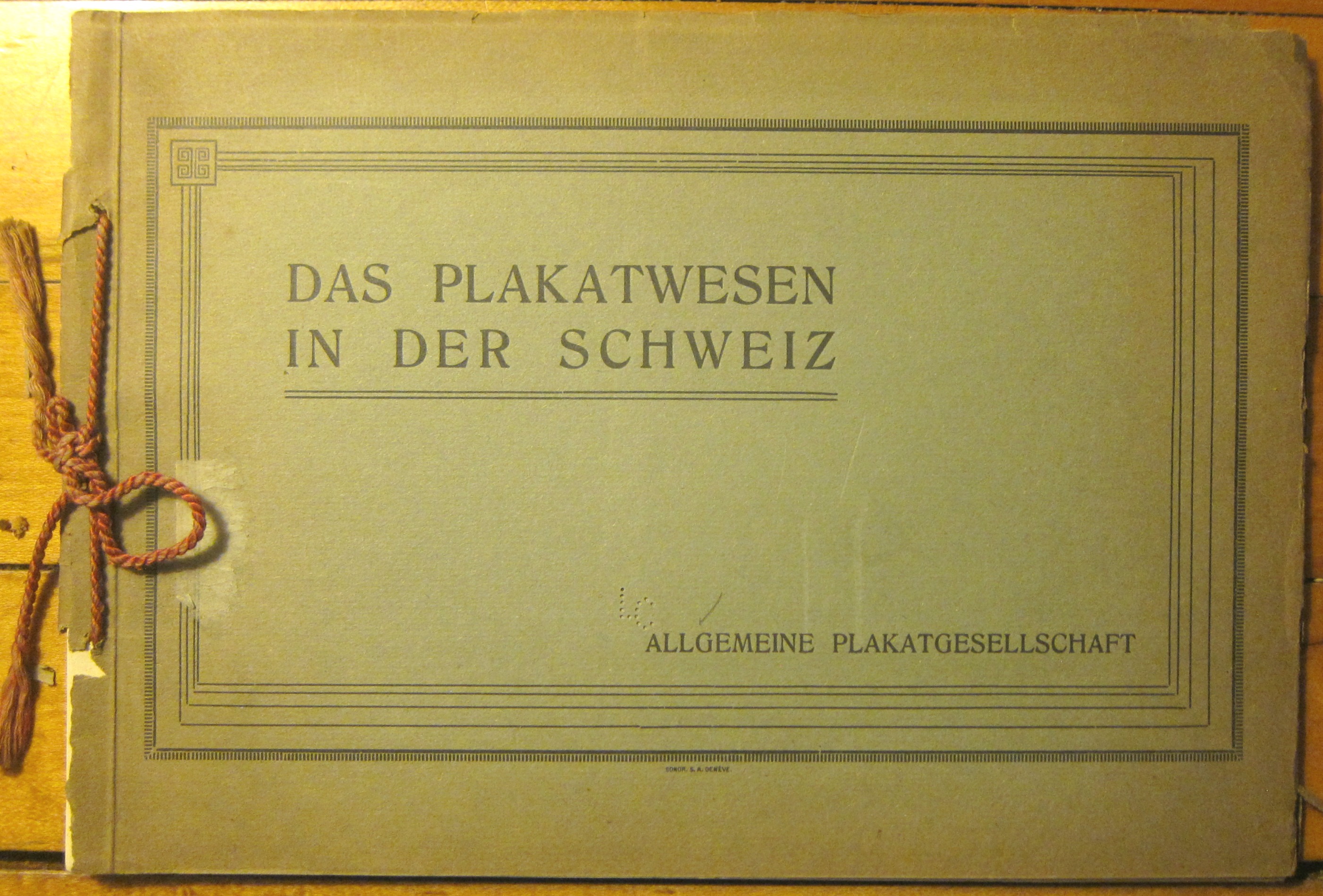
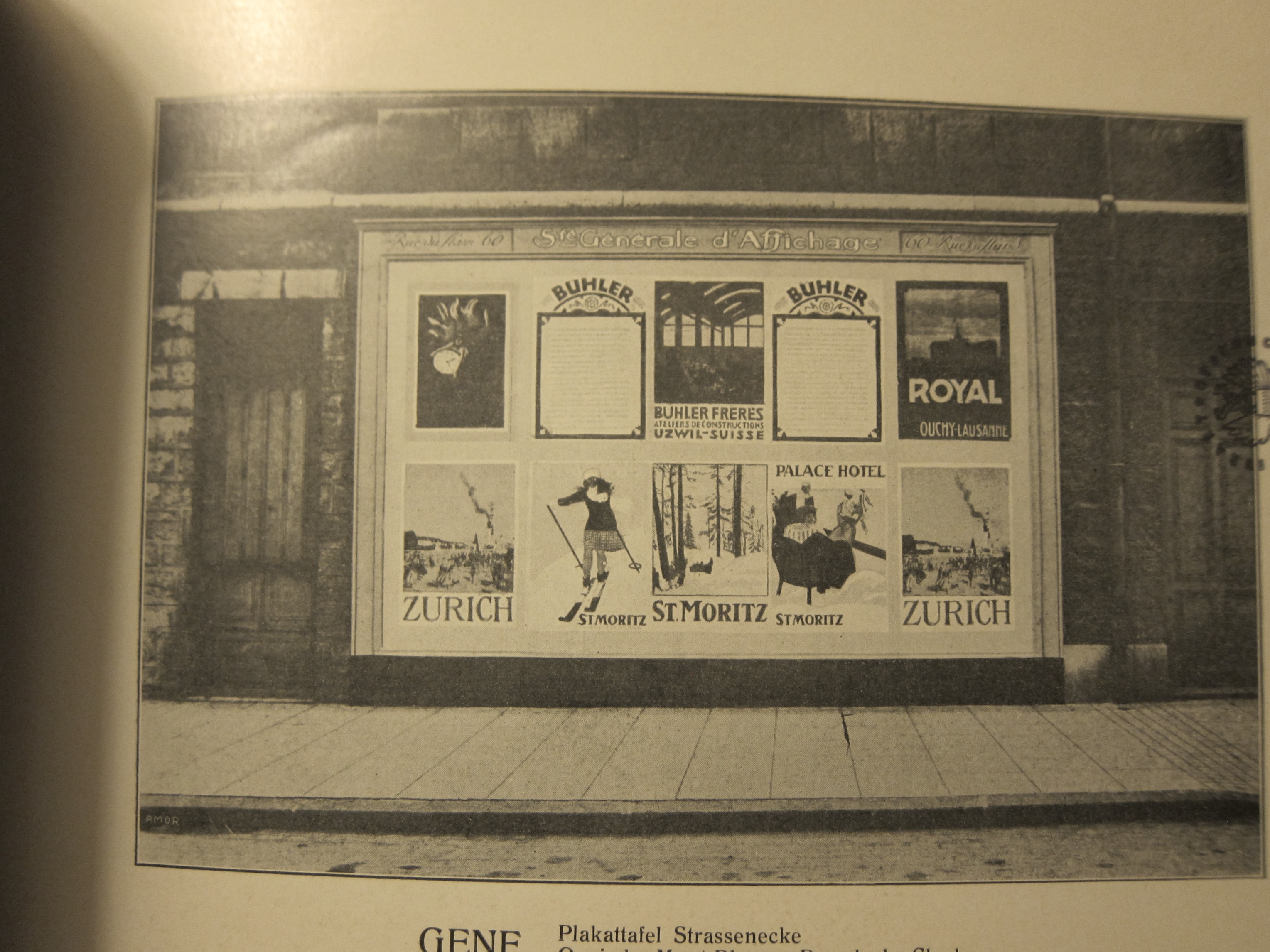
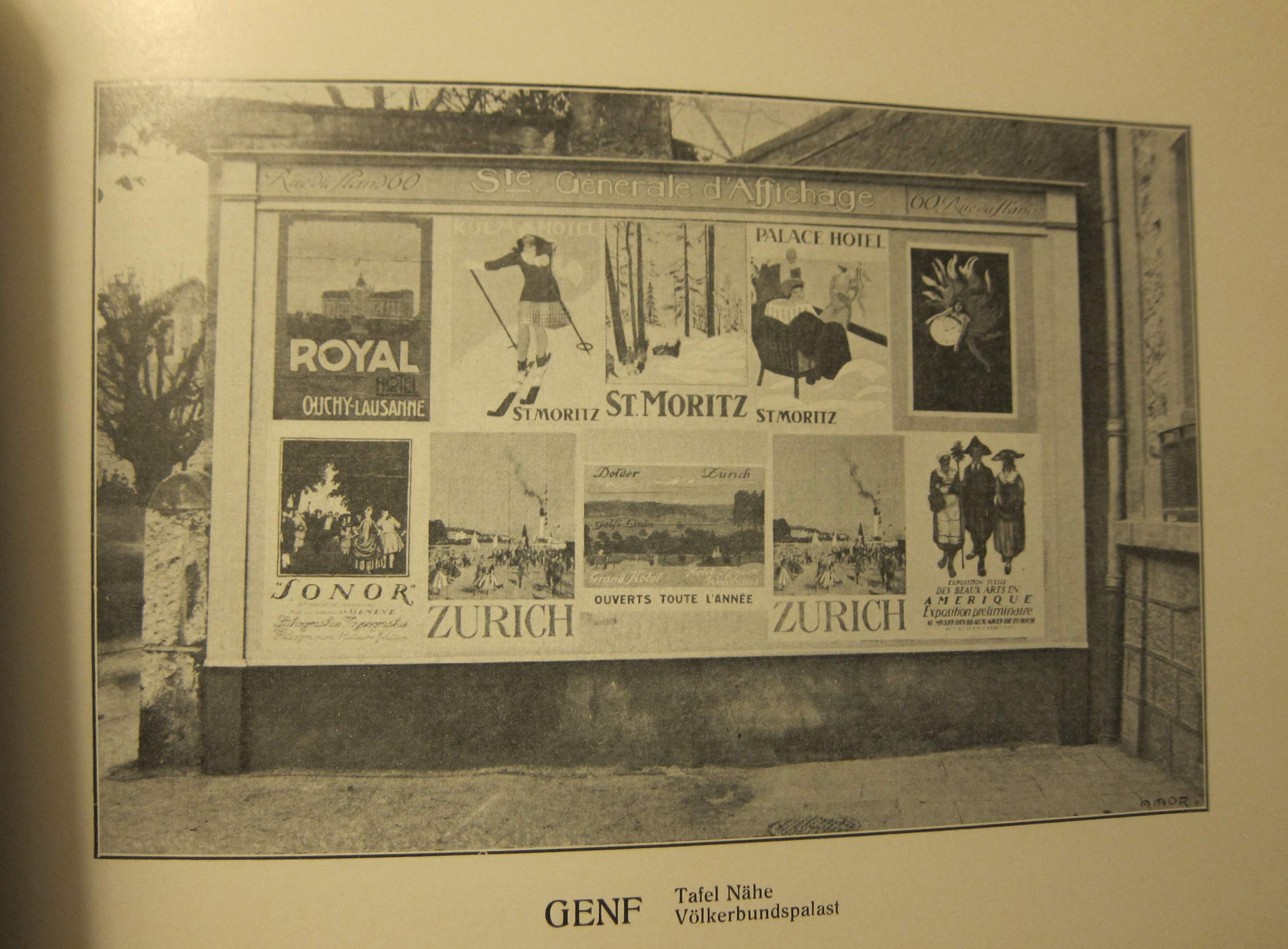
    Das Plakatwesen in der Schweiz. Allgemeine Plakatgesellschaft.  Printed by Sonor in Geneva, circa 1928-1932 (?).  17x24cm, 16 leaves, all of which are photos of outdoor poster advertising (as seen in the examples here). Bound in paper wrappers with a cord tie.  $250 

    Provenance: Library of Congress, with their 6mm perforated “LC” on the front wrapper and their rubber stamp “surplus duplicate” on the first page/photo

    Condition: the wrappers were made to fail, I think, being made to overhang the text block by a few millimeters, and so ensuring that most of the edges have gotten dinged and banged up. The spine cover has come away, leaving two pieces for the cover, though those are held in place by the binding.  Overall, still a GOOD copy.__+__

    This is an unusual work showing examples of Swiss poster advertising.  So far as I can determine, there are NO copies of this work in the OCLC/WorldCat.  Curious and scarce. 

    Swiss advertising _1_ cover

    Swiss advertising _2_

    Swiss advertising _3_


    ·Posted by :

    ·in:


  • Anti-KKK and anti-Catholic (1923)

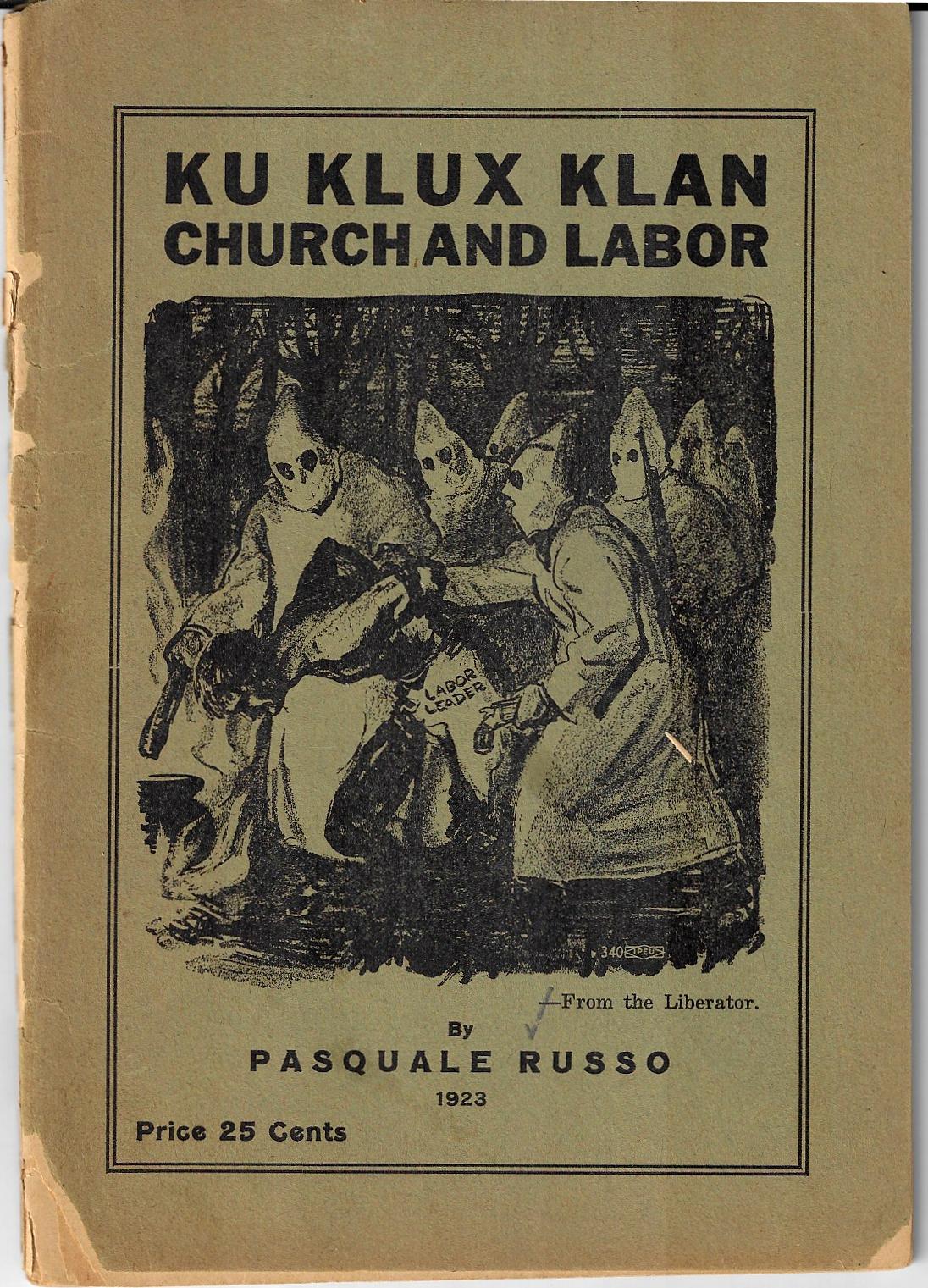
    Pasquale Russo, Ku Klux Klan, Church and Labor, 1923; published by Mr. Russo in Chicago (833 Sedgwick Street). 7×5″, 59pp.  Original wrappers.  Fair copy, only, as the pamphlet was printed on inferior stock and is coming apart with use (the covers are detached, several pages have been pulled away…) Provenance: Library of Congress, with their surplus/duplicate rubber stamp on the rear cover.  WorldCat/OCLC locates 16 copies, though I have not been able to find any other copies for sale.  $50

    KKK Church and Labor 1923Mr. Russo (also the author of “Negro Slavery or Crime of the Clergy” and “Tony the Immigrant” among others) makes a case against the KKK, and also manages a conjoined condemnation against the “Church”–and that being, so far as I can tell, the Catholic Church–all the while building a very strong pro-labor (Socialist?) overview for the improvement of the condition of the working classes. This seems a little unusual to me as the KKK was also anti-Catholic, making similar arguments against that religion as Mr. Russo. Mr. Russo’s reasoning behind the attack here seems to be that the Church was in its way complicit with the actions of the KKK by being against labor, as was the Klan, and so with this thinking the Church was pro-KKK and anti-working class by restricting the freedom of the laborer, and against “the solidarity of the white and colored”.  There is very strong support in the pamphlet for the Negro worker (the “N” in “Negro” being capitalized at a time when even that small dignity was rejected by many in the publishing industry), railing against the  segregationist policies of the “United Federation of Scabs” (the American Federation of Labor, A.F.L.) and Samuel Gompers and for being the “lickspittles” of the ownership class. The pamphlet was published at an interesting time–1923–for the main aspects of the work: there was significant anti-Catholic leanings high and low throughout the country; the KKK was about halfway through its second very short-lived revival before its collapse later on in the decade; the African American as a race and as a worker class was still very abused; and the infatuation with Socialism and the newly-formed Soviet Union was young and growing. So the pieces of history were there, though they are in a jumble. 

    The pamphlet is a highly problematic but forensically-interesting work, and speaks to its times in a number of ways–that said, I am not sure where this fits in with anything, and how much of Mr. Russo’s self-published philosophy was shared and how much of it was simply an externalized internal insight. 


    ·Posted by :

    ·in:


  • An Early Case against the Wobblies and the Espionage Act of 1917 (1918)

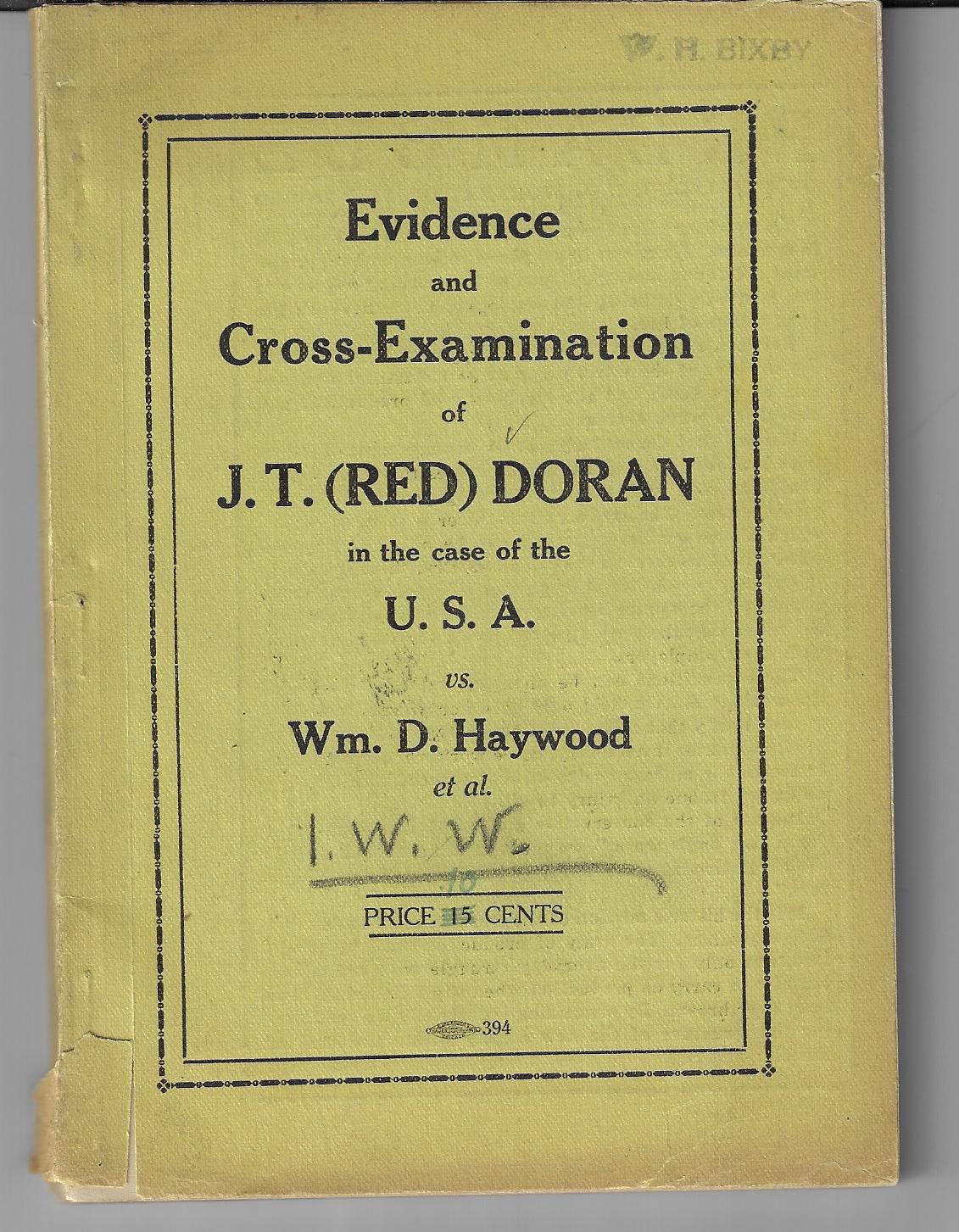
    Books Red DoranJohn T Doran; Otto Christensen; Frank Knowlton Nebeker; United States. District Court (Illinois : Northern District); Evidence and cross examination of J.T. (Red) Doran in the case of the U.S.A. vs. Wm. D. Haywood, et al. [Chicago], [General Defense Committee], [1918?] 7×4.5”, 151pp. Original wrappers. The copy of W.H. Bixby (with his name rubber stamped on the front cover top right).  Bit of chipping at spine, otherwise in VG condition. Provenance: General W.H. Bixby, and then the Library of Congress (with their rubber stamp on the rear cover).  $137.

    (General) W.H. Bixby was one of a number of society leaders who protested the rough treatment of the IWW members (including Mr. Doran) accused under the Espionage Act of 1917, and who would plead for amnesty on their behalf.  (General William Herbert Bixby (1849-1928), USMA 1876,  served in the Corps of Engineers and was president of the Mississippi River Commission in 1908-10 and 1917-18.)

    We IWW’s say “Listen What is the good of buying railroads We don t want to buy railroads. We don’t want to buy brickyards nor the mills nor the factories. We don t have to indulge in a co operative plan or operative program. This is what we mean to do organize the slaves in the brickyards and then we own the brickyards. Organize the slaves on the railroads and then we own the railroads. Organize the slaves everywhere and all these things are ours. But to buy them and attempt to compete with the capitalistic masses it is nonsense. We are not there.” (page 36)

    ·Posted by :

    ·in:


  • “The Fatal Deadfall of Abolition”–Threatening the Newly-Freed Southern Slaves, 1867

    JF Ptak Science Books 

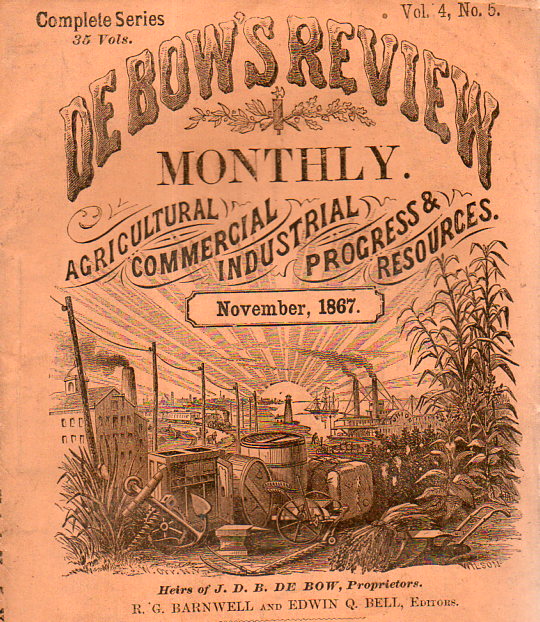
    De Bow’s Review in 1867, in the dire straights of the Southern doom and despair of the just-finished war, lashed out like a wicked conspiratorial rant against the Northern states and anyone who comforted them.  Published in Nashville, all I have of the magazine presently is this loose issue for November 1867, and in spite of the energetically positive view depicted on the cover of the magazine had little to do with what you found in the writing inside.  
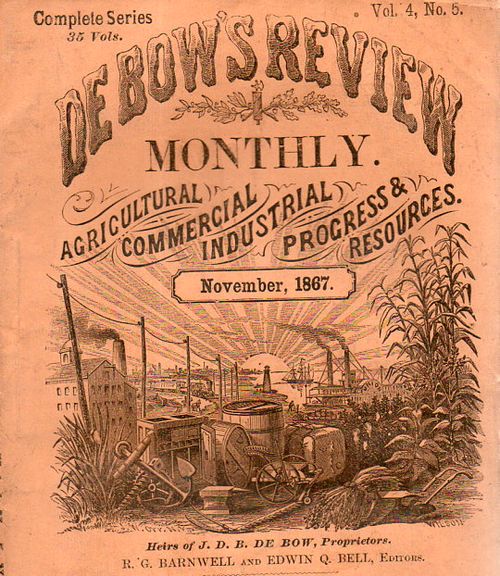
    De Bow175

    The leading article is an odd one, yelling about Great Britain manufacturing the cause of anti-slavery in the United States, which pretty much is made abundantly clear in the title,  “Black Republicanism, the Dupe and Agent of British Policy in Respect to American Interests”. The “scheme of so-called Negro Emancipation…is a British Invention” crushing the U.S. which “suffered immeasurably” under the Abolition Program, “the fatal deadfall of the abolition trap“, all of which in the end will “crush the innards out of the “Black Republican Yankee”.  It was the Brits according to the writer of this article who FORCED THE UNITED STATES TO ABOLISH SLAVERY” [caps in the original]. 

    The second article is called “No Treason” and makes the case for the Confederacy for not having committed treasonous acts.  

    The article ends with the following enormously assumptive and categorical statements:

     This might be the bones of this issue, but the next article, comes the marrow: “The Future of the Blacks”. It is here where “the Blacks” are threatened with death as a race should they become politically and economically mobile, and threatened in such a way that they were being given advice for their own good should the “blacks” (with a little “b”) “forget their true position”:

    The short article was long on advice for the newly-freed slaves of the United States to abide. For example, in citing a letter to the freedmen of Lowndes county, Mississippi (by the same author as this article, still unnamed), the writer admonishes “Mingling in politics never did any man any good, and may prove your ruin”. And more:


    Add on it goes, this bitter article, into its long, fearful, vengeful, and sweaty night.  

    Notes:

    1. The variations in the title of the magazine gives you a pretty good idea of what they’re about: 1846-June 1850, The Commercial review of the South and West (caption title, 1846-Jan. 1847, July 1848-June 1850,  The Commercial Review; from  Feb. 1847-June 1850: De Bow’s commercial review of the South and West)–July 1850-Dec. 1852, De Bow’s review of the Southern and Western States (caption title: De Bow’s southern and western review); 1853-July/Aug. 1864, De Bow’s Review and Industrial Resources, Statistics, etc.’ 1866-Dec. 1867, De Bow’s review, devoted to the restoration of the Southern States, and the development of the wealth and resources of the country…
    ·Posted by :

    ·in:


  • On the Starvation Conditions in Europe, 1946

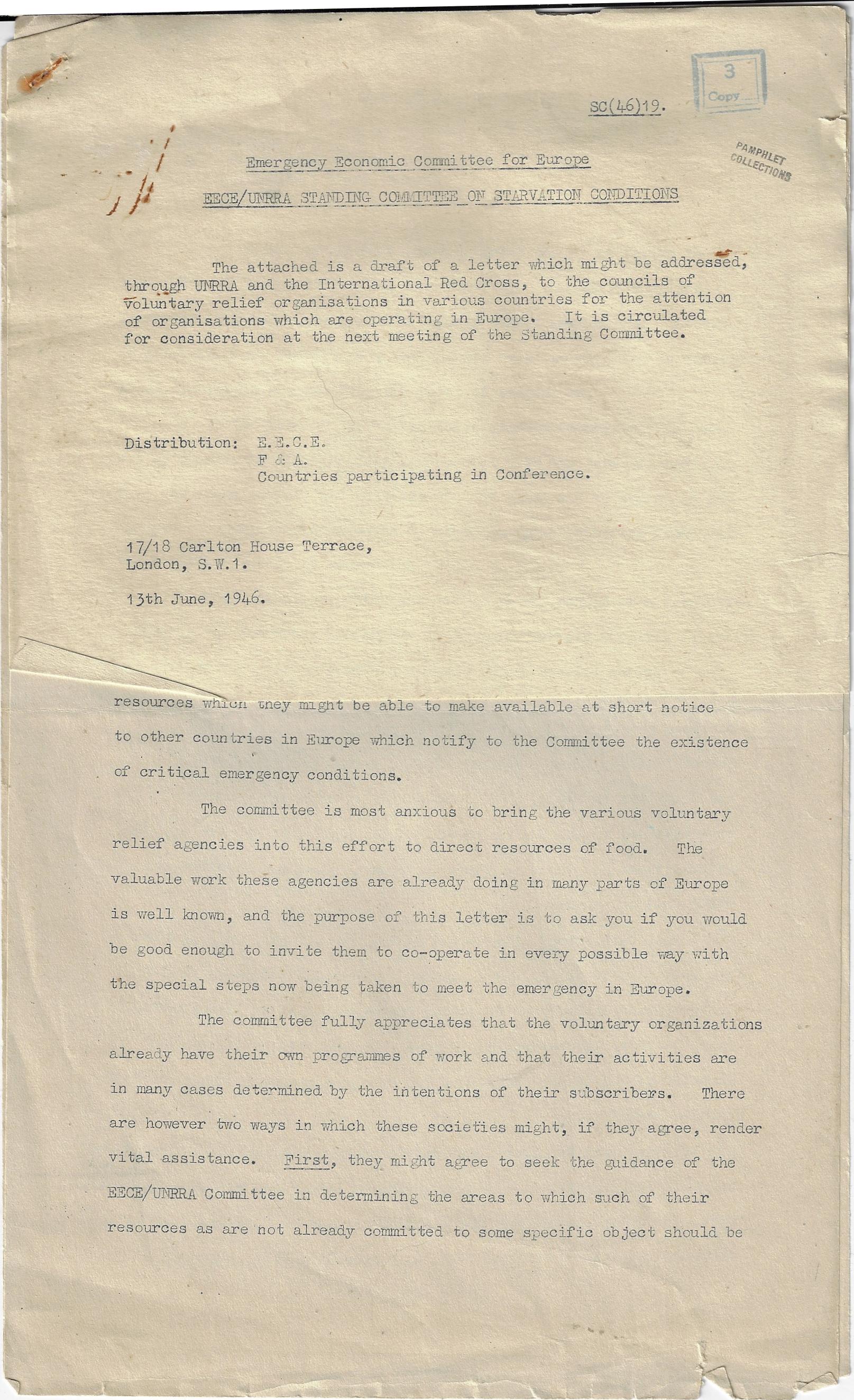
    Starvation _1_Emergency Economic Committee for Europe, EECE UNRA Standing Committee on Starvation Conditions SC(46)19  12.5×8.5″, 5pp, 3 sheets, including a truncated cover sheet. Provenance: Library of Congress, with their surplus/duplicate stamp on the rear of the last sheet. Very Good condition.  $150 

    I reproduce the entire document, below. It is interesting to note that this deals just with Europe, with no mention of, say, the Ukraine (which was suffering from famine already by 1945), or of the artificially-famine-induced Soviet Union.  

    The United Nations Relief and Rehabilitation Administration (UNRRA, 1943-1947) was established to “plan, co-ordinate, administer or arrange for the administration of measures for the relief of victims of war in any area under the control of any of the United Nations through the provision of food, fuel, clothing, shelter and other basic necessities, medical and other essential services…By 1947, UNRRA was running nearly 800 resettlement camps, housing seven million people. Forty-four nations contributed to funding, supplying, and staffing the agency, of which the United States was the leading donor. The largest recipients of UNRRA commodity aid, in millions of US dollars were China, $518; Poland – $478; Italy – $418; Yugoslavia – $416; Greece – $347; Czechoslovakia – $261; Ukraine (USSR) – $188; and Austria – $136.”–wikipedia


    ·Posted by :

    ·in:


  • Some Current Catalogs: WWII, the Soviet Union, Nuclear Weapons, WWI Photographs, and of course Large Color Lithographs of San Marco

    CONTACT:   jfptak AT thesciencebookstore DOT com    johnfptak AT gmail DOT com

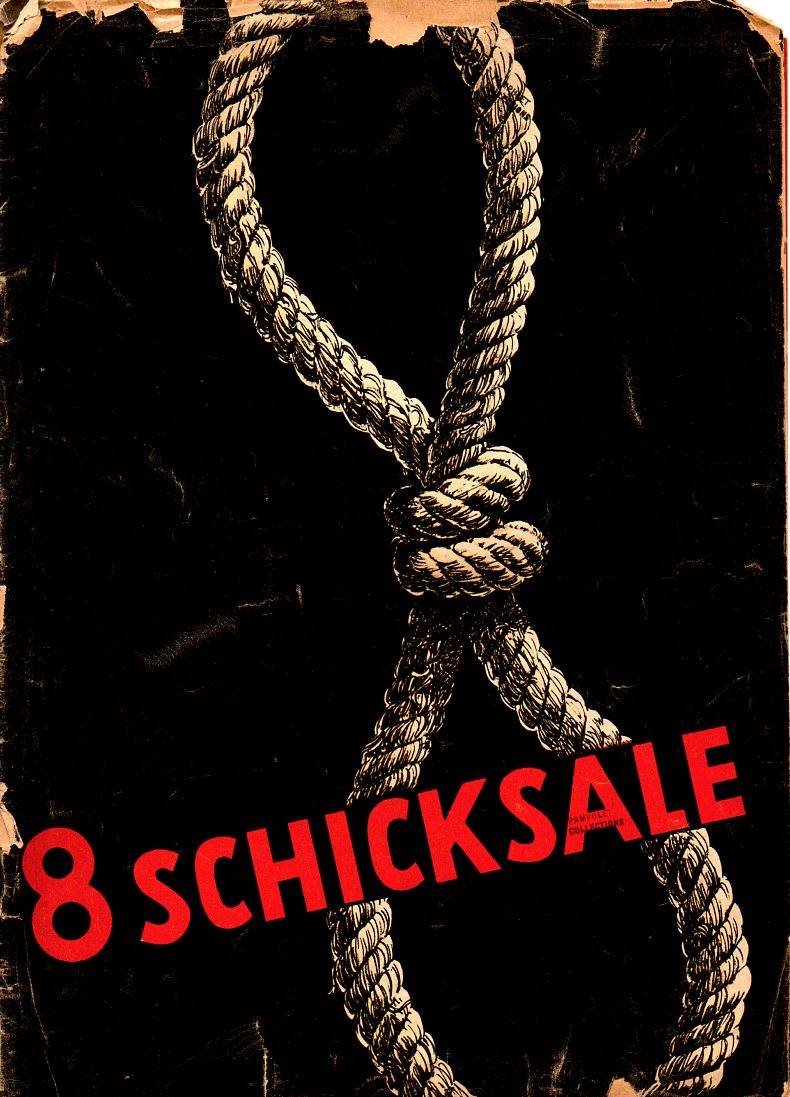
    Weimar pamphlet 8 schicksale336

    Weimar-Era to 1944 German Social, Political, and Military Pamphlets  

    Download Weimar-era to 1944 German pamphlets 

    (44pp, 5 meg. heavily illustrated)


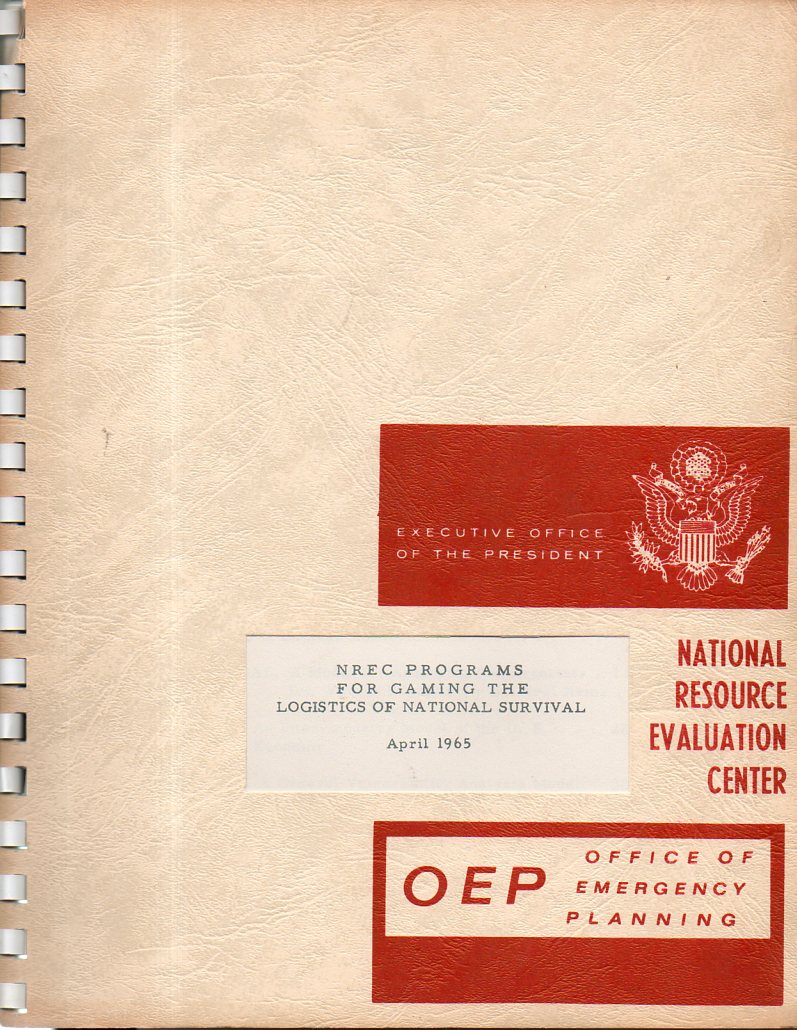
    Nukes hoover NREC237

    Nuclear Weapons and Planning the Post-Apocalypse Society

      Download Nuclear Weapons for PDF 

    (66pp,  8 meg, heavily illustrated)


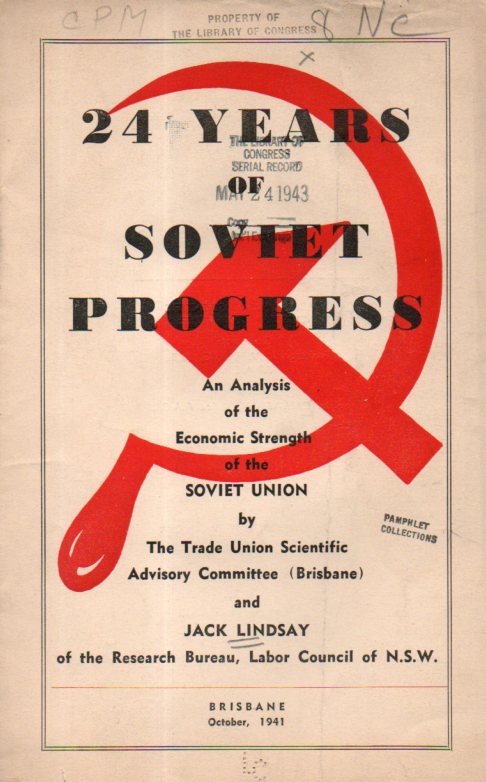
    Russian a131

    The Soviet Union and Communism (1920’s-1945)


    Download Soviet Union and Communism

     (20pp, 496k) 


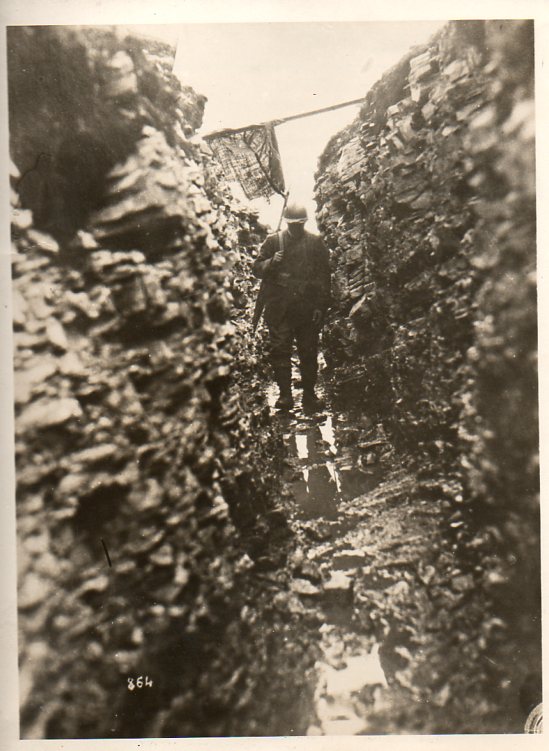
    WWI News Photo Service Archive, 1918 WWI cold ditch

    Download WWI News Photo Service Archive (41pp, 67 megs) 


    San Marco _1_

    Lavish Architectural Chromolithographs, 1886

    Download Catalog San Marco 

    23pp 4 meg pdf

    ·Posted by :

    ·in: