A Daily History of Holes, Dots, Lines, Science, History, Math, Physics, Art, the Unintentional Absurd, Architecture, Maps, Data Visualization, Blank and Missing Things, and so on. |1.6 million words, 7500 images, 4.9 million hits| Press & appearances in The Times, Le Figaro, Mensa, The Economist, The Guardian, Discovery News, Slate, Le Monde, Sci American Blogs, Le Pont, and many other places… 5000+ total posts since 2008.

Category: Electro-LUXurious

  • Electro-LUXurious 10: The Wandering Uterus and the Issue of Female Satisfaction

    JF Ptak Science Books   Post 1492

    This is the 10th in a new series of posts on interesting, early applications of electricity, most of which are taken from the archives of the U.S. Patent Office.

    As usual there is no explanation for the intended function or outcome was for these belts, although I think that they occupied two ends of a spectrum.  It seems as though the women’s belt apparatus was meant to address “female hysteria”, which for many centuries was seen as the dementia a woman suffers when she felt the need to fill up her womb with a baby; Plato (in his Timaeus) reckoned that the uterus actually detaches and wanders through the body, causing all manner of havoc, including “hysteria”. 

    Plato, who lived ca. from the mid 4th to mid 3rd century of the common era, commented so:

     “The animal within them is desirous of procreating children, and when remaining unfruitful long beyond its proper time, gets discontented and angry, and wandering in every direction through the body, closes up the passages of the breath, and, by obstructing respiration, drives them to extremity, causing all varieties of disease.”  –Plato, Timaeus, 91c

     (It is odd that Plato starts this book out with Socrates counting to three, but that’s another story I guess.)

    The issue of the physiology of the uterus received modern treatment in modern times, though the philosophical aspects of this and other similar issues managed to rip themselves free of biology and culturally implant themselves without the benefit of factual support, lending their entirely questionable weight to the continued issue of the subjugation of women.  The idea of woman’s “hysteria” as a very wide term into which all classes of medical concern was dumped seeped into the 20th century, and was answered with devices such as this electro-onanistic medical quackery.


     For the men it seemed that the issue of “seminal seepage” and erection control was answered with devices such as this thing, below, a slightly shocking reminder to keep thinking the pure thought:

    And of course a belt like this would not be complete without “complete” treatment, and so is included the following “attachments”, Fig 7 being the one of some considerable interest to the wearer:


    Of course it is entirely possible (likely?) that I have gotten this all wrong, completely wrong, and backwards.

    Note:

    Here’s an interesting book:  Maines, Rachel P. (1998). The Technology of Orgasm: “Hysteria”, the Vibrator, and Women’s Sexual Satisfaction. Baltimore: The Johns Hopkins University Press


  • Electro-LUXurious 9: Combination Medical Apparatus and Alarm System, 1892.

    JF Science Books   Quick Post

    This is the fourth in a new series of posts on interesting, early applications of electricity, most of which are taken from the archives of the U.S. Patent Office.

    I am uncertain why there should be a combination bell/alarm and electrical stimulation medical device wrapped up in one small wooden package, but here it is.  Certainly there was no explanation for the need for the bell, or alarm; but then again, there wasn’t an explanation on what this thing did to the body (or soul, or whatever) either–that was not the job of the patent report, which tells the reader how the thing works, but not necessarily what it does. Of course this is just finding fault with a small bit of nonsense wrapped up in a larger chunk of junk…perhaps it was all just distraction.  In the larger world of electrical vapor baths, vacuum coffins, electrical hair, automatic tongue pullers, and so on, what difference could one extra bell make?


  • Electro-LUXurious 8: Electrical Medical Cane, 1899

    JF Ptak Science Books   Quick Post

    This is the eight in a new series of posts on interesting, early applications of electricity, most of which are taken from the archives of the U.S. Patent Office.  Unlike the general post in this blog, many of the Electro-LUXurious post images and documentation can be presented without commentary.

    I thought at first when I found this “electric cane” that there would be a light source or something embedded in the hanle.  There is a small light bulb inside the handle, but there are no lenses, no glass; just metal caps.  It turns out that this is a medical cane, an electrical unit with brass or copper barrels to be held in the hands or applied to various areas of the body for electrical stimulation. 


  • Electro-LUXurious 7: Electric Hair Brush with Stimulator Sponges, 1899

    JF Ptak Science Books  Quick Post

    This is the seventh in a new series of posts on interesting, early applications of electricity, most of which are taken from the archives of the U.S. Patent Office.  Unlike the general post in this blog, many of the Electro-LUXurious post images and documentation can be presented without commentary.


    And then there’s this beauty from 1912:


  • Electro-LUXurious 6: Electrical Probing Stimulator, 1898

    JF Ptak Science Books   Quick Post

    This is the sixth in a new series of posts on interesting, early applications of electricity, most of which are taken from the archives of the U.S. Patent Office.  Unlike the general post in this blog, many of the Electro-LUXurious post images and documentation can be presented without commentary.

    This, simply put, is  a vibrator, and in the 19th century was a medical response to female sexual arousal, which at the time was termed “hysteria”.  And so women were sent to their medical practioner to be treated for hysteria with much larger units until the apparatus became small and portable enough to be used at home and without the assistance of the doctor. 


    No doubt.

    We read further that figure 3 “is a side view of a cylindrical electrode for internal treatment”. 


  • Electro-LUXurious 5: Alpha and Omega Casket and the History of Death

    JF Ptak Science Books   Post 1491

    This is the fifth in a new series of posts on interesting, early applications of electricity, most of which are taken from the archives of the U.S. Patent Office.  Unlike the general post in this blog, many of the Electro-LUXurious post images and documentation can be presented without commentary.

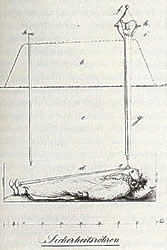
     It has not been an easy job over the centuries in determining whether a person was alive or dead, and dead as in really truly dead, absolutely so.  Consider how this would be done in case of coma and such in the days before the stethoscope, when doctors and medical people would use cones and other hearing apparatus to help the wizened old practitioner hear with their deteriorated hearing, listening for signs of life with an inferior instrument and Burial premature limited auditory capacity.  (The stethoscope wasn’t invented until 1816 by Rene Laennec–who produced a monaural device much like a primitive hearing horn made of solid wood—which was a vast improvement over no stethoscope at all, by again was very crude compared to early 20th century devices.) There is little wonder about the tales of horror of premature burial (as with Poe) and the spate of burial devices where–of the dead suddenly became not so, awakening in the coffins underground, that they could activate one of the many ingenious life-saving devices to alert someone to come and dig them up. (There were also patented designs that would deliver air to the coffin as well as have an accessible ladder to the surface.)
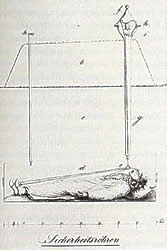
    The most fool-proof way of determining death in the 19th century was to leave the body alone for three days or so to see if it began to putrefy–this was the method proposed by Christian August Struwe, among others, who advocated the construction of special hostels for the dead (“Leishenhauser”), where they, the supposed dead, would lie in state for the period of time necessary for putrefaction.  This was also among the most elegant solutions given limited technological capabilities, especially when compared to nipple-pulling, scalding, tongue-yanking and of course the infamous tobacco smoke enema (seen below).

    What I am getting to though in the Electro-LUX series is the coffin/life-determination box, a sort of all-in-one affair where a body could be both determined to be dead and buried in the same thing, one of the few (?) medical devices that after performing its job be used as a coffin for its patient.  It is an alpha & omega bit, supposedly sparking to life the pre-dead if they were alive, or serve as the taxi to eternity for those who were truly and most sincerely dead.

    I’m having a bit of fun with this, but the issue of what constitutes being “dead” is still somewhat contentious–the issue was much larger 150+ years ago, when the philosophical/physical/biological questions were still very wide open, still. 


    Here are some other examples of determining whether a person was dead, or not, all taken from  Jan Bondeson’s delightful Buried Alive, the Terrifying History of Our Most Primal Fear (Norton, 2001):

    –Christian Friedrich Nasse’s Thanatometer was a long thermometer  that was inserted into the stomach, supposedly measuring a core body temperature that would determine if life was possible (and published in 1841);

    –The (Englishman’s) Barnett scalding death cure, which recommended burning the skin of the arm to see if it blistered (no blister/no life);

    –the German Middeldorph invented a heart flag, a needle device that would be thrust into the heart, which if functioning would trigger something or other that would cause a flag to be released at the top of the needle (a very Victorian and visual one, this);

    –Christian August Struwe’s interesting Lebenspruefer (1805) was an electrical device that delivered a dual shock to the eye and lip, the logic here being that if the person was still alive that there would be a resulting twitch;

    –the nameless tobacco enema, which blew smoke…(delivered in the beginning by breath through a tube and improved later to replacing the lips with a bellows, this secondary improvement by Antoine Louis2 and furthered by Dr. P.J.B. Previnaire’s much more powerful anal tobacco furnace.  [Now there’s three words I’ve never strung together before].)1

    –Leon Collongues believed that he could hear the capillary functions of a possibly-dead person’s fingers if placed in his ear;

    –Jules Antoine Josat2 invented a nipple-pincher (“pince-mamelon”) life-rejuvenation device, operating on the assumption that a deeply sedated person could not resist a strong pinch of the nipple and would have to wake up if alive.

    Perhaps the most spectacularly extension of the nipple-pincher was the tongue-pulling idea of Dr. J.-V. Laborde3 (1830-1903), a research physician with wide credentials, who reasoned that a continued regimen of advanced and strenuous pulling of a patient’s tongue would over time bring them back to life if alive.  This is what leads us to the point of this post:  Laborde established a mortuary, and in this mortuary, where the dead were waiting to die, he employed a man whose job it was to pull the tongues of these bodies.  In the misty picture of all of this that is painted in my mind’s eye, the fellow working his way from body to body pulling their tongues with a heavy pincer seems far worse than nipple squeezing or even being an anal smoke blower, though to choose between the three in a twisted Purgatorial mandate would be hard to so.  Although the nipple pincher wasn’t replaced by anything mechanical, the smoke blower was (by a powerful bellows), and so was our friend the tongue puller, who after complaining of the boredom of his task was pushed aside by an electrical device. 

    Notes:

    The text for the patent report, below:

    1. From the Bondeson book, page 156:

    “Antoine Louis had also proposed another method of testing life, or at least stimulating the vital spark in the apparently dead person: with a powerful bellows, he administered an enema of tobacco smoke. One of the pipes of this remarkable apparatus was thrust into the anus of the apparently dead person; the other was connected, by way of a powerful bellows, to a large furnace full of tobacco . Such enemas of tobacco smoke were thought to be very beneficial and were used to try to revive not only people presumed dead but also drowned or unconscious individuals. In 1784, the Belgian physician P.J.B. Previnaire was given a prize by the Academy of Sciences in Brussels for a book on apparent death, which described and depicted an improved bellows for enemas of tobacco smoke, which he called Der Doppelblaser. These enemas were regularly used well into the nineteenth century, particularly in Holland; modern science has discerned no physiological rationale for their use, except the pain and indignity of having a blunt instrument violently thrust up one’s rear passage must have had some restorative effect.”

    2.  Josat.  From Weird Universe.net I found the following, quoting Death and Sudden Death, by Paul Brouardel and F.L. Benham:

    “Josat invented a pair of forceps with claws, with which he proposed to pinch the nipples of persons whose death has to be ascertained. Josat obtained the first prize of the Academy, but Briquet, repeating the same tests on the hysterical subjects under his care, proved that they did not react under Josat’s forceps any more than the dead.”

    3.  M. Laborde won a 2500 franc prize for his innovation in 1894 (as reported by the Revue scientifique.  He sounded like an interesting man:  according to the British Medical Journal (in reporting his death 25 April1903) upon his own death in that year Laborde: “as a freethinker had a civil ceremony; as an hygienist was cremated; as a member of the Societe Mutuelle d’Autopsie willed his body to be dissected; as an anthropologist willed his brain to be preserved at the Anthropological Museum…” Some of Laborde’s works include   Le traitement physiologique de la Mort. And Les tractions rythmées de la langue, moyen rationnel … de ranimer la fonction respiratoire et la vie … Avec … dessins, etc  And:  La traitement physiologique de la mort (Paris , 1894) And: La signe automatique de la mort reelle (Paris, 1900). And  “Les Tractions Rhythmees de la Langue”, VIII, pp. 76 ff, ed. 2, Paris, 1897, and VIII, 2d part, pp. 406-510. And commented upon in some number, for example:  Le Traitement physiologique de la mort par les tractions rythmées de la langue. Le tracteur lingual automatique Laborde, by Alix Hache.
  • Electro-LUXurious 4: the Curative Electric Chair, Complete with Apparatus for the Treatment of the “Depending Organ”, 1891

    JF Ptak Science Books   Quick Post

    This is the fourth in a new series of posts on interesting, early applications of electricity, most of which are taken from the archives of the U.S. Patent Office.

    J(osephus) C. Chambers, the patentee of the apparatus below, was the owner of Chambers’ National Lightning Protection Company (Newport, Kentucky), and held a number of patents relating to lightning rods, electrical insulators, a telephone apparatus (1881), and a number of associated bits of techno. I’m not exactly sure what this device, below, did, except that it seems like a low-voltage quack-medical electric chair.

    The first patent drawing, below, shows a view of the chair and at front, looking backwards towards the  “ornamented” wooden cabinet that contained the guts of the machine, with the seat (which would have a metallic, conductive surface) removed.  You would place your hands on the two capital “H” pads that seem to be just below the two drawers; your feet would go on the two “h” pads at bottom. 

    The drawing below references how the various swinging arms and such can be maneuvered to reach any part of the body.  Mind you now the inventor doesn’t actually state what this electrical treatment “does”, only how you apply it and the technical stuff behind the machine. Also ir is not a solitary experience–there would be another person operating the controls on the top of the wooden case.

    I wondered about the cup (“J”), and thought, well, maybe that’s not what I think it might be for…but it is, waiting there to treat “the depending organ”.


    The U.S.  Patent Office report reads as follows:

    United States Patent Office.

    JOSEPHUS C. CHAMBERS, OP DETROIT, MICHIGAN.
    ELECTRICAL MEDICAL APPARATUS.

    SPECIFICATION forming part of Letters Patent No. 445,636, dated February 3, 1891.

    Application filed April 21,1890, Serial So, 348,911, (So model,)

    To all whom it may concern:


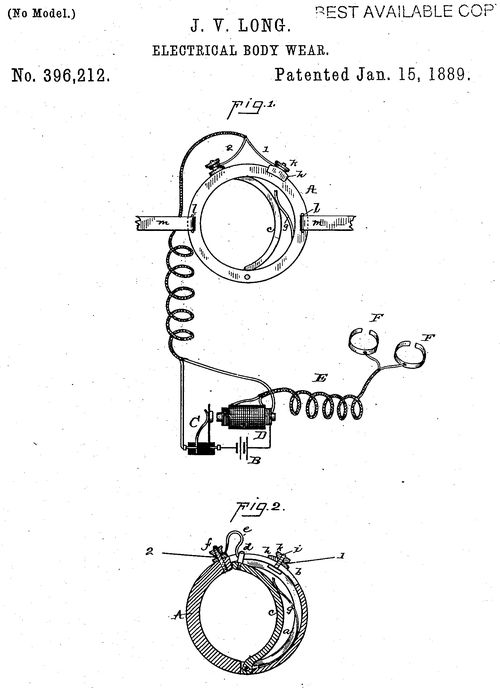
  • Electro-LUXurious 3: Anti-erection “Body Wear” 1889

    JF Ptak Science Books  Quick Post

    Electrical Anti-Erection “Body Wear”  1889

    This is the third in a new series of posts on interesting, early applications of electricity, most of which are taken from the archives of the U.S. Patent Office.  Unlike the general post in this blog, many of the Electro-LUXurious post images and documentation can be presented without commentary. 

    Patent anti erection


    [Source: Google Patents, http://www.google.com/patents/US396212]


  • Electro-LUXurious, 2: Electrical Anti-Masturbation Device for Horses,1894

    JF Ptak Science Books   Quick Post

    This is the second in a new series of posts on interesting, early applications of electricity, most of which are taken from the archives of the U.S. Patent Office. 

    Electrical Anti-Masturbation Devices for Horses, 1894


    Be it known that I, Geoger. King, residing at Dallas, in the county of Dallas and State of Texas, have invented a new and Im5 proved Electrical Appliance, of which the following is a specification.

    My invention relates to an electric appliance, adapted for use on stallions, to stop and cure the habit of masturbation, and such invention consists; in the peculiar and novel combination of parts, hereinafter fully described in the specification, and particularly pointed out in the claims, reference being had to accompanying drawings in which—

    Figure 1 is a perspective view of the appliance. Fig. 2 is a similar view thereof with the upper plate detached, to illustrate the electric generating devices, and Fig. 3 is a view illustrating the appliance as applied to the animal. Referring to the accompanying drawings, A indicates a suitably constructed box or receptacle, preferably of the shape shown, the side and end walls a a’ of which are formed of hard rubber or some other non-conducting material.   B indicates the bottom plate of brass or other metal, which projects beyond the end walls a’, as at ~b b, and provided with slots VV as shown.  C indicates the electric generating devices which are held in the box A, and which may be of any well known construction:, one terminal of which contacts with the lower plate…


  • Electro-LUXurious 1: Electrical Advertising Signs

    JF Ptak Science Books   Quick Post

     This is the first in a new series of posts on the history of the invention of early applications of electricity to, well, whatever.  This first example, far from being the first patent granted for an electrical apparatus, is interesting because of how relatively modern its outcome looks–if we defined “modern” at about 1975.  Digital displays have replaced most signage whose basis was formed in this patent, though various palm readers, “loose” gold buyers and tent revivalists continue to use the things.  But for the times in which machines like this were new commodities, they were sensational–not only did they actually utilize electricity (many things advertised during this period were named “Electric _____  or  _____” but had absolutely nothing to do with the application of a current–they were simply using the name in a fad for brand recognition, much like Atomic Bakery and Nuclear Toasties did) seeing the electrically-lighted words must’ve felt a little like the exhilaration in seeing your first television.  [An earlier post on this blog on very early electrical signs appears here.]


    The patent reads (below):