A Daily History of Holes, Dots, Lines, Science, History, Math, Physics, Art, the Unintentional Absurd, Architecture, Maps, Data Visualization, Blank and Missing Things, and so on. |1.6 million words, 7500 images, 4.9 million hits| Press & appearances in The Times, Le Figaro, Mensa, The Economist, The Guardian, Discovery News, Slate, Le Monde, Sci American Blogs, Le Pont, and many other places… 5000+ total posts since 2008.

Book Category: Social History

  • The RCA TV Field Test, 1936

    RCA field Test _1_RCA Television and 1936 Field Test. Licensee Bulletin LB 370, Radio Corporation of America, 1936. 11” x 8.5”, 26pp, photos and schematics. Original wrapper, Fine copy. $300

    The first broadcast images in the history of television transmission were revolutionary if not very interesting in themselves.  Beginning in 1928 the first experimental Radio Corporation of America (RCA, via the National Broadcasting Company, NBC, its broadcasting division) images were of Felix the Cat, and something that would be received with 60-line clarity on a two-inch display.  For the most part, the daily two-hour broadcasts consisted of Felix or test patterns, broadcast from NYC, until 1931.  

    Image quality increased markedly by the 1932 field trials with the use of iconoscope cameras, which allowed for 240-line reception though still with very noticeable flickering. The 1934 trials were improved further to 343 lines and with some less amount of flicker. For the 1936 field test the transmitting station and offices for NBC and RCA were located in the Empire State Building (utilizing the mooring mast at the top of the building for the antenna, as well as some of the upper floors for the transmitter and offices on the 52nd floor, while the transmitting studio was located in the RCA building in Rockefeller Center).  The broadcast began on 29 June 1936 from W2XF/W2XK “to an audience of some 75 receivers in the homes of high level RCA staff and a dozen or so sets in a closed circuit viewing room…(in the RCA building)” (See: The Television Museum, at Earlytelevision DOT org.)

    The rare pamphlet [available for purchase from our blog bookstore, here] that I uncovered in the attic speaks to the first public demonstration. “The first public demonstration of these field trials took place on July 7, 1936 to RCA’s 225 licensees. Major General J. G. Harbord, chairman of the board of RCA announced that there were three sets in operation at the time, the most distant in Harrison, N. J.”2  It addresses the history of the field tests as well as the tech specs for the 1936 test, as well as the need to address the fuller and complicated issues of establishing a network of transmission capabilities:  “Television services required the creation of a system, not merely the commercial development of apparatus.”–July, 1936, RCA Field Test Plan, page 8.

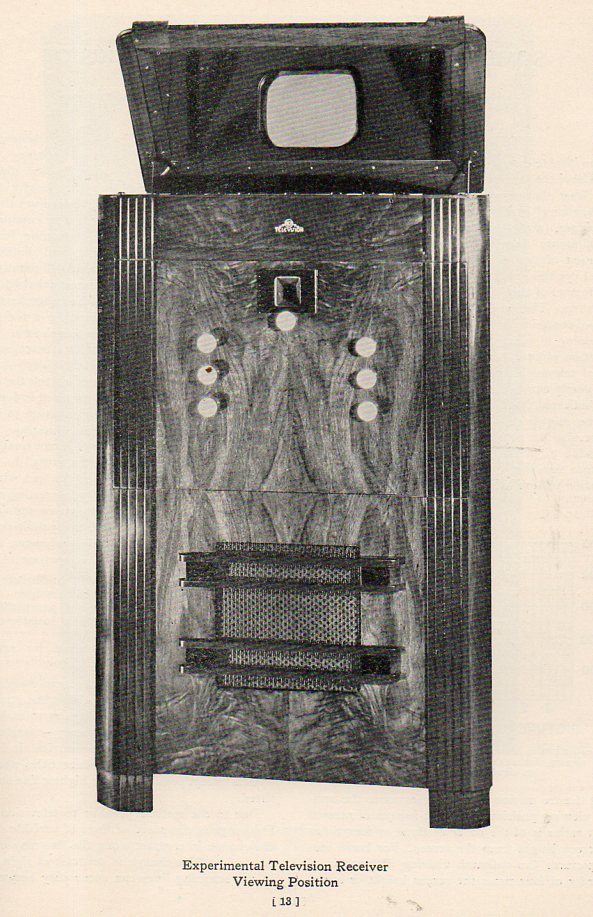
    The set on which the transmission was received was the RCA RR-359 trial set:
    RCA field test _2_

    ·Posted by :

    ·in:


  • Chinese Propagandist Publication on the February 28th Incident (2-28) (1947)

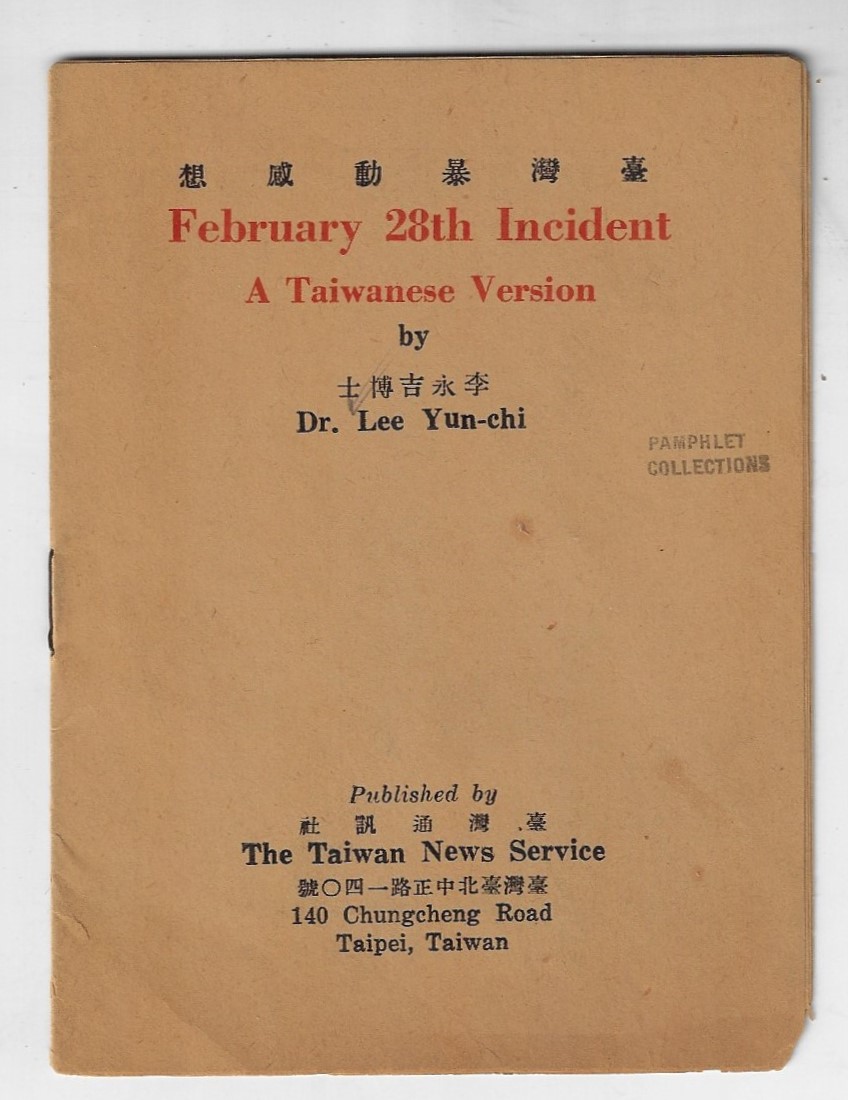
    Taiwan Incident Lee Yun-chi, February 28th Incident, a Taiwanese Version. Published by the Taiwan New Service, Taipei, Taiwan (“printed by the Mercury Press”), [1947] . 5″x 3.75”, 7pp. Wrappers. Printed on inexpensive newsprint, and the pages are now browned. Good condition, though better than what might expected from the origin of the paper. Provenance: Library of Congress, with their rubber stamp on the rear wrapper. 

    Only two copies located in WorldCat: Cornell and Yale. $250

    This is a propaganda piece on the “February 28th Incident” (“2-28”), which was a brutal suppression of a Taiwanese social movement by the government of China, resulting in the death of thousands of Taiwanese over a period of weeks (1). The author of this pamphlet insists on being Taiwanese eyewitness and lays the blame for the all that happened and all of the atrocities with the Taiwanese.

    Here are some examples of the vicious sentiments of the (supposed) author:

    • “Indiscriminate beatings of all Mandarin Chinese women and pregnant women and children…”
    • “Taiwanese no longer they respect themselves as citizens of China but the old slaves of the Japs. Their sadism was immediately manifest.”
    • “They lynched the Chinese, some dead some half-dead”;
    • Taiwanese atrocities similar to those of the Japanese during WWII;
    • Attacks by groups of “ruffians” and students;
    • Taiwanese in “relentless hunt”for Mainland Chinese;
    • Established the 2-28 committee to create peace by Taiwanese elements used it as a way to try to gain political power;
    • The greatest shortcoming of Chen Yi administration is “granting democratic rights to my fellow Taiwanese…;
    • Taiwanese never learned humanitarian love”;
    • “The aggressive Japs taught the Taiwanese VIOLENCE”;
    • The author claimed that years of re-education (of the Taiwanese) was needed.
    • The “responsibility for the present chaos….is simple politicians, Communists, Jap instigators, and rascals…I hope the government will take adequate steps to exterminate these bugbears…”
    • The ending sentence: “The future of Taiwan is bright and rosy.”

    ·Posted by :

    ·in:


  • Two Unlocated (?) Items by a Yugoslavian Freedom Fighter (1944)

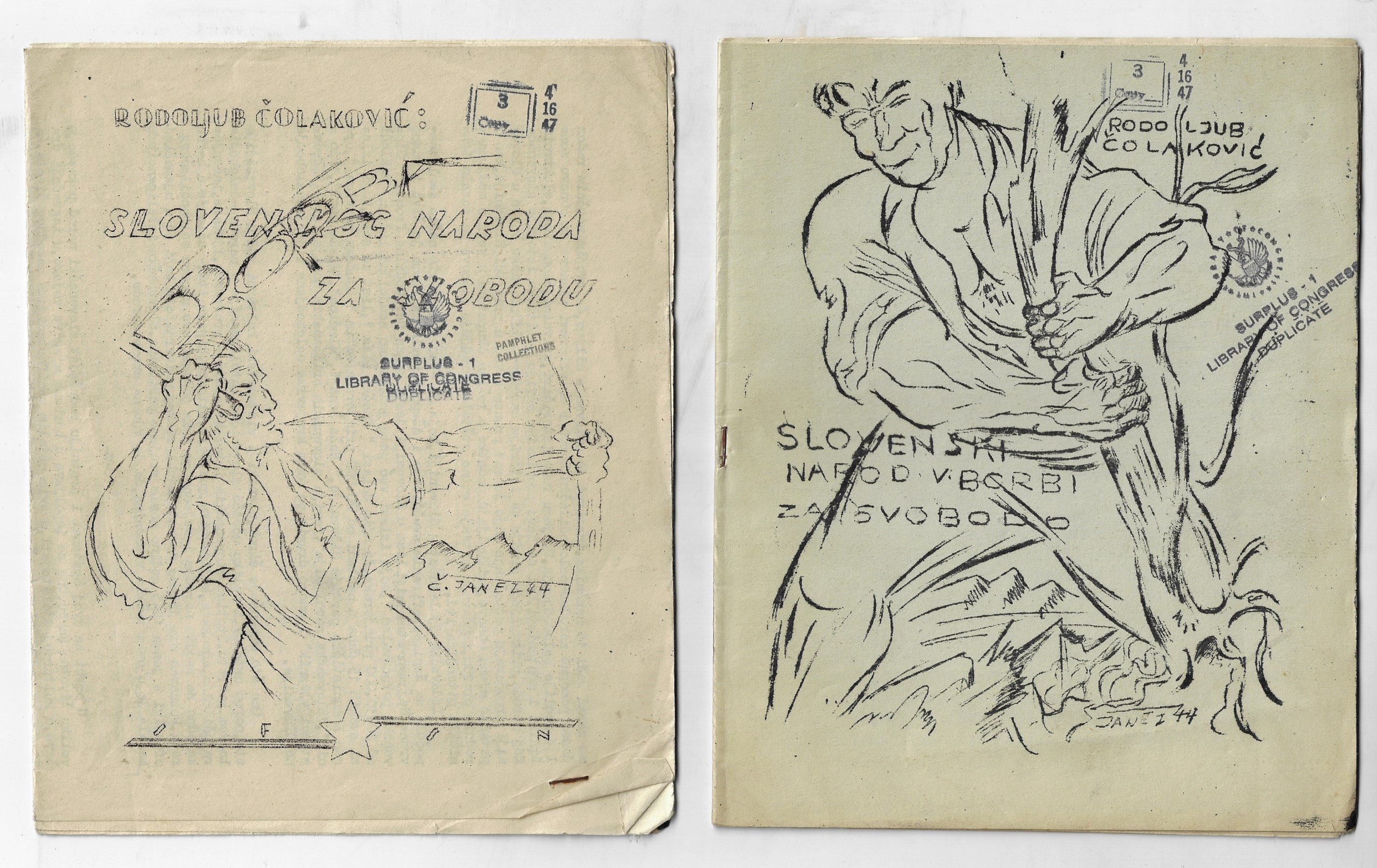
    COLAKOVIC, Rodoljub. Slovenski Narod V Borbi za Svobodo. (From the “Neve Jugoslaije”, St. 4-, 20 aprila 1944.
    8×6″, 16pp, wrappers.
    with:
    another version of the above, this with a different introduction (so far as I can determine) with the rest of the contents
    looking the same as the above, except in a different format. This version: folded 11×8″ sheets, and printed vertically
    on three sheets of paper.

    Provenance: Library of Congress. Neither is located in the WorldCat/OCLC. I did find a couple of references to this
    title being published as part of a larger, edited work, but for 1945. Both of these pamphlets feature artwork on the
    cover dated 1944. $300

    Yugoslavian freedom fighter


    ·Posted by :

    ·in:


  • Rare Work on the Sociological State of the USSR, Summer 1933

    Philena Weller Montgomery and John Ferguson Montgomery, Traveling Hard Through the USSR. Printed by the authors, 1105 Morrison Ave, Bronx, NYC, 1934.

    Unusual and detailed travelogue through the Soviet Union in the summer of 1933.

    11”x 8.5”, 77 leaves (printed on one side only), approximately 35-40,000 words, printed from the typed originals by mimeograph (?), with occasional line drawings in text by the authors. Perfect bound in wrappers with a cloth-covered spine. Front stiff wrapper is pretty tender, but overall the condition is VG. $2000

    • WorldCat locates only one other copy (Antioch, where the two Montgomerys went to school). It seems to me that the work was printed but not published, as there is no trail for the work, anywhere. This copy is from the Library of Congress, and I suspect that the authors sent at least one copy there for the sake of posterity, and another copy was left with alma mater. I cannot find any reference to this work in any of the standard histories of this period.

    The authors left with a group of 10 other people (fellow students?) for a loosely-guided trip through the Soviet Union in the summer of 1933. They write that even though they had a guide that they were in no way constrained from wandering off or speaking to anyone they wished; they felt that there was no control over their activity outside of the route they were following for their visit. The fact that they saw so much poverty and hardship, and interviewed whomever they pleased, attests to the limited control the state placed on their tour.

    Their adventure begins in Leningrad, and moves to Moscow, Gorki, Kaza, Samara, Saratov, Stalingrad, Rostov, Yalta, Odessa, and then back west via Kiev. The authors write that if the USSR were really trying to control what the visitors saw that they would positively not send people out of or into the country via Kiev because of the state of the city and the people. More on that later.

    The real flavor of this work, to me, is the ability of the writers to see the small local, personal detail—they weren’t interested so much in a grand building, but rather the women who were scrubbing the marble floors with some evil-smelling something because there was a shortage of soap; and not so much the boat they were passengers on, but rather the shabby dress whites of the captain and how he moved through the crew and how the crew responded to that; not the grand vistas of old St. Petersburg but rather the dirty shop windows that displayed pictures of items that they didn’t have in stock. That sort. It was a very interesting and unusual read.Here are some notes from my reading:

    Kiev

    • pale children working elevators at night of their hotel;

    • more Bezpreysosny (orphans) here than they saw in all the rest of the Soviet Union combined;

    • city swarmed with red Soldiers and OGPU;

    • shop windows displayed odd assortments—corks, urinals, bridge lamps, washboards, side-by-side, with very little consumer goods;

    • buildings were shabby as were the people, especially the children, “who show the effects of suffering”’;

    • visit to a Jewish collective farm

    • prophylactorium mostly for the peasants

    • doling out gold colored safety pins to a throng of 30 women;

    • Pechersk Monastery, with a translated story of the 1905 Revolution;

    • the authors remarked that if the Soviet government wanted to give a good impression of their country that it would be best for them to leave Kiev out of the picture, as it “leaves a bad taste in your mouth”.

    ·Posted by :

    ·in:


  • With a Map of the Geography of Prostitution in Portland

    Talbot, Henry Russell. Report of the Portland Vice Commission to the Mayor and City Council of the City of Portland, Oregon.. Portland, 1913. 9”x 6”, 216pp. Original stiff wrappers. Provenance: Library of Congress via the Washington DC Public Library. Condition: there are six small stamps for the libraries located on title page, end papers, and one on the front cover. Overall, a GOOD+/solid copy.  $200

    This is a survey of prostitution in Portland in one section of the city (Irving Street-Hall Street-23rd St-Harbor line) which investigated 547 buildings/rooming houses finding 98 to be “moral” and 431 to be “immoral”) with 98 in a gray-ish “doubtful” category. The publication includes the following sections: “A Report on the Social Evil, as affecting places of public resort and accommodation; hotels, apartment houses, rooming and lodging houses”, pp 4-81; “On the Legal and Police Aspects of the Social Evil”, pp 81-122; “A Report on the Juvenile Aspect”, pp 123-164; “Report on the Economic Aspect”, pp 165-202; “Report on a Segregated District”, pp 203-216.

    The contents are fascinating. For example, there is a section on interviews with proprietors, which includes a number of very colorful quotes, including one “madame” from a bawdy house on Sixth Street, who claimed “Portland is the best town on the coast for a sporting woman to make money in.” Other madams agree! There are interviews with “sources of vice” (“grills, chauffeurs, pool rooms, messenger boys newsboys…”), efficiency of the police and civil service.  A good standard example of a description of one of the bawdy houses reads: “Hotel [unnamed and with no street address identified] Taylor Street. Shabby place of 46 rooms. Run by man and woman, who occupy front rooms, one of which the woman uses as a parlor, the other as a bed room for immoral business. Three prostitutes work for management, paying one-half of their earnings from bed money. Liquor sold.”

    The “study of the docket” is a listing of occupations of prostitutes, arrests, charges, fines, and wages paid the prostitute; there is a section on “testimony” in which the sex worker tells her story, and another section on the general living conditions in the bawdy houses. The last section in the publication deals with “segregation”, though the type of segregation here has nothing to do with race, and simply means that there would be a set-aside space for sex businesses in Portland.

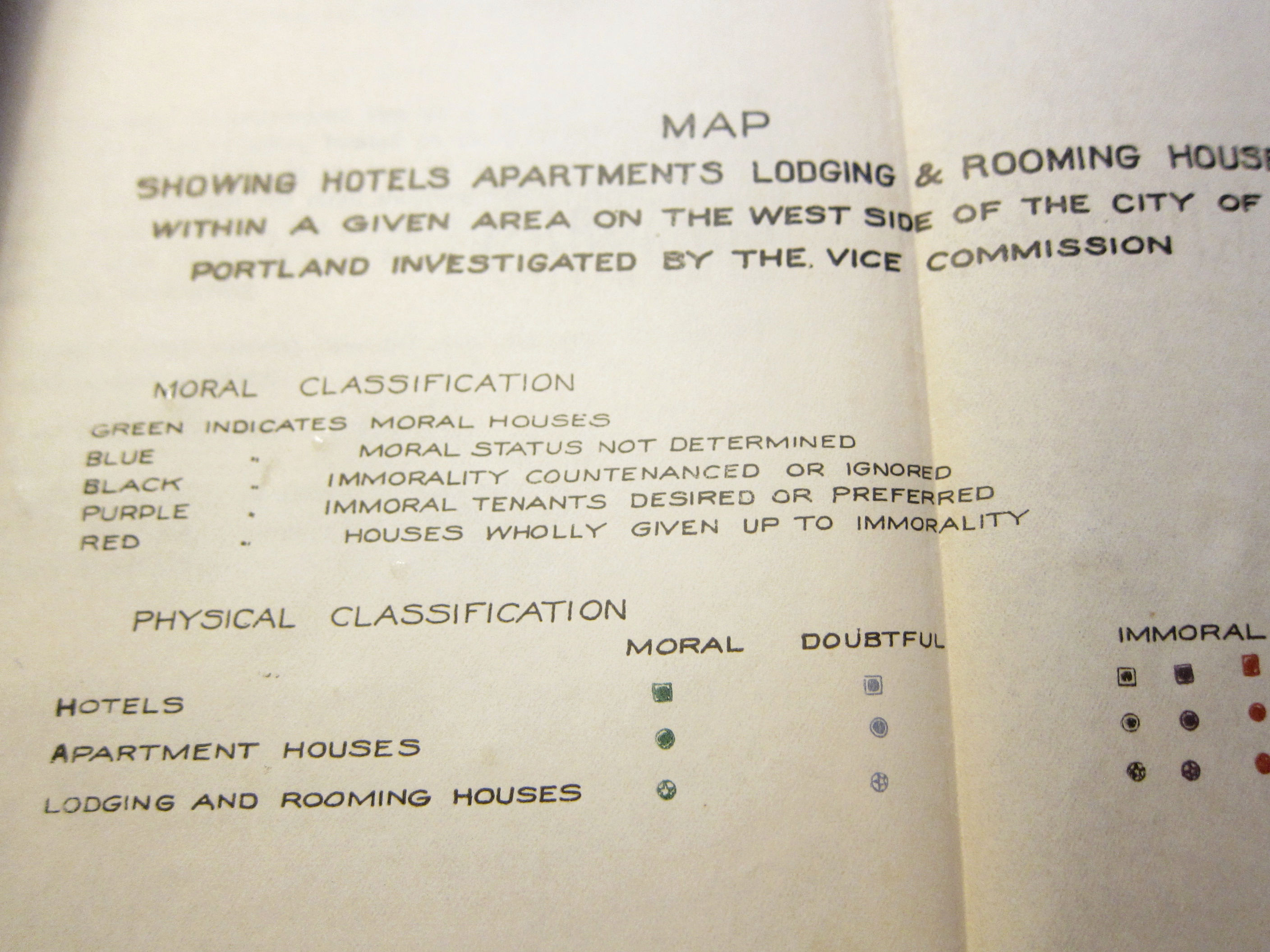
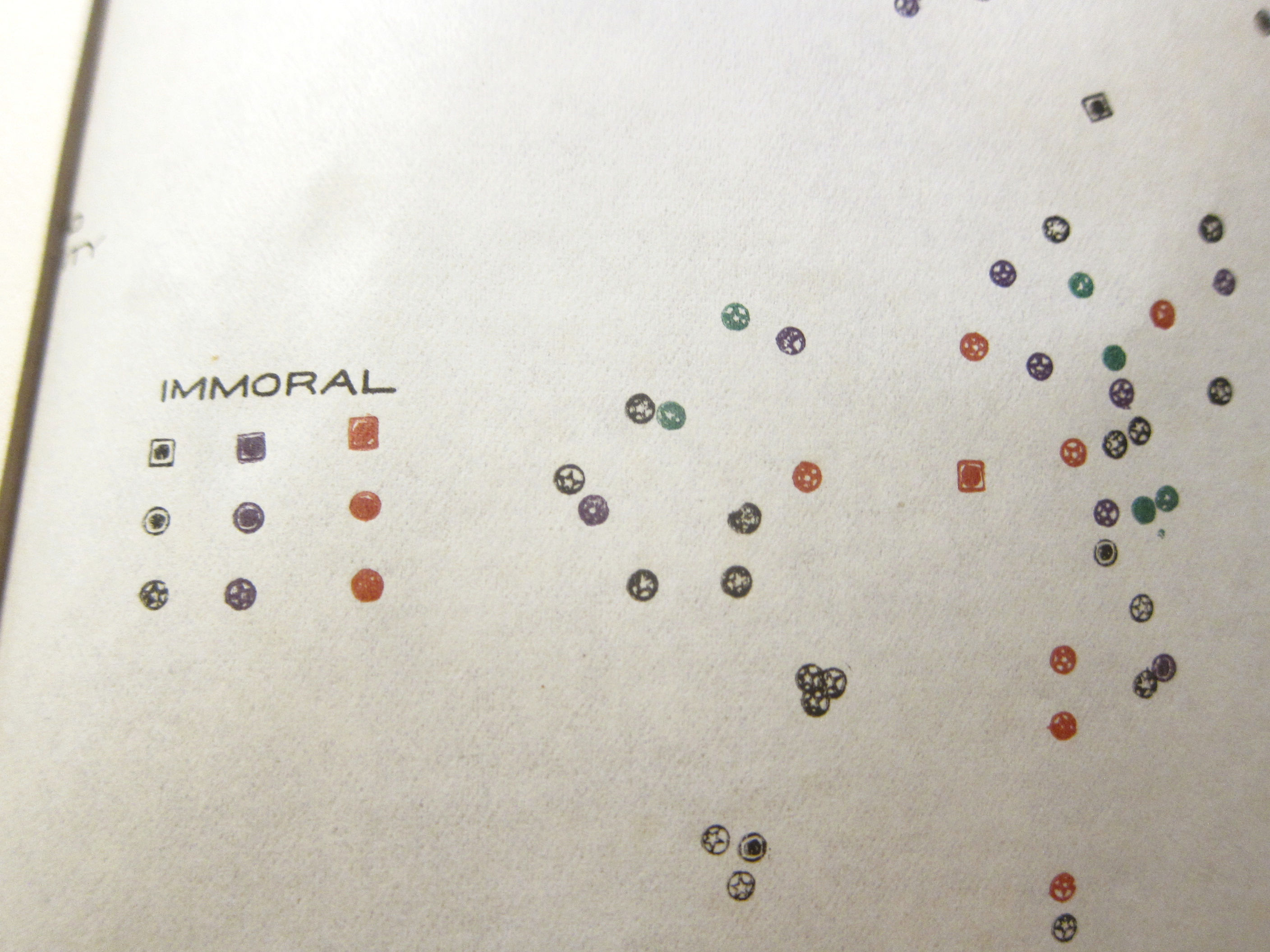
    There is also a very daring and fascinating map in the first section which identifies hundreds of the Social Evils establishments. They are classified top -to-bottom in the following way: “Moral houses”, followed by moral status not determined” and then steeping into “immortality countenanced or ignored”, to “immoral tenants desired or preferred”, and then finally to “house wholly given up to immorality”. The odd thing about the map is that it is an overlay, meaning that the details of the actual geographical part of the map are left out and there is no underlying map on which this skeleton map is laid (as published), which I guess was a preventative measure to squash the possible plans of some enterprising people to use a detailed map as a guidebook to Portland Houses of Ill Repute.

    Portland Vice Map
    Portland Vice Map

    There is an endless amount of social commentary and history that lives and thrives in these pages.

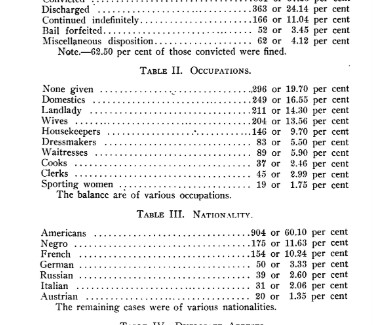
    One unexpected find: on page 96 there is a listing of nationalities of prostitutes arrested—in the accompanying table the leading nationality is “American” followed by “Negro” and then “German”…which seems to me that U.S. Citizenship is being denied to African Americans on the basis of race, and that, evidently, “Negroes” are not American citizens. And according to the law and the constitution in the state of Oregon, “Negroes” were not even allowed to migrate to the state, stated as such right in the Oregon constitution—a law that was not addressed and eliminated until 1924. I suspect that African Americans were illegally in the state and thus, somehow, had their rights of citizenship in the USA stripped away.

    Negro Nationality


    ·Posted by :

    ·in:


  • Rare Protest Broadside in Support of Jailed Indian Congress Members, 1944

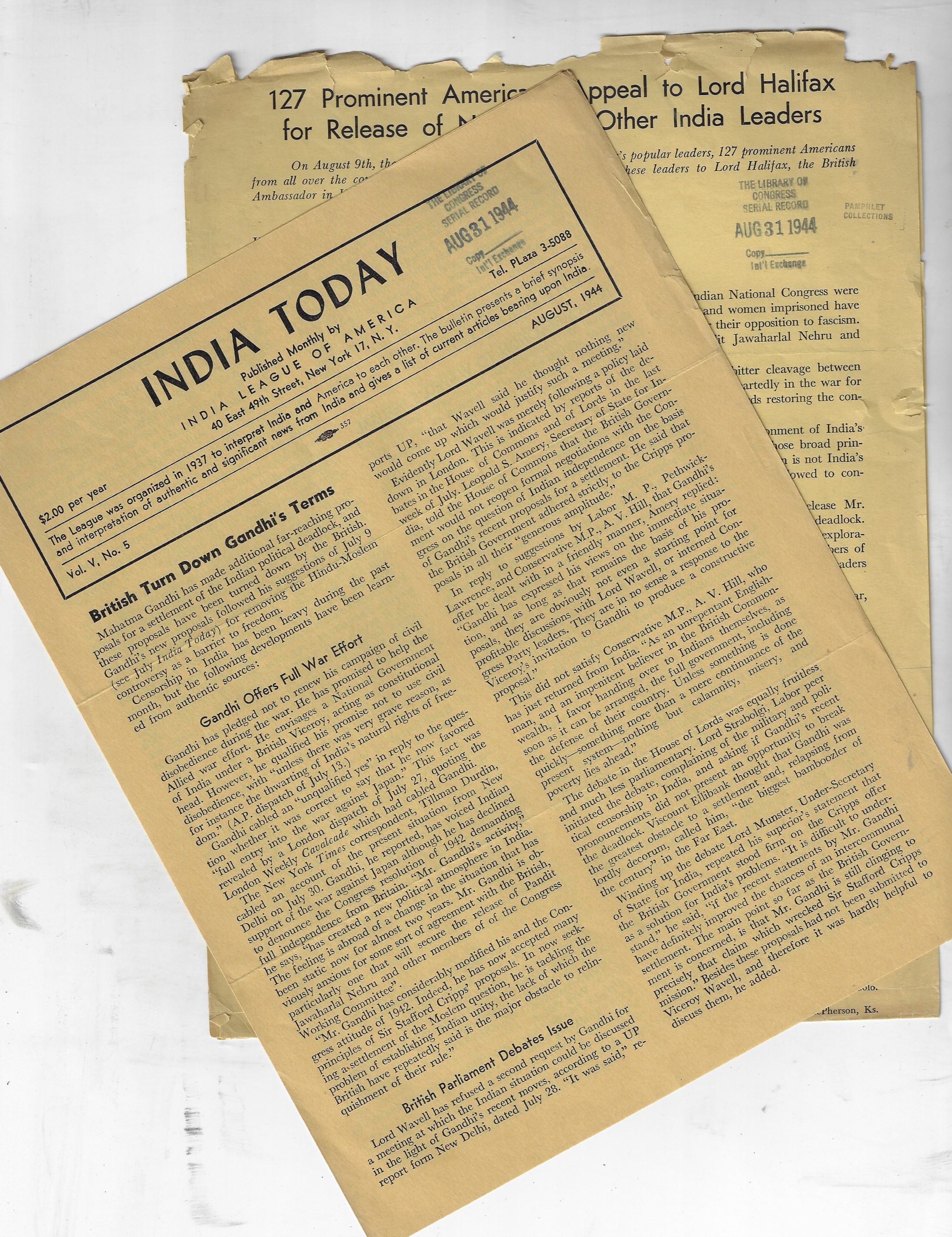
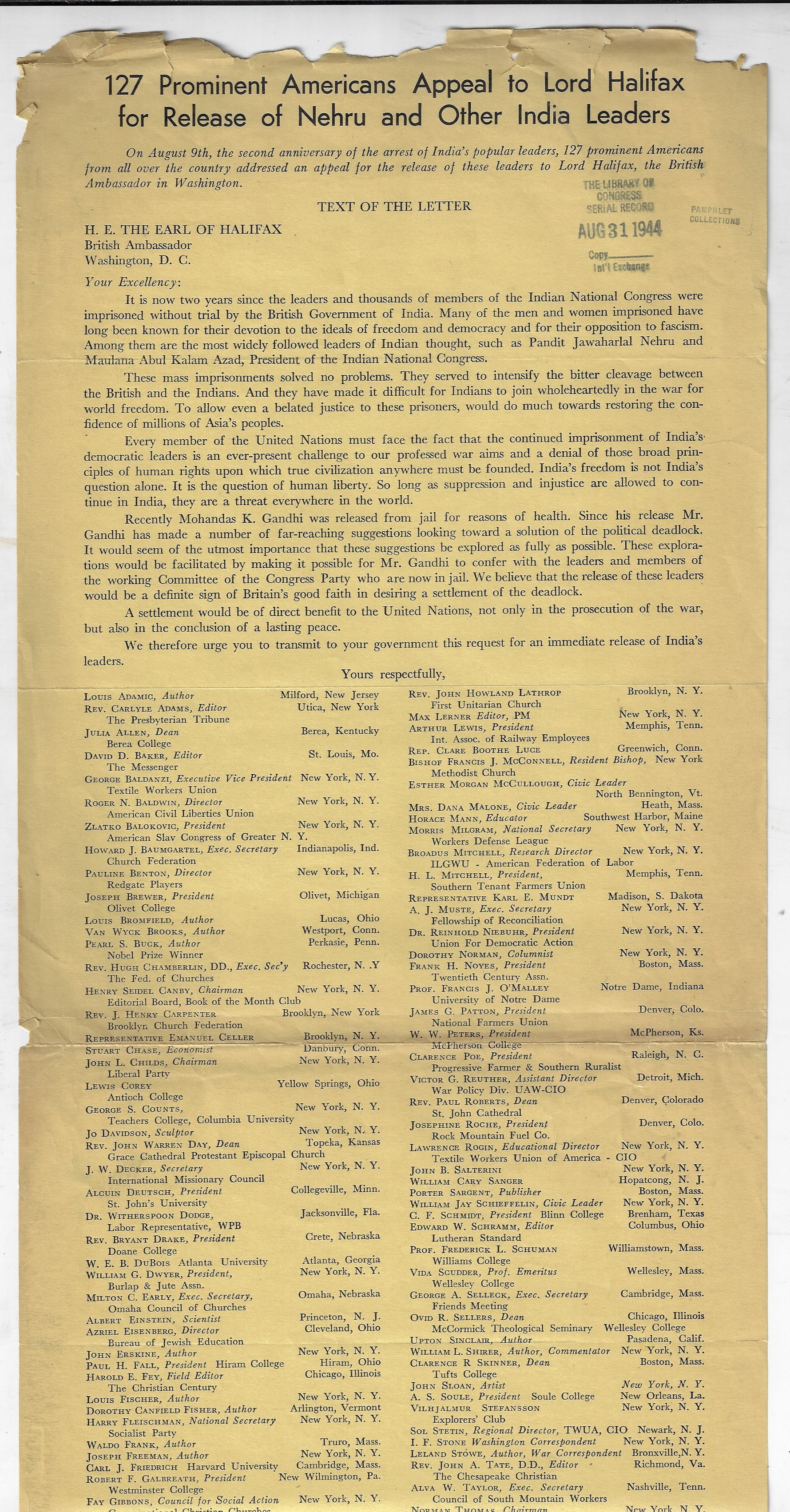
    India 127 cover 127 Prominent Americans Appeal to Lord Halifax or Release of Nehru and Other India Leaders. Published by the India League of America, NYC, (1944). Broadsheet/poster, 22” x 8.5”. The top of the document is a bit tattered and torn and missing in some sections, though not affecting the text. Provenance: Library of Congress Pamphlet Collections. Good copy. Scarce. Only one copy located in WorldCat. $450

    I’m pretty sure that the broadside came folded in quarters in the August 1944 issue of India Today (4pp). Currently the broadside is folded in half but there are very dim remnants of the two other quarter folds.

    “On August 9th, the second anniversary of the arrest of India’s popular leaders, 127 prominent Americans from all over the country addressed an appeal for the release of these leaders to Lord Halifax, the British Ambassador in Washington.”


    India 127 cover

    The anniversary referenced here is the 9 August 1942 arrest of Gandhi by British officials in their hope to suppress a civil disobedience program aimed at the Raj and UK leadership to gain the independence of India. This followed the August 7-8th All India Congress voting to pass the Quit India Resolution. Gandhi’s arrest was followed by those of nearly the entire leadership of the Indian National Congress..and another 60,000 or so other people over the following few months.

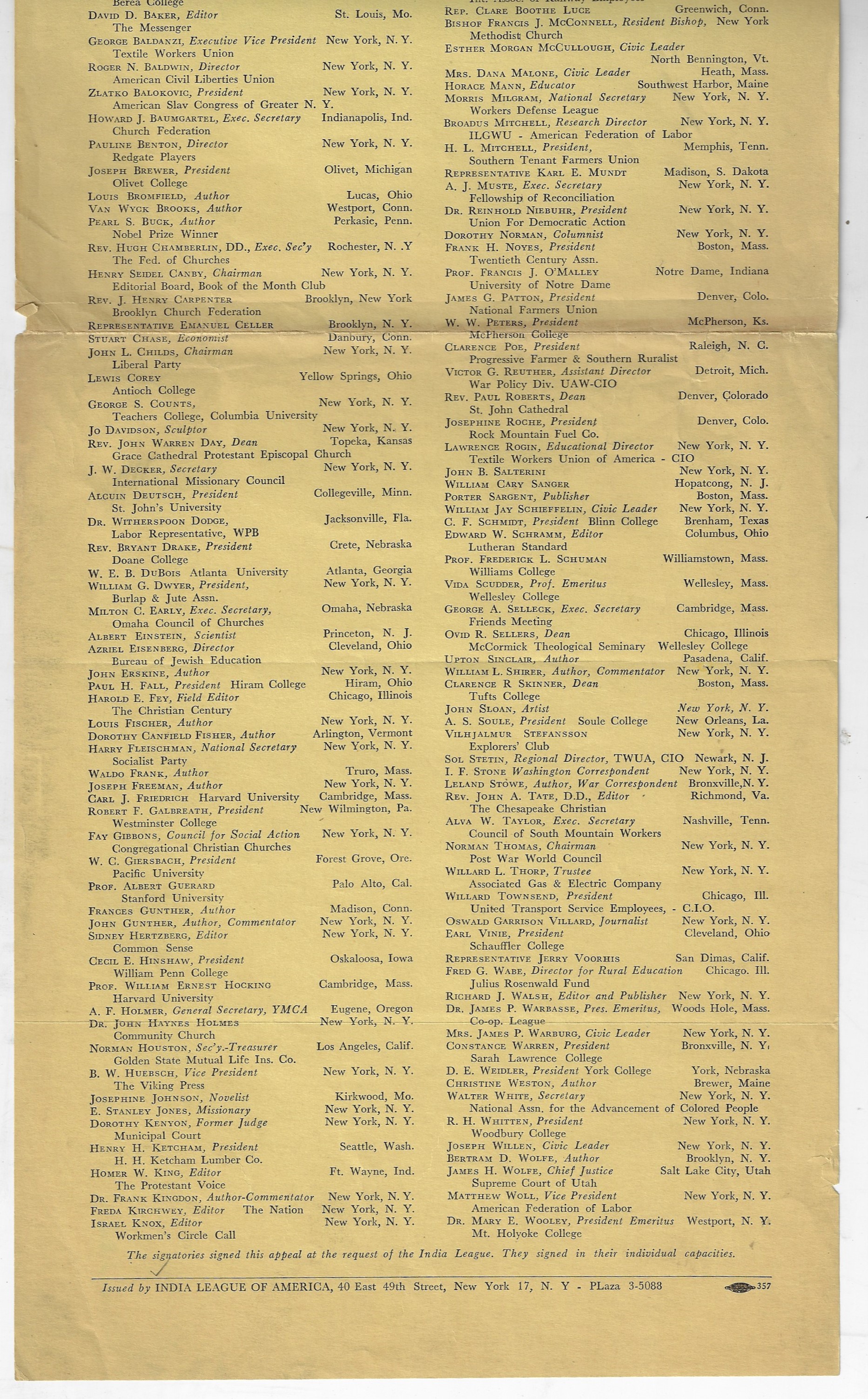
    The petition is signed by many luminaries, including Albert Einstein, Louis Adamic, Louis Bromfield, Van Wyck Brooks, Pearl Buck, Max Lerner (editor of the great PM), , Horace Mann, Reinhold Niebuhr, Claire Booth Luce, William Shirer, Upton Sinclair, IF Stone, and many others.

    India 127 cover

    ·Posted by :

    ·in:


  • H.L. Mencken’s Copy

    Catheryne Cooke Gilman. Responsibility for Better Motion Pictures. Women’s Co-operative Alliance, Inc., Minneapolis, 1929. 9”x 6”, 16pp. Original wrappers. Provenance: Library of Congress (with their rubber stamp on rear cover). Given to the LC by H.L. Mencken, with a notation in pencil on the back of the title page attesting to that. VG copy. $95 Only two copies located in WorldCat/OCLC (MoMA and Columbia).  $95

    Gilman was a renowned social work, early sex educator, general secretary of the Women’s Co-operative Alliance, and president of the Federal Motion Picture Council in America, Inc.

    ·Posted by :

    ·in:


  • Longish Report on NYC Central Park by the Chief Engineer (1867)

    William H. Grant, “The New York Central Park”, in: Journal of the Franklin Institute, 1867, third series vol 53 (vol 73 all together), 426+vpp. Half calf and marbled boards; ex-library (with some ghost remnants of a spine label, and that’s about it save for a few stamps on the title page and a bookplate). Very nice copy. $135  The Grant article occupies pp 11-14, 100-107, 153-161, 233-238, 297-304, 390-397.

    Also in this volume (among many other contributions) are:

    • Fleeming Jenkin, “Submarine Telegraphy”, pp 42-46, 122-180,
    • Henry Morton, “Lectures on Electricity and Light”, pp 48-54, 200-203, 356-358; 413-414
    • “The Magic Lantern as a Means of Demonstration”, pp 47-58, 204-206, 282-284, 354-356, 409-412,
    • “The USS Armored Frigate New Ironsides”, pp 73-81;
    • George A. Parker, “The Susquehanna Bridge”, pp 239-249, with two folding plates, one being a map and the other a long profile of the bridge.
    • The Electric Light, pp 289-294;
    • John Tyndall, “On Sounding and Sensitive Waves”, pp 260-263, 346-349.

    ·Posted by :

    ·in:


  • Goldman Emma 1869 1940 Fragment Of The Prison Experiences Of Emma Goldman And Alexander Berkman In The State Prison At Je


    Goldman Emma Alex Berkman Goldman, Emma, 1869-1940. Fragment of the prison experiences of Emma Goldman and Alexander Berkman in the State Prison at Jefferson City, Mo., and the U.S. Penitentiary at Atlanta, Ga., February, 1918-October, 1919. New York : S. Comyn, [1919?] 9“ x 6”, 25pp. Original wrappers.  $250

    Provenance: Library of Congress, with their 95%-faded away rubber stamp on the rear cover. Good condition. This was printed on inexpensive paper from the start, which was susceptible to nicks and short tears. This copy has a 10mm square bit missing from front cover top/right; there’s also a 1”-long tear in an ad leaf at rear. Otherwise this is a pretty nice copy. Scarce: only 6 copies located in WorldCat , or so it seems that this is the case—I checked numerous records for this in its original and reprint, and that seems to be the correct number).

    ·Posted by :

    ·in:


  • Classic and Significant Paper in the History of Helicopters

    Florine, N. “Elements du Calcul de Stabilite d’un Helicoptre” in Bulletin du Service de l’Aeronautique. No. 10, May 1930, pp 1-50. Also with M. Risack, “Note Concernant de l’Etablissement des Equations du Mouvement” on pp 51-55. Original wrappers. There’s an old fold going through the center vertically through the publication, otherwise the publication is a solid VG. Scarce. $200

    • “Nicolas Florine worked at l’Administration de l’aéronautique, based in the buildings of the Hotel des Monnaies in Saint-Gilles (Brussels). In 1926 he was responsible for initiating the Centre d’aérodynamisme …He was involved in the creation of Belgium’s first wind tunnel…The studies Florine performed…in 1926 led to patents related to helicopter control and in particular how to counteract the torque resulting from using two rotors. The results of the studies were published in the article “Eléments du calcul de stabilité d’un hélicoptère”. Herein, the principle was described of a helicopter with two rotors. These rotors turned in the same direction, in contrast to the current tandem helicopters…This publication formed the basis of all his designs that would follow.”—Wikipedia

    Helicopter florine stability 1930


    ·Posted by :

    ·in: