A Daily History of Holes, Dots, Lines, Science, History, Math, Physics, Art, the Unintentional Absurd, Architecture, Maps, Data Visualization, Blank and Missing Things, and so on. |1.6 million words, 7500 images, 4.9 million hits| Press & appearances in The Times, Le Figaro, Mensa, The Economist, The Guardian, Discovery News, Slate, Le Monde, Sci American Blogs, Le Pont, and many other places… 5000+ total posts since 2008.

Book Category: Social History

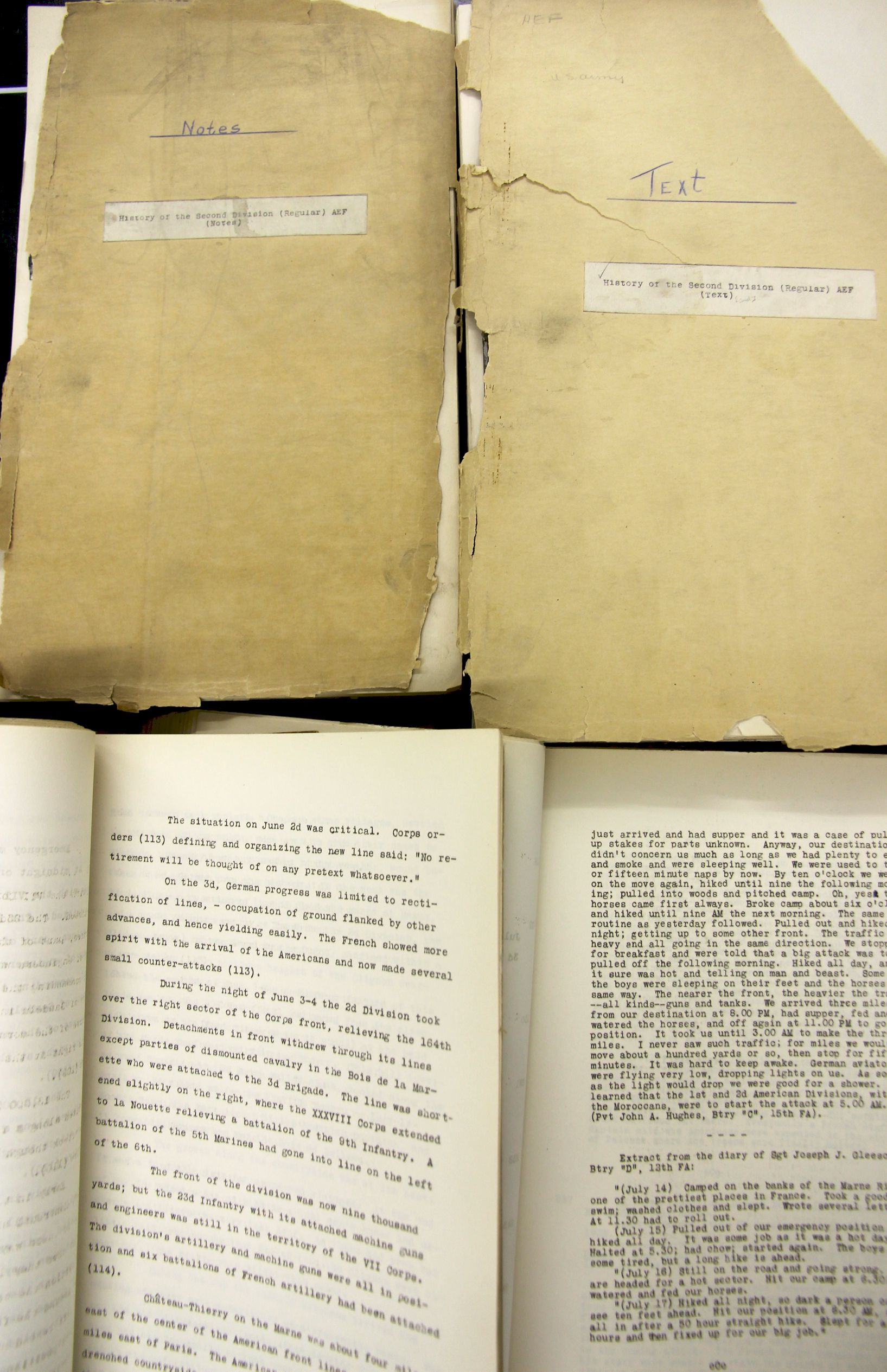
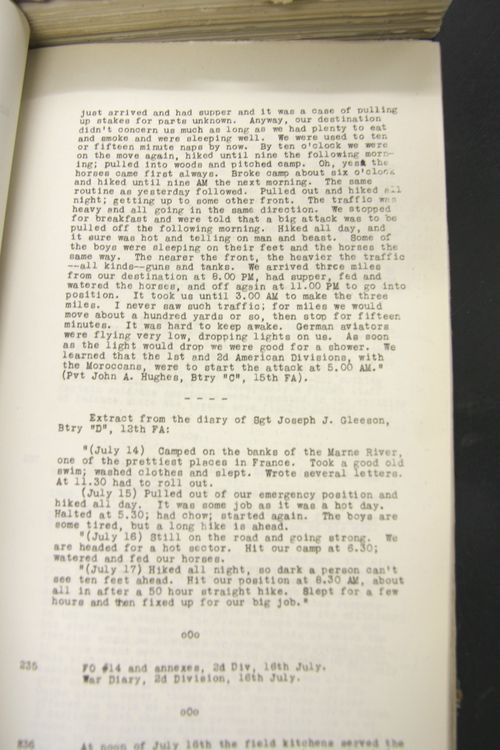
  • RARE Work on the History of the 2nd Division, USAEF 1917-1918

    (Colonel Oliver Lyman Spaulding and Colonel John Womack Wright.) History of the Second Division (Regular) AEF. 1936. 2 volumes, 35cm. 282 leaves+157 leaves (printed on one side only). Offset printed/mimeo printed (?), two-hole punched with metal clasps. Simple plain manila wrappers which are detached and very chipped.  $750

    This is the original version of this publication, with no mention of authors or printer. I’ve determined the book was based on the two authors listed above under the title “The Second Division, American expeditionary force in France, 1917-1919”, published in New York, by the Historical Committee, Second Division Association, The Hillman press, inc., 1937. There is a version of this online at Hathi Trust, and the two are the same.

    Second division _1_

    The published version appeared so: 2 p. l., iv, 412 p. front., illus., 6 port. on 1 pl. 24 cm. There are no illustrations or maps in the preliminary version offered here, though there is a call for illustrations and maps “to follow”. This is copyrighted by Maj. General Preston Brown (1872-1948), CoS 2nd Infantry (April-Swept 1918), CoS IV Corps, Commander 3rd Division.

    RARE. This preliminary version—printed a year before the published version appeared—is NOT LOCATED in WorldCat.

    Second Division _2_

    ·Posted by :

    ·in:


  • German Anti-Soviet Propaganda (1942)

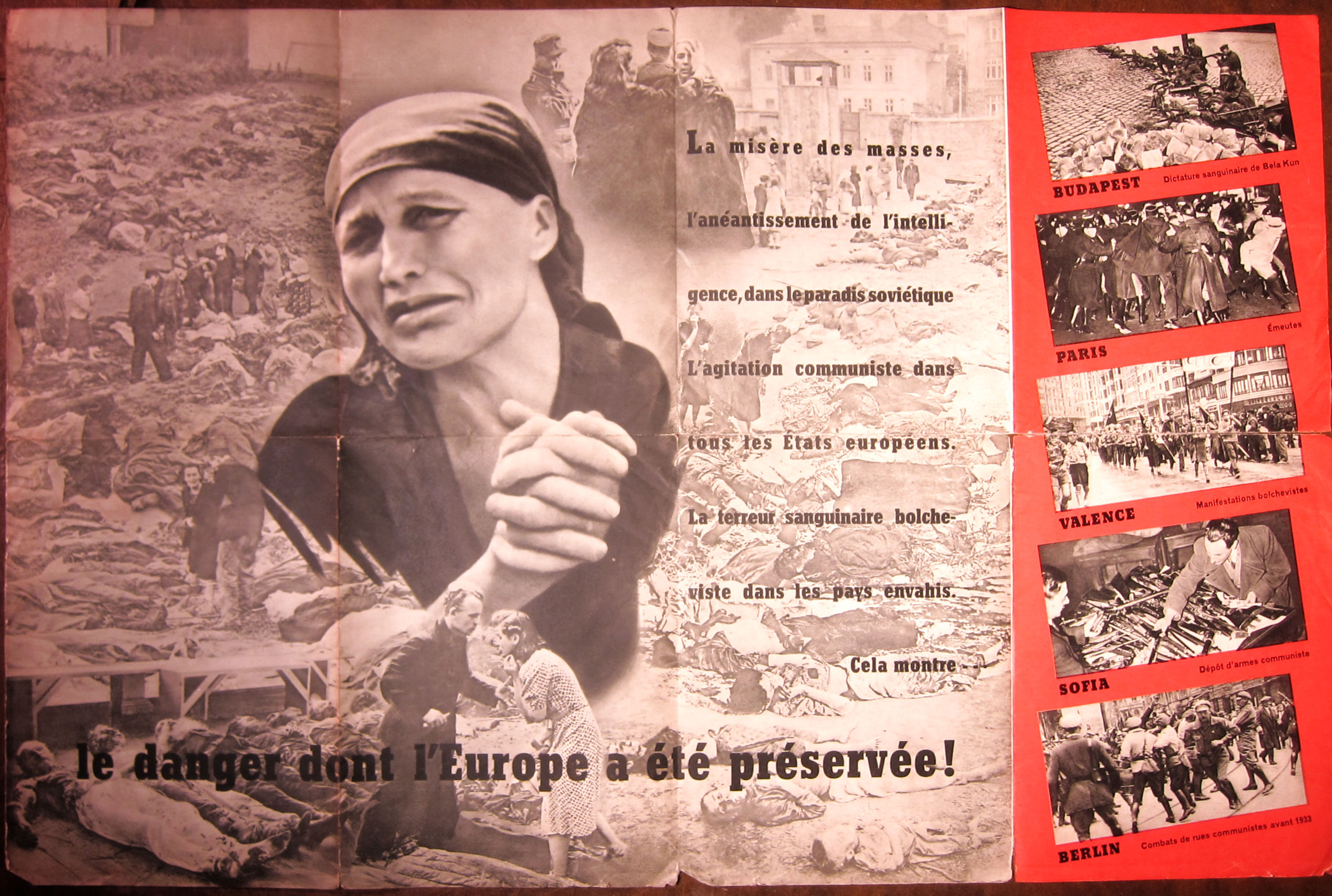
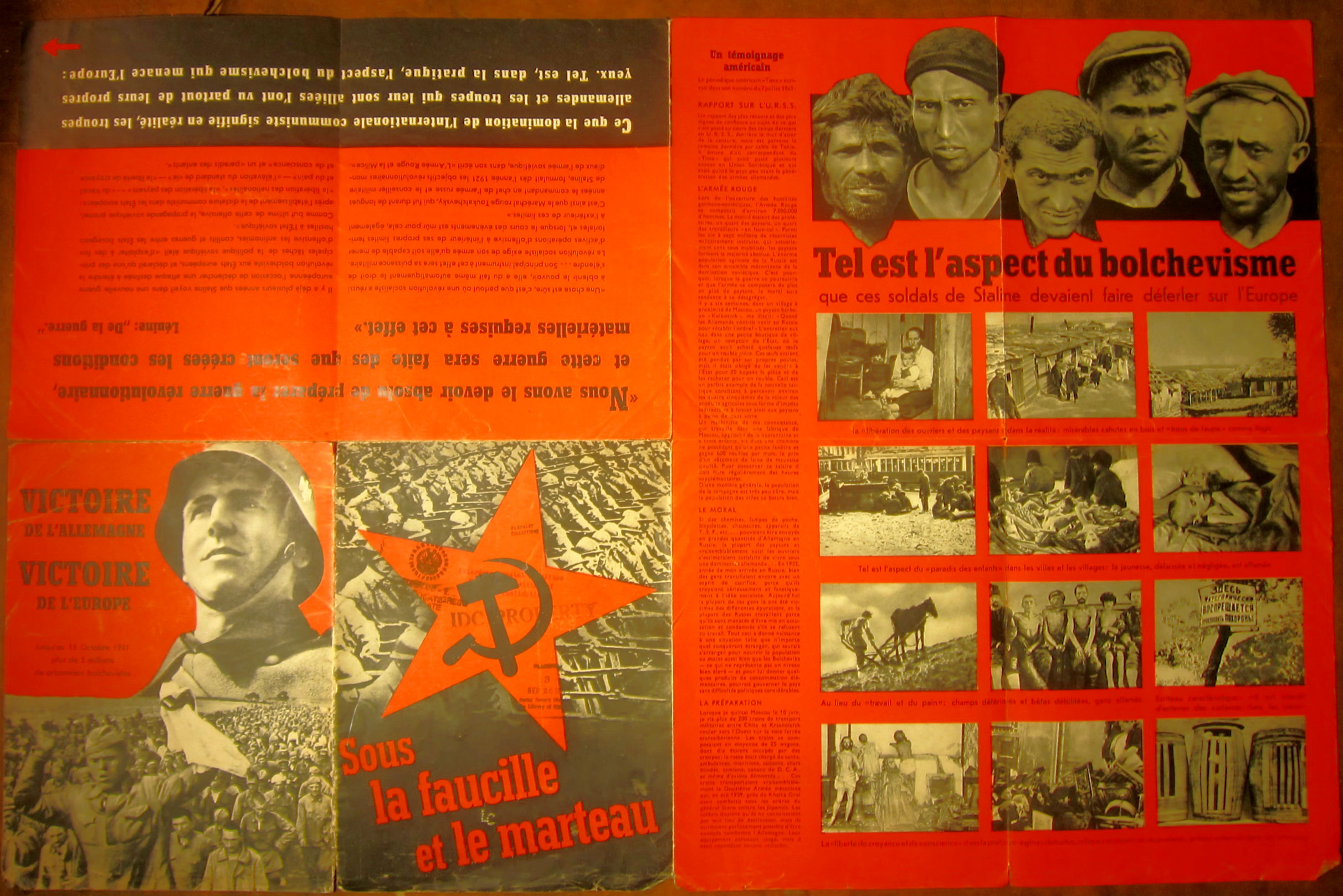
    Sous la faucille el le marteau (“Under the Hammer and Sickle”). (No indication of place of publication, or publisher, or date of publication, though I would guess around 1942.) 18”x 28”. One separation along 10” of a fold repaired with archival Japan tape; otherwise VG. Provenance: Library of Congress, with their rubber stamp on the front cover. WorldCat locates 10 copies—none in the U.S. (Also they estimate the publication date to be 1945, which I think is too late in the war; I would guess 1942.)

    $250

    This “pamphlet” is uncut from the original sheet, meaning that in order to read it you unfold/open the object three times: one panel to start, then two, then four are revealed, and then eight. This is an effective technique, as the images become progressively more grim; when you arrive at the “poster” portion of this pamphlet, the images are very bad.


    German propaganda poster _2_


    This is a searing and bitter piece of German anti-Soviet propaganda printed for French readers somewhere near 1942—it seems to me to be a product of the Nazi thought engineers that was made before the turning point of Operation Barbarossa, before things started to go very badly for the Germans in mid/late 1941 and advancing into 1942 (the campaign and the VI army ending in January 1943). This is something that goes far beyond a general strafing of the Soviet Union, and on into a condemnation of the system/soldiers/people as barbaric and “deviant”.

    The opening page leads with an indicting quote from Lenin and then introduces the rest of the imagery saying, in effect, “what the domination of international communism means in reality” and reporting the first-hand accounts of what “the German troops and their allies and saw…everywhere with their own eyes” which is established as the “practice, the aspect of Bolshevism that menaces Europe”.

    German propaganda hammer sickle covers poster 1_


    Then comes the hard stuff, the pamphlet opening into a poster, with grainy pictures depicting terrible things: menacing-looking portraits of men said to be the ‘deviant” USSR soldiers; depictions of hardscrabble and dilapidated villages in the “worker’s paradise”; a common sight of a sign in a park prohibiting the burial of cadavers on park grounds; profanities committed against the church, including imprisoning priests in barrels as cells, and then advancing to the terrible depiction of the “children’s paradise”, showing “the youth, neglected and abandoned, starving”, with photos of piles of small bodies.

    On the other side of the “poster” is another dire set of images, again depicting the supposed hell-hole of Bolshevism, the “Soviet paradise” nothing but misery, accompanied by the “annihilation” of intelligence/intellect. Very tough stuff, especially writ large like this.

    ·Posted by :

    ·in:


  • Report No 1 Confidential Eye Witness Reports From North Of The 38Th Parallel Russian Occupation Zone In Korea 13X8

    Russia North Korea

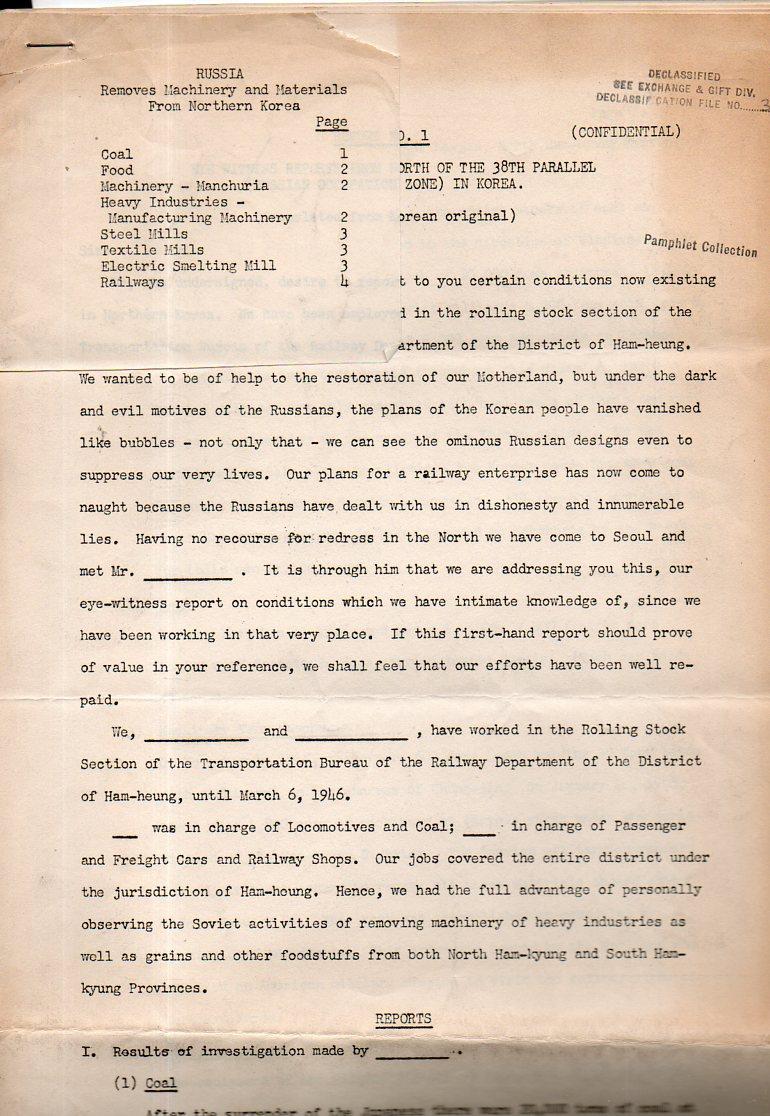
    Report No. 1. (Confidential) Eye Witness Reports from North of the 38th Parallel (Russian Occupation Zone) in Korea. 13×8″, 5 leaves, offset printed. Offset printed. WorldCat/OCLC locates NO copies. $750

    Condition: old vertical fold at the bottom quarter. Stamped “declassified” by the exchange and gift division, Library of Congress, with their surplus/duplicate stamp on the rear page.

    There are various reports with the “eyewitness” names left out, replaced by subscript lines. The materials removed are categorized so: coal, food, machinery, Manchuria, heavy industries, manufacturing machinery, steel mills, textile mills, electric smelting mill, railways, and so on.

    This document seems to offer proofs of large-scale stripping of North Korean facilities back to the Soviet Union–at just the time when it was said that there perhaps wasn’t good evidence for this. (See: The North Korean Revolution, 1945–1950 By Charles K. Armstrong, page 150, available online).

    ·Posted by :

    ·in:


  • The World Dope Menace and the U.S. Contribution To It (1923)

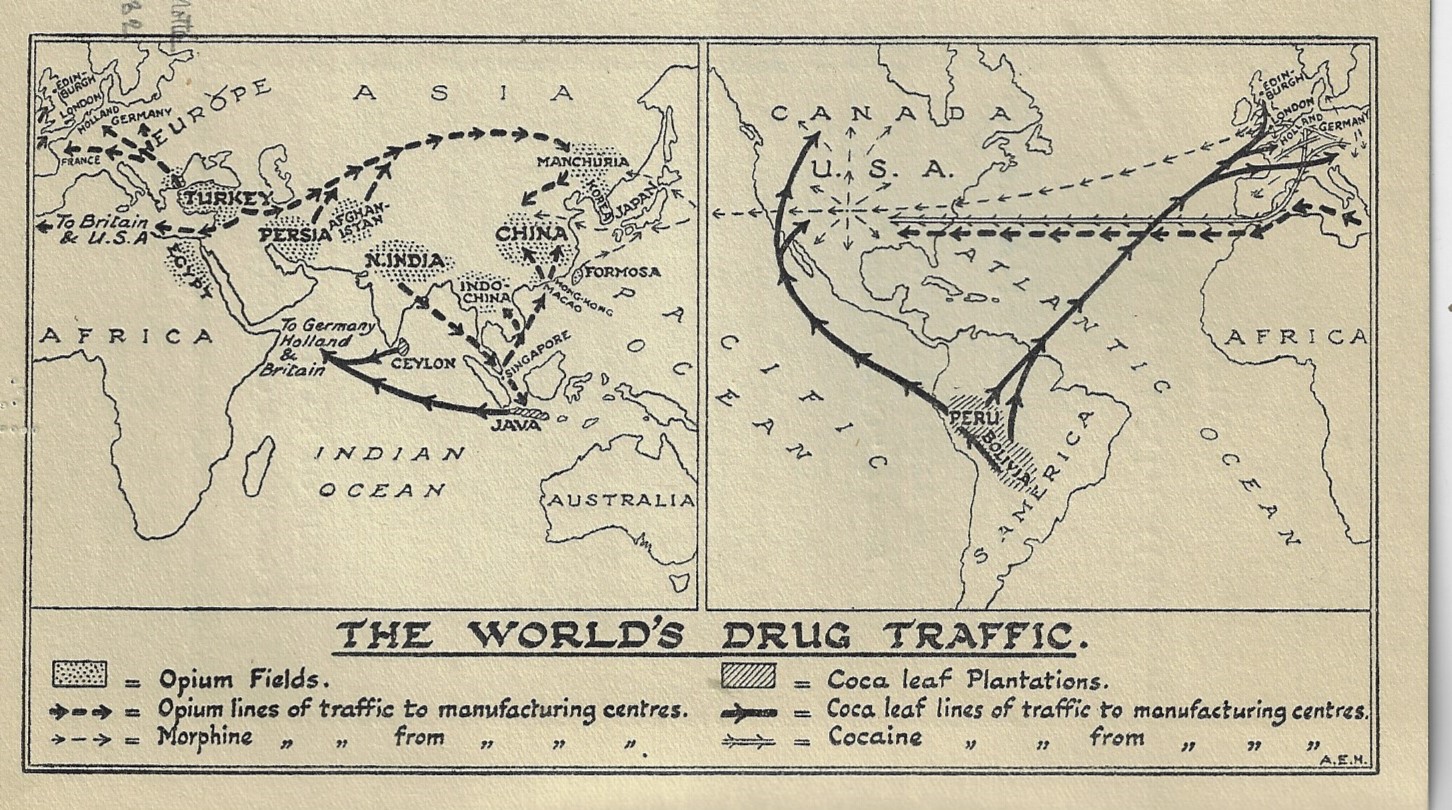
    Basil Mathews, The World “Dope” Menace and the League of Nations. London, the League of Nations Union, 1923. 7″x 5″, 24pp. Original wrappers.  VG copy. $95

    A sober and clinical appraisal of the amount of narcotics being smuggled and consumed in Hong Kong, China, Japan, french Indochina, Ceylon, Mauritius, and others.

    He also states the amounts that Western countries export to (in this case) Japan: England 10,000 lbs, France 8,000 lbs, Germany 2.800 lbs, Belgium 2800 lbs, Switzerland 4400 lbs, Holland 250 lbs, USA 18,500 lbs.

    World Dope menace map

    “In cold literal fact men in Britain and America and Japan have grown rich by debauching of China’s morphino maniacs who are now innumerable.”

    “The seriousness of morphine addiction can be understood from the opinion of an expert authority who says Morphine is not only ten times more deadly than opium but is more seductive and overwhelming in results. The addict becomes an absolute slave entirely powerless for not only are his will and moral fibre entirely rotted by the drug itself but he becomes the victim of the most dreadful tortures directly that he is robbed of his doses nervous tortures so terrible that they often drive him mad and end in death.”–from the pamphlet, p. 15.


    Basil Mathews, The World “Dope” Menace and the League of Nations. London, the League of Nations Union, 1923. 7″x 5″, 24pp. Original wrappers.  VG copy. $95

    A sober and clinical appraisal of the amount of narcotics being smuggled and consumed in Hong Kong, China, Japan, french Indochina, Ceylon, Mauritius, and others.

    He also states the amounts that Western countries export to (in this case) Japan: England 10,000 lbs, France 8,000 lbs, Germany 2.800 lbs, Belgium 2800 lbs, Switzerland 4400 lbs, Holland 250 lbs, USA 18,500 lbs.

    “In cold literal fact men in Britain and America and Japan have grown rich by debauching of China’s morphino maniacs who are now innumerable.”

    “The seriousness of morphine addiction can be understood from the opinion of an expert authority who says Morphine is not only ten times more deadly than opium but is more seductive and overwhelming in results. The addict becomes an absolute slave entirely powerless for not only are his will and moral fibre entirely rotted by the drug itself but he becomes the victim of the most dreadful tortures directly that he is robbed of his doses nervous tortures so terrible that they often drive him mad and end in death.”–from the pamphlet, p. 15.

    ·Posted by :

    ·in:


  • Admiral Wainwright’s Working Copy of the Preliminaries for the Third Hague Conference

    Wainwright _1_
    WAINWRIGHT, Richard, Admiral. Spanish-American War hero, Medal of Honor, Superintendant of the US Naval Academy (1900-1902), and etc.

    Memorandum, Preliminary Study, Preparatory Committee of the United States for the Third Hague Conference.

    Carbon copy on very thin, onion-skin-like paper. Ca. 1913. 11”x 8.5”, 296 leaves, partially paginated: (3),134 lvs, (14 lvs), (41 lvs), (6 lvs), (3 lvs), (13 lvs), (82 lvs); approximately 75,000 words. Bound in a contemporary store-bought “Shipman’s Common Sense binder”. VG copy.

    WorldCat does NOT locate this version of a subsequently-published report. $1750

    Provenance: Admiral Richard Wainwright, then to the Navy Department library (received 30 Sept 1926), then to the Library of Congress

    Various library stamps: mostly-removed Navy Department ex-libris; rubber stamp “Discarded/Navy Department Library”, rubber stamp of receipt by Navy on front free endpaper; “Admiral Wainwright” in a fine hand in ink at the top of front free endpaper; rubber stamp “Surplus Library of Congress Duplicate” on rear endpaper.

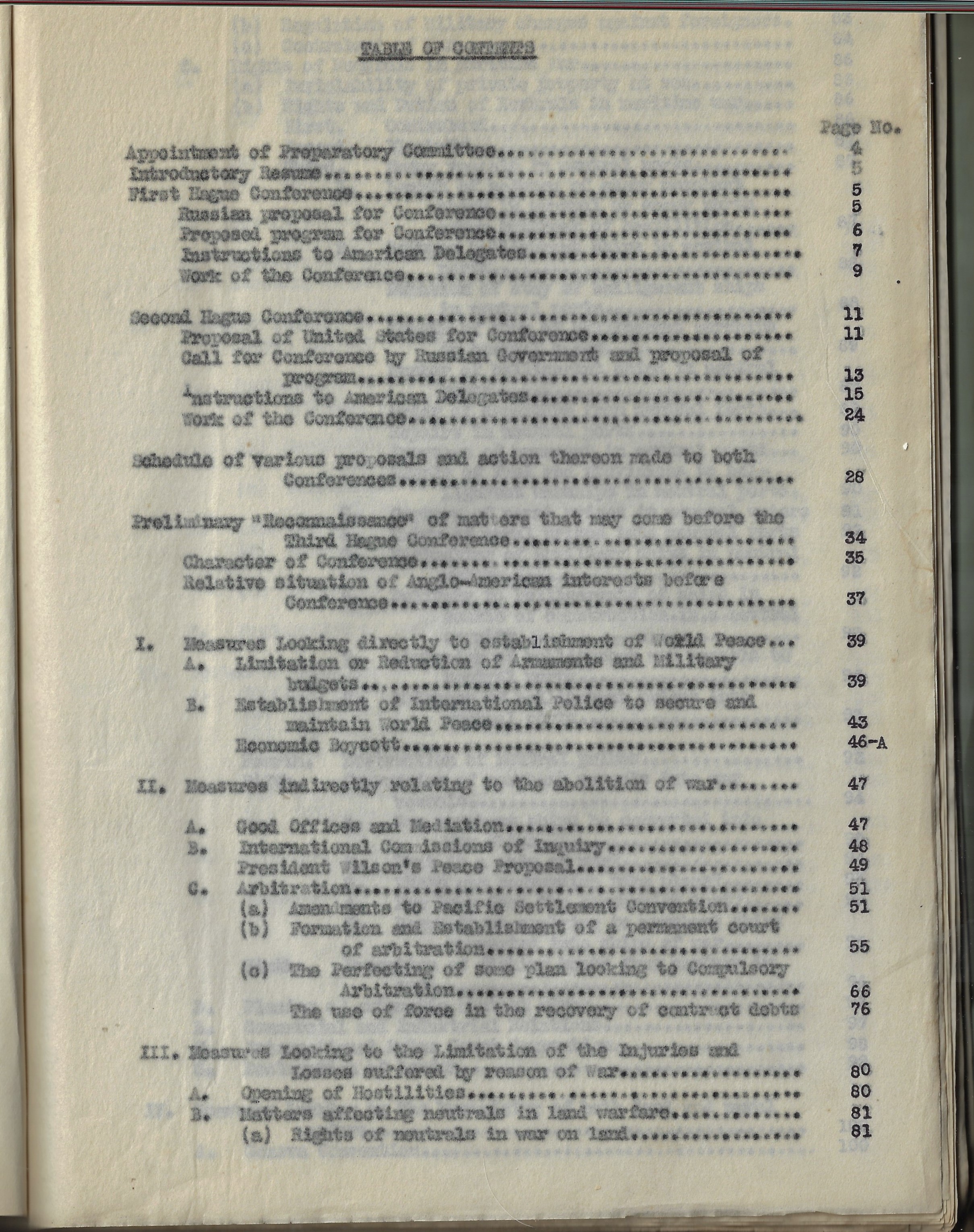
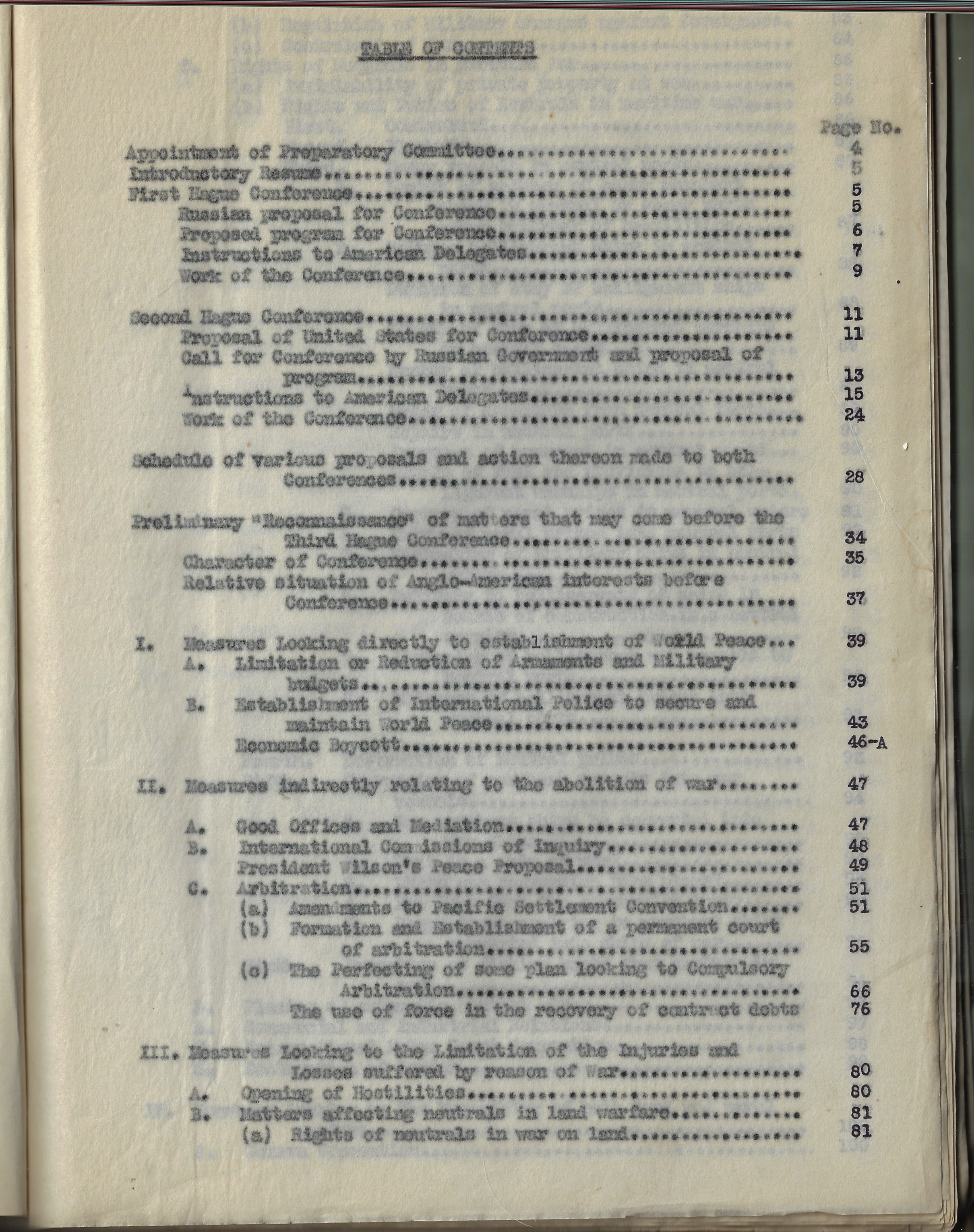
    This seems to be a preliminary edition of Preliminary Report of the Preparatory Committee of the United States for the Third Hague Conference, to which Admiral Wainwright and two others were appointed by President Taft. “The committee appointed by President Taft June 10, 1912 consists of Hon J Reuben Clark ex Solicitor for the Department of State; Gen Enoch H Crowder, Judge Advocate General of the United States Army; and Rear Admiral Wainwright of the United States Navy. The report begins with the letter of Secretary Knox to President Taft April 5 1912 recommending the appointment of such a committee This letter suggests the importance of such a committee that the Government of the United States might be informed precisely of its relations to the Hague Conference The committee was appointed with the understanding that it represent the United States upon the international preparatory committee contemplated by the Second Hague and that the members should be technical delegates to the Third Hague Conference This letter also sets forth that since in the practical application of the principles and rules of international law all responsibility falls upon the Department of State the War Department and the Navy Department therefore the committee might well be made up of a representative of each department The committee which is to serve continuously until the close of the Third Hague Conference was set the task of preparing a general program for the participation of the United States in a Third Hague Conference While as suggested by the title the report submitted is but preliminary to the formal report hereafter to be submitted the general …”–Advocate of Peace, Washington D.C., 1914., Vol 76 #1.

    ·Posted by :

    ·in:


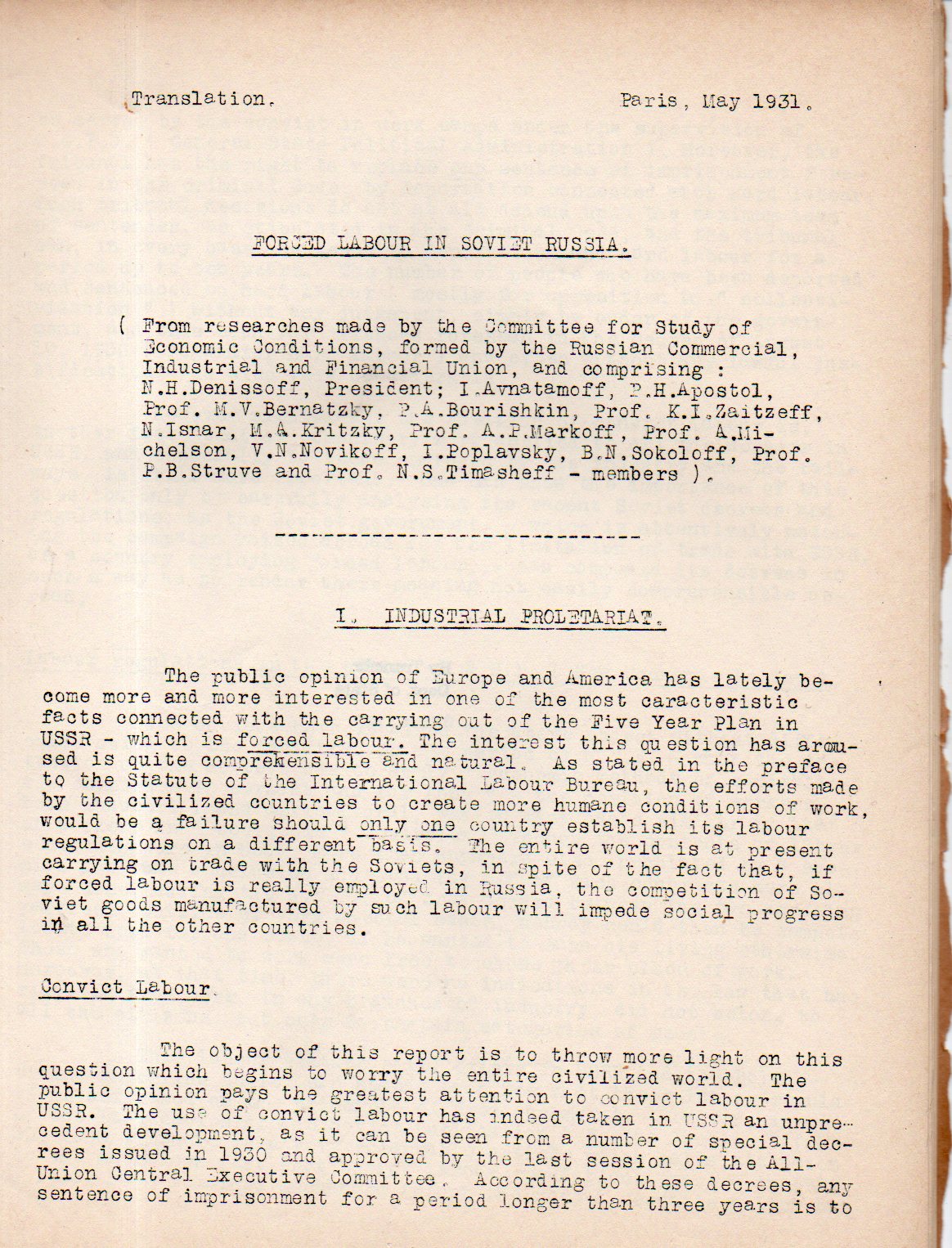
  • Very Scarce Reports on the USSR, including a Report on Forced Labor–1931

    Including a Report on Forced Labor in the Soviet Union, 1931

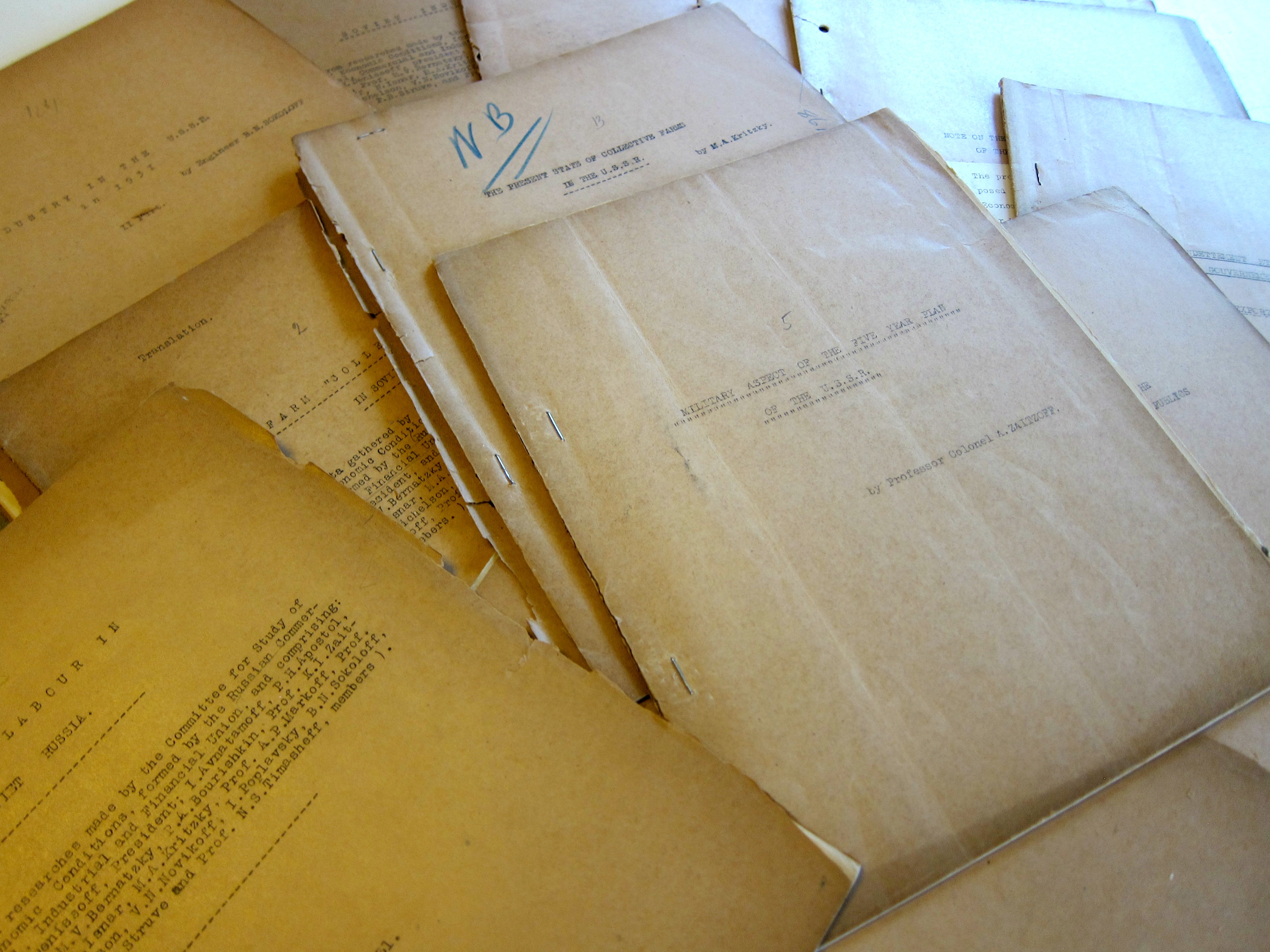
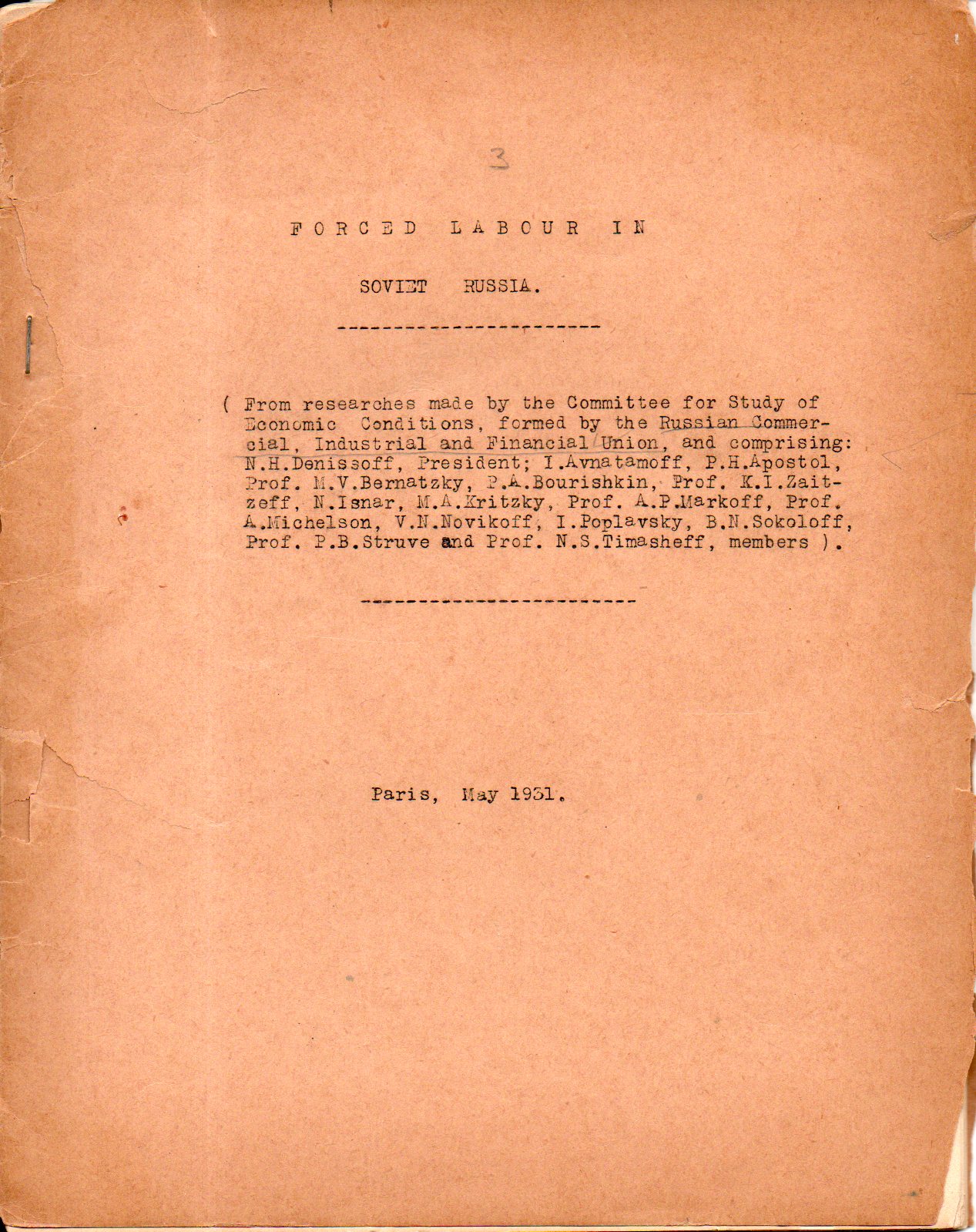
    “The Committee for Carrying Fight Against the Soviet Economic Policy has until now issued and diffused in all countries, free of charge, bulletins, published in French and English, on the following subjects” “From the Researches Made by the Committee for the Study of Economic Conditions, formed by the Russian Financial, Commercial and Industrial Union…” 

    Soviet Reports 1931

    • This is a collection of 13 translations of summaries of various social, economic, and political situations in the Soviet Union in 1931. There is an overview sheet (in tatters) which states that there should be 13 sections overall—however, this set below (from the Library of Congress) has three sections on Soviet industry rather than one, and lacks the French translation of #5, and also #11, the “Russian Organization Abroad”.  #12 is present though this is a different title than the one called for in the overview. 

    WorldCat locates only four of the thirteen papers: “Forced Labor” with 2 copies located, “Notes on Indebtedness” with 4, “Present State” with 3, and “Dumping” with 6. The others are not located.

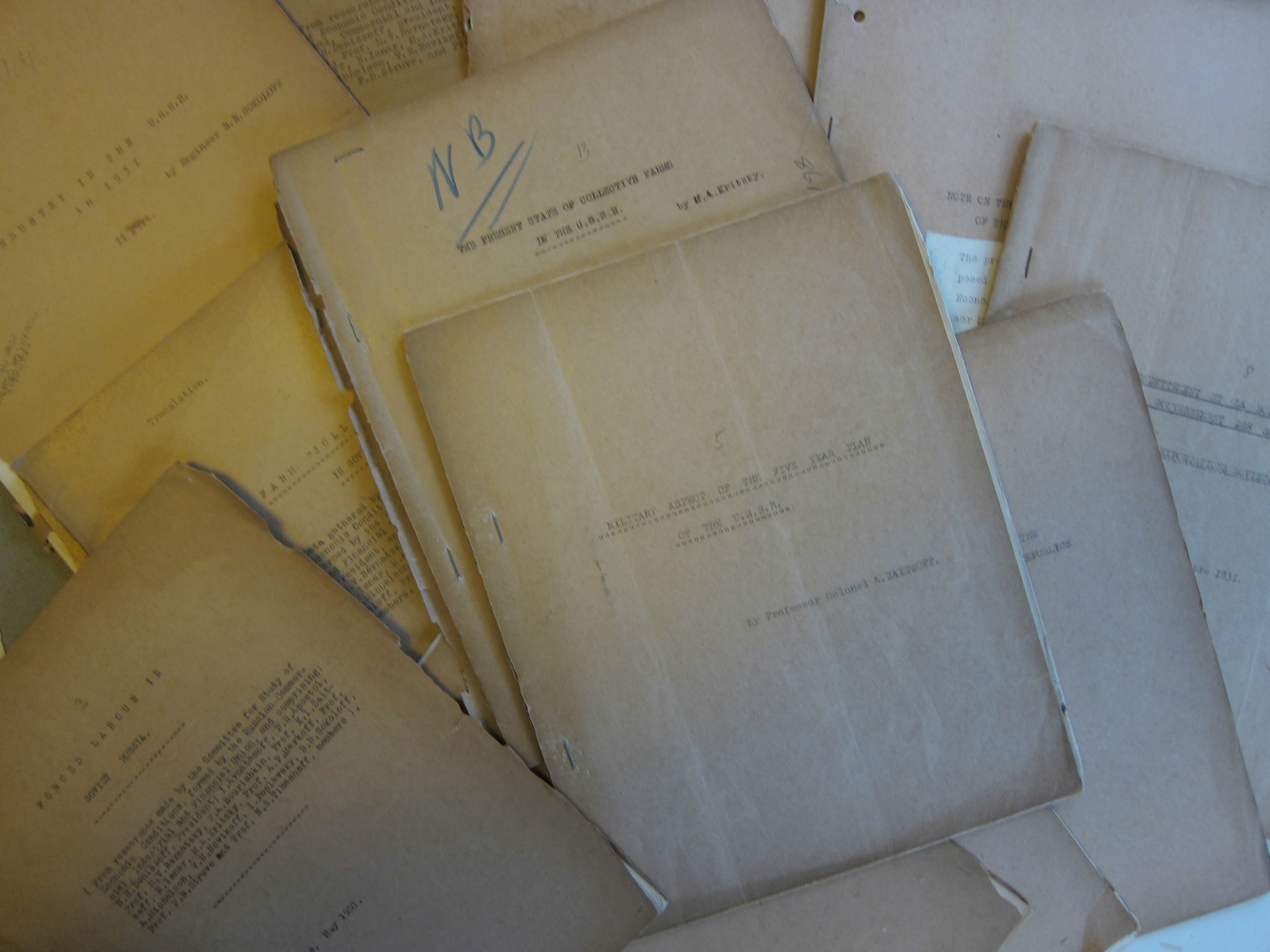
    Soviet Reports 1931b

    The pamphlets are all 11×8” and are stapled together at the left side with two staples. Each section has a brown cover though they are all brittle—the text of the works however are on much better paper and are not brittle. Nearly all are stamped “Library of Congress Surplus/Duplicate” on the back cover.  

    • Overall: 13 items/papers, including 11 of the called-for 13 parts, totaling 211pp. Very scarce. WorldCat locates only four of the thirteen papers: “Forced Labor” had  2 copies, “Notes on Indebtedness” had 4, “Present State” had 3, and “Dumping” had 6. The others were unlocated in WorldCat. 
    • Provenance: U.S. Department of State, transferred to the Library of Congress in 1940. $3000

    The set includes:

    (1.)  “Soviet Industry. Paris”, June 1931. 23 leaves. (No date of publication list)

    (1a) “Industry in the USSR in 1931, Part I.” (by Engineer B.N. Sokoloff). 16 leaves.

    (1b) “Industry in the USSR in 1931, Part II.” (by Engineer B.N. Sokoloff). 16 leaves. (March, 1932)

    (2)  “Farm Collectivization in Soviet Russia.” May 1931. 19 leaves. “Data gathered by the “Committee for the Study oif Economic Conditions”. This committee has been formed by the Russian Commercial, Industrial, and Financial Union, and includes: N.H. Denissoff, President, and I. Avanatamoff, P.H. Apostol, Prof M.V. Bernatzky, and eight others.)  

    (3)  “Forced Labor in Soviet Russia”, May 1931, 20 leaves.  (Cover detached.)

    (4) “Soviet Dumping”, by Engineer B.N. Sokolov. April, 1931. 17lvs (Corn, coal, and various ores.)

    (5)  “Military Aspects of the Five Year Plan of the USSR”, by Prof. Colonel A.. Zaitzoff, 18 lvs. (Plus one duplicate.)

    (7)  “Note on the Indebtedness and Credit of the Soviet Government. October 1931, presented by Prof. M.V. Bernatzky. 11 leaves

    (8) “L’Endettement et la Solvabilite du Gouvernement des Soviets. La Crise des Exportations Sovietiques de Ble” October, 1931. 12 leaves.

    (9) “Memorandum on the Present Conditions of the Union of the Soviet Socialistic Republics and its Population.” October 1931. 13 leaves.

    (10) “The Communist International and the United States of America.” October 1931. 13 leaves.

    (12) “The Economic Situation of the USSR and the Development of Soviet Foreign trade.” 10 leaves.

    (13) “The Present State of Collective Farms, by M.A. Kritsky.” 24 leaves.

    Note: the cover sheet (only) as mentioned and described above is found online in the State Department archives with the following classification: “Records of the Department of State Relating to Internal Affairs of the Soviet Union, 1930-1939 › Industrial Matters: Monopolies, Concessions, Contracts, Bounties, Subsidies, Cartels, Trades, Expositions And Exhibitions › 861.60 › “

    Russia h139


    Russia h140


    ·Posted by :

    ·in:


  • An Alphabet of Whiskey Names Drawn from the Bible of Booze

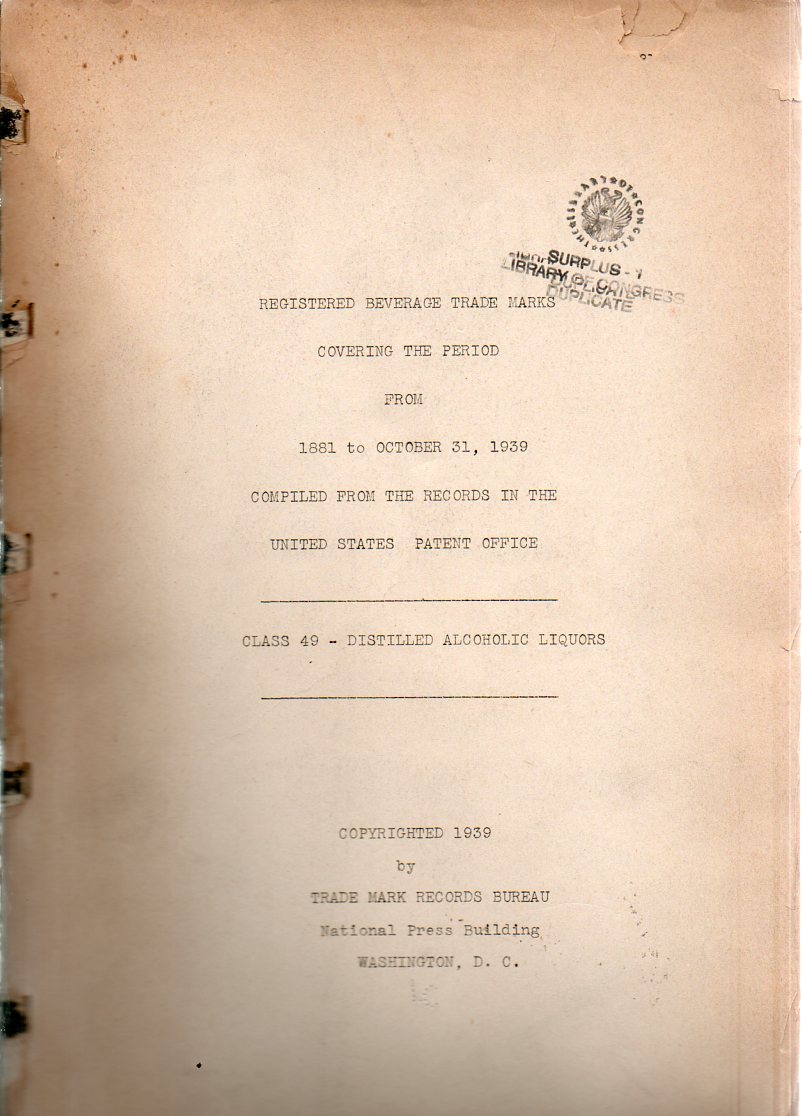
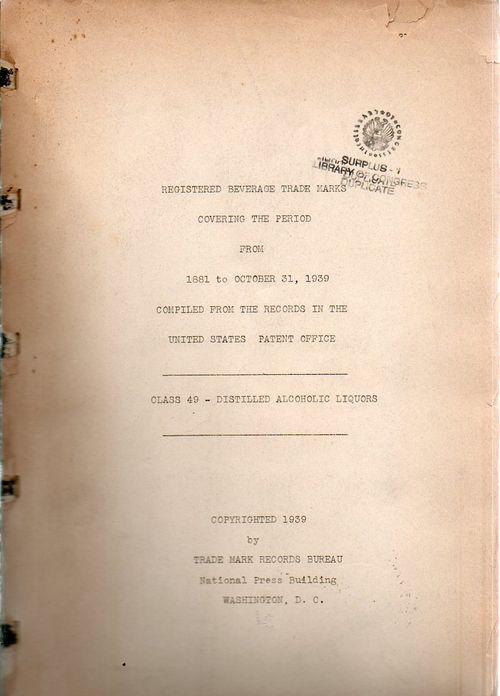
    This document–Registered Beverage Trade Marks Covering the Period from 1881 to 1939 Compiled from the records in the United States Patent Office (Distilled Alcoholic Liquors)–may be the keys to the kingdom of names of booze(s) trademarked in this country.  15″ tall, an inch thick, and 296 sheets big, this work (copyrighted by the Trademark Records Bureau (in the National Press Club Building in DC, the one with the problematic parking garage) lists some 7,500 names of whiskey, cordials, gin, rye, bourbon and who knows what else. RARE.  I cannot find another copy, nor is there any scent of it in the WorldCat/OCLC. This is from the Library of Congress, with a few scant LC stamps.  $2000.
    Booze alphabet532

    So I sat down with this book for an hour pulling out interesting, odd, out-of-place, from-another time and bizarre names, including all manner of expected animal names like bull and elk, and then unicorn; and lots of sunny this-and-that, sloping/sunny/grassy hills, mountains, clubs; and of course the Old _____  category seem fairly filled up. 

    If I spent a little more time on this entire alphabets could be produced relating to nothing but names from the animal kingdom, flora, the sciences, professions, religion, states of mind, altered states,  literature, and the labels that suggest a possible medical benefit.  One of my favorite categories is the “conversational liquor label”, the label that speaks to you, invites you, tells you what to do with the bottle of booze:  Hava Cocktail and Uneeda Whiskey are good examples of that, as are You’re Lookin Good, Uvanta and Yugeta whiskeys. Another is the liquor name ending in “o”, like the beautiful Famo, from St. Jo, MO, which unfortunately wasn’t trademarked in ’00.  The label of suggested promise and outcome is another good one:  Kentucky Courage, Pleasant Dreams, Invincible Rye, Solace Whiskey and Ready Money are all good examples of the implied end-of-bottle pillow-fluffer…maybe, especially, The Old Solution whiskey.

    And then of course, there are those where the (creative) spirit has just flown away, like the lumpily-named Standard Spirits Whiskey, its hometown of New Orleans embarrassed by the lack of effort–especially in the light of some many hundreds of imaginative creations, like the fabulous Bone Factor Whiskey (1903), which like so many other great names  (Yellow Hammer Whiskey) comes from Louisville, Kentucky.

    Antediluvium Whiskey, NYC, 1898; Anti-Grippine Whiskey, Philadelphia, 1906; Ash Cake Whiskey, Lynchburg, VA. 1899, Auto Crat Whiskey (St. Louis, MO), 1905

    Bank Check Whiskey, Boston, 1900; Bone Factor, 1903;

    Caloric Whiskey, 1904; Cremo Whiskey, 1902; and the confusing Chickencock “potable spirits”, 1929

    Devil’s Island Benefactor Gin, 1905; Daily Mash Whiskey, 1935; Dandilyon Whiskey, Columbus, OH, 1906;

    Electric Whiskey, Cincinnati, 1890;

    Flow Whiskey, Pittsburgh, 1908; Famo Whiskey, St. Jo, Mo 1894; Faust’s Own Whiskey,  Phila, 1900.

    Gopher Gin, St. Paul, 1902; Gas Away, Columbus OH, 1902; Galoxy Whiskey, NYC, 1905; Gong “ethyl alcohol, etc,” 1932′ Georgia Watermelon, 1911

    Hen Bolt Whiskey, 1889;  Hava Cocktail, NYC, 1933; Hospitality Gin, Louisville, KY, 1900

    Index Whiskey, Cincinnati, 1906; Invincible Rye, 1900

    Jupiter Gin, Boston, 1905; Judge’s Preference, Boston, 1905;

    Kentucky Courage Whiskey, Lexington, 1900

    Marconi Whiskey, Birmingham, 1903

    Old Tom Gin, 1887 (There are any number of Old ____ labels: Old Crow, Old Man River, Old Count, Old Court, Old Coon, Old King Cole, Old Rock, Old Moss, Old Soldier, and so on–there’s a specialized sub-alphabet in this category, alone.)  Perhaps my favorite “old” is The Old Solution, Baltimore, 1900.

    Peeper Whiskey, Lexington, KY, 1880; Pen and Pencil Club Rye, Phila, 1894; Pleasant Dreams Whiskey

    Radium Whiskey, Terre Haute, 1905; Rolling Fork Whiskey, Lexington, KY, 1876; Ready Money Whiskey

    Sun Shot Cordial, Birmingham, AL, 1901; [SWASTIKA emblem, no name] Whiskey, Frankfort, KY,  1902; Suburban Whiskey, Boston, 1909; Solace Whiskey, Balto, 1900

    Tidal Wave Whiskey, Houston, 1905

    Uncle Tom Whiskey, Cincinnati, 1905; Uneedda Whiskey, Davenport IA, 1899;  Uvanta Whiskey, Louisville, KY, 1905

    Vitoline Brandy,  St. Paul, 1897

    Yugeta Whiskey, Plymouth, PA, 1906; You’re Lookin Good Whiskey, D.C., 1902; Yellow Hammer Whiskey, Louisville, 1905

    Zeno, Ace of  Clubs Whiskey

    And to sew up the specialty market in school-named liquors, Lawrence McCormick of Baltimore trademarked whiskey names for Brown, Yale, Harvard, Princeton, Cambridge, Cornell, Swarthmore, Chicago, Oxford and of course Lehigh University, not to mention various label designs that featured books and “philosophical instruments” emblazoned on shields and rocks and such, all perhaps for those in search of higher education.


    ·Posted by :

    ·in:


  • Scarce Work on Migrant Workers during the Great Depression, 1937-1939

    Surfacing today in the warehouse was a collection of papers, all bound together punch-bound in a makeshift manila binding, all on the subject of mechanization and its impact on the migrant worker, and all from 1936-1939 or so.It was the mechanization of farming chores following the recession after WWI which contributed to over-farming and over-production of farming land, and that, combined with with this soil erosion with drought, contributed to the Dust Bowl and the vast migration of the Great Depression.

    The work:

    • Mechanization in Agriculture, Migration.  A collection of papers on the impact of farm implements on farmers and laborers. 15 papers, 7 papers printed via offset, one carbon copy of a report on Texas migrants, two composed of newspaper clippings, and generally-published works.  All are bound in a manila punch binder, hand-lettered on the cover.  $350

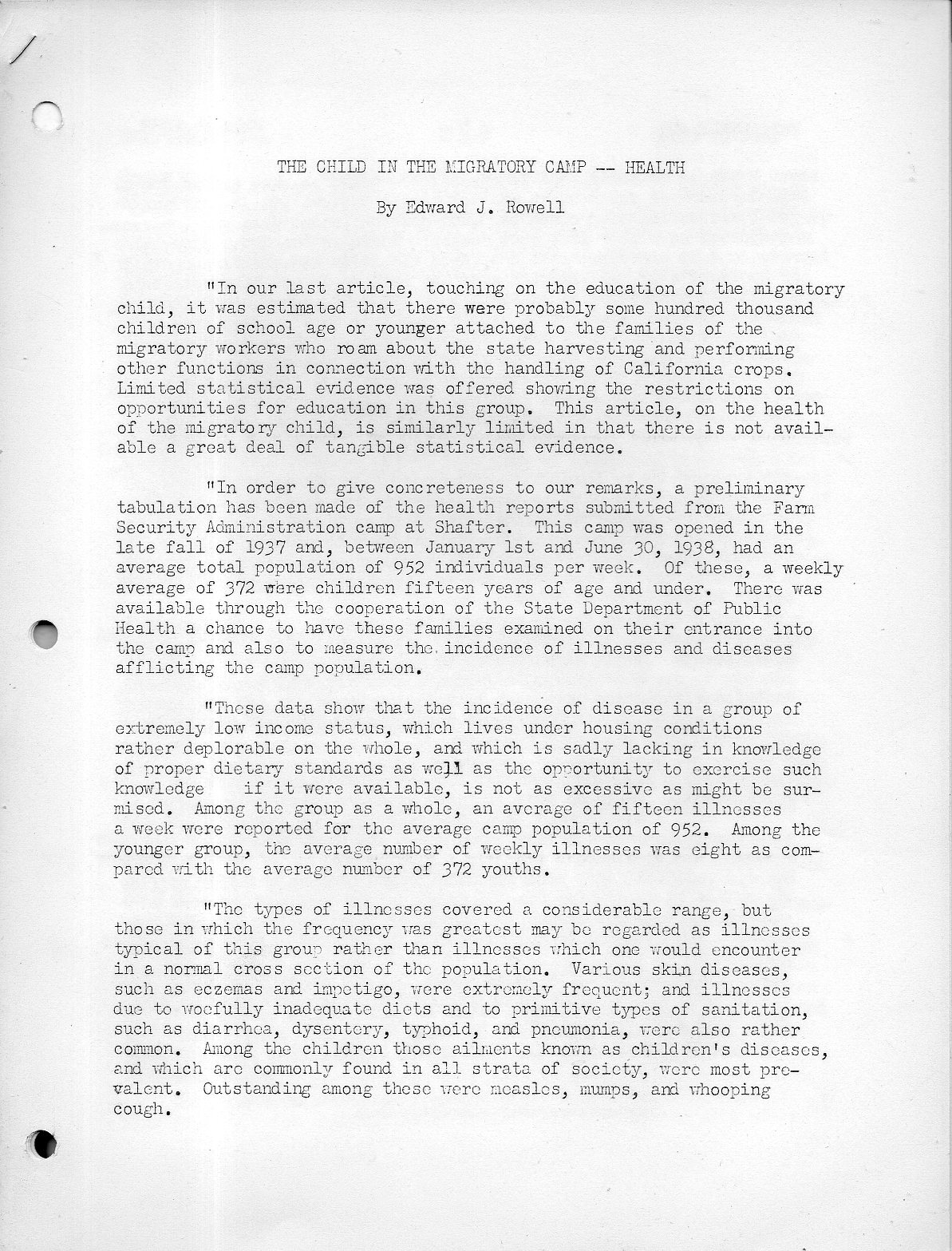
    Among the papers on new farm implements and the millions of people on the move was “The Child in the Migratory Camp—Health”, by Edward J. Rowell, a slim but telling four pages on the plight of kids in migrant camps. This paper was published in California Children, Sept 1938, pp 1-4, and is referenced in James Noble Gregory, American Exodus: The Dust Bowl Migration and Okie Culture in California, p 289. It is a very sobering read, and I reproduce it below in full as there are but a few references to it. 

    • [As one migrant child told John Steinbeck, “When they need us they call us migrants, and when we’ve picked their crop, we’re bums and we got to get out” (Steinbeck, “Harvest Gypsies” 1. after his In Dubious Battle, a work that deals with the migrant worker and which was published in 1936, Steinbeck was given an assignment and space to further document the situation of the mobile workers in the San Francisco News, the stories appearing October 5-12, 1936. These seven articles were later published together—along with 22 photographs by Dorothea Lange—in a work called Their Blood is Strong, appearing in 1938.)]

    Other papers in this collection include:

    Summary Report and Recommendation of the Migratory Labor Problem in Texas, 1938? 22pp. Carbon copies of the original, on onion paper.

    Edward J. Rowell, The Child in Migration Camp–Education, 5pp. Offset from typed originals. (1939?)

    Edward J. Rowell, The Child in the Migratory Camp—Health. 4pp. Offset from typed originals. (1939?)

    Outline of Migration Labor Camp Program, USDA, FSA, 4pp. Offset printed from typed originals.

    G. Horace Hamilton, The Social Effects of Recent Trends in Mechanization, 1938, 13pp, offset printed from typed originals.

    Mechanization in Agriculture and its Effect on Labor, 1937, 9pp.

    (The Problem of Farm Tenancy), 9pp, 1937.

    Power Farming and Labor Displacement in the Cotton Belt, 1937, Parts I and II (1937) 29pp. Government publication.

    …and seven other papers.  Scarce publication, unique in this format.  

    Migratory camp798


    ·Posted by :

    ·in:


  • Scarce Prospectus for the Boulder Dam (1928)

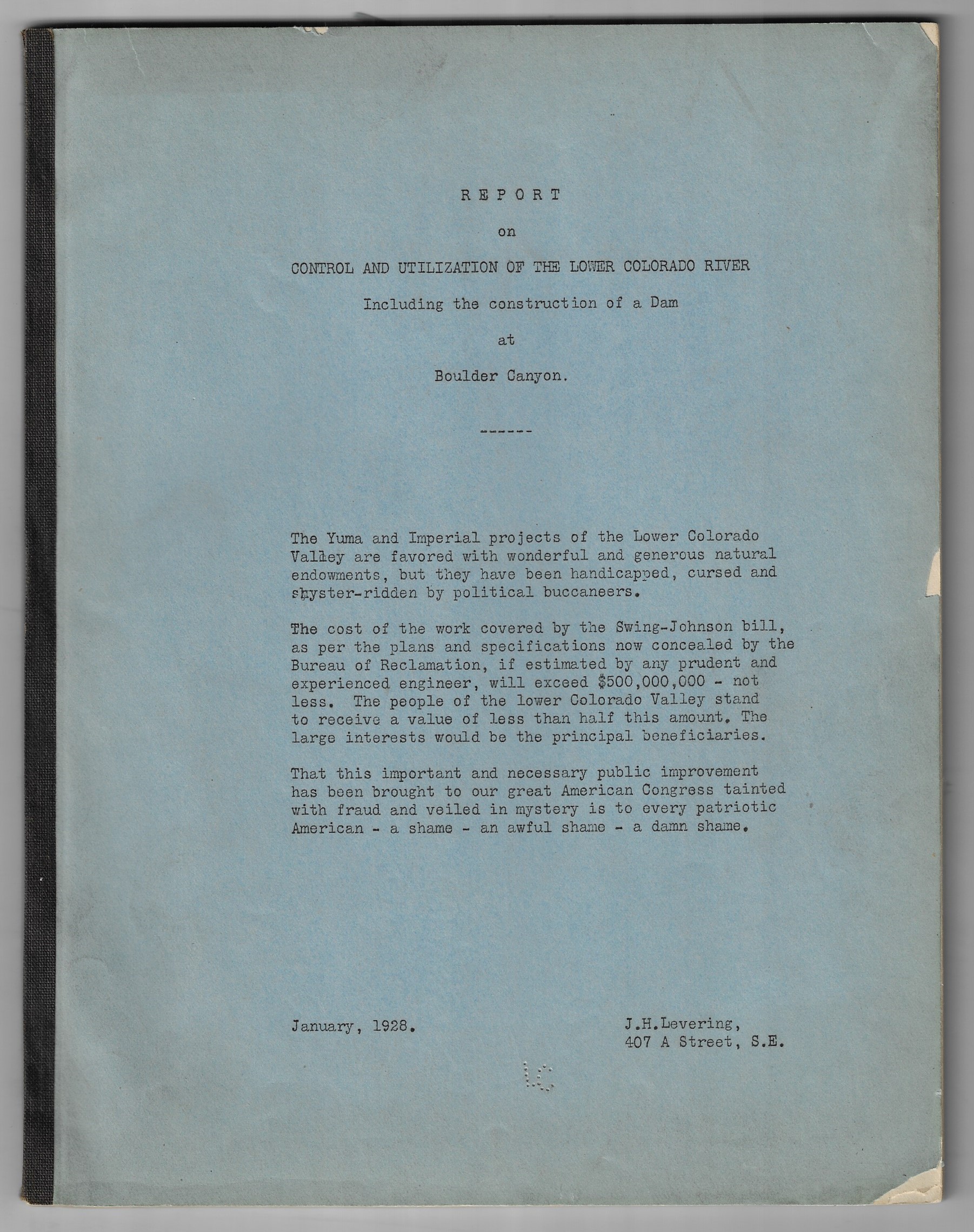
    J.H. Levering, Elwood Mead; R M Priest . Report on Control and Utilization of the Lower Colorado River including the Construction of a Dam at Boulder Canyon. Privately printed in Washington D.C. 1928. 11”x 8.5”, 28pp plus 6pp appendix, p;us 9 plates (8 photos), plus two folding plates (including one map). Printed wrapper, cloth-covered spine. VG condition. Provenance: Library of Congress, with their tiny 6mm “LC” perforated stamp on the bottom of the cover and their LC rubber atamp on rear cover. WorldCat locates only ONE copy (Arizona State Library). $175.00

    Boulder Dam

    ·Posted by :

    ·in:


  • Rare and Very Detailed Report on the Johnstown Flood, 1936

    Johnstown Flood, 1936 Mimeograph Report

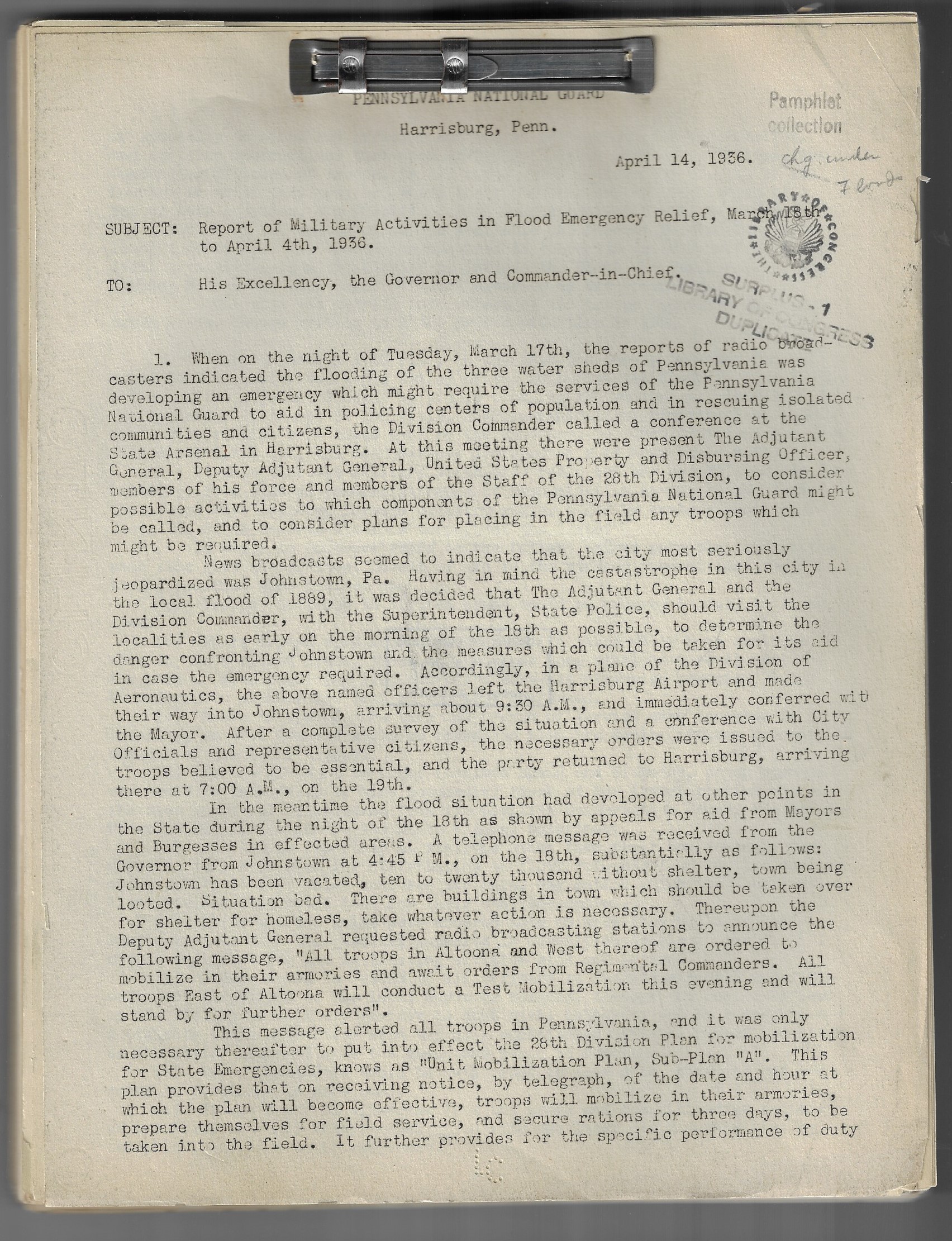
    Johnstown Flood _1_Edward Caswell Shannon, Major-General; Pennsylvania. Militia.; Pennsylvania. Governor (1935-1939). Report of Military Activities in Flood Emergency Relief, March 18 to April 4th, 1936.

    Scarce. $450

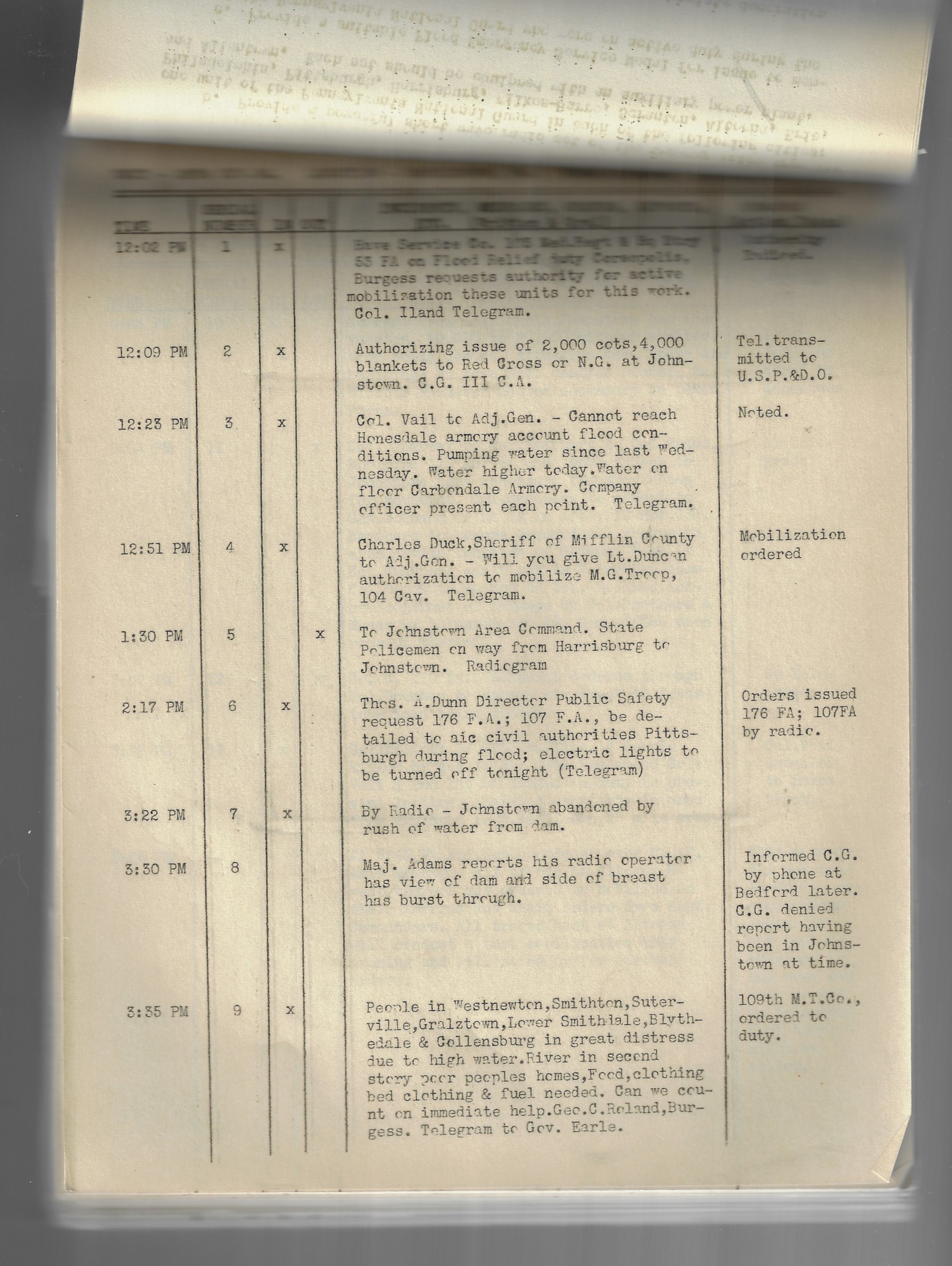
    This is a very uncommon and exhaustive summary of the Pennsylvania state response to the disastrous “Johnstown Flood” of 1936, covering the period March 18 through April 14, 1936. There is a 91-lv section with an hour-by-hour summary of responses by the PA National Guard as well as general announcements that they were reacting to.

    11” x 8.5”, 113 leaves (printed one side only). Offset printed—no indicator of printer or author. I suspect that this wasn’t so much a “publication” as it was a circular. Gathered at top with a two-pronged metal clasp and in the original heavy manila binder. The text is a solid VG, though the binder has seen better days, as it has dings and tears. The text has been pulled away from the rear of the manila back cover. Overall, still VG.

    A typewritten annotation on the homemade/typed paper label on the front cover states “Copy #33”.

    NO copies located in WorldCat (currently; an older Google search found two copies listed).

    Provenance: Library of Congress, with their tiny 6mm “LC” perforated stamp on the foot of page one and their LC surplus rubber stamp on front top corner page 1.

    3pp introduction, followed by:

    Overview of troops dispatched and help given, pp 4-9. All 15 sections and commands (Johnstown and Pittsburgh) were evaluated in nine categories of aid and help rendered (including a “remarks”) section, including data of the troops deployed (designated) and who they reported to, area under water (city blocks and %); how many homeless there were and how they how the homeless were fed, clothed, and who housed by.

    The next section is a listing of city and government officials and who they reported to and for, pp 10-11, along with a graph of deployment if PA National Guard.

    Johnstown Flood _2_

    General Order #2: Flood Emergency Mobilization, Flood Emergency Commendation, pp 12-

    The last section is a 10pp tabular listing ofg the every day use of the National Guard during the flood emergency, including the units; deployment duties; types of military personnel, location, and casualties.

    ·Posted by :

    ·in: