A Daily History of Holes, Dots, Lines, Science, History, Math, Physics, Art, the Unintentional Absurd, Architecture, Maps, Data Visualization, Blank and Missing Things, and so on. |1.6 million words, 7500 images, 4.9 million hits| Press & appearances in The Times, Le Figaro, Mensa, The Economist, The Guardian, Discovery News, Slate, Le Monde, Sci American Blogs, Le Pont, and many other places… 5000+ total posts since 2008.

Book Category: Physics

  • Freeman J Dyson Heisenberg Operators In Quantum Electrodynamics I Offprintthe Physical Review Vol 82 No 3 Pp 428 439

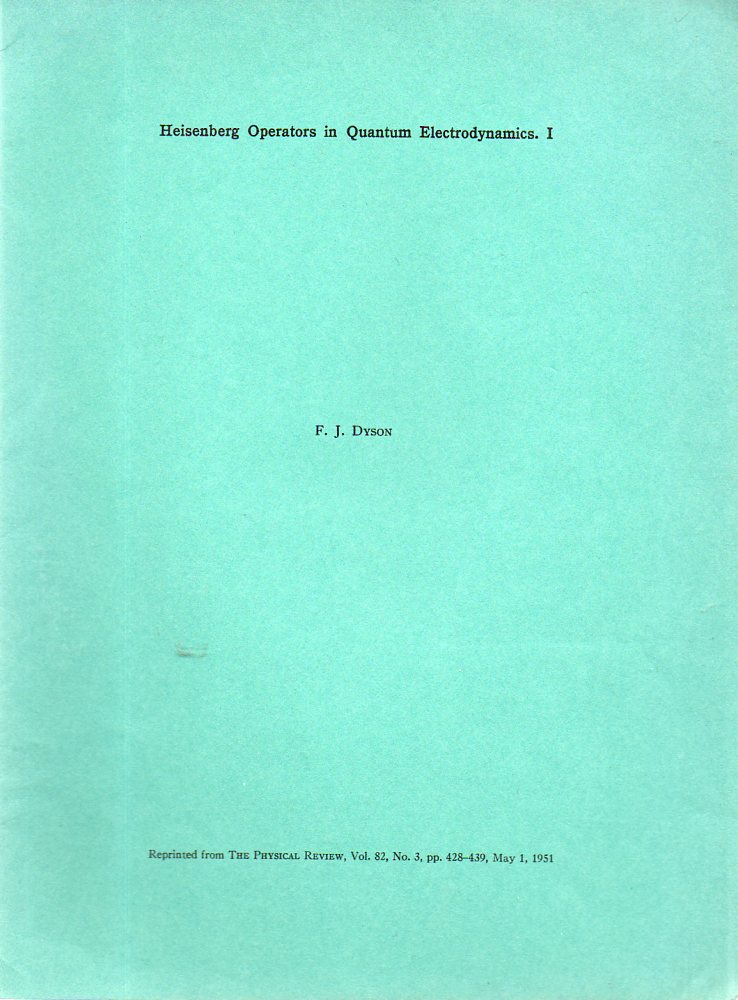
    Freeman J. Dyson.  “Heisenberg Operators in Quantum Electrodynamics, I.”  Offprint: The Physical Review, vol 82, no 3, pp 428-439, May 1, 1951.  Fine copy in the original wrappers.  $175  

    • “A new analytic continuation principle is described, by means of which the calculation of matrix elements of Heisenberg operators in any quantized field theory is greatly simplified. By a “Heisenberg operator” is meant an average over a finite space-time region of a field operator in the Heisenberg representation of the theory. The analytic continuation is made by varying the characteristic masses of the fields through real values. In this way a Heisenberg operator with the physically occurring masses is derived from an operator calculated with very large fictitious masses. In the region of large masses, where real creation of particles is impossible, the operator is identical with the S-matrix for a suitably chosen scattering problem. The calculation reduces to the calculation of an S-matrix, to which the techniques of Feynman are directly applicable. “–Physical review Journals abstract online.
    • Also see Silvan S. Schweber,  QED and the Men who Made it: Dyson, Feynman, Schwinger, and Tomonaga, p 556.

    Note: the faint white vertical stripe was made by the scanner and does not exist on the original. 

    Dyson314

    ·Posted by :

    ·in:


  • Relativity, 1915

    A.W. Conway. Relativity. London, G. Bell & Sons, 1915. Edinburgh Mathematical Tracts No3.  215x140mm, 43pp. Stiff wrappers. Good/Very Good copy. $150 This is one of the earliest separately-published works on the theory of relativity. Interestingly, Einstein’s name appears only twice in the text, in this sample (below) and at the end.

    “Here we have at once a result at variance with our hypothesis  that the aether is at rest. An explanation was put forward independently by 
    Fitzgerald and Lorentz, and developed in detail by the (... the Fitzgerald- Lorentz contraction) could compensate for the difference of
    path in such a way that the null effect of the Michelson-Morley experiment would be adequately explained. The mathematical treatment
    of this theory in the hands of Lorentz and Larmor shows that all experiments on the relative motion of matter and ether must give
    approximately a null result."
    "The interpretation of these experiments received a different
    treatment from Einstein, whose paper in the " Annalen der Physik,"
    4te Folge. 17, 1905, gave rise to most of the recent theoretical investigations which are included under the head of "Relativity."
    I shall now proceed to the deduction of the fundamental equations of this theory, following the above-named paper...”

    ·Posted by :

    ·in:


  • Weighing the Earth in 1799

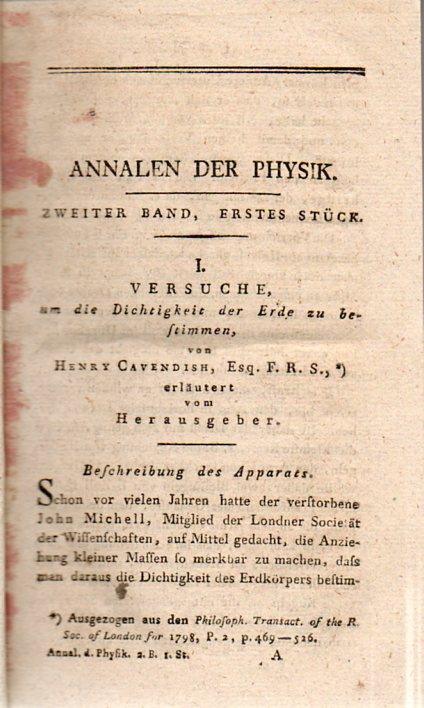
    CAVENDISH, Henry. “Versuche über die Dichtigkeit der Erde zu Bestimmen.” 1799, and published  in Annalen der Physik,edited by von Ludwig Wilhelm Gilbert, series I, volume 2.  120pp in this section, 488pp overall in in the entire volume, with 9 plates.  Cavendish’s paper occupies pp 1-62, with two plates  (the torsion balance of Michell shown on the plates). Condition:  Ex-libris Deutsche Akademie der Luftfahrtforschung, then Wright Patterson Field Library (USAF), then Library of Congress.  Library markings:  small gilt-stamped “Akademie der Luftfahrtforschung”, page edges stamped “Wright Field Library/Dayton, Ohio” on top and bottom. Contents quite nice.  $450

    Cavendish131

    In this experiment–the first appearance in German following the original paper “Experiments to determine the Density of the Earth” that appeared in the Philosophical Transactions in 1798.–the great and somewhat mysterious (and odd) Henry Cavendish determined to, of all things, weigh the Earth.  Now there are certain remarkable things to be achieved in the 18th century, and of course the idea of measuring the weight of the Earth was a high intellectual achievement.  He set off to measure the force of attraction between large and small lead balls using his dead friend John Michell’s torsion balance (which he had created in 1783), and using of course Newton’s laws showing that the force of gravity between two objects depends on their masses as well as the distance between them.  Michell had thought of the experiment years before but died before he could present; Cavendish carried on and up, and out. Mind he wasn’t the first on the spot, or the first with the idea–he was the first to complete it, though, taking the difference in the measures on the very sensitive balance from a distance using a telescope so as to not disturb the readings.  It was a lovely idea, and  a fantastic piece of work. 

    “Henry Cavendish had fitful habits of publication that did not at all reveal the universal scope of his natural philosophy. He wrote no books and fewer than twenty articles in a career of nearly fifty years. Only one major paper was theoretical, a study of electricity in 1771; the remainder of his major papers were carefully delimited experimental inquiries, the most important of which were those on pneumatic chemistry in 1766 and 1783–1788, on freezing temperatures in 1783–1788, and on the density of the earth in 1798.” (D.S.B. III, p. 155).

    ·Posted by :

    ·in:


  • A Fundamental Paper in the History of Quantum Mechanics


    Bose-Einstein Statistics

    BOSE, S.N. “Plancks Gesetz und Lichtquantenhypothese”, (Planck’s Law and Light Quantum Hypothesis) in Zeitschrift für Physik , vol. 26, issue 1, pp. 178-181, 1924. Offered in the full volume, bound with volume 27, comprising 401+395pp.   Very pretty copy, in period cloth and marbled boards with cloth tips; institutional bookplate, and faded rubber stamp on the title page. About a fine copy. $1150

     “Discovery of new statistical counting rules for light quanta and a new derivation of Planck’s radiation law. Known as Bose-Einstein quantum statistics for particles with integer spins.” —Particle Physics: One Hundred Years of Discoveries

     “…the work is of the uttermost significance. As Bose himself put it when writing to Einstein:

    “Respected Sir, I have ventured to send you the accompanying article for your perusal and opinion. You will see that I have tried to deduce the coefficient .. in Planck’s law independent of classical electrodynamics.’

    “Not only did Bose try, but he succeeded spectacularly, deriving the law from which quantum mechanics sprang without any recourse to classical physics.

    “When Einstein then extended this idea to describe the monoatomic ideal gas, he deduced the existence of an exotic state of matter that is now know as Bose-Einstein condensate.  Neither Bose nor Einstein would live to see this confirmed experimentally.  It took until 1995 for technology to catch up to the theoretical insight of these titans of physics.”–from the Wavewatching website, http://wavewatching.net/lost-papers

    BOUND WITH:

    • FERMI.  “Uber die Wahrescheinlichtkeit der Quantenzustande”, vol 26, pp 54-57
    • HEISENBERG. “Uber den Einfluss der Deforierbarkeit der Ionen auf optisch und chemische Konstantin III.” Pp 196-204
    • HEISENBERG. “Ueber eine Abanderung der frmalen Regeln der Quantentheorie…” Pp 291-308
    • BORN. “Uber Quantenmechanik”. pp 379-395.
    • Plus other contributions by Hhn/Meitner, Meitner, Gerlach, Frenkel, Freundlich, Schottky, and many others.
    • ALSO bound with, in volume 27:
    • EINSTEIN. “Zur Theorie der Radioemterkrafte”, pp 1-6. 
    • And other contributions by Geiger, Nordheim, Lande, Gans, Bose and others.  

    ·Posted by :

    ·in:


  • The Memoires of the Academy of Sciences, containing a “pioneering study of the differential geometry of space curves” 1731

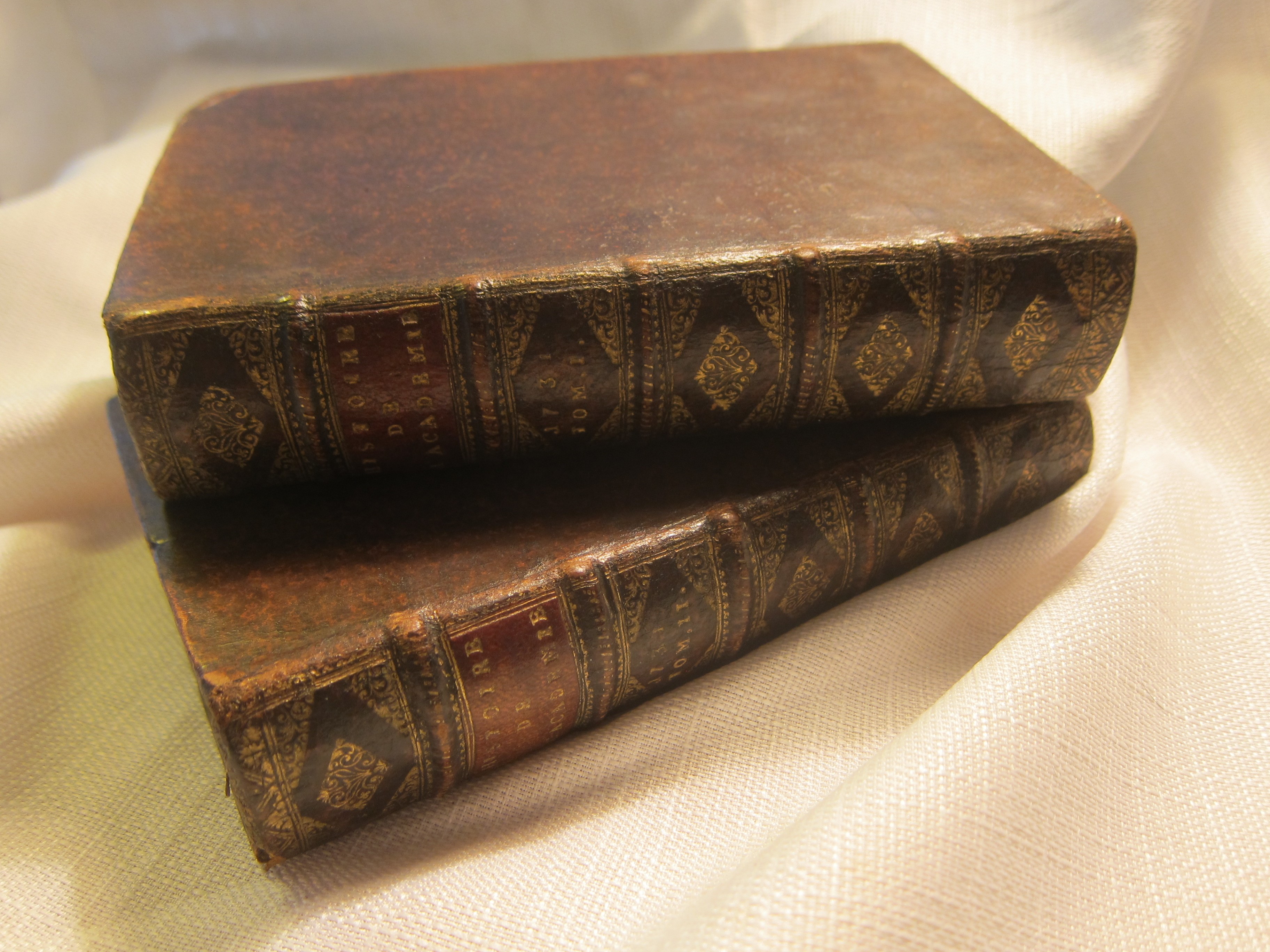
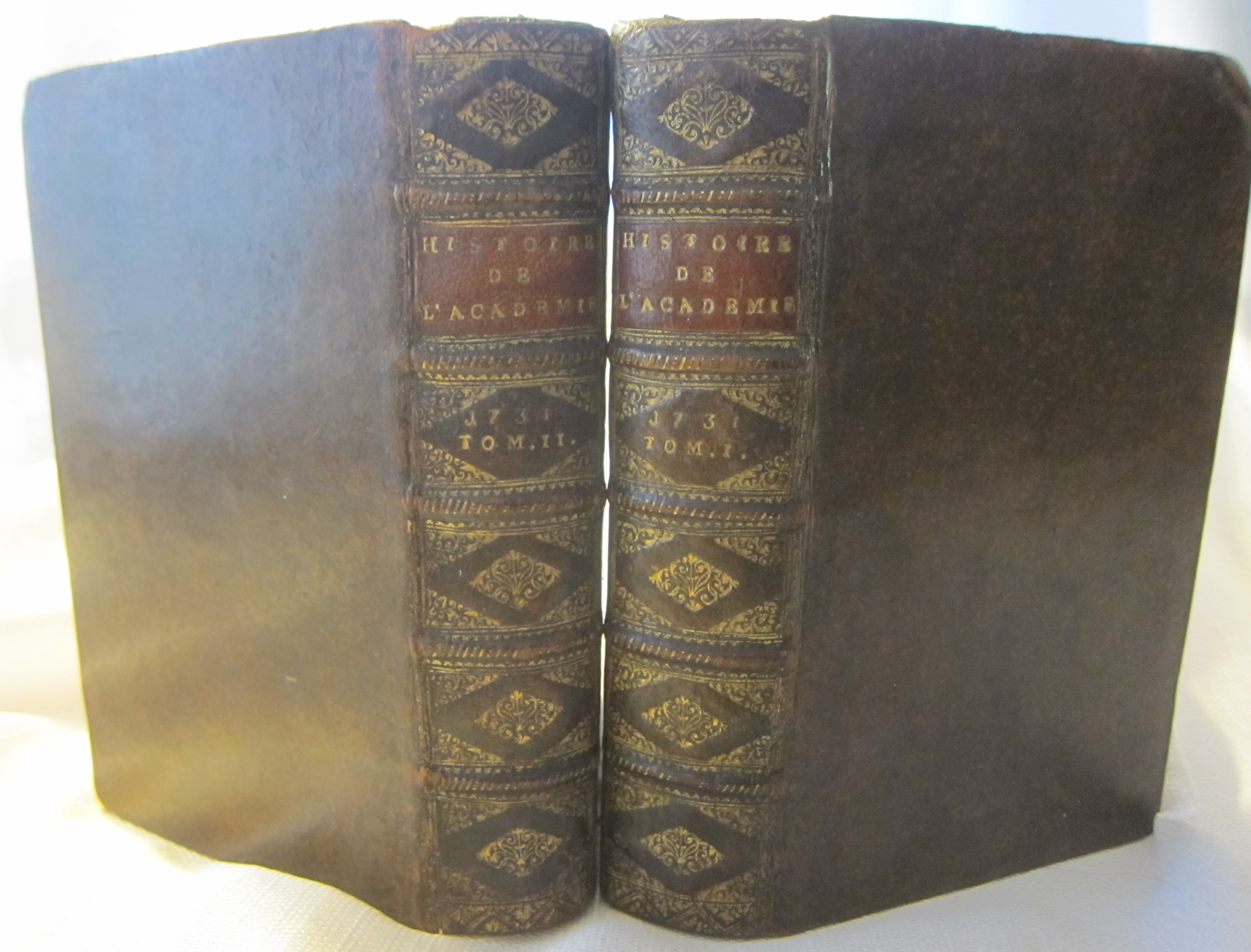
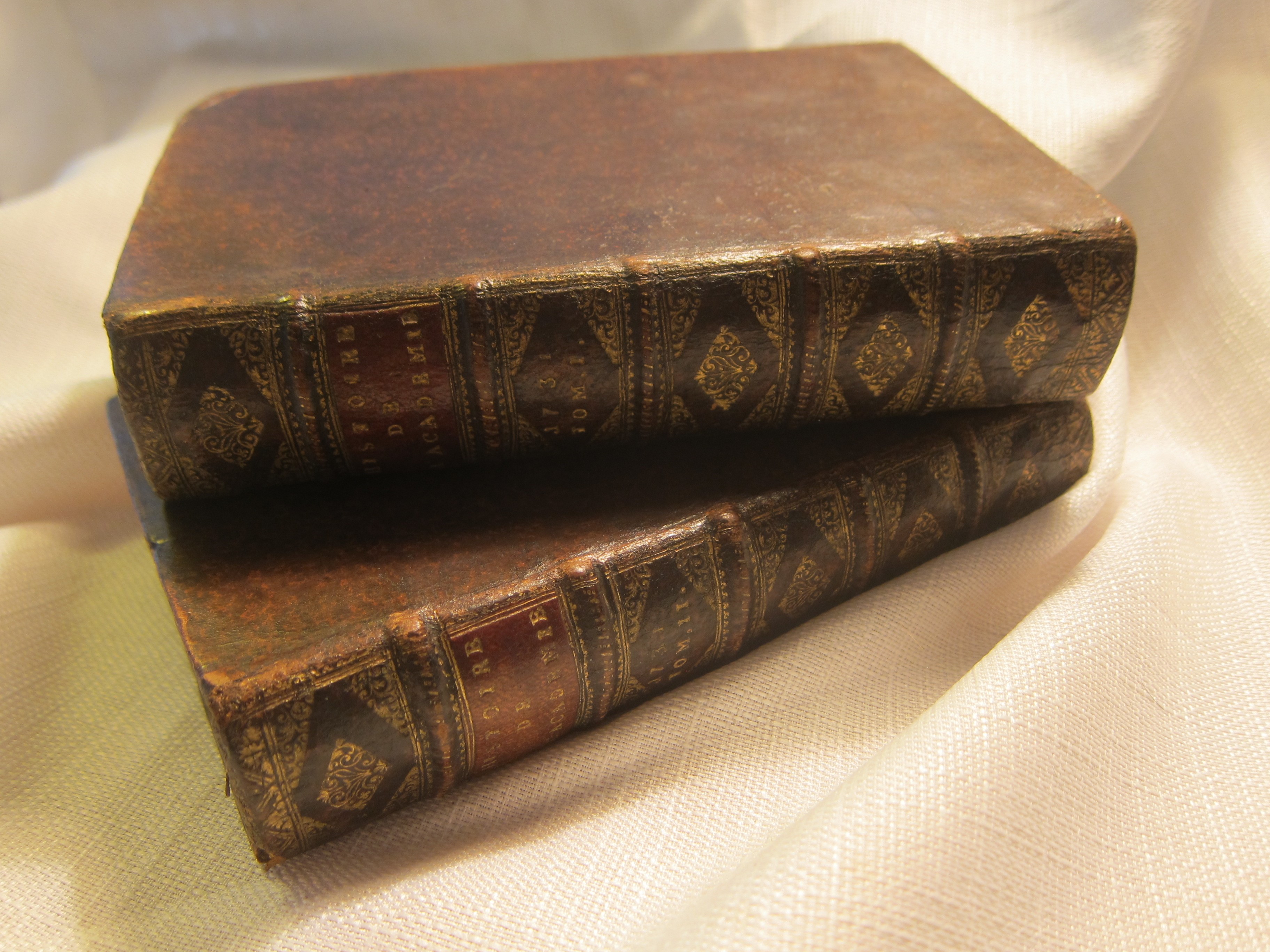
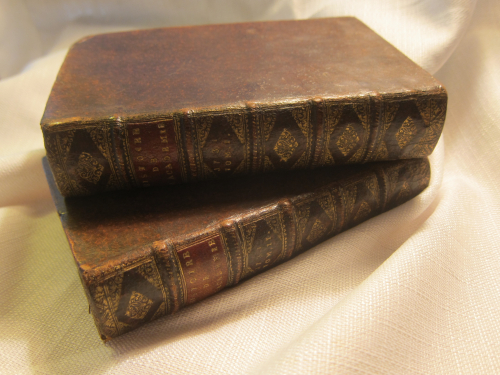
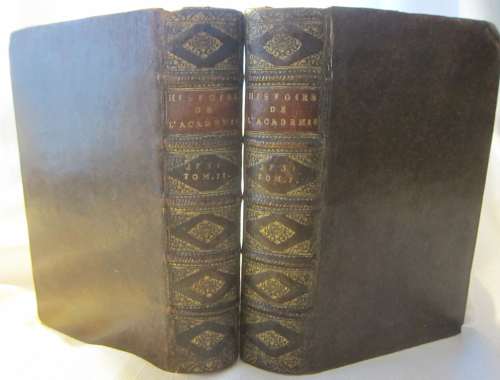
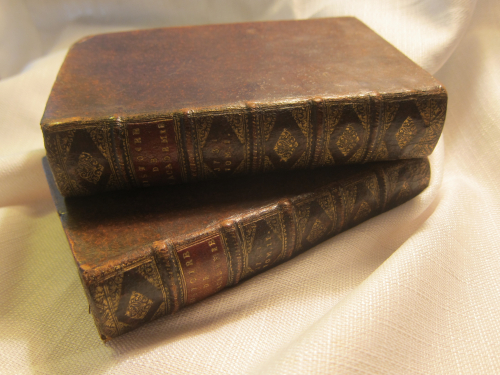
    Clairaut, Alex Claude (b 1713, making him 18 at the time of the reception of the paper in 1731), “Sur les Courbes que l’ou forme en coupant une surface courbe quelconque, par un plan donne de position”, pp 680-694. (“…on solid analytic geometry, a pioneering study of the differential geometry of space curves”–Parkinson, Breakthroughs, p. 149). Bound in:  Histoire de l’ Academie Royale des Sciences. Annee M. DCCXXXI. Avec le memoires de mathematique & de physique, pour la meme annee. Amsterdam by Pierre Mortier, 1735, 17x10cm., viii, 155pp; plus the Memoires section, pp 1-316 in this volume, and pp 317-737, with 40 folding plates. Bound in full leather, with raised bands. Lovely copies, very fresh and clean. Two volumes; Very Good condition. $450
    Memoires 1731 _1_

    In the first section, the Histoire contains a review of the recent advances in the sciences (physics, math, geography, geology, biology, “Sur Quelques Experiences de l’Aiman”, “Sur le Nouveau Thermometre”, “Observations de Physique Generale”, “Sur une Nouvelle Espece de Vegetation Metalliques), and then proceeds to the Memoires (scientific contributions section) including:

    Clairaut, Alex Claude, “Nouvelle Maniere de trouver les formules des centres de gravite”, pp 226-231. (In his letters Clairut states “Here is a new way of finding the formulas of the centers of gravity that I read there is hardly at the Academy  I do not give it to you as a new way of having the centers of gravity, for it is not one, but only as a new way of having the formulas already found.”
    Memoires 1731 _2_

    Mairan, “Observations de quelques Aurores Boreales…”, pp 531-545. (This is areport supplement to an entire volume published on thi ssame topic, one of the earliest of its kind, offered elsewhere on this blog under Mairan’s name. It was published as volume III of this set for the Memoires of 1731, and stands complete in itself.)

    Couplet, “Recherches sur la Construction des Combles de Charpentier”, p 999-102;

    Petit, “Dissertations sur la maniere le Sang dans les Hemorragies…”, pp 122-146;

    de Maupertius, “Experiences sur les Scorpions”, pp 317-326

    d’Onzembray, “ Machine pour coonoitre sur Mer l’Angle de la Lgine du Vent et de la Quille du Vaisseau…” pp 335-340 (with plate!);

    Maupertius, “Sur la separation des Intetermindes dans les Equations differnetielles”, pp 147-157;

    Maupertius, “Balistique arithmetique”, pp 419-422;

    Maupertius, “Probleme Astronomique”, pp 652-655;

    de la Condamine, “Sur une nouvelle Maniere de considerer les Sections Coniques”, pp 340-35.
     

    Memoires 1731 _3_

    Condamine, “ Sur une nouvelleespece de Vegetation Metaliiques” (with a glorious plate), pp 655-680;

    Pitot, “Methode d’Analytique de tracer les Lignescorrespondentes ou des Minutes aux grande Meridiennes”, pp 519-531;

    Nicole, “ Sur les Sections Coniques”, pp 157-176.
     

    ·Posted by :

    ·in:


  • Works by Hermann Weyl

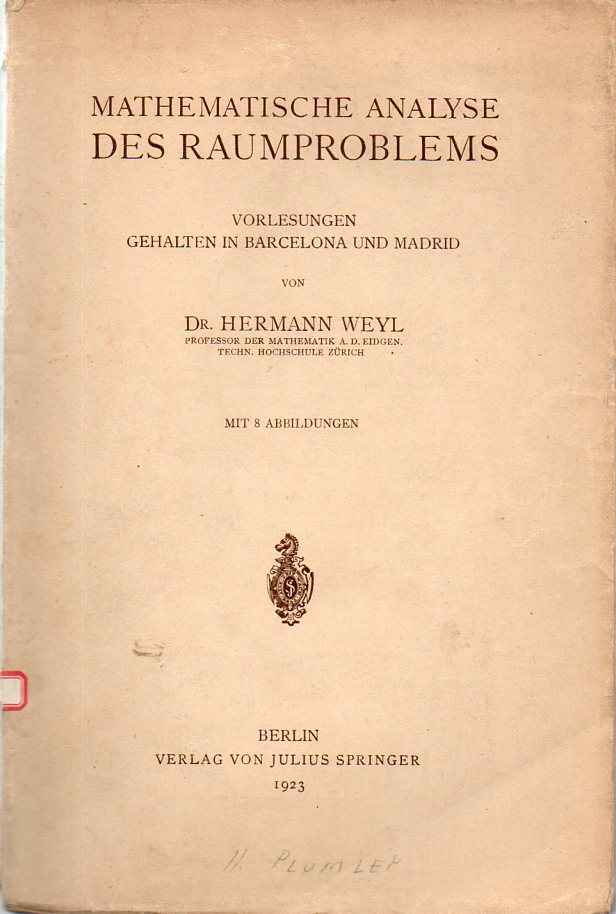
    Hermann Weyl.  Mathematische Analyse des Raumproblems, vorlesungen Gehalten in Barcelona und Madrid.  Berlin; Julius Springer:  1923.  116pp.,  Original printed wrappers.  Very nice copy.   $125

    Weyl raumproblems355

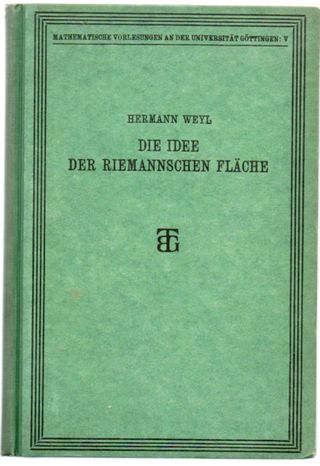
    WEYL, Hermann.  Die Idee der Riemannschen Flaeche.  Lipzig, Teubner,  1923.  Second (expanded) edition.  183pp.  Excellent condition, superior copy, although the pages are browned somewhat given the inferior paper used demanded by the trying economic times.  This is Fritz John’s copy, with his name on the front free fly.  $225

    Weyl204

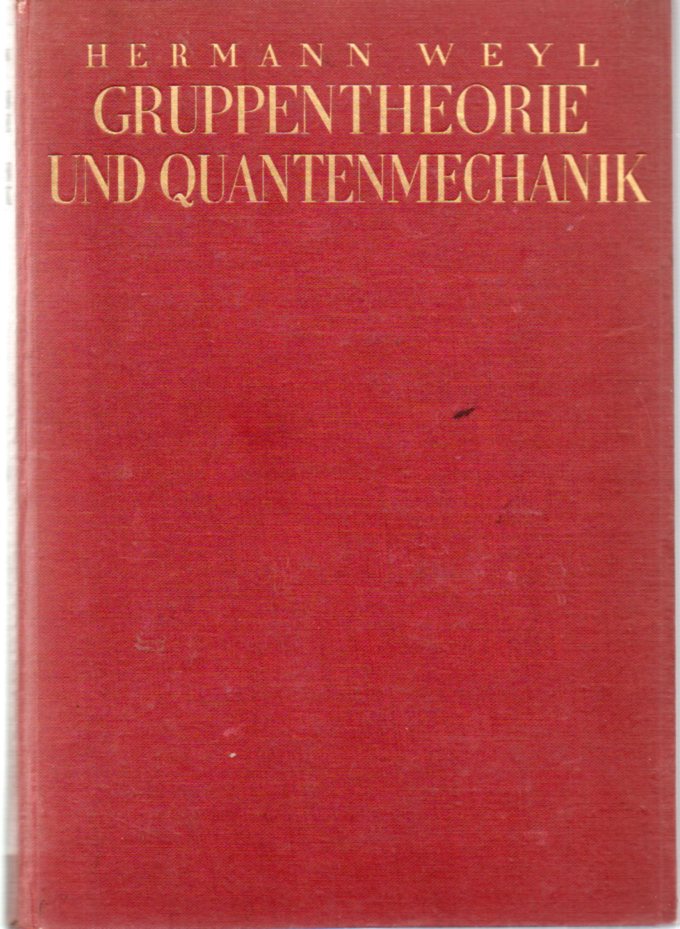
    WEYL, Hermann.  Gruppentheorie und Quantenmechanik.  Verlag von S. Hirzel, Leipzig, 1928.  First edition.  288pp.  Cloth.
    Exceptional copy, at least in fine condition.  $250

    Weyl209

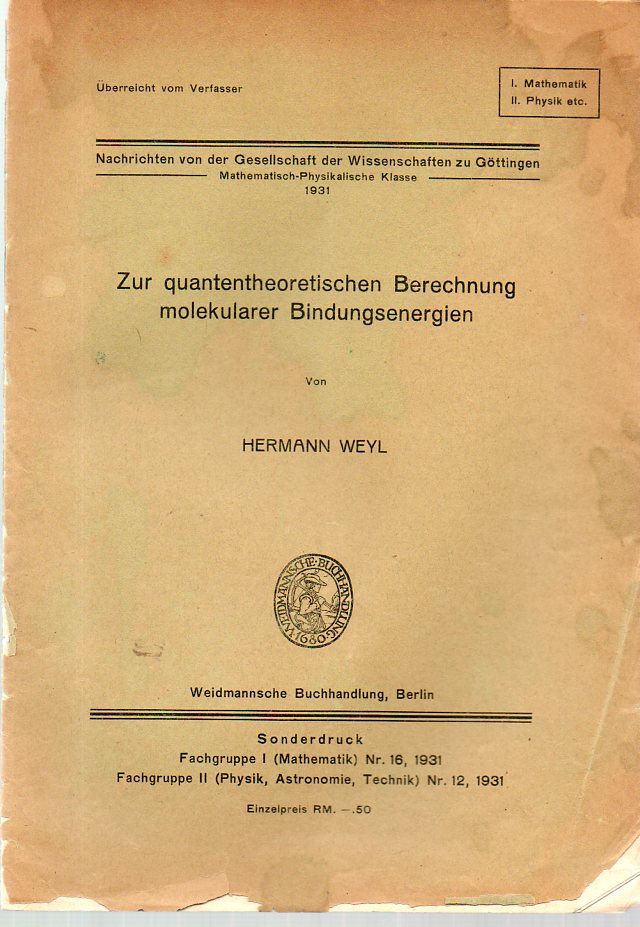
     WEYL, Hermann.  Zur quantentheoretischen Berechnung molekularer Bindungsenergien.  Offprint:  Nachrichten der Gesellschaft der Wissenschaften zu Göttingen. 1930.  Pp 285-294.  Original printed wrappers.  Very good copy. 

    Weyl quanten]348

    Also, with Part II.  1931.  Pp 33-39.  Good copy.  Original wrappers.  The two papers:  $175

    Weyl quanten II349


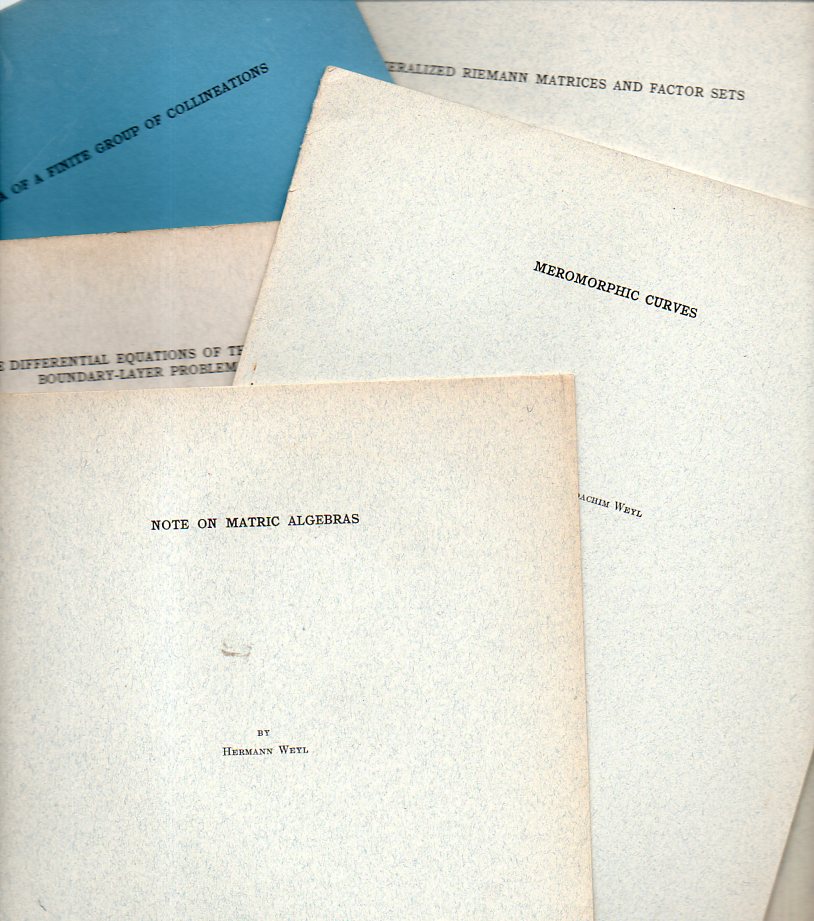
    ann Weyl.  Five offprints, all in original wrappers.  $175

    “Generalized Riemann Matrices and Factor Sets.”  Offprint: Annals of Mathematics, July 1936. 

    “Commutator Algebra of a Finite Group of Collineations.” Offprint:  Duke Mathematical Journal, 3/23, June 1937. Original wrappers.

    “Note on Matric Algebras.” Offprint: Annals of Mathematics, 38/2, April 1937. 

    “Meromorphic Curves”, offprint, Annals of Mathematics, July 1938. 

    “On the Differential Equations of the Simplest Boundary-Layer Problems.” Offprint: Annals of Mathematics, April 1942. 

    Weyl 5 offprints351

    Hermann Weyl.  Emmy Noether.  Offprint:  Scirpta Mathematica, vol III, No. 3, July 1935. 20pp.  Fine copy.  $75

    Hermann Weyl.  In Memory of Emmy Noether, Visiting Professor of Mathematics, Bryn Mawr College, 1933-April 1935.  Address delivered by Professor Hermann Weyl of the Institute for Advanced Study, Princeton, N.J.  April 26, 1935.  In original wrappers.  Very good copy.  20pp.  $75


    ·Posted by :

    ·in:


  • An Uncommon Essay on Relativity Theory, 1921

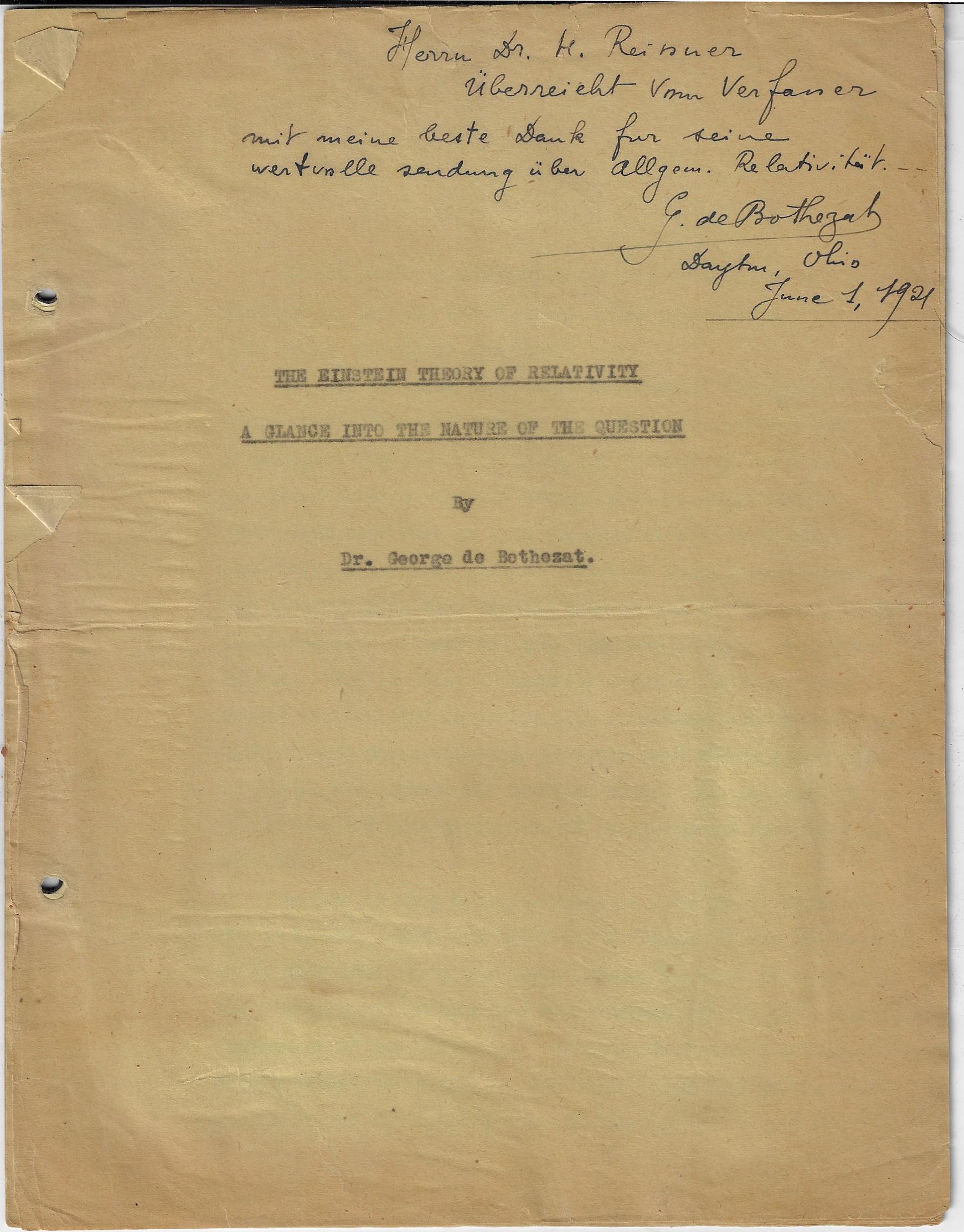
    George de Bothezat (1882-1940) The Einstein Theory of Relativity, a Glance into the Nature of the Question. Carbon copy from typed sheets, I believe, 1921. 11×8, 12 leaves. The leaves seem to be glued together as a binding along the left edge of the sheets; the cover is present but detached, or loose. There are also two punch holes for binding.  I can find only one listing for this 1921 work in WorldCat/OCLC.  $450

    BothezatPresentation copy to Prof. Hans J. Reissner (Reissner-Nordstrom metric among much else)–I imagine that de Bothezat would have been well familiar with the early flight engineering work of Reissner as well as his terrific contribution on the Einstein metric. Condition: a good copy, with perhaps either some damp staining that led to some pressure marks in the paper, or perhaps these were just pressure marks, from pressure. In any event, the paper it was printed on was inferior even when new, and so it has browning and is brittle here and there.  Apart from the general history of the theory de Bothezat seems to be very uneasy with Einstein in this paper, and I cannot find any mention of it in the usual Einstein sources.  In any event, it is a very scarce thing. (A 7pp paper by this name of was published in the journal The New World in November, 1930, pp 105-112, but I cannot locate a copy to compare the two efforts. de Bothezat would return later to Einstein in a book titled Back to Newton..., in which he refutes the theory of relativity (and a lot of modern  physics). Oh, well. 

    • George Bothezat (1882-1940) was a Russian-American engineer, mostly remembered today for his early engineering work on helicopters and aerodynamics. “In May 1918, with his homeland in the throes of the Russian Revolution, de Bothezat fled from the Bolsheviks to the United States. In June 1918, he was hired by the National Advisory Committee for Aeronautics. He lectured at the Massachusetts Institute of Technology and the Columbia University. …In 1921, the US Army Air Service hired de Bothezat to build a prototype helicopter. The quadrotor helicopter, known simply as the de Bothezat helicopter, was built by de Bothezat and Ivan Jerome in the hangars of Wright Field near Dayton, Ohio. The first flight turned out to be surprisingly successful for a machine that had been built without prototyping. In 1922, their “flying octopus” flew many times, although slowly and at low altitudes. In fact, its horizontal motion was induced by wind more than by the pilot’s controls. The Army, now more interested in autogyros, cancelled the underperforming project.”–Wiki
    • “Hans J. Reissner (1874-1967) was a leading German pioneer in aeronautics and aeronautical engineering and mathematical physics. He was appointed to the chair vacated by Arnold Sommerfeld at the Technische Hochschul at Aachen, where he established the aerodynamics laboratory and designed the great experimental wind tunnel at Aachen where he was the second director (after T. von Karman). He went on to the University of Berlin where he remained until 1938, when he left Germany for the United States. Reissner held a chair at the Illinois Institute of Technology and in 1944 joined the faculty at Brooklyn Polytechnic Institute.  Van Karman spoke very highly of Reissner and attributed his work in aerodynamics to be as important as those advances made by Prandtl (see von Karman’s Wind and Beyond). Reissner was also celebrated with two anniversary volumes of Applied Mathematiics for his 60th and 75th birthdays (in 1934 and 1949).”

    Also see:  Michael J. Hirschberg, “A Perspective on the First Century of Vertical Flight”, SAE International website.

    ·Posted by :

    ·in:


  • Poincarehenri Sur Le Dynamique De Lelectron Incomptes Rendusparis 1905 Volume 140 Pp 1504 1508 Offered In The Entire

    POINCARE, Henri. “Sur le dynamique de l’electron”, in Comptes Rendus, Paris,  1905, volume 140, pp 1504-1508, offered in the entire bound volume of 1749pp for the half year.  Bound in boards and  leather spine, the spine cover nearly detached.  A good copy.  $550  (English translation found here.)

    “HENRI POINCARE’S major work on a theory of the electron is “Sur la dynamique de l’electron”.  It is considered, by some, as evidence that POINCARE, more than anyone else in the late 19th and early 20th centuries, anticipated EINSTEIN’S 1905 theory of relativity.”

    “This study will focus on POINCARE’S attempt in “Sur la dynamique…” to formulate a purely electromagnetic theory of a deformable electron that is consonant with his conception of the principle of relativity. PPoincare believed that if all physical processes could be reduced ultimately to the interaction of charged particles which move about in LORENTZ’S all-pervasive ether, then such a theory would be an important step toward a unified description of nature. Thus,  the laws of the various branches of physics, and in particular NEWTON’S second law,  could be derived from those of electromagnetism. This scientific viewpoint (or  Weltbild) will hereafter be referred to as the “electromagnetic world-picture. ”…–From the introduction of Arthur Miller’s fine study of this paper in Archive for History of Exact Sciences, Vol. 10, No. 3/4/5 (18.IX.1973), pp. 207-328, “A Study of Henri Poincaré’s “Sur la Dynamique de l’Électron”.”

    It has always seemed strange to me that Poincare never followed up on this paper, nor did he seem publicly (?) interested in Einstein’s great work of 1905; nor did Einstein show much interest in Poincare’s work on this topic (or nearly any other), and was otherwise indisposed when he was approached to write an appreciation of Poincare upon is death six years later. 

    ·Posted by :

    ·in:


  • Sound Mills (Phonometers) 1884

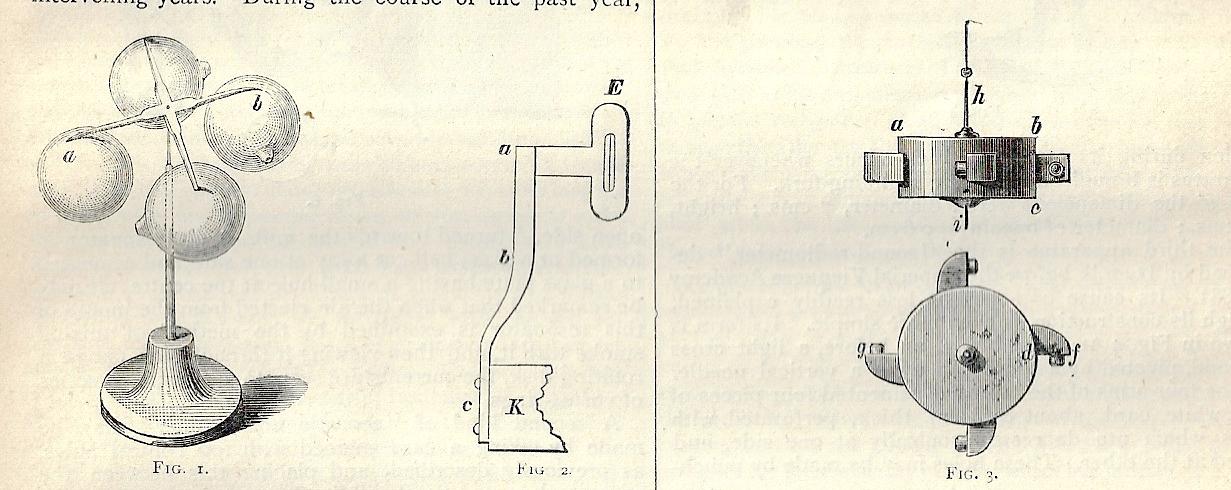
    Sylvanus P. Thompson. “Sound-Mills”  in Nature, February 14, 1884, pp 363-364, in the weekly issue of pp 353-376, and with several text illustrations. Nice copy, the weekly issue removed from a larger bound volume. Very Good.  $45

    Nature 1884 SOund mills

    The opening paragraph of the Thompson paper describes the instrument in general, and introduces the work of Dvorak:

    “After the notable researches of [Sir William] Crookes on radiation, which culminated in the discovery of the radiometer, or lightmill, it was a natural transition of thought which suggested to several minds almost simultaneously the possibility of devising an apparatus which should rotate under the influence of sound waves as does the radiometer under the influence of the rays of light and heat. Such instruments were indeed devised independently about six years ago by Lord Rayleigh, by Prof Alfred M. Mayer of Hoboken, by Mr Edison, the well-known inventor, by Prof Mach of Prague, by Dr A. Haberditzel of Vienna, and by Prof Dvorak of the University of Agram (in Croatia). These researches, though of great scientific interest, have been somewhat overlooked in the rush of scientific inventions during the intervening years. During the course of the past year, however, Dvorak has given to the world, in the pages of the Zeitschrift der Instrumentenkunde (vol. iii, Heft 4), a detailed account of his experiments, together with figures of various piece of apparatus hitherto undescribed. We propose to give a resume of the principal points of Dvorak’s researches…”

    Much of the rest of the paper describes four different Dvorak instruments.  

    ·Posted by :

    ·in:


  • Important Work by Clausius on the 2nd Law

    Clausius, Rudolf. “Ueber die Anwendung der mechanischen Wärmetheorie auf die Dampfmachine”, in: “Annalen der Physik und Chimie, Leipzig, Johann Ambrosius Barth, edited by J.C. Poggendorff, 1856, volume 97, series II, sections 3+4. pp 441-476 and pp 513-559. Offered in the entire volume of (x), 644 pp., with 5 folded engraved plates.  PROVENANCE: Provinzial-Gewerbschule zu Aachen (with their small, oval rubber stamp on the title page; then on to the Deutsche Akademie der Luftfahrtforsuchung (with their name stamped in gilt at the spine bottom); and then on to Wright Patterson Air Force Base Field, with their rubber stamp on the page edges (exterior) top and bottom. Lastly, the Library of Congress, with their “surplus” stamp on the rear endpapers. All that said, this is a nice, clean, crisp copy. VG $500

    The volume contains other significant works:

    Thomson, W. (Lord Kelvin) & J.P. Joule, “Ueber die Wärmewirkung bewegter Flüssigkeiten” (On the Thermal Effects of Fluids in Motion”, 1853),pp. 576-414. First edition in German om the Joule-Thomson Effect.

    Kohlrausch, R. “Ueber die elektrischen Vorgänge bei der Elektrolyse”, a two-part paper, pp. 397-414 and 559-575.

    ·Posted by :

    ·in: