A Daily History of Holes, Dots, Lines, Science, History, Math, Physics, Art, the Unintentional Absurd, Architecture, Maps, Data Visualization, Blank and Missing Things, and so on. |1.6 million words, 7500 images, 4.9 million hits| Press & appearances in The Times, Le Figaro, Mensa, The Economist, The Guardian, Discovery News, Slate, Le Monde, Sci American Blogs, Le Pont, and many other places… 5000+ total posts since 2008.

Book Category: Physics

  • Nobel Prize Effort at the Beginning of Quantum Electrodynamics–the Lamb Shift, 1947

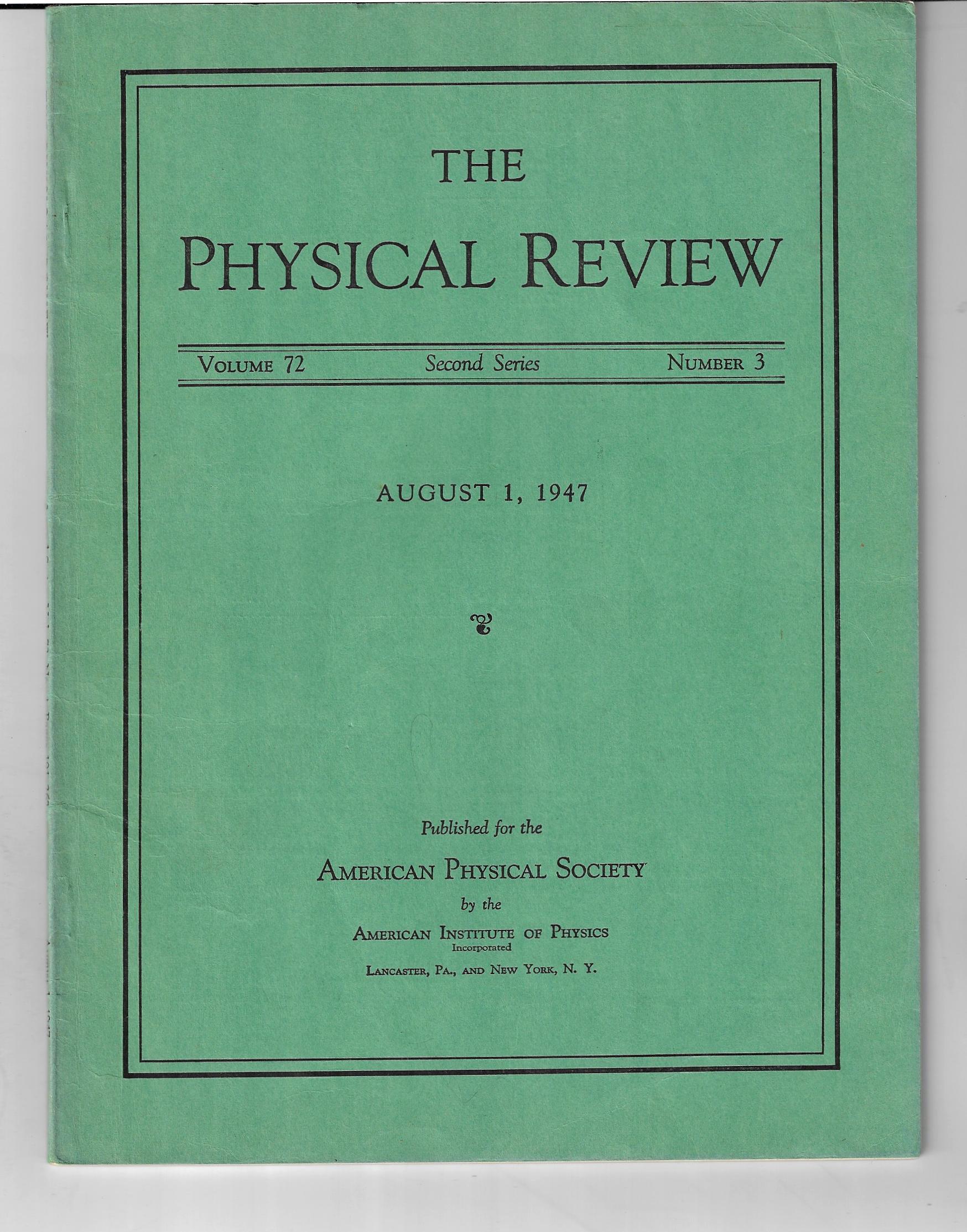
    Lamb, Willis E. And Robert C. Retherford, “Fine Structure of the Hydrogen Atom by a Microwave Method”. In Physical Review, volume 72, number 3, August 1, 1947, pp 241-243, in the issue of pp 189-261. Fine copy in the original wrappers. $1000

    _____. Another copy, not quite as nice. Very Good.  $750


    The Lamb Shift and the beginning of quantum electrodynamics. Lamb won the Nobel Prize in Physics in 1955 for his discoveries related to the Lamb shift.

    • “…it became clear that a new chapter in physics was upon us.” A. Pais, Inward Bound, relating Lamb delivering his report at Shelter Island, p 451.

    PR 1947 Lamb shift
    “This effect was first measured in 1947 in the Lamb–Retherford experiment on the hydrogen microwave spectrum and this measurement provided the stimulus for renormalization theory to handle the divergences. It was the harbinger of modern quantum electrodynamics developed by Julian Schwinger, Richard Feynman, Ernst Stueckelberg, Sin-Itiro Tomonaga and Freeman Dyson.”

    “On Lamb’s 65th birthday, Freeman Dyson addressed him as follows: “Those years, when the Lamb shift was the central theme of physics, were golden years for all the physicists of my generation. You were the first to see that this tiny shift, so elusive and hard to measure, would clarify our thinking about particles and fields.”–Wikipedia on the Lamb Shift

    Elsewhere Dyson referred to the best place for experiment in physics to be in the world at that time was Columbia, with Rabi in charge, and where Lamb (Ph.D. under Oppenheimer) was doing his work on the hydrogen atom. In an interview Dyson remarked that hydrogen was the “most deeply explored” object in science, and that “if you don’t understand the hydrogen atom, then you don’t understand anything”. When Lamb—using the new microwave measuring capacities—found that there was a discrepancy between theory and experiment regarding the hydrogen spectrum it was found to be, well, “deeply disturbing”.–quotes from Freeman Dyson on https://www.webofstories.com/play/freeman.dyson/64

    • This paper reprinted in Quantum Electrodynamics edited by Julian Schwinger (1958) paper 26.

    ·Posted by :

    ·in:


  • The Complete Sextet of Schwinger Papers on Quantized Fields, 1951-1954

    Julian Schwinger. Theory of Quantized Fields, I-VI, six parts in five issues, 1951-1954.

    “On 13 June 1978 the Nobel laureate Chen Ning Yang wrote the following to the chairman of the physics department at the University of California, Los Angeles (UCLA) to support Julian Schwinger’s appointment as professor: ‘Professor Julian Schwinger is among the great physicists of the contemporary era. His work covers an amazing range, from nuclear physics to elementary particle physics to field theory, from synchrotron radiation to group theory to microwave propagation.… The most important work of Schwinger was his contribution to renormalization, a contribution that stands among the greatest developments in physics in mid-twentieth century. Professor Schwinger is an eminently successful teacher. He probably has graduated more influential theoretical Ph.D. students than any other living physicist’.”-DSB

    Including:

    “Theory of Quantized Fields. I”. In Physical Review, vol 82 number 6, June 15, 1951. Pp 914-927 in the issue of pp 777-1016. Original wrappers. VG/VG+ copy.  Copy of Al Wattenberg, with his “AW” in the upper right corner.  1000+ citations. 

    “Theory of Quantized Fields. II and III” In Physical Review, volume 91 number 3, August 1, 1953, pp 713-728 and 728-740 in the issue of pp 505-772. Original wrappers. This issue has some problems with the spine cover and the inch or so onto the front wrapper a sort of damp staining or some such. Copy of Al Wattenberg, with his signature on the upper right front wrapper.

    “Theory of Quantized Fields. IV.” In Physical Review,  volume 92 number 5, December 1, 1953, pp 1283-1300 in the issue of pp 1101-1329. Original wrappers. Fine copy.  

    “Theory of Quantized Fields. V.” In Physical Review, volume 93 number 3, February 1, 1954, pp 615-628 in the issue of pp 365-651.  Original wrappers. VG/VG+ copy.  

    “Theory of Quantized Fields. VI.”  In Physical Review, volume 94 number 5, June 1, 1954, pp 1362-1384 in the issue of pp 1091-1444.  Original wrappers. Fine copy. 

    The five issues: $750

    ·Posted by :

    ·in:


  • Bethe’s “Best Paper”

    Bethe, Hans.  “Zur Theorie des Durchgangs schneller Korpuskularstrahlen durch Materie”  [“Theory of the Passage of Fast Corpuscular Rays Through Matter],” Annalen der Physik, Series V/5, 1930, (overall #397), a long paper of 75pp (pp 325-400) in the issue of pp 305-428. This is offered with the original wrappers, disbound from a larger volume. Ownership stamp from the U.S. Patent Office on the front wrapper. The wrappers are a little frail given the quality of the paper used, the paper of the test being better than that. Overall, a very conservative GOOD copy. $250

    • “According to J(eremy) Bernstein, Bethe considered this his best paper.”–from the Hans Bethe bibliography, at Sonoma, http://www.phys-astro.sonoma.edu/brucemedalists/bethe/BetheRefs.html

    This is a significant paper by Bethe (with 4000+ citations):

    • “The Bethe stopping-power theory is considered in the context of heavy target atoms in which the relativistic effects of’ the target electrons are partially accounted for within the semirelativistic and independent-particle description.”–PT Leung, “Bethe stopping-power theory for heavy-target atoms”, Physical Review A, 40/8, November 15, 1989.


    ·Posted by :

    ·in:


  • General Relativity and Flat Space (1940)

    Nicholas Rosen, “General Relativity and Flat Space I” and “General Relativity and Flat Space II” and “Note on Ether-Drift Experiments”, the three papers in the Physical Review, volume 57, number 2, January 15, 1940, occupying pp 147-155 in the issue of pp 75-162. Original wrappers.   Solid, fresh, Very Good copy.  $200

    • Also in this issue J.R. Oppenheimer, H. Snyder and R. Serber, “Production of Soft Secondaries by Mesotrons”.  

    ·Posted by :

    ·in:


  • A Significant Paper by the Great John A. Wheeler (1937)

    Wheeler, John. “On the Mathematical Description of Light Nuclei by the Method of Resonating Group Structure”, Physical Review; Volume 52 No. 11, pp. 1107-1122 in the issue of pp 1079-1200. Offered in the original wrappers, a good fresh, crisp copy. The detraction here is some wear along the spine, which obscures much of the word “Review”; there’s also two small chips missing from the spine top and bottom. VG copy. $250

    “In a 1937 paper “On the Mathematical Description of Light Nuclei by the Method of Resonating Group Structure”, Wheeler introduced the S-matrix – short for scattering matrix – “a unitary matrix of coefficients connecting the asymptotic behavior of an arbitrary particular solution [of the integral equations] with that of solutions of a standard form.” Werner Heisenberg subsequently developed the idea of the S-matrix in the 1940s. Due to the problematic divergences present in quantum field theory at that time, Heisenberg was motivated to isolate the essential features of the theory that would not be affected by future changes as the theory developed. In doing so he was led to introduce a unitary “characteristic” S-matrix, which became an important tool in particle physics.”–Wikipedia entry on Wheeler. 

    (I just wanted to point out here that only seven years passed between the time that Wheeler graduated from high school and receiving his Ph.D., in 1933, at age 22. He published his first scientific paper in 1930, at age 19. Two years after this 1937 paper was published, Wheeler wrote a paper with Niels Bohr explaining the mechanism of nuclear fission (on the day that Germany invaded Poland).

    ·Posted by :

    ·in:


  • The Einstein-Cartan Theory (1922)

    Cartan, Elie. SIX gravitation papers from 1922, as follows: “Sur une définition géométrique du tenseur d’énergie d’Einstein”; bound with “Sur une généralisation de la notion de courbure de Riemann et les espaces à torsion”; bound with “Sur les espaces généralisés et la théorie de la Relativité”; bound with “Sur les espaces conformes généralisés et l’Univers optique”; bound with “Sur les équations de structure des espaces généralisés et l’éxpression analytique du tenseur d’Einstein”, all together in a two-brick-sized volume of the Comptes Rendus Hebdomadaires des Séances de L’Academie des Sciences, volume 174, January-June 1922, with the Cartan papers occupying 437-439, 593-595, 734-737, 857-60, and 1104-1107 in the volume of 1815pp.

    ALL with their ORIGINAL FRONT WRAPPERS bound at the end of the volume.

    Also offered with a sixth paper:

    Cartan, Elie. “Sur un theoreme fondamental de M.H. Weyl dans la theorie de l’espace metrique”, in Comptes Rendus, 1922, volume 175, number 2, pp 81-5. This is offered disbound from a  larger volume, but with the original front wrapper.  

    The volume bound in cloth with the previous owner/institution name gilt stamped at the spine bottom (“U.S. Weather Service”). The covers have some general wear and scuffing, and the text is printed on relatively skimpy post-war-affected paper stock (as is the case with the CR for most of the 1920’s and into the Depression years of the 1930’s). That said, this is a Good Copy. $950

    “Cartan was one of the most profound mathematicians of the last hundred years, and his influence is still one of the most decisive in the development of modern mathematics…”–Complete Dictionary of Scientific Biography

    Cartan had just attended (on 6 April 1922) the Societe Francaise de la Philosophie (founded in part by Henri Poincare) “for a discussion of the general and special theories of relativity”.   (Pais, Subtle is the Lord, p. 163) Also in attendance were Hadamard, Painleve, Jean Becquerel, Einstein, , Langevin, Bergson, Meyerson, and numerous others. Pais also points out (on page 340) that via this work that Einstein’s “labors had a major impact on mathematics”. “…Cartan was the first to introduce nonsymmetric connections…there is considerable interest by general relativitists in theories of this kind, called Einstein-Cartan theories…their main purpose is to link torsion to spin…” (Pais, p 344.)

    “Albert Einstein became affiliated with the theory in 1928 during his unsuccessful attempt to match torsion to the electromagnetic field tensor as part of a unified field theory. This line of thought led him to the related but different theory of teleparallelism…Einstein–Cartan theory has been historically overshadowed by its torsion-free counterpart and other alternatives like Brans–Dicke theory because torsion seemed to add little predictive benefit at the expense of the tractability of its equations. Since the Einstein–Cartan theory is purely classical, it also does not fully address the issue of quantum gravity. In the Einstein–Cartan theory, the Dirac equation becomes nonlinear and therefore the superposition principle used in usual quantization techniques would not work. Recently, interest in Einstein–Cartan theory has been driven toward cosmological implications, most importantly, the avoidance of a gravitational singularity at the beginning of the universe. The theory is considered viable and remains an active topic in the physics community.” –Wikipedia entry for Einstein-Cartan Theory, which also identifies the essential papers as “Cartan, E. (1922). Comptes Rendus 174, 437–439, 593–595, 734–737, 857–860, 1104–1107”.

    Three of the five papers are referenced in Lecat’s Bibliographie de la Relativite  (1924) #404-406, pg 18. 

    _____. ANOTHER Copy, without the original wrappers.  

    The volume bound in cloth and paper boards, and is from an institutional library in Baltimore, though with very minimal library markers. The text is printed on relatively skimpy post-war-affected paper stock (as is the case with the CR for most of the 1920’s and into the Depression years of the 1930’s). That said, this is a Very Good Copy. $400

    ·Posted by :

    ·in:


  • A Great Moment in the History of Quantum Mechanics (Niels Bohr, 1928)

    Niels Bohr, “Das Quantenpostulat und die neurere Entwicklung der Atomistik”, in Die Naturwissenschaften, volume 16, part 15, 13 April 1928, pp 245-255 in the issue of pp 245-268. This is the complete weekly issue, without the wrappers, removed from a larger bound volume. Very Good condition.  $500

    ”From the epistemological point of view, the discovery of the new type of logical relationship that complementarity represents is a major advance that radically changes our whole view of the role and meaning of science. In contrast with the nineteenth-century ideal of a description of the phenomena from which every reference to their observation would be eliminated, we now have the much wider and truer prospect of an account of the phenomena in which due regard is paid to the conditions under which they can actually be observed—thereby securing the full objectivity of the description, since the description is based on purey physical operations intelligible and verifiable by all observers. The role of the classical concepts in this description is obviously essential, since those concepts are the only ones adapted to our capabilities of observation and unambiguous communication.

    ·Posted by :

    ·in:


  • Is this the Earliest Mention in a Scientific Periodical of the Results of the 1919 Eclipse Confirming the General Theory of Relativity ?

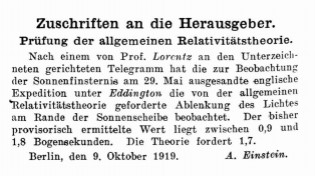
    Einstein, Albert. “Zuschriften an die Herausgeber, Prufung der allgemeinen relativitatstheorie”, in  Die Naturwissenschaften, volume 7, heft 42, October 17, 1919. p 776 in the issue of pp (761)-780, offered in the original wrappers, removed from a larger bound volume.  Condition: the wrappers are browned somewhat. given the supply of paper in the broken German economy of 1919, but the text paper is unaffected, being pretty much blemish-free, though slightly dulled to one of the myriad descriptors of “pale white” or “eggshell”…anyway, quite but not brilliantly so.  The announcement comes from Einstein himself, and is one short paragraph long. Given that the tiny notice appears in what looks like a short index on the front of the magazine that it was being given some sort of prestige, it wasn’t–every entry in the short issue is listed there, so no big deal on finding the Einstein on the front cover. Very nice copy. sold

    • This seems to be the earliest mention of confirming results of the 1919 expeditions to confirm GTR,  submitted by Einstein himself weeks before the formal announcement at the Royal Institution. There was at least one newspaper story on the eclipse–with the information again supplied by Einstein from a telegraphic communication from Lorentz–but I cannot locate the article to see if any of the figures were included in the story.  I cannot find any evidence that an article or notice appeared in a scientific journal before this and it seems unlikely that it would be so. Also a few simple Google searches on the title and author of the announcement reveals, well, almost nothing, which was unexpected.  But “unlikely” is hardly definitive, and so the qualified (and questioned) “firstness” of the announcement. 

    According to Abraham Pais, an “excited” Albert Einstein contributed a very short note (“Zuschriften an die Herausgeber, Prufung der allgemeinen relativitatstheorie”/”A Test of the General Theory of Relativity”) to the editors of the journal Die Naturwissenschaften1 reporting on the telegram he had received from H.A. Lorentz on September 22 on the impending confirmation of the theory of relativity as it was tested in the May 29, 1919 eclipse experiments organized by Sir Frank Dyson. Chandrasekhar explains the situation so: 

    • “It was some months before the two expeditions returned to England and the participants were able to measure their plates and collate their results. But rumours of the successful confirmation of Einstein’s prediction reached Einstein in early September 1919. And on 22 September 1919, the Dutch physicist Hendrik Antoon Lorentz sent Einstein a telegram confirming the rumours to which Einstein replied (also by telegram).. Einstein’s own satisfaction with the outcome of the British expeditions is shown by the postcard (dated September 27, 1919) to his ailing mother in Switzerland. It said: Dear Mother: Good news today. H. A. Lorentz has wired me that the British expeditions have actually proved the light deflection near the Sun….”

    “The telegram that had announced the news to Einstein…was an informal communication. Nothing was definitive. Yet Einstein sent almost at once a very brief note to Naturwissenschaften for the sole purpose of reporting the telegram he had received. He was excited.” (Pais, Subtle is the Lord, p 303).

    Einstein’s note in Naturwissenschaften was concise and to the point: “…the English expedition, under Eddington…has observed the deflection of light at the limb of the sun demanded by the General Theory of Relativity3…”

    The results of the experiment were read on November 6, 1919 (the presentation begun by Dyson, followed by A. C. Crommelin, the leader of the Sobral expedition)  to a joint meeting of the Royal Society and the Royal Astronomical Society, and famously published in the Philosophical transactions of the Royal Society in 1920 as “A Determination of the Deflection of Light by the Sun’s Gravitational Field, from Observations Made at the Total Eclipse of May 29, 1919”4.  J.J. Thomson (as president of the Royal Society)  closed the meeting and “pronounced the canonization [of Einstein]”: ‘This is the most important result obtained in connection with the theory of gravitation since Newton’s day, and it is fitting that it should be announced at a meeting of the society so closely connected with him. . . . The result [is] one of the highest achievements of human thought.’ (Pais, Subtle…, in the chapter “The Suddenly Famous Doctor Einstein”, p 305) R.H. Fowler, president of the Royal Astronomical, also spoke and announced ‘“The conclusion is so important that no effort should be spared in seeking confirmation in other ways.”

    The Einstein note is dated October 9 in the text and was published a week later in the issue of  October 17, 1919.  It is one of the first appearances on the confirmation of the theory, with the exception, evidently, of at least one notice in a Berlin newspaper5 just days earlier. (Again, this according to Pais.) It would be on November 6 that “Lorentz sent another telegram to Einstein, confirming the news. On November 7, 1919, the Einstein legend began.” I assume that Pais is talking about the general article that appeared in the London Times on that day (and which would be written for the New York Times on the 9th, and then it was off to the races with the news, with Einstein himself contributing an article three weeks later to The Times). Well, “off to the races” except in Germany, where the reporting beyond this notice in Naturwissenschaften was more reserved, as noted by an article on the 1919 eclipse on the Max Planck Gesellschaft website: “In contrast to the enthusiastic reception shown by the foreign press, the media in Germany were more reticent on the subject. Not until 14 December 1919 did the Berliner Illustrierte Zeitung publish a photo of Einstein and an article entitled: “A new luminary for the history of the world: Albert Einstein, whose research means a total revolution in the way we see the world and whose findings are equal to those of a Copernicus, Kepler and Newton”. 

    Here’s the entire announcement from Naturwissenschaften:
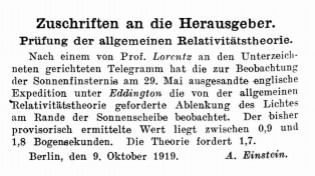
    EInstein 1919

    Writing about the eclipse on his website, Simon Singh says that J.P. McEvoy, author of Eclipse: The Science and History of Nature’s Most Spectacular Phenomenon (Fourth Estate Ltd., 1999), “encapsulated the significance of the announcement” writing of the ironies of the event:  “A new theory of the universe, the brain-child of a German Jew working in Berlin, had been confirmed by an English Quaker on a small African island.” A further bit to add here is that the expeditions were undertaken by British scientists to prove the work of a German scientist, beginning their work before the end of WWI.

    S. Chandrasekar reports that in 1933 Rutherford expounded on the eclipse and Einstein’s fame, rather more broadly and more deeply:

    “The war had just ended: and the complacency of the Victorian and the
    Edwardian times had been shattered. The people felt that all their values and
    all their ideals had lost their bearings. Now, suddenly, they learnt that an
    astronomical prediction by a German scientist had been confirmed by
    expeditions to Brazil and West Africa and, indeed, prepared for already
    during the war, by British astronomers. Astronomy had always appealed to
    public imagination; and an astronomical discovery, transcending worldly
    strife, struck a responsive cord. The meeting of the Royal Society, at which
    the results of the British expeditions were reported, was headlined in all the
    British papers; and the typhoon of publicity crossed the Atlantic. From that
    point on, the American press played Einstein to the maximum…”6

    I guess this is where the ultra-fame of Einstein begins.

    Notes:

    1.  Die Naturwissenschaften, volume 7, heft 42, October 17, 1919. p 776

    2. S. Chandrasekhar, “Verifying the Theory of Relativity”, in Notes and Records of the Royal Society of London Vol. 30, No. 2 (Jan., 1976), pp. 249-260.

    3.  The Collected Papers of Albert Einstein, Volume 7 (English).

    4. W. Dyson, A. S. Eddington, C. R. Davidson, “A Determination of the Deflection of Light by the Sun’s Gravitational Field, from Observations Made at the Solar eclipse of May 29, 1919”, Philosophical Transactions of the Royal Society,  A 220 (571-581): 291–333 (1920). Eddington had written previously on the expedition, “The total eclipse of 1919 May 29 and the influence of gravitation on light”, in The Observatory, Vol. 42, p. 119-122 (1919)

    5. “An article by Alexander Moszkopwski entitled ‘Die Sonne bracht es an den Tag’ in the Berliner Tageblatt of October 8, 1919, must presumably have been based in information from Einstein himself”. (Pais, Subtle…, footnote p 306.) Also, Andrew Claude de la Cherois Crommelin contributed  “The Eclipse Expedition to Sobral”  in The Observatory 42, 368-371, and though it published in October there is no mention of definitive results yet.  Crommelin also publishes an article in Nature on 13 November (volume 104, p. 280-1), appearing about a week after the Royal Society meeting, in which he publishes the results, all on the equivalent of a single page.  

    6.  Chandrasekhar, ibid., pg 251.

     [Interesting to note here that in Maurice Lecat’s Bibliographie de la Relativite (1924) this contribution receives only a scant placement within the Einstein section, in part 13 (c).]
    ·Posted by :

    ·in:


  • Early German Translations of Classics in Optics (1811)

    YOUNG, Thomas and DAVY, Humphrey. Several translations of his work  appearing in Annalen der Physk, Leipzig, Ambrosius Barth, 1811, series I, vol 39; (vi), 485pp, 4 plates.  Cloth-backed marbled boards; the boards I suspect are older than the cloth, which dates from the 1930s.  Ex-libris Deutsche Akademie der Luftfahrtforschung, then Wright Patterson Field Library (USAF), then Library of Congress.  Library markings:  small gilt-stamped “Akademie der Luftfahrtforschung”, page edges stamped “Wright Field Library/Dayton, Ohio” on top and bottom. The text is crisp and bright.  $250

    [Young, Thomas]  Ludicke,  (translator).  According to the general index these are the first appearances of the Young papers in the Annalen, and also represent nearly the majority of all papers on Young that appeared in the entire first series of the AdP.

    • “Ueber die Theorie des Lichts von Thomas Young…”, pp 156-206, “Theory of Light and Colours”, the great paper that appeared in  Philosophical Transactions of the Royal Society of London, Volume 92, Part I, 1802, pp. 12-48, Dibner 152; PMM 259.
    • and”Nachricht von einigen Faellen einer bisher noch nicht beschriebenen Entstehung der Farben von Thomas Young…” from Philosophical transactions, ibid.   pp 206-223;
    • and “Beschreibung einer Vorrichtung, um mittelst des Sonnen-Mikroskops die Farben dunner Flachen darzustellen”, pp 255-261;
    • and “Versuche und Berechungen zur physikalischen Optik von Thomas Young…”, Philosophical Transactions.…, 1804. pp 262-291.

    [Davy, Humphrey] Gilbert, (editor and translator) “Die drei neuesten Abhandlungen Humphry Davy”, pp 1-90.

    and

    Henry Hyde Wollaston, “Ueber gewisse chemische Wirkungen des Lichts”, pp 291-299.

    ·Posted by :

    ·in:


  • Early Contribution to Brownian Motion 1863 (by Not-Norbert) Wiener


    WIENER, Christian (1826-1896) . “Erkldrwig des atomistischen Wesens des Jiussigen Korperzustandes und Bestatiguny desselben durch die sogennanten Molekularbetvegungen”, in the Annalen der Physik, 1863, volume 118, part 1, pg 79-94, offered in the entire volume of 644pp with 8 folding plates (1 plate split at the fold and detached). Ex-libris Deutsche Akademie der Luftfahrtforschung, then Wright Patterson Field Library (USAF), then Library of Congress.  Library markings:  small gilt-stamped “Akademie der Luftfahrtforschung”, page edges stamped “Wright Field Library/Dayton, Ohio” on top and bottom.. Contents quite nice.  $350

    “The first name which calls for reference in this respect [regarding Brownian motion] is, perhaps, that of Wiener, who declared at the conclusion of his observations, that the movement could not be due to convection currents, that it was necessary to seek for the cause of it in the liquid itself, and who, finally, almost at the commencement of the development of the kinetic theory of heat, divined that molecular movements were able to give the explanation of the phenomenon” – Perrin, Jean. Brownian Movement and Molecular Reality, 1910, pg 3.

    “…molecular -kinetic explanation of Brownian Motion (first qualitatively proposed by Christian Wiener in 1863)…”–“Error and the Growth of Experimental Knowledge”, Deborah G. Mayo, p 218.

    “In his studies on molecular physics, Wiener demonstrated by extremely careful observations that Brownian movement is an “internal motion peculiar to the liquid state…”–“Wiener, Ludwig Christian.” Complete Dictionary of Scientific Biography. Vol. 14. Detroit: Charles Scribner’s Sons, 2008. 342-344.

    “(Wiener was a) German mathematician who specialized in descriptive geometry. Wiener was also a physicist and philosopher. In 1863, he was the first person to identify qualitatively the internal molecular cause of Brownian motion.”–Wiki 

    Also bound with: KIRCHHOFF, Gustav.  “Zur Geschichte der Spectral-Analyse under der Analyse der Sonnenatmosphaere”, same volume, pp 94-111.  Kirchhoff (1824-1887) was part of the Bunsen-Kirchhoff teams that developed the spectroscope in 1859 and then detected the first chemical elements in the spectrum of a star (1859 and 1860, respectively).  This article (“On the history of spectral analysis and the analysis of the solar atmosphere”) is interesting  given that it is relatively lengthy for such a short history, though it does reach back into the early 19th century for related developments.


    ·Posted by :

    ·in: