A Daily History of Holes, Dots, Lines, Science, History, Math, Physics, Art, the Unintentional Absurd, Architecture, Maps, Data Visualization, Blank and Missing Things, and so on. |1.6 million words, 7500 images, 4.9 million hits| Press & appearances in The Times, Le Figaro, Mensa, The Economist, The Guardian, Discovery News, Slate, Le Monde, Sci American Blogs, Le Pont, and many other places… 5000+ total posts since 2008.

Book Category: Physics

  • “Penetrating investigation of the so-called parity laws which has led to important discoveries regarding the elementary particles”

    “A rather complete theoretical structure has been shattered at the base and we are not sure how the pieces will be put together” –I. Rabi

    YANG, C.N. and T.D. Lee.  “Questions of Parity Conservation in Weak Interactions”. The Physical Review,  volume 104, October 1, No. 1, 1956.  Article occupies pp. 254-58 in the entire issue of 272pp.  Offered in the original wrappers, a fine copy.  $750

    Chen Ning Yang and Tsung-Dao Lee were awarded the 1957 Nobel Prize for their work “for their penetrating investigation of the so-called parity laws which has led to important discoveries regarding the elementary particles”. “The award was the climax of the most exciting year in postwar physics.”–Jeremy Bernstein, The New Yorker, 1962

    • “The importance of parity conservation, its fundamental nature, was discovered in 1927 by the physicist Eugene Wigner, Wigner proved that Laporte’s rule was a consequence of right-left symmetry (or mirror image symmetry) of the electromagnetic force. Conservation of parity rested upon Maxwell’s equations describing electromagnetism, but more important, the intuitive idea that nature should be left-right symmetric had been established on the quantum level. Thus, when in 1949, the weak force was postulated to explain disintegration of elementary particles, physicists could not conceive that parity conservation would not hold for reactions involving the weak force. It was a minor oversight however that there was no direct evidence for the extension of this law to the fourth force of nature. Seven years later physicists would come full circle to question their acceptance of parity conservation”
    • “The new province of weak interactions had not been tested before Lee and Yang made the suggestion. Nevertheless, the physicists’ assumption that nature will present a simple understanding is unflailing. Chen Ning Yang has stated, “In the study of nature, one believes in something simple underlying all”. Madame Wu agrees, “One hopes that nature possesses an order that one may aspire to comprehend. When we arrive at an understanding, we shall marvel how neatly all the elementary particles fit into the great scheme.” Violation of the law of conservation of parity, then, should lead one to search for an even more fundamental symmetry to the universe.”–Symmetry Destroyed: The Failure of Parity, 1984 Krishna Myneni

    ·Posted by :

    ·in:


  • Tesla’s London Lectures, 1892

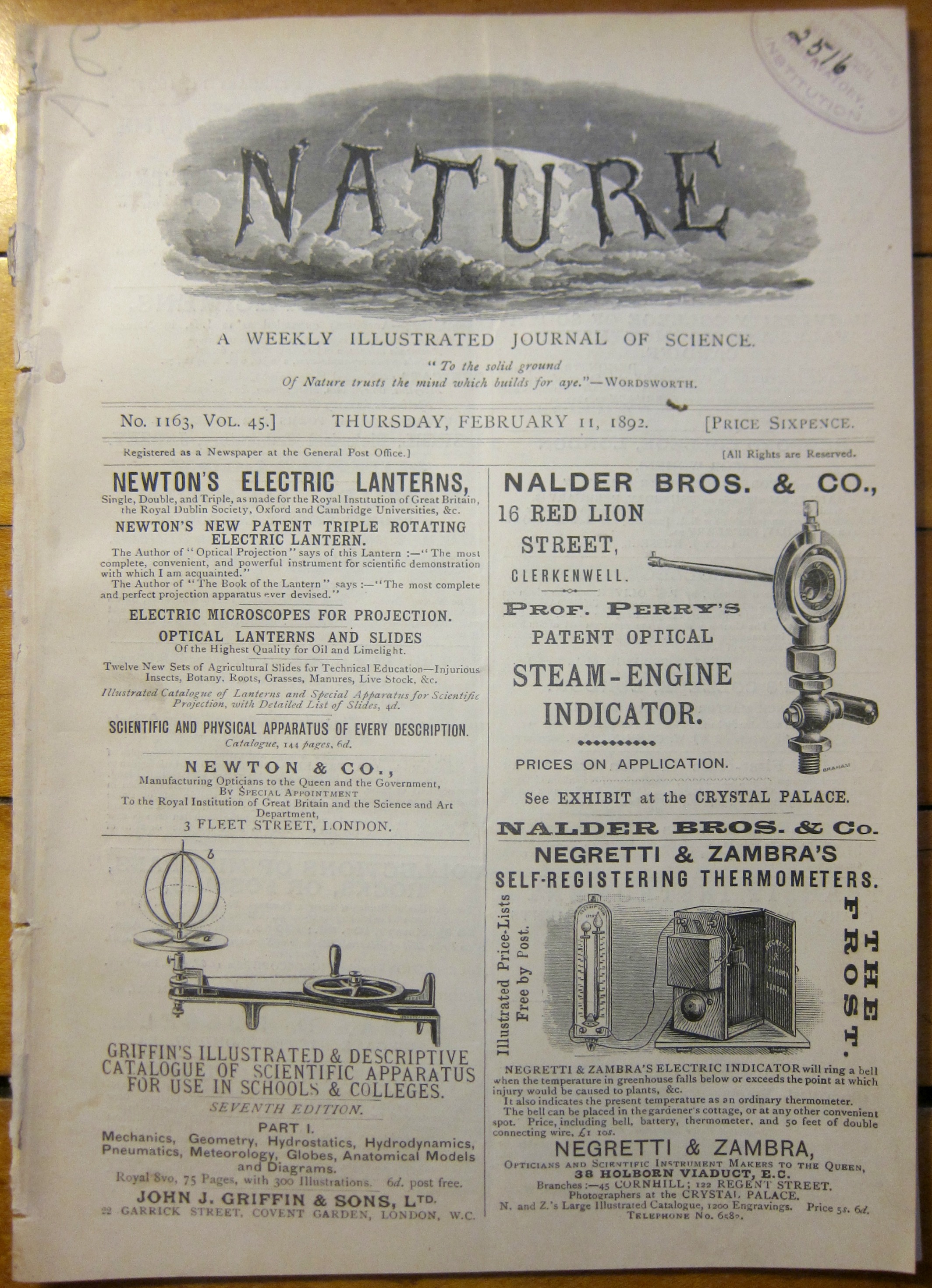
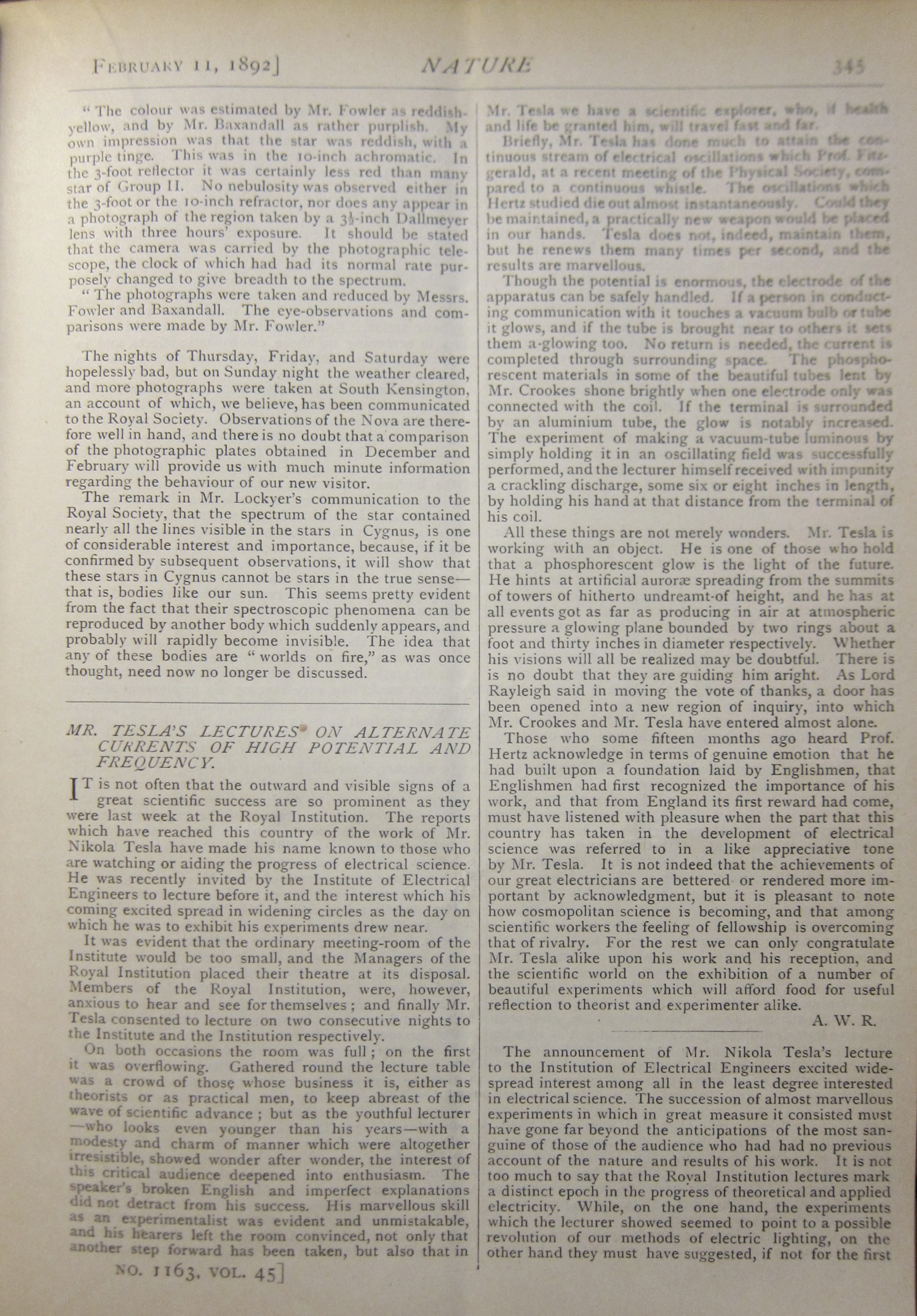
    [Tesla] “Mr. Tesla’s Lectures on Alternate Currents of High Potential and Frequency”, in Nature, volume 45, February 11, 1892, no. 1163, pp 345-7 in the weekly issue of pp 337-360. Offered with the original wrappers, including the cover plus 7pp of ads. This is extracted from a larger bound volume, ex-library from the Smithsonian Astrophysical Observatory , with their small oval rubber stamp in the upper corner of the front cover. Its a nice copy though it does have an old, mostly faded, vertical fold through the text.  The article runs around 2500 words and includes two reviews of the lecture(s), which overflow crowds enjoyed over two days at the Royal Institution.  Good, solid copy, with the uncommon wrappers.  $200

    TEsla 1892 cover

    Tesla 1892 text

    ·Posted by :

    ·in:


  • Two Great Papers in One Issue of the Physical Review: Oppenheimer/Snyder and Bohr/Wheeler

    Robert Oppenheimer and Hartland Snyder, “On continued gravitational contraction”,

    • AND BOUND WITH

    Niels Bohr and J.A. Wheeler, “The mechanism of nuclear fission”  both appearing in the Physical Review, September 1, 1939, Vol. 56, #5, pp. 426-50 and pp. 455-59, respectively. 

    First editions of these two papers, presented in the original wrappered issue of the great Physical Review. Condition:  the issue is not without its problems, and these are limited mostly to the spine cover, which is mostly worn away, though the spine itself is fine. THe only legible part of the lettering on the spine is the date on the spine bottom. Also there is some rust staining from the internal staples.  Other than that the issue is really quite nice. All that said, I’m offering this at a fraction of what prettier copies are being sold for presently. $1250  
     
    The two papers appear together in a single issue of the journal, a remarkable set of achievements found in one small space–remarkable even more for the fact that 1939 (as with 1859, 1543, 1932, and 1948) is one of those remarkable single years in the history of science.
     
    The Oppenheimer and Snyder (a graduate assistant) paper is one of the most prescient in the history of modern physics, correctly physically describing (where Chandrasekhar and Eddington in their discussions did not) what happens in a particular collapse of a neutron star, and still today reads as fresh and and brightly as it did in 1939.  Really, it is an extraordinary work, and a foundation paper in the history of gravitation, the application of RT, singularity, and astrophysics.  (The Southampton GR Explorer site nicely states it this way: “This paper has strong claims to being one of the most prophetic ever written in this field of research. Today, 60 years later, this paper needs little revision – even the terminology is undated!”)
    Phys Rev 1939 Oppenheimer Gravitational
    In an often-repeated quotation, they write, somewhat in irony and in a certain and understated manner on page 456: “The star thus tends to close itself off from any communication with a distant observer; only its gravitational field persists”. And later: “When all thermonuclear sources of energy are exhausted, a sufficiently heavy star will collapse. Unless fission due to rotation, the radiation of mass, or the blowing off of mass by radiation, reduce the star’s mass to the order of that of the sun, this contraction will continue indefinitely”, they wrote.
     
    Next comes Bohr and Wheeler, “The mechanism of nuclear fission” is the experimental foundation stone (on the basis of the liquid drop model of atomic nuclei) of nuclear fission and the great leap forward in the construction of the atomic bomb.
    Condition: the paper of the spine of the publication is about one-third owrn away, otherwise this is a very nice copy. 

    From the abstract: “On the basis of the liquid drop model of atomic nuclei, an account is given of the mechanism of nuclear fission. In particular, conclusions are drawn regarding the variation from nucleus to nucleus of the critical energy required for fission, and regarding the dependence of fission cross section for a given nucleus on energy of the exciting agency. A detailed discussion of the observations is presented on the basis of the theoretical considerations. Theory and experiment fit together in a reasonable way to give a satisfactory picture of nuclear fission”.

    ·Posted by :

    ·in:


  • Nuclear Fission in “Revue Scientifique”, 1939


    Revue Scientifique, January-August, 1939, volume 77, numbers 1-8, quarto, 551pp. Wrappers (front and back) bound in at the rear of the volume, with supplemental ads throughout the volume. Bound in an attractive red cloth. Tidy institutional bookplate; institutional rubber stamp on first page of each monthly issue as well as one rubber stamp on wrapper covers. Fine copy, very tight and fresh. $500

    This volume contains a couple of original articles of interest to the development of nuclear fission as well as 16 articles that are reviewed/abstracted/somewhat reprinted from other journals (in the February, March, and April issues), and when not in French written in or translated into French, which in many cases are the first translations of some of the great papers in this period of nuclear physics. The great majority are one or two columns in length.

    Included are works by Thibaud, Savitch, Joliot, Frisch, von Halban, Meitner, Feather, Bretscher, Heyn, Strassmann, Curie and others–these are rapidly published translations/reviews, in many cases coming jsut weeks after the original paper was published.  

    • Issue for February, 1939 

    VEIL, S. “Les controls chimiques de transmutations d’atomes”, p 111-112.

    And unattributed in the “echos” section:

    “La Rupture Explosive des noyaux d’uranium et de throium dans l’Action des Neutrons”. One column article on page 133, citing Fermi/Amaldi 1934, Curie/Savitch 1938, Hahn and Strassmann (Jan 1939).

    Then:

    “Un nouveau type de reaction nucleaire”, Nature, 143, 233, 1939, translated by S. Veil—this is the “introductory” statement in Nature preceding the Meitner/Frisch paper a few pages later.

    MEITNER, Lise and O. Frisch. “Disintegration de l’uranium par les neutrons: un nouveau type de reaction nucleaire”, translated by S. Veil, pp 133-4, and which appeared in Nature, 143, 233, 1939.

    JOLIOT, F and J. Perrin. “Preuve experimentale de la rupture, explosive des noyaux d’uranium et de thorium sous l’action des neutrons”, from Comptes Rendus, vol 208, 199, 341-343, and here appearing in two columns on one full page (135).

    CURIE, I. And P. Savitch. “Sur les radioelements formes dans l’uranium et le thorium irradies par les neutrons”, from Comptes Rendus, volume 208, 1939, p 343-346, and here on one full page (136).

    • The issue for March, 1939 77/3, pp (139)-218 is very interesting:

    THIBAUD, Jean and A. Moussa. “La cassure de l’uranium, la formation d’un halogene et la liberation d’energie qui en resulte”, pp 182-185.

    And then, in the “echo et information” section, which is basically a reporting section on work that was published elsewhere (though not necessarily in French), we find abstracts and announcements of a number of very significant publications:

    THIBAUD, Jean and Andre Moussa. “Sur la rupture des noyaux d’uranium sous l’action des neutrons et la liberation d’energie qui en resulte”, from the Comptes Rendus 208, 1939, pp 744-6, p 211-212.

    SAVITCH, Paul. “Sur un radioelement gazeux forme dans l’Uraium bombarde par les neutrons”, from Comptes Rendus, 208, 1939, pp 646-647, this all on a long columns on page 212.

    JOLIOT, F. “Observation par la methode de Wilson des trajectoires de brouillard des produits de l’explosion des noyaux d’uranium”, from Comptes Rendus, vol 208, 1939, pp 647-649. one and a half columns, with photo illustration.

    FRISCH, O. “Evidence physique de rupture du noyaux lourds sous bombardement de neutrons”, in Nature, 143, 1939, p 276. This 1.25 columns.

    Von HALBAN, H. and F. Joliot. “Liberation de neutrons dans l’explosion nucleaire de l’uranium”, from Nature, 143, 1939, p 470. This pp 214-215.

    MEITNER, L. and O.R. Frisch. “Les Produits de rupture du noyaux f’uranium”, in Nature143, p 471, 1939. This is all on page 215, in two full columns.

    • The issue for April, 1939: pp 186-298

    FEATHER, N. and E. Bretscher. “La Rupture Explosive des Noyaux d’Uranium”, from Nature, 143, p 516, 1939. Here occupies 1 column.

    HEYN, F. and Aten and Bakker. “Transmutations d’uranium et de thorium par neutrons”, from Nature, 143, 516, 1939. Here occupies two full columns.

    BRETWCHER, E. and L.G. Cook. “Transmutations de noyaux d’uraniumet de thorium en moyen de neutrons”, from Nature, 143, p 559, 1939. Here the work occupies a full column.

    FEATHER, N. “La duree du processis de rupture nucleaire”, from Nature, 143, p 597, 1939. Here the work occupies two columns.

    THIBAUD, J. and A.Moussa. “La disintegration de l’uranium par l;effet des neutrons et la partition de cet element”, from Comptes Rendus, 208, 652-4, 1939. Here the artcile occupies two columns on page 293.

    DODE, M. and von Halban and Joliot. “Sur l’energies des neutrons libertes lors de la partition nucleaire de l’uranium”, (no mention of origin). This is one full column on page 294. 

    • Issue for June-July 1939, pp 371-455

    COUFFIGNAL, L. reviews/abstracts/summarizes A. Einstein and L Infeld “L’Evolution des Idees en Physique”, pp 427-8

    Also for interest in the history of computer science: Nice article on Maurice d’Ocagne (1862-1938) by Louis COUFFIGNAL and Rene Harmegnies.Fe 1939, p 70 p. 67-76 Feb 1939
    ·Posted by :

    ·in:


  • Philip Abelson Investigation Of The Products Of The Disintegration Of Uranium By Neutrons In The Physical Review Volume 5

    Philip Abelson, “Investigation of the Products of the Disintegration of Uranium by Neutrons”. In: The Physical Review, volume 56, number 1, July 1, 1939. In the original wrappers, the weekly issue, on pp 1-10 (in the issue of pp 1-124).  Nice copy, with a tiny indentation on the front cover right-middle. This is #30 in Louis Turner’s bibliography, “Nuclear Fission”, 1940, in Reviews of Modern Physics, vol 12/1, January 1940, pp 1-30. SOLD

    ·Posted by :

    ·in:


  • Important Papers in the History of Nuclear Fission, 1939

    The Atomic Bomb–the French Contribution, first half, 1939. 

    14 major papers (in 12 different weekly issues) in the history of nuclear fission, all published in Comptes Rendus hebdomadaires des Séances de l’Academie des Sciences, volume 208, January-June 1939, 2250pp, a single bound volume, thick and stout. Ex-libris, with a bookplate–also, each title-page of each weekly issue (of which there are 26 in this volume), has a small round rubber stamp of the library. Cloth binding. ca. 1950. Nice condition.  There is a faded, old vertical fold that extends through the text, no doubt from when the original owner folded the issues in half…over the years in binding, the fold is mostly gone.   $1000

    Included are the following:

    BECK, Guido and Peter Havas, “La dissymetrie de la rupture de l’uranium”, 3 April 1939, no. 14,  pp 1084-1086

    BECK, Guido and Peter Havas, “Sur le ralentissement dans l’air des fragments atomique résultant de l’explosion de l’uranium”,  22 May 1939, no. 21, pp 1643-1645;

    *CURIE, Irene and Paul Savitch. “Sur les radioelements formes dans l’uranium et le thorium irradies par les neutrons”, 30 January 1939 (one of two papers in this issue), pp 343-346; 

    DODE, Maurice, Hans von Halban, Frederic Joliot, Lew Kowarski. “Sur l’energie des neutrons liberes lors de la partion nucleairede l’uranium”, 27 March 1939,  p 995-997

    HAENNY, Charles and Albert Rosenberg. “Émission de neutrons lors de la rupture provoquée du noyau d’uranium. Possibilité de réaction par chaine” “20 March 1939, no 12, pp 898-900;  

    **JOLIOT, Frederic. “Preuve experimentale de la rupture explosive des nayaux d’uranium et de thoriumsous l’action des neutrons” 30 January 1939,  p 341-343– THE FIRST INDEPENDENT CONFIRMATION OF NUCLEAR FISSION. 

    *JOLIOT, Frederic. “Observations par la methode de Wilson des trajecoires de brouillard des produits de l’explosion des noyaux d’uranium”, 27 February 1939, p 647-649

    MAGNAN, Claude, “Sur la cassure des noyaux éléments plus légers que l’uranium, sous le bombardement des neutrons”, 6 March 1939, no. 10, pp 742-4;

    MAGNAN, Claude. “Sur les neutrons emis lors de la bipartition de l’uraniumsous l’action des neutrons”, 17 April 1939, pp 1218-1220

    *PERRIN, Francis. “Calcul relatif aux conditions éventuelles de transmutation en chaine de l’uranium”, 1 May 1939, no 18,  pp 1394-1396; 

    *PERRIN, Francis. “Calcul relatif aux conditions éventuelles de transmutation en chaine de l’uranium”, 15 May 1939, no. 20, pp 1573-1575; 

    *THIBAUD, Jean Thibaud and Andre Moussa. “Sur la rupture des noyaux d’uranium sous l’action des neutrons et la libération d’énergie qui en résulte”,  6 March 1939, no. 10 (second article of the issue) 744-6;

    von HALBAN, Hans, Lew Kowarski, Paul Savitch. ” Sur la capture simple des neutrons thermiques et des neutrons de resonance par l’uranium”, 1 May 1939, no 18 (second article in this issue) pp 1396-1398; 

    von Halban, Hans, Lew Kowarski, Michael Magot. “Sur l’intensite des neutrons dans le radiation cosmique”, 20 February 1939, pp 572-574.


    ·Posted by :

    ·in:


  • First Appearance of the Oppenheimer-Phillips Process

    J. Robert Oppenheimer and Melba Phillips. “Note on the transmutation function for deuterons”, in Physical Review volume 48, September 15, 1935, pp 500-502, in the issue of pp 491-572. Original wrappers. Very Good copy. $175

    “The Oppenheimer–Phillips process or strip reaction is a type of deuteron-induced nuclear reaction. In this process the neutron half of an energetic deuteron (a stable isotope of hydrogen with one proton and one neutron) fuses with a target nucleus, transmuting the target to a heavier isotope while ejecting a proton. An example is the nuclear transmutation of carbon-12 to carbon-13…The process allows a nuclear interaction to take place at lower energies than would be expected from a simple calculation of the Coulomb barrier between a deuteron and a target nucleus.”

    Also in this issue:Enrico Fermi “On the recombination of Neutrons and Protons”, E.O. Lawrence et al “Transmutation Functions for Some Cases of Deutron-Induced Radioactivity”, and others.

    From the abstract: “We consider the effect of the finite size and ready polarizability of the deuteron on the probability of transmutations involving the capture of the neutron. These have as a consequence that the Coulomb repulsion of the nucleus is less effective than for alpha-particles or protons, and that the corresponding transmutation functions increase less rapidly with deuteron energy. We treat the collision by the adiabatic approximation and obtain quantitative results for this energy dependence which are in good agreement with experiment.”

    This was a few years later expanded by H. A. Bethe in his paper “The Oppenheimer-Phillips Process”, in Phys. Rev. 53, 39 , 1 January 1938 and then again in 1940 in a paper of the same title in the Phys Rev by GM Volkoff.

    ·Posted by :

    ·in:


  • An Early Paper with Extended Bibliography on Special Relativity, 1910

    J. Laub, “Uber die experimentellen Grundlagen Relativitatsprinzips, in Jahnrbuch der Radioaktivitat und Elektronik, 1910, volume 7, Leipzig, S. Hirzel, 662pp.  Bound in half calf. Ex-library, U.S. Patent Office. This volume is intact, though has a number if nicks and dings, and is in Fair condition, though perhaps a little better than that.  Uncommon.  $250

    Jakob Laub–the first collaborator of Albert Einstein–wrote one of the earliest histories/retrospectives of relativity theory for the Jahrbuch der Radioaktivitat und Electronik in volume 7 for 1910: “Uber die experimentellen Grundlagen des Relativitatsprinzips”, pp 405-463. (It seems that I don’t often see/notice references on this level citing the first German edition of an integral work in another language, which Laub does here for example in two articles by Fizeau that he found in Annalen when their original publication took place in the Comptes Rendus.)  (See the reference for Laub in Physics Before and After Einstein  edited by M. Mamone Cap; also The Scientist as Philosopher: Philosophical Consequences of Great Scientific ...by F. Weinert. 

    This paper also contains a 127-item bibliography.

    On Laub, from the Dictionary of Scientific Biography, volume 17:

    “Laub attended gymnasium in Rzeszόw. In 1902, after studying briefly at the universities of Cracow and Vienna, he entered the University of Göttingen as a student of mathematics and physics. There, taking courses and seminars with David Hilbert and Hermann Minkowski, he became interested in the electron theory. He turned to experiment, and in 1905 he decided to work with Wilhelm Wien at Würzburg. Laub’s doctoral dissertation (1907) concerned secondary cathode-ray emission. At his oral defense (1906), he introduced Einstein’s special theory of relativity, which Wien had recommended to him in September 1905. For the next several years Laub remained at Würzburg and concentrated on extending Einstein’s ideas.”

    “Although by early 1908 Einstein was attracting notice from distinguished physicists, he had not yet received a university appointment. It was an unusual step, then, when in February 1908 Laub wrote to Einstein to ask if he could visit Bern to study relativity with him. Laub became Einstein’s first scientific collaborator. Together they published articles criticizing Minkowski’s notion of electromagnetic force and suggesting an experiment to decide between Einstein’s special relativity and Hendrik Lorentz’s electron theory.”

    ·Posted by :

    ·in:


  • Part of a Busy Year for John Bardeen

    BARDEEN, J. “Electron-Vibration Interactions and Superconductivity.” APS, 1951. 1st edition. Reviews of Modern Physics 23/3, July 1951.

    Original printed wrappers. Fine condition. $150

    This was a busy year for Bardeen, publishing a number of papers on this topic, though almost entirely in the Phys Rev. Other contributors here include Walter Brattain (Copper Oxide Rectifier), George Breit (Topics in Scattering Theory) and JH Van Vleck (Angular Momentum). 

    ·Posted by :

    ·in:


  • A Significant Alteration and Correct in Chasing the Speed of Light (1882)

    Michelson, A.A. “Sur le mouvement relatif de la terre et de l’éther”, in Comptes Rendus Hebdomadaires des Séances de L’Academie des Sciences, 20 February 1882, vol 94, no 8, the Michelson on pp 520-523 in the weekly issue of pp. 473-548. Offered as an extract with no spine covering, from a larger bound volume. Nice, fresh issue. $150

    With a round, black rubber stamp from the Port de Toulon (library or tax stamp, I cannot tell).

    This is a report from Michelson correcting an error affecting the performance of the interferometer described and tested in the 1881 paper on ether drag (that appeared in the American Journal of Science”, Third series vol. XXII, 1881) leading to the iconic experiments on the speed of light (with Edward Morley beginning in 1885) in 1887 and 1888 (and etc., these preceded by the three efforts of Fizeau, Foucault, and Cornu, as well as Simon Newcomb).

    See: Gerald Holton, “Einstein, Michelson, and the ‘Crucial Experiment,’” in Isis, 60, no. 202 (Summer 1969), 133–197.

    ·Posted by :

    ·in: