A Daily History of Holes, Dots, Lines, Science, History, Math, Physics, Art, the Unintentional Absurd, Architecture, Maps, Data Visualization, Blank and Missing Things, and so on. |1.6 million words, 7500 images, 4.9 million hits| Press & appearances in The Times, Le Figaro, Mensa, The Economist, The Guardian, Discovery News, Slate, Le Monde, Sci American Blogs, Le Pont, and many other places… 5000+ total posts since 2008.

Book Category: Physics

  • Poincare’s Great 1905 Paper

    POINCARE, Henri. “Sur le dynamique de l’electron”, in Comptes Rendus, Paris,  1905, volume 140, pp 1504-1508, offered in the entire bound volume for the half year.  Bound in bloards and  leather spine, the spine cover nearly detached.  A good copy.  $650  (English translation found here, though it is the version that appeared in the Rendiconti del Circolo matematico di Palermo 21: 129–176.)

    “HENRI POINCARE’S major work on a theory of the electron is “Sur la dynamique de l’electron”.  It is considered, by some, as evidence that POINCARE, more than anyone else in the late 19th and early 20th centuries, anticipated EINSTEIN’S 1905 theory of relativity.

    “This study will focus on POINCARE’S attempt in “Sur la dynamique…” to formulate a purely electromagnetic theory of a deformable electron that is consonant with his conception of the principle of relativity. POlNCAIRE believed that if all physical processes could be reduced ultimately to the interaction of charged particles which move about in LORENTZ’S all-pervasive ether, then such a theory would be an important step toward a unified description of nature. Thus, the laws of the various branches of physics, and in particular NEWTON’S second law, could be derived from those of electromagnetism. This scientific viewpoint (or Weltbild) will hereafter be referred to as the “electromagnetic world-picture. ”…–From the introduction of Arthur Miller’s fine study of this paper in Archive for History of Exact Sciences, Vol. 10, No. 3/4/5 (18.IX.1973), pp. 207-328, “A Study of Henri Poincaré’s “Sur la Dynamique de l’Électron”.”

    It has always seemed strange to me that Poincare never followed up on this paper, nor did he seem interested in Einstein’s great work of 1905; nor did Einstein show much interest in Poincare’s work on this topic (or nearly any other), and was otherwise indisposed when he was approached to write an appreciation of Poincare upon is death six years later. 
    ·Posted by :

    ·in:


  • One of the Earliest Reviews on the State of Quantum Theory, 1929-1930

    KEMBLE, Edwin C. “General Principles of Quantum Mechanics, Part I.”  In: the Physical Review Supplement, Studies in Contemporary Physics, October 1929, volume 1 #2, pp 157-215 in the issue of pp 157-240.

    With: Kemble:  “General Principles of Quantum Mechanics, Part II”, in Reviews of Modern Physics, January 1930, volume 2 #1, pp 1-58 in the issue of pp 1-122. 

    Both in the their original printed wrappers.  Very good condition. There is some sort of 1/4″ plastic adhesive (?) on the front hinge of both issues…I’m not sure if these actually re-enforce the pamphlet, or not, but they don’t seem to make much of an impact appearance-wise.  $150, the pair.

    It is interesting to see these early issues of the Reviews of Modern Physics–especially the vol 1/2 issue under the Physical Review Supplement, which would soon changes its name to the RMP.  Kemble evidently did a service to the physics community with these well-received papers, coming at a time when there were not many writing in this area . (H. Krage points out in Quantum Generations  p. 171) that of the 284 papers published in that year (from among the 2400 members and fellows of the APS) that only 45 of them concerned themselves with quantum theory.)  Abraham Pais states in Subtle is the Lord that the Kemble paper is the first reviewing the state of quantum mechanics at the end of the decade…and at first blush, this seems to be not the case as a review of the subject, though that feeling (for me) is quickly disassociated. (There are some interesting references int eh footnotes, including some that are unexpected to me, at least, like a Bridgman paper cited from Harper’s Magazine from March 1929.  In any event if you’re not familiar with this paper it is available online and is at least worth a peek for the footnotes.) 

    ·Posted by :

    ·in:


  • The First Appearance of the “Compton Effect” 1923–Important, “Turning Point in Physics”, and Nobel Prize Effort

    Arthur H. Compton, “A Quantum Theory of the Scattering of X-Rays by Light Elements” in Physical Review, volume 21, May 1923, pp. 483-502. Offered in the full bound volume, iv, 736pp. 

    • The great paper is preceded in print by a ca. 175-word abstract of the paper given by Compton at the Chicago meeting of the American Physical Society, December 1 and 2, 1922, in the February issue, pg 207. 

    Bound in a very sturdy green cloth. Provenance: US Geological Survey, with their bookplate. There is a Library of Congress surplus stamp on the front free end paper.  This copy was evidently not or little-used, as it is nice and fresh and in great condition.    $1750

    On Compton and his “Compton Effect” 

    “Compton’s achievement in 1923 was not merely in describing the effect, but also in explaining it in the context of quantum theory. Although Compton was well acquainted with quantum theory, it was only after he read a paper by Albert Einstein (1879–1955) on the linear momentum of photons that he saw a way to demonstrate it using X-rays. A photon, according to quantum theory, was the basic unit (or quantum) of electromagnetic radiation. If an X-ray photon carried linear momentum as well as energy, Compton could treat the interaction in terms of momentum and its conservation, as an X-ray photon collides with an electron in the target substance. Assuming the conservation of energy (a fundamental principle of physics), Compton had to account for all of the energy after impact. He showed that the collision resulted in a new photon of less energy (and thus greater wavelength) being scattered after contact, while the target electron took on some of the energy as well. The total energy was conserved. The shift in wavelength depended on the mass of the electron and the angle of scattering. This work was crucial in establishing experimental evidence for conceiving of electromagnetic radiation (such as light and X-rays) as composed of quanta, with both energy and directed momentum.”

    “The Compton effect was important not only for its description of photon scattering, but also for its ramifications for understanding electrons. In the interaction just described, the electron was at rest. After a collision, however, the electron recoiled. Compton calculated the wavelength of the electron in motion after striking a photon, and the result became known as the Compton wavelength. Compton’s results, which support the notion that radiation behaves as both wave and particle, precipitated a flurry of fundamental work in quantum physics in the 1920s. The quantum mechanics that emerged at the end of the decade can be viewed in part as the theoretical explanation of the experimental evidence found in Compton’s laboratory. Even Werner Heisenberg’s (1901–1976)uncertainty principle, asserting the impossibility of locating the electron with accuracy, can trace its origins to the problems of electron recoil described by Compton in 1923.”

    “Compton’s 1927 Nobel Prize, shared with C. T. R. Wilson (1869–1959), demonstrated the international recognition of his work and cemented his leading position in the U.S. community of physicists. He turned his research from X-rays to cosmic rays, for which he led expeditions throughout the world to measure their intensity. This work ended abruptly during World War II, when Compton entered the project to build the atomic bomb.”–Science in the Early 20th Century, by Jacob Jamblin (an interesting encyclopedia I haven’t used before…”early” meaning 1900-1950). 

    See also:

    Compton, Arthur Holly. Atomic Quest: A Personal Narrative. New York: Oxford University Press, 1956

    Shankland, Robert S. “Compton, Arthur Holly.” In Gillispie, Charles Coulston, ed., Complete Dictionary of Scientific Biography, vol. III. New York: Charles Scribner’s Sons, 1971, 366–372.

    Stuewer, Roger. The Compton Effect: Turning Point in Physics. New York: Science History Publications, 1975

    ·Posted by :

    ·in:


  • Meteorological Instruments (1926)

    Dorno, C. Ausstattung moderner Strahlungsobservatorien, Braunschweig, Vieweg u. Sohn, 1926. 10×7”, 13pp+ an interesting illustrated section, “Bilder aus dem Physikalisch_Meteorlogischen Obervatorium, Davos”, which has 9 photo illustrations of the instruments, 6 of which have numbered glassine overlays to help with the identifying legend for the plate. Original wrappers. There is a 2”-long 1”-square bit missing from the upper right corner. Provenance: U.S. Weather Bureau (1932), and the Library of Congress, with a stamp on the reverse of the title page and on the back cover. Good copy, though the text is bright and fresh. $45

    “The latter work aims at uniformly comprehending the whole economy of atmospheric light, that is to say, establishing what has become of the incident solar radiation, and what sort of charges it has undergone with regard to intensity, have been devoted to the perfection of recording methods measurements in the foregoing years. These efforts arrived at an almost complete success, as has been shown in “Progress in radiation measurements” published in the Monthly Weather Review in 1922, according to which Davos is the first place in the world to continuously record the total exchange of heat by radiation during the course of a whole year”. —Monthly Weather Review, March 1924, pg 150

    DocFile (2)

    ·Posted by :

    ·in:


  • First Appearance in Print of the Terms “Relativity Theory” and “Theory of Relativity” (1906)

    Max Planck, “Die Kaufmannschen Messungen der Ablenkbarkeit der β-Strahlen in ihrer Bedeutung für die Dynamik der Elektronen” [The Measurements of Kaufmann on the Deflectability of β-Rays in their Importance for the Dynamics of the Electrons], in a bound volume of Physikalische Zeitschrift, 1906, volume VII, the paper occupying pp 753-761 (printed in double columns), printed in Leipzig by S. Hirzel. There are other papers of relativity in VII including Wacker (p 300), Farkas (p 654), Stark (p 353), and Wilkens (p. 846). Bound in cloth. Fine and sturdy copy.  $500

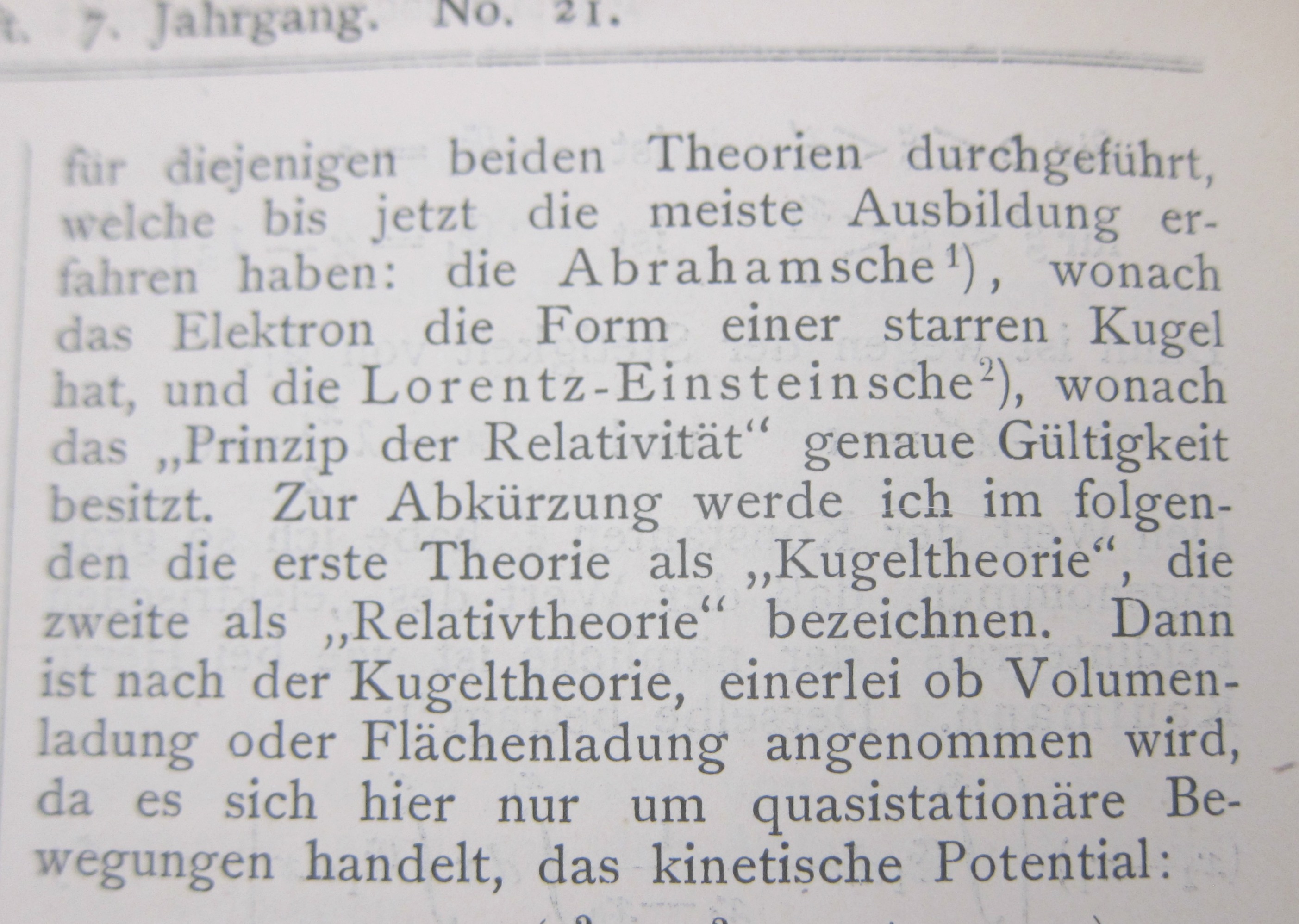
    Prior to using the words “postulate” and “principle” associated with relativity (as in “Prinzip der Relativitat”, appearing in the second paragraph of Einstein’s June 1905 “Zur Elektrodynamik bewegter Körper” in Annalen der Physik)  it is first referred to as “relativity theory” (“Relativtheorie”) by Max Planck on p. 756 (col 2 line 9 and also on pp 758+759) of this volume. Then in the “discussion” part of the Planck paper the “theory of relativity” (“Einsteinische Relativitatstheorie”) appears for the first time in print just a few pages later (p. 760 col 2 line 15) by Alfred Bucherer.

    • “The term “theory of relativity” was based on the expression “relative theory” (German: Relativtheorie) used in 1906 by Planck, who emphasized how the theory uses the principle of relativity. In the discussion section of the same paper, Alfred Bucherer used for the first time the expression “theory of relativity” (German: Relativitätstheorie).”–Wikipedia

    It was very surprising, finding this, the first time that something so familiar as “relativity theory” appeared in its most familiar form. 

    Einstein relativtheorie


    And there it is.

    ·Posted by :

    ·in:


  • The Klein-Gordon Equation (1926)

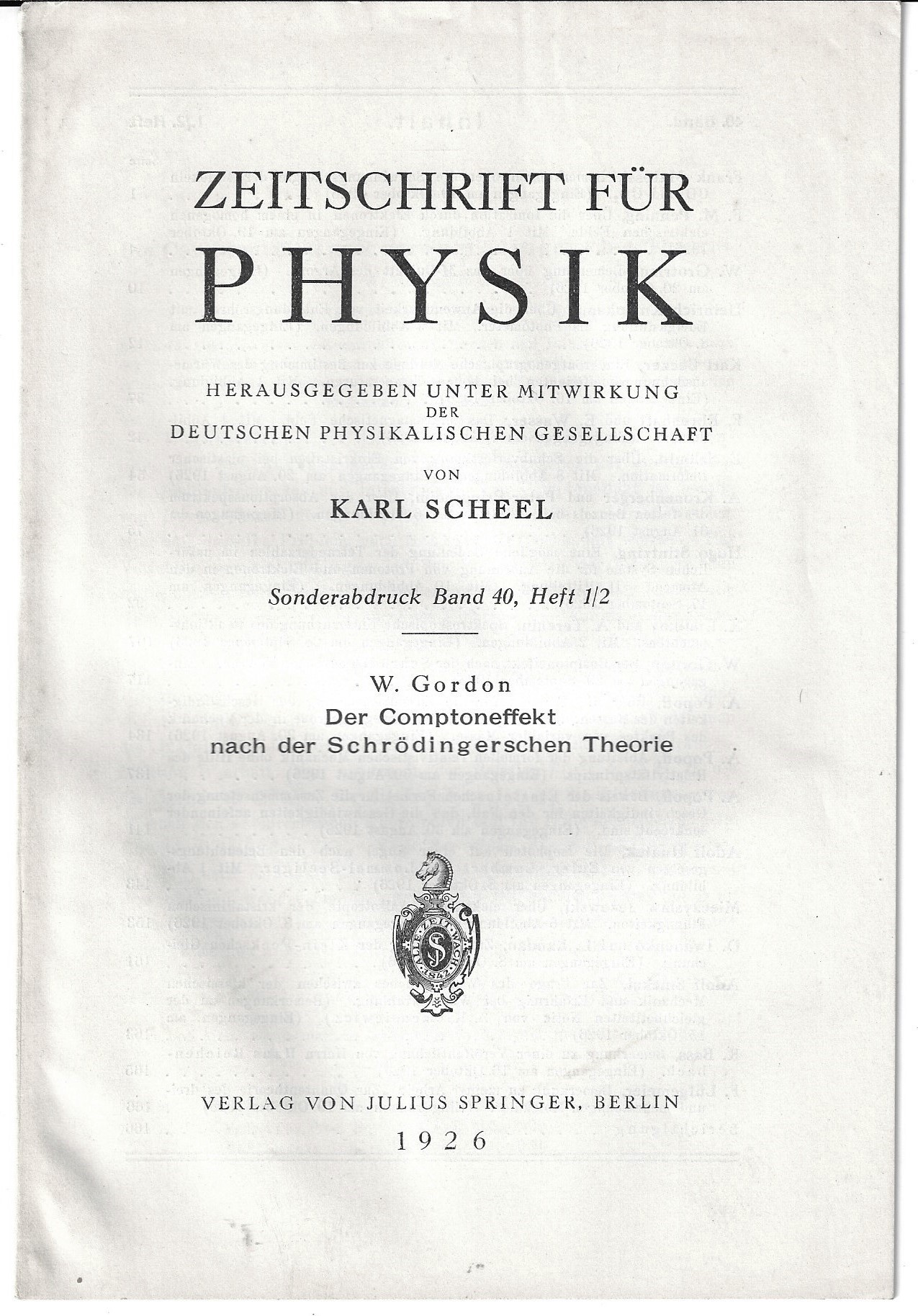
    Gordon Walter ComptoneffektW(alter) Gordon, Der Comptoneffekt nach der Schrödingerschen Theorie”, offprint from Zeitschrift fur Physik, 40, 1-2, Berlin, Julius Springer, 1926, pp 117-133. Original wrappers. Very Good.  SOLD


    “…the Klein–Gordon equation correctly describes the spinless relativisitic composite particles, like the pion. On July 4, 2012 CERN announced the discovery of the Higgs boson. Since the Higgs boson is a spin-zero particle, it is the first observed ostensibly elementary particle to be described by the Klein–Gordon equation.”–Wiki

    See also:

    • H. Kragh: “Equation with Many Fathers, the Klein-Gordon Equation in 1926”, AmJ Phys 52(100), pp 1024, 1984.  (Also citing Vladimir Fock, Johann Kudar, Théophile de Donder and Frans-H. van den Dungen, and Louis de Broglie. )
    • Weisstein, Eric W. “Klein-Gordon Equation.” From MathWorld–A Wolfram Web Resource.
    • Jiří Bičák, Tomáš Ledvinka, eds: Relativity and Gravitation: 100 Years after Einstein in Prague, p. 268.
    • Victor E. Borisenko, Stefano Ossicini, What is What in the Nanoworld: A Handbook on Nanoscience and Nanotechnology

    ALSO:

    W(alter) Gordon, “Zur Lichtfortpflanzung nach der Relativitätstheorie”, offprint from Annalen der Physik, IV/72, 1923, published by Barth in Leipzig., p (421)-456. Original wrappers. Very Good.  SOLD

    “…the main reason why Gordon’s paper should have been considered at the time of its appearance and remembered thereafter is, in our opinion, another one and, to our knowledge, it has remained completely unnoticed by everybody [in spite of 250+ citations?], if one excludes the attentive reviewer of Gordon’s article for “Physikalische Berichte”: that paper contains a clear-cut argument for selecting, through a clever reductio ad vacuum, the stress-energy-momentum tensor of the electromagnetic field in non-dispersive matter, provided that the latter be homogeneous and isotropic when considered in its rest frame “–A forgotten argument by Gordon uniquely selects Abraham’s tensor as the energy-momentum tensor for the electromagnetic field in homogeneous, isotropic matter. S. Antoci and L. Mihich Dipartimento di Fisica “A. Volta” – Pavia, Italy

    ·Posted by :

    ·in:


  • One of the Earliest X-Ray Photos Published in a U.S. Journal (6 February, 1896)

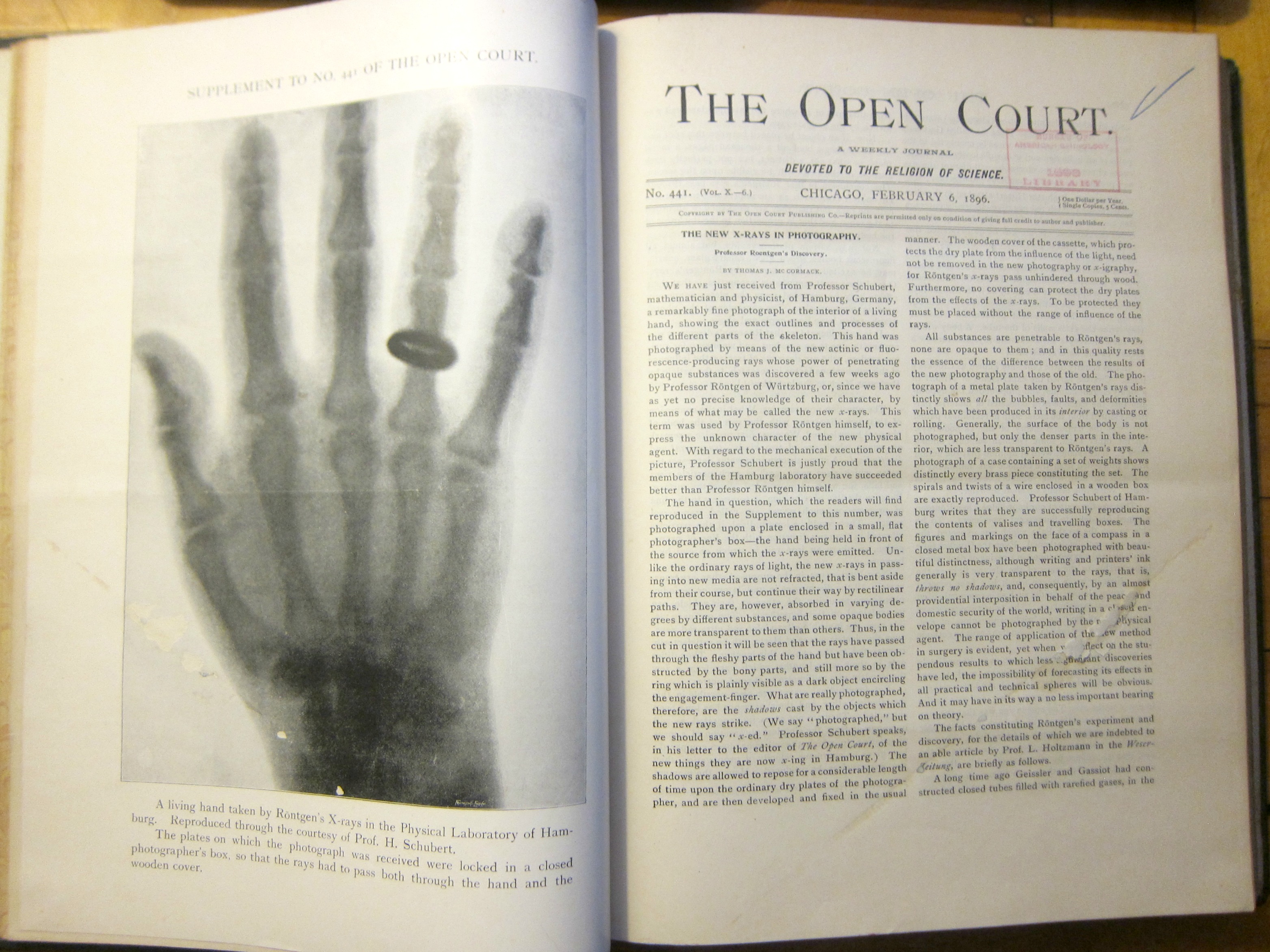
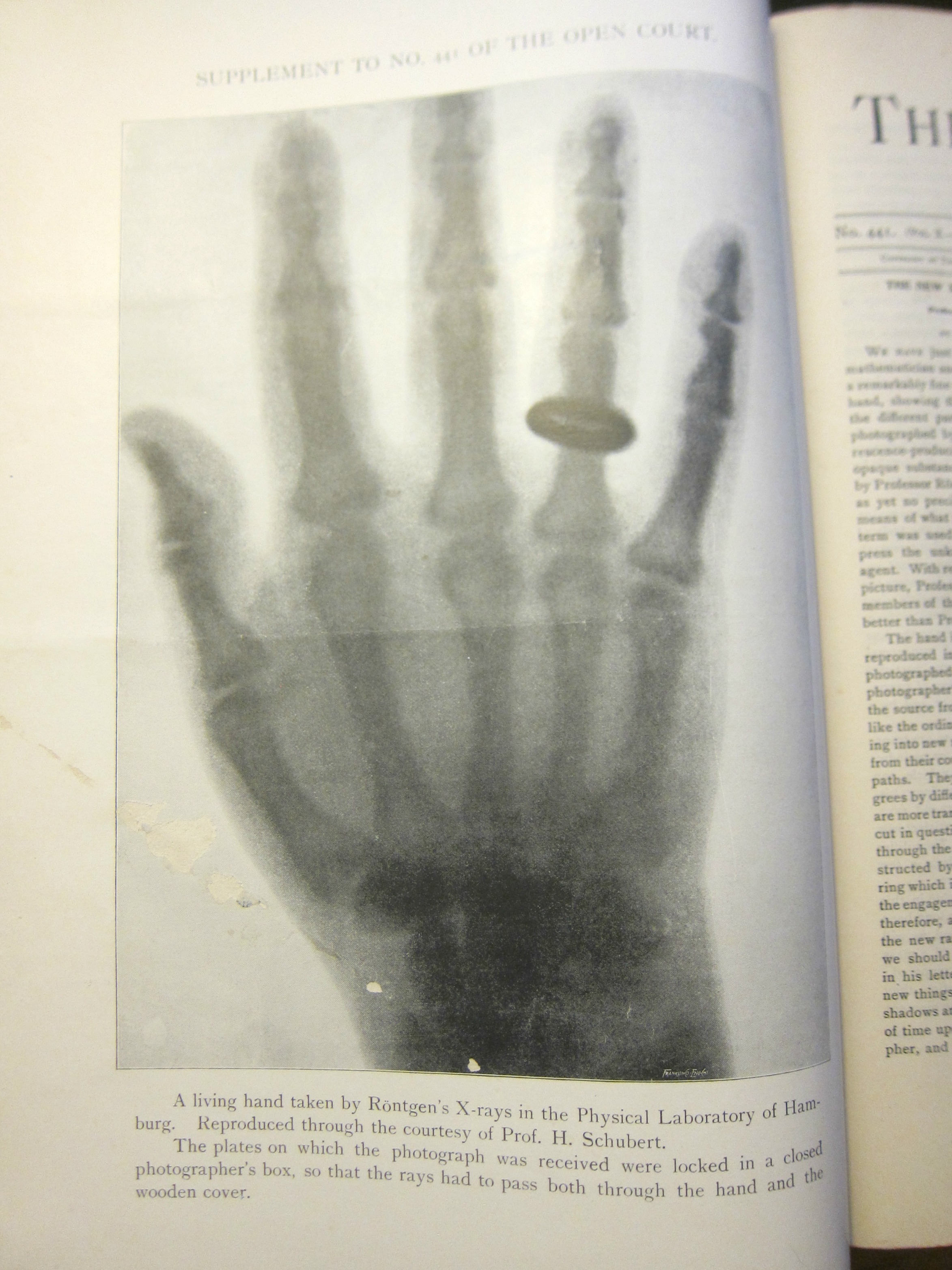
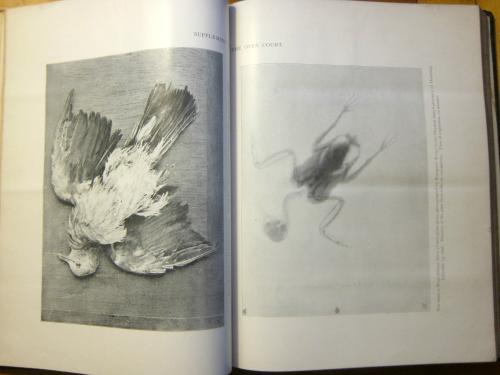
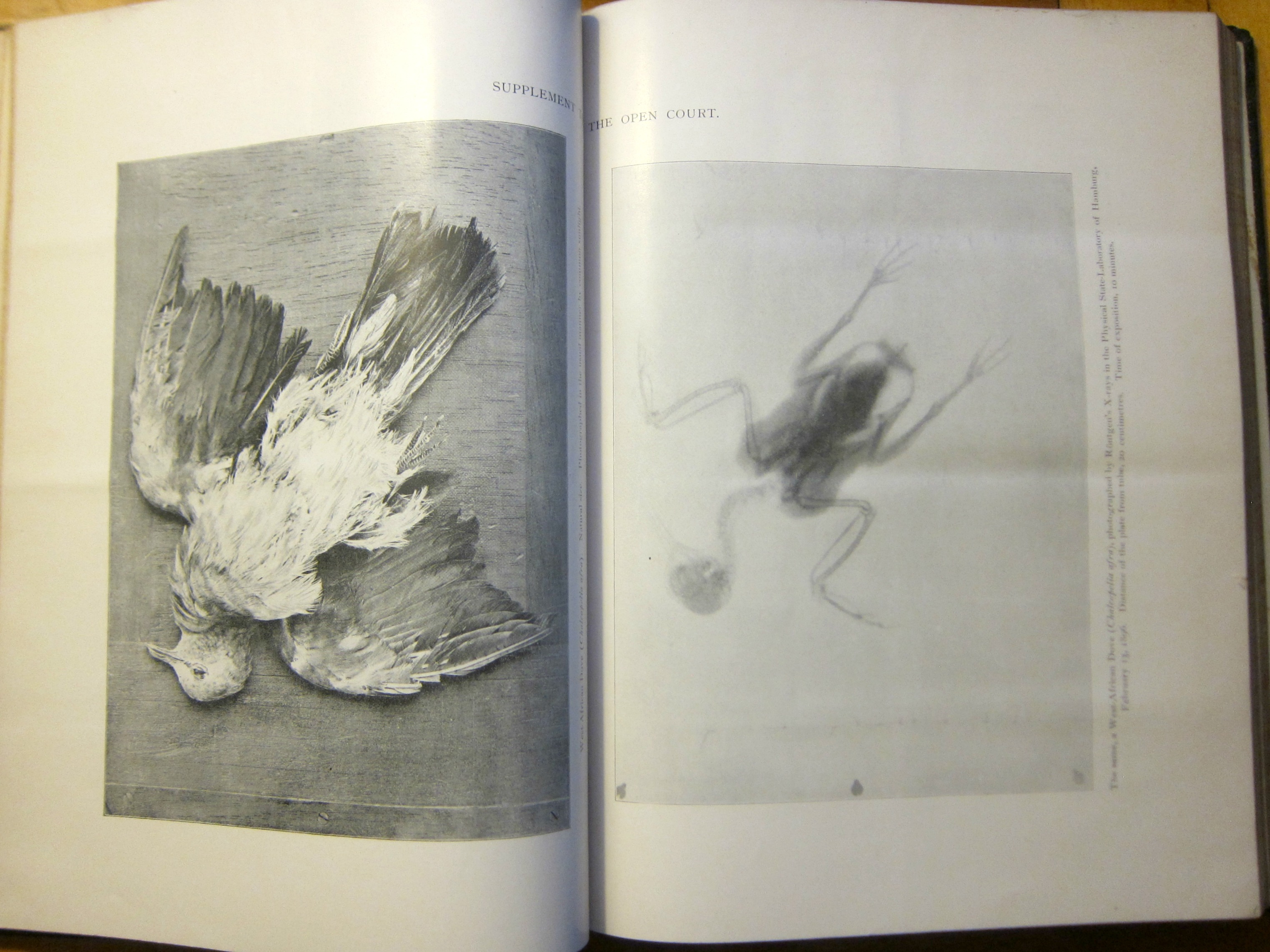
    Thomas J. McCormack, “The New X-Rays in Photography”, in a bound volume of The Open Court, a Weekly Journal Devoted to the Religion of Science, February 6, 1896, no. 441, volume x-6, pp 4799-4801.  With a very large photographic image (12×9.25″ 31x24cm).
    Also appearing in this volume: 

    _____. “Roentgen’s Rays Again”, no. 446 vol X-11, March 12, 1896, pp 4483-4844, illustrated with a double-page photographic image. 

    X-ray _3_

    This is offered in the full bound volume of pp 4759-5174. Bound in modern black cloth with a call number gilt stamped on spine bottom. Each weekly section title has a small rubber stamp from the former library. PROVENANCE: interesting Federal history of ownership on this volume, belonging to the Bureau of American Ethnology, the Smithsonian Institution, and then dispensed by the Library of Congress (with their surplus stamp on the front free endpaper). Also, the major issue is a little bit of damage to the text on the first page of text of the first x-ray paper; also, there is some scuffing to the photo plate of the x-ray, removing a 10x10mm section from the face of the background, which is really a shame. In any event, the price for this item takes this bits into account: $200

    This is a very early appearance in the U.S. of the weeks-old Roentgen discovery of the x-ray. The first journal edition in English appears to be 23 January 1896 in Nature (vol 53), and the first in a U.S. journal in Science on 31 January, though that is not illustrated.  (The Science article, written by Hugo Muinsterberg of Harvard, notes that this was a good thing for the reassurance of German stature in physics as they had in the last year lost Kundt, Hertz, and von Helmholtz, but now they had Wilhelm Roentgen to take their places in living greatness.)


    X-ray _2_

    A close-up of the 12″ tall image

    The illustrated article by McCormack, in the Taoist-historico-scientific journal Open Court, shares an example of x-ray photography by H(ermann). Schubert (1848-1911, and who would have his paper on the Rontgen rays translated for the Monist in April) ) of the Physical Laboratory in Hamburg which is very large, more than 12″ tall, and by far the largest of these famous photos that I have seen. There is a short discussion on what exactly to call the “photograph”, since it really wasn’t a photo by general standards, and the term “x-ed” is suggested…I’m not sure when the “X-Ray” as a term for the product of being exposed to x-rays and photographic film was, but it wasn’t long after this.)  There is a bit of history of the discovery of the x-ray, and a discussion on the idea of chance and discovery in scientific progress. 

    There would be an enormous wave of publications on the x-ray over the course of the next year–in fact, the Bibliography of X-ray Literature and Research (1896-1897) by Charles Phillips (published in 1906) is 68pp long and finds more than 1500 books and articles published over just two years. Oddly, the Open Court papers are not to be found in the Phillips bibliography, and I’m not sure why.  

    It seems to me that Open Court publishes on the of the first photographs of an x-ray in a U.S. journal. 

    McCormack (1865-1932) had an interesting career, translating Lagrange, Weismann, Mach, as well as the photographer and mathematician  Hermann Schubert’s books on recreational mathematics), and wrote several books in disparate disciplines.  

    X-ray _1_

    ·Posted by :

    ·in:


  • Proving the Einstein-Lorentz Formula, 1915

    GUYE, Charles-Eugene and Charles Lavanchy, “Vérification expérimentale de la formule de Lorentz-Einstein par les rayons cathodiques de grande vitesse “, in Comptes Rendus, vol 161, no 3, 19 July 1915, the article on pp 52-55 in the (very slim, wartime) issue of pp 45-60. Offered with the original front wrapper, removed from a larger bound volume. GOOD copy. $175

    “In 1915, Charles-Eugène Guye and Charles Lavanchy measured the deflection of cathode rays at 0.25c–0.5c. They used a tube with a cathode and anode in order to accelerate the rays. A diaphragm at the anode produced a beam which was deflected. A screen was placed at the end of the apparatus, at which the impacts were photographed by a camera. They subsequently computated the ratio of transverse electromagnetic mass mT and rest mass m0 indicated by the red and blue curve, and obtained good agreement with the Lorentz–Einstein formula…supplementing Neumann’s result. Neumann’s and Guye/Lavanchy’s experiments were considered by many as conclusively proving the Lorentz-Einstein formula.–Wikipedia

    “Experimental Confirmation of the Lorentz Einstein Formula for Highspeed Kathode Rays CE Guye and C Lavanchy Comptes Rendus 161 pp 62-65 July 19 1915. The experimental method here adopted is that of identical trajectories previously developed by CE Guye and S Ratnovsky see Abs 418 1910 A reproduction of the photographs is given A table of 25 determinations is appended and compared with the theories of Lorentz Einstein and of Abraham. The former is distinctly supported and not the latter,”–Science Abstracts, volume 18, 1915, #1453

    “In the debate over the circumstances which led to a full understanding and acceptance of Einstein’s theory of relativity, historians have in particular investigated the role played by the attempts to corroborate relativity by experimental investigations. We report here on the replication in progress of the celebrated experiment performed on cathode rays by the Swiss physicist Charles-Eugène Guye and his assistant in their attempt to vindicate the relativistic mass formula…”–“Replication of Guye and Lavanchy’s experiment on the velocity dependency of inertia”, Jack Lacki and Yacin Karim.

    ·Posted by :

    ·in:


  • Contributions by Marconi and Poincare (1912)

    Revue Scientifique (Revue Rose), January-June, 1912. 832, (50)pp.  Bound in a sturdy red cloth, with former owner stamps on the title page of each weekly issue, as well as a nice bookpalte.  The text is a little brittle around the edges.  Nice copy.  $145 Includes contributions by:

    MARCONI, G. “La Radiotelegraphie”, 10 February, pp 161-170 (from an address at the Royal Institution on 2 June 1911);

    POINCARE, Henri. “L’Hypothese des Quanta”, 24 February, pp 225-232 (not the paper given in Journal de Physique Theor. App., 1912, pp 5-34)

    RAMSAY, William. “Elements et energie”, 27 January, pp 97-109;

    LORENTZ, H.A. .Quelques Remarques sur la theorie du magnetisme”, June 3,  (pp3-6)

    BERTHELOT, D. “Les Rayons Ultra-Violets et les Actions Vitales”, pp 353-356;

    RICAHARDS, Theodore William. “Les Proprietes Fondamentales des Elements”, 16 March, 321-327; 

    LOEB, Jacques. “La Vie”, 9 March, pp 289-298.


    ·Posted by :

    ·in:


  • Lodge on Science and Etc., A to Z (1913)

    LODGE, Sir Oliver. “Continuity” (An address of the President of the British Association for the Advancement of Science), in two issues of Science:  vol 38, no. 977, 19 September 1913, a long article pp 379-395 in the issue of pp 379-416. AND: “Continuity II”, in Science, vol 38, no. 978, pp 417-430 in the issue of pp 417-454.

    Both in their original wrappers, untrimmed.  First issue VG; second, near-Fine.   $125/pair

    Lodge wrote on thermodynamics, laws of motion, abstraction and Euclid, Boyle’s and Kepler’s laws, Millikan and his new “determination of molecular magnitudes”, Plank’s quanta, Brownian motion, Michelson and Morley, and Tagore and the ether and telepathy, as well as the spirit world, and rounded off with the separation of consciousness from the brain.  It is an interesting read, and one which was expanded by him the next year in a separate publication.  

    ·Posted by :

    ·in: