A Daily History of Holes, Dots, Lines, Science, History, Math, Physics, Art, the Unintentional Absurd, Architecture, Maps, Data Visualization, Blank and Missing Things, and so on. |1.6 million words, 7500 images, 4.9 million hits| Press & appearances in The Times, Le Figaro, Mensa, The Economist, The Guardian, Discovery News, Slate, Le Monde, Sci American Blogs, Le Pont, and many other places… 5000+ total posts since 2008.

Book Category: Physics

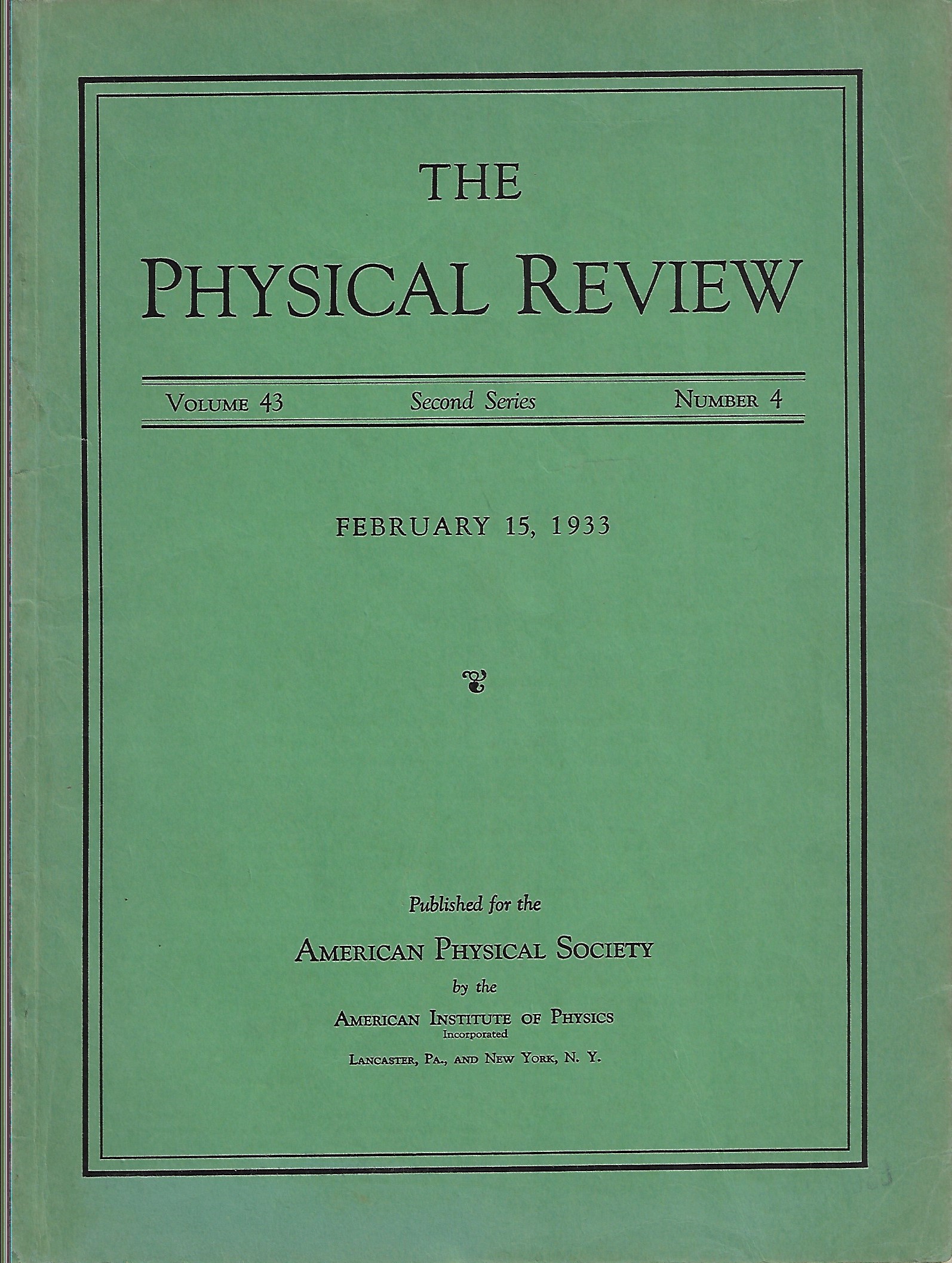
  • Eugene Wigner On The Mass Defect Of Helium Physical Review 43 No 4 Pp 252 257 15 February 1933 And With By Milt

    PR 1933 Wigner DWEugene Wigner , “On the mass defect of helium”, Physical Review 43 No. 4 pp. 252-257, 15 February 1933. AND WITH:  by Milton G. White and Ernest O. Lawrence , “Disintegration of Boron by Swiftly Moving Protons” in the same issue, pp. 304-305. Original wrappers.  Beautifully and expertly rebacked (quite seamless) with a plain paper perfectly matching the wrapper color. Wrapper edges are slightly sunned.  $195

    • “Eugene Wigner discovered that the force binding nucleons together is weak when the distance between them is great but strong when they are close together in the atomic nucleus. White and Lawrence confirm the first nuclear reaction (carried out by Cockcroft and Walton earlier in the year) with another element, Boron.”–David Wenner, author of A History of Physics, the Wenner Collection.     

    See also: Wigner, “The Neutron: The Impact of Its Discovery and Its Uses”, part of  Wigner Collected Works,  volume B / 7.

    ·Posted by :

    ·in:


  • Important Supplemental Paper in the Discovery of Morphine–in the Original Wrappers (1817)


    SERTUERNER, Friedrich.  “Ueber eins der fürshterlichen Gifte der Pfalnzenwelt, als ein Nachtrag zu seiner Abhandlung über die Mekonsäure und das Morphium; mit bmerkungen, den aciden Extractivstoff des Opiums und seine Verbindungen betreffend”  In Annalen der Physik, I/57, 1817; pp 183-202. Offered in the full volume of 440pp. Four full numbers (#s 9-12), each with their original front and rear wrapper, thus making this version quite scare. This is the important supplemental paper on morphine to the first paper just months earlier in of January 1817 in the same journal (vol I/55). $450

    On the discovery of morphine:

    “Rational drug discovery from plants started at the beginning of the 19th century, when the German apothecary assistant Friedrich Sertürner succeeded in isolating the analgesic and sleep-inducing agent from opium which he named morphium (morphine) after the Greek god of dreams, Morpheus. He published a comprehensive paper on its isolation, crystallization, crystal structure, and pharmacological properties, which he studied first in stray dogs and then in self-experiments…This triggered the examination of other medicinal herbs, and during the following decades of the 19th century, many bioactive natural products, primarily alkaloids (e.g., quinine, caffeine, nicotine, codeine, atropine, colchicine, cocaine, capsaicin) could be isolated from their natural sources”–Atanas G.Atanasova, et alia, “Discovery and resupply of pharmacologically active plant-derived natural products: A review”, Biotechnology Advances, Volume 33, Issue 8, December 2015, Pages 1582-1614.

    “(Serturner’s) determination now of the alkaline nature of morphine marks an important step in the beginnings of alkaloid chemistry. Its isolation is the first isolation of an alkali with a vegetable origin”–Claire Parkinson, Breakthroughs, p. 264. 

    Ex-libris Deutsche Akademie der Luftfahrtforschung, then Wright Patterson Field Library (USAF), then Library of Congress.  Library markings:  small gilt-stamped “Akademie der Luftfahrtforschung”, page edges stamped “Wright Field LIbrary/Dayton, Ohio” on top and bottom.

    Also in this volume:

    • CHLADNI, Ernst Florens Friedrich . “Ueber Unabhängigkeit der meteorsteinfälle und der Feuerkugeln von Jahres-Tagesseiten, von den Himmelsgegenden, von der geographischen Lage, vom Wetter und bestimmten Perioden” (“…German physicist and musician. His most important work, for which he is sometimes labeled the father of acoustics, included research on vibrating plates and the calculation of the speed of sound for different gases”–Wiki)
    • VOLTA, Alessandro. “Ueber periodische Wiederkehr von gewittern, und über den sehr kalten und ausserordentlich trockenen Wind, den man nach Hagelschauern mehrere Stunden lang bemerkt”, and many others.

    ·Posted by :

    ·in:


  • James Clerk Maxwell

    New to this list:

    • MAXWELL, James Clerk.  “On the Final State of a System of Molecules in Motion Subject to Forces of any Kind”, pp 5378. AND with: “On the Equilibrium of Temperature of a Gaseous Column Subjected to Gravity”, (letters to the editor section), p 527. Both in the same issue of Nature, volume 8, no. 208, October 23, 1873. Offered in the original weekly issue of pp 521-542. This issue removed from a larger bound volume. VG copy. $125
    • MAXWELL, James Clerk.  “Clerk Maxwell’s Kinetic Theory of Gases”. London: Nature Magazine, May 29, 1873, vol 8 # 187,  p 84 in the issue of pp 81-96. Wrappers. Weekly issue removed from a larger bound volume.  VG copy. $75

    MAXWELL,   James Clerk.  On a Real Image Stereoscope.  London:  Isaac Taylor,  1867.  The Chemical News, vol 16, #408, Sept 27, 1867  Pp 163-174  Small 8vo.  Printed wrappers.  Very good condition.  Clerk Maxwell’s article squeezes onto the bottom corner of pp 167 and runs about 400 words. This notice first appeared earlier this years as an address to a meeting of the British Association for the Advancement of Science (Section A). Maxwell was of course perhaps the leading scientist of the 19th century, and his foray into this aspect of optics produced one of the finest designs for the stereoscope.   $95

    MAXWELL,  James Clerk.  Mathematical and Physical Sciences–address to Section A of the British Association.  London:  1870.  1st edition.  Nature, vol 2, Sept 22, 1870  8vo.  Original printed wrappers.  Very good condition.  Maxwell addresses the British Association for the Advancement of Science meeting in a long (for Nature) entry of about 4,000 words, over 4 pages. We offer the entire issue of 20pp, with their very scarce original wrappers.     $225

    MAXWELL,   James Clerk.  On Colour Vision.  London:  Nature,  1871.  Nature, a Weekly Illustrated Journal of Science  Original printed wrappers.  Very good condition.  This is the entire weekly issue of 4 May 1871, offered with the original outer wrappers, the whole cleanly removed from a larger bound source. The Maxwell article occupies pp 13-16 and runs about 1500 words. $250

    The following lengthy quote is taken from the wonderful maths website at the University of St. Andrews http://www-groups.dcs.st-and.ac.uk/~history/Projects/Johnson/Chapters/Ch4_2.html

    • “Maxwell’s major paper in optics, On the Theory of Colour Vision, was presented to the Royal Society of London in 1860 and was awarded the Rumford Medal. It showed that colour blindness was due to individuals being unable to recognise red light and conclusively proved his theory of three primary colours. Most of the experiments for this work were conducted in Maxwell’s London home with the help of his wife, Katherine Mary Dewar daughter of the Principle of Marchisal College, Aberdeen. These were wonderfully constructed and made use of a colour box designed by Maxwell himself. Maxwell’s final achievement in optics was producing the first ever colour photograph. He displayed the picture of a Scottish tartan ribbon at a lecture on his colour investigations at the Royal Institute in May 1861. He took a black and white photograph through three filters – green, red and blue – and then projected and superimposed the results through the same filters. Later it was noticed that this should not have worked, as the collodion process he had used was not red sensitive. However Maxwell was lucky as the process, which was sensitive to the ultraviolet passed by the filter, compensated for the error. [Early photographic process using glass plates coated with iodised collodion sensitised with silver nitrate solution and exposed in the camera while still wet. This technique is still used by many large photograph companies to develop important film.] Maxwell’s work on colour vision, although very clever, was probably some of his least astonishing work. It was not ground breaking like his work on gases or the electromagnetic field, nor did it contain the same originality of thought. However it was easier for his contemporaries to understand and it received more recognition than some of his other works. It is merely in comparison to his greater works that this excellent combination of mathematics and experimental physics is made to look ordinary…”

    MAXWELL, James C. “Molecules”, in Nature, 1873, a very long piece (for this journal) running four pages and about 6,000 words. Removed from larger bound volume but with the original front and rear wrappers, including ads.  $225

    [MAXWELL,   James Clerk.]  Clerk Maxwell’s Electricity and Magnetism–a review by the editor of Nature.  London:  Nature Magazine,  1873.  Nature Magazine, April 24, 1873  16pp  Royal 8vo.  Printed wrappers, removed.  Very good copy.  This is Nature’s very close review of Maxwell’s masterpiece “Electricity and Magnetism…” published just the month before. It appears on only 3 pages, but the Nature pages are 2 columns of 83 lines and 12 words per line per page–so the review turns out to be fairly lengthy by Nature standards. $150

    MAXWELL, James Clerk.  “Clerk Maxwell’s Kinetic Theory of Gases”. London: Nature Magazine, May 29, 1873, vol 8 # 187,  p 84 in the issue of pp 81-96. Wrappers. Weekly issue removed from a larger bound volume.  VG copy. $75

    MAXWELL,   James Clerk.  On Action at a Distance.  London:  Nature Magazine,  1873.  Nature Magazine, 2 issues, February 27 and March 6, 1873  32pp  Printed wrappers, removed.  Very good copy.    $250

    MAXWELL,   James Clerk.  Plateau on Soap Bubbles. A REVIEW of J. Plateau’s “Statique experimentale…”.  London:  Nature,  1874.  Nature magazine, Thursday June 18, 1874.  Pp 119-138  Wrappers.  Very good condition.  Interesting and concise review by Maxwell occupying pp 119-121. Nature was a very closely-printed periodical; Maxwell’s review runs about 3500 words even though it occupies but 3 pages. +++This is the weekly issue removed from a larger bound issue of the entire year. It is the complete issue for June 18, 1874.   $135

    MAXWELL,   James Clerk.  “Grove’s ‘Correlation of Physical Forces’ “.  London:  Nature,  1874.  Nature Magazine, August 20, 1874.  Pp 299-330  Wrappers.  Very good condition.  This is Maxwell’s review of the sixth edition of William Grove’s The Correlation of Physical Forces (1874). It occupies pp 302-304 and is about 2500 words long. Also contained in this issue is Helmholtz’s appreciation of John Tyndall, occupying pp 299-302 and running more than 4000 words. +++ We are offering this weekly issue in its entirety; it is removed from a larger bound volume containing all 52 issues of the magazine.   $175

    MAXWELL,  James Clerk.  Van der Waal’s on the Continuity of the Gaseous and Liquid States. REVIEW.  London:  Nature,  1874.  Nature magazine, Thursday, October 15, 1874.  pp 475-494  Wrappers.  Very good condition.  This is Maxwell’s reviews of Van der Waal’s significant contribution and occupies pp 477-480, running about 3500 words. We’re offering the entire weekly issue of the great journal, removed from a larger bound collection of a year’s-worth of the publication.   $150

    MAXWELL, James Clerk. “Diffusion of Gases Through Absorbing Substances”, an article in the weekly issue of Nature, 11 May 1876, pp 24-24 in the issue of pp 21-40.  Very nice copy, removed from a larger bound copy.   $150

    MAXWELL,   James Clerk.  Whewell’s Writing and Correspondence (Book Review).  London:  Nature,  1876.  1st edition.  Nature, an Illustrated Weekly…vol 14, 6 July 1876  Royal 8vo.  Original printed wrappers.  Fine condition.  We offer the entire weekly issue complete with its very scarce outer wrappers. The Maxwell review is of Todhunter’s biographical account of the Whewell correspondence.  $150

    MAXWELL,  James Clerk.  Report on the Committee for Testing Experimentally the Exactness of Ohm’s Law….  London:  Nature,  1876.  Nature, an Illustrated Weekly…, vol 14, 21 Sept 1876  Royal 8vo.  Original printed wrappers.  Fine condition.  We offer the entire weekly issue, complete withj the scarce outer wrappers, removed cleanly from a larger bound volume. The Maxwell bit runs one full column but is about 500 words.  $150

    MAXWELL,   James Clerk.  Hermann Ludwig Ferdinand Helmholtz–Scientific Worthies No. X.  London:  Nature,  1877.  Nature, volume 15, March 8, 1877  8vo.  Original printed wrappers.  Fine condition.  Maxwell writes a lovely appreciation of von Helmholtz–one of the premier thinkers of the 19th century and perhaps its most outstanding polymath (with Thomas Young perhaps). Complete with an excellent steel engraved portrait. We offer the entire weekly issue of 25 pp (of which Maxwell’s effort occupies several pages and about 2500 words, in its scarce original outer wrappers, cleanly removed from a larger volume.   $175

    MAXWELL,  James Clerk.  Tait’s “Thermodynamics”. REVIEW article..  London:  Nature,  1878.  Nature Magazine, January 31, 1878  Pp 257-276  Wrappers.  Very good condition.  This is part 1 of a review of PG Tait’s great Thermodynamics by Maxwell, covering pp 257-259, running about 2500 words. This is the entire issue for the week of 31 January, removed from a larger bound volume. This also and unusually contains the very scarce cover wrappers and rear (advertising) wrappers. Uncommon thus.   $175

    [Maxwell, James Clerk] “Scientific Worthies, XVIII–James Clerk Maxwell.”  In: Nature, 27 October 1881, the weekly issue on page 601 (though a single page the article runs a tight 1500 words) with the fine steel engraved portrait of Maxwell and the article occupying pp 601-602. The article removed from the larger bound volume, with the original outer wraps and ads.  Fine condition.  $150

    MAXWELL,   James Clerk.  Theory of Heat.  London:  Longmans, Green and Co,  1916.  11th edition.  348pp  Cloth.  Very good condition.  This is the 1916 printing of the 1891 edition with the Lord Rayleigh additions and corrections. This is also in unusually nice condition for this work–generally copies from this series are usually seen pretty well used and rubbed. This copy is quite fresh. It bears the former owner’s signature on the front free endpaper and front pastedown (Raleigh Gilchrist, of the NBS) and dated 1920.  $100

    MAXWELL,   James Clerk.  Scientific Papers of James Clerk Maxwell.  New York:  Dover,  1965.  606+804pp  8vo.  Cloth, dust jackets.  Very fine condition.  Fine dust jacket.  Excellent copy of the “Squat and Sturdy” edition of the Maxwell papers–this is the second-best copy of this book that we have had for sale. $225.
    ·Posted by :

    ·in:


  • Papers by William Crookes

    Welcome to Plasma!

    CROOKES, William.  “A Fourth State of Matter”, in Nature, 17 June 1880, pp 153-4, in the weekly issue of pp 141-164.  This is the popular appearance of the article that appeared in the Philosophical Transactions for the week earlier, June 10.  Very good  copy in the original wrappers, removed from a larger bound volume.  $150

    CROOKES, WIlliam.  “Contributions to Molecular Physics in High Vacua”, in Nature, volume 22, June 3, 1880, pp 101-104.  OFFERED WITH: Crookes, “Contributions to Molecular Physics in High Vacua, II”, in Nature, June 10, 1880, pp 125-128.  Both are in their original wrappers, removed from a larger bound volumes.  Nice copies.  $150

    CROOKES, William with Lecoq de Boisbaudran.   “Radiant Matter Spectroscopy”, in Nature, July 23, 1885, pp 2183-286 in the weekly issue of pp 265-288.  Wrappers, cleanly extracted from a larger bound volume.  $100

    ·Posted by :

    ·in:


  • Raman and Krishnan on the Nobel Prize Work on the Raman Effect (1928)

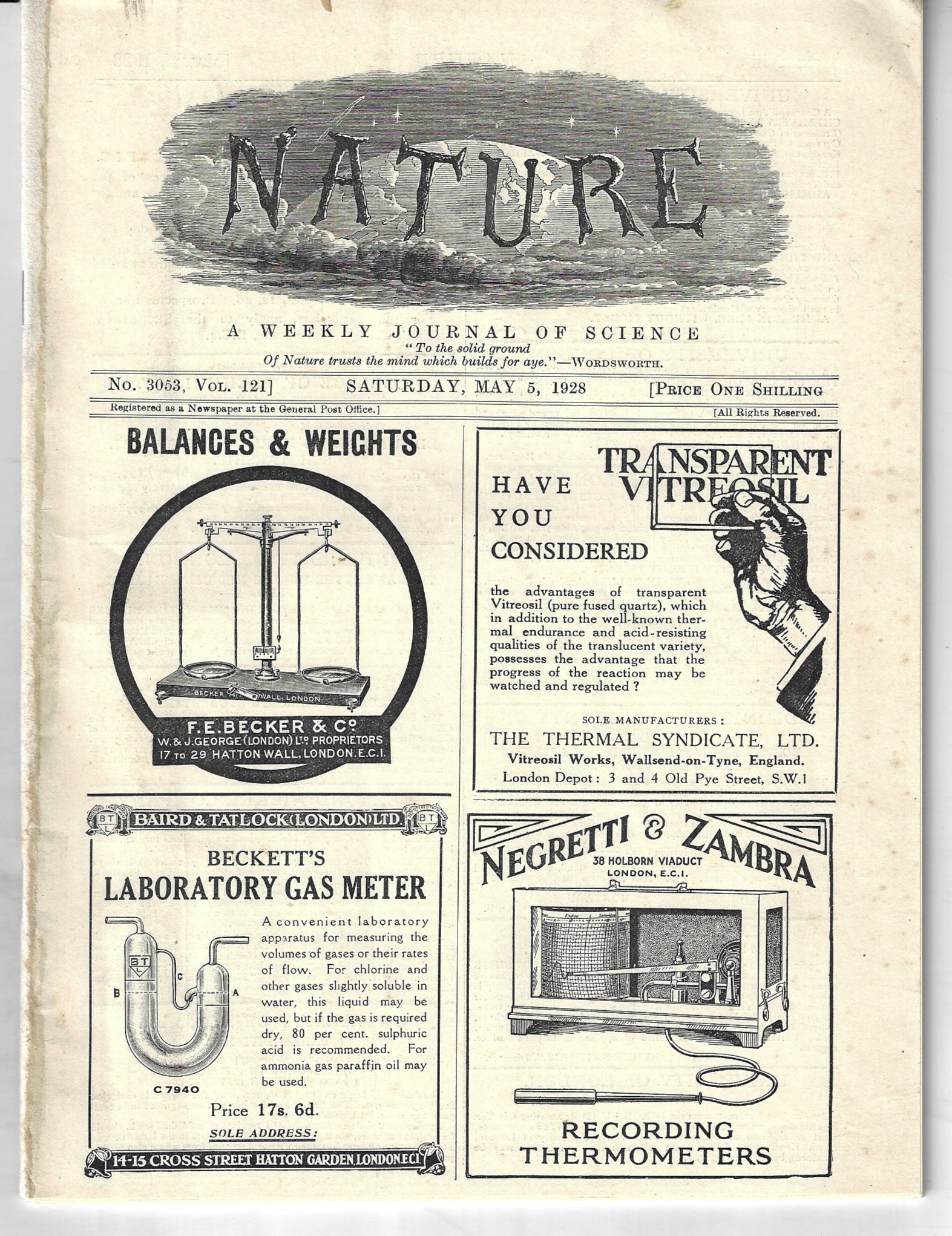
    Nature 1928 RamanC.V. Raman and K.S. Krishnan, “The Optical Properties of the Compton Effect”, in Nature, vol 121, No. 3053, May 5, 1928, the weekly issue, pp 697-736. Original wrappers, with a very fine and nearly invisible repair is made to the spine.   $200  

    In this paper Raman (1886-1970) and Krishnan return to their earlier paper of February (pg 501, “A New Type of Secondary Radiation” of Nature in which the effect which bears Ramsn’s name appears and for which Raman would be awarded the Nobel in 1930 (“for his work on the scattering of light and for the discovery of the effect named after him.”–Nobel Prize organization). “Raman and K. S. Krishnan then undertook to isolate the effect under impeccable experimental conditions. They employed complementary light filters placed in the paths of the incident and scattered light, respectively, and observed a “new type of secondary radiation” from the scattering of focused beams of sunlight in both carefully purified liquid and dust-free air. They reported this discovery in a letter to Nature in February 1928. Raman then refined the experiment by using a mercury arc as the source of light; the effect was thus clearly seen for the first time on 28 February 1928 and was reported to the Science Congress at Bangalore the following month. The secondary radiation showed several lines shifted toward longer wavelengths, the shifts being characteristic of the substances being examined, and indicated the absorption of energy by the scattering molecule—the precise effect that had been predicted by A. Smekal in 1923. G. Landsberg and L. Mandelshtam, in the U.S.S.R., independently observed the same phenomenon in quartz, shortly after Raman and Krishnan”–DSB

    ·Posted by :

    ·in:


  • The First Comprehensive Presentation of the Mathematical and Physical Ideas of Einstein (1921)

     Wolfgang Pauli. Relativitätstheorie. Sonderabdruck aus der Encyklopädie der mathematischen Wissenschaften. Mit einem Vorwort von A. Sommerfeld. Verlag und Druck von G.B. Teubner, Leipzig & Berlin, 1921. First edition. 9.75”x6.5”, pp iv, (539)-775. Paper covered boards, cloth spine. The printed cover is good and bright; the printing on the spine is mostly dulled to the point where you can barely read the title. A Very Good copy of a not-common and important, rock-solid book.  $200

    “Felix Klein was then publishing the Encyklopädie der mathematischen Wissenschaften, a monumental compilation that was to examine the current state of science from all sides. Leading scholars—mathematicians and physicists—were contributors. Klein had requested Sommerfeld to write an article on relativity theory for the Encyklopädie. Sommerfeld ventured to entrust the task to Pauli…(Sommerfeld revealed admirable courage and insight in letting a student in his fourth semester write this important article.)”

    “Pauli soon completed a monograph of about 250 pages [the book offered here], which critically presented the mathematical foundations of the theory as well as its physical significance. He took thorough account of the already very considerable literature on the subject but at the same time clearly put forth his own interpretation. Despite the necessary brevity of discussion, the monograph is a superior introduction to the special and general theories of relativity; it is in addition a first-rate historical document of science, since, together with H. Weyl’s Raum, Zeit, Materie(“Space, Time, and Matter”), it is the first comprehensive presentation of the mathematical and physical ideas of Einstein, who himself never wrote a large work about his theory.”

    “Sommerfeld was elated by this performance and wrote to Einstein that Pauli’s article was “simply masterful”—and so it has remained to the present day. Pauli showed here for the first time his art of presenting science, which marks everything he wrote.”

    “In Sommerfeld’s institute Pauli also became acquainted with the quantum theory of the atom. He wrote in his Nobel lecture:

    While, in school in Vienna, I had already obtained some knowledge of classical physics and the then new Einstein relativity theory, it was at the University of Munich that I was introduced by Sommerfeld to the structure of the atom, somewhat strange from the point of view of classical physicist, accustomed to the classical way of thinking, experienced when he came to know of Bohr’s “basic postulate of quantum theory” for the first time.”

    All of the above from the Complete Dictionary of Scientific Biography (online). 

    ·Posted by :

    ·in:


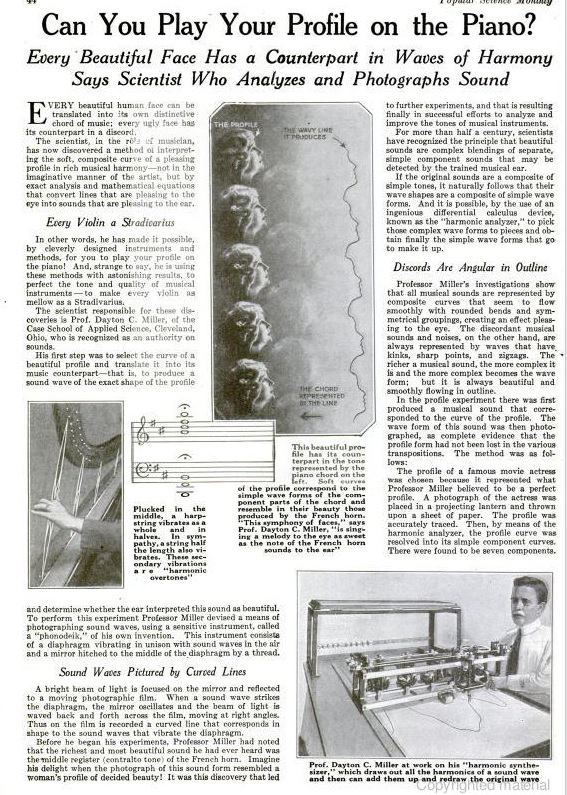
  • An Harmonic Analyzer, 1916

    JF Ptak Science Books   

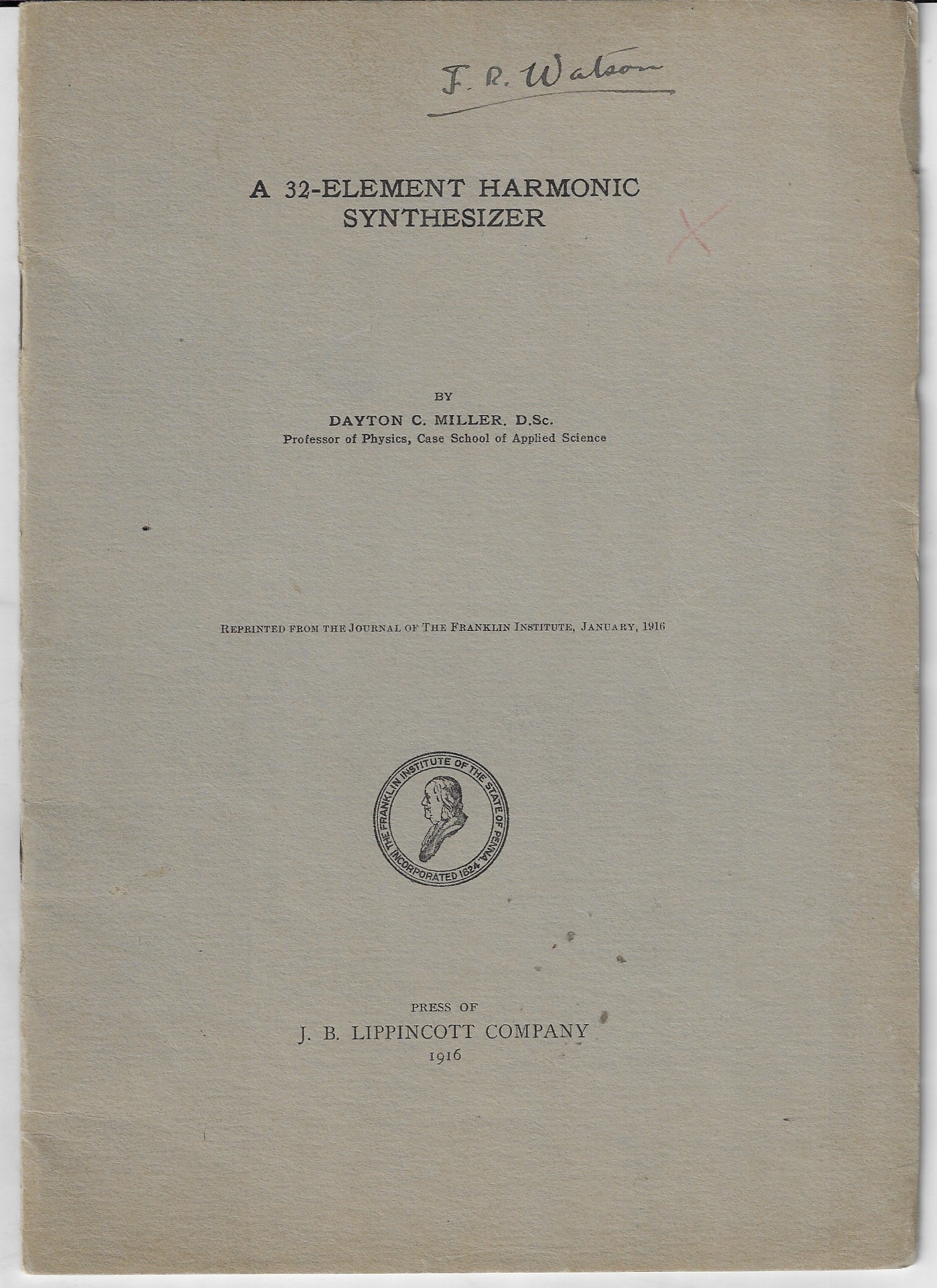
    Miller, Dayton C. A 32-Element Harmonic Synthesizer.  Offprint: Journal of the Franklin Institute, January 1916; printed by Lippincott Company, 1916. 9″x6″, pp 51-81, with illustrations.  Original wrappers. Fine condition. Original owner’s name on the front wrapper.  $150

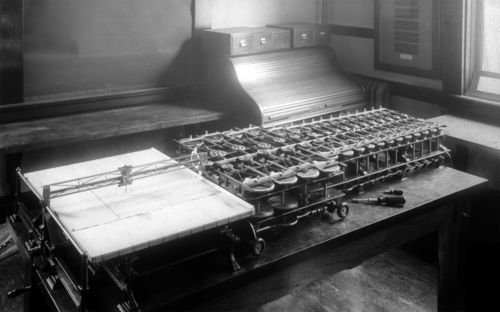
    It isn’t really an onomatopoeia, but the harmonic synthesizer at least feels like itself in the mouth as the two words are spoken. try it: h a r m o n i c   s y n t h e s i z e r.  The name does feel as though it touches the boundaries of most of the mouth, and that is basically what this analog computer does, analyzes sound, and record it in lovely waves (the plotter on the left in the photo).   http://www.phys.cwru.edu/ccpi/Harmonic_synthesizer.html

    It is also a beautiful machine. The one above is by Dayton Miller of Case Western Reserve, and it is described in a 1916 publication from the Journal of the Franklin Institute. 

    Miller harmonic analuyzer

    32_component_synthesizer

    “As described on the Case Western Reserve University website, “Lord Kelvin’s harmonic synthesizer is basically Henrici’s harmonic analyzer in reverse. Originally designed as a tide predictor in 1873, the system can combine numerous component waves—in some devices, up to 64 separate components—into a single curve. It is based on the earlier pin-and-slot device, which produces simple harmonic motion with the turn of a crank.”

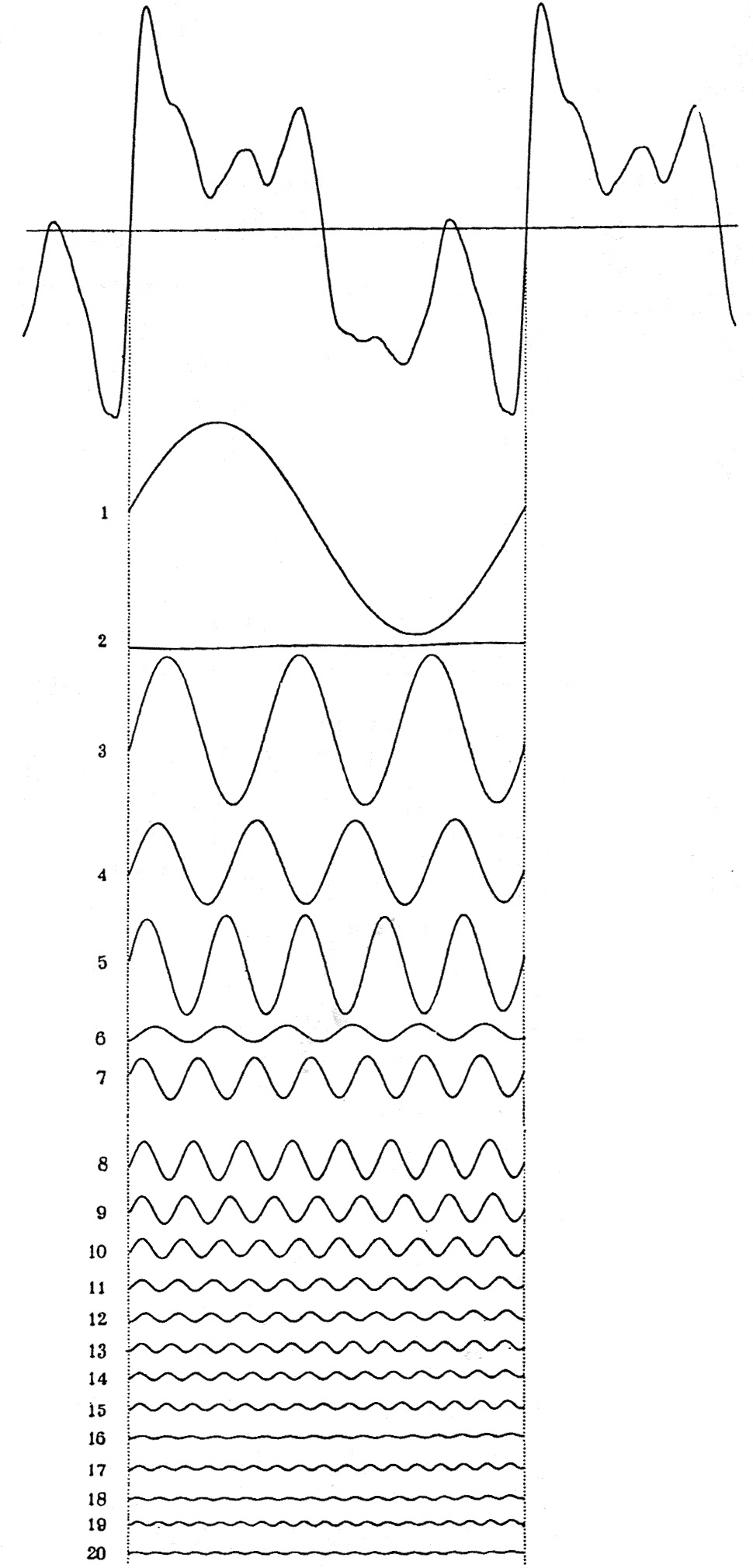
    And one of the results as it appeared on page 73 of the Journal of the Franklin Institute,  a curve representing the sound wave from a clarinet and twenty of its harmonic components: 

    32--big--Harmonic_synthesizer_diagram

    “The version used by Dayton Miller was designed and built in the laboratory and instrument shop of the Physics Dept. of the Case School of Applied Sciences. It consisted of 32 rotating pin-and-slot devices (see diagram below), each of which produced simple harmonic motion with a specified amplitude and phase; these 32 elements controlled the motion of a single cable that traced out the combined wave with a stylus and sliding drafting table. It was used by Dayton Miller to check the results produced by the harmonic analyzer against the original phonodeik curve…” http://www.phys.cwru.edu/ccpi/Harmonic_synthesizer.html

    And from the magazine Popular Science for Augusat, 1921, we find the following article:

    Dayton harmonic

    [Source:  Google Books]


    ·Posted by :

    ·in:


  • The Matter of Space, 1883


    Charles Morris. “The Matter of Space”, in Nature, in the weekly issue of  February 8, 1883. pp 349-351.

    And with A.S. Herschel’s three-part paper in support of Morris:

    • “The Matter of Space”, in Nature, March 15, 1883, pp 458-460; and
    • “The Matter of Space II”, pp 504-506 in the weekly issue of March 29, 1883, and
    • ““The Matter of Space”, issue of July 26, 1883, pp 294-7 in the weekly issue.

    “Besides meteoric astronomy, Herschel was interested in many branches of physical science, and became a member of the Physical Society of London in 1889 and of the Society of Arts in 1892. He contributed frequently to Nature,an article on “The Matter of Space” in 1883 being specially noteworthy. “

    • Together: 4 papers, as described above, all from two volumes of Nature, 1883, removed from a larger bound volume, without their original wrappers.  Very Good condition.  $125 for the group.

    “Professor Alexander Stewart Herschel (5 February 1836 – 18 June 1907) was a British astronomer.. Although much less well known than his grandfather William Herschel or his father John Herschel, he did pioneering work in meteor spectroscopy. He also worked on identifying comets as the source of meteor showers.The Herschel graph, the smallest non-Hamiltonian polyhedral graph, is named after Herschel due to his pioneering work on Hamilton’s Icosian group.”–Wiki

    [Charles Morris] “contributed frequently to Nature, an article on ‘The Matter of Space’ in 1883 being specially noteworthy.  –Dictionary of National Biography, 2nd supplement; also see his obituary in  Monthly Notices of the Royal Astronom. Soc, Feb. 1908.

    “Mr Charles Morris on the pre nebular condition of matter: Others again suppose matter to be present everywhere throughout space. This view has been ingeniously advocated by Mr Charles Morris in an article on The Matter of Space which appeared in Nature February 8 1883. The hypothesis of an ether specially distinct from matter he considers to be a gratuitous assumption and one of the last surviving relics of eighteenth century science and unless it can be proved that highly disintegrated matter is positively incapable of conveying light vibrations there is no warrant for assigning this duty to a distinct form of substance. But that matter exists in outer space in the same conditions as in planetary atmospheres he thinks is improbable. Its duty as a conveyor of radiant vibrations seems to require a far greater tensity and its disintegration is probably extreme. Assuming matter throughout the universe here as condensed spheres and there in outer space as highly rarified substance the atmospheric envelopes of the spheres he considers will gradually shade off into the excessively rare matter of mid space. “–Stellar Evolution and Its Relations to Geological Time, p. 75 by James Croll

    Also in the March 29 issue is a fine article by G.H.  Darwin, “On the Formation of Mudballs” (similar to the natural formation of snowballs). Wonderful!

    ·Posted by :

    ·in:


  • Weather Prognostics and Weather Types, 1883

    Ralph Abercrombie, “Weather Prognostics and Weather Types”, in Nature, 2 August 1883, pp 330-334 in the weekly issue of pp 313-336. Includes two charts and three weather maps. Offered is the weekly issue, removed from a larger bound volume. Nice copy. $50

    This is an abstract of Abercrombie’s paper with Marriott “On Weather Prognostics” and “On Certain Types of British Weather” for the Meteorological Society. See: Tor Bergeron, “Synoptic Meteorology: An Historical Review” in Pageoph, Vol. 119 (1980/81), Birkhauser Verlag, Basel 1981. See p 451, particularly for Abercrombie’s use of the Ley cyclone model. “It should particularly be noticed that C. Ley’s model also gives the essence of the three-dimensional structure of a frontal low as we know it to-day…In this respect his model is a true forerunner to E. Palmen’s three-dimensional model of the flow in a mature cyclone published in 1931. ..” Abercrombie also references our old friend Boys Ballot in regards to his meteorological law.

    ·Posted by :

    ·in:


  • A Pre-Foucault Gyroscope (1852) in 1818

    Johann Gottlieb Bohnenberger, “Beschreibung einer Maschine, welche die Gesetze der Umdrehung der Erde um ihre Axe, und der Veranderung der Lage der Erdaze zu erlautern dient”, in Annalen der Physik, series I volume 60, 9th section, article V, 1818 last quarter 1818.  The paper occupies pp 60-71, and is illustrated with one small figure on plate 1.  (There was an earlier publication of this article in 1817 in a very obscure journal, otherwise this is the first appearance of the invention in a major publication.) 

    Offered in the full volume 60 of the Annalen, 475pp, with three plates (including a hand-colored map). Bound together with the very scarce (pinkish) outer wrappers. Bound in half cloth and marbled boards (ca. 1935). Ex-libris Deutsche Akademie der Luftfahrtforschung, then Wright Patterson Field Library (USAF), then Library of Congress.  Library markings:  small gilt-stamped “Akademie der Luftfahrtforschung”, page edges stamped “Wright Field Library/Dayton, Ohio” on top and bottom.  Scarce item. $350

    “Johann Gottlieb Bohnenberger (1765-1831) was a Professor of physics, mathematics, and astronomy at the University of Tübingen, Germany, as well as the scientific head surveying officer of the Kingdom of Württemberg. He made not only significant contributions to introducing modern geodesy in Germany but also constructed various physical instruments. The “Machine of Bohnenberger” is considered to be the first gyro with cardanic suspension and forms the precursor of J.B.L. Foucault’s Gyroscope of 1852…”, Jörg Friedrich Wagner (University of Stuttgart), in “The Origin of the Gyroscope: The Machine of Bohnenberger”.

    And this description of the apparatus from Pike’s illustrated descriptive catalogue of optical, mathematical and philosophical instruments: 

    • “Bohnenberger’s Machine. — This apparatus (see figure 146 below) consists of three movable rings,A,B,C, mounted on a stout base. The two inner rings are mounted on pivots; those on the smallest ring at right angles to the middle one; in the smallest ring is supported a metal ball, having a roller on one of its pivots; around the roller a string may be wound, and when pulled off a rapid rotary motion may be given to the ball. This motion may be given with the axis in any position required, and when communicated, the ring supporting the ball will resist considerable effort to alter its position, and whatever way the instrument may be turned, its axis will continue to maintain the position it had when set in motion, illustrating the inertia, or that property of matter which resists any change of state, whether of rest or motion.” —Benjamin Pike, Jr. Pike’s illustrated descriptive catalogue of optical, mathematical and philosophical instruments : manufactured, imported, and sold by the author, with the prices affixed at which they are offered in 1856. Found on page 142, illustrated by figure 146 and sold for 5 bucks, which could’ve bought you a month of lodging at a decent hotel in Manhattan in 1850.


    • This volume also contains: Friedrich Stromeyer (1776-1835), “Ueber das Kadmium”, pp 193-210. This is a report on cadmium, a discovery he made at the same time as C.S. Hermann, who reported his results in the preceding volume (though in the same year) of the Annalen, in “Noch ein schreiben über das neue Metall”. Annalen der Physik, volume 59, 1818.


    ·Posted by :

    ·in: