A Daily History of Holes, Dots, Lines, Science, History, Math, Physics, Art, the Unintentional Absurd, Architecture, Maps, Data Visualization, Blank and Missing Things, and so on. |1.6 million words, 7500 images, 4.9 million hits| Press & appearances in The Times, Le Figaro, Mensa, The Economist, The Guardian, Discovery News, Slate, Le Monde, Sci American Blogs, Le Pont, and many other places… 5000+ total posts since 2008.

Book Category: Physics

  • Poincarehenri Sur Le Dynamique De Lelectron Incomptes Rendusparis 1905 Volume 140 Pp 1504 1508 Offered In The Entire

    POINCARE, Henri. “Sur le dynamique de l’electron”, in Comptes Rendus, Paris,  1905, volume 140, pp 1504-1508, offered in the entire bound volume of 1749pp for the half year.  Bound in boards and  leather spine, the spine cover nearly detached.  A good copy.  $550  (English translation found here.)

    “HENRI POINCARE’S major work on a theory of the electron is “Sur la dynamique de l’electron”.  It is considered, by some, as evidence that POINCARE, more than anyone else in the late 19th and early 20th centuries, anticipated EINSTEIN’S 1905 theory of relativity.”

    “This study will focus on POINCARE’S attempt in “Sur la dynamique…” to formulate a purely electromagnetic theory of a deformable electron that is consonant with his conception of the principle of relativity. PPoincare believed that if all physical processes could be reduced ultimately to the interaction of charged particles which move about in LORENTZ’S all-pervasive ether, then such a theory would be an important step toward a unified description of nature. Thus,  the laws of the various branches of physics, and in particular NEWTON’S second law,  could be derived from those of electromagnetism. This scientific viewpoint (or  Weltbild) will hereafter be referred to as the “electromagnetic world-picture. ”…–From the introduction of Arthur Miller’s fine study of this paper in Archive for History of Exact Sciences, Vol. 10, No. 3/4/5 (18.IX.1973), pp. 207-328, “A Study of Henri Poincaré’s “Sur la Dynamique de l’Électron”.”

    It has always seemed strange to me that Poincare never followed up on this paper, nor did he seem publicly (?) interested in Einstein’s great work of 1905; nor did Einstein show much interest in Poincare’s work on this topic (or nearly any other), and was otherwise indisposed when he was approached to write an appreciation of Poincare upon is death six years later. 

    ·Posted by :

    ·in:


  • Sound Mills (Phonometers) 1884

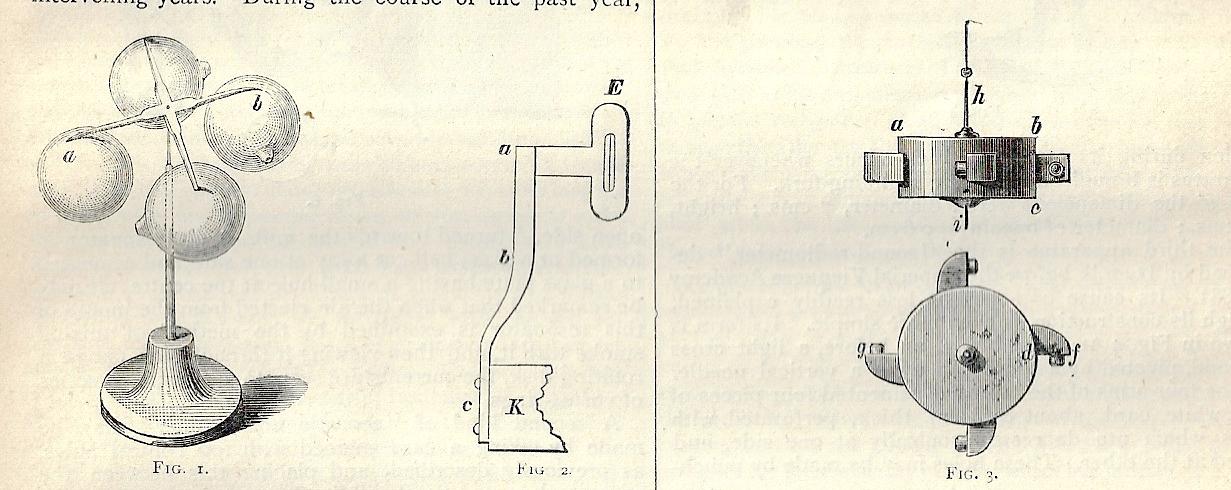
    Sylvanus P. Thompson. “Sound-Mills”  in Nature, February 14, 1884, pp 363-364, in the weekly issue of pp 353-376, and with several text illustrations. Nice copy, the weekly issue removed from a larger bound volume. Very Good.  $45

    Nature 1884 SOund mills

    The opening paragraph of the Thompson paper describes the instrument in general, and introduces the work of Dvorak:

    “After the notable researches of [Sir William] Crookes on radiation, which culminated in the discovery of the radiometer, or lightmill, it was a natural transition of thought which suggested to several minds almost simultaneously the possibility of devising an apparatus which should rotate under the influence of sound waves as does the radiometer under the influence of the rays of light and heat. Such instruments were indeed devised independently about six years ago by Lord Rayleigh, by Prof Alfred M. Mayer of Hoboken, by Mr Edison, the well-known inventor, by Prof Mach of Prague, by Dr A. Haberditzel of Vienna, and by Prof Dvorak of the University of Agram (in Croatia). These researches, though of great scientific interest, have been somewhat overlooked in the rush of scientific inventions during the intervening years. During the course of the past year, however, Dvorak has given to the world, in the pages of the Zeitschrift der Instrumentenkunde (vol. iii, Heft 4), a detailed account of his experiments, together with figures of various piece of apparatus hitherto undescribed. We propose to give a resume of the principal points of Dvorak’s researches…”

    Much of the rest of the paper describes four different Dvorak instruments.  

    ·Posted by :

    ·in:


  • Important Work by Clausius on the 2nd Law

    Clausius, Rudolf. “Ueber die Anwendung der mechanischen Wärmetheorie auf die Dampfmachine”, in: “Annalen der Physik und Chimie, Leipzig, Johann Ambrosius Barth, edited by J.C. Poggendorff, 1856, volume 97, series II, sections 3+4. pp 441-476 and pp 513-559. Offered in the entire volume of (x), 644 pp., with 5 folded engraved plates.  PROVENANCE: Provinzial-Gewerbschule zu Aachen (with their small, oval rubber stamp on the title page; then on to the Deutsche Akademie der Luftfahrtforsuchung (with their name stamped in gilt at the spine bottom); and then on to Wright Patterson Air Force Base Field, with their rubber stamp on the page edges (exterior) top and bottom. Lastly, the Library of Congress, with their “surplus” stamp on the rear endpapers. All that said, this is a nice, clean, crisp copy. VG $500

    The volume contains other significant works:

    Thomson, W. (Lord Kelvin) & J.P. Joule, “Ueber die Wärmewirkung bewegter Flüssigkeiten” (On the Thermal Effects of Fluids in Motion”, 1853),pp. 576-414. First edition in German om the Joule-Thomson Effect.

    Kohlrausch, R. “Ueber die elektrischen Vorgänge bei der Elektrolyse”, a two-part paper, pp. 397-414 and 559-575.

    ·Posted by :

    ·in:


  • Laplace on the Mathematics of Capillary Action, 1809

    Laplace, Pierre-Simone de. “Theorie der Kraft. 1.-4 Haupttheil. (1. Welche in den Haarröhren und bei ähnlichen Erscheinungen wirkt.   2. Die Wirkung der Haaröhren-Kraft auf eine neue Art Betrachtet.  3. Theorie des Anziehens und Abstossens schwimmender Körper, der Adhäsion einer Scheibe an einer Flüssigen Oberfläche, und der Figur eines grossen Quecksilber-Tropfens mit prüfenden Versuchen von Gay-Lussac. -4. Allgemeine Betrachtungen über die Haarröhen-Kraft und über die Kräfte der chemischen Verwandschaft.”) AND  “Übersetzt von Brande und Gilbert. (Mit Anmerkungen).” AND “Zwei Berichte.Als Einleitung zu dem folgenden Aufsätze.(Theil 3 und Theil 4). Frei übersetzt von Gilbert.” 

    • Each section in which the Laplace contribution is printed (sections [Stuck] 9-12 contains the two pages of outer wrappers, bound in, making this a scarce publication.  

    Published in the Annalen der Physik, series 1, volume 33, published in Leipzig by J. Ambrosius Barth, and printed  in 1809.  We offer the entire volume of  (12),452 pages and with 4 folding engraved plates, with the Laplace contributions on  pp. 1-114, pp. 141-182, pp. 273-293, pp. 293-338 and pp. 373-394. Each section is complete

    Provenance: from the Library of Bernhard Meining; then, the Deutsche Akademie der Luftfahtforschung; and on the USAAF library at Wright Patterson, and finally to the Library of Congress.  Very well traveled. Nice copy.  $500

    ·Posted by :

    ·in:


  • Georg Simon Ohm (Five Papers, 1825-1853)

    First Appearance of Ohm’s Law, May 1825

    OHM, Georg Simon (1789-1854). “Vorläufige Anzeige des Gesetzes, nach welchem Metalle die Contakteletricität leiten”,  in: Annalen der Physik, 1825, series II vol. 4, part 1, section 5, pp. 79-83. Offered in the entire volume of [12], 476 pp, with  4 folding charts, 6 engraved plates (2 folding, including one of the barometric pressures of the North Pole region and North America). Nice condition, crisp and fresh, in cloth-backed marbled boards (ca. 1940). There is a small punch/hole of about 3mm at the bottom right corner of the spine.  $1300

    This is Ohm’s first appearance in print, and the first appearance of milestone Die Galvanische Kette Mathematische Bearbeitet  (published in 1827, and which was the  fully developed presentation of his theory of electricity), known as Ohm’s Law.

    Provenance: formerly from the Library of Bernhard Meining; then, the Deutsche Akademie der Luftfahtforschung; and on the USAAF library at Wright Patterson, and finally to the Library of Congress. “Wright Field Library” is rubber stamped on the text block’s top and bottom. Very well traveled.  

    • AND bound with: LENZ, E. “Bemerkungen ueber di eTemperatur des Weltmeers in verschiedenen Tiefen”, pp 616-626.

    OHM, Georg S.  “Versuch einer Theorie der durch galvaische Krafte hervorgebrachten elektroptischen Erscheinungen”, in Annalen der Physik, 1826, series II/volume 6, section 4, part 4, pp 459-469, offered in the entire volume of (viii), 514, (ii)pp with six folding plates.  Bound in black cloth, marbled boards, and with cloth tips.  

    Provenance:  from the”Provinzil-Gewesschule zu Aachen”. then, the Deutsche Akademie der Luftfahtforschung; and on to the USAAF library at Wright Patterson, and finally to the Library of Congress. “Wright Field Library” is rubber stamped on the text block’s top and bottom. Nice copy.   

    “In February and April 1826, Ohm published two important papers that dealt separately with the two major aspects of his ultimately unified theory of galvanic electricity. The first, “Bestimmung des Gesetzes, nach welchem Metalle die Contaktelektricitä leiten, nebst einem Entwurfe zu einer Theorie des Voltaischen Apparates und des Schweiggerschen Multiplicators,” announced a comprehensive law for electric current that brought order into the hitherto confused collection of phenomena pertaining to the closed circuit, including the solution to the problem of conductibility as he and others had conceived of it.[in Schweigger’s Journal für Chemie und Physik, 46 (1826), 137–166.] The second paper, “Versuch einer Theorie der durch galvanische Kräfte hervorgebrachten elektroskopischen Erscheinungen,”[offered above] broke new ground in associating an electric tension with both open and closed galvanic circuits.” [DSB referencing  Poggendorff’s Annalen der Physik und Chemie, 6 (1826, 459–469; ibid., AND  volume 7(1826), 45–54, 117–118 in footnote 6 [offered below].

    Offered with:

    • OHM, Georg S. “Versuch einer Theorie der durch galvaische Krafte hervorgebrachten elektroptischen Erscheinungen”, in Annalen der Physik, 1826, series II/volume 7, pp 45-54  Bound as volume 6, above, with the same provenance.

    And bound with:

    • (OHM) “Ein Nachtrag aus dem vorrstehenden Aufsatz de Hrn Dr. Ohm”, same volume, pp 117-118.  

    OHM, Georg S. “Ueber die Definition des Tones , nebst daran geknupster Theorie der Sirene und oehnlicher tonbildender Vorrichtungen”, in Annalen der Physik, volume 59, 1843, pp 513-565. Black cloth-backed marbled boards with cloth tips. 

    Provenance: formerly from the library of the Deutsche Akademie der Luftfahtforschung; and on the USAAF library at Wright Patterson, and finally to the Library of Congress.  Few interior stamps, plus “Wright Field Library” rubber stamped on the text block’s top and bottom.  That all said, a very nice copy.  $400 Offered in the full volume of 644pp. 

    The Bookman’s Bus will definitely take you from point A to Point B, though it might not be a direct route, even when the direct route is the only route–there are stops to be made, turns to be taken, and of course turns to be built before they can be taken; eventually though you’ll get to your destination, or not.  And the destination can change, according to what is found along the way–it can get closer, or farther, as necessary.  It is in the getting-there that some real stuff may happen. 

    I was looking for the Annalen der Physik publication by Gauss and Weber on the first use of an electromagnetic telegraph, but I was looking in 1843 rather than 1833, which is a mistake I often make (which is weird because Morse’s telegraph appears in 1837 and his code in 1843, so the date mix-up is a mystery. So with the retrieved volume 59 I realized that I was ten years off from where I wanted to be, but like any practicing reader I browsed–and my general book browsing practice is back-to-front, which is how I found a good article by Clapeyron, almost at the end of the book in the 8th section. I went a little further to see the neighbors for the Clapeyron in the 644-page book and the very paper preceding turned out to be a fairly significant paper in the history of physics and acoustics–Georg Simon Ohm’s on what would be known as Ohm’s Law of Acoustics. That would be the other Ohm’s law.  The big Ohm (published in his pamphlet Die Galvanische Kette in 1827) is one of the most powerful of the 19th century, and states “a relationship between the voltage across an electric circuit, the electrical resistance in the circuit, and the current in the circuit.”(–Dictionary of Scientific Biography.) Ohm’s law of acoustics doesn’t take such a big bite out of the not-determined but is significant in the history of acoustics: “The proposition that the human auditory system responds to a complex sound by generating sensations of the separate components of the sound rather than a sensation of a single integrated sound; thus when we listen to an orchestra we hear the separate instruments although the ears receive only a single complex sound wave.”(–Oxford Reference)  And for the record the paper’s title: “Ueber die Definition des Tones , nebst daran geknupster Theorie der Sirene und oehnlicher tonbildender Vorrichtungen”, pp 513-565).

    There were other interesting papers populating this volume, several of which had to do with early photography, including a work on using the Daguerreotype with the microscope, along with two papers by Moser (one of which was the first German translation of his work on “Invisible Light”), and another on shortening the time of exposures by the soon-to-be-very-famous H. Fizeau. Also there are two not-so famous papers by the famous Lenz (a two-parter, actually, on heat flow). There are others, not the least of which is a paper famous perhaps not for the complicated theory on the development of mountain ranges that was wrong, but for the data that was collected for the construction of the not very good theory–that was the work of Jean-Baptiste Elie de Beaumont, who had a long and distinguished career though not for his mountain theory.  

    So. There was a lot in this volume, and a lot of it turned out to be very interesting, in spite of teh fact that I had selected the wrong volume to begin with.  

    OHM, Georg S. “Galvanische Einzelnheiten”, in Annalen der Physik, II/63, 1844, pp 389-405. Offered in the full volume of viii, 597, (ii)pp.   Black cloth-backed marbled boards with cloth tips. Formerly from the library of the Deutsche Akademie der Luftfahtforschung; and on the USAAF library at Wright Patterson, and finally to the Library of Congress.  Few interior stamps, plus “Wright Field Library” rubber stamped on the textblock’s top and bottom.  That all said, a very nice copy.  $500

    OHM, Georg S. “Ueber eine Interferenz-erscheinung bei ein axigen Krystallplatten in geradling polarisirtem Lichte”, in Annalen der Physik, 1853, series II/volume 90, pp 327-332.  Formerly from the library of the Deutsche Akademie der Luftfahtforschung; and on the USAAF library at Wright Patterson, and finally to the Library of Congress.  Few interior stamps, plus “Wright Field Library” rubber stamped on the textblock’s top and bottom.  That all said, a very nice copy.  $250

    ·Posted by :

    ·in:


  • Weighing the Earth (1799)

    Weighing the Earth in 1799

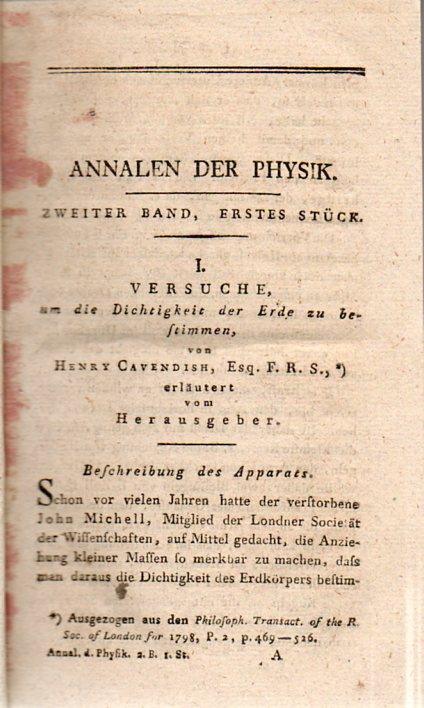
    CAVENDISH, Henry. “Versuche über die Dichtigkeit der Erde zu Bestimmen.” Halle, Rengerschen Buchhandlung, 1799, and published  in Annalen der Physik, edited by Ludwig Wilhelm Gilbert, series I volume 2,  120pp in this section, 488pp overall in in the entire volume, with 9 plates.  Cavendish’s paper occupies pp 1-62, with two plates  (with Michell’s torsion balance being examined on one of the plates).  First edition in German of this important paper.  

    Provenance:  Ex-libris Deutsche Akademie der Luftfahrtforschung, then Wright Patterson Field Library (USAF), then Library of Congress.  Library markings:  small gilt-stamped “Akademie der Luftfahrtforschung”, page edges stamped “Wright Field Library/Dayton, Ohio” on top and bottom. Contents quite nice.  $450

    Cavendish131

    In this experiment–the first appearance in German following the original paper “Experiments to determine the Density of the Earth” that appeared in the Philosophical Transactions in 1798.–the great and somewhat mysterious (and odd) Henry Cavendish determined to, of all things, weigh the Earth.  Now there are certain remarkable things to be achieved in the 18th century, and of course the idea of measuring the weight of the Earth was a high intellectual achievement.  He set off to measure the force of attraction between large and small lead balls using his dead friend John Michell’s torsion balance (which he had created in 1783), and using of course Newton’s laws showing that the force of gravity between two objects depends on their masses as well as the distance between them.  Michell had thought of the experiment years before but died before he could present; Cavendish carried on and up, and out. Mind he wasn’t the first on the spot, or the first with the idea–he was the first to complete it, though, taking the difference in the measures on the very sensitive balance from a distance using a telescope so as to not disturb the readings.  It was a lovely idea, and  a fantastic piece of work. 

    “Henry Cavendish had fitful habits of publication that did not at all reveal the universal scope of his natural philosophy. He wrote no books and fewer than twenty articles in a career of nearly fifty years. Only one major paper was theoretical, a study of electricity in 1771; the remainder of his major papers were carefully delimited experimental inquiries, the most important of which were those on pneumatic chemistry in 1766 and 1783–1788, on freezing temperatures in 1783–1788, and on the density of the earth in 1798.” (D.S.B. III, p. 155).

    ·Posted by :

    ·in:


  • Uranium- and Nuclear-Laced Volume (1939)

    [ATOMIC BOMB]  Uranium- and Nuclear-Laced Volume (1939) 

    Revue Scientifique, January-August, 1939, volume 77, numbers 1-8, quarto, 551pp. Wrappers (front and back) bound in at the rear of the volume, with supplemental ads throughout the volume. Bound in an attractive red cloth. Tidy institutional bookplate; institutional rubber stamp on first page of each monthly issue as well as one rubber stamp on wrapper covers. Fine copy, very tight and fresh. $750.

    This volume contains a couple of original articles of interest to the development of nuclear fission as well as 16 articles that are reviewed/abstracted/somewhat reprinted from other journals (in the February, March, and April issues), and when not in French written in or translated into French, which in many cases are the first translations of some of the great papers in this period of nuclear physics. The great majority are one or two columns in length.

    Included are works by Thibaud, Savitch, Joliot, Frisch, von Halban, Meitner, Feather, Bretscher, Heyn, Strassmann, Curie and others–these are rapidly published translations/reviews, in many cases coming jsut weeks after the original paper was published.  

    • Issue for February, 1939 

    VEIL, S. “Les controls chimiques de transmutations d’atomes”, p 111-112.

    And unattributed in the “echos” section:

    “La Rupture Explosive des noyaux d’uranium et de throium dans l’Action des Neutrons”. One column article on page 133, citing Fermi/Amaldi 1934, Curie/Savitch 1938, Hahn and Strassmann (Jan 1939).

    Then:

    “Un nouveau type de reaction nucleaire”, Nature, 143, 233, 1939, translated by S. Veil—this is the “introductory” statement in Nature preceding the Meitner/Frisch paper a few pages later.

    MEITNER, Lise and O. Frisch. “Disintegration de l’uranium par les neutrons: un nouveau type de reaction nucleaire”, translated by S. Veil, pp 133-4, and which appeared in Nature, 143, 233, 1939.

    JOLIOT, F and J. Perrin. “Preuve experimentale de la rupture, explosive des noyaux d’uranium et de thorium sous l’action des neutrons”, from Comptes Rendus, vol 208, 199, 341-343, and here appearing in two columns on one full page (135).

    CURIE, I. And P. Savitch. “Sur les radioelements formes dans l’uranium et le thorium irradies par les neutrons”, from Comptes Rendus, volume 208, 1939, p 343-346, and here on one full page (136).

    • The issue for March, 1939 77/3, pp (139)-218 is very interesting:

    THIBAUD, Jean and A. Moussa. “La cassure de l’uranium, la formation d’un halogene et la liberation d’energie qui en resulte”, pp 182-185.

    And then, in the “echo et information” section, which is basically a reporting section on work that was published elsewhere (though not necessarily in French), we find abstracts and announcements of a number of very significant publications:

    THIBAUD, Jean and Andre Moussa. “Sur la rupture des noyaux d’uranium sous l’action des neutrons et la liberation d’energie qui en resulte”, from the Comptes Rendus 208, 1939, pp 744-6, p 211-212.

    SAVITCH, Paul. “Sur un radioelement gazeux forme dans l’Uraium bombarde par les neutrons”, from Comptes Rendus, 208, 1939, pp 646-647, this all on a long columns on page 212.

    JOLIOT, F. “Observation par la methode de Wilson des trajectoires de brouillard des produits de l’explosion des noyaux d’uranium”, from Comptes Rendus, vol 208, 1939, pp 647-649. one and a half columns, with photo illustration.

    FRISCH, O. “Evidence physique de rupture du noyaux lourds sous bombardement de neutrons”, in Nature, 143, 1939, p 276. This 1.25 columns.

    Von HALBAN, H. and F. Joliot. “Liberation de neutrons dans l’explosion nucleaire de l’uranium”, from Nature, 143, 1939, p 470. This pp 214-215.

    MEITNER, L. and O.R. Frisch. “Les Produits de rupture du noyaux f’uranium”, in Nature143, p 471, 1939. This is all on page 215, in two full columns.

    • The issue for April, 1939: pp 186-298

    FEATHER, N. and E. Bretscher. “La Rupture Explosive des Noyaux d’Uranium”, from Nature, 143, p 516, 1939. Here occupies 1 column.

    HEYN, F. and Aten and Bakker. “Transmutations d’uranium et de thorium par neutrons”, from Nature, 143, 516, 1939. Here occupies two full columns.

    BRETWCHER, E. and L.G. Cook. “Transmutations de noyaux d’uraniumet de thorium en moyen de neutrons”, from Nature, 143, p 559, 1939. Here the work occupies a full column.

    FEATHER, N. “La duree du processis de rupture nucleaire”, from Nature, 143, p 597, 1939. Here the work occupies two columns.

    THIBAUD, J. and A.Moussa. “La disintegration de l’uranium par l;effet des neutrons et la partition de cet element”, from Comptes Rendus, 208, 652-4, 1939. Here the artcile occupies two columns on page 293.

    DODE, M. and von Halban and Joliot. “Sur l’energies des neutrons libertes lors de la partition nucleaire de l’uranium”, (no mention of origin). This is one full column on page 294. 

    • Issue for June-July 1939, pp 371-455

    COUFFIGNAL, L. reviews/abstracts/summarizes A. Einstein and L Infeld “L’Evolution des Idees en Physique”, pp 427-8

    Also for interest in the history of computer science: Nice article on Maurice d’Ocagne (1862-1938) by Louis COUFFIGNAL and Rene Harmegnies.Fe 1939, p 70 p. 67-76 Feb 1939
    ·Posted by :

    ·in:


  • Becquerel and Uranium, in English, June 1896

    [Becquerel] “Uranium”, in Nature, June 4, 1896, volume 54, pp 116-7 (in the issue of pp 97-120) being a three-paragraph note of about 500 words. Offered in the weekly issue, with the scarce outer wrappers (including 4pp of nicely illustrated advertisements including several for x-ray apparatus). This weekly issue is removed from  a larger bound volume. Provenance: Smithsonian Institution Astrophysical Observatory with their rubber stamp on the upper right corner of the front wrapper. Very Good copy.   $250

    Becquerel began presenting his results in the discovery of radioactivity of uranium (uranyl sulfate) to the Academy beginning 24 February 1896 and “[with his] last announcement, on 18 May, Becquerel’s discovery of radioactivity was complete, although he continued with ionization studies of his penetrating radiation until the following spring”.

     “Of more importance, he had shown that the power of emitting penetrating rays was a particular property of uranium. However, the implications of this second conclusion were by no means clear at the time. Becquerel characterized his own achievement as the first observation of phosphorescence in a metal. His immediate successors, G. C. Schmidt and Marie Curie, started with quite conventional views about the rays and came only gradually to realize that such radiation might also be emitted by other elements. Both then searched among the known elements, finding that only thorium was also a ray-emitter. Marie Curie and her husband, Pierre, pushed on to search for unknown elements with the same property, however, and so discovered polonium and radium. With these discoveries, the field of radioactivity (a term that the Curies coined) was fully established. Nothing that Becquerel subsequently accomplished was as important as this discovery, by which he opened the way to nuclear physics.”–Dictionary of Scientific Biography  

    This announcement in Nature 4 June is a very early English-language notice on his work on uranium. The first half of the short notice discusses Moissan with the second to Becquerel.  

    ·Posted by :

    ·in:


  • Four Early X-Ray Papers from Nature, 1896

    J.J. Thomson,  “The Rontgen Rays”, in Nature, July 30, 1896, volume 54, pp 302-306 (approximately 4500 words) in the issue of pp 289-312.   Offered in the weekly issue, with the scarce outer wrappers (including 4pp of nicely illustrated advertisements including several for x-ray apparatus). This weekly issue is removed from  a larger bound volume. Provenance: Smithsonian Institution Astrophysical Observatory with their rubber stamp on the upper right corner of the front wrapper. Very Good copy. $75

    A.A. Michelson,  “A Theory of the X-Rays”, in Nature, May 21, 1896, volume 54, pp 66-7 (about 1000 words) in the issue of pp 49-72. Offered in the weekly issue, with the scarce outer wrappers (including 4pp of nicely illustrated advertisements including several for x-ray apparatus. This weekly issue is removed from  a larger bound volume. Provenance: Smithsonian Institution Astrophysical Observatory with their rubber stamp on the upper right corner of the front wrapper. Very Good copy. $50

    Alexander Meek, “A Biological Application of Rontgen Photography”, in Nature, May 7, 1896. volume 54, page 8, with what is no doubt the first published photo of an x-ray of a starfish. Offered in the weekly issue, with the scarce outer wrappers (including 4pp of nicely illustrated advertisements including several for x-ray apparatus. This weekly issue is removed from  a larger bound volume. Provenance: Smithsonian Institution Astrophysical Observatory, with their rubber stamp on the upper right corner of the front wrapper. Very Good copy. $35

    G.G. Stokes, “On the Rontgen Rays”, in Nature, September 3, 1896, volume 54, pp 427-430 (which is somewhat longish for the journal at this time, running about 4,000 words) in the issue of pp 409-432. Offered in the weekly issue, with the scarce outer wrappers (including 4pp of nicely illustrated advertisements including several for x-ray apparatus. This weekly issue is removed from  a larger bound volume. Provenance: Smithsonian Institution Astrophysical Observatory with their rubber stamp on the upper right corner of the front wrapper. Very Good copy. $45


    ·Posted by :

    ·in:


  • Wide-Ranging Results of Work Completed by the French Academy of Sciences for 1729–

    Histoire de l’ Academie Royale des Sciences. Annee M. DCCXXIX Avec le memoires de mathematique & de physique, pour la meme annee. Tires des registres de cette academie. Printed in Amsterdam by Pierre Coup, 1733, four years after the first French edition (Paris 1729). [Histoire de l’ Academie Royale des Sciences] vii, 164pp; [Memoires de mathematique & de physique] 595pp (in two vols paginated vii,164, 256 and pp257-595, plus 27 folding engraved plates.

    16.5×9.5cm. Very nicely bound in full leather, with decorated six decorated spine panels. Fine condition.  $350

    The volumes for this issue of the meetings, experiments and communications of the French academy of Sciences include:

    In the review/Histoire section is an interesting “Sur les Machines a remonter les Bateaux”, pp 112-121;

    Mairan, J-J.D. “Nouvelles conjectures sur la cause du mouvement diurne de la Terre sur son Axe d’Occident en Orient”, pp 54-92, with 3 plates. Jean-Jacques Dortous de Mairan (1678-1771,”was a mathematician and an enthusiastic experimenter whose major works were on the formation of ice and on the aurora borealis. However, he was also interested in all the important topics addressed the scientific community in the eighteenth century, among them, the shape of Earth, light, colors, sound, the composition of matter, and vis viva (the debate around the force of moving bodies and the conservation of matter).”–DSB  

    Cl. An. Couplet (1742-1722, architectural engineer and treasurer of the French Academy of Sciences, and son of former Academician P. Couplet)

    “…stdides frictionless systems…deriving (with extraordinary elaboration) a set of [11] theorems and corollaries from fundamental propositions…” This is one of two major papers delivered by Couplet in the Memoires that “[took] a remarkable step forward from de la Hire and Belidor”, so states Edoardo Benvenuto in the chapter “First Theories About Statics of Arches and Domes”, in An Introduction to the History of Structural Mechanics:, pp 339-340.

    Couplet, C. “De la Poussee des Voutes”, pp 107-163, with 5 folding plates.

    Louville, “Sur la Theorie des Mouvemes Varies’, pp 213-256;

    Nicole, ‘Traite es Kignes du troisieme Ordre ou des Courbes du Seconde Genre”, 272-310;;

    Hunauld, “Observations sur la structure et de l’action des quelques muscles de doigts”,  346;

    Molieres, l’Abbe “Probleme Physico-Mathematiques, dont la solutio tend a servir de Reponse a un des Objections de M. Newton contre la possibilite des Tourbillons calesses”, p 333-346. “Privat de Molieres [1676-1742, physicist and mathematician, member of the Royal Academy, and professor at the College Royal] was one of those who most vigorously opposed the introduction into France of Newton’s theories of gravitation , to which he opposed the Cartesian conception of planetary movements. Subsequently, in a series of memoirs and articles published by the Academy of Sciences and Trevoux’s Journal , he tried to reconcile the two systems by using Malebranche’s ideas on vortices or “small vortices.” –Wiki

    Maupertuis, ‘Sur quelques affections des courbes’ (reflecting on the theory of curves);

    Rene Antoine de Reamur (1683-1757), “Second mémoire sur la porcelaine, ou suite of the principes qui doivent conduire dans la composition des porcelaines de différents genres etc.”;

    Réaumur, “Quelle et la Principle cause d’alteration de la blancheur des Platres des batimens neufs” (on why the whiteness of the stone facades of new buildings do not stay that way);

    Henri Pitot, “Comparison entre quelques machines mues par les courants des Fluides…”, which is an interesting section on the blades of paddle wheels and other machines utilizing water power;

    And as usual set throughout the work are three works by Cassini on astronomical observations and eclipses…

    ·Posted by :

    ·in: