JF Ptak Science Books LLC Post 156
Today we make a handy little post on understanding some of the rudimentary and occasionally fickle meanings of the feelings and emotions associated with flowers–otherwise known as the Language of Flowers. I post this without editorial comment. Perhaps it will be useful to someone. ALSO: there is a reverse index of emotions:flower in part two of this post.
Abatina Fickleness
Abecedary Volubility
Acacia Secret, chaste love
Acalia Temperance
Acanthus Art
Aconite Misanthropy
Agrimony Thankfulness
Almond Promise
Aloe Grief
Althea, Frutex I am deeply in love.
Amaranth Immortality, or piety.
Amaranth (Globe) Immortal love
Anemone Fading hope.
Angrec Royalty
Apple-blossom Preference
Arbor vitae Everlasting friendship.
Auricula, Scarlet Pride. You are proud.
Bachelor’s button Hope in love.
Balm I long for your society.
Balsamine Impatience; or, pray come.
Bay Leaf I change but in dying.
Bay wreath Glory
Bee orchid Industry
Bells of Ireland Luck
Bird’s foot trefoil Revenge
Box Constancy
Broom Humility
Bulrush Docility
Buttercup Riches
Cabbage Profit
Category: Mythology
-
Language of Flowers
-
The Mermaid–Not Exactly a Disney Creature, 1822
JF Ptak Science Books LLC Post 155
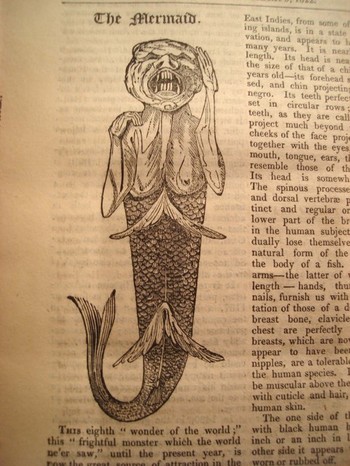
Contrary to common belief and image saturation, the Mermaid was not
exactly a cuddly, whimsically enchanting, luxuriously beautiful
creature, as this woodcut from the British The MIrrour (1835) magazine
attests. The mermaid is old and world-wide, but in British
storytelling, it is mostly an ominous creature, creating havoc,
provoking doom and destruction, and perhaps even devouring ships (as
they could be enormous in size, 150 feet and up). The syrienic
beauties of John Waterhouse and Frederic Leighton et al,
with beauty and intrigue dripping from their brushes, had little to do
with most of the legends of these creatures. This is one of the most
fascinating of these images that I’ve seen–in a pitched battle between
The Kraken and this 150′ mermaid, I think that the she-demon would win.
-
Beautiful Title Pages 6: Losing Your Head—St. Denis and the Cephalophoric Title Page
JF Ptak Science Books LLC Post #90
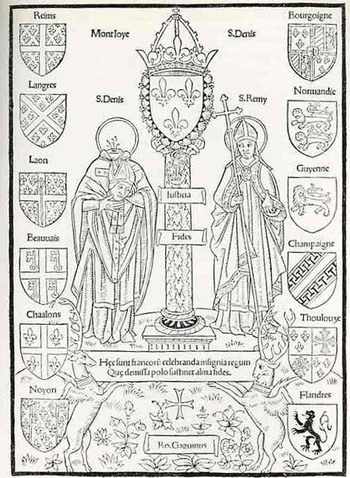
Robert Gaugin (1433-1501) produced this fabulous illustration for his Compendium de origine et gestis Francorum, a 180-leaf history of France, printed in Paris in the second week of 1500. (This is actually the fourth edition of this work which first appeared in the year 1495, which would officially make it incunabula.)
St. Denis and St. Remy are pictured here standing on either side of a column supporting the fleurs-de-lys, and surrounded by the coats of arms of various French cities and provinces.
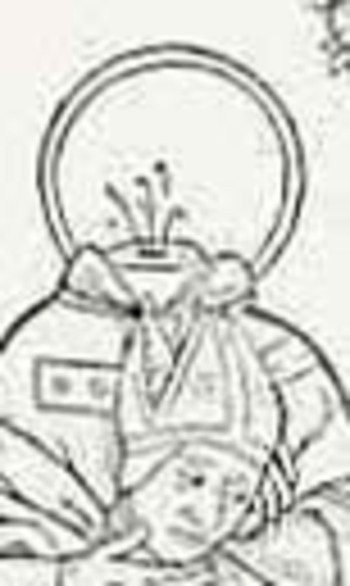
So far as I can limitedly determine this is the first title page featuring a headless, or decapitated, human. And that human is St. Denis of Paris, also called Dionysius, Dennis and Denys, the third century bishop of Paris who was martyred about the year 250. It is said that after being beheaded by the Romans at the highest point in the city of Paris (now known as Montmarte, “mount of the martyr”), Denis picked up his head, held it in his hands, and walked two miles in this fashion, preaching all the way.St. Denis however was not the only beheaded person to carry his head, nor was he anywhere near being the only saint to do so. As a matter of fact there is an entire category of saints who carried their heads following beheading, called Cephalophores. This special class of saints
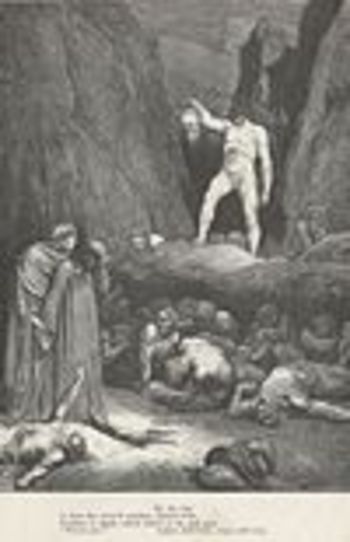
include Paul of Tarsus, Saint Ginés de la Jara, Saint Gemolo , Aphrodisius of Alexandria, (pictured below) Nicasius of Rheims, Cuthbert of Lindisfarne and Oswald of Northumbria, while others of this category though not saints include Lucian of Beauvais, Nectan, , Osyth, Quiteria, Winefride and Wyllow. Cephalophores also make many appearances in literature, most notably in Dante’s Inferno (8th Circle, Bertrand, pictured left)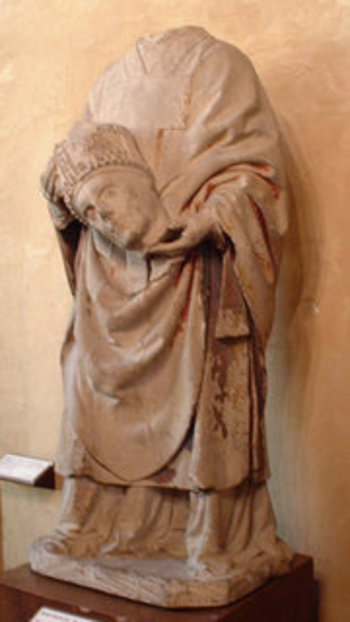
) and in Sir Gawain and the Green Night.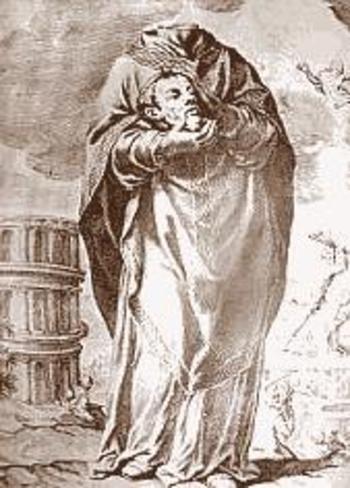
But none I think appear on a title page of a book earlier than this 1500 example of St. Denis.
As a very occasional note, St. Denis is pictured here with one halo–sometimes he has two.
-
The Big Cycle—the Beginning and the End of the World and the Weight of All Things, Depicted 1445-1550.
 JF Ptak Science Books Post #82
(1) The End
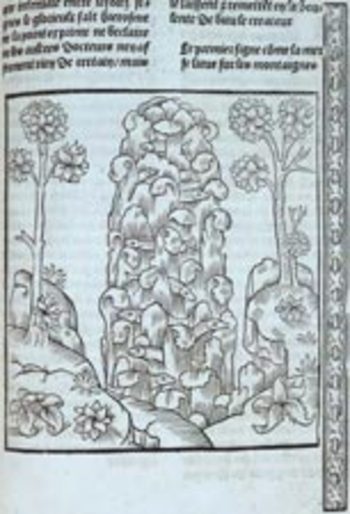
I came to this post through the interest in an image that shows life as we know it in its very last teetering stage, at the crystalline moment just before the bullet hits the bone, just before the wave breaks, just before the shade swallows the light. The image is incredible, seemingly far beyond the reach of the 15th century, far above its naïve absolutism, showing a tower of water, the oceans risen from their depths and towering over the mountains, just before the cascade and inundation begins. It is by Antoine Vérard and was published in 1493/4 in André Bocard’s (b. 1453) L’Art de bien vivre et de bien mourir . Those little poking-out bits are indeed fish, the sign of life and the aymbol for Christ in that unimaginable column of Earth-killing water, one of the Christian indicators that the Judgment Day was near. Actually I think that we’ve moved far beyond Judgment at this point, and that the print shows the watery effectuator of the warnings and promises heaped down on the readers of Revelations and Apocalypse, among other things.
(2) The Beginning
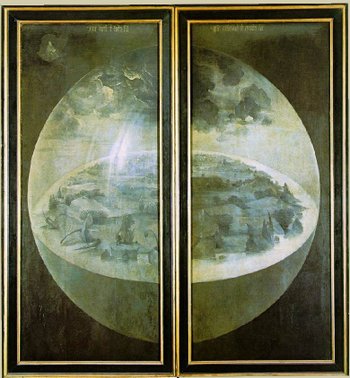
I love this painting by Bosch showing the creation of the universe , mainly because we associate the hyper-imaginative old man (Bosch, not God) with dripping and dire images of the other end of the space time continuum. This view of the cosmos is quiet and benign—Bosch to me seldom *waits* for things to happen, as in this painting, which seems all about anticipation and possibility. The canvas is empty, quite unlike the very full, kinetic, no-time-for-reflective-action images that we usually associate with this painter.(3) The Beginning of the Beginning and the Beginning of the End.
The Bible is a relatively long book, but the space between creation and the (quick?) ultra-final desiccation of Paradise happens in such short word-distance from one another that you can barely get comfortable in your chair before the race to the end begins. (My wife Patti Digh says that this action is so quick because we need forward action in the telling of the story—we need the wolf to make Little Red Riding Hood more interesting.)
The painting, Creation of the World and Expulsion from Paradise, is by Giovanni di Paolo, and was completed in 1445.
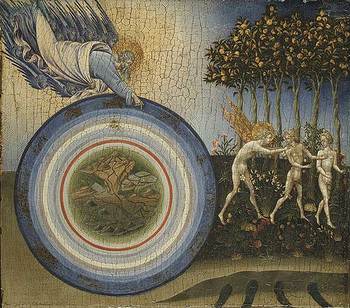
The expulsion part was particularly gloomy for all non-human things because, as I am told, it is from this point (day?) forward that animals no longer live in harmony with one another, and that their vast majority is made to eat each other, consuming each other for energy sources, in a vast, incredible orgy of killing and death. That’s quite a price to pay for human insouciance. It seems to me that if you added up the weight of everything on earth that killed other living things for energy versus the weight of everything else gaining energy from the sun or chemically or whatever, that the later would compose only a fraction of the killers’ weight. (As Gus McRae says in Lonesome Dove,”the Earth is just one big boneyard”.One interesting part of this painting is di Paolo’s depiction of the nine spheres of creation, which he depicts in eight. (The earth at center, followed by the elements water, air, and fire, then the moon and planets, then the fixed stars with signs of the zodiac, the primum mobile and finally the undefined Empyrean heaven, the place where God and all of its components sit. Perhaps di Apolo felt that he could not contain the Empyrean, and so left it unbounded.
(4) The Cycle of Cosmic Life
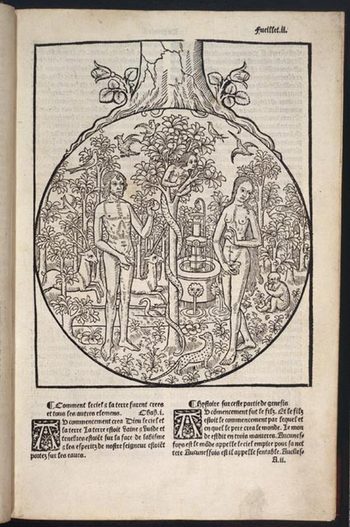
This interesting woodcut by Antoine Verard in his French Bible of 1517 shows Adam and Eve in the Garden in the opening moments of Genesis, its incubating sphere seemingly at the root of a great tree, which, for all of its great beauty, seems backwards. Perhaps the message would be different if you put the Garden at the top of the tree, the tree of life; having the garden and its quick demise (where did the garden “go”, anyway?) seems to symbolize death at the root of all that followed the expulsion, as great trees all wind up lichen-bait at some point.(5) The Cycle of Life on Earth
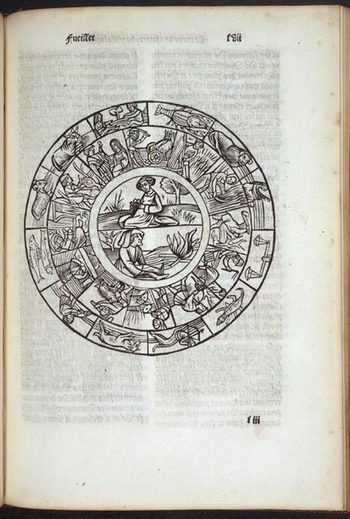
This wonderful woodcut from Jean de la Garde’s The Heart of Philosophy (1504)—an amalgam and witches brew of hermetic and astrological texts and conjectures—and is perhaps the most brilliant of the sixty-two woodcut illustrations in the wide-ranging, over-reaching book. The complex message here shows the influences of the earth and cosmos on the life of humans, the astrological signs and symbols of the seasons and etc. all bearing down very hard on the flower in the lap of the woman at the center of it all. It just seems so odd that there should be so much forebearance and such an extraordinary concentration of effort to be brought to bear against a solitary womb. With all of that reigning down on us, I wonder how it is that we are expected to breathe?