A Daily History of Holes, Dots, Lines, Science, History, Math, Physics, Art, the Unintentional Absurd, Architecture, Maps, Data Visualization, Blank and Missing Things, and so on. |1.6 million words, 7500 images, 4.9 million hits| Press & appearances in The Times, Le Figaro, Mensa, The Economist, The Guardian, Discovery News, Slate, Le Monde, Sci American Blogs, Le Pont, and many other places… 5000+ total posts since 2008.

Category: Biology

  • The Old is New Department: Refuting Darwin with Commas, Adjectives, and the Creator (1873)

    JF Ptak Science Books    Post 1423
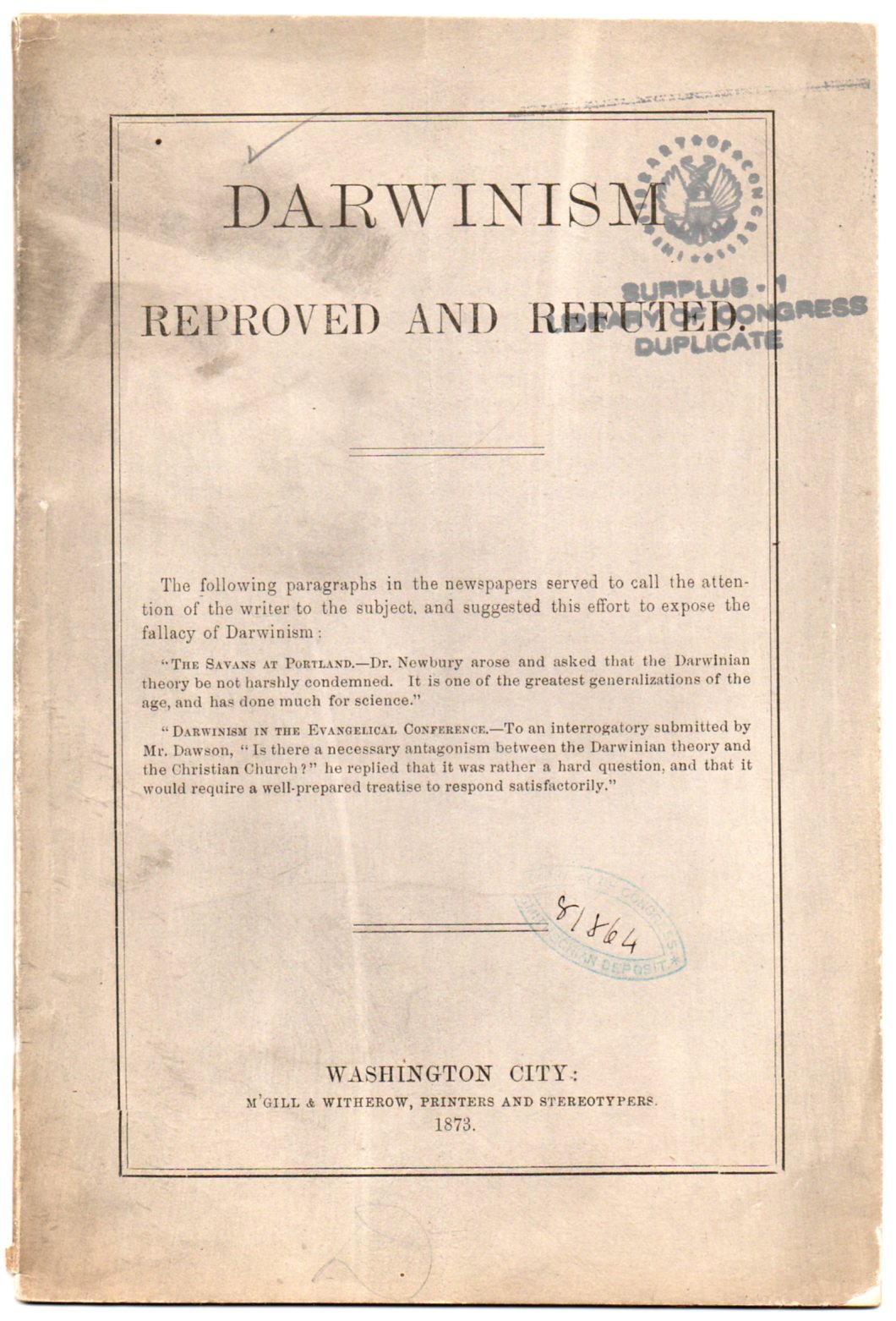
    Darwin refuted296 I wasn’t going to write anything at all about this pamphlet, but the vocabulary was so strong and vehement, and reminded me so much of what we can read in today’s daily press, that I thought to at least pick out some of the choice morsels. 

    Darwinism Reproved and Refuted, published in Washington D.C. in 1873, is left without any attribution to the author, the writer not caring to sign his/her name, not even to use as the wood into which some shingle with a weak social sciences/psych/religious Ph.D. could be nailed.  It is just left to the imagination or indignation that the writer didn’t or couldn’t feel confident enough to actually sign their work.  It is also one of hundreds if not thousnads of anti-Darwin vehemence–there is a chance I guess that there were more of these things written than there are visible-to-the-naked-eye stars in the night sky.  (The original pamphlet is available at our blog bookstore.)

    The author has little room for Mr. Darwin’s work1, clearly on a super-rant over The Descent… and on the theory of evolution, using such colorful words in runny purple prose like “\repugnant, revolting, unsophisticated, outrage, deadening influence, peculiar, fallacious, cunning”–and this coming from the first two paragraphs.  Needless to say, even though  the writer was too weak to sign their name, they did have some strong opinions. 

    “Utterly false, radically and fundamentally wrong, futile in the extreme, unreliable, ungrounded, false, short-sighted (in relation to god), ridiculous…” continues the author. The endowments of the Creator stuff doesn’t work its way in until the third page, when the adjectival and adverbial assault was already on it way, all without the assistance of any scientific counterexamples–but then the rest of the work is dedicated to proving the godless nature of Darwin’s work and its escape from scientific reality.

    We find this:  “Evolution is founded on materialism, which is another term for atheism”….”let this doctrine be compared with the Mosaic account of creation, and then the student of nature determine if he will choose for his progenitors Darwin’s pair of ring-tailled [sic] monkeys, or ‘Adam…’ “

    And so that’s what we get to in the refutation:  the Creator.  Old version of a contemporary complaint to get Darwin tossed out of classrooms to protect the youth of America, replacing it with divination.  The author writes:  “In the investigation of nature which is the proper province of the scientist, the most effectual method of studying it, in order to render this subject clearly intelligible to the human mind, is to regard the economy of nature as a form of government, having God for its founder, its Supreme Ruler, and Law-giver.”

    There’s not too much one can do with that, and even though it sounds antique, isn’t necessarily so, because the philosophy exists today, only with fewer commas. 

    Notes:

    1.  By 1873 Darwin already had produced an epochal body of work, including but not limited to On the Origin of Species by Means of Natural Selection, or the Preservation of Favoured Races in the Struggle for Life (1859),  On the various contrivances by which British and foreign orchids are fertilised by insects (1862), On the Movements and Habits of Climbing Plants  (1865), The Variation of Animals and Plants under Domestication (1868), The Descent of Man, and Selection in Relation to Sex (1871), and  The Expression of Emotions in Man and Animals (1873)

  • An Uncomfortable Caricature: Darwin, the Descent, and the ASPCA (1871)

    JF Ptak Science Books  Post 1422

    Darwin cartoon  bergh294

    Poor Mr. Bergh.

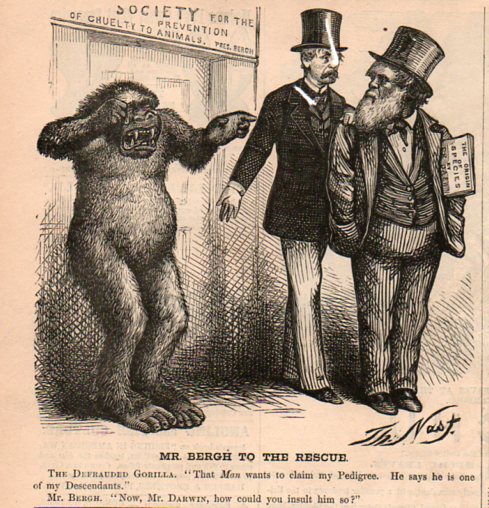
    I wonder what his reaction was to appearing in this 1871 Harper’s Weekly cartoon by the great and indomitable Thomas Nast, linking him in a terrible and probably inscrutable way with the man of the century? 

    Henry Bergh was the founder of the American Society for the Prevention of Cruelty to Animals (mainly I think in response to the treatment of work horses and the campaign for anti-sweating rules), and he is grabbing Darwin’s shoulder to remind the old man that in the shadow of the publication (earlier that same year) of The Descent of Man, and Selection in Relation to Sex (twelve years after the first edition of the Origin, and two years after the appearance of the Origin in its fifth edition) that a great harm was being done to the weeping gorilla.  Weeping because he was upset at being coupled with Darwin, weeping with the insult that someone such as Charles Darwin could be associated with him, with Mr. Bergh gently but firmly pointing out to Darwin that by connecting himself with the gorilla that he was doing a grave injustice to the gorilla.  (The original is available on our blog bookstore.)

    Darwin cartoon  bergh295
    Of course Darwin didn’t use a gorilla in the Descent, but no matter–it was a quick work by Nast and it contained enough of the stuff of some truth to reach publication.  Nast after all usually produced two of these small sketches plus a full-page work every week, and would do so for decades.  He got his point across–and it was a point shared by many, not the least of which/whom was The Times.

    The Times of London gave such an awful review of the book that a review of this review was published in the April edition of the British journal Nature1.   It was Thomas Stebbing who wrote the response to The Times‘ inciteful, hateful attack upon the Descent of Man. The Times saw Darwin’s work as an attack upon society,  accusing him of undermining authority and principles of morality, opening the way to “the most murderous revolutions”.  A “man incurs a grave responsibility when, with the authority of a well-earned reputation, he advances at such a time the disintegrating speculations of this book.” Stebbing’s review of the review is drippingly sarcastic, pointing out obvious errors in specific and the tone of the article in general in the defense of the book. Darwin’s “facile method of observing superficial resemblances” (says The Times) incites Stebbing to issue the following: “they may fancy that truth is worth discovering , even when it seems to involve some contradictions to our pride and some loss of comfort to our finer feelings…” (What a great line!)

    And so Thomas Nast piled on, though I’m not sure if he had a personal opinion on the matter–I prefer to think of Nast as rather forward thinking, at least in terms of more-correct thought on Indians/women/Blacks/the KKK/public education/government corruption, though he did have his failures in regards to the Irish, Catholics in general, the Pope, and some other areas2.  Nast may have just been reporting on public sentiment, or maybe not.  He at least doesn’t depict Darwin in a physically abusive manner like so many others, though Darwin does appear a little on the stubby side. 

    But getting back to Bergh–I have my doubts that he would’ve been entertained by being depicted so.  As I said, he founded the ASPCA, and also founded the American Society for the Prevention of Cruelty to Children.  He inherited a fine family fortune, and put it to good use.  He died at home, 429 5th Avenue (around 38th St and 5th, just a couple of blocks from where the NYPL would be) in 1888.  I hope he didn’t care; I doubt Charles did. 

    NOTES

    1. Nature,  1871, volume 3, 20 April 1871.

    2. He hated Gen. George McClellan so far as I can tell, which gives him an “A” rating in my book.
     

    ·Posted by :

    ·in:

    —