A Daily History of Holes, Dots, Lines, Science, History, Math, Physics, Art, the Unintentional Absurd, Architecture, Maps, Data Visualization, Blank and Missing Things, and so on. |1.6 million words, 7500 images, 4.9 million hits| Press & appearances in The Times, Le Figaro, Mensa, The Economist, The Guardian, Discovery News, Slate, Le Monde, Sci American Blogs, Le Pont, and many other places… 5000+ total posts since 2008.

  • Books as War Booty, 1918

    JF Ptak Science Books   Quick Post

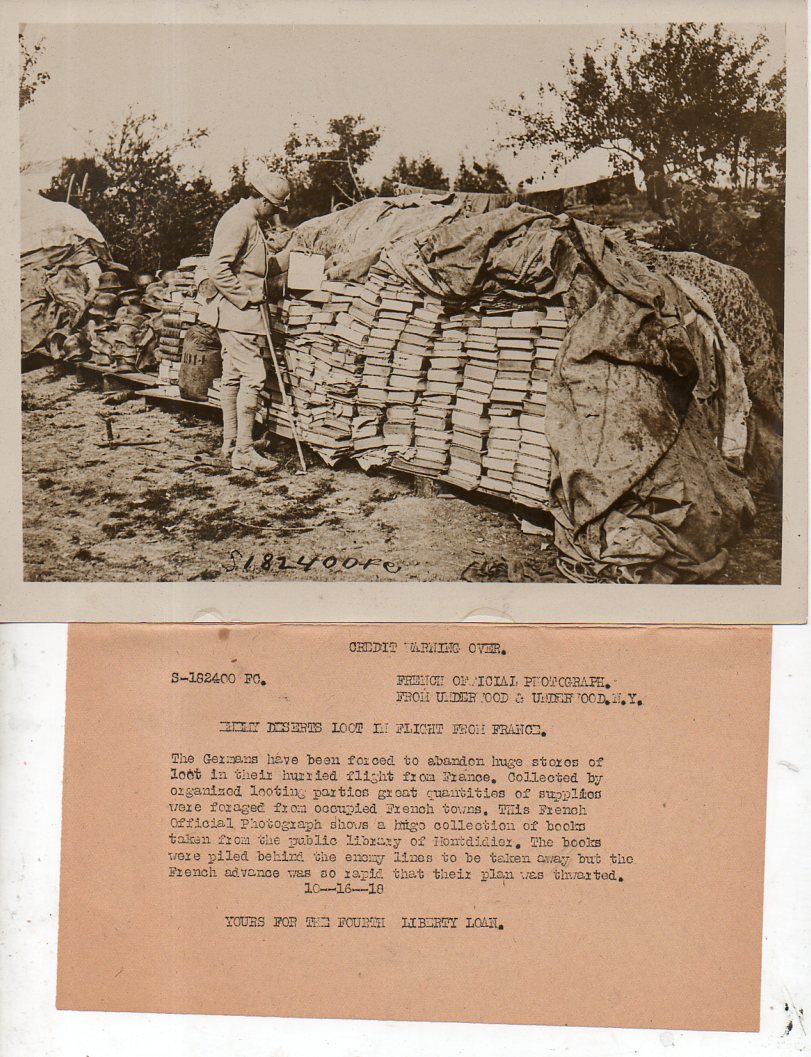
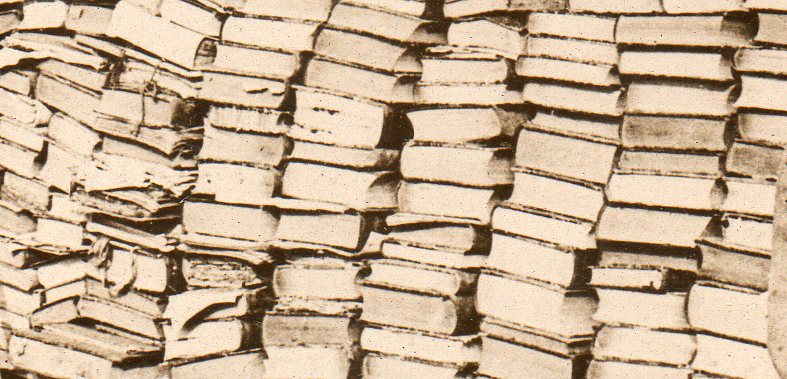
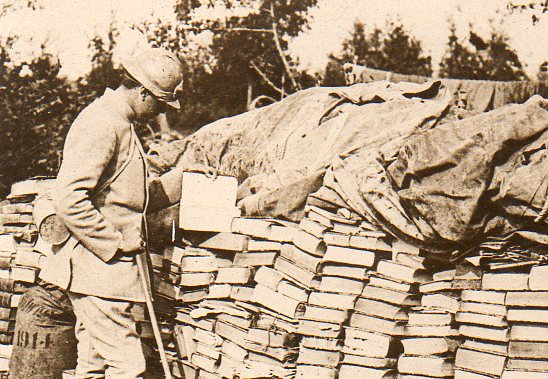
    In the vast caches of loot taken during the course of war I suspect books have ranked somewhere in the middle of stolen stuff–no doubt some fine libraries have disappeared, though I can’t offhand say how many fine libraries emerged from the slaughterhouse.  This photograph–a wartime news photo service image–is one of the few that I have seen depicting the capture of stolen books. The image:  9×7 inches, including the original text that came with the photo for the use of captioning it.  Good condition.  $175


    WWI photos--looted books113

    ANd a moderate detail:

    WWI photos--looted books112xcxc

    WWI photos--looted books111

    ·Posted by :

  • Mundane Images of War Necessities–Found Bullets

    JF Ptak Science Books

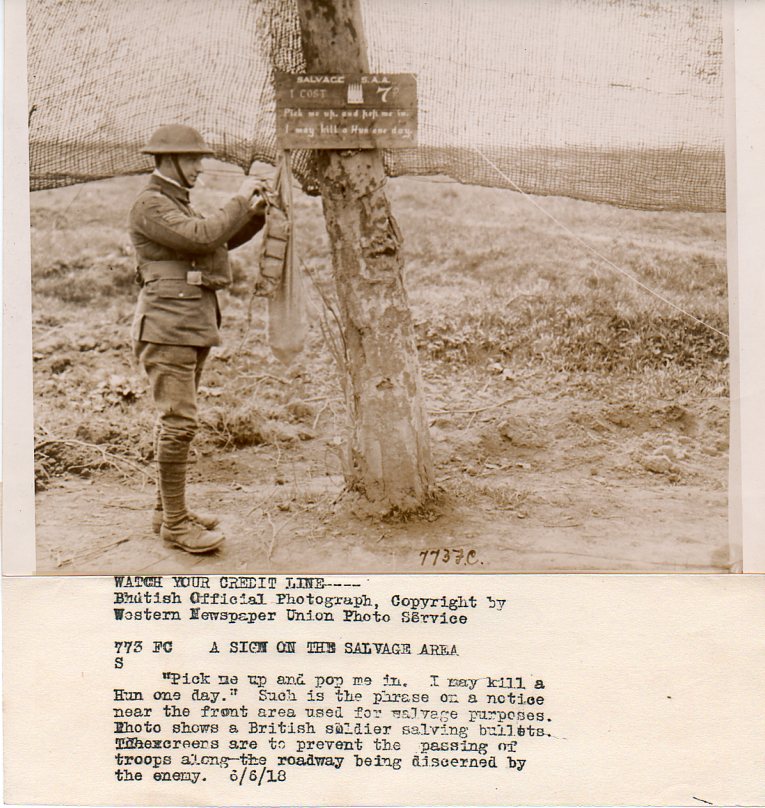
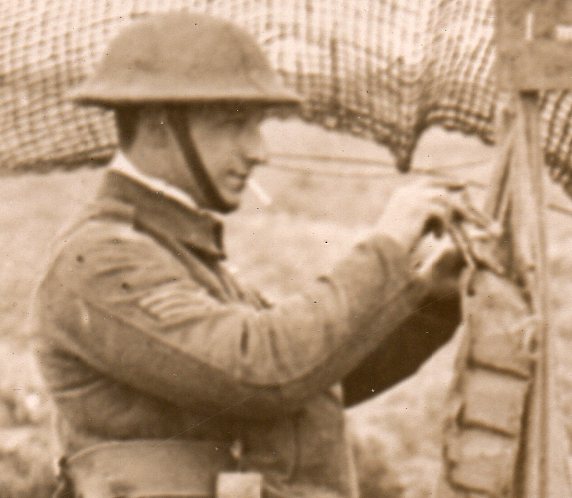
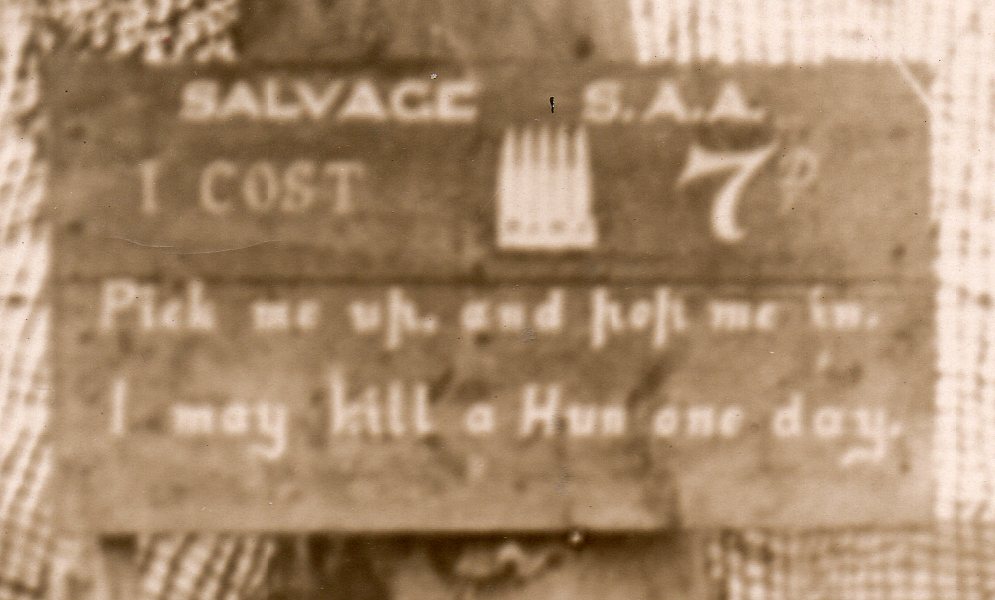
    A little went a long way, sometimes, in collecting the ends and bits of a campaign or a retiring column or from the attics and basements of village houses, or in scrapyards or dustbins or abandoned yards and buildings. Scrap has sometimes contributed greatly to major war efforts; and sometimes it has contributed just a few hundred rounds of ammunition, gathered from the sick or dying or forces on the move, that have told the tale of change in battle.  When you can only carry so much in a campaign where shooting can be an endless process, you can by definition never really carry enough bullets when you’re already carrying enough of everything else.

    Original photograph, 1918.  8×6 inches.  Good condition.  $225.


    WWI--salvage719 
    WWI--salvageb720

    WWI--salvagec721

    Comments

    Feed You can follow this conversation by subscribing to the comment feed for this post.


    Verify your Comment

    Previewing your Comment

    This is only a preview. Your comment has not yet been posted.


    Working...
    Your comment could not be posted. Error type:
    Your comment has been saved. Comments are moderated and will not appear until approved by the author. Post another comment

    The letters and numbers you entered did not match the image. Please try again.

    As a final step before posting your comment, enter the letters and numbers you see in the image below. This prevents automated programs from posting comments.

    Having trouble reading this image? View an alternate.


    Working...

    Post a comment

    Comments are moderated, and will not appear until the author has approved them.

    Your Information

    (Name is required. Email address will not be displayed with the comment.)


    This weblog only allows comments from registered users. To comment, please enable JavaScript so you can sign in.

    ·Posted by :

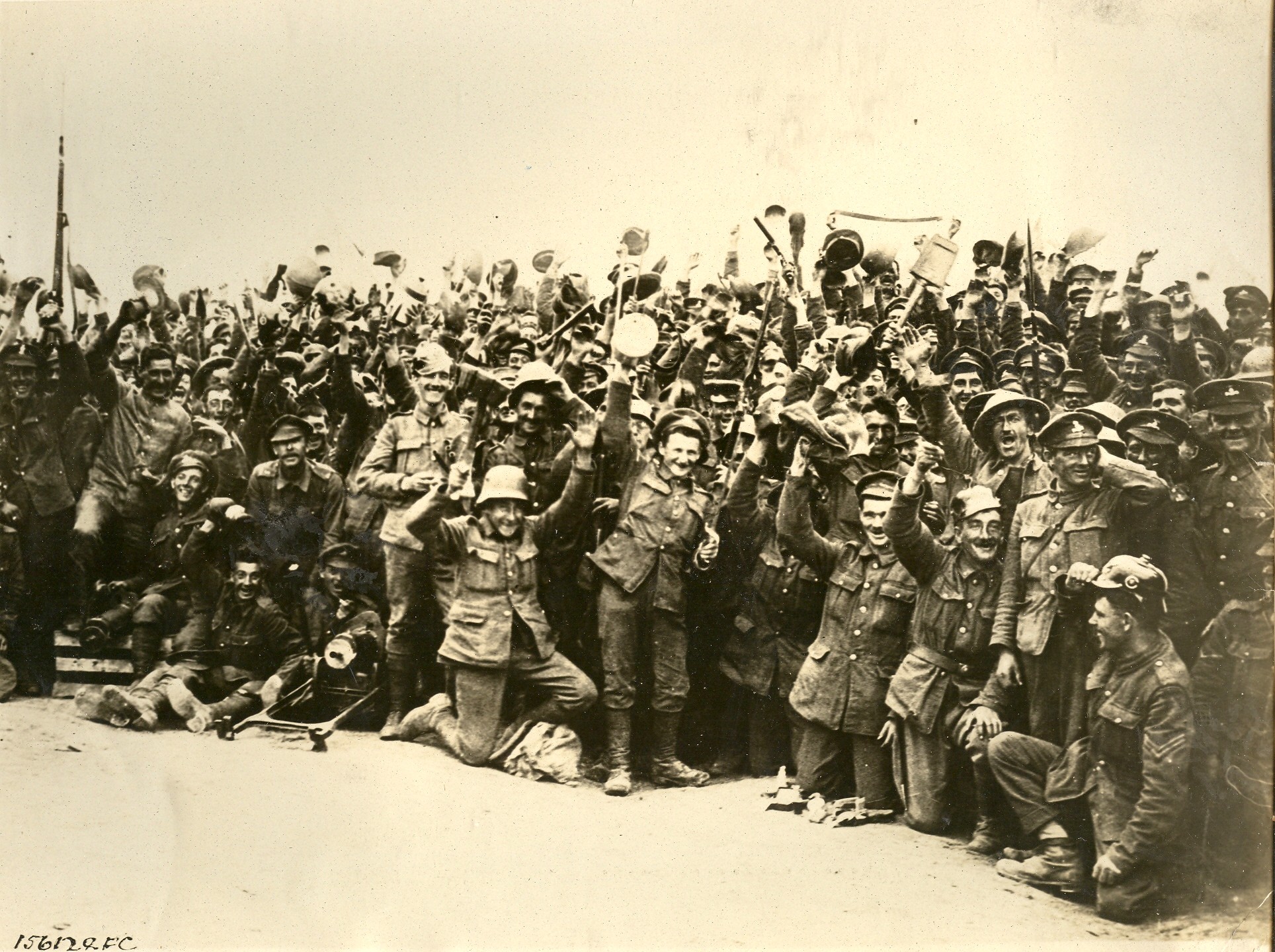
  • Irish Tommies, 1917

    ITEM:  News photo service original photograph, “Irish Tommies”.  1917. 9×7 inches.  Very good condition.  $350

    Blog dec 26 irsh tommies


    In the heavy mist of the Civil War, where brother fought brother, there was another sort of fratricide, of countrymen removed from their homes, finding themselves in America and there fighting against one another in opposition. Such is the case of the Irish in the American Civil War, where 180,000 of the immigrants fought in the war, with 30,000 fighting in butternut, and 150,000 fighting in blue.   The Irish faced one another across battlefields like of Appomattox, Malvern Hill, and especially Antietam, along the Sunken Road. 

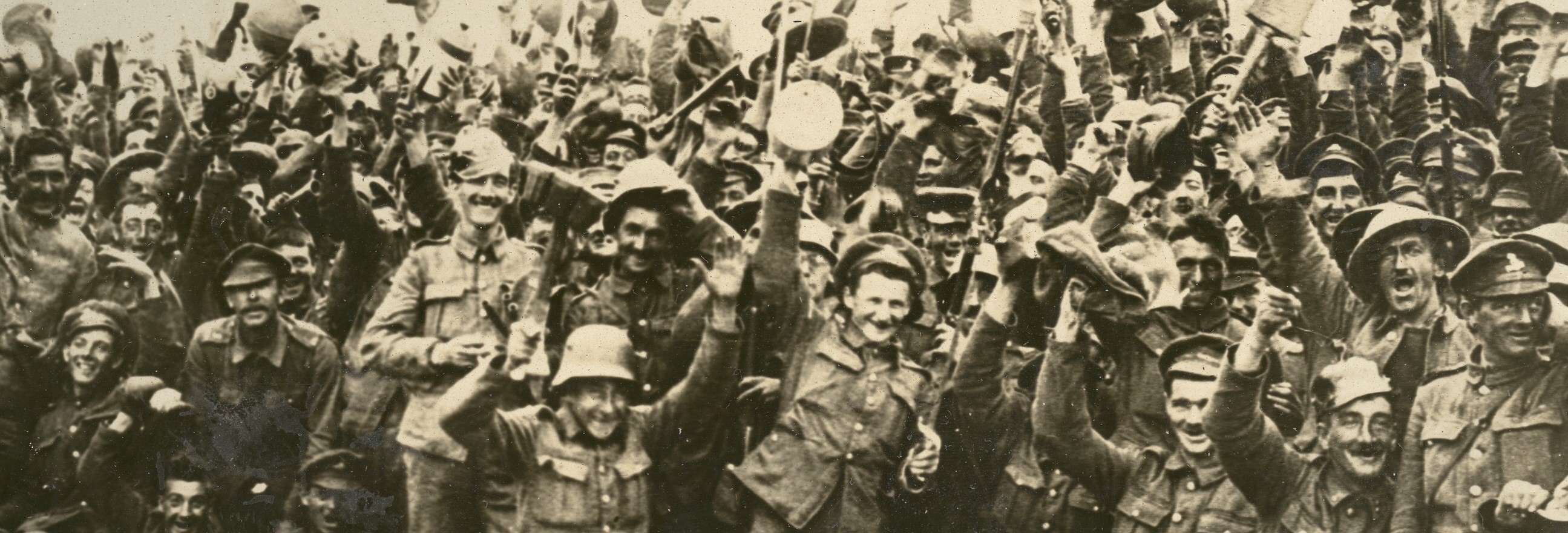
    Blog dec 26 irsh tommies det


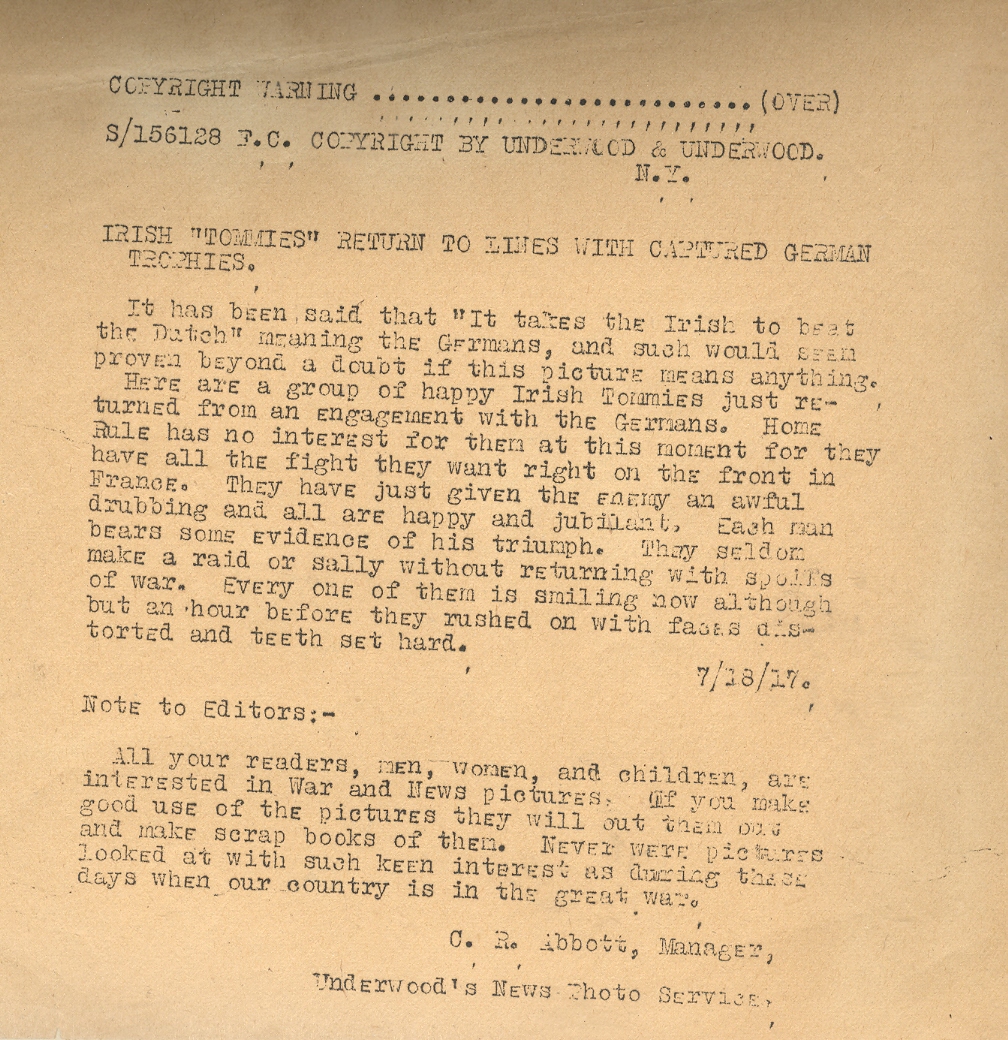
    I was thinking about the American Irish of New York and Pennsylvania and Louisiana and Texas of 1864 while looking at this Underwood & Underwood New Photo Service photograph of the “Irish Tommies” of WWI.  It shows a large group of Irishmen displaying their trophies taken from Germans, and dated 18 July 1917. This was also a period of terrific change and hardship, what with the Easter Rising of 1916 and the Proclamation of the Irish Republic (24 April 1916) having taken place just a year earlier.

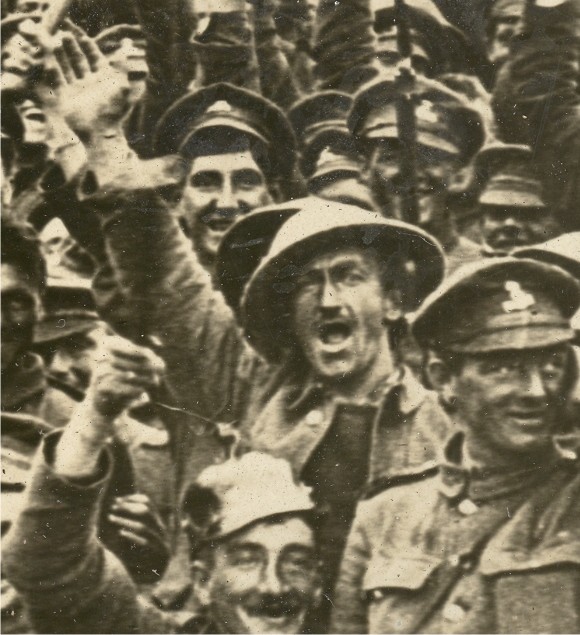
    Blog dec 26 irsh tommies det2


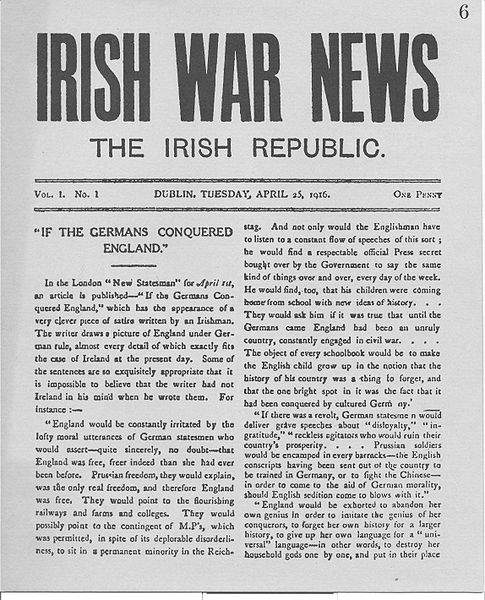
    I don’t know what it meant to be Irish and fighting with the Brits during the war, during this time of Trouble and upheaval (the enemy of my enemy bit come to mind).  It is interesting to see this piece by Sinn Feinist and Irish Republican Robert Lynd in the Irish War News, “If the Germans Conquered England”, and making elegantly and cleverly making the case of superior similarity between the British in Ireland and the Germans in England.  I know it is far off the mark to think about black slaves

    Blog dec 26 irsh tommies text

    owned by the Cherokees sold into service to fight for the Confederacy, but maybe not so very far off….


    (Irish War News source)

     
    Read the full text by Robert Lynd IF THE 
    GERMANS CONQUERED ENGLAND, AND
    OTHER ESSAYS
    Printed by George Robert, Dublin, 1917.

     Irish news

    The article begins:

    “When a small tradesman applies for exemption from military service on the ground that his business would be ruined by his absence, a question that is often put to him is: “What do you think will happen to your business if the Germans win the war ? ” As a rule the tradesman does not know what to think. He has no means of measuring world-catastrophes. He has not Dr. Johnson’s short way with questions to which there is no answer. In the first place, the small tradesman does not believe in the possibility of a German victory. In the second place, he has not the slightest idea what would happen to his business as the result of one. Perhaps, however, he knows as much about the matter as the members of the tribunals. All of us know that a German victory which involved the conquest of England would make life intolerable for Englishmen until the conquest was undone. But as to its effect on small businesses, that is another matter. It is quite possible that the little grocery, the little tobacco-shop, and the confectioner’s would be able to hold up their heads under German rule as under English. The valid argument against a German conquest is not that it would make an end of the small business man ; it is that it would make an end of a free England. If it could be proved that a German conquest would add twenty-five per cent, to the incomes of all Englishmen, even that would not make it tolerable. Most men in all nations are ready to sacrifice their lives in order that their country may be free.”

    ·Posted by :

  • A Gift from the Wartime Magi–Making Things Disappear (Camouflage, 1918)

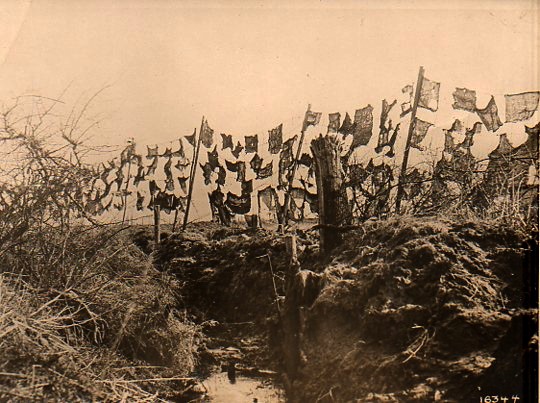
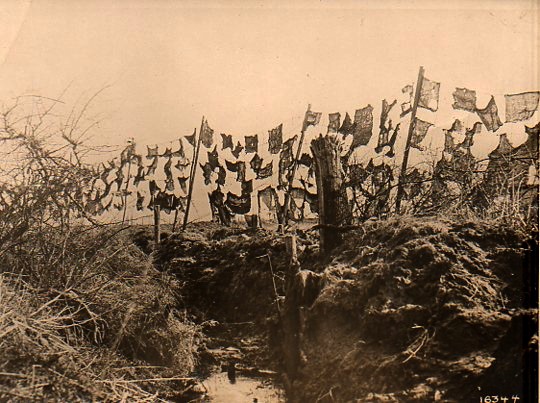
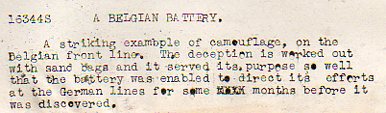
    Item:  7×5 inch orginal photogoraph, 1918. Camouflage on the Belgian Front.  With original text.  Very good condition.  $175

    Its a little difficult to think of Ellsworth Kelly, Jacques Villon, Grant Wood, Laslo Moholy-Nagy and Thomas Hart Benton as painters-for-war.  But its true, and true for many of hundreds of other artists in the 1915-1918 era. Its not as though they were in the trenches gunning down the enemy or lobbing hand grenades into the swirling gunsmoke. They were camofleurs, camouflage1 experts, artists employed as magicians, Wartime Magi, employed/drafted to make ships and such disappear. 

    Ever since it was (sort of) first noticed in 1915 that designs odd to the environment, stark geometric patterns and such, were capable of fooling the eye, people with  design capacity were pressed into service, rendering offensive and defensive instruments of war optically semi-impervious with variations of the then-five-year-old modern nonrepresentational art. That must’ve been a very odd position to wake up to every morning. 

    Of course the idea of camouflage in the animal world is probably 250 million years old–animals and insects have been blending into their environment for eons, and I’m sure too that early hominids did their fair share of walking behind brush.  But the idea of hiding great amalgamations of very heavy metal with paint is really quite modern.
    World War I photos--Camouflage291 

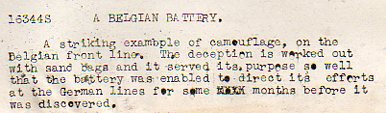
    In this photograph, the camouflage is more a more futuristic conception of art than the abstract and cubist approaches that were taken during the war, this looking more like assemblages of found material more than anything else.  And, according to the text that accompanied the photograph (which comes from 1918, from the Underwood & Underwood news photo service agency), the camouflage–empty sandbags thrown on a barbed wire fence) successfully concealed a gunnery emplacement for months on end. 
    World War I photos--Camouflage det292 

    Notes

    1. A fine bibliography on camouflage appears here, at Leonardo Online.

    The definition of “camouflage” from the Oxford English Dictionary shows that it is a young word, in English:

    (n) The disguising of any objects used in war, such as camps, guns, ships, by means of paint, smoke-screens, shrubbery, etc., in such a way as to conceal it from the enemy; also, the disguise used in this way; freq. attrib.

    1917    Daily Mail 25 May 4/4   The act of hiding anything from your enemy is termed ‘camouflage’.
    1917    Daily Mail 16 July 5/3   The King paid a visit to what is called a camouflage factory.
    1922    C. E. Montague Disenchantment viii. 108   A French aerodrome across which the French camouflage painters had simply painted a great white high-road.
    ·Posted by :

  • World War I Photographs–German Prisoners, Mass Scene, 1918

    Original photograph, printed 1918. 9×6 inches.  Good condition. $150


    Blogcrowdsphoto_ww1249_2

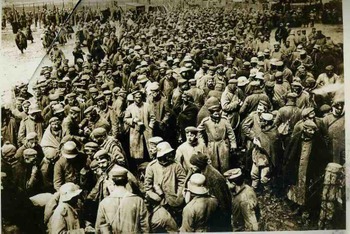
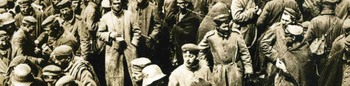
    This image comes from a collection here of First World War news service photographs,  showing German prisoners being readied for transport home, and dated 20 November 1918.  This group had evidently surrendered just before the armistice was signed, and was sent directly and instantly  to a staging area for transport back to the Fatherland.  The way that many newspapers obtained the war images that they published in their papers was via a semi-centralized pool of war images.  The newspaper would request, say, a photo of German prisoners, and would contact one of these photographic agencies—in this particular case, it was the Central News Photo Service of 26-28 Beaver Street, NYC—and purchase the rights for republication, and then print it in the newspaper along with the story.  In almost every case the photo would be accompanied by a caption mimeographed onto an attached piece of cheap paper, and in this case it reads:  “Waiting to Return Home/a photo just received showing a batch of enemy troops who surrendered just before the signing of the armistice, joyously discussing the coming of peace and the opportunity of returning home to their families.”

    Blogcrowdsphoto_ww1_detail_long251

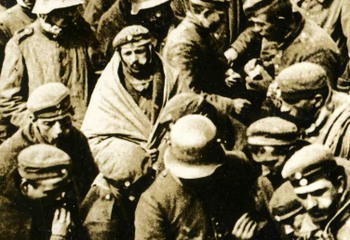
    I seriously doubt that the copy editor could read the minds of either the photographer or the troops in the photo.  I would imagine that they were definitely joyous about going home ALIVE to their families, but when looking really closely at the picture the thing that seems to dominate the actions of the people is food.  Or cigarettes.  But mostly when looking hard at the faces in the photo, the men just look tired. 
    Blogcrowdsphoto_ww1_detail_super253
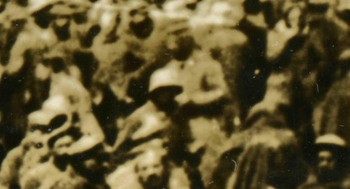
    Looking very closely at these types of images has always been fascinating; look close enough, under high magnification, and the large photo becomes composed of dozens of smaller photos.  The whole is an assemblage of vignettes, each in themselves a work of art.

    Continuing in a more odd tone, I’m also reasonably convinced that after looking at hundreds of faces in a photo like this that you’ll find a picture of yourself.

    Blogww1_crowd258_2

    I did.  This section is a 3200 dpi scan of a 15×10 mm section, and I am undoubtedly and unquestionably the bald bearded man (one of the few people in the image without a hat) at center-bottom. 

    ·Posted by :

  • World War I–Women in the War, Vermeer of the Tars, 1918

    8×5 inch original photograph, published in 1918.  Good condition.  $150

    0 ebay nov 20 WWI Vermeer

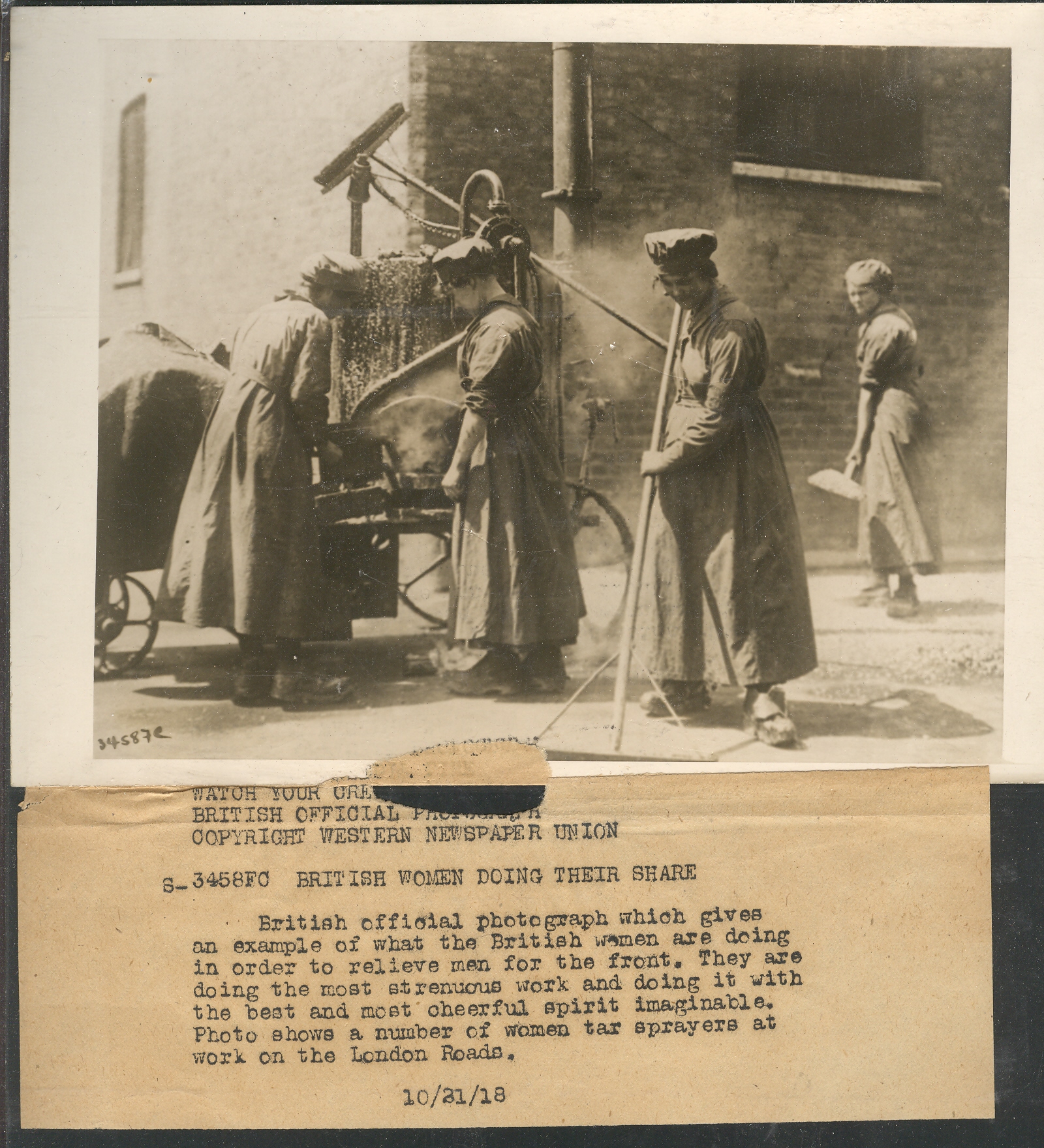
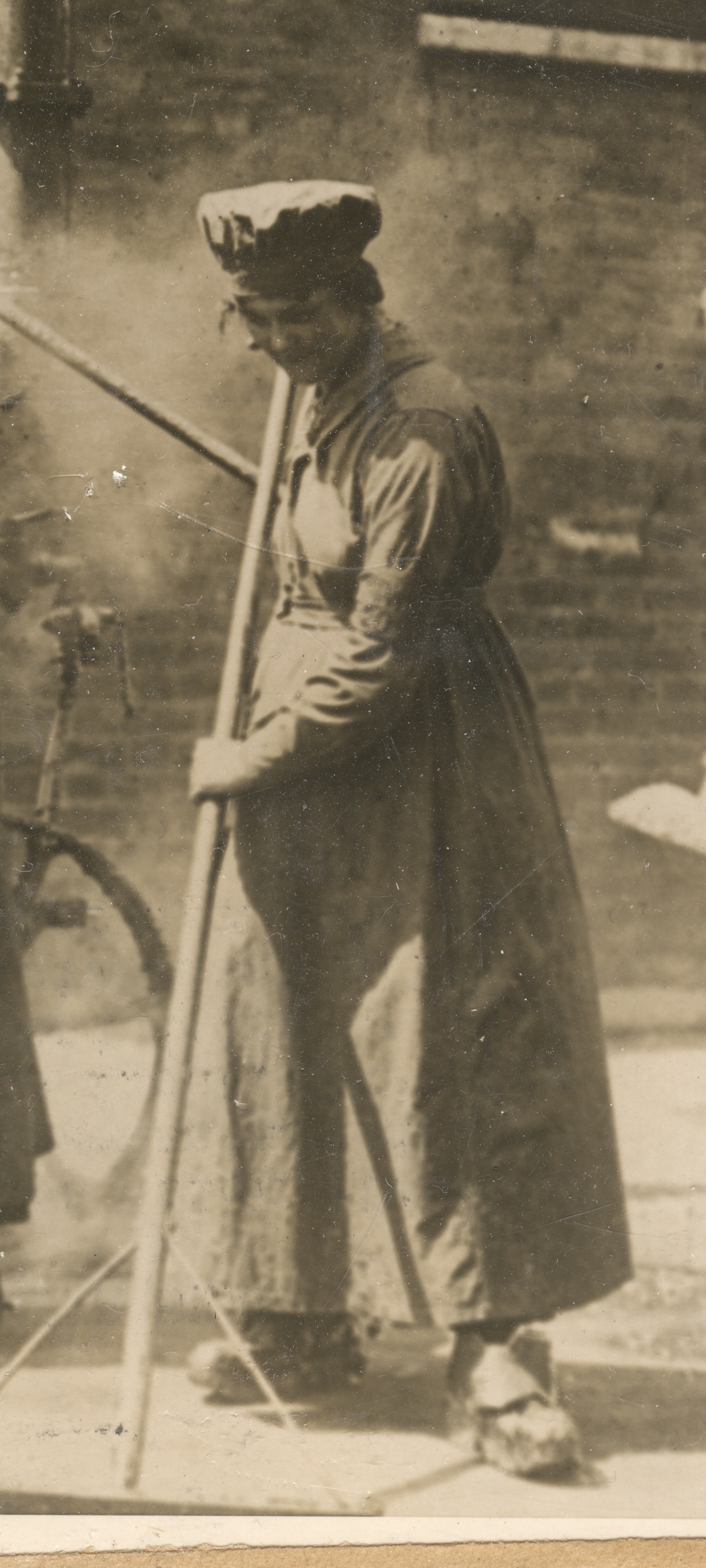
    In England, women were welcomed to the (paid) workforce during the years of the First World War (1914-1918)—their employment in traditionally male positions enabled those they replaced to go out to the front and die for their country.  Thus the women seen here in the News Photo Service Agency photograph (taken in 1918), working at spraying tar in the streets of London, were appreciated, and tolerated.  For women in England the War blasted away the contrivances of formally scheduled employment:  something like 12% of fall women in England were working as servants and house cleaners.   Come the War, women were offered jobs of revolutionary stature in a wide range and variety of work.  The Civil Service employment for women went from 33,000 in 1911 to 102,000 in 1921, and trade union membership rose 160% (357,000 in 1914 to 1,000,000 in 1918 (with men showing a 44% increase at the same time); for the most part, though, employers took advantage of the situation, and the women still generally earned less than half of the salary as comparable male workers did (or the men they replaced). 

    When the end of the War came, so did the appreciation for the women replacement workers—there was bitter feelings in the post-war period because of the weak British economy and a scarcity of jobs.  So the women who took the jobs of men to help the country’s war effort and free up hundreds of thousands of men for war service became an atavistic action, “taking” the jobs of men who had gone out to fight for their country. This of course cost many women their jobs, but the damage had already been deeply done to the pre-1914 British world of the sexual politics of business-being-done, though it would take World War II to really ingrain the appearance of women in the workforce into the national psyche.

    I’ve liked this photo for a long time, seeing things differently in it over the years.  It struck me just yesterday that the woman in foreground-right–whose close-up reminds me too of a Madonna, a Mona Lisa of the Tars–looks like a Vermeer character from 400 years ago.  Or at least the position of her body does.

    0 ebay nov 20 WWI Vermeer 001 

    ·Posted by :

  • Odd Man Out–One Singular Person in a Huge Crowd

    Original photograph, printed 1918.  9×6 inches, good condition.  $135


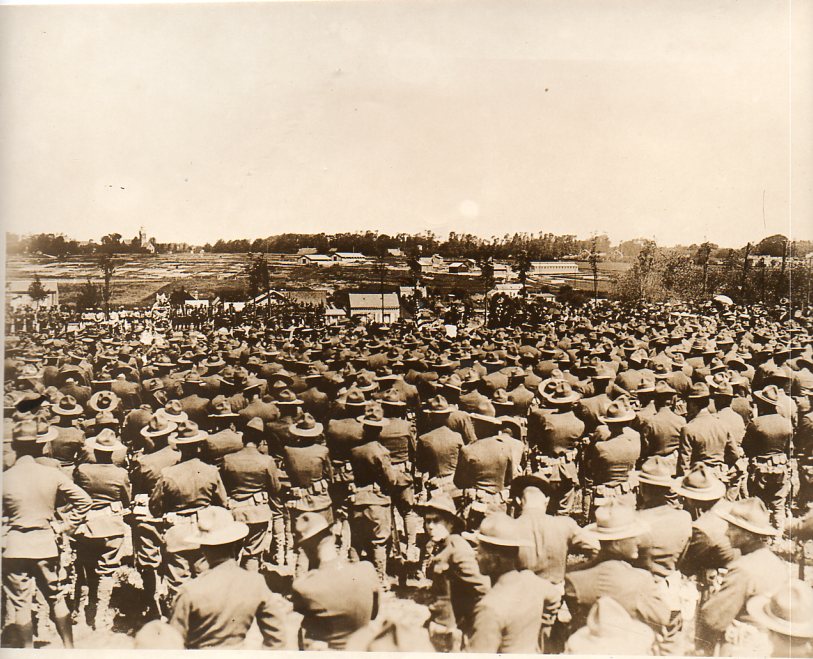
    In this photograph, taken of American troops at a ceremony at the cemetery of St. Marie, Havre, France in November 1918, the massive crowd (the largest funeral service held in France) is almost entirely focused on the proceedings–except this one serviceman in front, lathced onto the photographer.

    WWI--crowds--cemetery708

    ·Posted by :

  • Odd Person Out–Large Crowds and the Singular Person in Photographs

    Original photograph, 8×6 inches, 1918.  Good condition,  $250

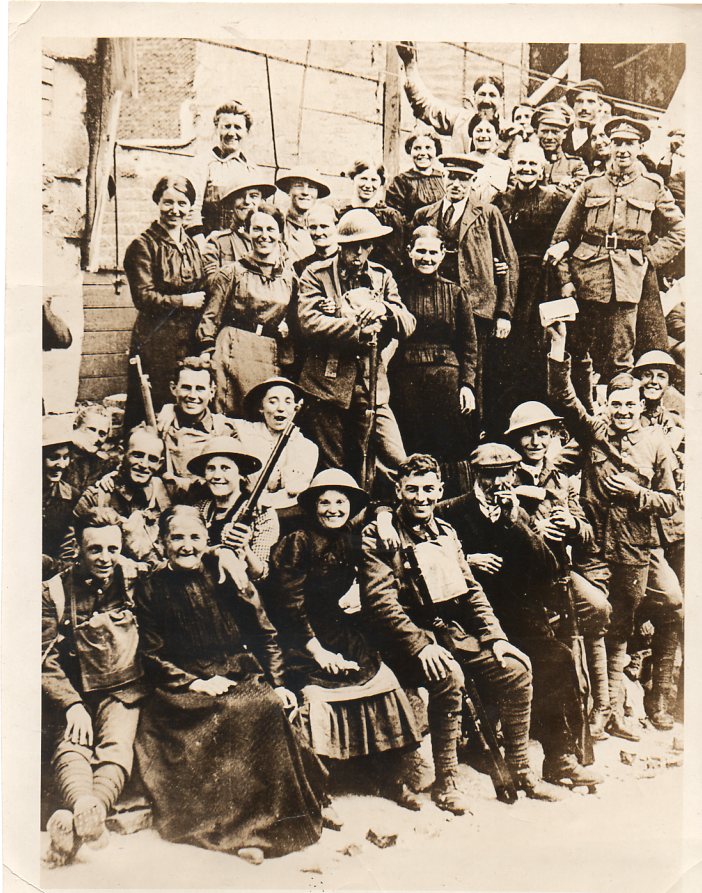
    This remarkable photograph shows the joy and relief of the townspeople of Saudemont, France (20 kilometers south-east of Arras), after just having been freed from German occupation after four years of captivity. 

    WWI--crowds--free town701 
    Saudemont had evidently suffered greatly over the four years, and seemed as though the population of the entire town was going ot be removed along with the Germans–but they weren’t, and teh town was simply abandoned, found and recaptured by these Canadian forces.

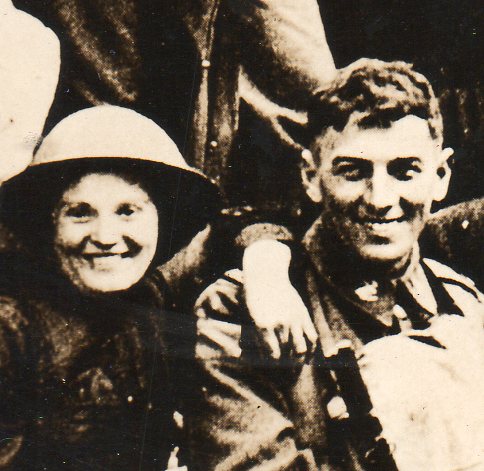
    The images of overwhelming joy are (almost) everywhere:

    WWI--crowds--free town detb703

    Except of course for the man at the fulcrum of the image (and the woman behind him), who remained, well, stolid:

    WWI--crowds--free town deta702
    But so far as everyone else is concerned:

    ·Posted by :

  • Mundane Images of War Necessities–Found Bullets

     Original photograph, 1918.  8×6 inches.  Good condition.  $225.

    WWI--salvage719 
    WWI--salvageb720

    WWI--salvagec721


    ·Posted by :

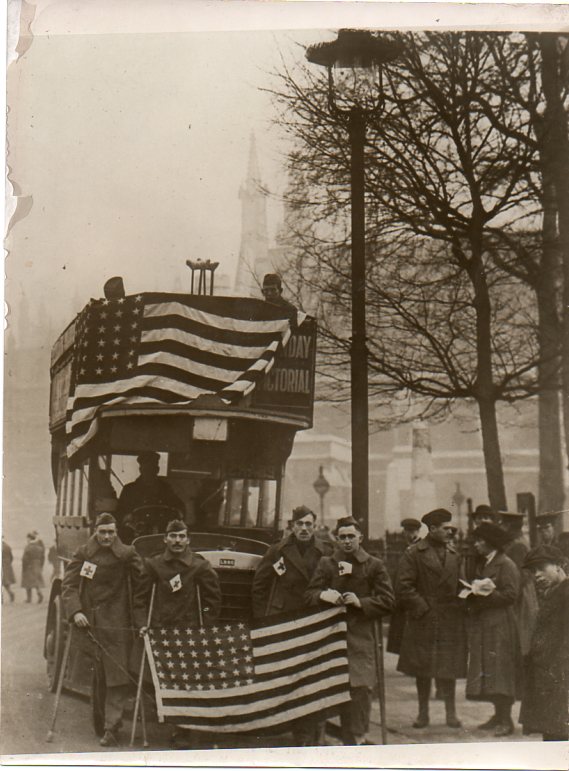
  • Americans in London, July 4, 1918

    Original photograph  from News Photo Service Company, July, 1918.  8×6 inches. Good condition.  $750

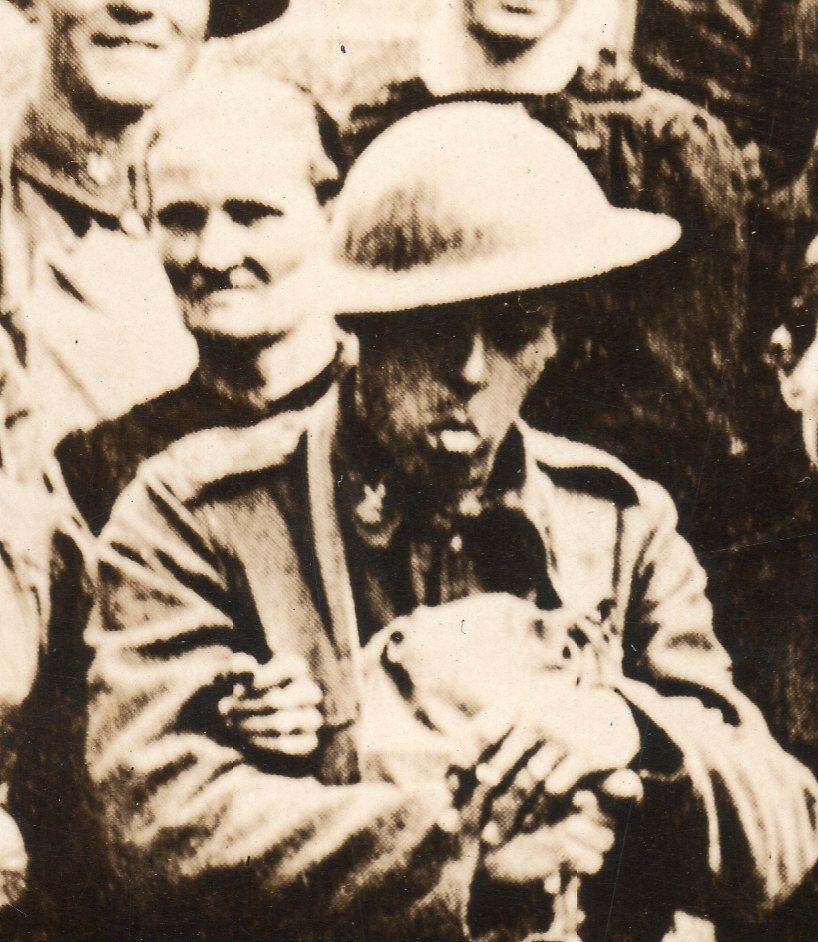
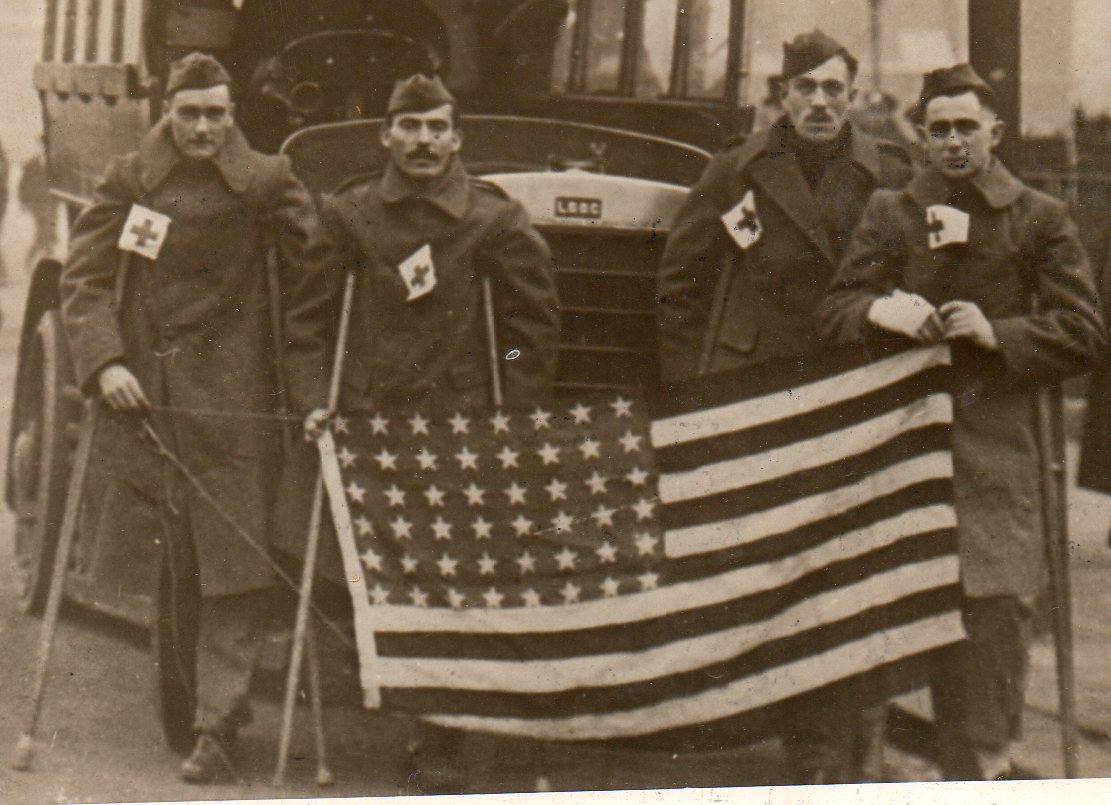
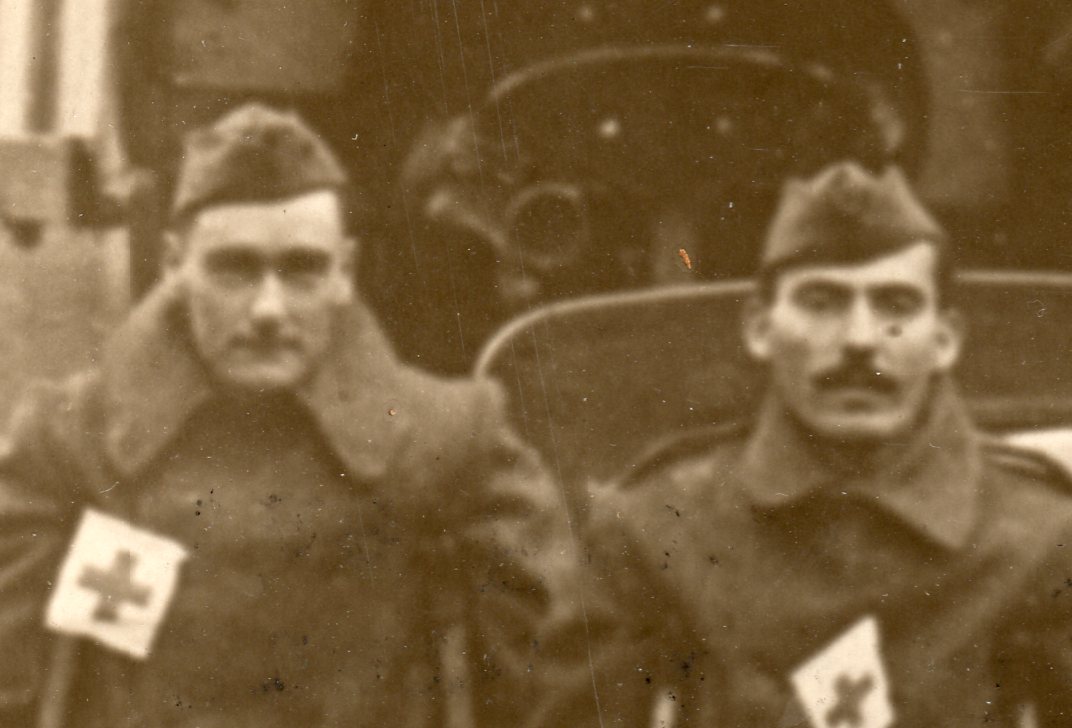
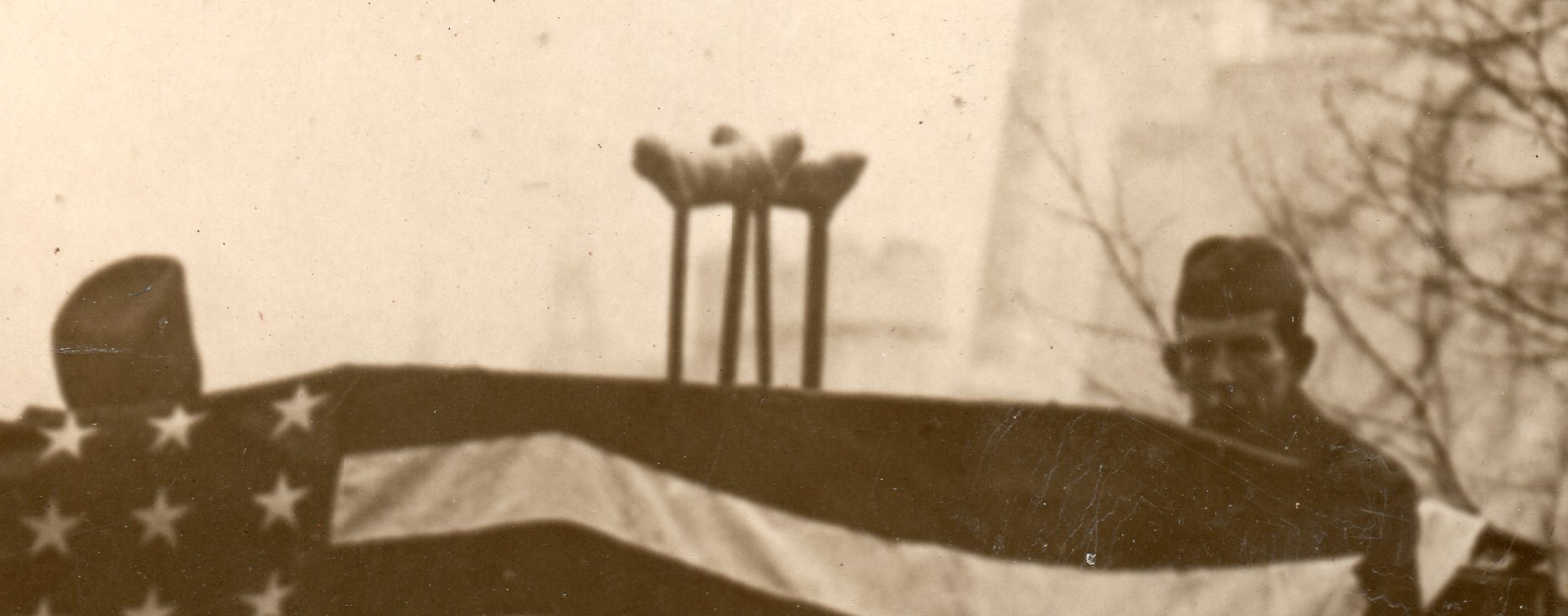
    This image–from a collection that I’ve mentioned previously on this blog–shows a group of wounded-in-action American Doughboys recuperating in London on 4 July 1918.  There were at least six of these soldiers aboard this bus, touring, being invited to celebrate their independence day in London, their flag–and a big one at that–draped across the bow of the upper deck of the bus. 

    There were be about 204,000 American soldiers wounded and 116,500 killed during WWI, the end of which was in sight at this point, just five months away.  These were some of the survivors of the American share of war casualties.  Almost all other nations fared far worse (see below)

    WwI--photos--flags london030

    WwI--photos--flags london b031
    WwI--photos--flags london c032
    WwI--photos--flags london e033


    ·Posted by :

  • WWI Photographs–Uncle Sam’s Metal Drive, June 1918

    Original photograph, ca. mid-1918.  8×6 inches.  Good condition.  $750

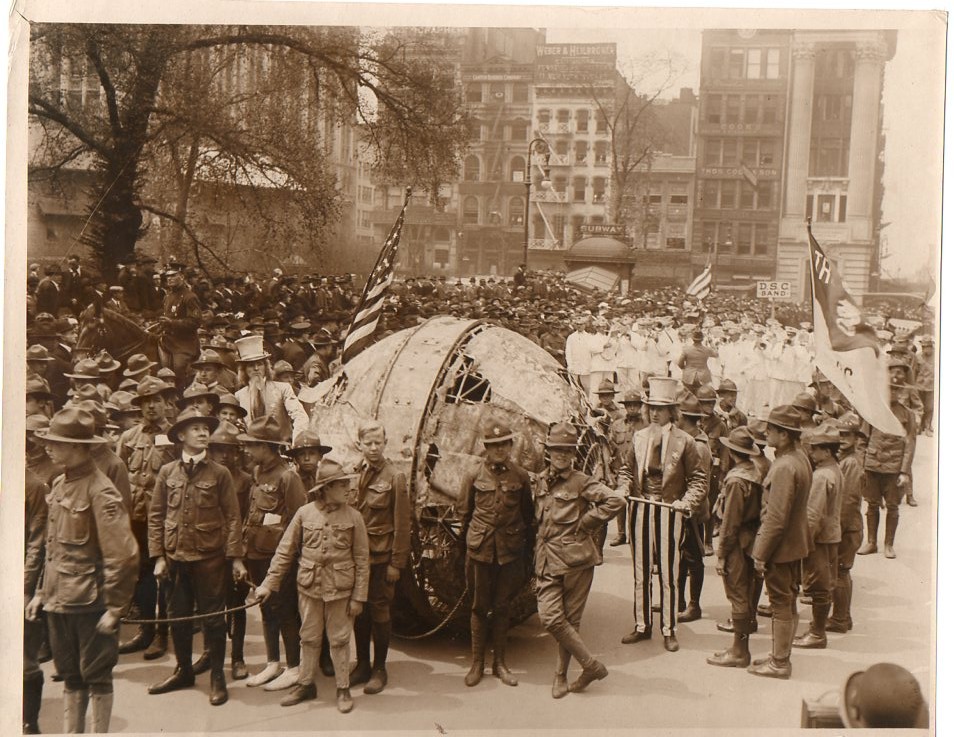
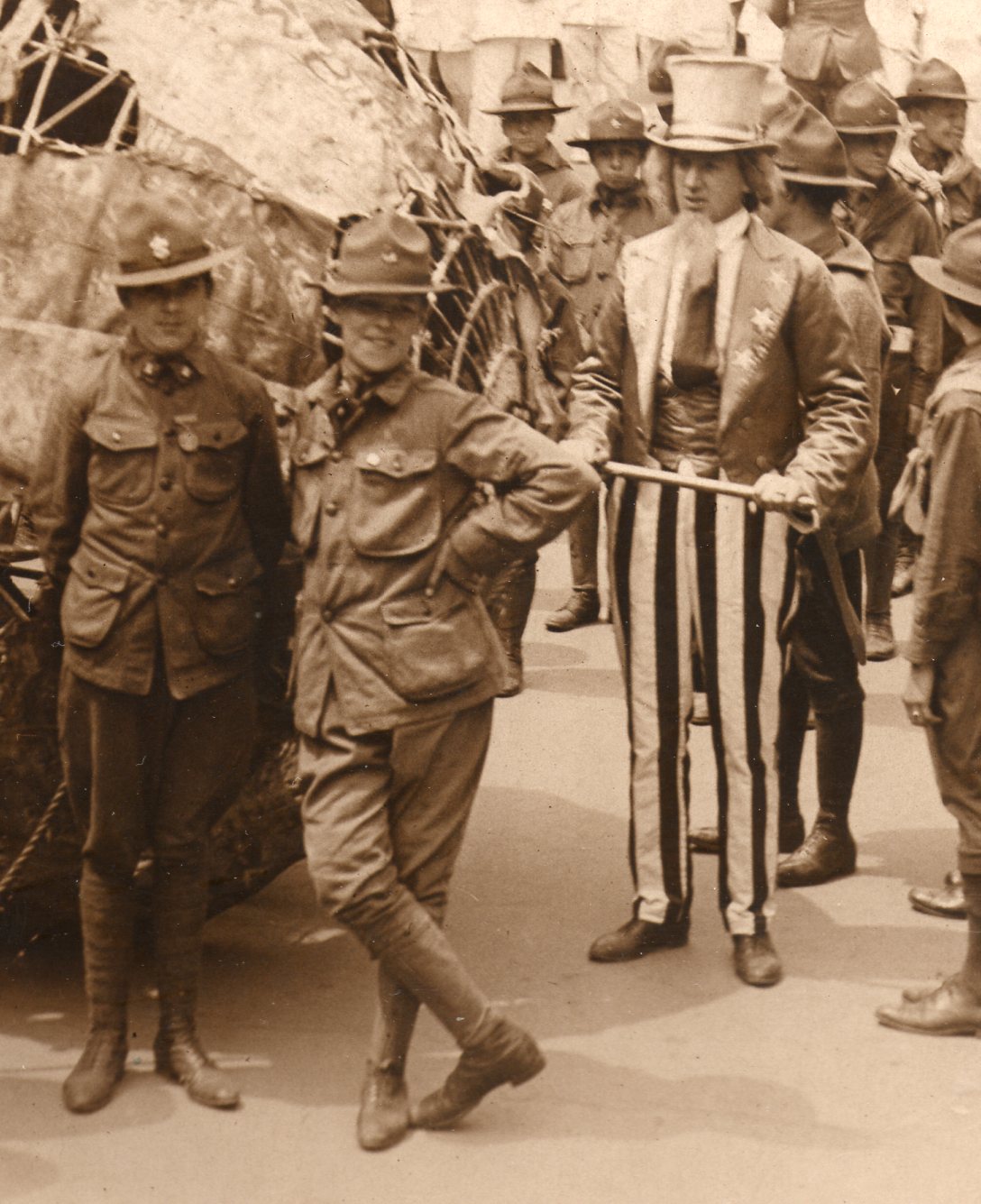
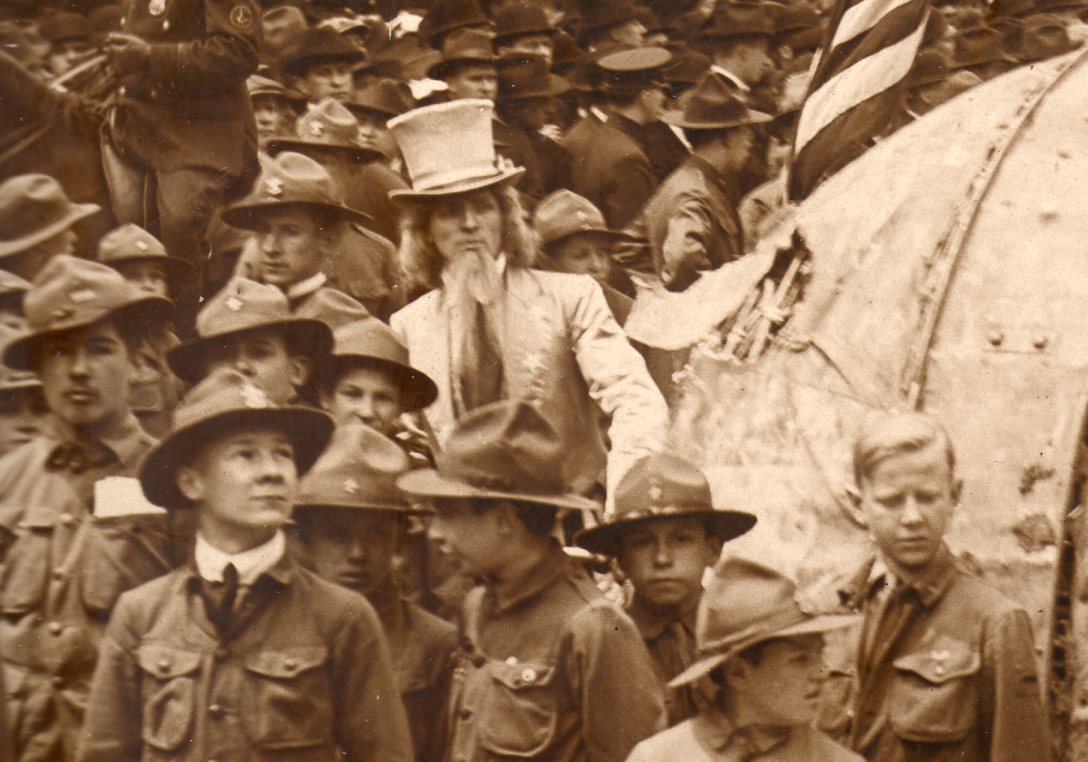
    Like its more-famous WWII counterpart, scrap drives during The Great War were also frequently conducted.  This is an original photograph showing just such a thing, depicting two Uncle Sams surrounded by Boy Scouts pulling a large hollow metal sphere–I believe that thin metal scrap would be hammered flat and then molded onto the sphere’s frame, though I’m not terribly sure.  I am sure that this is a great photograph. 

        WwI--photos--flags parade039
    (The original is available from our blog bookstore.)

    and the detail:

    WwI--photos--flags parade b040


    WwI--photos--flags parade c041

    ·Posted by :