A Daily History of Holes, Dots, Lines, Science, History, Math, Physics, Art, the Unintentional Absurd, Architecture, Maps, Data Visualization, Blank and Missing Things, and so on. |1.6 million words, 7500 images, 4.9 million hits| Press & appearances in The Times, Le Figaro, Mensa, The Economist, The Guardian, Discovery News, Slate, Le Monde, Sci American Blogs, Le Pont, and many other places… 5000+ total posts since 2008.

Category: Imaginary and Impossible, Museum of the

  • NYC Miniatures, Glass Diaries, Cannon Alphabets and the Bio-Secrets of Sing Sing

    JF Ptak Science Books  Post 1009

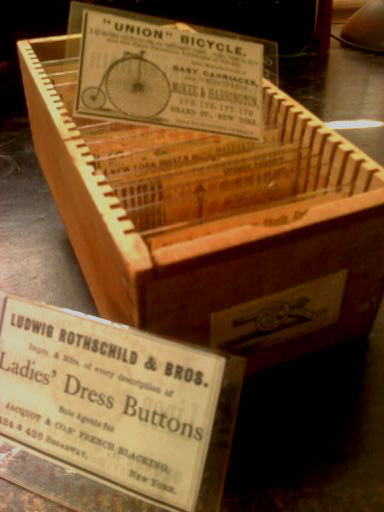
    Lost commonness is never so sweet as when it is unexpectedly recovered–and today it has happened for the second time in three days via tremendously obscure sources working in the same almost entirely unused medium.  Several days ago I wrote about the lost work of a German diarist who recorded tiny advertisement images for posterity on glass slides. “Onkel Karl’s Berlin” is an assembly of tiny advertisement images published mostly during the days of Weimar Republic; the artwork for these images are now almost entirely lost to time.  
    April 19 glass slides

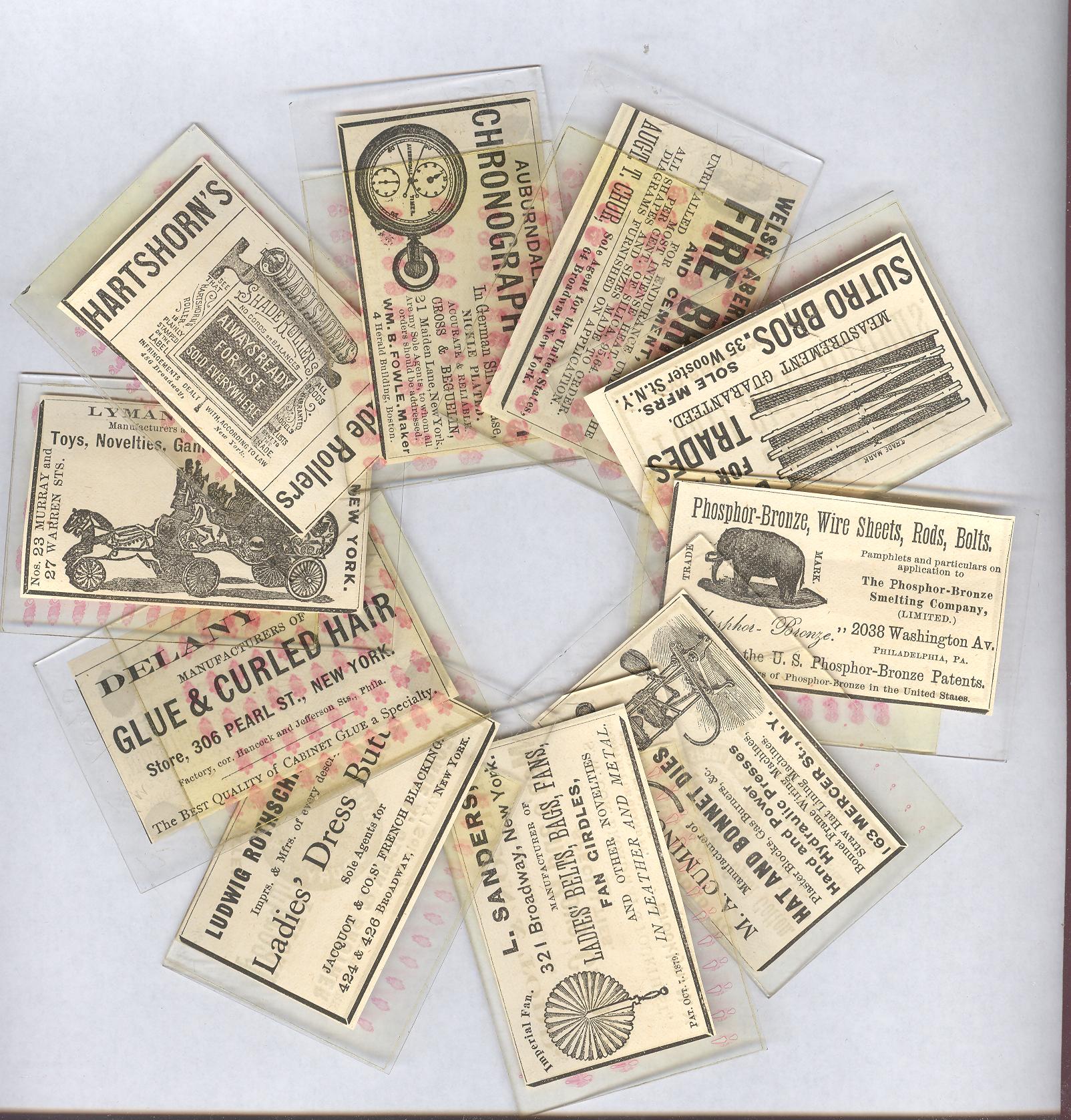
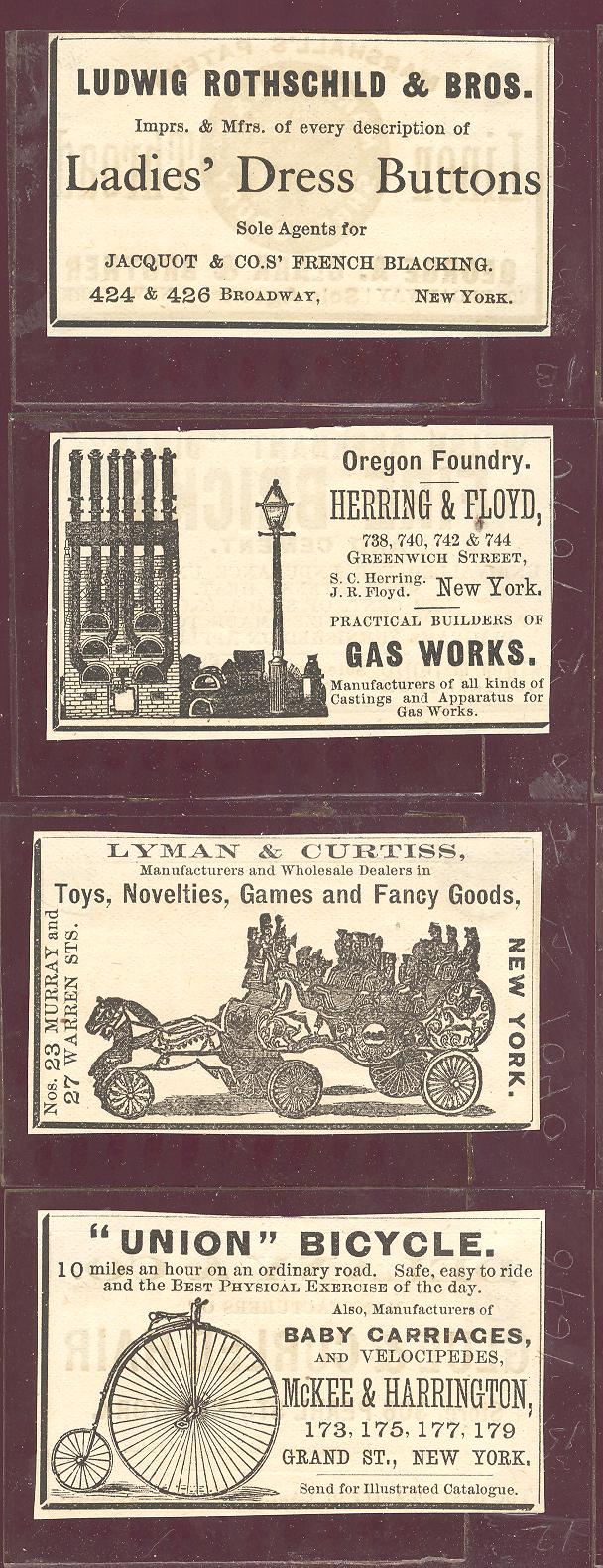
    Another entry is made here today in the infrequently dynamic glass diary category–“The New York City of Karl von Onkel”.  Aside from the advanced astonishment of another similar collection is the almost miraculous similarity of the names of the collector/observer, neither of whom were related, and who were also separated by an ocean and 50 years in time.  These two diarists also shared a great closeness in their appreciation for the ephemeral bits of their attractive present, with Mr. von Onkel’s dedication directed towards miniature business cards from NYC in the late 1870’s, most of which were almost entirely unknown before the unveiling of this collection.

    The highly  attractive but perhaps dubious other soaring aspect of originality in this later collection was the method used to record written information.

    Mr. von Onkel constructed an alphabet composed entirely of cannon and cannon parts. 

    What is more remarkable is that he evidently outfitted an 1872 Remington typewriter with these miniature cannon bits, replacing the English alphabet keys with his own creations.  No one has yet deciphered the entire 118-page manuscript (entitled in script “The Other Anthon”), as there seems to have been a further bit of cyphering added to the cannon mix–the elements of the cannon-part alphabet would (evidently) change every third line or so, making the decoding part of it toweringly difficult.  
    April 18 glasss slides

    For example, the letter “e” which appeared in the first line of page one was represented by a spoke/half spoke/screw/burned spoke–four elements for one letter! But this would change by line three, where the letter “e” became fuse/spoke/broken half-spoke/powder/harness–a delightful but maddening mess.  Thus “he saw a dog” might be rendered in 45 cannon part bits, all of which would change every few lines.  Without the encoding device and without the means of determining when and where the symbols were changed in representing the alphabet, it is impossible perhaps to ever know the contents of the manuscript. There is also the further added difficulty of “missing” cannon parts–these are “blanks” that weren’t so, their nothingness standing for something depending on their placement in the page.  
    April 18 glasss slides 1

    On the other hand, it seems as though all Mr., von Onkel was recording was the information already printed on the business card–plus a veritable haiku of his personal observation. (This could be determined from the few English language entries in the journal.  His narrative for “Stemp’s Used Nail Emporium” was “not on corner; walked past; where breakfast used to be”, while “Phlob’s Gun Enameling” was limited to simply “Walked past”. Perhaps there is no need to know anything beyond this. 

    There are over 3,000 slides in the van Onkel collection, covering everything from braided baby hair ropes to margarine slippers to corset burners–items all relegated to a history that is almost beyond memory. 

    Carter Crotchgroin, a registered library card holder and patron of the Port Authority Department of Lost Things and renowned glass-transfer image collector, remarked that the Onkel collection “:is a savagely didactic ensemble, a color opera in shatterable black and white”. 

    “True and not so true”, says Dr. Grownhand Heap, Director of the New York Center for the Advanced Invisible. As an Invisibility Expert, Dr. Heap has discovered the collection’s beauties and its “unfortunabilities”.  “It was not known until we investigated the background of the slides” said Dr. Heap, “that all of the background glassware was appropriated somehow from the state correctional facility at Ossining. More accurately, they came from the archives which held the Medical Welfare Support Society, which was a group of “medical” doctors intent on improving the position of society in general by experimenting on the prisoners. (The Socity existed apart from Sing Sing proper, their samples collected by the prison barbers.  Of particular interest is the sub-colelction of the blood and hair of every prisoner executed at Sing Sing, most of these being the work of one man, the longest-serving barber-of-the-condemned, Scott “Simple” Malfesance.)  The Society was disbanded in 1872 for its questionable practices, and it was thought that their medical collection was either removed to the archives in Albany or destroyed.   The slides contained blood and hair samples of every prisoner who was part of the Sing Sing system for the 1830-1873 period.  To find this sort of ancient biological archive is nothing short of phenomenal”.

    A detail April 18 glasss slides blood 1of one of the slides clearly shows the blood samples; an etched numbering system refers to prison records which clearly identifies the prisoner.  

    The contention now is to how to deal with the von Onkel collection–as art, or as a medical goldmine. 

    April 18 glasss slides blood hair

    In addition to his glass diary, Mr. Onkel was also a lateral brick collector, and was founder of the Louisville (Kentucky) Society of Line Collectors (a subsidiary of The Horizontal Society of Wilmington, North Carolina AND the Right Angle Society of Grove Park, Indiana).  A 20th century photo of the Louisville group celebrating their 25th anniversary in honor of their founder is shown below.:
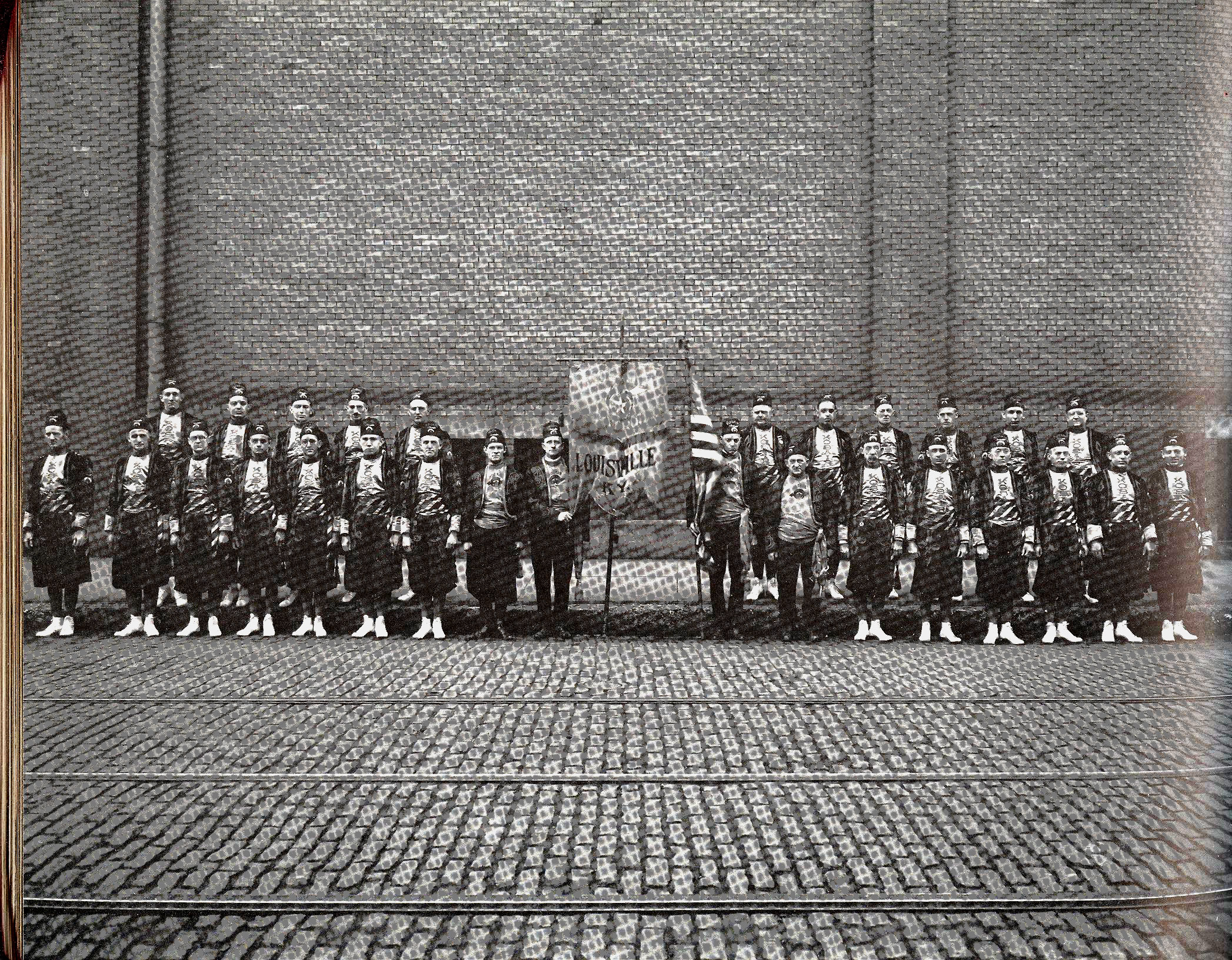
    April 20 bric k


     Additional images from the von Onkel collection can be seen below:


  • Museum of the Impossible: The Basis for Goedel’s Attempt to Formalize the Logic of Boredom?

    JF Ptak Science Books  LLC 
    Post 730  Blog Bookstore

    (#17.5) Goedel’s Psychiatric Cheat Sheets

    This description appears on pages
    85-87 of the guide to the G.R.”Joe”

    Museum of the Imaginary and the Impossible*
    The physical location of the collection is just south of Savannah
    on Tybee Island, Georgia.

    Catalogue #17.5 (maths)  Received by Museum:  2 January 1960 

    Kurt Godel’s Psychiatric Cheat-Sheet;  The Logician’s
    Notes on Surviving the 50-Minute Hour

    Goedel

    Kurt Goedel, this
    century’s greatest logician (inventor/discoverer of the uncertainty principle
    and destroyer of what was thought to be the nearly-completed
    castle of Mathematical Finality) fled/escaped National Socialist Germany
    in 1940 and settled in
    Princeton’s ’s Institute for Advanced Studies
    (IAS).  Goedel’s remarkable logical
    ability was followed closely by his collection of singularities—in a world of
    uneven people at the IAS, Goedel’s Unusual Prominences were highly unusual, and
    for many “odd” people Kurt Goedel was the definition of their three-letter
    defining disclaimer.

    On exhibit is a
    collection of the intellectual paraphernalia that Goedel evidently assembled to
    bring with him to a September 1949 therapy session with his Trenton
    psychiatrist, Dr. R. Blister Kent. 
    Goedel put together a number of thoughts on various scraps of material
    that he must have used as “thought prompters”—their existence and purpose
    was  revealed in a series of letters to
    the Postmaster of Princeton describing these iconic objects “as Tibetan prayer
    rags…they were supposed to assure me of a certain level of attention and
    suffice to bring my mind to the business of the therapy session….without my
    scribbled clues I would have found myself bored beyond the supplication of
    mortal words.”

    We see here the
    contents of an aged manila envelope labeled “

    Trenton 
    Dr.
    Can Not Sep49” including the following, (with Goedel’s notations in quotation):

    (Two)  Pressed flowers  with “ask about the laundry”; (three)
    Ticonderoga pencils with penciled notes “at what time did I happen”;  matchbook cover (“Happy’s Coffee Happy
    Restaurant”) with “I thought to stay and I stayed to go…”; a U.S. penny with a
    penned “x” through Lincoln’s head and the tiny words “not to be The Eat”; a 2’
    long and 1” wide rolled piece of paper with musings on the relationship between
    memory, truth and imagination; a menu for a 1954 formal dinner introducing the
    JOHNIAC computer at the IAS in which Goedel has drawn a self portrait next to
    all  listed honorees names except his
    own; and several other small, inscrutable items.

     In
    Goedel’s collected correspondence from his uninvited letters to the Dead Letter
    Office at the Trenton Post Office period it is can be seen that he was
    intending to construct a puzzle of these objects and writings which were
    believed to contain the key for his germinal theory on the mathematics of
    boredom.

    “There
    is a small leap from genius to boredom; if that can be breached and the two
    great concepts brought together I believe that I can accomplish truly wonderful
    thinking” Goedel wrote.  “I believe in
    boredom.  It is the Kind Devil that
    allows thought to grow; it is the great emancipator of time.  Boredom always wins; if I can ally that great
    heaviness with the energy of genius in pure form [i.e. mathematical formalism—editor] there will be no end to my
    creation.” 

    Curator’s Notes:  Goedel had (many would say “suffered”) a
    life-long obsession with his health and the things that he thought impacted
    negatively upon it.   He believed that
    medicines that were given him by doctors were toxic, that water from the faucet
    was toxic, that the sun was toxic, that most foods he received were poisoned or
    toxic.  By 1970, when he was convinced
    (and forced) to seek medical help, his weight was recorded as 86 pounds even
    though he was 5’ 6’’ tall.  Goedel  had perhaps the world’s most singular
    interest in numbers; he was also extremely interested in the minutiae of daily
    life
    . 


  • Museum of the Imaginary & the Impossible: Stolen Convicts’ Letters Collection

    JF Ptak Science Books  LLC  Post 725  Blog Bookstore

    (#123.2) The Convict Letter Collection

    This description appears on pages 188-189 of the guide to the
    G.R. “Joe” Gebors Museum of the Imaginary and the Impossible*
    The physical location of the collection is just south of Savannah on Tybee Island, Georgia.
     

    Catalogue #123.2  Received by Museum:  5 July 1957.  Originator:  Eric Mintz
    , born Erich Mintz in Paterson, New Jersey, 1830; died Archer City, Texas,
    1913.]

    Short Description:  Mintz’s
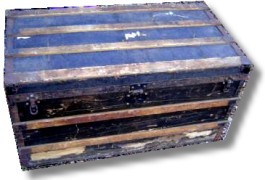
    leather-covered wooden steamer trunk (ca. 1855), with its contents of of undelivered, stolen letters from convicts under prisoner warder Mintz’s charge.Weltin--old trunk

    • Trunk: 
      wood and leather with metal clasps (broken). 32x28x44”. 
    • Trunk Contents: 2,412 letters, including 112
      self-folding envelope letters; 2300 letters in “modern” envelopes; 1 volume,
      “Diary”, with dated entries from 1850 to 1892..

    Summary:

    Mintz was a prison guard for more than
    half a century and “collected” letters that were written by convicts and
    entrusted to him for delivery to postal officials.  He performed the acceptance part but ignored
    the delivery and simply kept all of the letters.  Over his many years Mintz accumulated some
    402 letters.  All remained unopened.  Mintz’own diary–a scandalous affair of mostly repetitious, feverous, arithmetical nightmares in which he recorded his counting of one through ten many thousands of times–reveals that he stole the
    letters because he “liked the way they felt”. In our experience we have seen that people can be committed to
    deep and long-term heinous aberrations–like this–without very much
    thought at all as to why they’re doing it.  Mintz may or may not have
    collected money for postage; though even then the remuneration for
    theft over such a long period of time–and committed in such a way as
    to cause extended suffering for those waiting responses that were never
    to come–would have been insignificant.  There is also no evidence that he held the email “for ransom”.

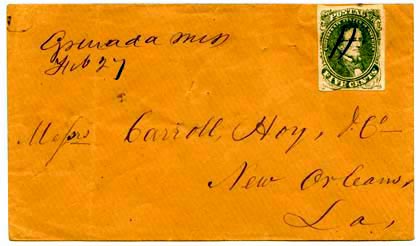
    Weltin--envelope 1862


    Mintz worked in 13 jails in 7 cities in two states, and collected
    letters from felons convicted of crimes such as wire cutting, brand stealing,
    chicken gutting, soil teasing, indiscretions with hoofed animals, stump mangle,
    murder, arson-murder, fright-murder, and wanton abduction. The letters, dating
    from 1850 to 1910, and ranging in locations from San Francisco to San Antonio, were found intact in a trunk in the
    estate of Samul Wundt, a trunk collector. 
    The letters–still unopened–are now all subject to inspection in a court of law to settle the question of ownership
    resulting from multiple lawsuits between the Mintz heirs (to recover all of the
    letters), the Wundt heirs (to recover the trunk with the letters), the
    descendants of the persons writing the letters (to recover the letters), and
    the state of California (saying that the letters belonged to the state because
    they were stolen by a California resident of California residents).  All in turn sued the state of California for allowing the thefts to occur.  There was one lawsuit filed against New York City, which was deemed responsible for the
    entire series of events because the city government invented the use of ships
    as prisons. This puts the Museum in a frightful place; we will not be a party to any lawsuit and will abide by the court’s decision(s).

    Mintz died in 1913, a suicide, in Archer
    City, Texas, by swallowing a deputy’s badge.  

    *Just to make sure, the Museum of the Imaginary and Impossible is my own fiction.  Everything else on this blog is factual. 


  • Museum of the Imaginary and Impossible: Found Word Biblopathology Poetry

    JF Ptak Science Books LLC  Post 724

    (#156.2) Found Word Bibliopathology Poetry  [The following description appears on pages 67-69  of the guide to the G.R. “Joe” Gebors Museum of the Imaginary and the Impossible.]


    Poetry from Found-Wordist and Book Pathologist Mr. Ignatio Norme

    • [Catalogue #156.2  Received by Museum:  19 September 2006.  Originator:  Mr. Ignatio Norme [b. Boston, Mass, 1923; d. Hyannis, 25 January 1988.]

    Short entry catalog  description: 

    Ignatio Norme, Found-Wordist and Page Number Collector (Boston, Mass.; 1923-1988)

    The man who found obscure phi-related connectivity between random word placement, page number and the poetic ideal.

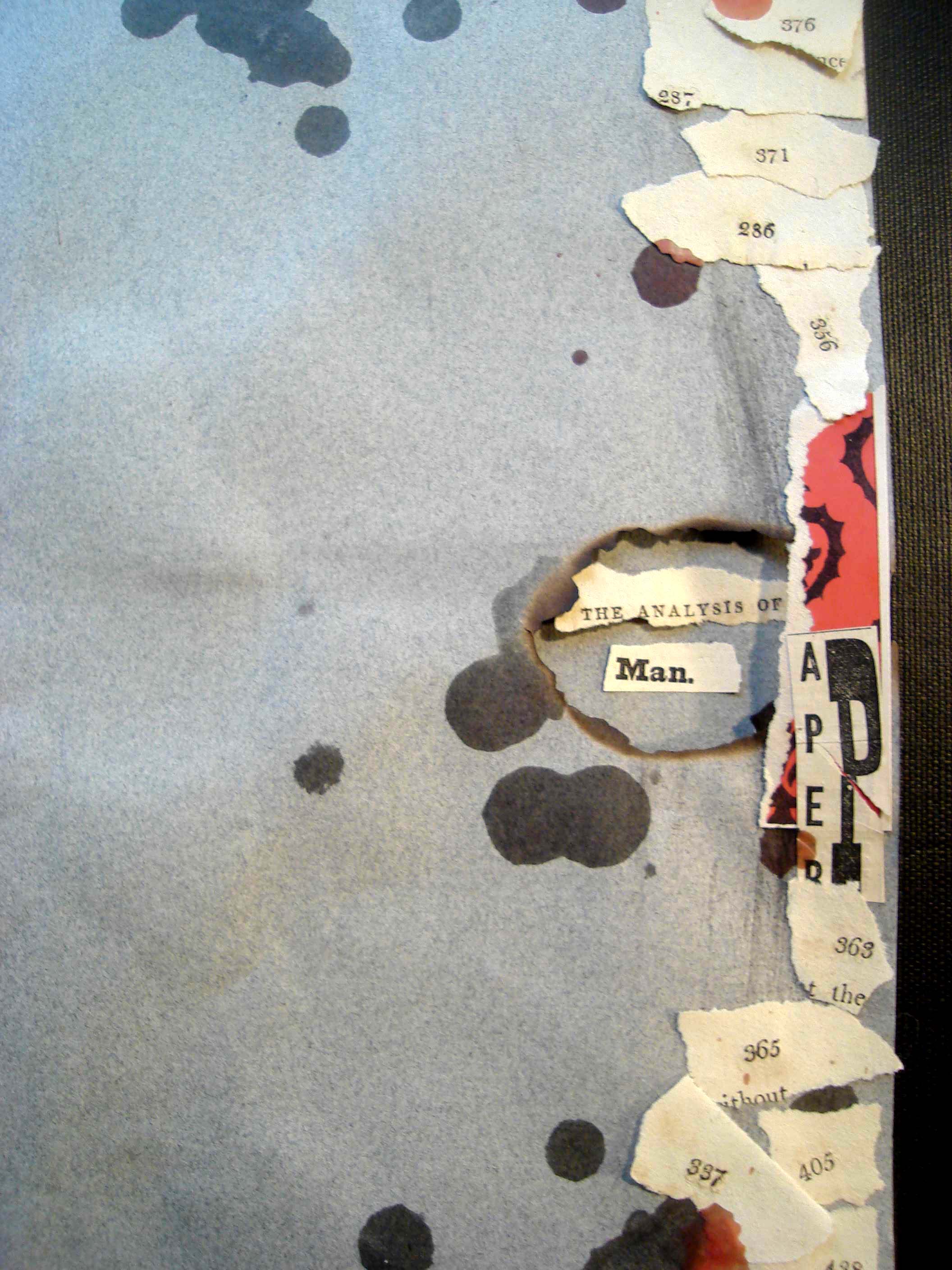
     0-blog-nov-20--norme-cvr


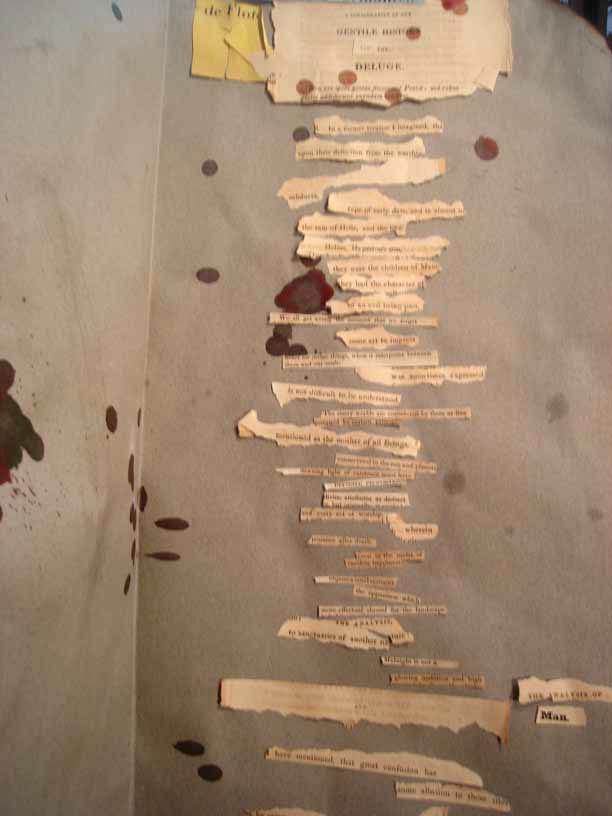
    Mr. Norme’s work first came to the attention of the literati in 1952 when Dallas Headman of Case Western described it as “a unique approach to approaching uniqueness”; this would be the only phrase ever used to evaluate Norme’s efforts in every review from 1922 to 1975, when his work stopped being noticed.  In a spectacularly prolific career Mr. Norme produced some 8,000 poems, most of which were produced on broadside sheets of paper or on large pieces of wood.  The combination of the materials of production and the many tens of  thousands of books led to Mr. Norme’s house being an internal castle, letting in neither visitor nor light, a friendly singularity for his pursuit.  As his utilities and taxes were paid decades in advance, Mr. Norme’s death, and the discovery of his corpse, was not discovered until 2005, seventeen years after his passing.


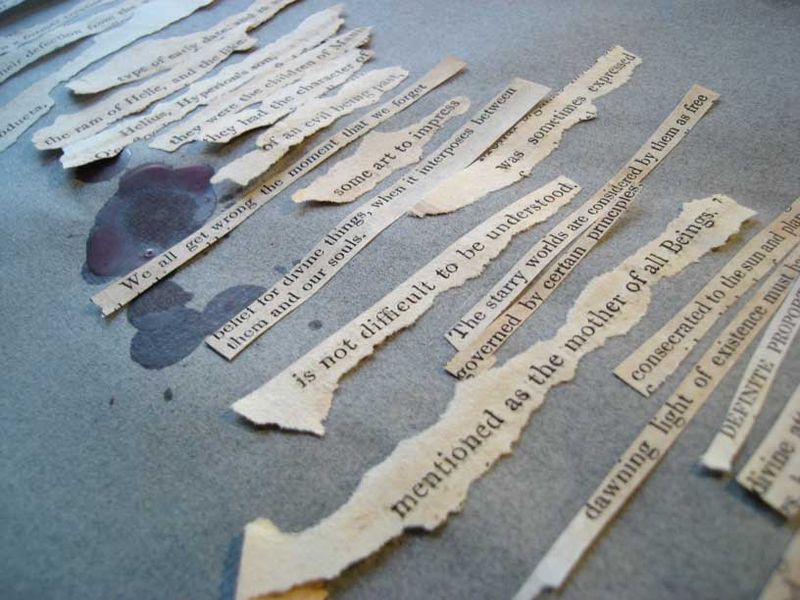
    According to his unpaginated journals, Mr. Norme’s pattern of poetic creativity and discovery involved removing all page numbers from the book he was reading and then choose a number of the “poem lugs” at random.  He would then reverse the number, go to that page of the book, and then add the page number and go to that line of the book, and tear out the number of words as indicated by the page numbers ending numeral.  The bits would then be assembled, and the page numbers glued to the walls of his house.  (We estimate that there were some 60 million page numbers glued to all surfaces of Mr. Morme’s home.  The house itself has been purchased by the Museum of American Art, a full room of which will be on display in that museum’s Outsider Art collection in the Henry Darger wing.)

    Weltin--norme


    Mr. Norme found poetry everywhere he found it, seeing in the simplest verb the most compound noun; even when the poetry seemed not to find an external logical sensate, the internal phi-correlated word relations played in the mind behind all phases of knowledge, an unheard neuro-music that encapsulated the idea of unknown “correctness” in the vision of the poem. 

    0-blog-nov-20-norme-full-pa