JF Ptak Science Books LLC Post 638 Blog Bookstore
battle between mathematicians and physicists. The pieces were constructed with
a mélange of bric-a-br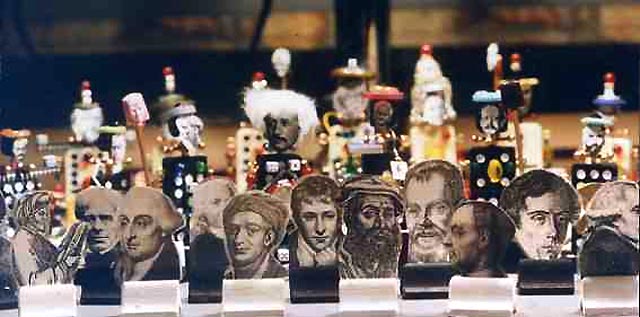 ac and junk, all with the same bases of dominoes. Each piece was an identifiable person from
the history of their respective fields. And
while the two divisions of science have become necessarily more porous over the
years, there remains no difference that there still is a difference between
math and physics. I brought this set with me when exhibiting my rare bookstore
stock at national meetings for the American Mathematical Society and the American Physical Society, and it
attracted a lot of attention—more so for the choice of who was what piece than
any game that was ever played on it. (The mathematicians were much more
ambitious in offering their opinions on the choices of mathematicians per
position.) There are chess
sets of “contraries” on the mass production market, though it is usually
limited to Star Wars and Civil War figures—and there it is generally generic
figures for anything outside the King and Queen.
I was intending on doing a post today on the unpleasant
contrariness of Michelangelo and Leonardo. (These guys are two of a small
number of people who are instantly identifiable by one name only, though a very
popular and vastly oversold modern author chooses to use Leonardo’s second name
as the identifier, a distinctly minority position….like referring to Michelangelo
as Buonarotti of Florence.) And then it struck me how interesting a
chess set would be made up of such opposed figures, happily or not squaring off
against one another on the 64s.
contraries is not so simple. Skipping
past Leonardo/Michelangelo (I’ll get to them in a minute) I went to the most
famous of all contrarians in the world of science—Isaac Newton. (Is the “Isaac” really necessary?) During his
famously grumpy and combative lifetime Newton
his day: Hooke and Leibniz being two of
the greatest of these figures. But I
think for this chess set I’d have Newton
born during his lifetime—William Blake.
Blake was an impossible anti-Newtonian, making a career of being a
spectacular (and perhaps insane/manipulative) anti-rationalist, a weaver of smoke, playing with and
distorting images like a theramin player, using language to produce dichotomies
in even the most standard of sensate ideas.
Blake was the poster child for thing anti-tech, an anti-scientist out to
save the world from its scientific self,
the rationalist world set to destroy imagination, the “Antichrist
science” hell bent on destroying the soul of art and religion.
life; Science is the tree of death” wrote Blake, and so he chose the
“Athesistic” Sir Isaac to stand for the
beast, depicting him in art as a naked geometer intent on subjugating the world
with a compass and a keen brain, reducing glory to quantification, the work of
Satan.. For most of my life I thought
that this image by Blake was celebrating Newton
thought the painting a reverence. When I
understood Blake a little, I saw that
the image was intended as a mockery of Newton
sensation, because absent the unspopken intention of the artist, you could still take the subject matter of
the artwork two ways.
leaves no doubt about where he stood on the issue, even though much of it (to
me) seems not terribly understandable due to its repeated and visceral
self-reference and private language (“Reason is the bound or outward
circumference of energy”, the “ratio of the things of Memory”:
The Spectre is the Reasoning Power in Man,
and when Separated from Imagination and enclosing in steel a Ratio Of the
Things Of Memory, It thence frames Laws & Moralities To Destroy
Imagination.
here in Newtonian mechanics, there in Renaissance rediscovery of classical
perspective—was killing the “eternity of the imagination”.
a “conversation” between the two men:
Blake saying Things, and Newton
them, answering in silence. OR perhaps
he would be vicious. God knows. Newton died in 1727 when Blake was still in
ueber-dimensional pre-pregnancy, waiting his turn to descend from the heavens,
which was not bound to happen for another thirty years. 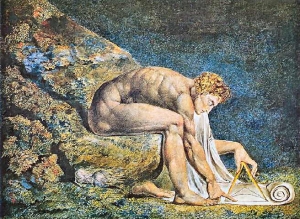
brilliant book, Art & Physics,
Leonard Shlain refers to Blake as a Cassandra, having the ability to see the
future but not being able to say or do anything about it. To think that Blake was “correct” in foreseeing the problems that technology would
bring to people’s lives leaves me baffled:
it is certain that people became more cog-nified with the advance of
technology, but it also allowed for the birth of “free time” for the masses,
giving them some soul and imagination that they would’ve have had if they were
in a flat field in Poland pulling potatoes out of the ground for 18 hours a
day. Perhaps Blake was just referring to
those lucky enough to wear clean white shirts and have a benefactor; perhaps
all of those Others didn’t exist in his many scheduled god/heaven visions he
had every day. (I should point out that Blake published Songs of Innocence and of Experience:
Shewing the Two Contrary States of
the Human Soul in 1794, which was actually a varied republication of his
1789 Songs of Innocence with the
addition of the Songs of Experience. Blake exposes the duality of experience and
innocence, of their opposing nature in human existence, neither negating the
other, both trying to survive simultaneously.
His engraved poems really are striking and gigantically, unreservedly, ars-religico-veritas
of the highest Romantic order. And then some.)
picking out the first pieces: : Blake
and Newton
have to give Newton
sacrificed.
Piece Two: Michelangelo and Leonardo.
though Michelangelo (1475-1564) and Leonardo (1452-1513) lived in the same city
(Florence) for several years that the only thing that developed between them in
the smallish societal/artist communities was a brew of mutual disdain. Diplomatically speaking, the men did not
care for one another, though it seems that the junior of the two,
Michelangelo–who was a well-established rising star of 35 or so to the more
famous Leonardo, who was 55—possessed the young man’s temper and was more
outspoken in his dislike of Leonardo. It
does seem spectacular that the two greatest talents of the Renaissance could
live so close together for several years and have no working or collegiale
relationship, no exchange of ideas, nothing.
They did, however,
almost work together in the same (big) room, though that too never came to
fruition. Both men received a commission
from Piero Soderini to decorate the walls of the Council Hall of the Palazzo
Vecchio with massive (20×50’ !) paintings
of great Florentine military victories: Leonardo would paint the Battle
of Anghiari and Michelangelo the Battle of Cascina. Like much else in the careers of both of these men, the projects were unfinished–Michelangelo not even getting beyond the cartoon stage in preparation; Leonardo actually got paint on the wall,s but made an error in trying to quicken the slow drying time, and heated the wax undercoating enough to make the paint run down the wall and puddle on the floor. It is interesting that it would be Guiseppe Vasari–the man who wrote one of the earliest biographies of renaissance painters, and the creator of the Ufizzi Gallery, and a large talent in his own right–who would be brought in to produce one of the large paintings. It seems to some that Vasari, ironically, painted his own work over that of the started and probable masterpiece of Leonardo. (As a matter of fact, there is an art historian who thinks that some of the Leonardo might have survived under Vasari’s work; that story can be seen here.)
of water and fire–cunctarum contraria semina rerum, Fasti, IV, 783, f–the
yin and yang, and other entities combative at all points. The question here is
for entertaining contraries at some interesting points—that’s good enough. All aspects needn’t be the mutually exclusive
of the other such that if one is true the other must be false. There’s room enough for neither-true-nor-false,
at least for this game, a wide-open Wittgensteinian arbitrary contrary.
It might be interesting to have a look at Vasari’s estimation of Leonardo and Michelangelo; I’ve reprinted the first tow paragraphs for each from Vasari below.