A Daily History of Holes, Dots, Lines, Science, History, Math, Physics, Art, the Unintentional Absurd, Architecture, Maps, Data Visualization, Blank and Missing Things, and so on. |1.6 million words, 7500 images, 4.9 million hits| Press & appearances in The Times, Le Figaro, Mensa, The Economist, The Guardian, Discovery News, Slate, Le Monde, Sci American Blogs, Le Pont, and many other places… 5000+ total posts since 2008.

  • A Million Miles of Barbed Wire

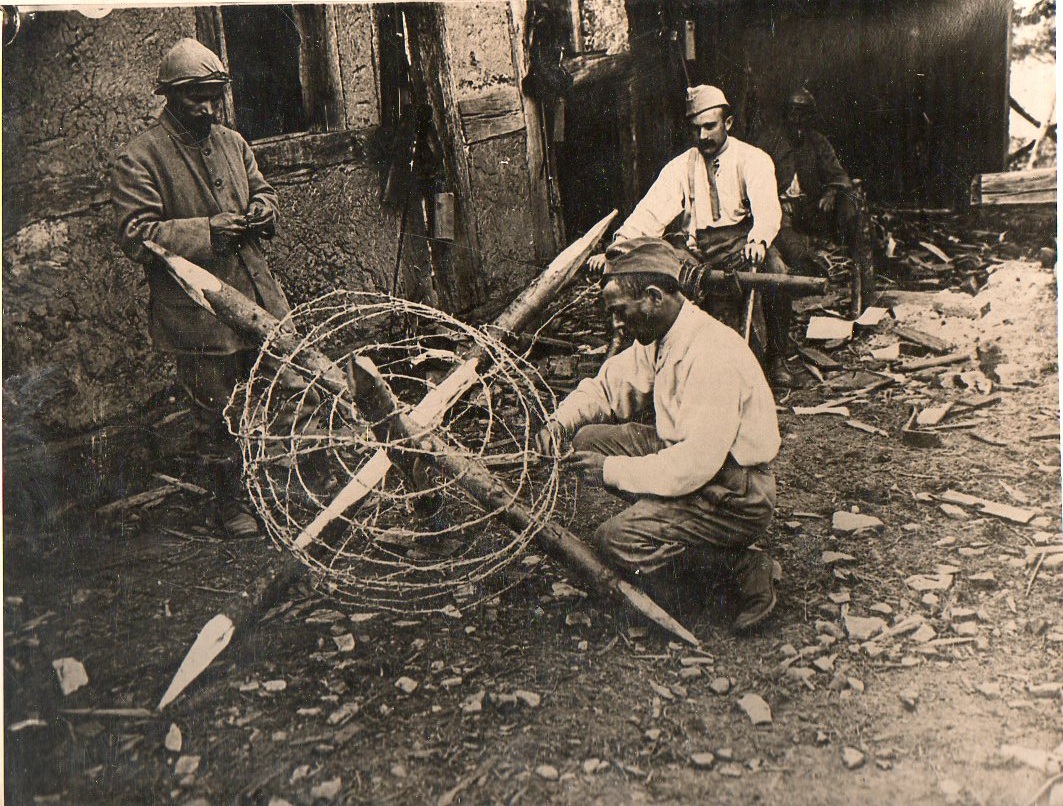
    Tending barbed wire entrapments. 9×7 inches, in very good conidtion.  $200  

     The following photo was found in my small collection of World War I news photo service images, all of which were made in 1918.  They show the preparation of barbed wire entanglements–these were devilish things, made to grab a soldier and suck them in into a deeper hold when resisted, like a sort of sharp, metallic quicksand.  Since there were something like 12-25,000 miles of trenches dug during WWI, I think that it might be a safe bet to say that there were a million miles of barbed wire fencing laid down–that would be equal to about 75 feet of wiring for every soldier who served, or about 200 feet for every person killed. Given the tactics, the trenches, the barbed wire, the machine guns, the gas, and so on, it is no wonder that there was very little advancement over battlefields that stretched for miles and involved hundreds of thousands of troops, costing (sometimes) hundreds of thousands of casualties.  It would have been just insane-nasty to have to charge through fields of this stuff while being bombed and shot at by people in holes. 

    No gloves, here, not for the soldier weaving the wire or for the spinner in the background:
    Arbed wire301

    ·Posted by :

  • Tree Rings of Soldiers’ Clothing, ca. 1918

    Original news serivce photograph, 1918.  8×6 inches.  Good condition.  $250.00


    WWI german uniforms500


    [Detail from below]

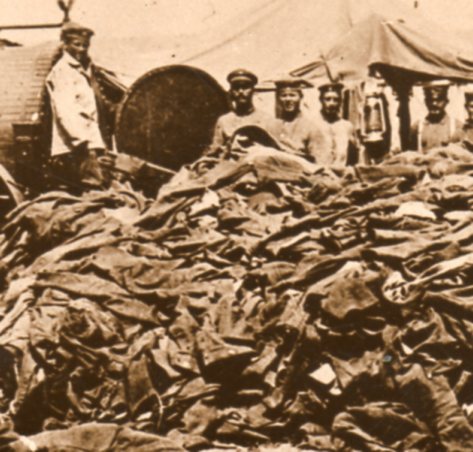
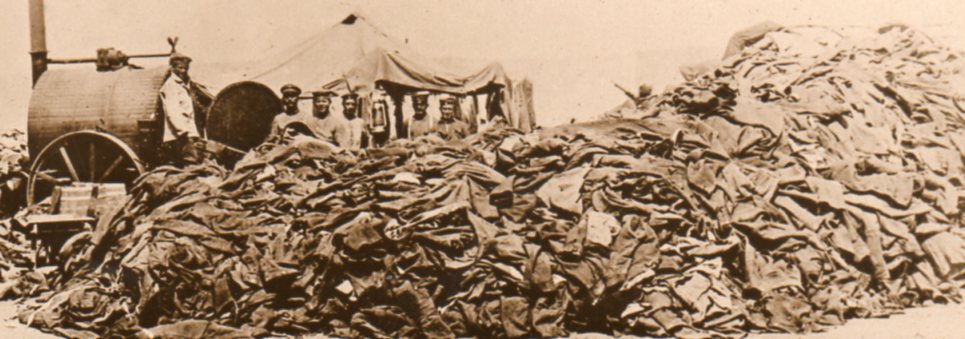
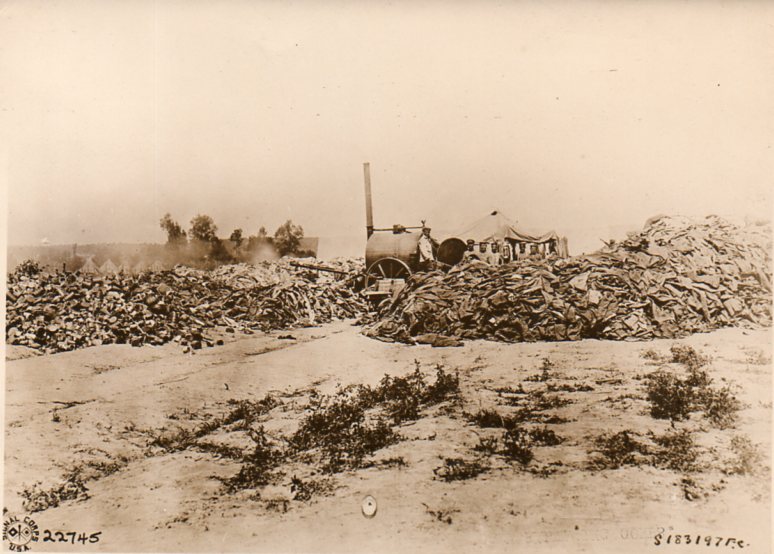
    Aside from the strong impact that this 1918 image makes, the enormous mounds of clothing of captured German solders that were routinely handled as part of their processing, it struck a deeper chord to an older image still (that we’ll see below).  The photograph seems threatening to me, even though the action taking place in it wasn’t, it was mundane–the men, who I believe are German POW’s, are processing the clothing for disinfection and cleaning.  But the size of the mound reminds us of the magnitude of the numbers of the dozens of millions who were killed during WWI, as well as the millions who were taken prisoner.  What remains to be said about this image is how often that pile of clothing was replaced:  is it a monthly, or weekly, or daily pile?  My guess is that it was more daily than anything else, if for no other reason than there is an enormous oil lamp in the background of the photo, suggesting that the process went on all day and into the night.  My initial reaction is that this pile was replicated often during any given month….

    WWI german uniforms499
      
    WWI german uniforms498

    ·Posted by :

  • On the Subject of Being Cold, 1918


    WWI cold173

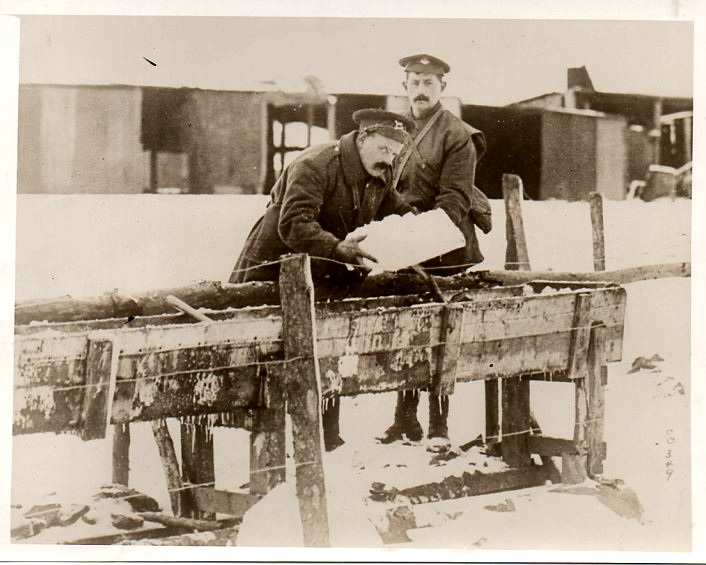
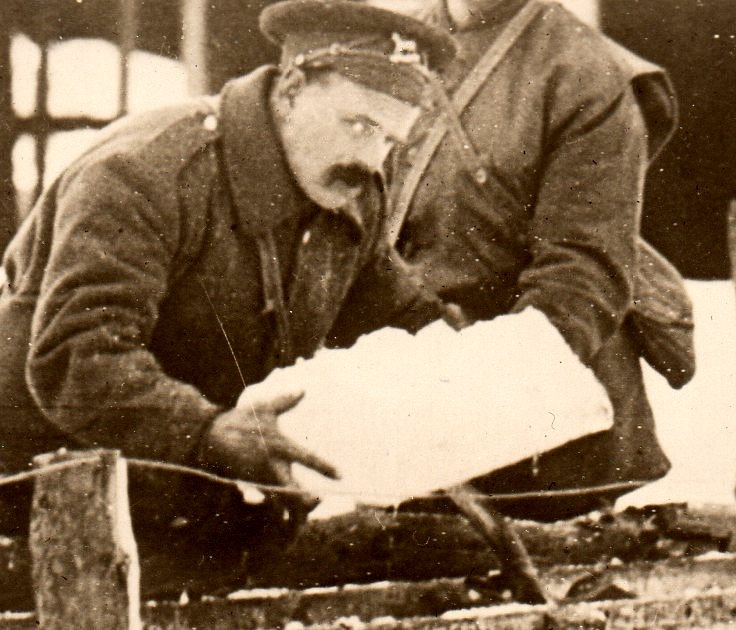
    Original news photo service photograph, a Canadian Official War Photo courtesy of the Western Newspaper Union. 1916.  8×6 inches.  Fine condition.  $250 


    The caption stamped on the back of the news photo service agency photograph (from the Western Newspaper Union) said that the bitter cold encountered by these Canadian soldiers ont he Western Front in the winter of 1916 “was one of many difficulties encountered by the soldiers”.  “Great hardships have been caused by the frigid weather in this region” continues the caption.  Indeed.  Even for Canadians this was a cold winter, though not so cold that the Canadian trooper in the foreground stopped to put on his gloves to remove the ice from the water trough. These soldiers may have been cavalry, as there is a horse-like medallion on the front of their lids.

    Evidently the role of the cavalry in the BEF along the Western Front is an under-appreciated thing, or misunderstood, at least.  I’m not sure how they influenced the outcome of this stagnant section of the war, where the line of battle remained essentially unchanged throughout the duration of the war.  Millions of troops were deeply entrenched over hundreds of miles of battlefront, wailing away at one another with massive artillery barrages, countless machine gun nests, and then eventually tanks, planes and poison gas.  Back in February 1916 there weather was so tough and frigid that the battle of Verdun was postponed a bit, waiting for less intense weather conditions.  Dozens of millions of artillery shells and  billions of bullets later, in 1918, there was little change in the positions of the armies, except of course for the millions of casualties.

    WWI cold174


    ·Posted by :